
Abstract
Recently, the fifth meeting of the Standing Committee of the Seventh People’s Congress of Shenzhen revised and passed the “Regulations on the Management of Government Investment Projects in Shenzhen Special Economic Zone”, which introduced key provisions:
1. Promote the comprehensive, innovative use of digital technologies such as Building Information Modeling (BIM) to achieve intelligent project management. (Article 8)
2. Construction units must establish leadership responsibility systems for government investment project archives and assign job responsibilities to relevant personnel. They are required to promptly transfer project archives and digital files covering the entire process—from decision-making to completion—to the municipal archives management agency in accordance with the law. (Article 56)
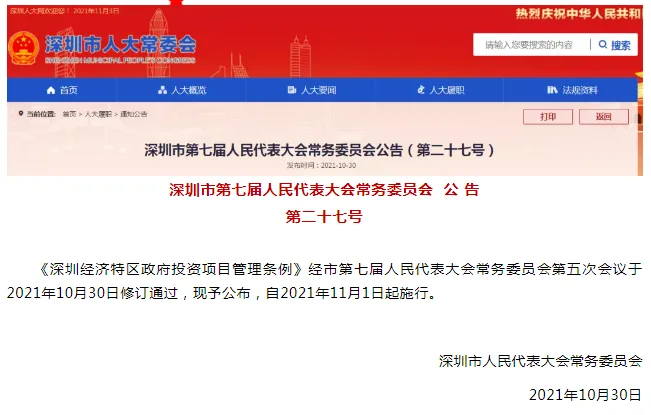
Regulations on the Management of Government Investment Projects in Shenzhen Special Economic Zone
(Approved at the 31st meeting of the Standing Committee of the 5th People’s Congress of Shenzhen on August 28, 2014; revised at the 5th meeting of the Standing Committee of the 7th People’s Congress of Shenzhen on October 30, 2021, following amendments decided at the 22nd meeting of the Standing Committee of the 6th People’s Congress of Shenzhen on January 12, 2018)
Chapter I: General Provisions
Article 1: These regulations are established to standardize local government investment behavior in Shenzhen, strengthen constraints on the annual government investment plan, enhance the management and supervision of government projects, improve investment efficiency, and stimulate social investment vitality. They are formulated based on relevant laws and administrative regulations such as the “Government Investment Regulations” and tailored to Shenzhen’s Special Economic Zone.
Article 2: The term “government investment of Shenzhen Municipality at the same level” refers to fixed asset investment construction activities within Shenzhen’s administrative area funded by the municipality’s financial resources. This includes new construction, expansion, reconstruction, and technological transformation.
Article 3: Government investment shall adhere to the principles of scientific methodology, standardization, efficiency, transparency, and balanced moderation.
Article 4: Government funds shall be invested primarily in non-operational public sector projects, such as public welfare services, infrastructure, ecological protection, major scientific and technological advancements, social management, and national security—areas where market resource allocation is ineffective.
The Municipal Government shall improve relevant policies, leverage government funds to guide and stimulate social investment in these areas, establish mechanisms for regular evaluation and adjustment of government investment scope, and continually optimize investment direction and structure.
Article 5: Government investment funds shall be allocated project-wise, predominantly through direct investment. For operational projects requiring support, capital injection is preferred, with possible supplementary methods including investment subsidies and loan interest subsidies.
Allocation shall comply with the division of government investment powers and treat all investment entities equally without discrimination.
Article 6: The Municipal Government is responsible for improving investment management mechanisms, fulfilling statutory duties, standardizing approval procedures, optimizing processes, and enforcing accountability in accordance with the law.
Article 7: The municipal development and reform department acts as the investment supervisory body, overseeing comprehensive management of government investment, establishing online platforms, and handling approval, standards, planning, and implementation.
Other municipal departments shall fulfill their respective investment management responsibilities.
Article 8: The municipal investment authority, with relevant departments, shall establish and enhance an online management platform covering the full lifecycle of investment projects. This platform shall integrate digital technologies like BIM to enable intelligent project management and be linked to the Municipal People’s Congress budget supervision system for data sharing.
Relevant departments must publish planning, industrial policies, job responsibilities, approval processes, and timelines through this platform, providing consulting services to project units. Except for projects involving state secrets, approval materials and circulation information shall be shared using project codes.
Education, health, and affordable housing departments should integrate IT projects, unify data standards, or seek approval for independent IT systems.
Article 9: Government investments should align with economic and social development levels and fiscal conditions, prioritizing safe, controllable, green, low-carbon, and resource-saving technologies and products. The municipal government and departments are prohibited from illegally borrowing debts to fund government investment.
Chapter II: Government Investment Decision Making
Article 10: Government investment projects involving direct investment or capital injection must sequentially obtain approval or review for project proposals, feasibility studies, preliminary designs, and overall budgets, except as otherwise specified by law or provincial regulations.
Project units are responsible for thorough preliminary work and must ensure the authenticity of related documents.
“Project unit” refers to organizations responsible for preparing and submitting project proposals, feasibility studies, designs, and budgets.
Article 11: The municipal investment department approves project proposals, feasibility reports, and budgets; preliminary designs are approved or reviewed by designated departments.
Projects with significant economic, social, or environmental impact require consultation with multiple departments and review by the municipal investment authority before municipal government approval.
Large-scale projects or those involving significant public interests must be publicly announced to solicit expert and public feedback.
Article 12: The municipal investment authority shall publicly disclose requirements and standards for project proposals, feasibility studies, and budgets.
Article 13: Projects meeting any of the following may apply directly for a feasibility study report, adding a demonstration of project necessity:
- Included in Shenzhen’s Five-Year National Economic and Social Development Plan;
- Approved by the municipal government executive meeting for preliminary work;
- Total investment below 50 million yuan;
- Simple projects like equipment procurement, building repairs, bus stops, urban lighting with small scale and straightforward technical solutions.
Article 14: For emergency and special emergency projects designated by the municipal government, project units may directly apply for preliminary design and overall budget, including project necessity and feasibility content in the budget.
Specific criteria for identifying emergency projects shall be separately formulated by the municipal government. Emergency and disaster relief projects are managed under relevant regulations.
Article 15: Project units may commission engineering consulting firms to prepare project proposals, which should thoroughly justify project necessity, location, scale, supporting works, investment estimates, construction and operation modes, financing, and expected benefits.
Article 16: Consulting firms may also conduct feasibility studies and prepare reports based on approved proposals. For projects with significant impact, the municipal investment authority may directly organize feasibility studies and financial plans.
Feasibility studies must analyze all aspects of the project lifecycle, including spatial, technical, safety, environmental, waste disposal, resource conservation, supporting works, operations, and financing.
Relevant departments issue approval results following standard procedures during this stage.
Article 17: Project units shall commission qualified entities to prepare preliminary designs and overall budgets complying with approved feasibility study requirements.
Preliminary designs must detail construction content, scale, standards, land use, materials, equipment, and technical parameters.
Overall budgets must cover all construction expenses.
Article 18: If actual budgets exceed feasibility study estimates by over 10%, project units must report to the municipal investment authority, which may require resubmission of the feasibility study.
Article 19: The municipal investment authority shall commission evaluations of project proposals, feasibility studies, and budgets by the government investment project evaluation agency and may involve legal compliance assessments.
Article 20: Projects requiring higher-level government approval shall have their applications managed by the municipal investment authority.
Article 21: A project reserve management system shall be implemented with dynamic classification. Projects with significant changes or prolonged inactivity may be removed from the reserve.
Specific reserve management measures will be separately defined by the municipal investment authority.
Article 22: Projects receiving government investment via subsidies must follow relevant procedures.
Chapter III: Annual Plan for Government Investment
Article 23: The municipal investment authority drafts the annual government investment plan considering laws, policies, Shenzhen’s development goals, and actual needs.
This draft should align with the municipal financial budget and may allocate funds to district governments for major city projects.
Article 24: The draft annual plan must include:
- Total annual government investment;
- Project details: name, code, phase, scale, total investment, construction period, annual fund allocation, funding sources, and content;
- Pending projects and reserved funds;
- Pre-project expenses;
- Other relevant matters.
Article 25: Ongoing projects may be directly included in the draft plan. New projects should be selected from the project reserve and generally require approved overall budgets before inclusion. Projects not meeting criteria can be listed as pending with reserved funds.
Article 26: The municipal investment authority shall allocate reasonable expenses for project preparation, reviews, major project planning, investment schemes, environmental assessments, legal services, BIM preparation, evaluations, acceptance, and post-project evaluations.
Article 27: After municipal government approval, the draft plan is submitted to the Municipal People’s Congress for review.
The municipal investment authority provides preliminary plans to relevant committees one month prior to the Congress meeting for focused reviews and feedback, which is then communicated to the Congress representatives.
Before approval, the municipal government may propose pre-arranged new projects for review and approval by the Congress Standing Committee.
Article 28: Following Congress approval, the municipal investment authority promptly issues the annual plan and shares it with relevant committees.
The plan must be strictly followed; no changes are permitted without legal procedures.
Article 29: Any necessary adjustments to the annual investment total or project list require a formal adjustment plan approved by the Congress Standing Committee, with corresponding budget adjustments also submitted for approval.
Article 30: Approved annual plans, adjustments, and implementation reports must be publicly disclosed within 30 days after approval.
Chapter IV: Implementation of Government Investment Projects
Article 31: Project units select construction units according to approved construction and operation modes. For unified or market-oriented commissioned construction projects, handover procedures must be completed before starting, with filing to the municipal investment authority within ten working days.
Unified construction management units execute construction-related tasks as assigned by the municipal government.
Projects under the legal person responsibility system must establish a legal entity responsible for construction, management, and operation.
The term “construction unit” includes unified management units, self-built project legal persons, and market-oriented commissioned construction units.
Specific handover procedures will be defined separately by the municipal government.
Article 32: Construction units must organize operations per approved site, scale, content, and mode, managing construction plans effectively.
Any proposed changes to site, mode, or significant alterations must be jointly approved by the construction unit, project unit, and original approving department.
Article 33: Projects must establish a responsibility system focused on budget control and final accounts, strictly follow construction procedures, and comply with legal construction conditions. Surveys, designs, and construction must not occur simultaneously.
Construction units are prohibited from financing government investment projects themselves.
Article 34: Construction timelines must comply with regulations without arbitrary compression or delay, and no unlawful interference is allowed.
Safety and pollution prevention facilities must be designed and constructed to meet main project needs and be put into use legally.
Article 35: Construction units must commission qualified entities to prepare construction drawings and project budgets based on approved preliminary designs.
Project budgets include all necessary construction expenses.
Article 36: For projects with long construction delays due to objective reasons, construction units may propose budget adjustments before restarting construction, subject to municipal approval.
Article 37: Investment should not exceed approved budgets. If increases are necessary due to policy changes, price rises, geological issues, or other factors, adjustment plans must be submitted for approval.
Budget increases exceeding 5 million yuan and 10% of the total budget require municipal government approval. Adjustment results must be shared with relevant committees.
Article 38: Projects may procure comprehensive or specific engineering consulting services via bidding or other methods.
Article 39: Projects with clear content and mature technical solutions may use general contracting, awarded after preliminary design or budget approval. Early contracting requires municipal government approval.
Article 40: Procurement of major equipment, materials, and services must follow construction bidding regulations; pure equipment procurement follows relevant rules.
Article 41: Relevant departments shall formulate fair and non-discriminatory bidding documents and contract templates. Project and construction units must standardize contracts, ensuring consistency with bidding documents. The municipal government will supervise contract signing and performance.
Article 42: Design changes require joint confirmation by construction, project, design, and supervision units, with construction units bearing primary responsibility.
Article 43: Government investment projects are generally managed without on-site visas. When increases due to force majeure necessitate visas, proper procedures and joint confirmations are required. Retroactive or unauthorized visas cannot be used for project settlement.
Article 44: The municipal finance department shall arrange timely annual funding and implement centralized treasury payment systems per laws and regulations.
Article 45: Project or construction units shall follow financial management regulations to request fund disbursement based on the investment plan, project progress, and contracts.
Article 46: Projects must implement guarantees such as bidding, performance, quality, and wage payment guarantees, provided by banks, guarantee companies, or insurance.
Article 47: Projects shall organize timely engineering acceptance according to regulations. Construction units may hire qualified intermediaries for acceptance consulting. Projects failing acceptance cannot be handed over for use.
Engineering acceptance includes completion and special inspections (planning, fire protection, environmental protection, special equipment).
Article 48: Construction units must prepare project settlement reports within three months of engineering acceptance and submit them for municipal financial review. Final settlement reports must be submitted within three months after settlement review.
Large projects may have staggered approval mechanisms. Extension requests for settlement report approvals shall be submitted to the municipal investment authority, which may grant extensions up to one year.
Article 49: The municipal financial review institution evaluates settlements considering finances, bidding, engineering, contracts, and other aspects.
Article 50: Bidding documents or contracts may specify that the municipal financial evaluation institution’s conclusions serve as the basis for settlement and payment.
Article 51: Project and construction units must jointly apply for project acceptance within 30 working days after completion settlement review. Extensions are possible under special circumstances.
The municipal investment supervisory department may delegate acceptance for projects under 50 million yuan to industry departments or district governments and may hire professional consultants.
Acceptance follows municipal government regulations and covers comprehensive project evaluations from feasibility to trial operation.
Article 52: Final settlement and acceptance reports shall be copied to the Municipal People’s Congress committees and municipal audit department.
Article 53: Project and construction units must apply to the municipal finance department for approval of completion financial settlements within 30 working days post-review. Finance may delegate approval to project management or related units.
Any surplus funds must be handled according to relevant regulations within 30 working days after approval.
Article 54: Upon project completion and acceptance, construction and project units shall handle asset delivery and registration procedures.
Article 55: For projects forming fixed assets, the project unit must complete accounting adjustments within 30 working days after final financial settlement approval.
If no fixed assets are formed, relevant follow-up actions shall be performed per financial management systems.
Article 56: Construction units must establish leadership responsibility and personnel accountability systems for project archives, promptly transferring all archives and digital files—including text, drawings, audiovisual materials, and BIM data—to the municipal archives agency as required by law.
Article 57: Construction and project units must submit project-related information as requested by the municipal investment authority.
Chapter V: Supervision of Government Investment Projects
Article 58: Except for projects involving state secrets, departments shall handle procedures and collect information using project codes generated by online platforms.
Supervisory departments shall strengthen monitoring through online tracking and onsite inspections.
Construction units must regularly and accurately report project progress via the online platform. Failure to report, false reporting, or concealment may lead to orders for correction and reporting to relevant city industry authorities.
Article 59: A system for reporting final accounts of completed projects shall be established. The municipal investment authority will supervise timely project completion settlement reporting annually.
Article 60: The Standing Committee of the Municipal People’s Congress supervises annual government investment plan implementation by reviewing reports, conducting inquiries, and organizing investigations.
Article 61: The municipal government must include the previous year’s investment plan implementation report in the current year’s draft plan and report mid-year progress to the Standing Committee. Reports should cover planned versus actual funding, project settlements, evaluations, and challenges encountered.
Article 62: The municipal investment authority is responsible for supervising implementation and reporting to the government.
Article 63: Relevant departments such as finance, planning, natural resources, environment, and housing shall supervise projects within their jurisdiction per the law.
Article 64: The municipal investment authority shall select completed projects for post-project evaluation by professional institutions, assessing approval and implementation effectiveness and providing recommendations for future planning and management.
Article 65: Names of construction, survey, design, supervision units, and responsible persons must be displayed on construction sites and completed structures.
Article 66: The municipal government shall establish public participation and management accountability systems for government investment projects, allowing individuals or organizations to report illegal activities during project approval and construction.
Chapter VI: Legal Liability
Article 67: If project units violate regulations—such as falsifying approvals or unauthorized document alterations—the municipal investment authority shall notify relevant departments for correction, suspend or withdraw funds, or halt projects. Responsible personnel will face legal penalties.
Article 68: Unified construction management or self-built units violating provisions—such as unauthorized work commencement, deviation from approved designs, unauthorized changes, budget overruns, demanding advance funding, neglecting schedules, misappropriating funds, failure to transfer archives, or falsifying documents—will be ordered to correct or face project suspension. Responsible individuals will be punished according to law.
Article 69: Market-oriented commissioned construction units violating similar provisions will be ordered to correct, suspended if serious, or blacklisted for refusal to comply, and held liable for damages.
Article 70: Engineering consulting and design units engaging in intellectual property infringement, fraud, or gross negligence will be blacklisted and subject to investigation and legal consequences, including liability for damages.
Article 71: Construction units delaying wages, committing fraud, or negligent during construction and settlement will be blacklisted and investigated, bearing legal responsibility for damages.
Article 72: City investment, finance, planning, natural resources, environment, housing departments, design approval agencies, and staff abusing power or neglecting duties in investment management will face legal punishment.
Article 73: Entities violating these regulations and subject to other legal responsibilities will be dealt with accordingly under this chapter and other applicable laws.
Chapter VII: Supplementary Provisions
Article 74: Information on government investment projects shall be disclosed publicly per laws and regulations.
Article 75: District governments may formulate specific measures for district-level government investment project management, based on local conditions and this regulation.
Article 76: Government investment management in the Qianhai Shenzhen Hong Kong Modern Service Industry Cooperation Zone shall follow municipal government regulations.
Article 77: These regulations take effect on November 1, 2021.
















Must log in before commenting!
Sign Up