
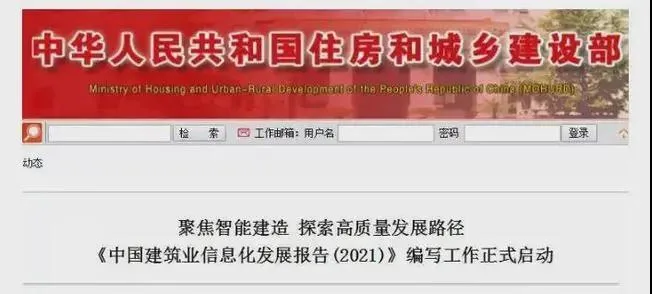
1. Ministry of Housing and Urban-Rural Development: Emphasizing Intelligent Construction and Accelerating BIM Technology Research and Application
Recently, the Ministry of Housing and Urban-Rural Development released the 2021 report on information technology development in China’s construction industry. Centered on intelligent construction, the report highlights current intelligent construction practices and explores pathways for high-quality industry development. It calls for vigorous advancement in digital design, intelligent production, intelligent construction, and intelligent operation and maintenance, with a focus on accelerating the research and application of Building Information Modeling (BIM) technology.
2. Zhejiang Province: Announcing Construction Reform Goals for the Next Five Years
The official website of the People’s Government of Zhejiang Province recently published an implementation opinion aimed at promoting high-quality development through reform, innovation, and modernization of the construction industry. The document sets a target for 2025, envisioning significant achievements in construction reform and innovation. It emphasizes effective promotion of new construction methods and organizational approaches, aiming to strengthen the “Zhejiang Construction” brand and establish the province as a national leader in new construction industrialization.
3. Jilin Province: Bonus Points for Bidders Using New Technologies such as BIM
The Department of Housing and Urban-Rural Development of Jilin Province issued a notice on implementing full-process consulting services for housing and municipal infrastructure projects. It clarifies a five-year goal for full-process engineering consulting development. Specifically, bidding units that have independently completed or led full-process engineering consulting in the past three years will receive extra points. Additional points are awarded for adopting new technologies such as BIM. When scores between “full license” consulting units and consortiums are equal, priority is given to “full license” units. Joint ventures of enterprises within the same group are considered “fully licensed.”
4. Hefei City: Targeting 100% BIM Project Application Rate
The Hefei Urban and Rural Construction Bureau issued a notice outlining key points for prefabricated construction work in 2021. The city aims to reach a prefabricated construction scale of 10 million square meters in 2021. Prefabricated construction in key areas should account for no less than 25% of new construction, with active promotion in other areas at no less than 20%. Hefei plans to establish an innovation alliance for the prefabricated construction industry, create one or two provincial-level or higher industrial parks, significantly improve the digitalization and industrialization levels of prefabricated component manufacturers, and achieve a 100% BIM technology project application rate.
5. Nanjing: Accelerating BIM Technology Application in New Construction Projects
On February 26, 2021, the Nanjing Municipal Commission of Urban and Rural Development and the Municipal Bureau of Planning and Natural Resources issued a notice to accelerate BIM technology adoption citywide. From March 1, 2021, many new construction projects meeting specified conditions are required to utilize the Nanjing Engineering Construction Project BIM Intelligent Review System for BIM planning, construction drawing review, and completion acceptance management.
6. Jinan City: Promoting BIM Technology Application
The Housing and Urban-Rural Development Bureau of Jinan released the draft “Management Measures for General Contracting of Housing Construction and Municipal Infrastructure Projects.” The document explicitly promotes BIM technology use in engineering general contracting projects, calls for establishing a BIM information management platform, and mandates BIM requirements in bidding documents.
7. Sichuan Province: Building Digital Water Conservancy Infrastructure
Sichuan Province issued the “Action Plan for Accelerating the Construction of New Infrastructure (2020-2022),” emphasizing the vigorous construction of digital water conservancy infrastructure. The plan promotes integrating advanced technologies like 5G, BIM, and 3S (remote sensing, positioning, navigation) into water conservancy engineering design, construction, operation, and water resource management.
8. Shanghai: Up to 1 Million Yuan Subsidy for BIM and Other Demonstration Projects
On January 12, 2021, the Development and Reform Commission of Huangpu District in Shanghai announced “Special Support Measures for Building Energy Efficiency and Green Building Demonstration Projects.” BIM technology application demonstration projects receive support as follows: 50,000 yuan subsidy for projects meeting expert review standards; 80,000 yuan for projects with good expert evaluations; and 100,000 yuan for projects with excellent expert evaluations. The maximum subsidy per project is capped at 1 million yuan.
9. Jiangsu Province: Enhanced Training Subsidies for Vocational Skills
On March 15, the Department of Human Resources and Social Security of Jiangsu Province released a list of 100 scarce occupations eligible for high-skilled talent training subsidies in 2021. This includes firefighters, BIM technicians, and prefabricated construction workers. Workers who complete training and obtain certificates in these fields are eligible for increased training subsidies.
10. Hebei Province: BIM Technology Application Demonstration Projects
Hebei Province’s BIM technology demonstration projects focus on engineering projects employing BIM across survey, design, construction, supervision, operation, or maintenance stages. Priority is given to government-funded projects, public welfare buildings, large-scale public buildings, and municipal infrastructure projects with investments exceeding 100 million yuan or building areas over 20,000 square meters.
11. Chongqing: Full Adoption of Digital Construction Mode by 2025
Chongqing is advancing BIM technology application throughout intelligent construction processes, emphasizing independent, controllable BIM technology. The city is establishing a system to store BIM models of parts and components and requires submitting these models on the BIM project management platform. It aims to enhance BIM design collaboration and virtual construction capabilities and promote BIM integration with 5G, VR, AR, drones, and other technologies on construction sites and industrial decoration projects.
12. Guangdong Province: Promoting High-Quality Construction Industry Development through BIM
Guangdong Province is fostering intelligent construction by promoting integrated use of BIM, the Internet, IoT, big data, cloud computing, AI, blockchain, and other technologies throughout the construction process. State-funded office buildings and other public buildings must fully adopt BIM technology. The province supports BIM-based positive design, the development of a City Information Model (CIM) platform, and the deep integration of BIM and CIM for intelligent construction, urban analysis, and building lifecycle management. It also encourages intelligent construction scenarios and “machine substitution,” offering investment tax credits for enterprises purchasing qualifying intelligent construction equipment.














Must log in before commenting!
Sign Up