
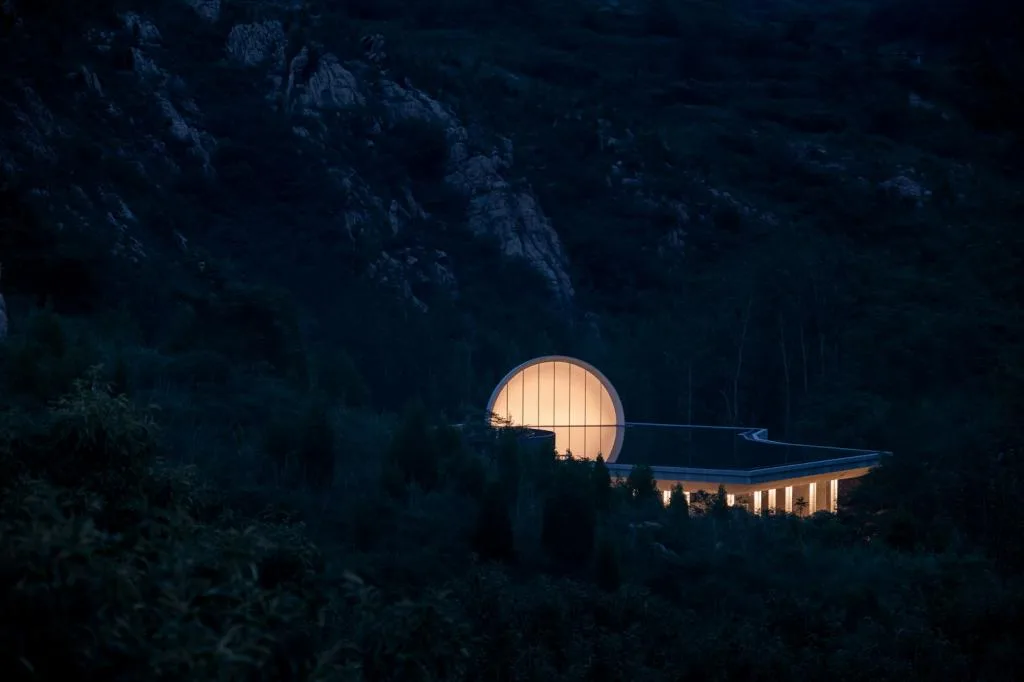
A gentle breeze flows through the forest, and the bright moon shines over the mountains.
Preface: The Possible ‘Hometown’
As the high-speed train arrives at Tai’an Station, visitors are greeted by ongoing advertisements promoting the themes of “hometown”—notably “the Moon of Hometown” and “the Cloud of Hometown,” perched atop Jiunv Peak, an extension of Mount Taishan. These attractions invite people to “step on the moon and climb on the cloud,” rivaling the main Mount Taishan scenic spot. Tai’an, a renowned mountain city anchored by Mount Taishan, is embracing a new chapter through the revitalization plan of Jiunvfeng.
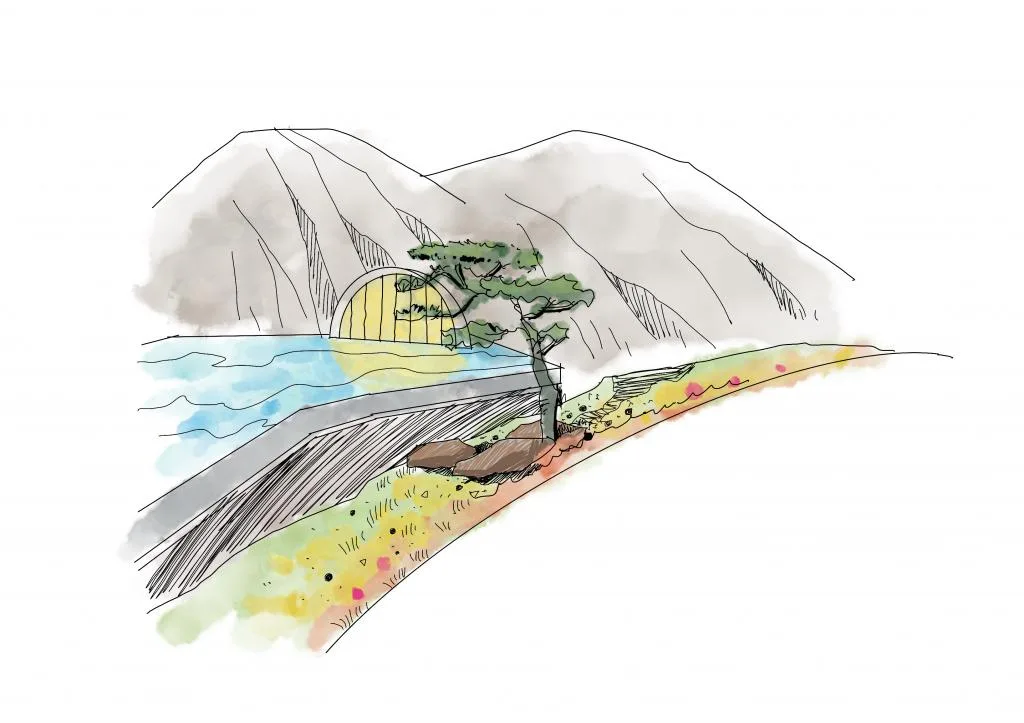
Hand-drawn Draft of the Moon of Hometown
In early 2019, Chalan Architecture was commissioned by Shandong Lushang Group to undertake the comprehensive planning and design of the village, including landmark buildings such as the “Moon of Hometown.” At that time, the “Clouds of Hometown” project was already taking shape. The building repeatedly plays Fei Xiang’s “Clouds of Hometown,” a familiar melody that stirs emotions and fosters a shared sense of nostalgia. Jiunvfeng quickly gained traction on social media, attracting new visitors, fresh faces, emerging industries, and exciting possibilities to Dongximen Village. Once a poverty-stricken mountain village, Jiunvfeng has transformed into a popular tourist destination, proving the immense power of architecture as a means of communication.
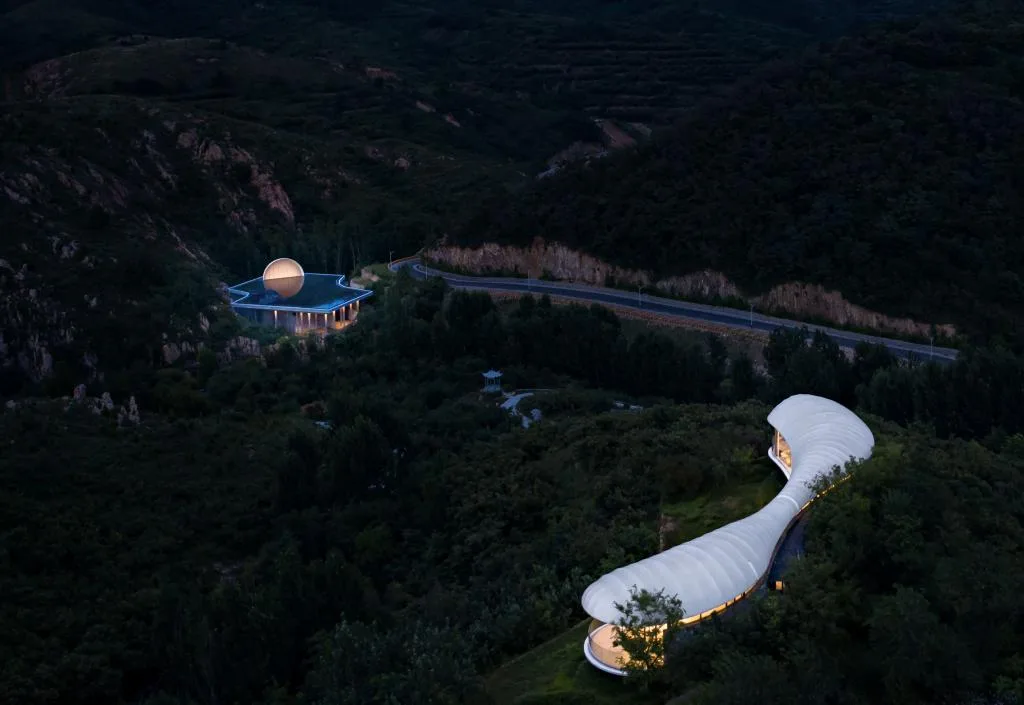
The Moon of My Hometown Resonates with the Clouds From Afar
Individual buildings alone cannot sustain a village’s revival. Within a year, the initial buzz around the “Cloud of Hometown” began to fade. To maintain momentum, the Lushang Group needed a comprehensive strategy to connect the diverse elements of this 55-square-kilometer mountain village. Planning industrial and spatial frameworks and introducing new, surprising features became essential to continuously engage visitors seeking fresh experiences. Drawing from years of rural development experience and the proximity to the Jinan urban area, Jianlan Architecture integrated three key living spaces—production, life, and ecology. Landmark structures like the “Eighth Floor Small Theater” and “Moon of Hometown” have since been unveiled. In an era where rural revitalization is increasingly valued, architects return to Confucian cultural roots to rebuild connections between city and countryside, people and nostalgia, rediscovering forgotten values and untapped possibilities.
The Moon as the ‘Hometown’ of Ming
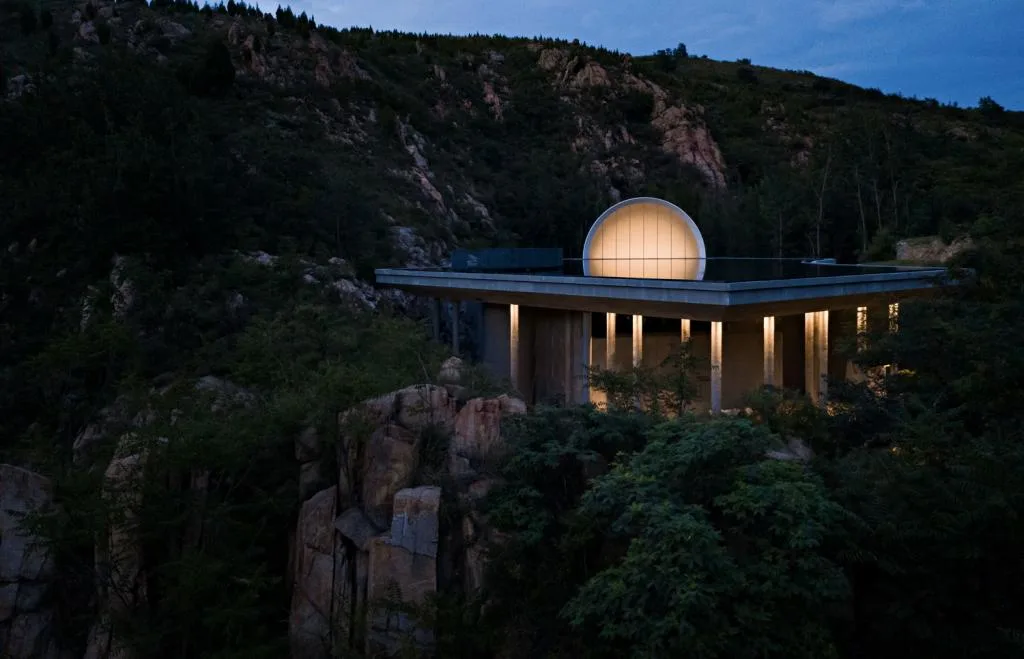
A luminous round moon now graces the Jiunvfeng area.
The concept of the “Hometown Moon” originated from the homeowner’s proposal essay. During the Mid-Autumn Festival of 2019, a 10-meter diameter balloon moon illuminated Nianhua Bay, adding a magical touch to the ancient town. Inspired by this, Lushang Group aimed to introduce a permanent round moon installation in Jiunvfeng, marking a new chapter for the “Hometown” brand with this artificial marvel.
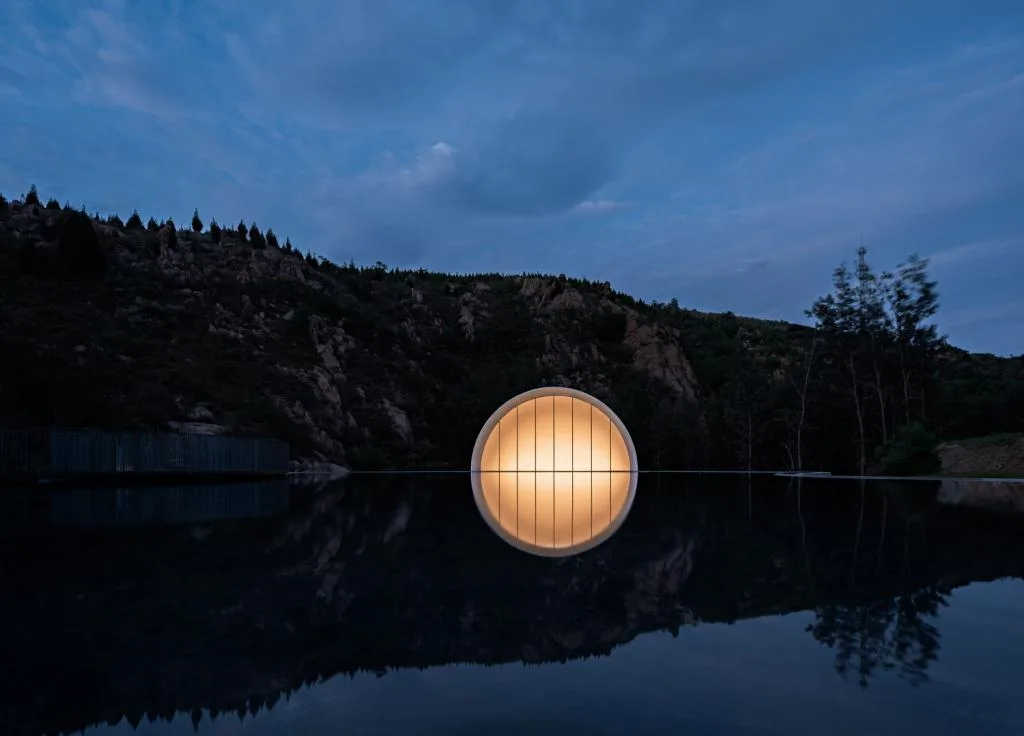
The Everlasting Moon
Lead architect Zou Yingxi sought to imbue the “moon” with deeper meaning. The resulting “never-ending moon” serves as a ceremonial hall, transcending mere formality and revitalizing rural resources through a visible, functional building that carries spiritual and operational significance.
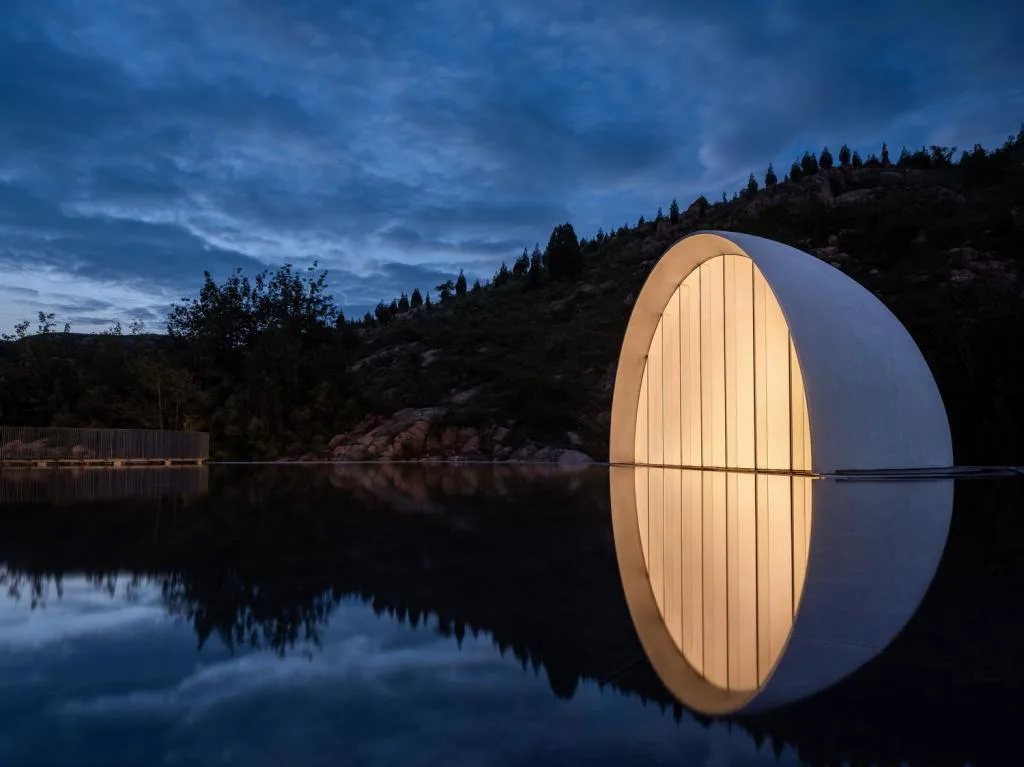
Clouds and Moon Are the Same, but Mountains and Rivers Differ
While clouds and moonlight may be universal symbols, the mountains and rivers that surround them are unique. Homesickness can transcend location, and the architectural poetry of the “moon” need not rely on literal symbols. Kanlan Architecture chose to forgo traditional, concrete forms, instead using abstract geometry and simple materials to craft pure, contemplative spaces that reach beyond surface aesthetics to touch the viewer’s soul.
01 – Site Selection
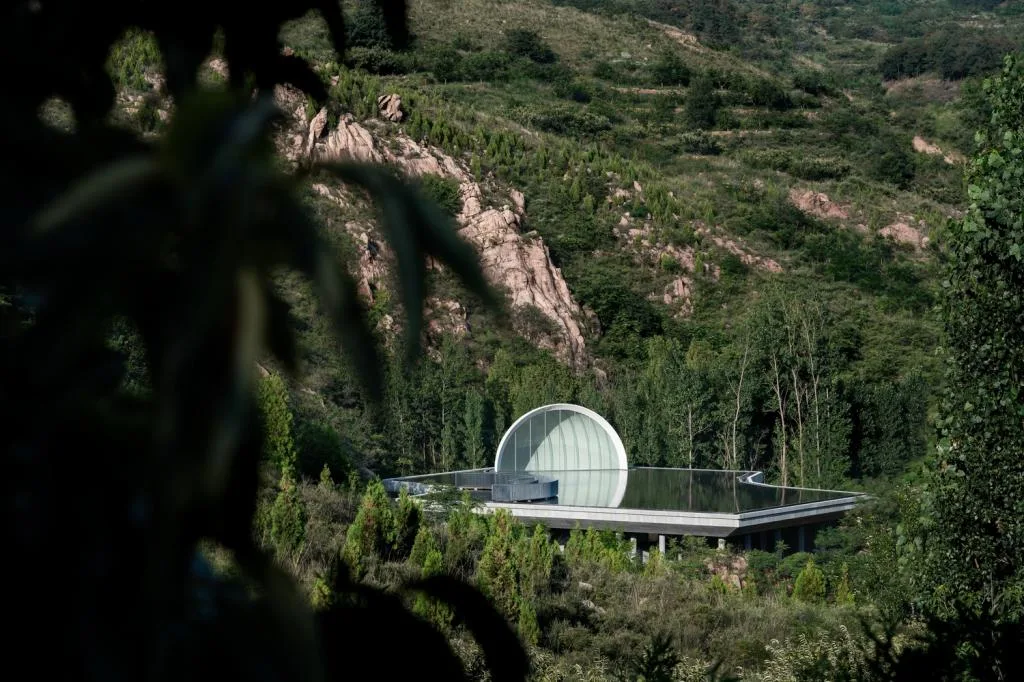
The “Moon” is nestled beside a mountain stream near the mouth of Shenlong Grand Canyon.
Choosing the location for the “Moon” was critical. It needed to build on the foot traffic generated by the “Clouds of Hometown” and engage in a meaningful dialogue with the natural landscape of Jiunv Peak. After thorough surveying and reflection, lead architect Zou Yingxi selected the viewing terrace of “Hometown Clouds” as the vantage point and ultimately positioned the “Moon of Hometown” beside the mountain stream at Shenlong Grand Canyon’s entrance.
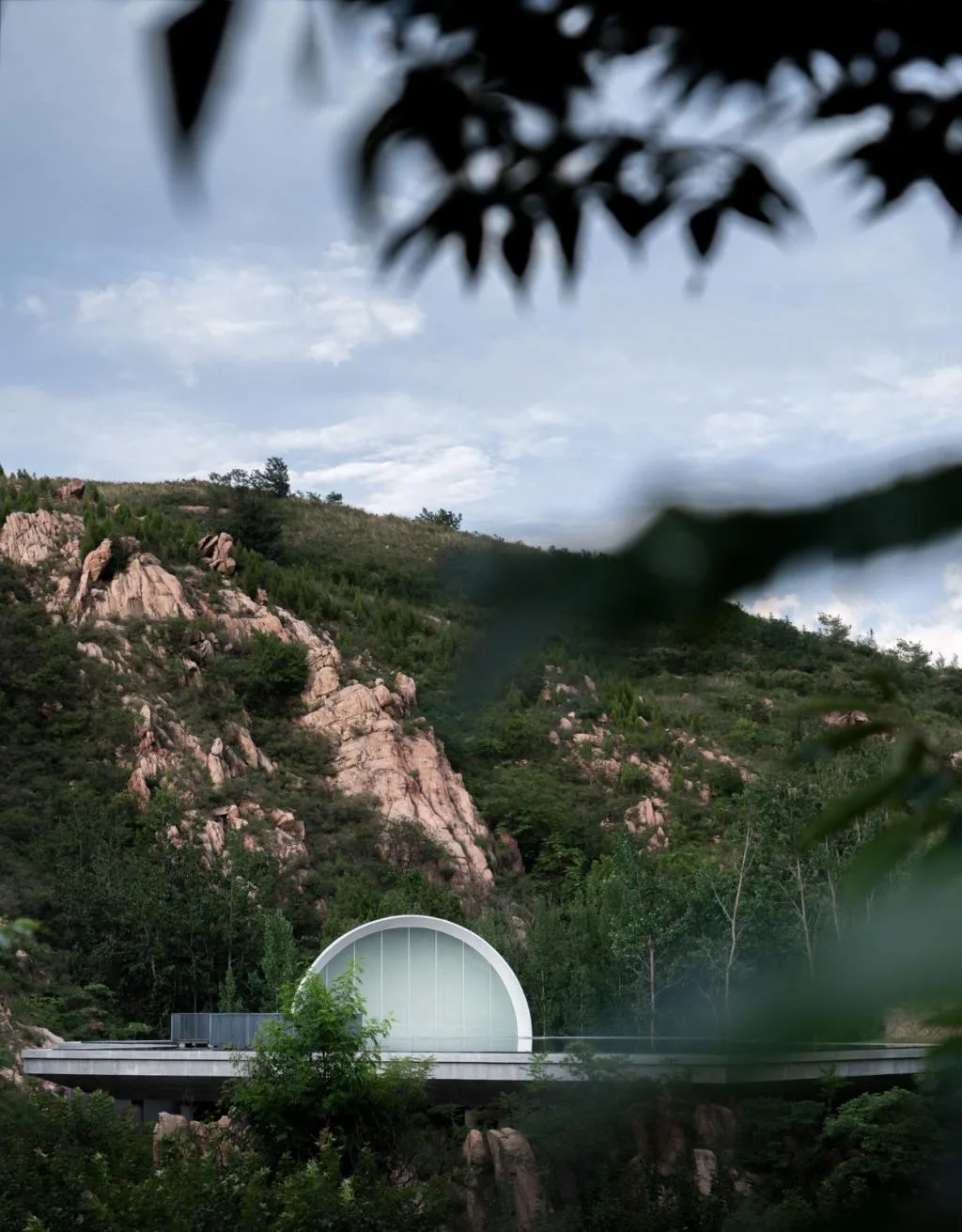
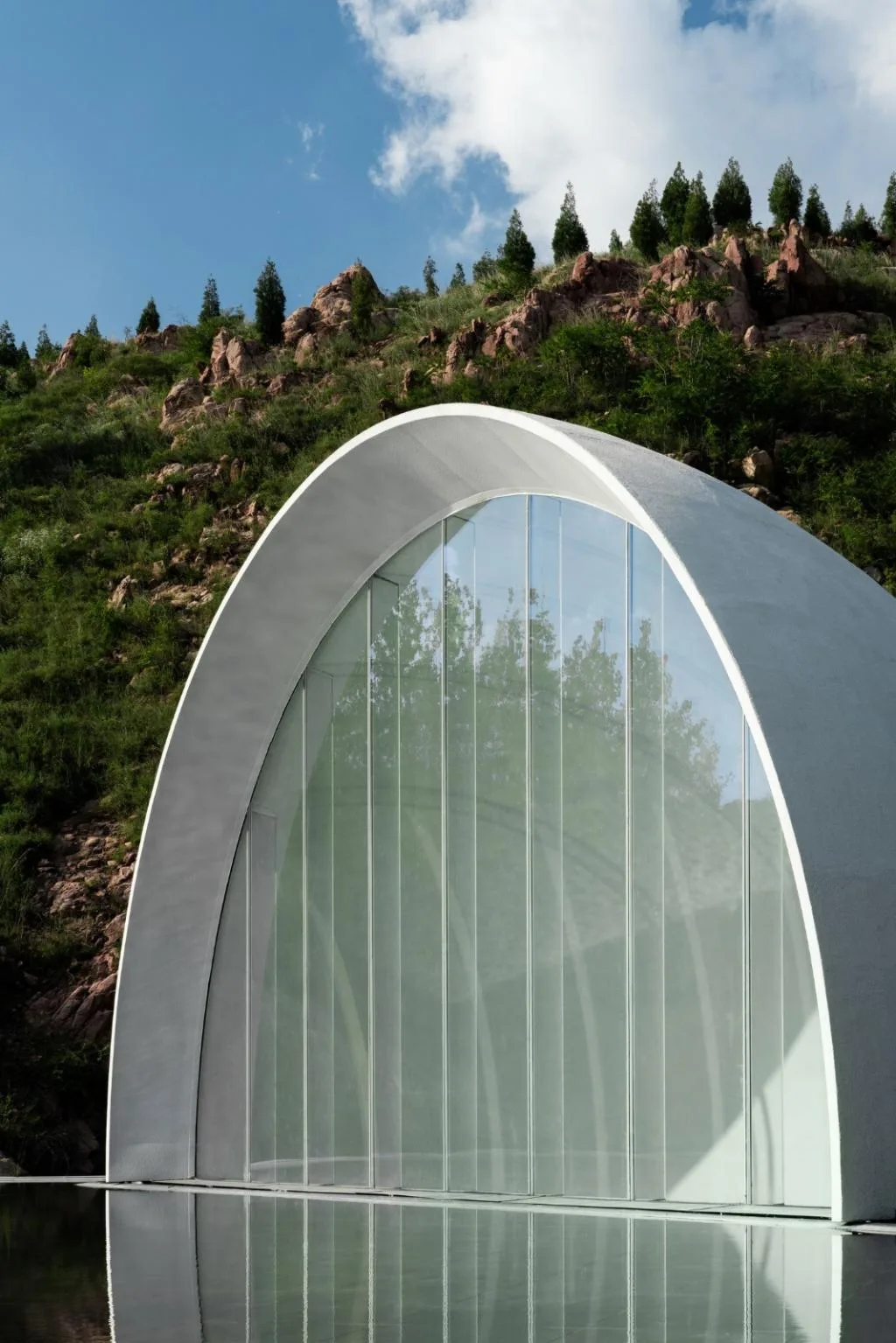
The moon subtly appears and vanishes among tree branches.
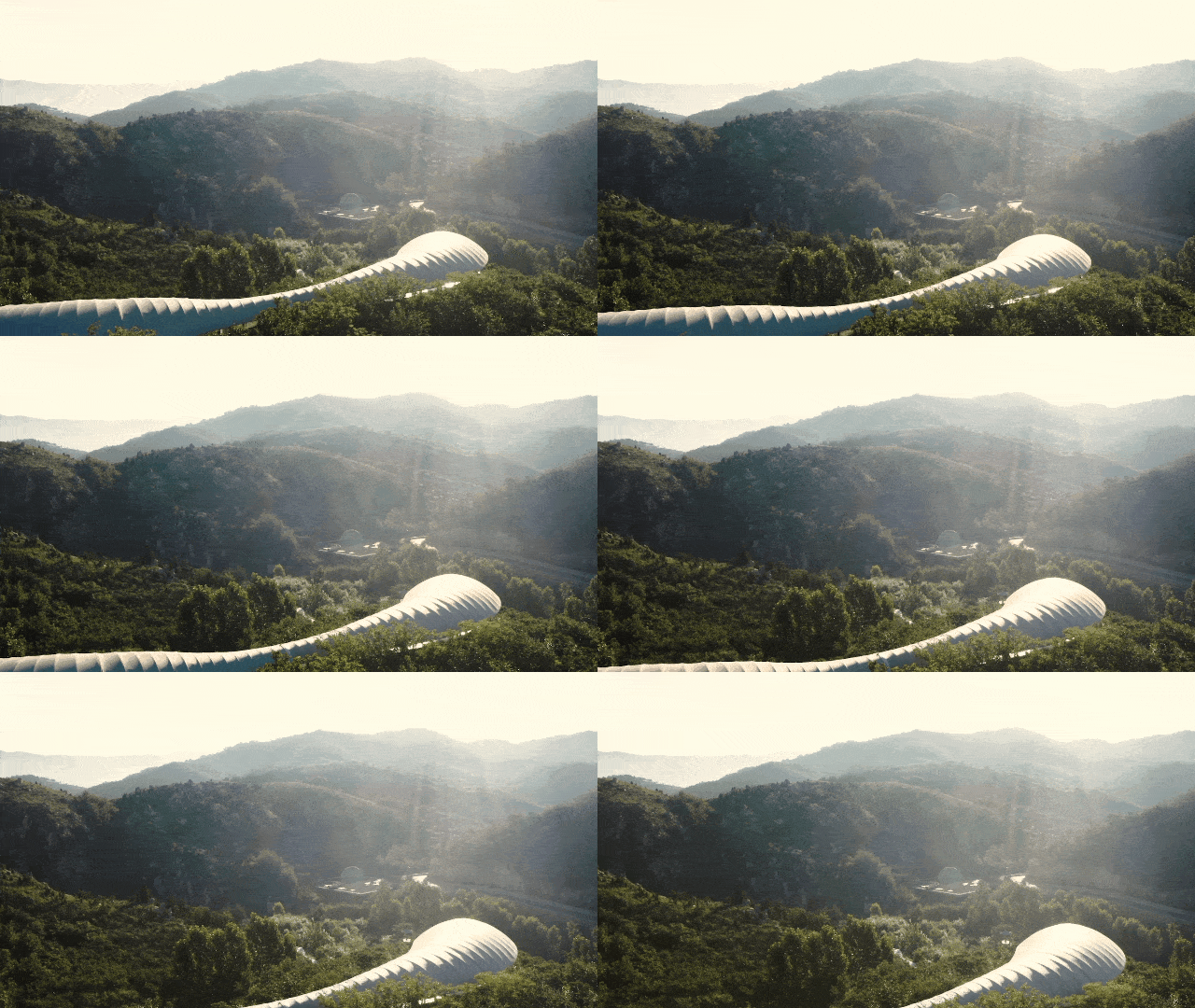
The “Clouds of Hometown” serve as both a viewpoint for the “Moon of Hometown” and a potential starting point for visitors to embark on a “moonlit journey.” From the mountaintop overlook, the “Moon of Hometown” engages in a dialogue between the man-made and the natural moon above, blending seamlessly into the environment without disrupting the valley’s integrity. As visitors descend the stairs and approach, the “moon” seems to flicker among the trees, gradually growing in view until it reshapes people’s perception of architecture and “home.” Looking back from within the “moon” toward the “Clouds of Hometown,” there’s a reciprocal call to “chase the clouds,” as these two architectural forms face each other like horns.
02 – Path
To enter the “moon” from the parking area, visitors traverse a “heart-cleansing” winding path. The boardwalk’s entrance is hidden behind a large rock, requiring a 5-10 minute walk—long enough to build anticipation but not fatigue. The path follows the mountain’s contours and streams, accompanied by birdsong, flowing water, rustling leaves, drifting mist, and the excitement pounding in visitors’ hearts. This journey around a mountain and across a river conceals the building from full view, inviting visitors to seek an “unexplainable” destination through their senses.
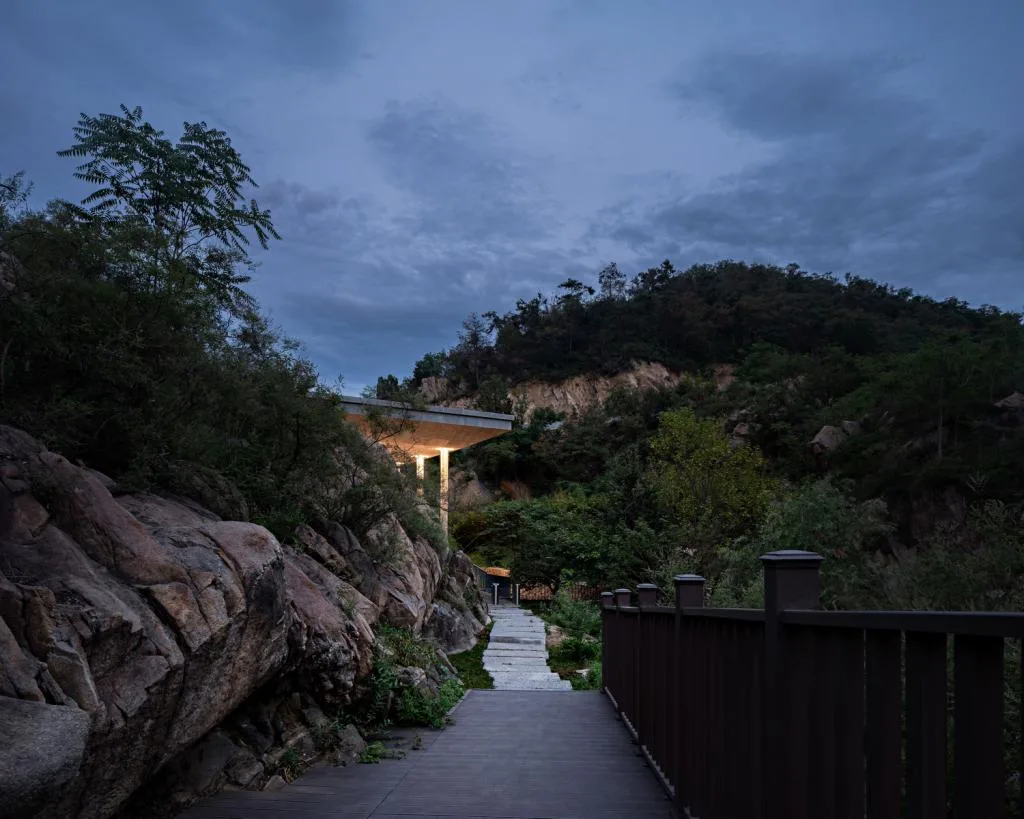
The boardwalk entrance leading to the ‘Moon of Hometown’.
This subtly distant and winding route creates a sense of expectation, guiding visitors to suddenly enter the space and be struck by the inverted moon. The experience resembles a moment of Buddhist enlightenment, framed by the mountains and forest, reshaping emotions through the setting and calming urban souls. Along the boardwalk, architects and owners have added functional nodes such as children’s playgrounds, wooden campsites, campfire areas, and misty installations, enriching the visitor experience.
Notes to editors:
There is a “moon-observing bridge” located on the rooftop pool, along with a boardwalk connecting the bridge to the mountain, allowing moon viewing without entering the building. During indoor ceremonies, the rooftop access can be closed to prevent disruption; otherwise, visitors can freely move between the rooftop and interior to enjoy the “moon” experience multiple times.
03 – Intervention
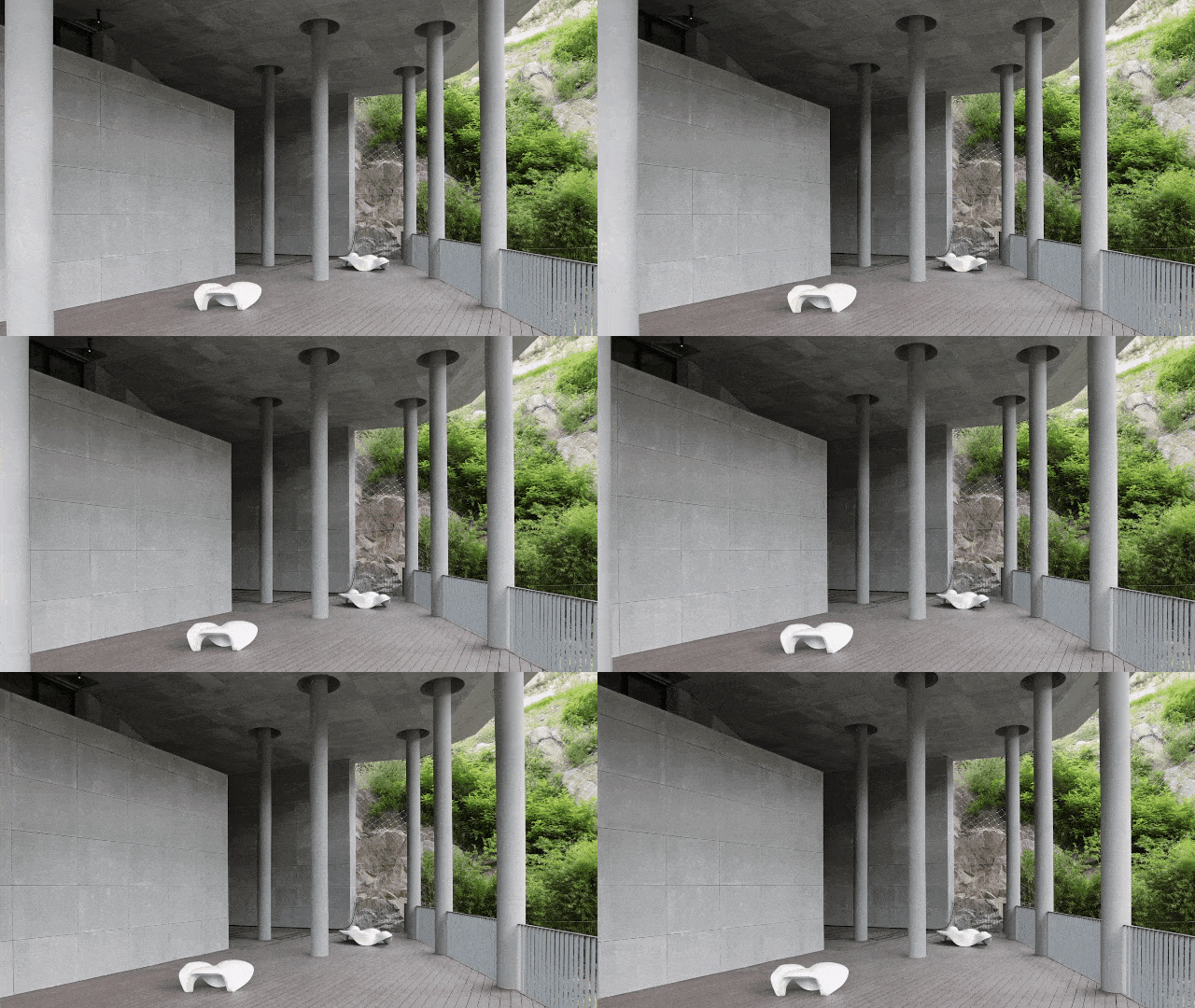
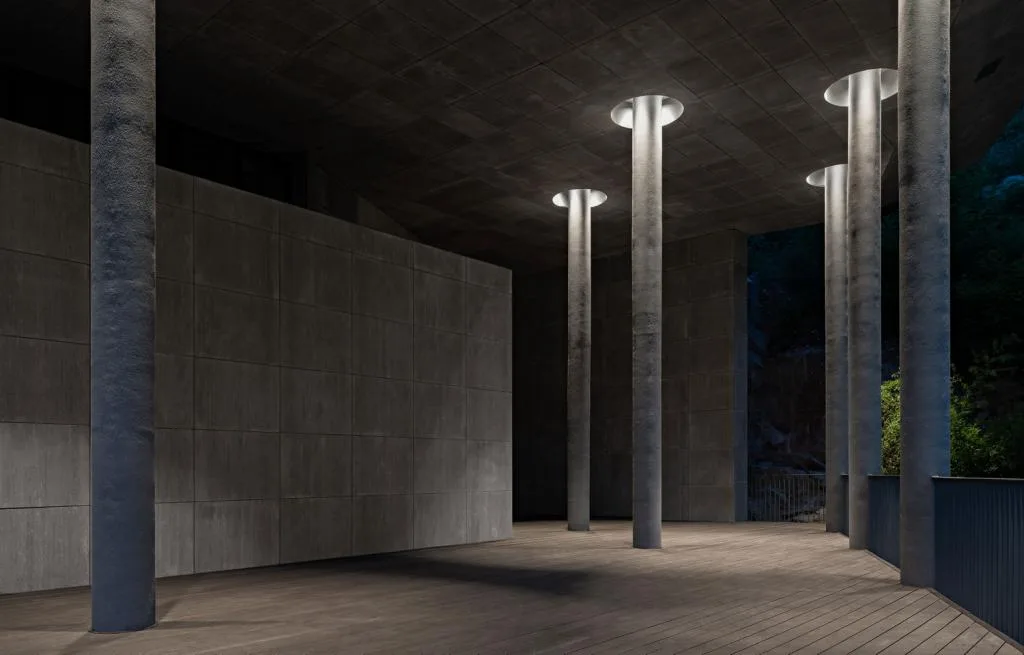
Entrance platform and pillar forest
Upon entering the gray space at the entrance, visitors officially enter the “Moon” territory. This over 1,000-square-meter building consists of three main parts: the moon, the cavity, and the gray space. Inspired by the mountain stream at the site, the design evokes the romantic image of “a bright moon over the sea” through architectural expression.
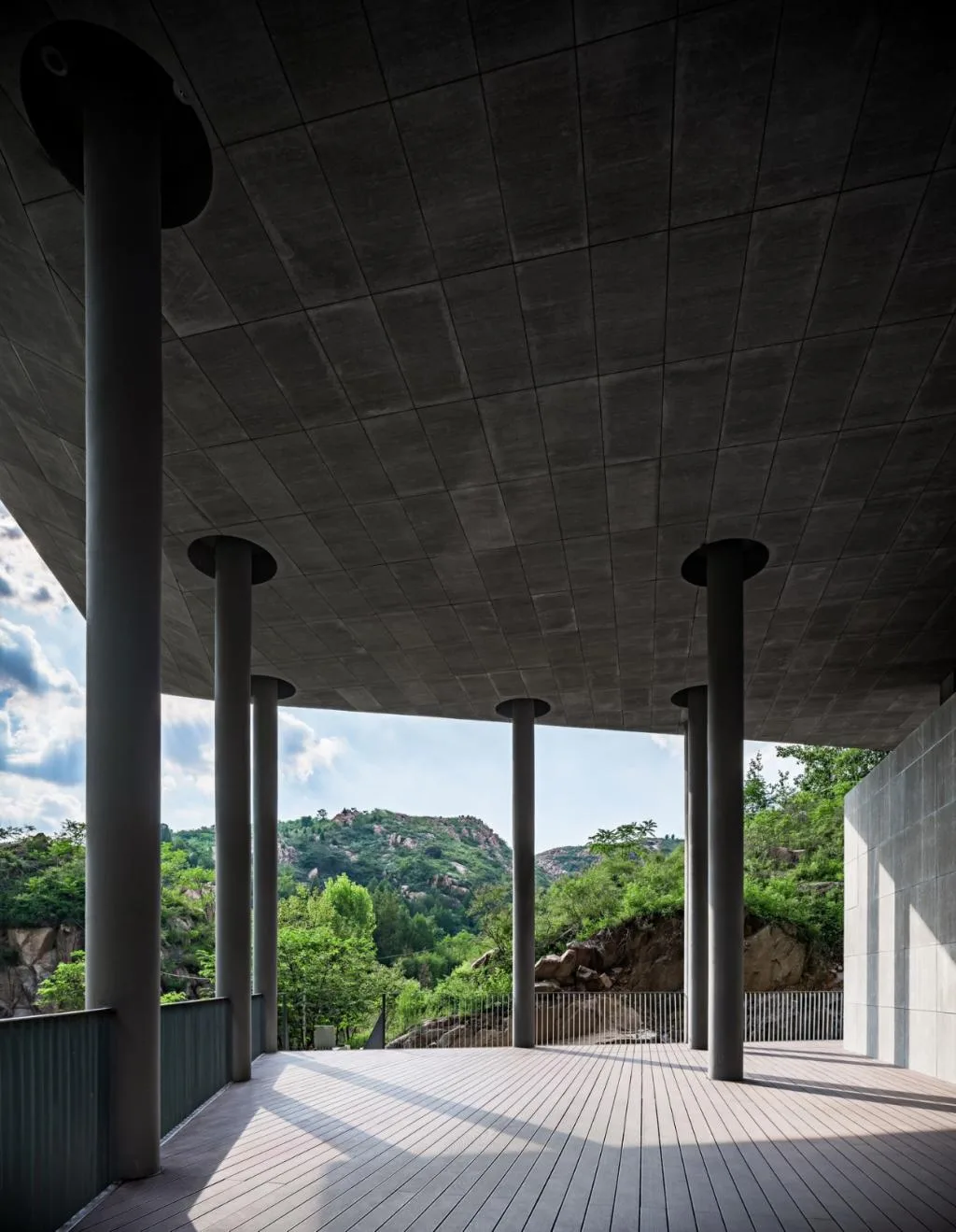
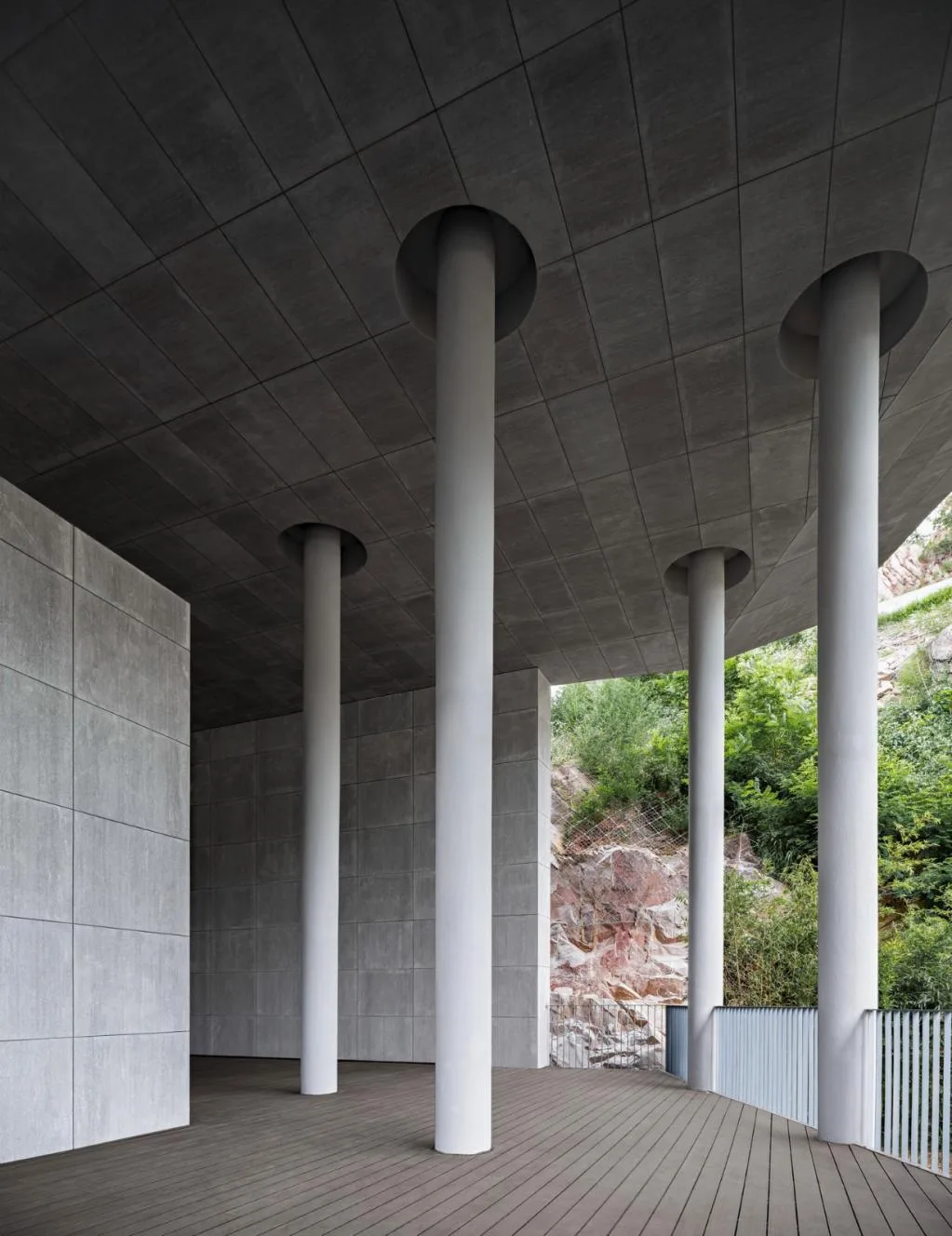
Dialogue between the entrance platform and the natural surroundings
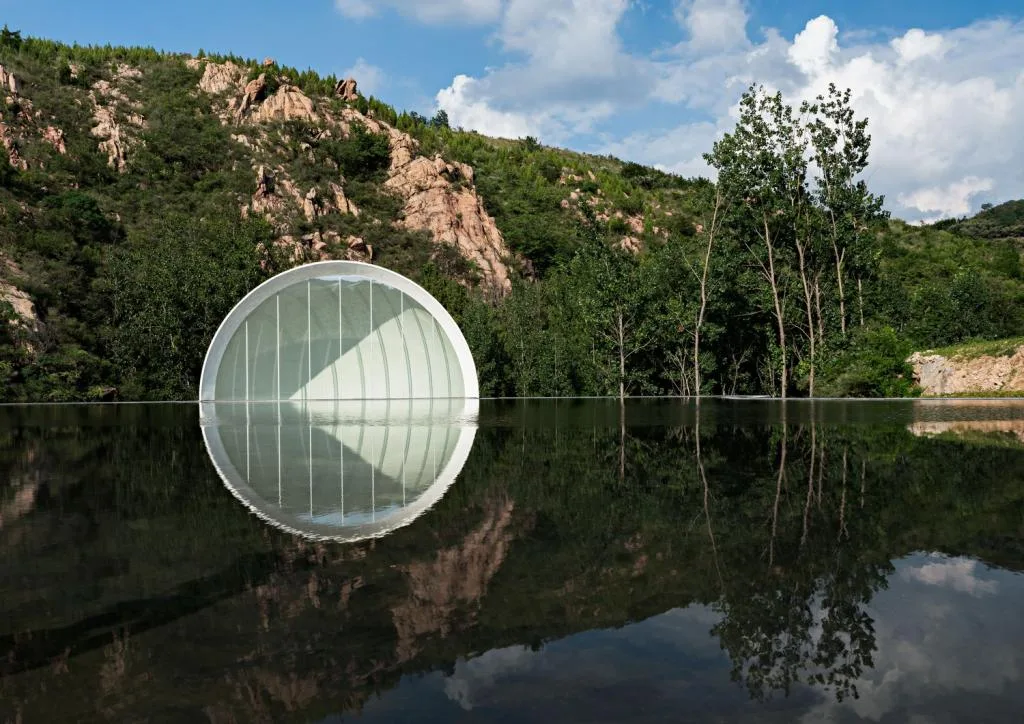
The “Moon of Hometown” placement was carefully considered: the building’s altitude ensures it neither blocks the mountains behind nor is obscured by nearby hills. Its diameter and relationship with the adjacent water surface are balanced so that the building and its reflection form a perfect full moon. The cavity inside accommodates a half moon (12m diameter) and the required height for ceremonial space.
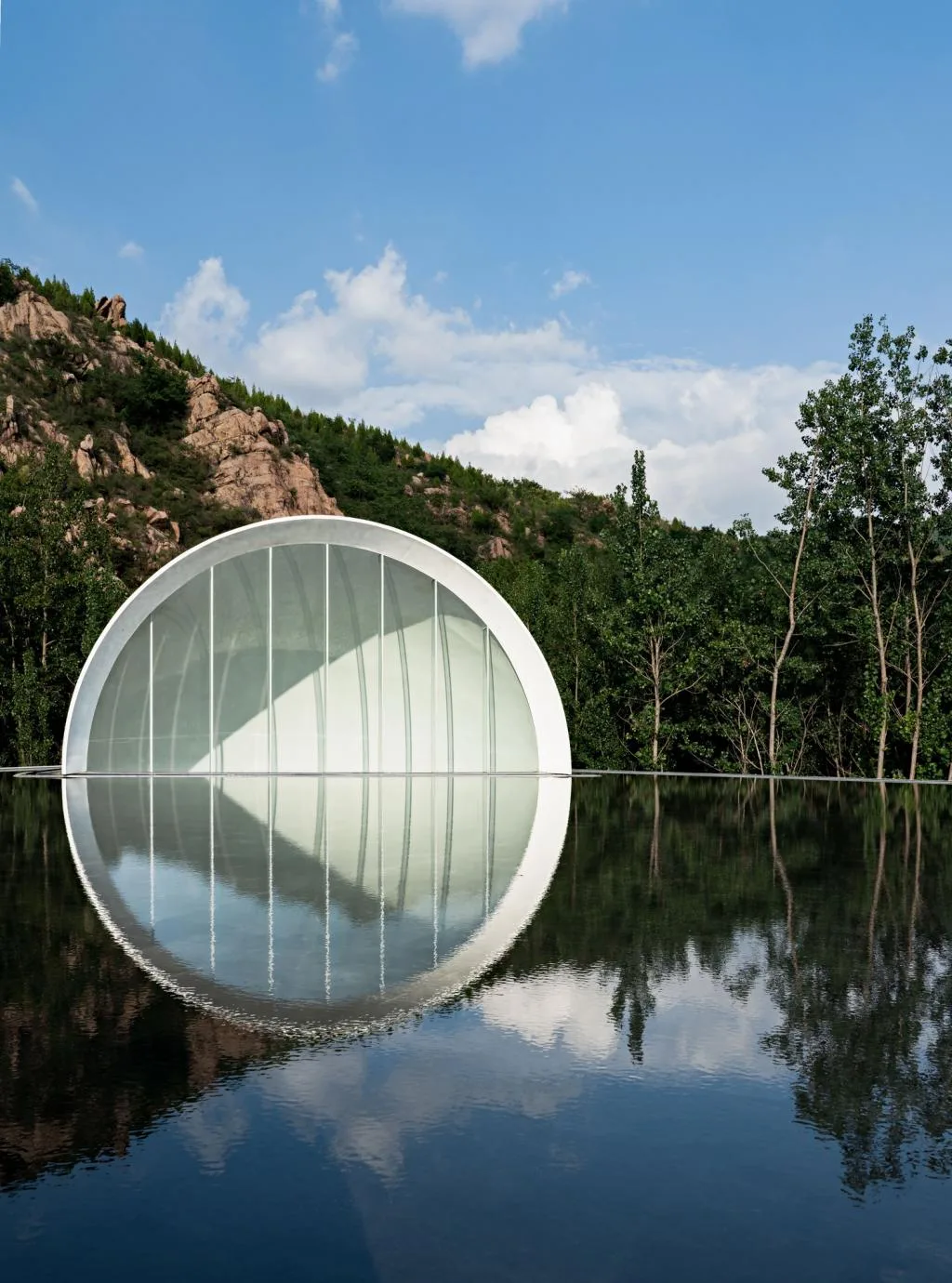
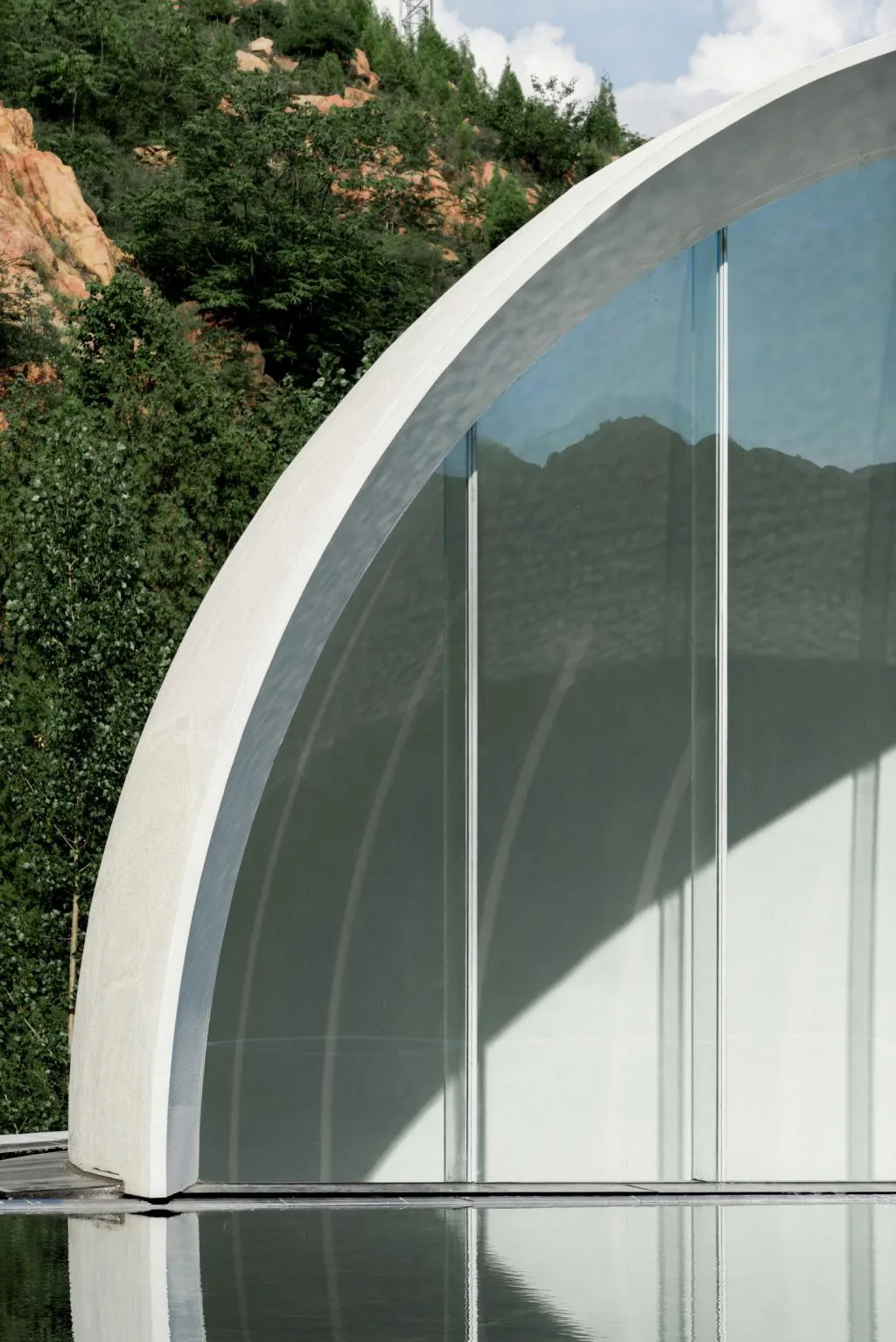
The building and its reflection together form a ‘full moon.’
To address water evaporation, the rooftop pool includes a 0.5m reservoir plus a permeable middle layer, reducing the need for frequent refilling. The ceremonial hall requires a column-free space, and to maintain the circular shape, beam thickness was carefully controlled. The multi-ribbed, beamless concrete floor structure provides an economical, sound, and load-bearing solution.
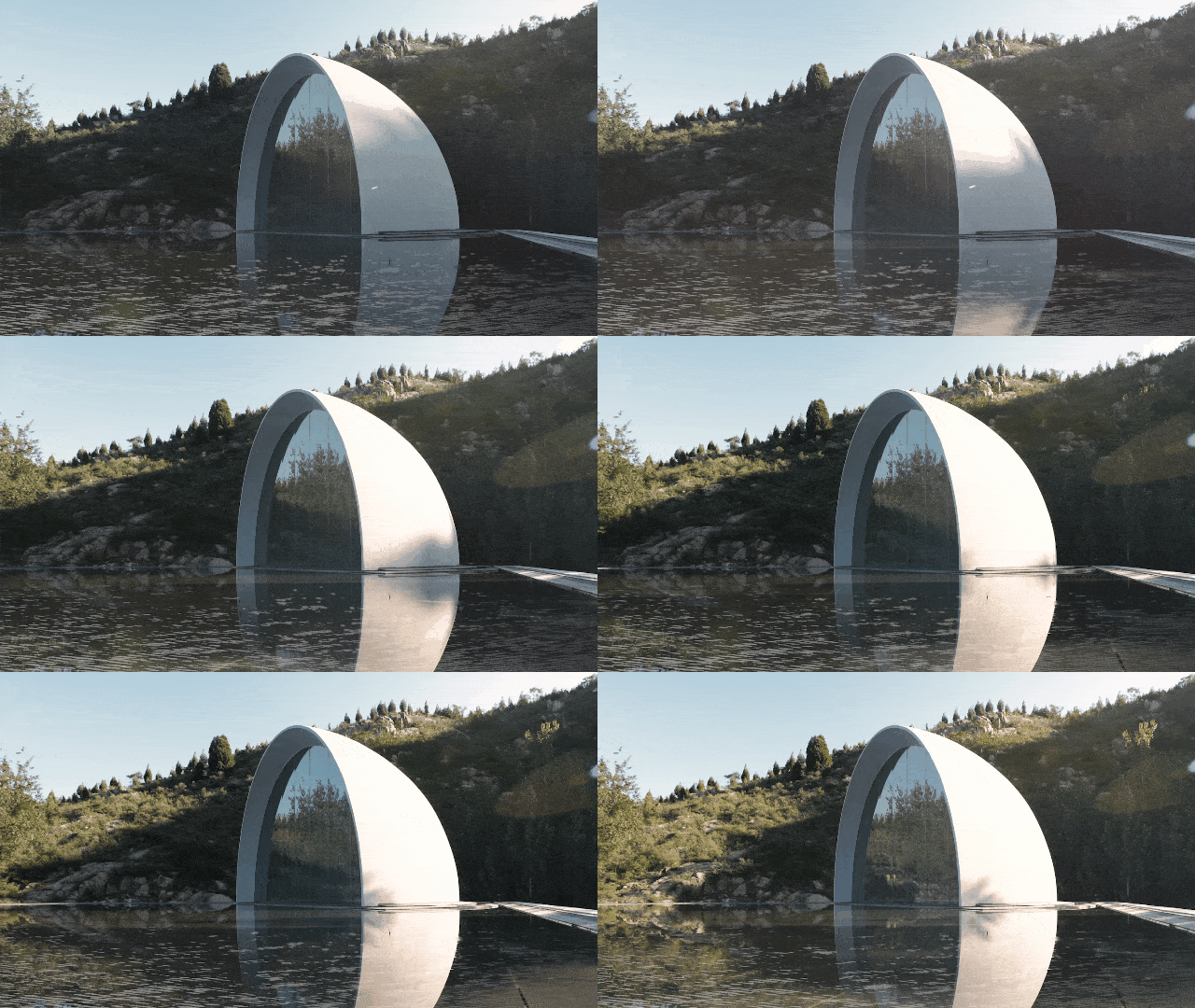
Building on these material foundations, Hanlan Architecture adopted a “limited intervention” approach: widening the valley floor to erect the building, preserving the original spillway to prevent natural disasters, and excavating the base according to the calculated diameter and spatial needs of the moon. A corner within the interior retains original mountain and moss as a testament to the interaction between nature and human design, contributing to the building’s aesthetic narrative.
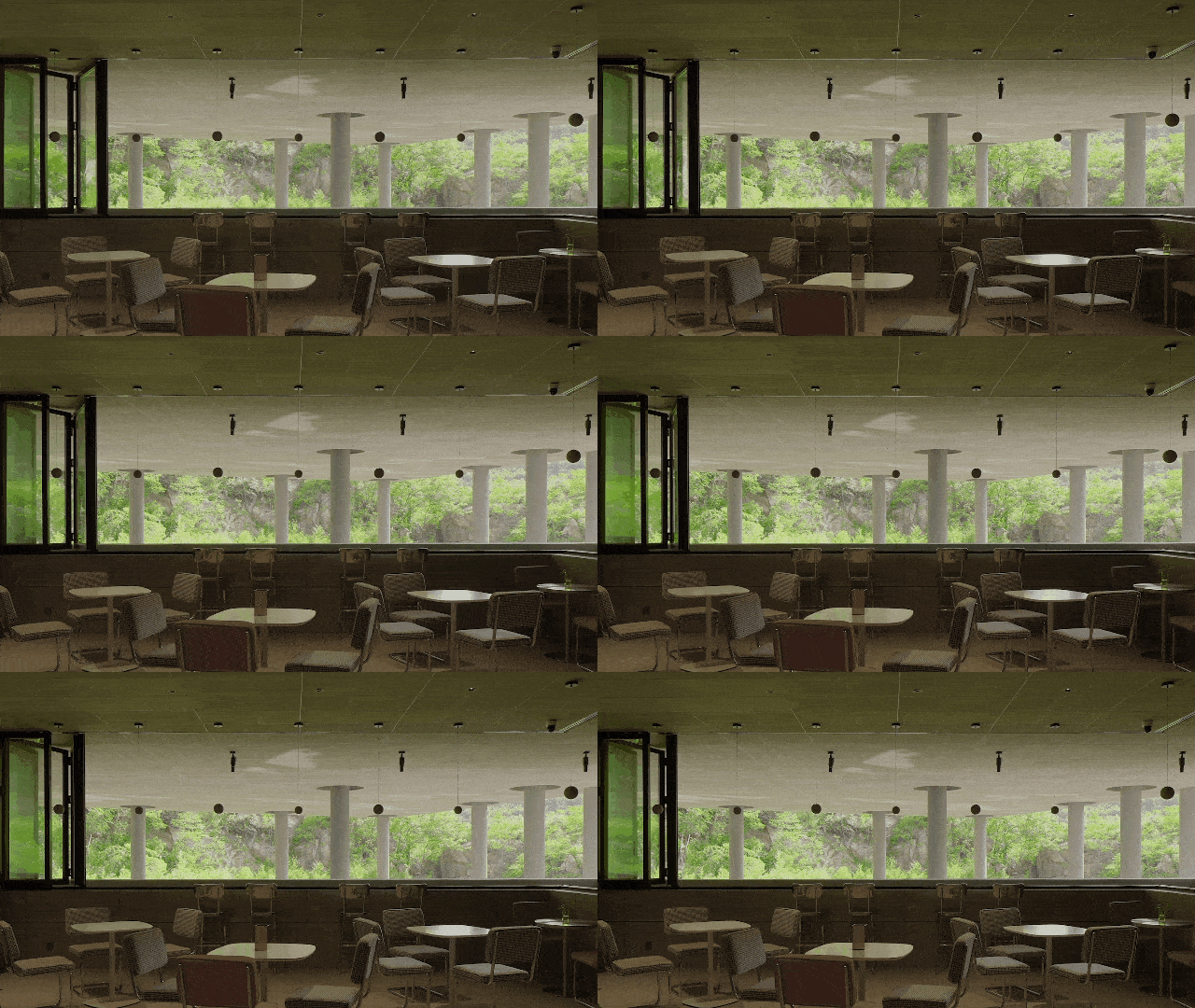
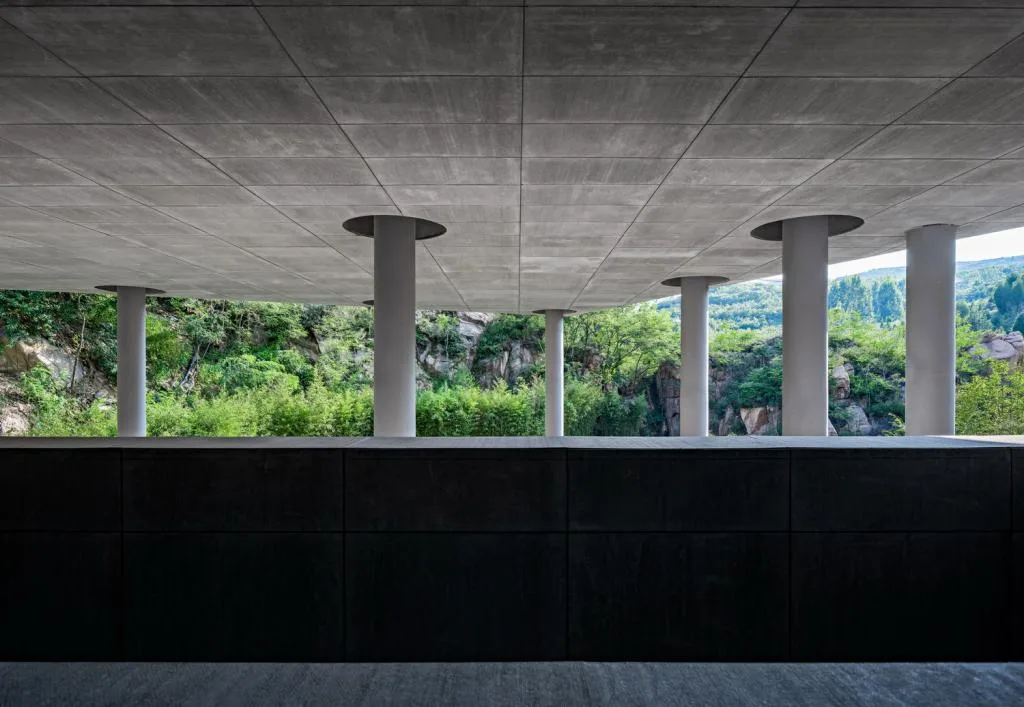
Café Landscape Terrace
Mountains, rocks, wind, and moon serve as the inspiration and catalyst behind the “Moon of Hometown.” The architects aimed to maximize integration with nature while ensuring functional and rational design solutions.
The Moon Tonight Is Beautiful
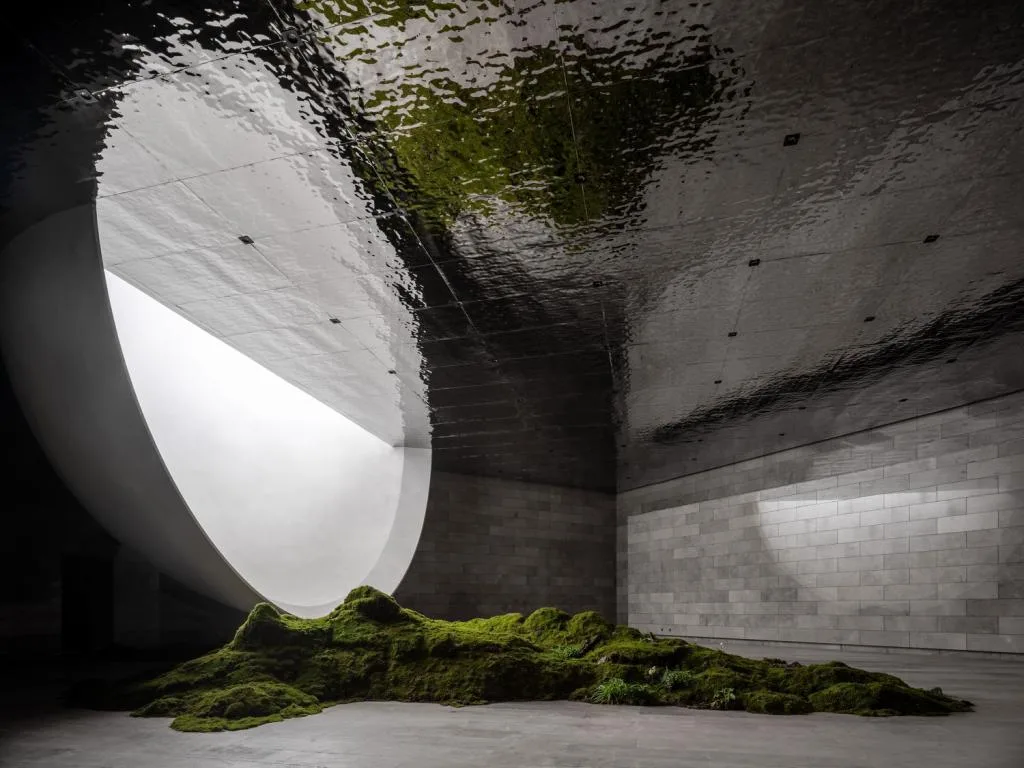
The moon merges seamlessly with the mountains.
Zou Yingxi drew upon his early experience designing wedding halls during his entrepreneurial return to China and observed innovations in local wedding concepts in Jinan and Tai’an. He envisioned the “Moon of Hometown” as a ceremonial hall offering elegant, ceremonial spaces to meet the demands of local and national high-end weddings. For ceremonial architecture, emotion itself becomes a vital function.
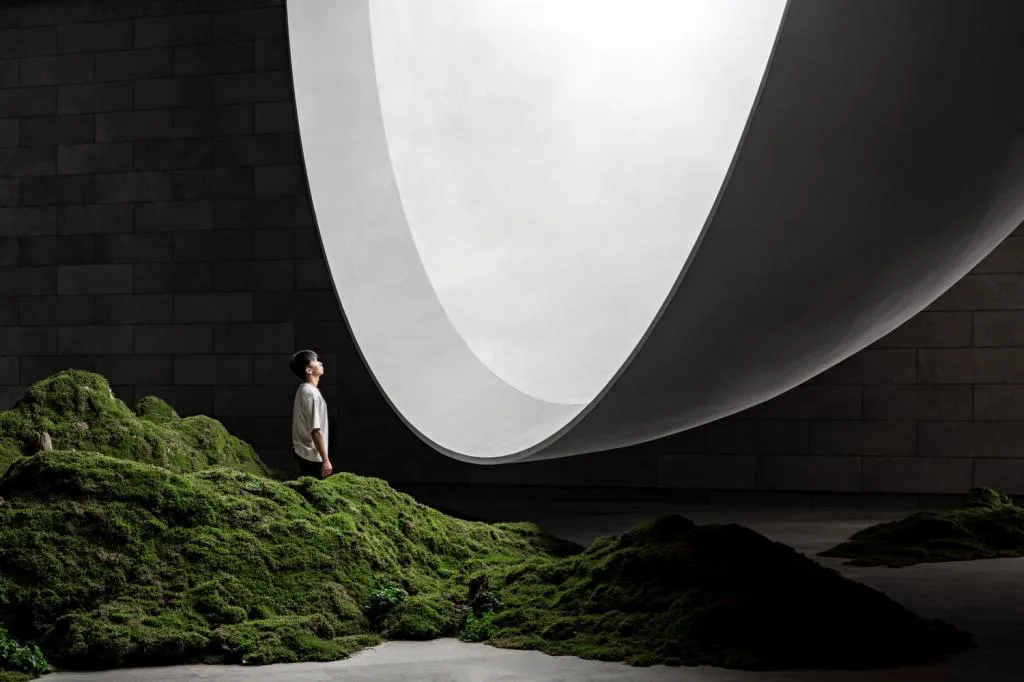
An elegant and ritualistic space
Beyond fundamental functions such as hosting ceremonies, waiting areas, receptions, dressing rooms, and washing facilities, the “Moon of Hometown” embodies love and warmth, serving as a place where happiness is created.
01 – Decoration
The connection between the “moon” and “love” is profound: ancient Chinese poetry celebrates “wind, flowers, snow, and moon,” while Japanese author Natsume Soseki famously translated “I love you” as “The moonlight is beautiful tonight,” evoking gentle affection. Blue Architecture expresses this uniqueness through natural materials—beautiful rock slabs, stone, and plain concrete closely matching the mountain’s colors—enveloping the building’s interior and exterior walls and floors. The rooftop features ultra-clear white glass, allowing sunlight to permeate and illuminate the interior naturally.
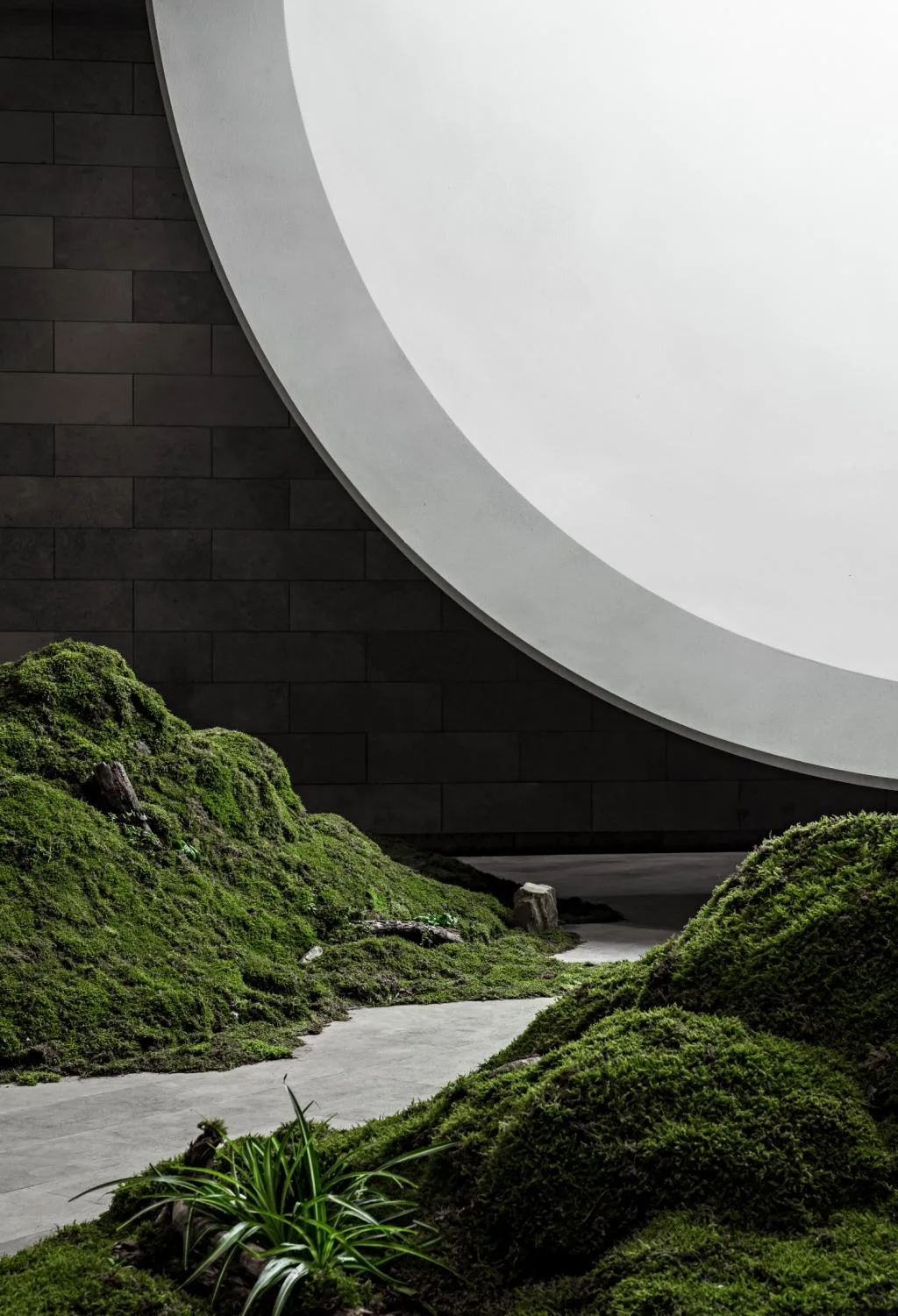
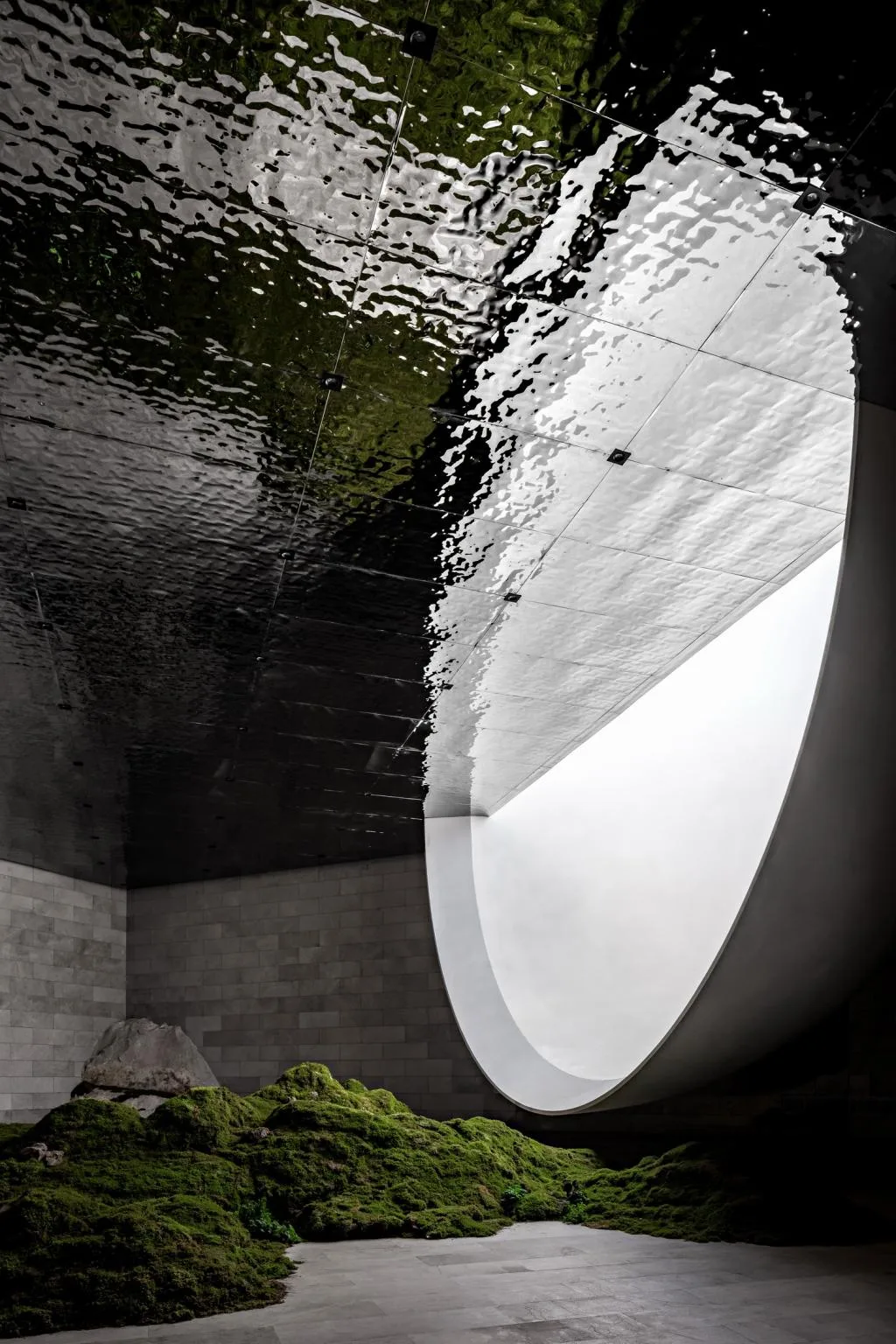
The moon’s curved wall serves as a natural echo chamber.
The curved wall forms a natural echo chamber, amplifying lovers’ promises and fostering a connection between heaven and earth. Throughout the day, shifting sunlight creates varied light patterns within the “moon,” reflecting the fullness and phases of love. Aside from the moon, the interior is nearly decoration-free, requiring no artificial lighting. This grand-scale “moon” transcends traditional religious or church spaces, inviting visitors into a broader spiritual realm where external distractions fade, focusing solely on love.
02 – Circular Fusion
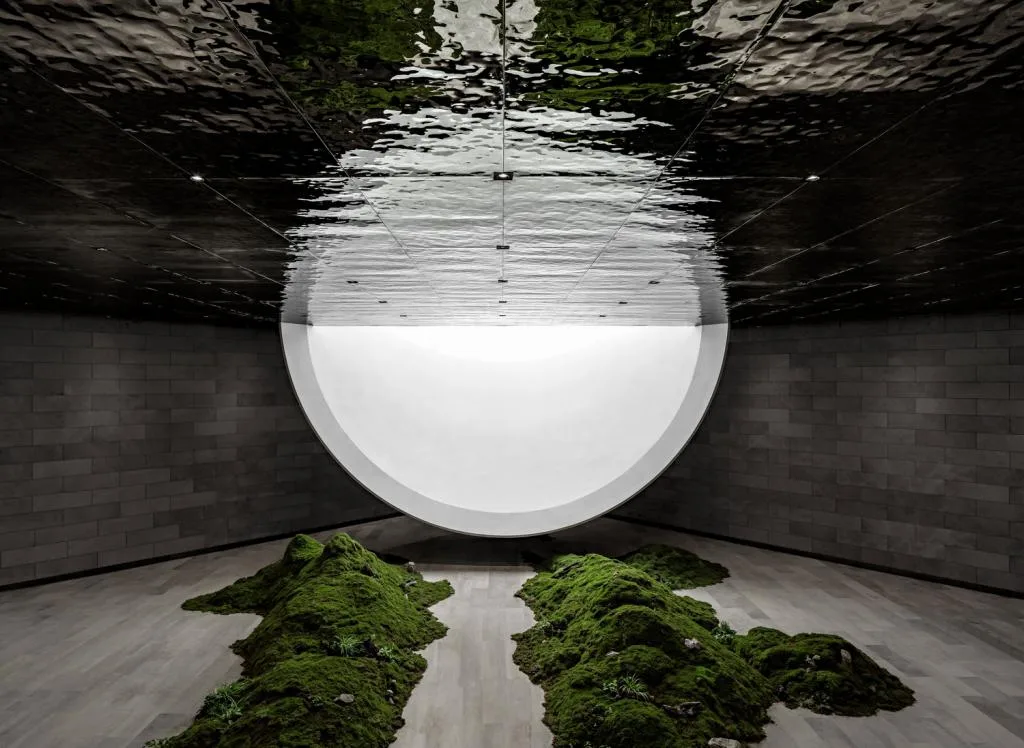
Inside, the “Moon of Hometown” is perfected by the reflective water ripples.
The ceremony hall divides a full moon into two halves, using the water surface and a stainless-steel ripple board to create a perfect reflection. Life’s essence may lie in imperfection, and the “other half” we seek represents a kind of “perfection”—a soulmate who completes and heals our life’s deficiencies. Architecturally, the building balances yang (top) and yin (bottom), embodying harmony through presence and absence, fitting perfectly with its ceremonial purpose.
Hanlan Architecture’s design philosophy is poetic and philosophical, drawing from Buddhist concepts of harmony, perfection, and infinity, Taoist ideas of emptiness, and Confucian family traditions. The “Hometown Moon” offers shelter from the elements, spiritual depth through rituals, aesthetic enjoyment, and serves as a rural development icon. It unites government, capital, media, and the public, giving the architecture a sense of completeness. This “Moon of Hometown” belongs to what Corbusier described as “ineffable space,” where the experience of being inside matters most.

Postscript
Since its completion, the building has fostered a new dialogue between users and nature. It is anticipated that as time passes and trees grow, the structure will become further integrated with its environment.
Architecture has only two destinies: to be destroyed or preserved. My aspiration is to create a work “too precious to demolish,” which would mark the pinnacle of my career. To achieve this, I seek to imbue architecture with deeper meaning and emotional resonance. I hope the “Moon” becomes such a building—even if it eventually fades, it can immortalize people’s spiritual world.”
— Zou Yingxi, Chief Architect, Jianlan Architecture
Additional Notes
- Due to beam structures, the two semicircles of the “moon” do not form a mathematically perfect circle.
- The gray space at the entrance serves as the gateway into the building and a gathering area before, after, or during ceremonies.
- An array of concrete columns at the entrance features lighting inspired by the “full moon.”
- The ceremonial hall includes a mezzanine and high stair railings, providing new vantage points to appreciate the “moon.” These also serve as control stations for stage and lighting staff, minimizing interference with ceremonies.
- Doors and windows in the café can fully open to blend indoor and outdoor spaces; they can be completely closed during special weather or specific requirements.
- A spiral staircase next to the café connects the roof to the main building. The café also serves as a waiting area for rooftop moon viewing.
Project Drawings
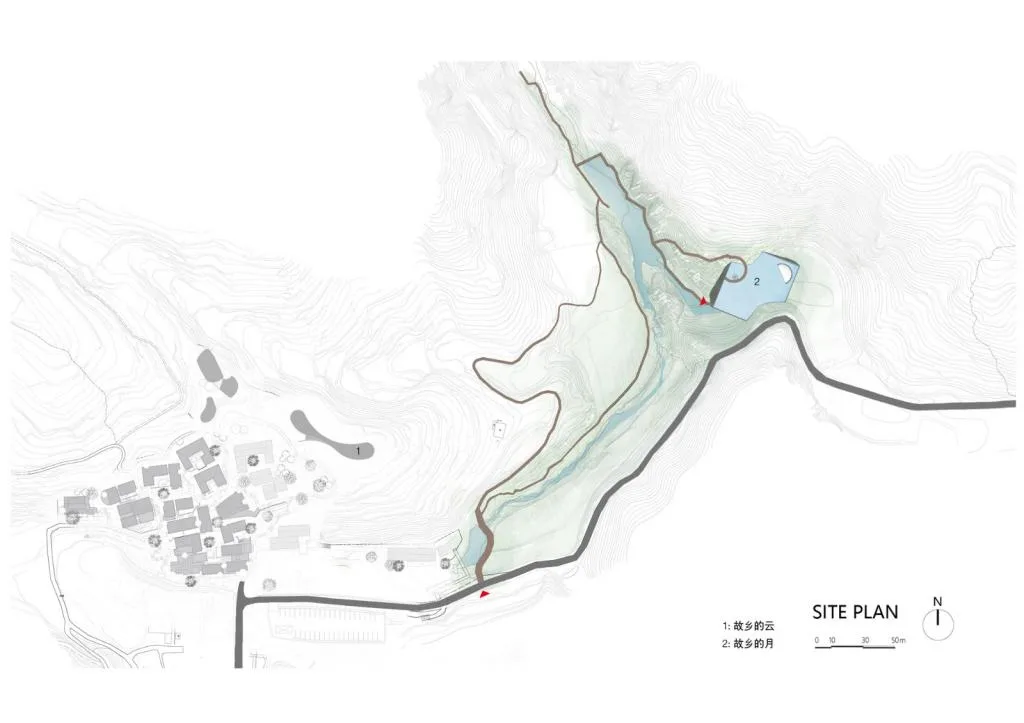
△ General Layout Plan
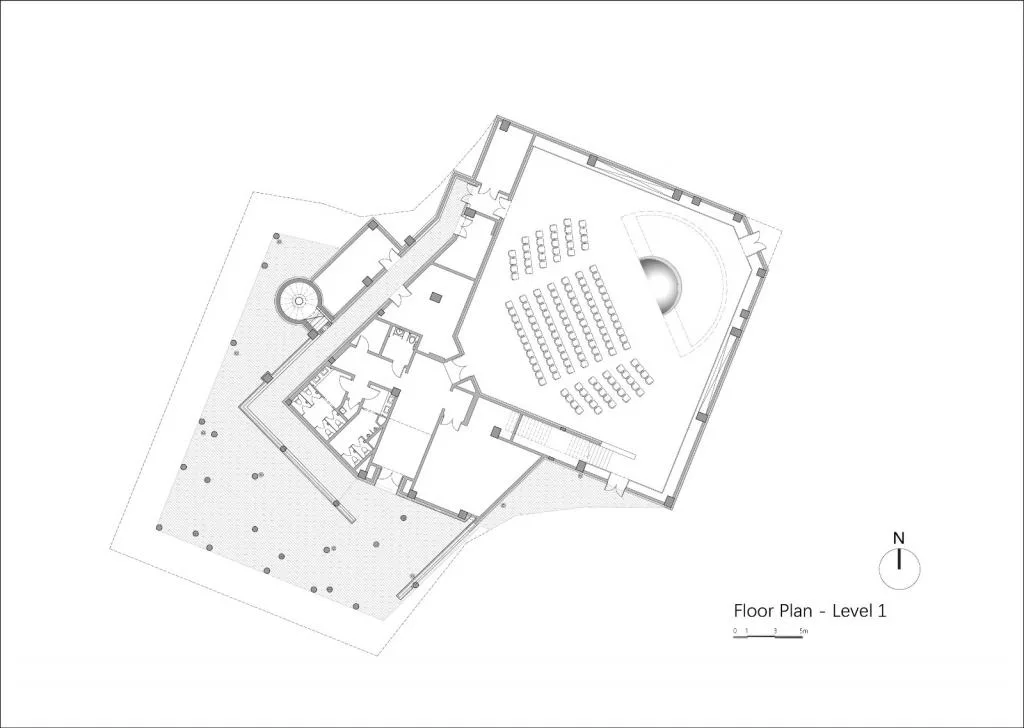
△ First Floor Plan
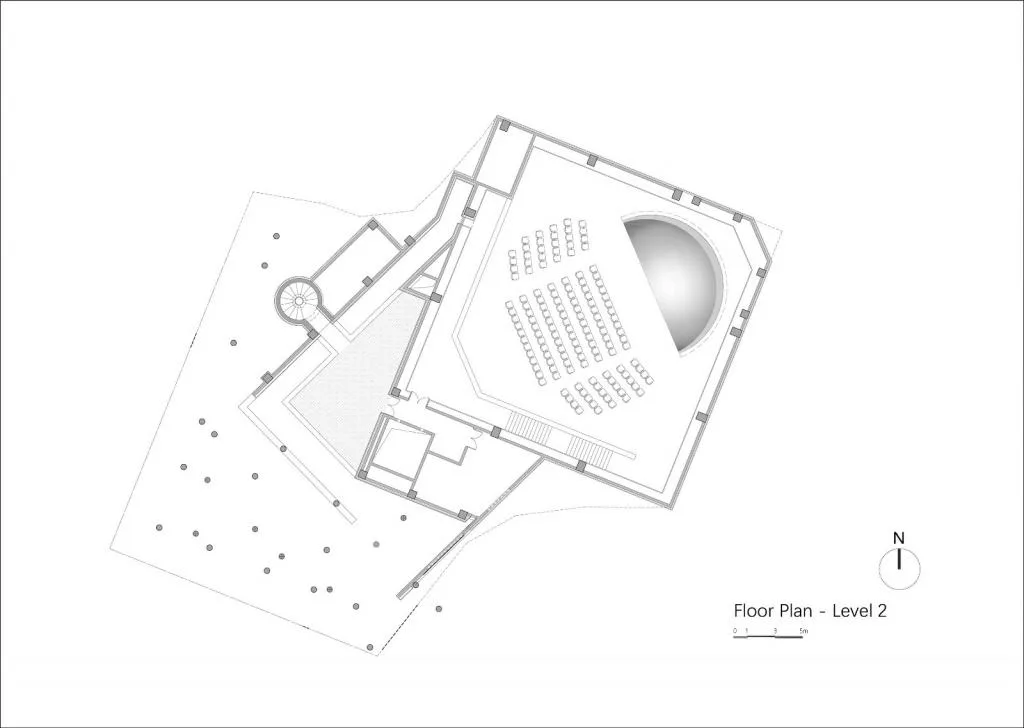
△ Second Floor Plan
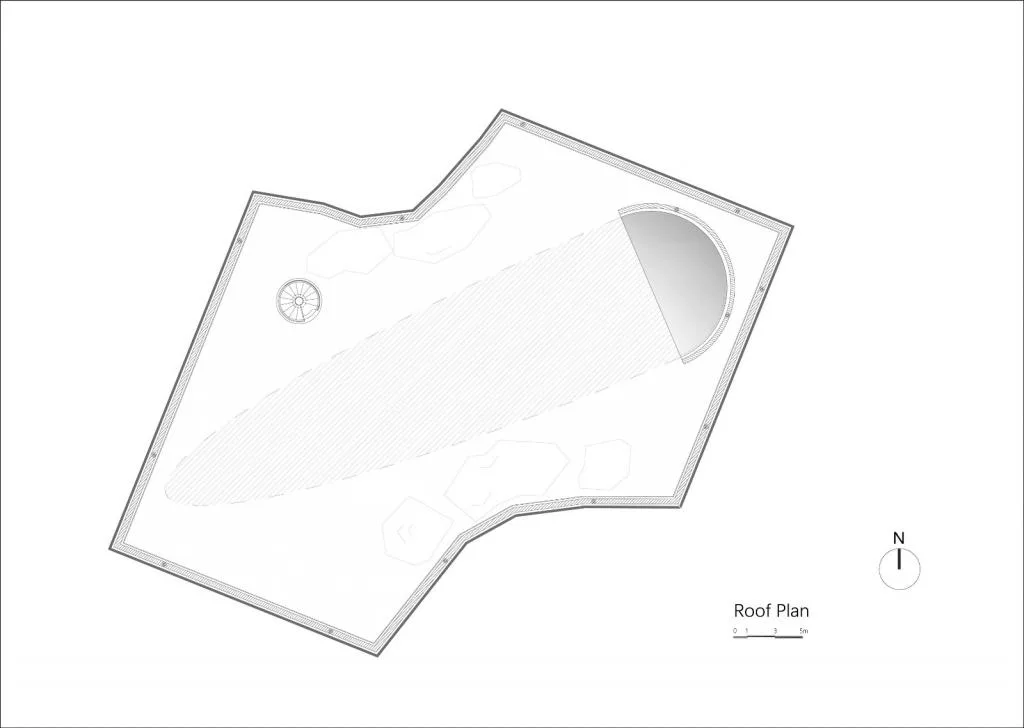
△ Roof Plan
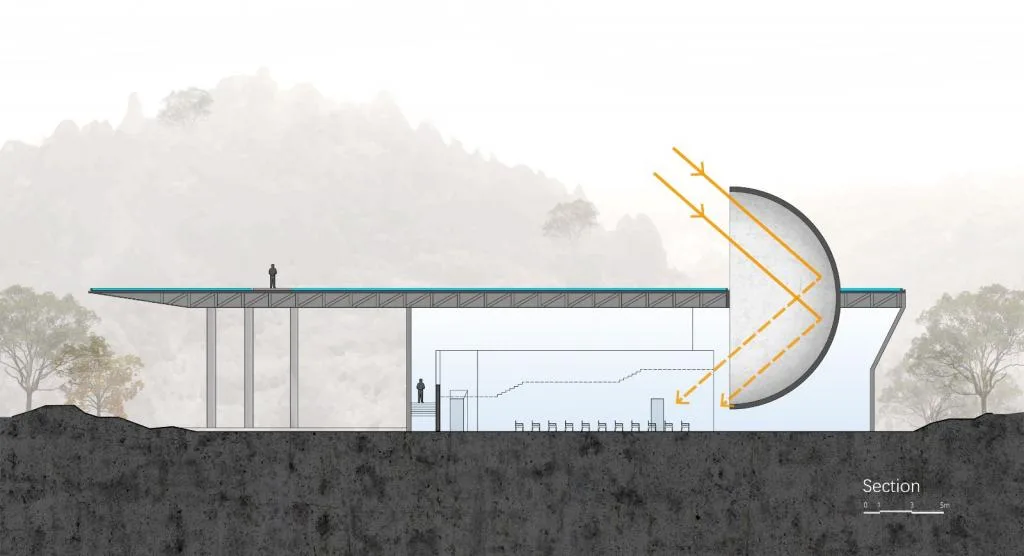
△ Section Diagram
Project Information
Project Name: Moon of Hometown
Location: Daolang Town, Tai’an City, Shandong Province
Client: Lushang Jiunvfeng (Tai’an) Rural Revitalization Co., Ltd
Project Scope: Architectural Design, Landscape Design, Interior Design
Design Period: October 2019 – July 2020
Construction Period: July 2020 – June 2021
Site Area: 1,866 sqm
Building Area: 1,469 sqm
Indoor Area: 856 sqm
Floor Area Ratio: 0.78
Greening Rate: 30%
Function: Auditorium
Lead Architect: Zou Yingxi
Project Architects: Liu Yuan, Jin Nan
Interior Design Team: Xia Fuqiang, Qian Guoxing, Cao Zhenzhen, Liu Tingting, Li Qianqian
Indoor Performance Team: Feng Yan, Guo Mengjia, Li Hui
Landscape Design Team: Jin Nan, Xu Lu, Liu Shuang, Li Beibei, Liang Jingqi
Architectural Rendering Team: Zhu Feng, Chen Lan, Liang Xiaoting, Ruan Jianjun, Shi Lina, Tang Tang Tang, Zheng Lihua, Liu Shuang (hand drawn)
Construction Contractor: Mount Taishan Puhui Construction Engineering Co., Ltd
Structural Engineers: Wang Qiang, Yang Jian, Yan Dongqiang
Mechanical, Electrical, and Pipeline Consultants: Huang Yuanzheng, Mei Yantao, Ji Pengcheng
Lighting Consultant: Chuangxing Xingguang Environmental Design (Beijing) Co., Ltd
Other Consultants: Feng Asuncion, Liao Shijie, Chen Lu, Xu Yan, Zheng Shuai
General Contractor: Mount Taishan Puhui Construction Engineering Co., Ltd
Photography by: Zheng Yan
Camera: Peanut Studio















Must log in before commenting!
Sign Up