
Project Introduction: Longfor Public Art Center serves as a vital part of Longfor’s public support services. Initially, it will host urban planning exhibitions in Zhengdong New Area. Over time, the center will fulfill its role as a public art hub, showcasing outstanding artworks and offering high-quality public activities. Working in harmony with the surrounding public spaces, it aims to create a vibrant and engaging waterfront living environment where residents can appreciate the new district’s development achievements from a high vantage point, enhancing their leisure experience by the water.
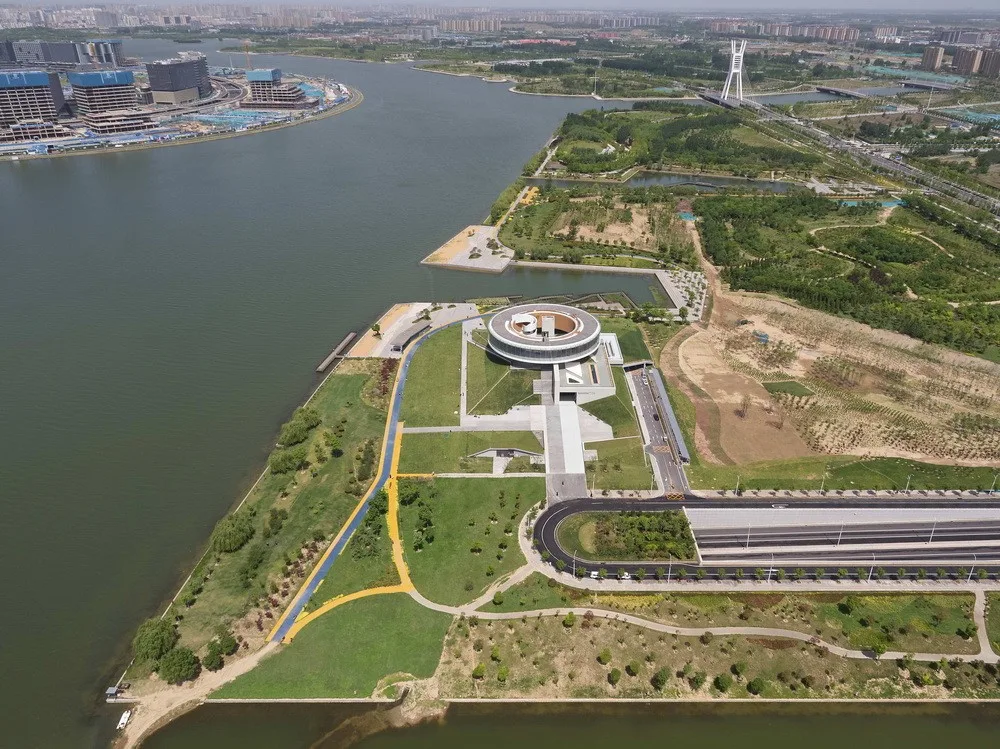
Aerial view of Longhu
Initial Impressions
Upon first visiting the site, we were struck by the expansive lakeside park. The area lacks towering buildings; even the financial island complex across the water appears modest in scale. Citizens are fortunate to enjoy such generous green space along the waterfront. Therefore, the buildings we design here must be environmentally sensitive and friendly, avoiding any sense of heaviness or dominance over the surrounding landscape.
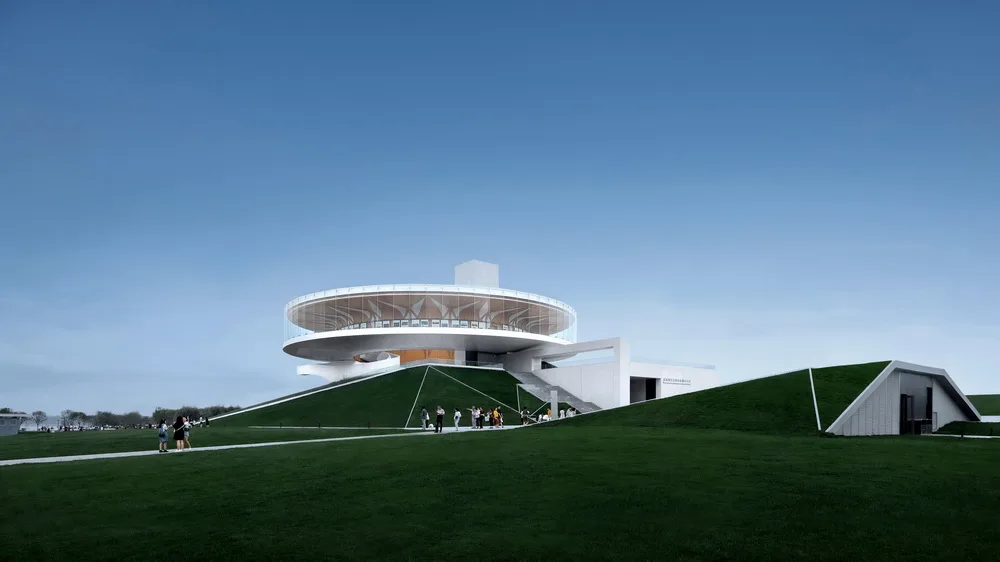
△ Shaped landforms
Design Challenge
The client envisioned this building as a landmark. The architectural challenge was to balance lakeside views, seamlessly integrate with the expansive park landscape, and truly stand out as a landmark. Our intuition and early analysis led us to conclude that this structure is neither purely architecture nor solely landscape architecture, but a hybrid of both — combining the best elements of each.
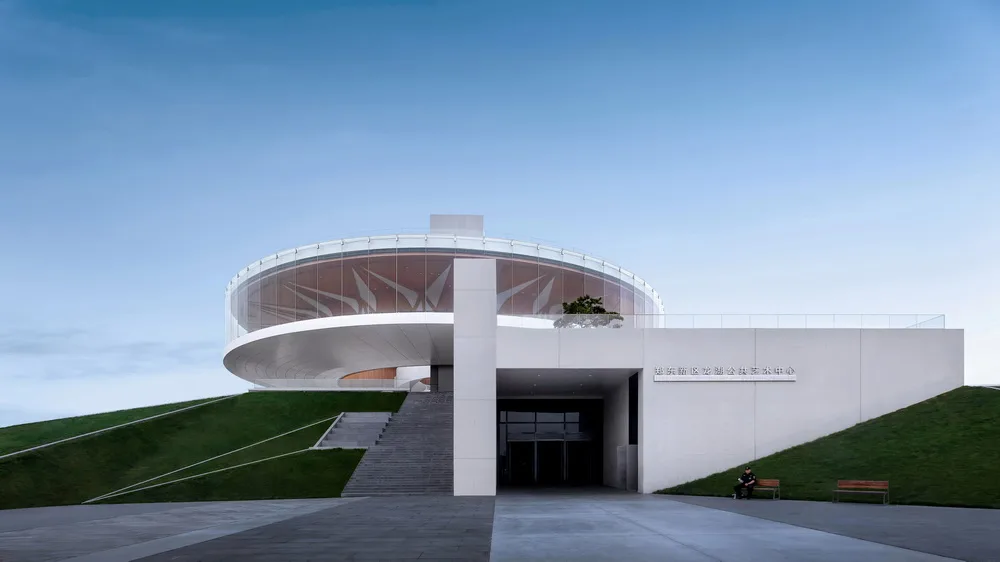
△ Main entrance plaza
Design Strategy
The project requires a large multimedia exhibition hall without natural light, a naturally lit exhibition hall, and a spacious parking area to support the lakeside park. Crucially, the repeated emphasis on “viewing” from the client became the primary design inspiration.
A circular ring floating on the green hill
From the site, on clear days, key landmarks and scenery of the new district are visible from multiple angles. For this reason, the exhibition hall was ultimately designed as a non-directional circle (ring), ensuring uniform panoramic views in all directions.
We also minimized the building’s footprint to preserve the lakeside park’s landscape. Over 97% of parking is underground, along with larger functional spaces like the multimedia exhibition hall, which occupies the equivalent of nine standard columns. This underground integration allows the building to blend harmoniously with the natural surroundings.
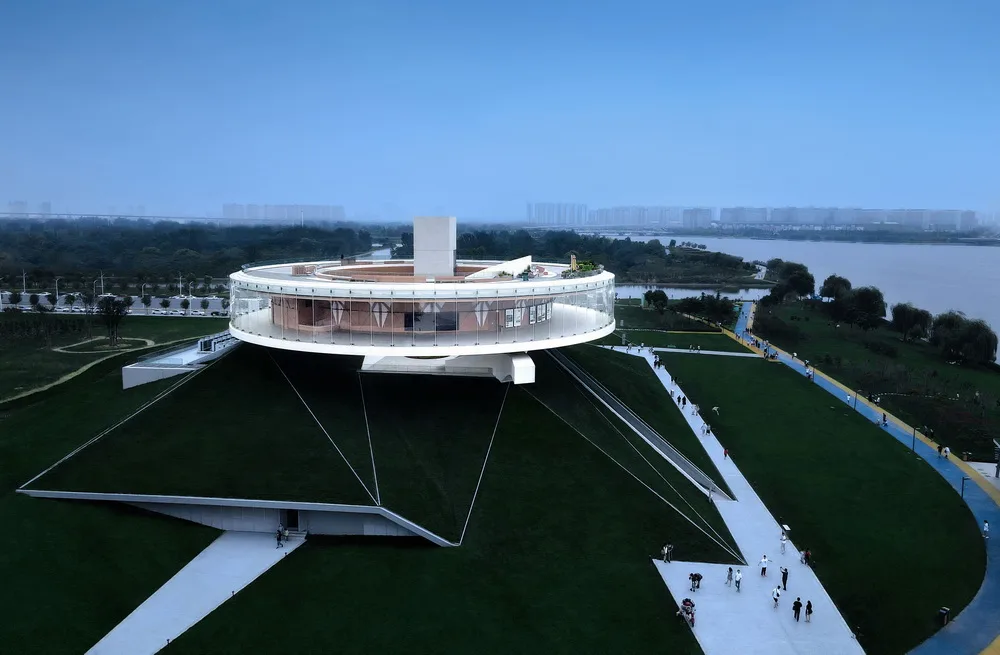
△ Slope ridge line
The Ring
With most functional spaces embedded into the earth, the dominant visible architectural element is the massive circular ring— the exhibition hall— hovering above the green hills. It appears light, delicate, and transparent during the day. At night, it glows like a radiant laurel crown, becoming a luminous symbol in the Dragon Lake skyline, radiating energy and spirit.
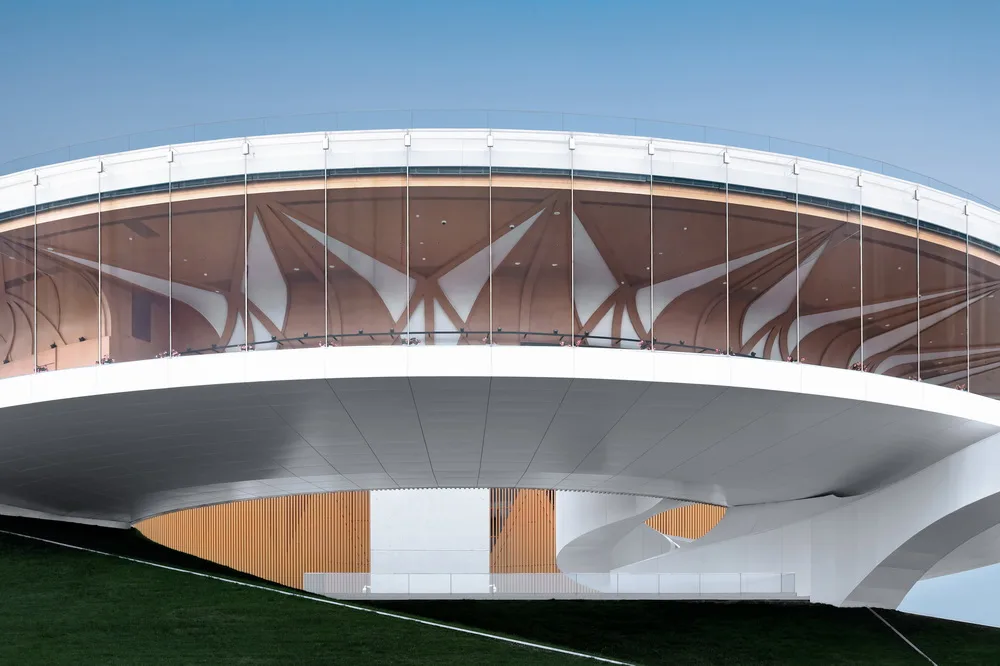
The ring’s interior consists of two concentric rings: the outer ring is a transparent floor-to-ceiling glass wall offering visitors a 360-degree panoramic city view; the inner ring serves as the display surface.
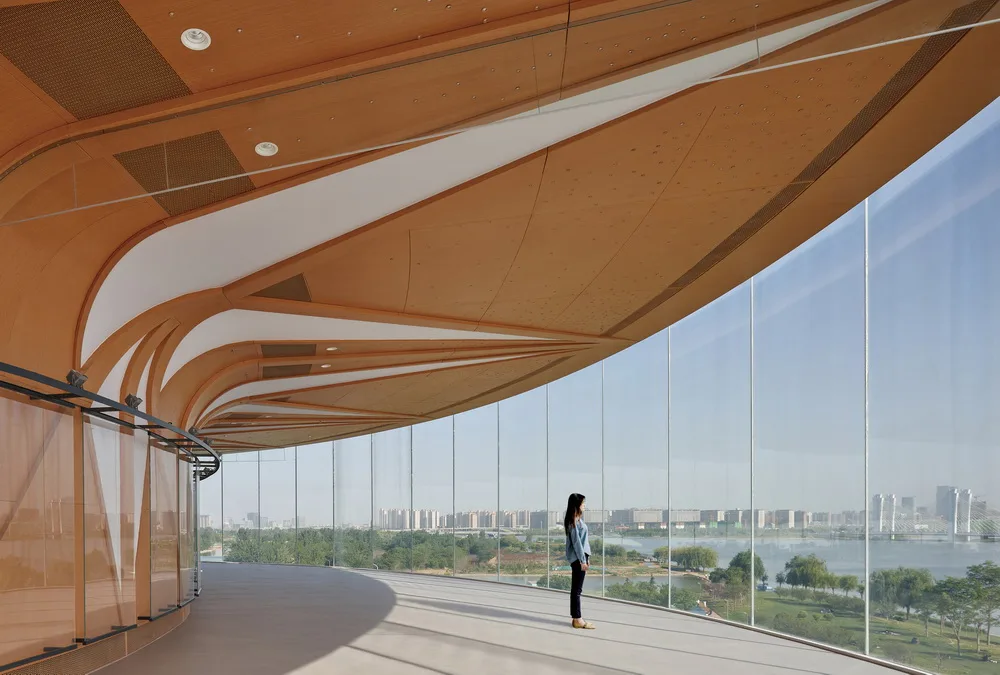
△ Complete Landscape Window
Multi-Level Viewing Platforms
The “floating” design redefines the relationship between interior and exterior spaces. These layers coexist in parallel without intersecting, creating interconnected yet independent outdoor and semi-outdoor areas. While the main interior spaces are enclosed geometric volumes—a square and a circle—the art center overall invites visitors to stroll freely through two main paths, one bright and one shaded.
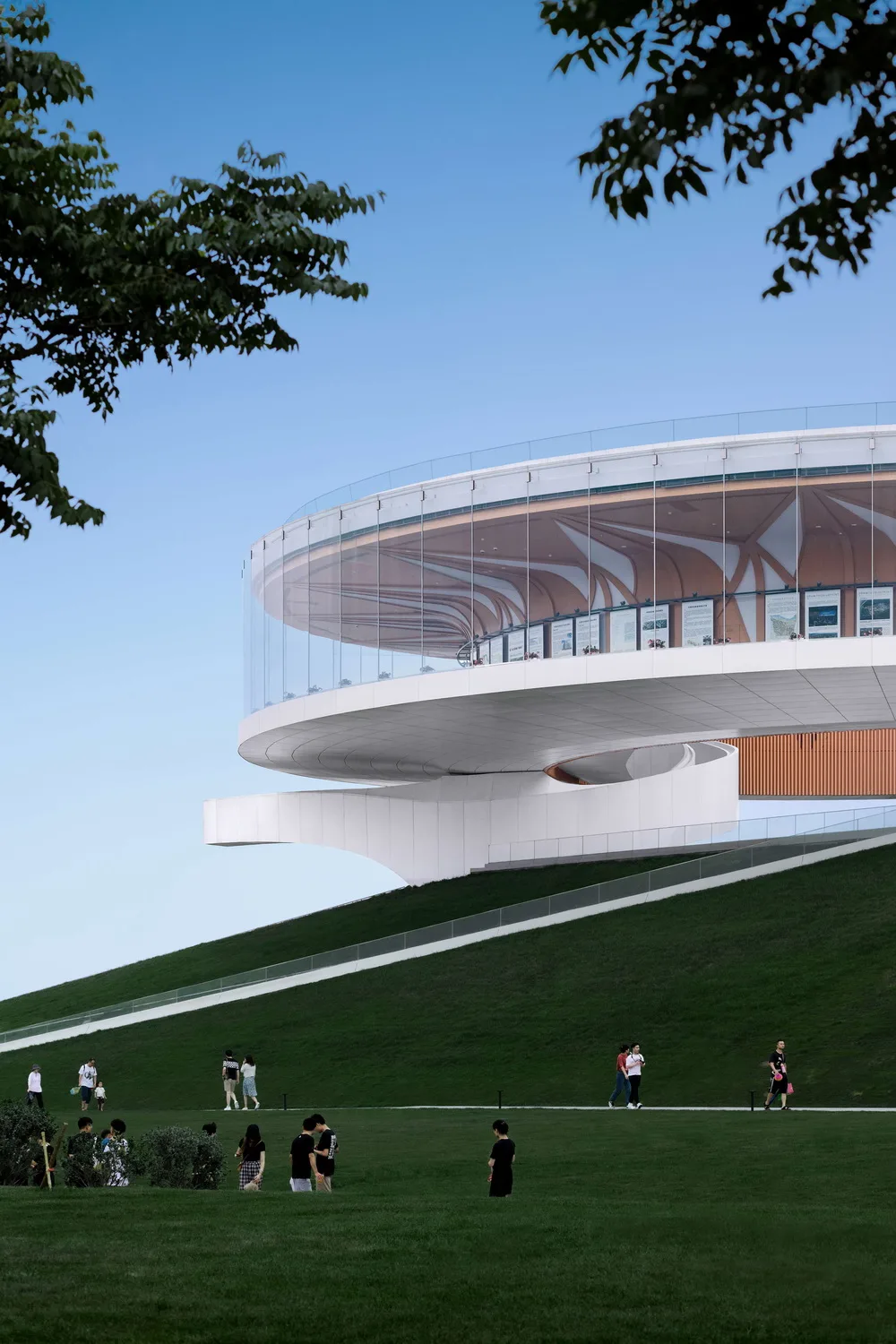
△ Fulcrum – “Elephant” Rotating Staircase
A Delicate and Transparent Circular Ring
The “visible lines” align with the landscape, while the “hidden lines” remain within the building. The “dark line” guides visitors indoors and leads to the top platform of the “Green Hill.” This inner courtyard is enclosed by the floating circular volume above, featuring a thin circular water pool at its center, drawing visitors inward. However, the courtyard’s boundary is a “virtual” gray space designed to create a subtle sense of enclosure beneath the ring, extending outward towards the lakeside park.
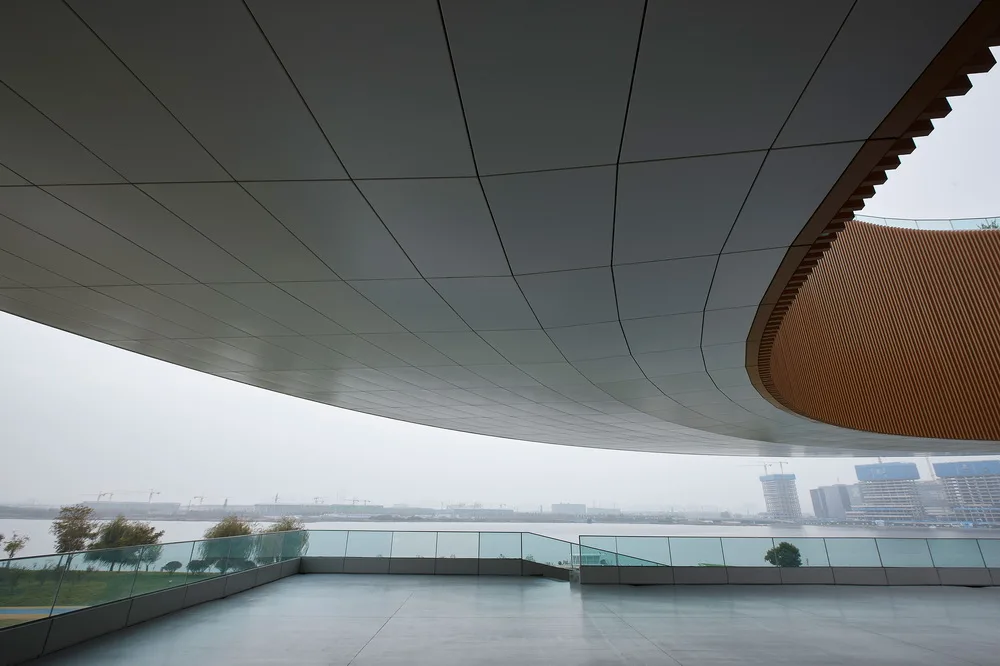
The virtual space between the circular ring and the top platform
Through the interplay of architecture and landscape, various viewing platforms at different heights and orientations are connected by vertical circulation elements such as wide steps, spiral stairs, ramps, and elevators. This creates an extensive walking system that extends the lakeside park’s pathways, allowing visitors to enjoy distant views and architectural landmarks not visible from the waterfront walkway.
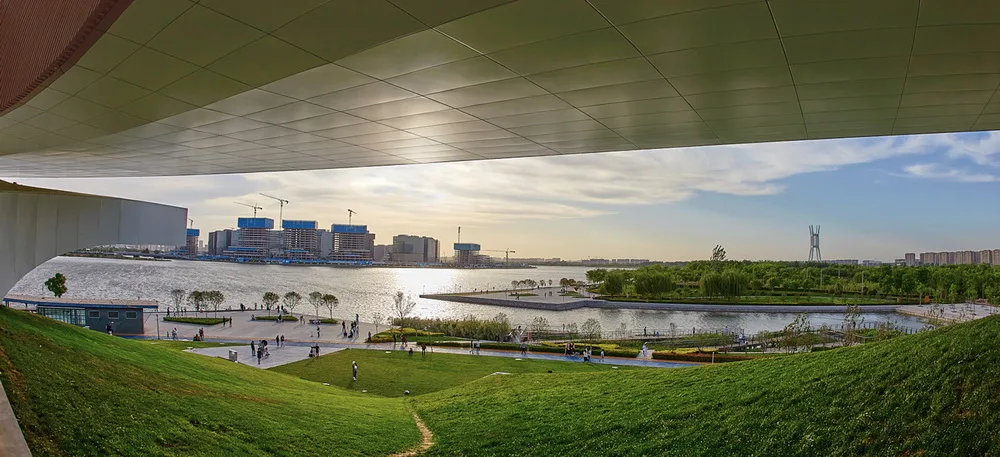
△ Grey space
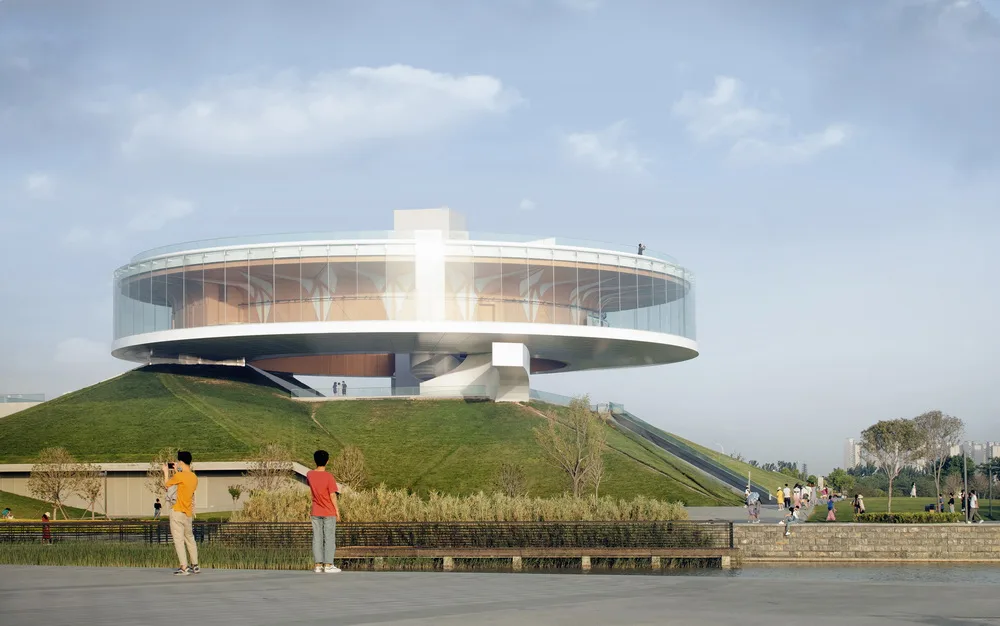
The Green Hill and the “Elephant” staircase serve as the two pivot points of the circular ring
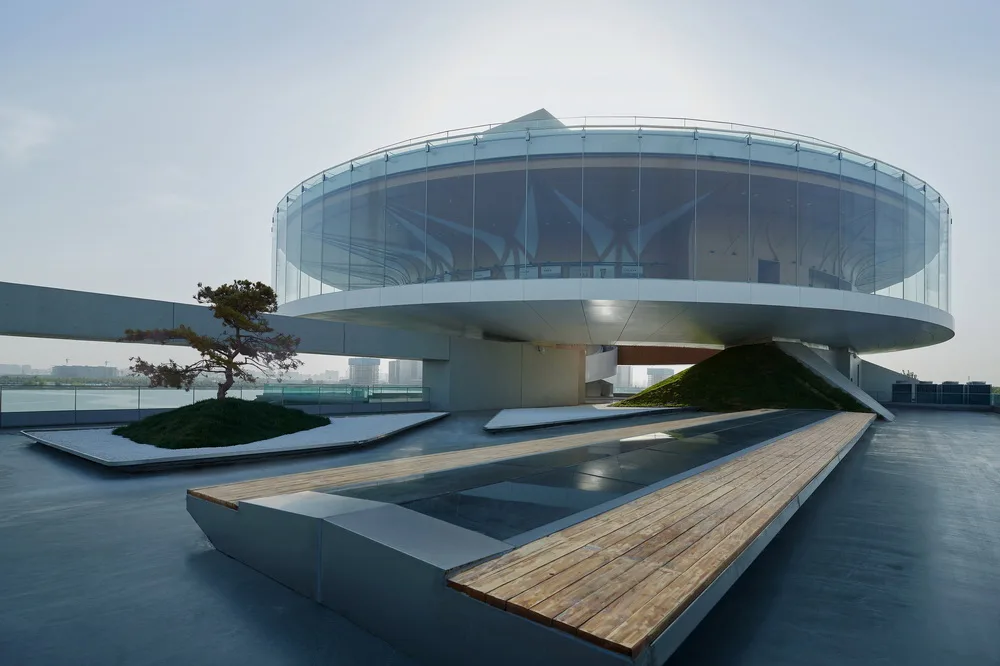
△ Rest seat
Structural System
The building’s structure is divided into two parts: the reinforced concrete frame and shear wall structure below, supporting the multimedia exhibition hall “Green Hill” and underground parking; and the steel truss structure forming the upper circular exhibition hall ring corridor.
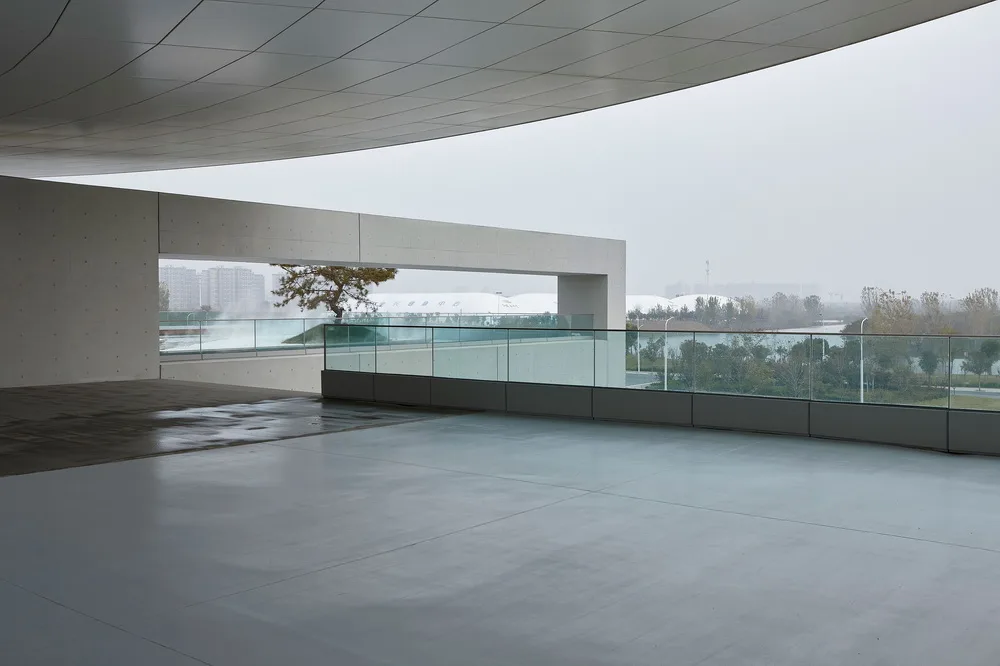
△ Fulcrum – Landscape Frame
The circular steel structure, measuring 53.2 meters in diameter, connects to the reinforced concrete base through just three pivot points. These points cleverly integrate with the frame walls, a small green slope, and the “elephant” spiral staircase. This staircase, serving both as circulation and emergency exit, leads visitors into the circular exhibition hall and its rooftop platform. Its slightly exaggerated front and rear ends form an “elephant” shape, adding a touch of whimsy to the otherwise rational design.
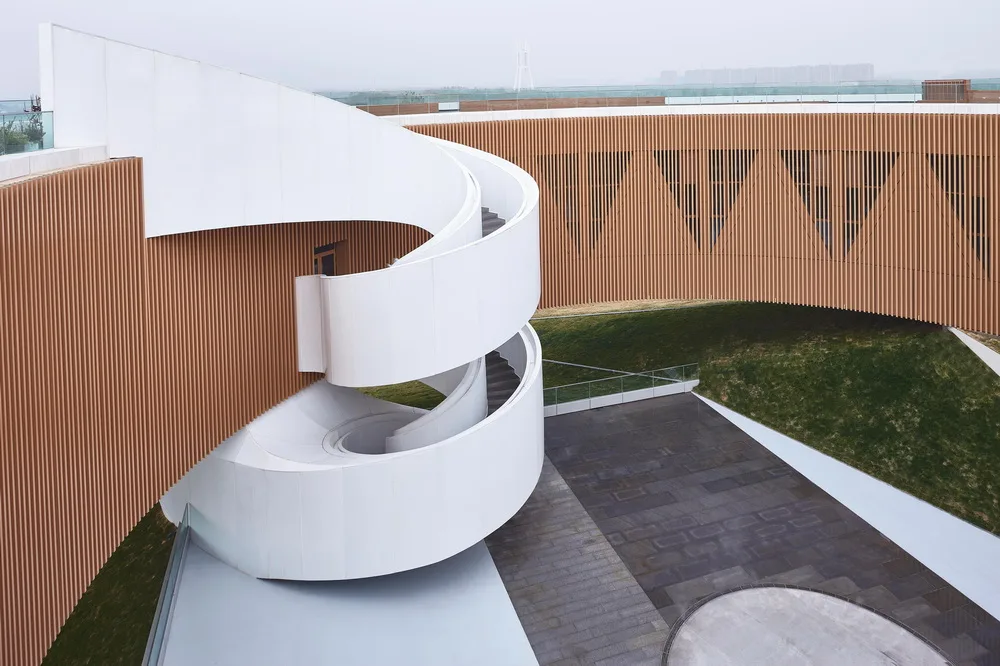
△ Rotating staircase
Inside the circular ring, the design eliminates columns along one side to ensure unobstructed views through the high glass curtain wall. The inner ring’s double integral truss protrudes outward, allowing the entire circular ring to achieve its “floating” effect through a large-span cantilever structure, optimizing views from the second-floor roof platform.
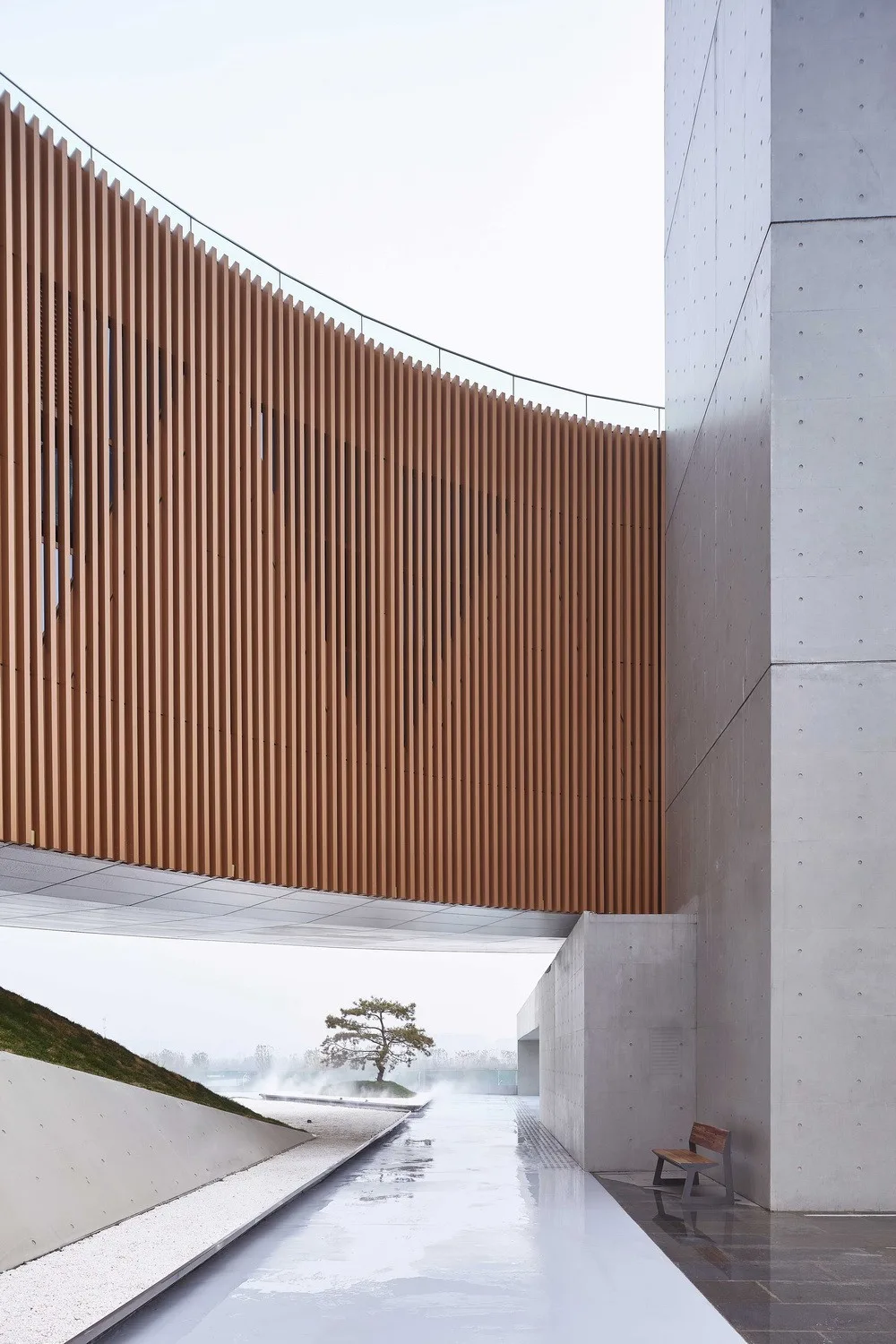
△ Ku Shan Shui Viewing Platform Area
Material Selection
The circular outer wall features a ribbed full glass curtain wall made from ultra-clear glass, providing exceptional visual clarity. The curtain wall’s top connects to the roof via L-shaped glass corners, emphasizing lightness and transparency. This design ensures an immersive visual experience from inside out, while externally layering rich spatial depth.
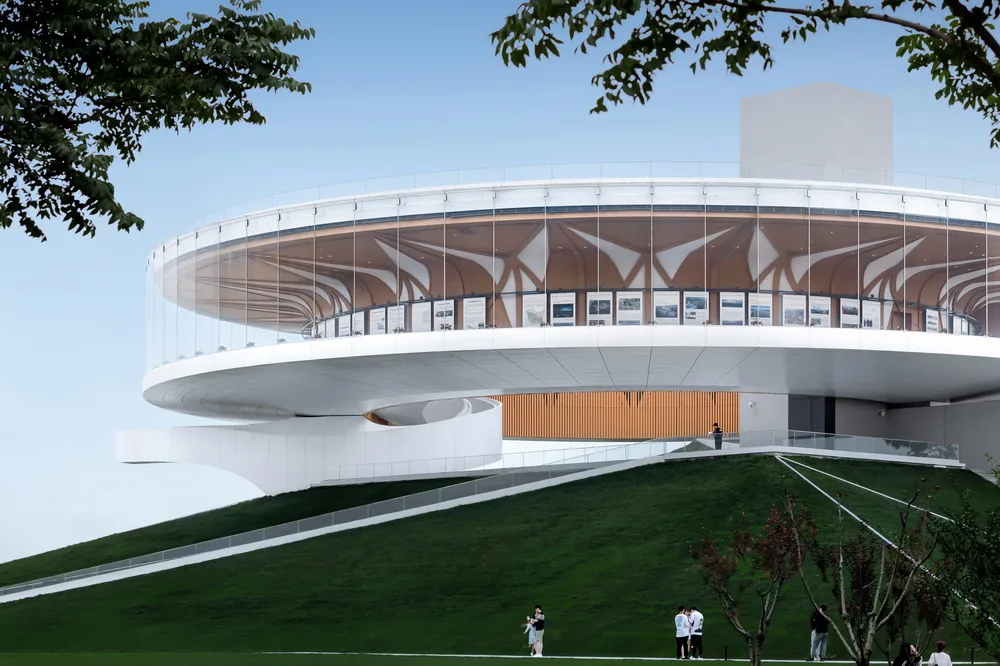
A circular ring floating on the green hill
The lower portion of the ring uses smooth plain concrete, emphasizing solidity and simplicity. Exterior materials for the ring and “elephant” staircase include white and wood-like aluminum panels and bars, creating a sharp contrast with the concrete volume.
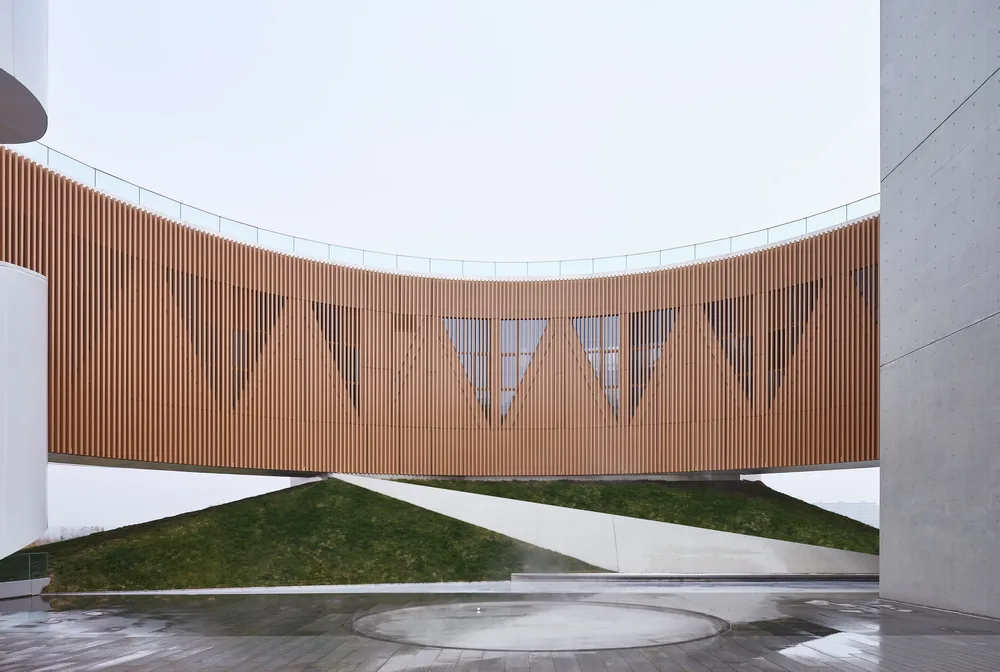
△ Fulcrum – Green Hill
Lighting and Smart Features
This building functions as a smart structure, with its “expressions” closely tied to social life. Interior lighting within the circular ring transmits through highly transparent glass walls, transforming the building into a nighttime beacon. The form of the internal wall and roof mirrors the steel structure, creating the visual effect of a “city crown.”
The lighting system can integrate with urban big data—such as weather and traffic—and artistically translate it into dynamic visual outputs.
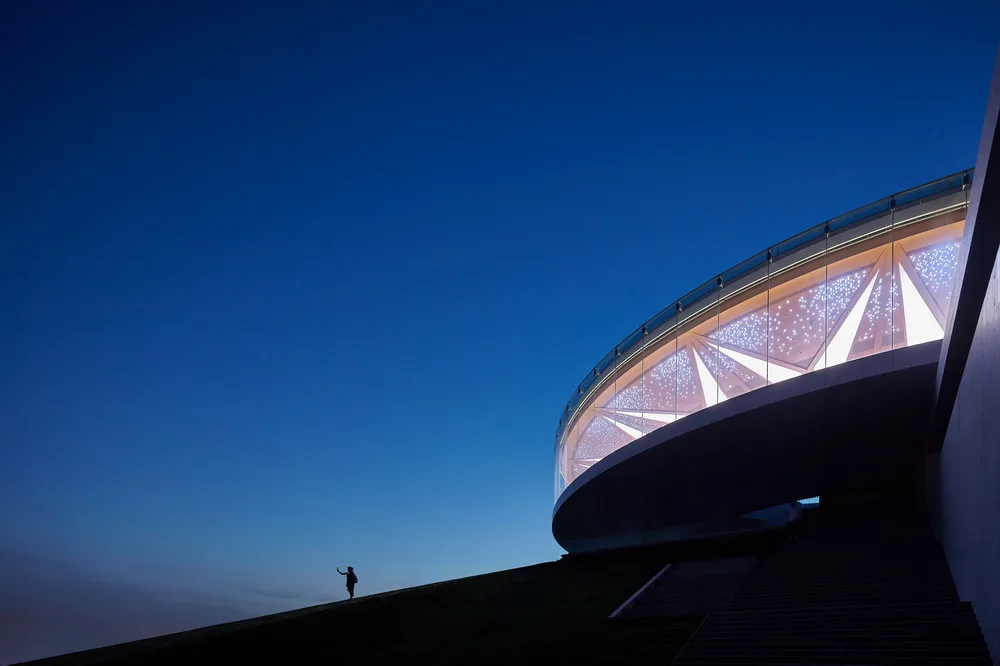
△ Night view
Moreover, the circular ring acts as a dynamic artistic medium, capable of displaying light-based art freely. During festivals, it can mimic the red lanterns of Chinese New Year or the cool white moon during Mid-Autumn Festival, enhancing the city’s festive atmosphere. On regular days, it can maintain a subtle, dark, starry nebula effect.
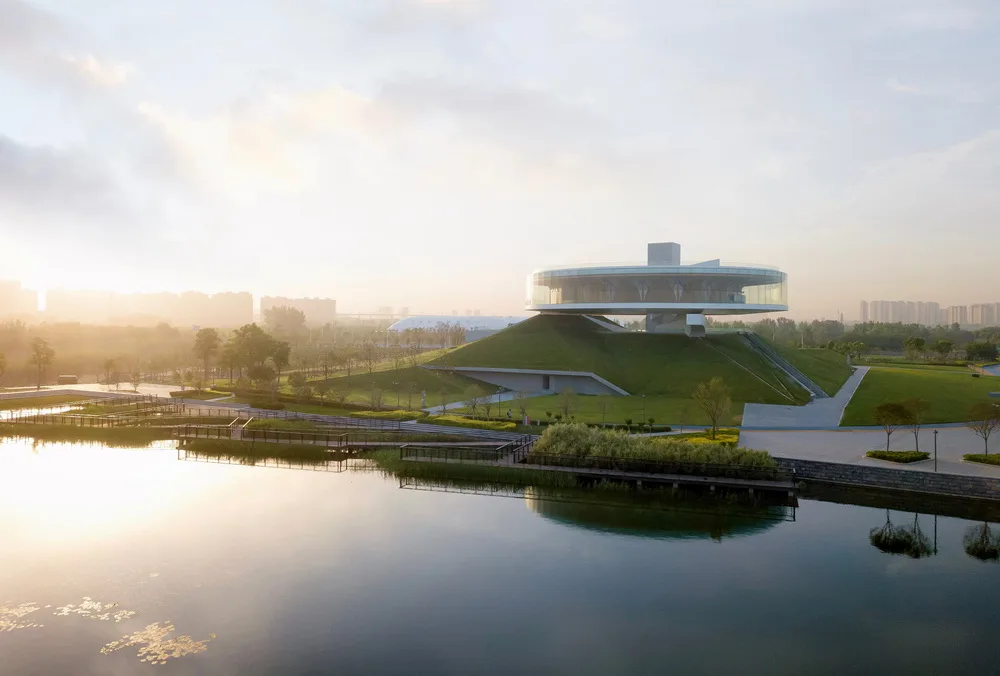
△ Daytime distant view
Technical Drawings
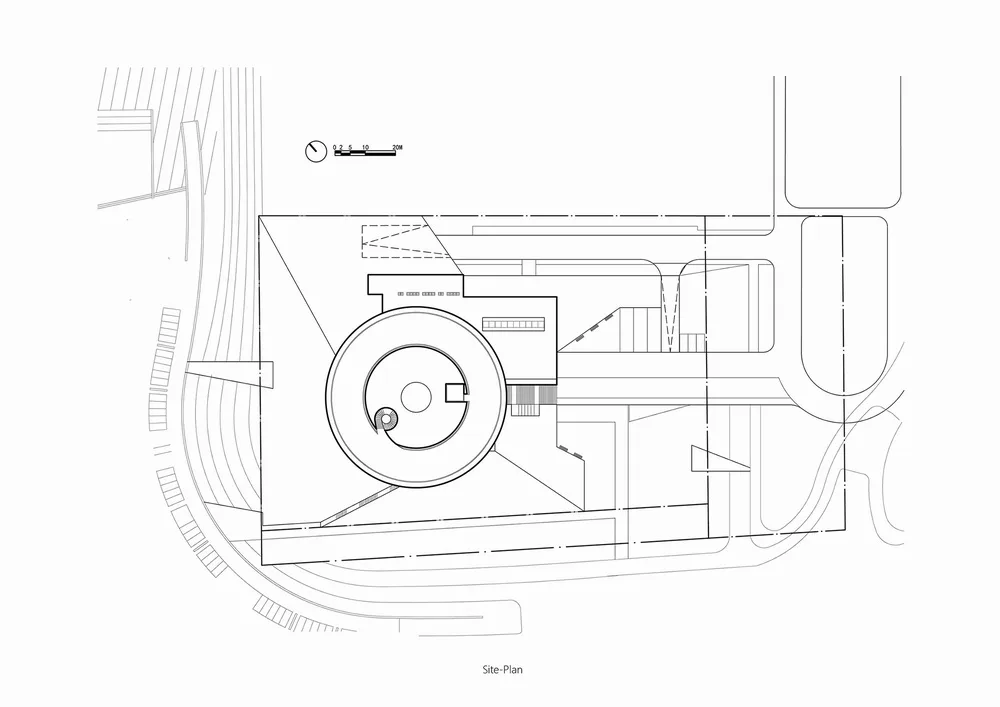
△ Site Plan
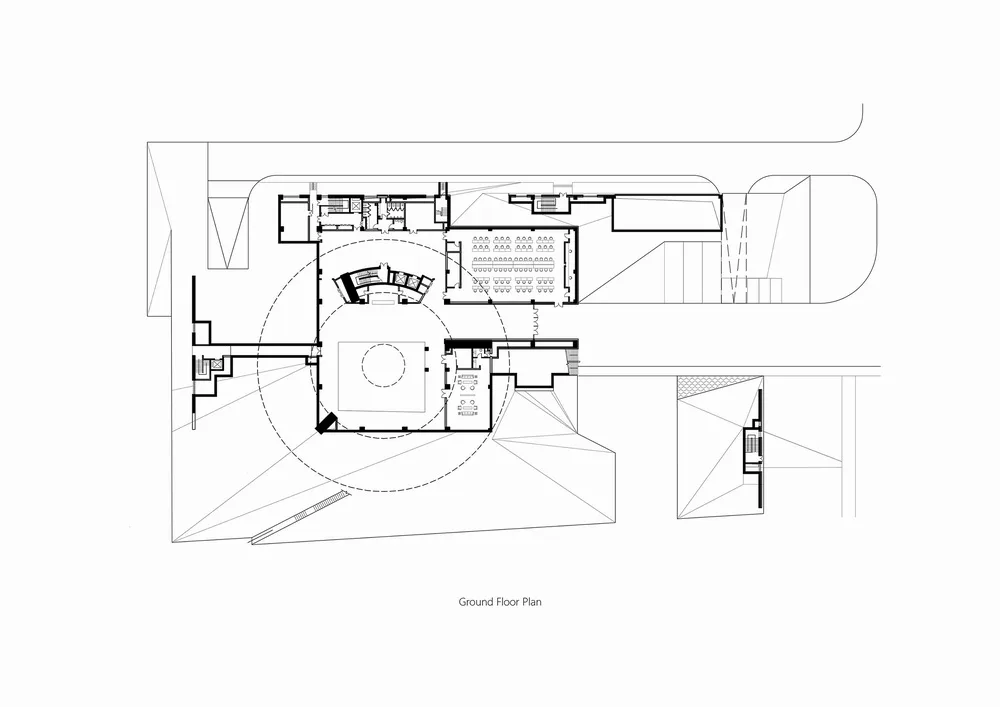
△ Ground Floor Plan
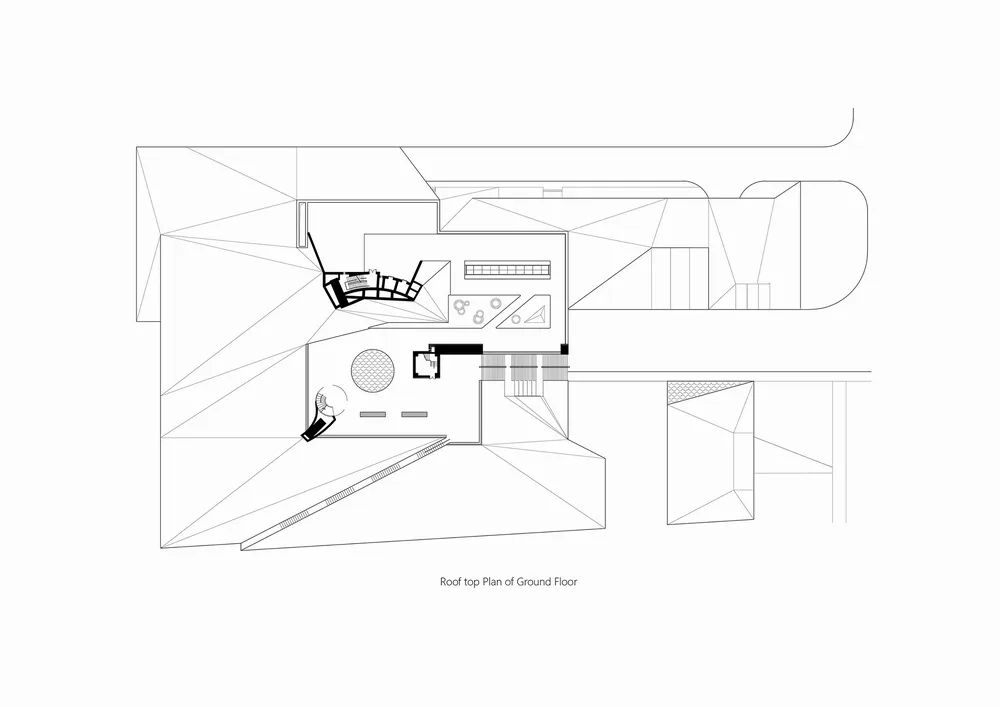
△ Roof Plan
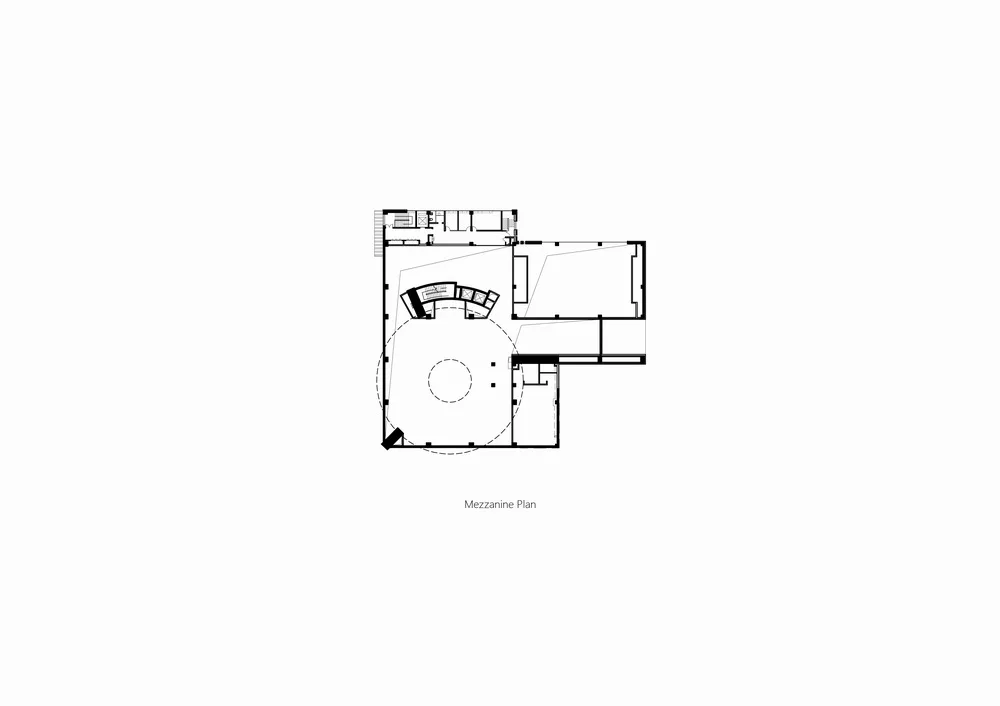
△ Mezzanine Plan
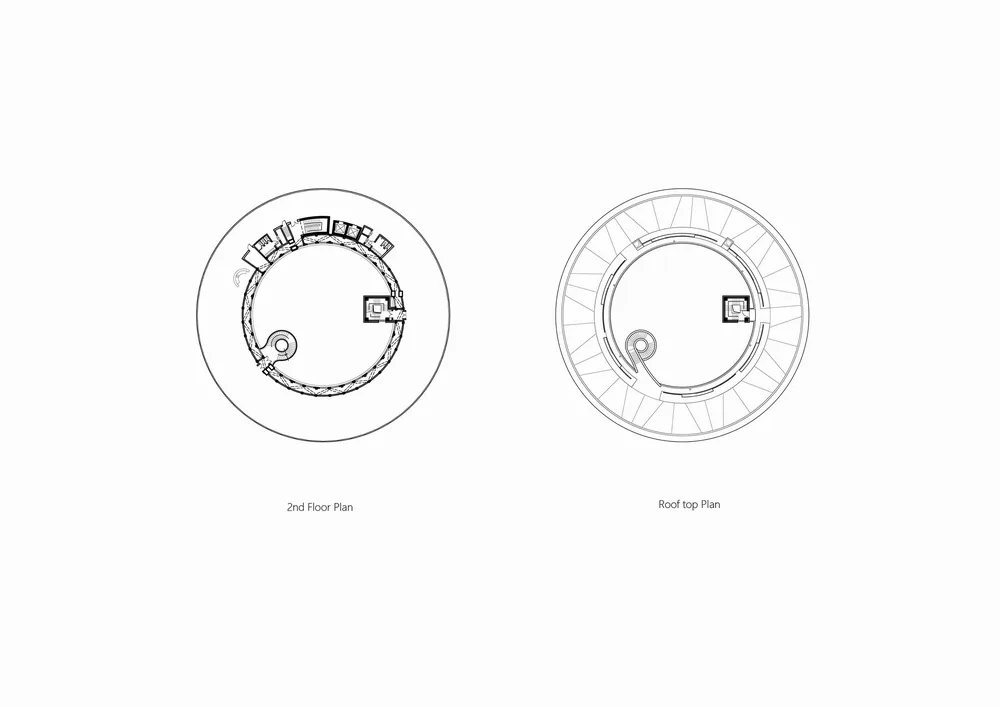
△ Second Floor Plan (left) and Second Floor Roof Plan (right)
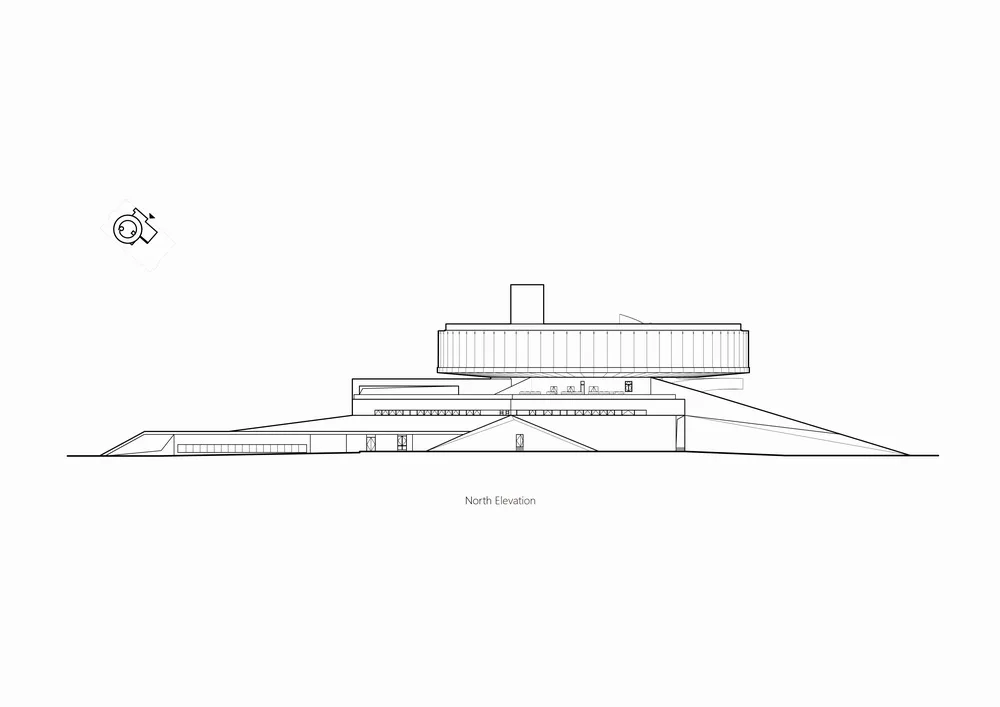
△ North Facade
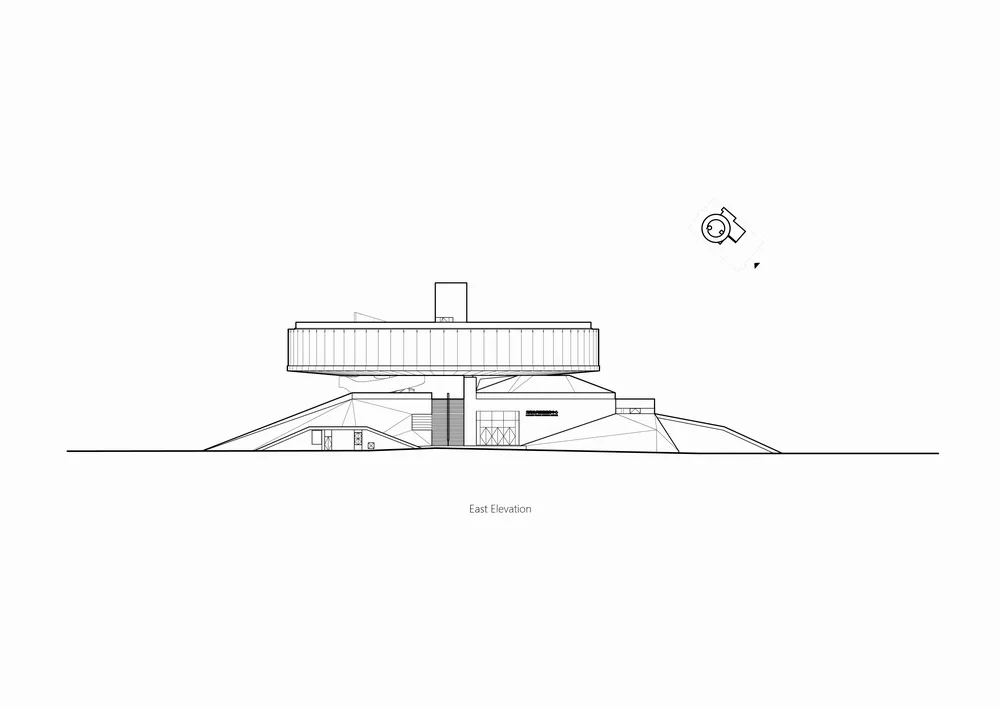
△ East Facade
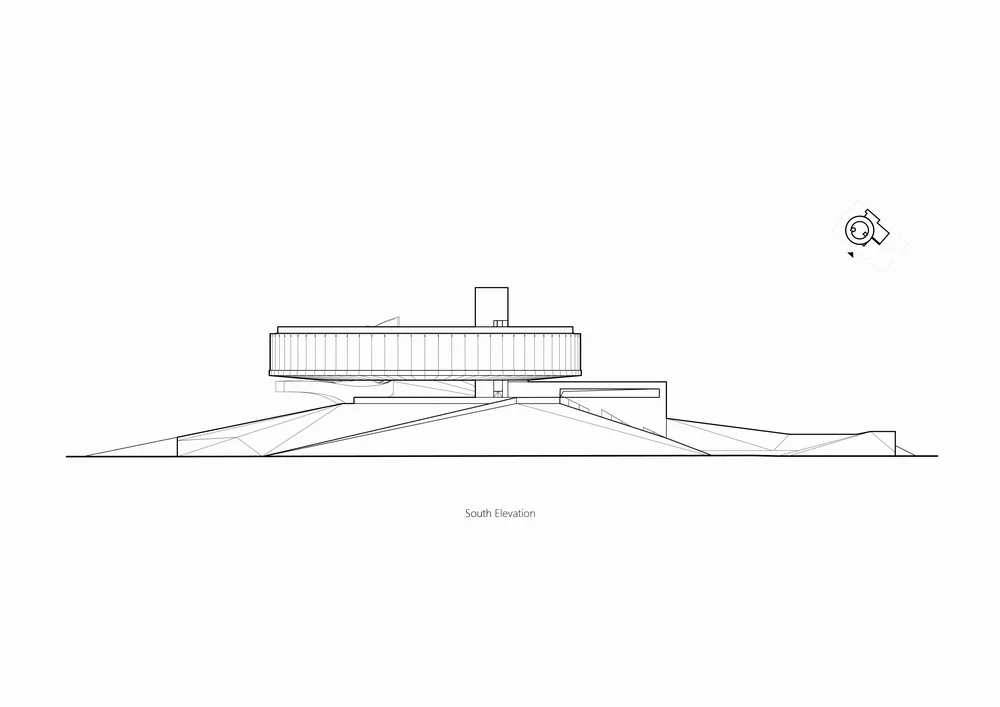
△ South Facade
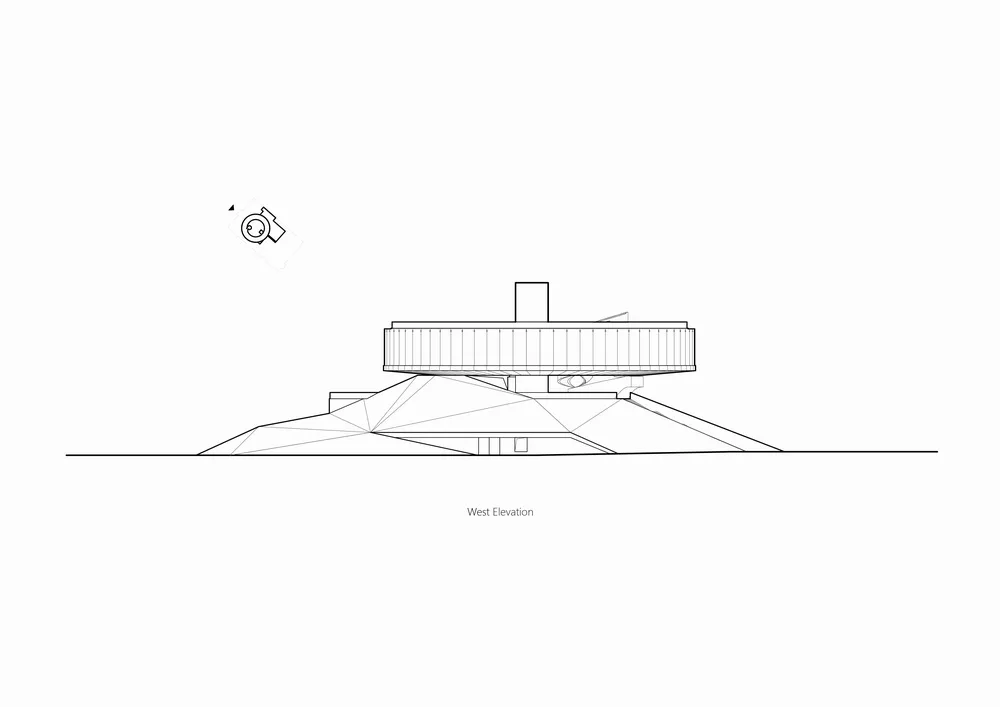
△ West Facade
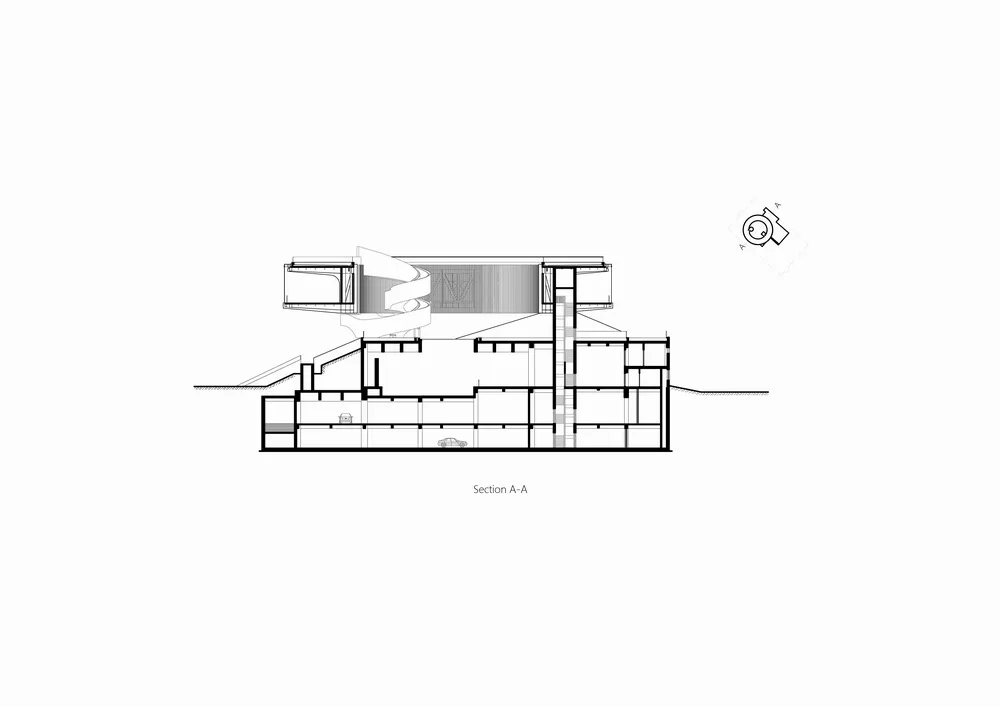
△ Section Diagram
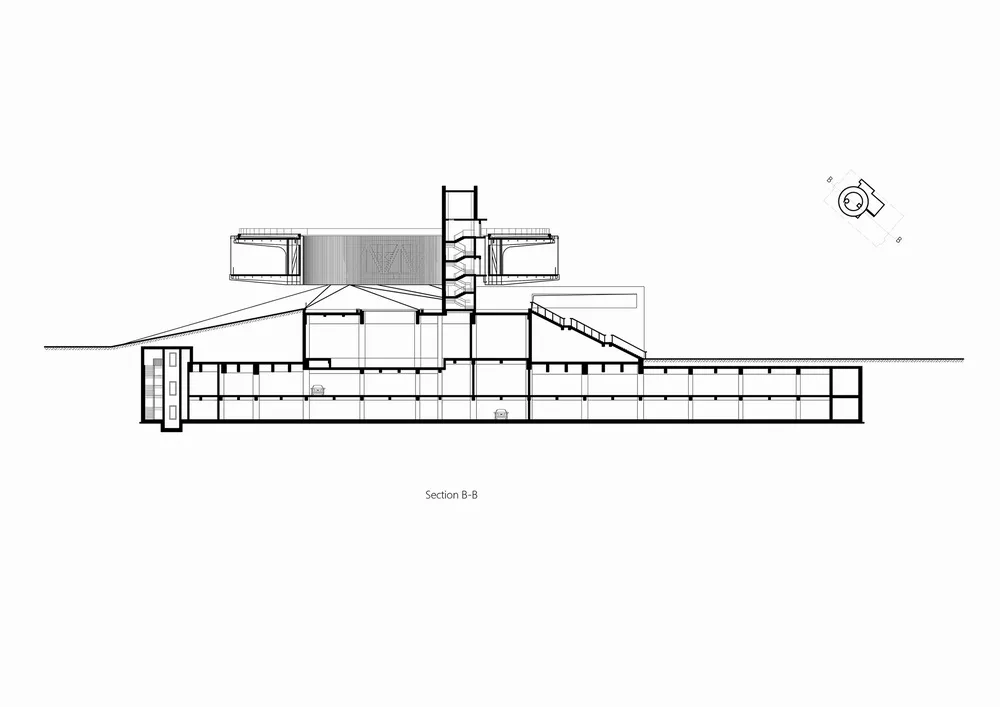
△ Section Diagram
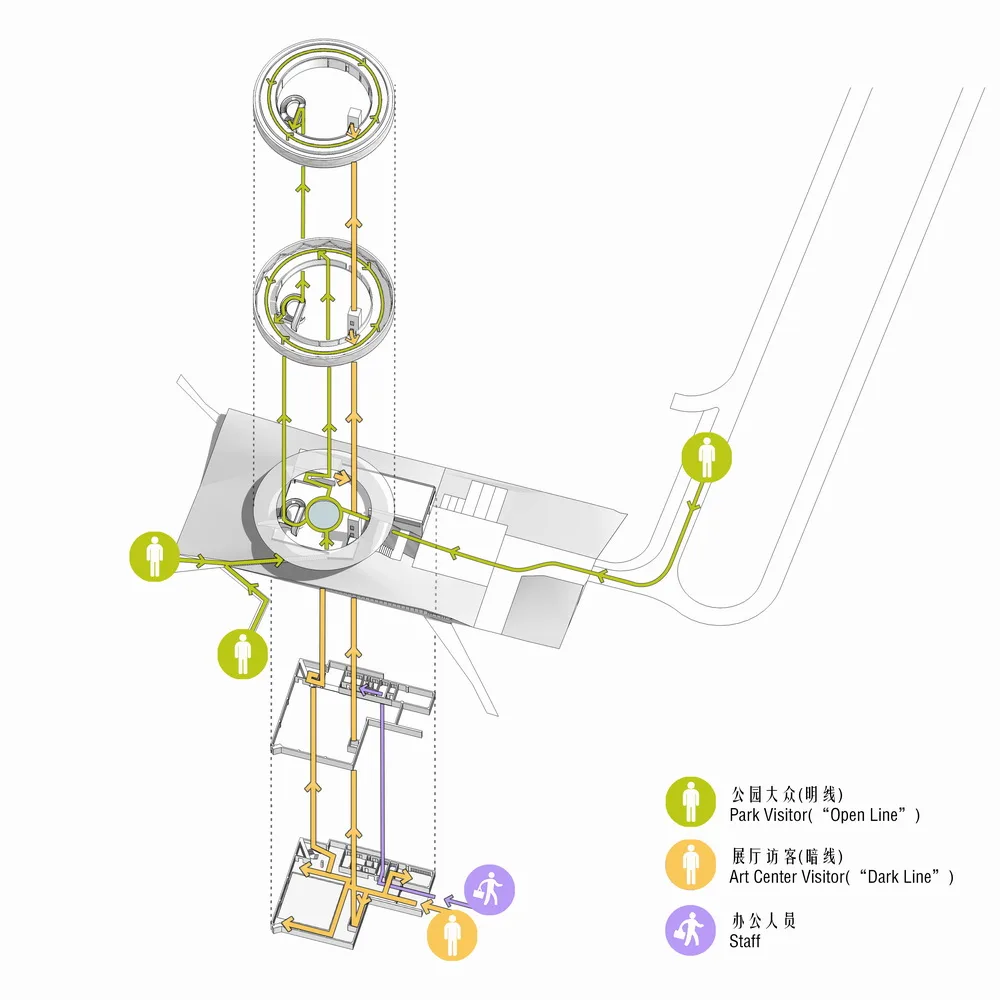
△ Flow Analysis Chart
Project Information
Project Name: Longhu Public Art Center
Location: Zhengzhou
Building Area: 21,205.88 square meters
Total Land Area: 16,404.24 square meters
Chief Designer: Wang Min (STUDIO A+)
Design Team:
Architecture: Wang Min, Ding Mei, Li Hui, Wang Yuliang, Miao Ye, Zhu Shizhuang, Liu Dahua, Wang Chongshuo, Liu Kefeng, Zhao Yufeng, Li Rui, Ge Jiale, Song Yiyang, Zhang Mingyan
Structure: Wang Hongxing, Chen Yachao, Chu Dewen, Mao Yanzhe, Chen Long
Structural Technical Guidance: Xiao Congzhen
Mechanical and Electrical: Mi Changhong, Chen Gang, Zhao Peijiang, Liu Shouyong, Li Hong, Zhang Peng, Zhang Li, Li Ying, Sun Zhenyu, Sun Bin, Shen Baolong, Wang Shuwei
BIM: Jiang Hao, Gao Yiting, Zhou Xiaoqiang, Liu Yan, Jin Heng
Curtain Wall: Qu Bing, Gao Chi
Lighting: Wang Dongning, Zhou Lihua, Liang Jinlong, Chen Qiang
Interior: Zhang Ge, Li Wuting, Wang Hongyu
Landscape: Zhang Wenwen, Liu Puqi, Shen Kai
Client: Zhengzhou Zhengdong New District Construction and Development Investment Corporation
Completion Date: September 2020
Design Firm: STUDIO A+ (Youjia Design)
Collaborators: Harbin Institute of Technology Architectural Design and Research Institute, China Academy of Building Research Co., Ltd.
Construction Contractor: China Construction Eighth Engineering Division Second Construction Co., Ltd.
Photography: Chen Su, Fang Chun, Jiang Zhendong, Existing Architecture















Must log in before commenting!
Sign Up