
Venue: A Natural Village at 800 Meters Altitude with Views of the County Town
In 2019, I was invited by the local government to visit Dianjiang for the first time. Dianjiang County is located about 120 kilometers northeast of Chongqing’s main urban area. The project site is situated in Leijiawan, a natural village cluster within Shilu Village, Guiyang Street, Dianjiang County. Nestled in the Mingyue Mountain Range at roughly 800 meters above sea level, the area offers a cool summer climate, making it an ideal escape from the heat.
To the west of the site lies a higher mountain, flanked by small hills on both sides. To the southeast, a gap in the terrain reveals a view of the county town, located 8 kilometers away, enhancing the site’s natural advantages. Of particular interest is a horseshoe-shaped rice field on the property, around which the original villagers’ lives and agricultural activities revolve. The half-acre plot supports a single cow, with villagers working from dawn to dusk.
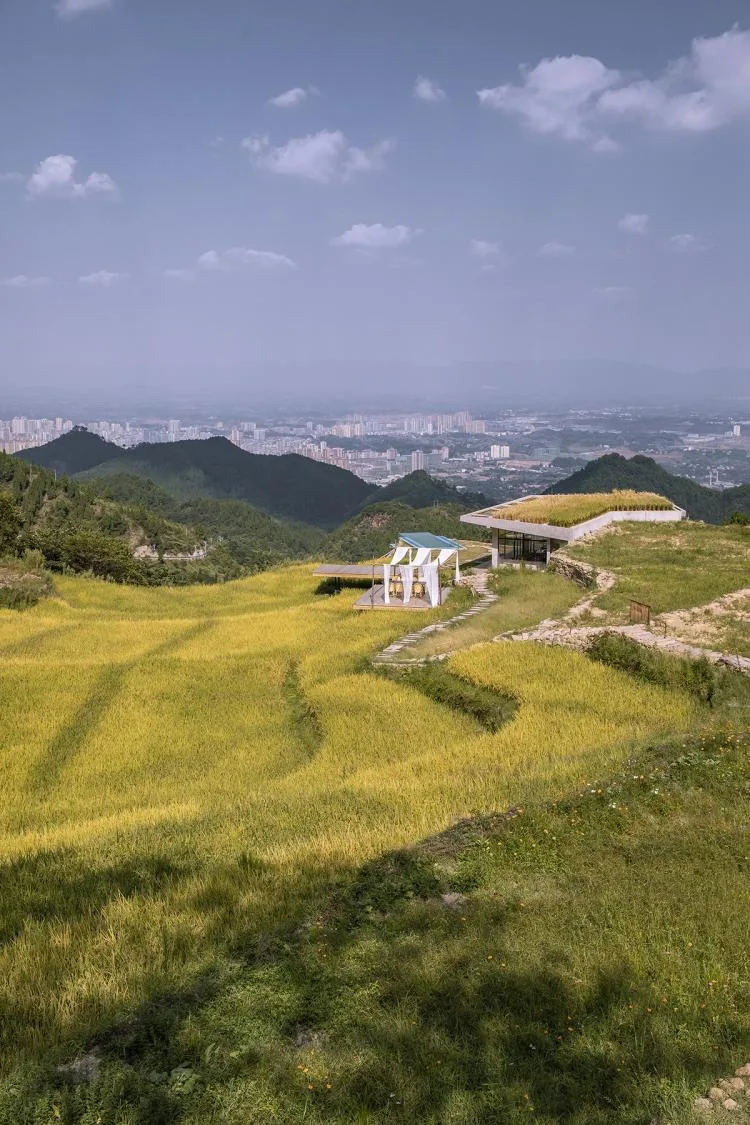
△ View of the county town through the mountain gap on the east side of the site © Jin Weiqi
Beyond the peaceful rural cultural landscape, the area also hosts historical landmarks, the most famous being the Bashu Ancient Road. Legend has it this was the route used to transport lychees for Yang Guifei, earning it the nickname “Lychee Ancient Road.” Climbing the stairs along the path, visitors can still see boundary markers from that era and cliff carvings left by scholars and literati over the centuries.
Layout: Preserving Rice Paddies and Arranging Buildings Around Them
The new development is a homestay complex, combining multiple homestay brands. The first phase includes two distinct homestays serving different groups, sharing public spaces such as a book bar, outdoor swimming pool, and a restaurant.
Upon reviewing the broader planning strategy, the architect learned that rice paddies would be incorporated into future village development. Therefore, building in this area does not conflict with agricultural land use. However, the question arose: is this the best approach? Although constructing directly in the paddies would simplify building challenges, it would damage the agricultural landscape and diminish the project’s charm. Ultimately, architects, builders, and operators agreed that preserving the rice paddies as the focal point of the homestay was paramount.
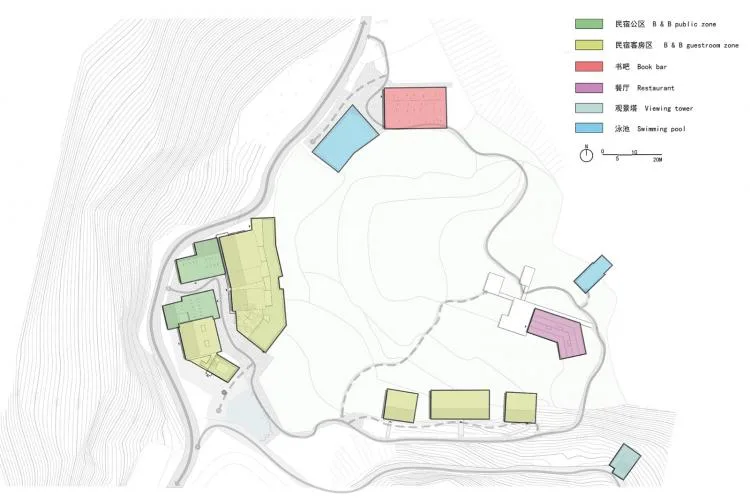
△ Functional layout
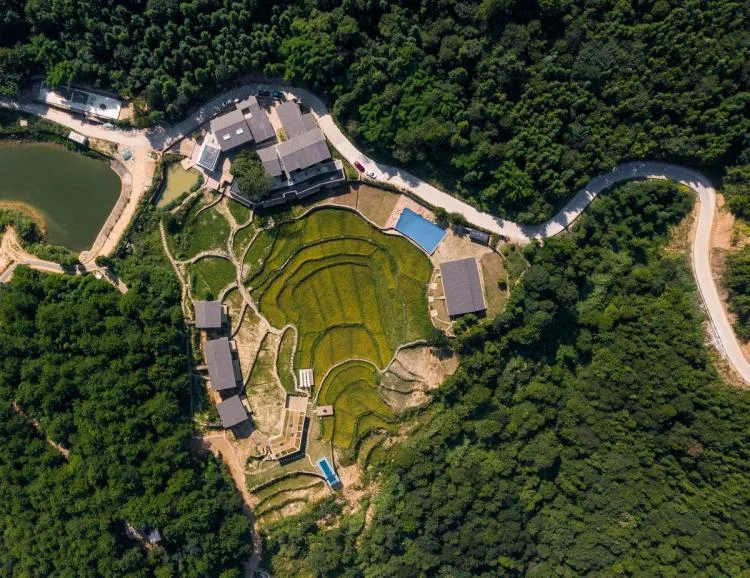
△ Preserving rice paddies and arranging buildings around them © Jin Weiqi
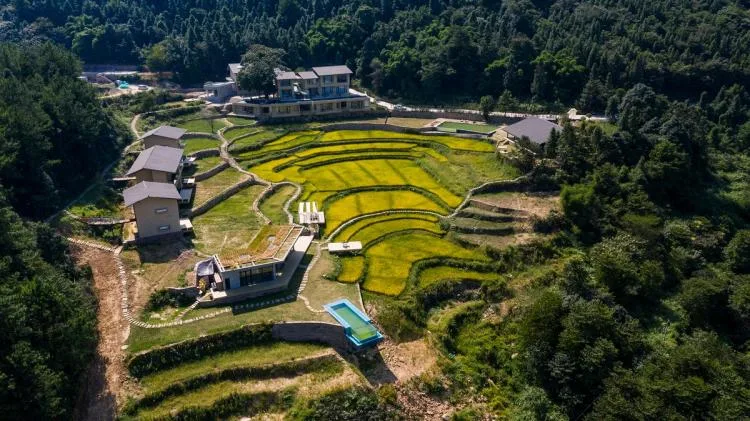
△ Aerial view © Jin Weiqi
The buildings are positioned around the rice paddies, creating dynamic spatial relationships and visual interactions reminiscent of the “see and be seen” concept found in traditional Chinese gardens. In this analogy, the rice paddies function like water surfaces in gardens, serving as both a focal point and a stage for human activities. After opening, the homestay hosted events such as harvest festivals and rice field yoga, reinforcing the rice paddies’ central role.
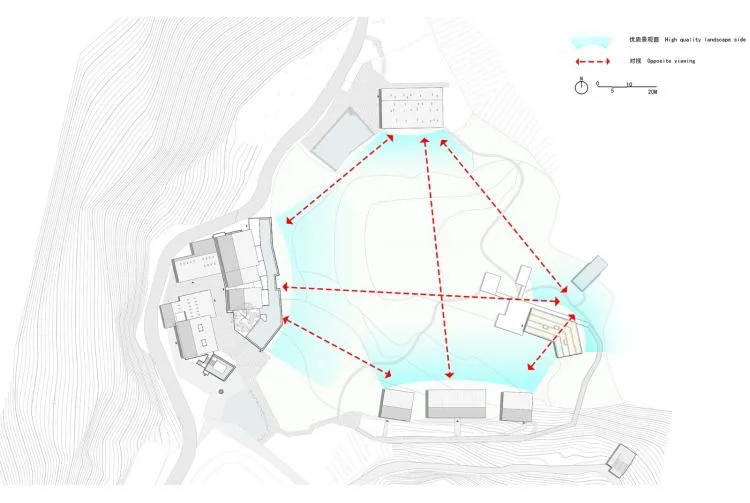
△ Landscape view
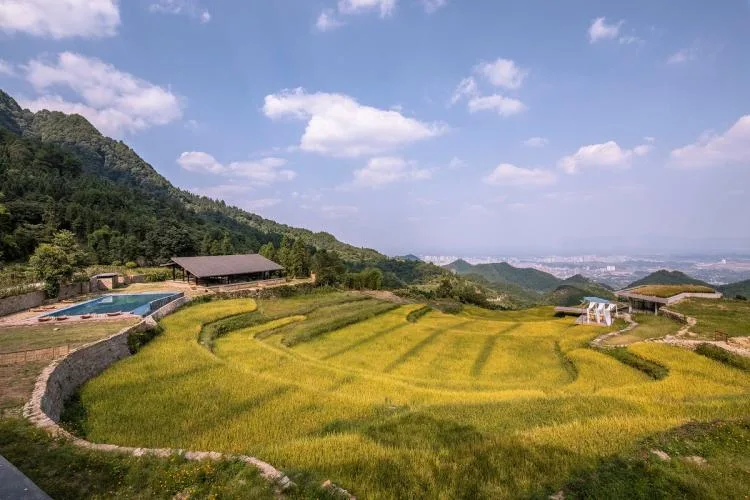
A book bar, swimming pool, and restaurant encircling the rice paddies © Jin Weiqi
The guest rooms and reception are nestled at the base of the mountains on the west and south sides, offering excellent views while minimizing farmland impact. The original road was rerouted westwards, passing between the new buildings and the forested mountain behind, isolating the buildings and rice fields from traffic disturbances and facilitating secure management.
The book bar and outdoor swimming pool are clustered on the north side of the rice paddies, backed by a forest. The restaurant, uniquely situated within the rice field on the east side, is built underground to blend seamlessly into the landscape. A watchtower stands in the southeast corner of the core area, serving for high-altitude observation and forest fire prevention.
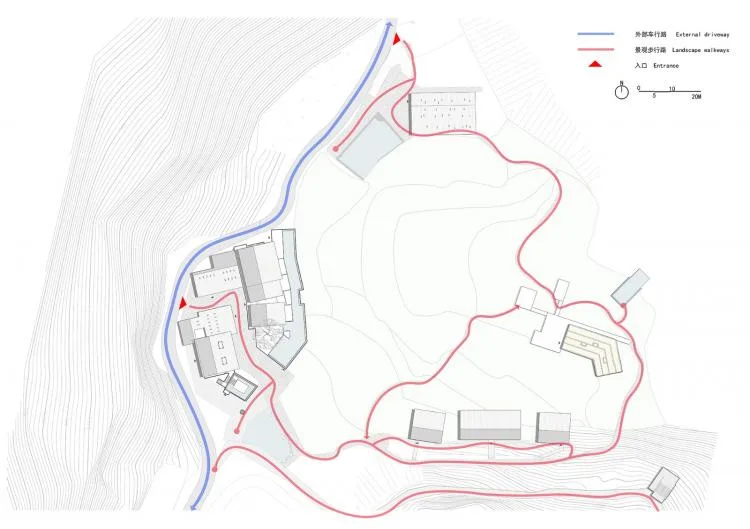
△ Traffic flow organization
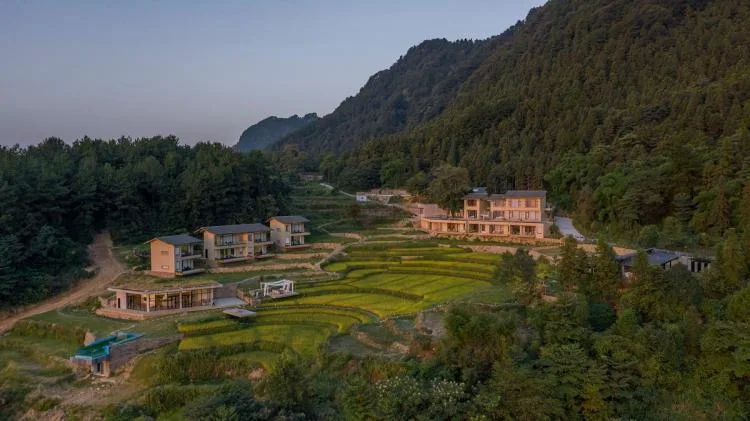
The homestay enjoys a backdrop of mountains and forests, facing the rice paddies © Jin Weiqi
Guest Rooms: Tailored Design, Calm and Practical
The project required 25 guest rooms to meet operational needs. However, to protect the environment, construction was restricted to a limited area, posing a design challenge: maximizing comfortable accommodations within a confined footprint while keeping building height modest.
The guest rooms are divided into two zones, each representing a different homestay brand: Feifuji and Yuanbai. Feifuji occupies the site of the original homestead (demolished due to structural issues) and faces the valley and mountain gap, offering the best views. This building has three floors with 12 rooms. The entrance and second floors feature rear porches, ensuring all rooms overlook the rice paddies.
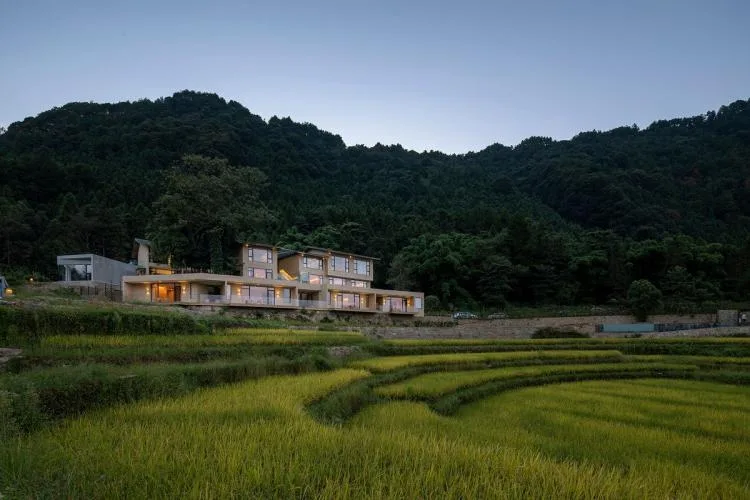
Feifuji Homestay blends harmoniously with old trees and rice paddies © Jin Weiqi
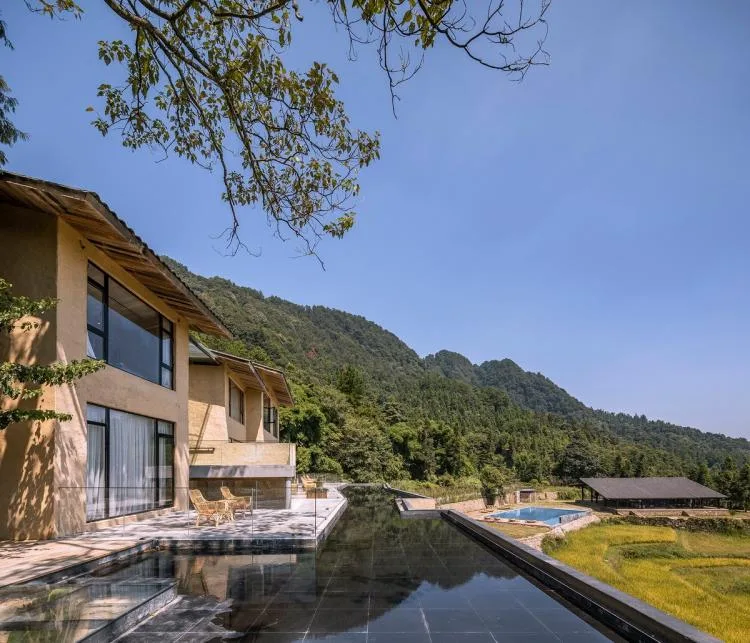
The first floor outdoor platform and shallow water pool at Feifuji Homestay © Jin Weiqi
The basement level is partially above ground, designed by leveraging the site’s natural slope. The staggered cross-section arrangement positions the basement’s roof as an outdoor terrace for the entrance floor. Besides the balcony, a shallow water pool enhances comfort and outdoor enjoyment while adding visual interest. This staggered design visually divides the building, reducing the massing impact of the three floors.
An old tree to the south carries historical significance. The architect preserved this tree, building adjacent to it to create a symbiotic relationship. A wooden deck under the tree connects to the shallow water pool, forming a pleasant outdoor leisure space.
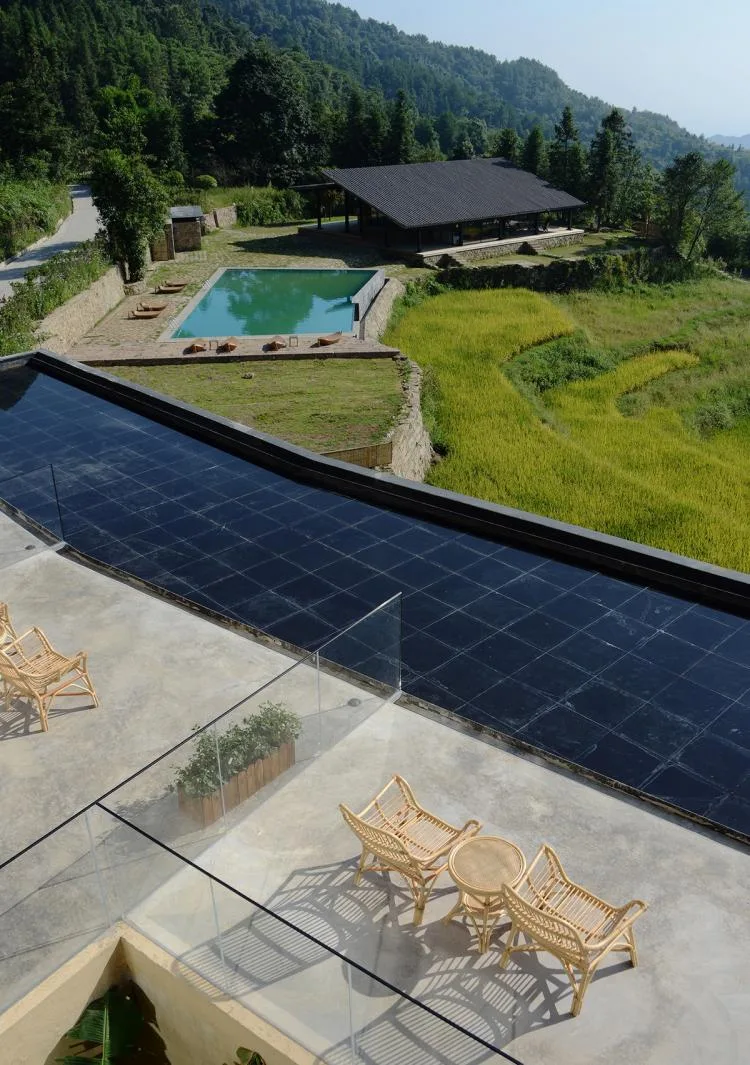
△ The terrace serves as an excellent outdoor leisure spot © He Wei
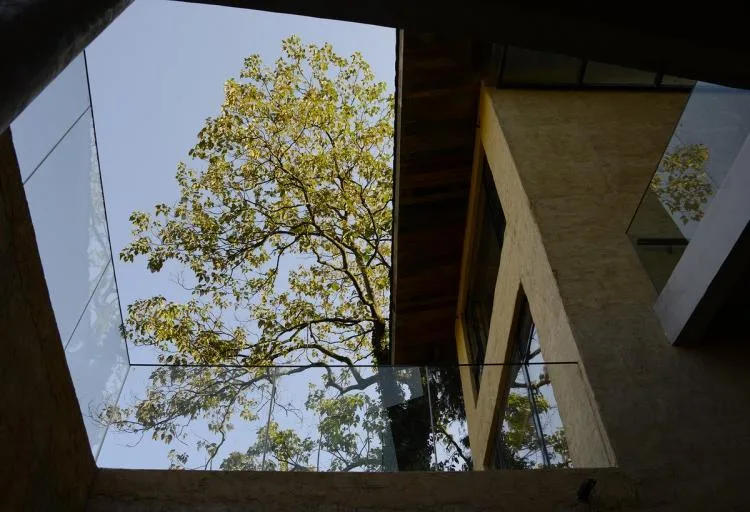
△ Courtyard on the basement level of the homestay © He Wei
Yuanbai Homestay is mainly located at the mountain base south of the rice fields, consisting of three two-story buildings. Floor-to-ceiling glass faces the rice paddies, bringing the scenic beauty inside. The split layout ensures privacy for each room while creating a “family-like” atmosphere.
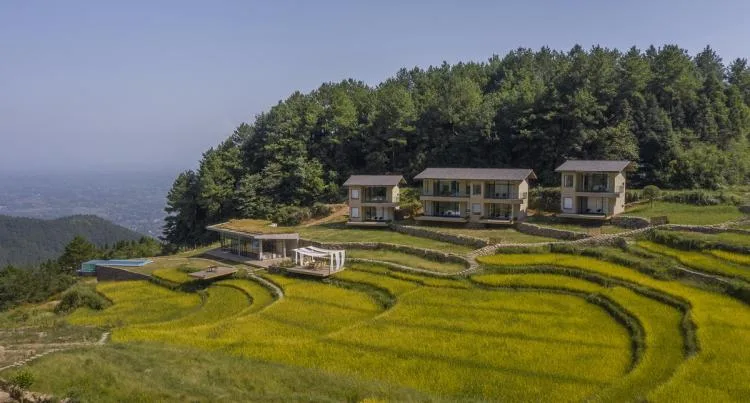
△ Yuanbai Homestay and Restaurant © Jin Weiqi
The guest rooms exhibit a simple and calm architectural style, avoiding overly sculptural or modern forms. Buildings feature double-pitched roofs with extended eaves, suited to Dianjiang’s rainy climate. Walls are constructed with innovative adobe materials, balancing low maintenance costs with a traditional residential appearance.
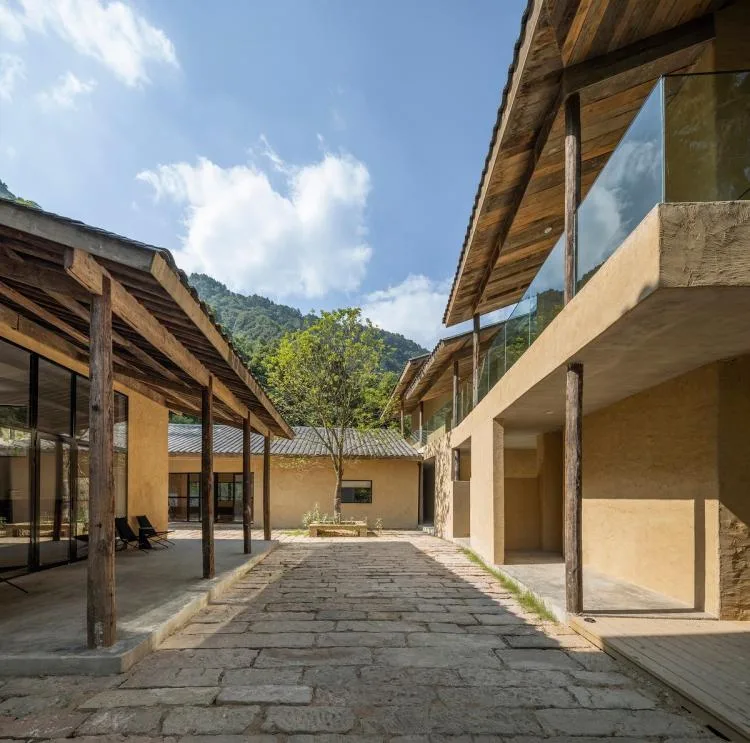
△ Homestay area © Jin Weiqi
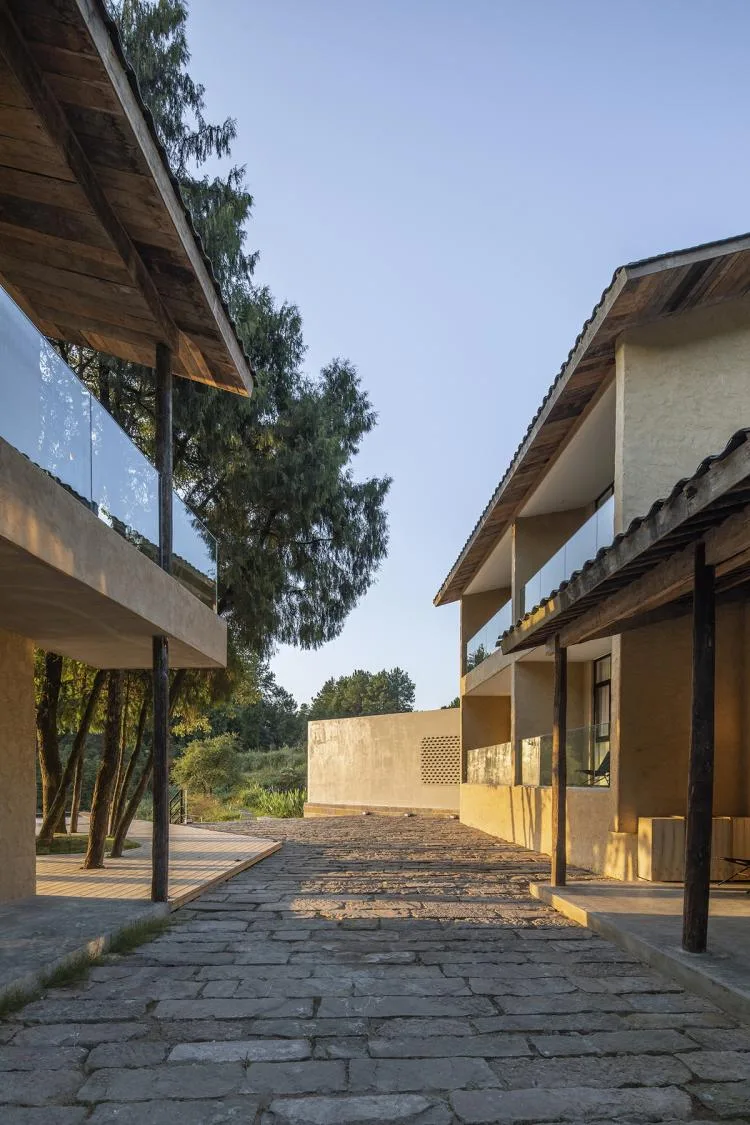
The homestay reuses existing old stone and wood materials from the site © Jin Weiqi
Book Bar and Swimming Pool: Interpreting Local Venue and Traditional Residences
Besides guest rooms and reception, several small buildings scattered throughout the site serve as public amenities and scenic highlights, contributing to the project’s overall atmosphere.
The book bar functions as both a library and water bar, located on the north side adjacent to the outdoor pool and opposite the Yuanbai homestay. It features a large roof inspired by the local traditional residential architecture, where roofs of wing rooms, kitchens, and pigsties merge to form a continuous, sweeping roofline with eaves near the ground.
The architect adapted this distinctive regional element into the book bar’s design. Its asymmetrical double-pitched roof has intentionally lowered eaves facing the rice paddies, creating a unique, calm, and extraordinary silhouette. This horizontal composition directs views toward the rice fields, guest rooms, and restaurant. Inside, visitors can immerse themselves in the surrounding scenery.
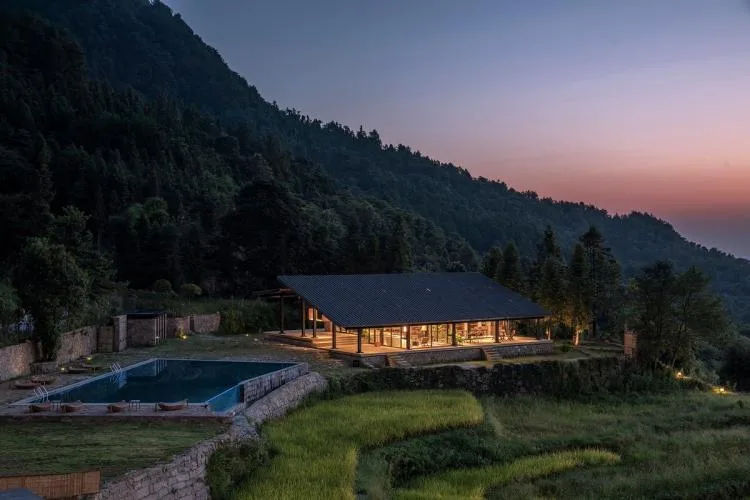
The exaggerated roof of the book bar draws inspiration from local traditional architecture © Jin Weiqi
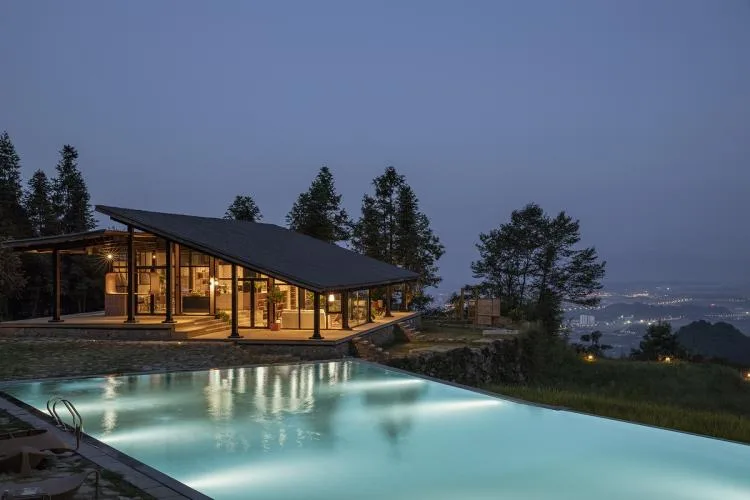
Reading area facing the swimming pool © Jin Weiqi
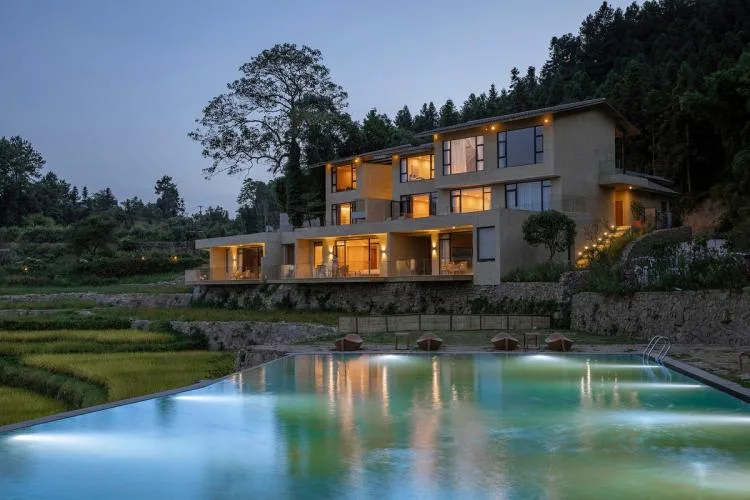
View of Feifuji Homestay from the swimming pool © Jin Weiqi
The outdoor swimming pool was renovated from an original fish pond, minimizing earthworks and enhancing landscape drama. Infinity pools are now standard in high-end homestays, and here the architect envisioned one set within the rice fields. As the agricultural landscape improves, the pool will blend even more seamlessly with the paddies, offering a romantic swimming experience surrounded by the scent and texture of rice plants.
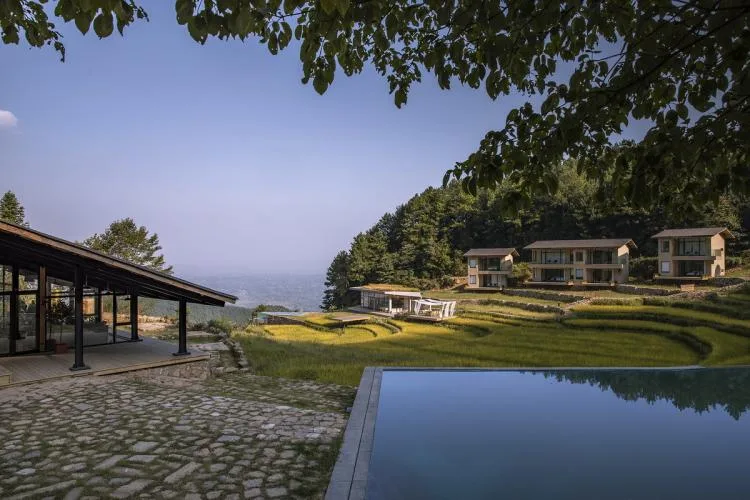
△ Book bar, swimming pool, Yuanbai homestay, and restaurant facing each other © Jin Weiqi
Restaurant: Hidden in the Rice Fields, Welcoming the Sunrise
The existing small-scale restaurant will focus on specialty catering after the second phase’s completion of a larger facility. Initially, the architect planned a modest building on the site’s eastern mountain gap to serve as a scenic viewpoint, allowing guests to witness sunrises, seas of clouds, and panoramic views of the county town from a cliff edge.
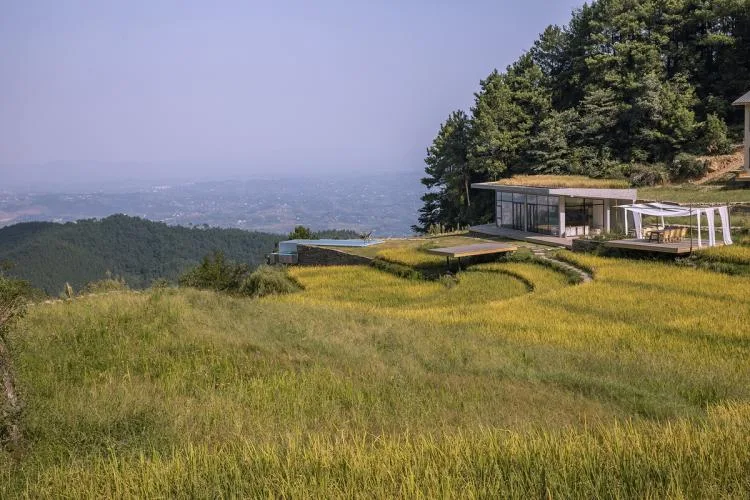
△ Restaurant, cliff-edge bubble pool, and outdoor wooden platform © Jin Weiqi
The restaurant was built at the rice field’s edge and buried underground to minimize landscape disruption. It features a simple linear layout, a single-slope concrete roof, and floor-to-ceiling windows facing the cliff gap, maintaining transparency between inside and out. The roof employs reverse beams to keep the ceiling flat, avoiding conventional roofing methods. Instead, rice is grown on the roof using soilless cultivation, with crossbeams acting as water-retaining barriers. This rooftop rice field integrates the building into its surroundings while giving it a distinctive character.
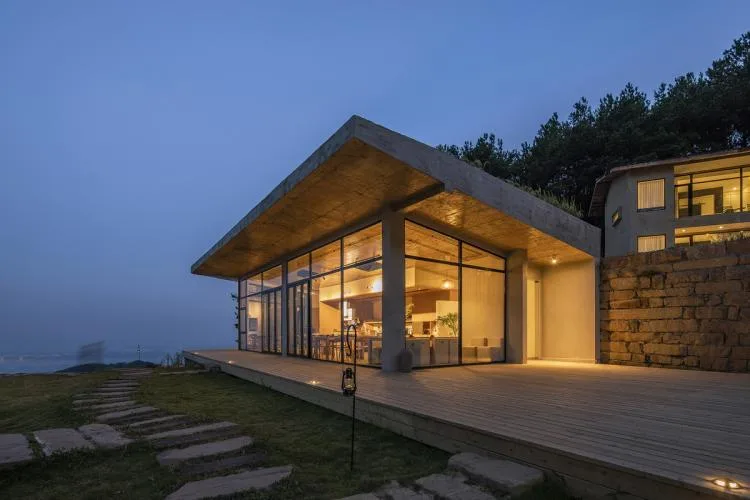
△ Restaurant © Jin Weiqi
A small bubble pool next to the restaurant was added per the owner’s request. Positioned at the cliff edge with stunning views, the pool and restaurant face east, making them perfect for welcoming sunrise. Evenings are illuminated by warm indoor lighting and candlelight on the outdoor deck, creating a romantic atmosphere.
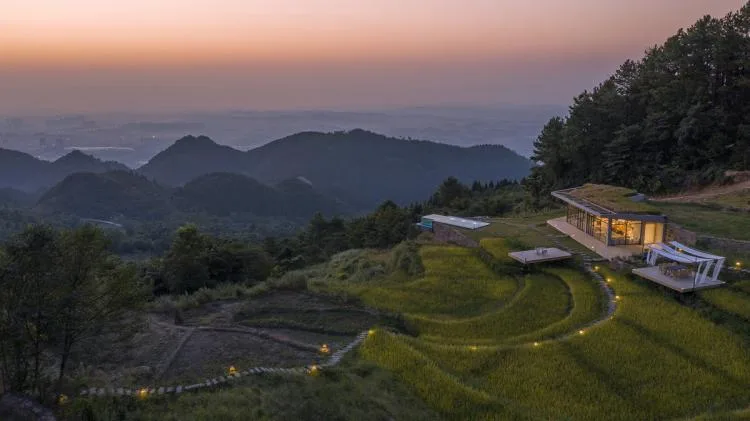
The walking path follows the original field ridges, simple and natural © Jin Weiqi
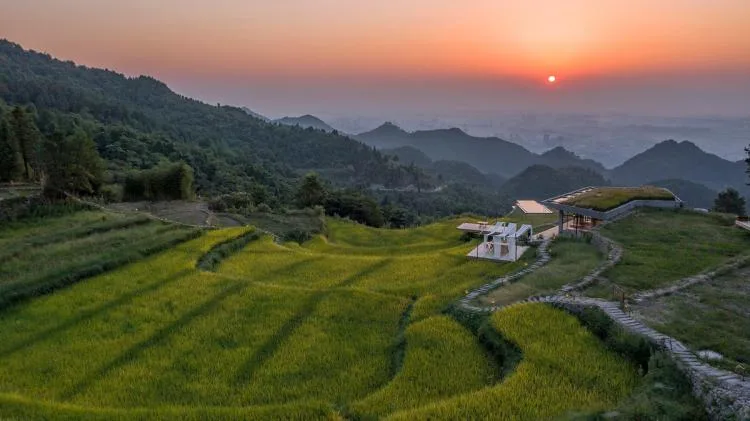
△ The restaurant is discreetly tucked within the rice fields © Jin Weiqi
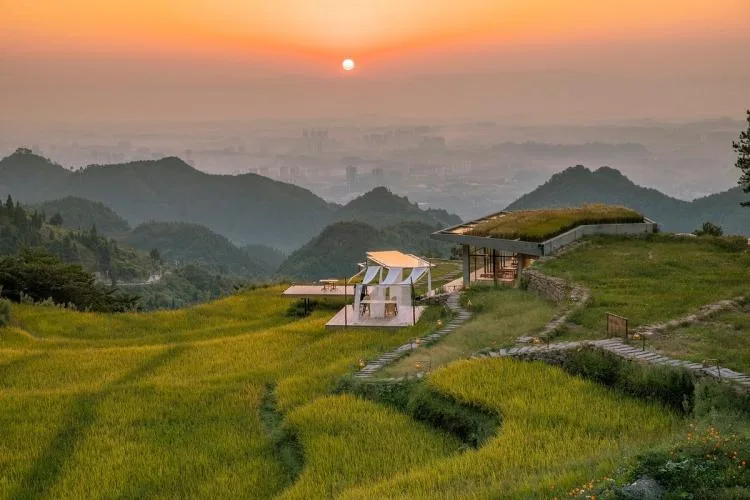
The restaurant is an ideal spot to watch the sunrise © Jin Weiqi
Landscape: Respect for Nature, Simplicity, and Authenticity
The project site enjoys a unique setting: mountains on three sides, an open eastern side, and a central rice field encircled by forest creating a serene paradise. This is not an urban environment but a retreat for modern city dwellers seeking “poetry and distance.” Consequently, the landscape design emphasizes minimal urban intervention, embracing a rustic, rural character.
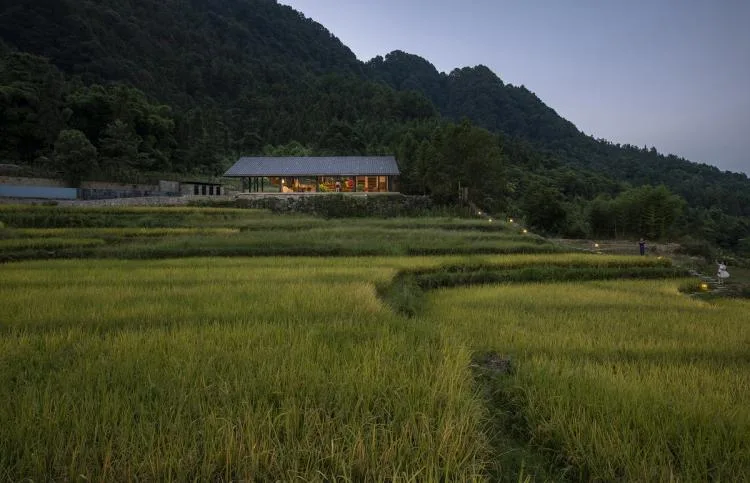
The path through the rice paddies links the book bar and restaurant © Jin Weiqi
The rice paddies are fully preserved. The road originally between the village and paddies was relocated west of the new buildings, allowing for a direct connection between buildings and fields. Pedestrian pathways connect the structures, following original ridges and forest trails. Surfaces are intentionally uneven, composed mainly of stones and rootstocks, encouraging a leisurely pace and mindful walking.
Areas around the homestay and public buildings are mostly paved with hard materials, using local bluestone fragments or foundation stones salvaged from old site buildings. This choice reflects local character and evokes a subtle nostalgia.
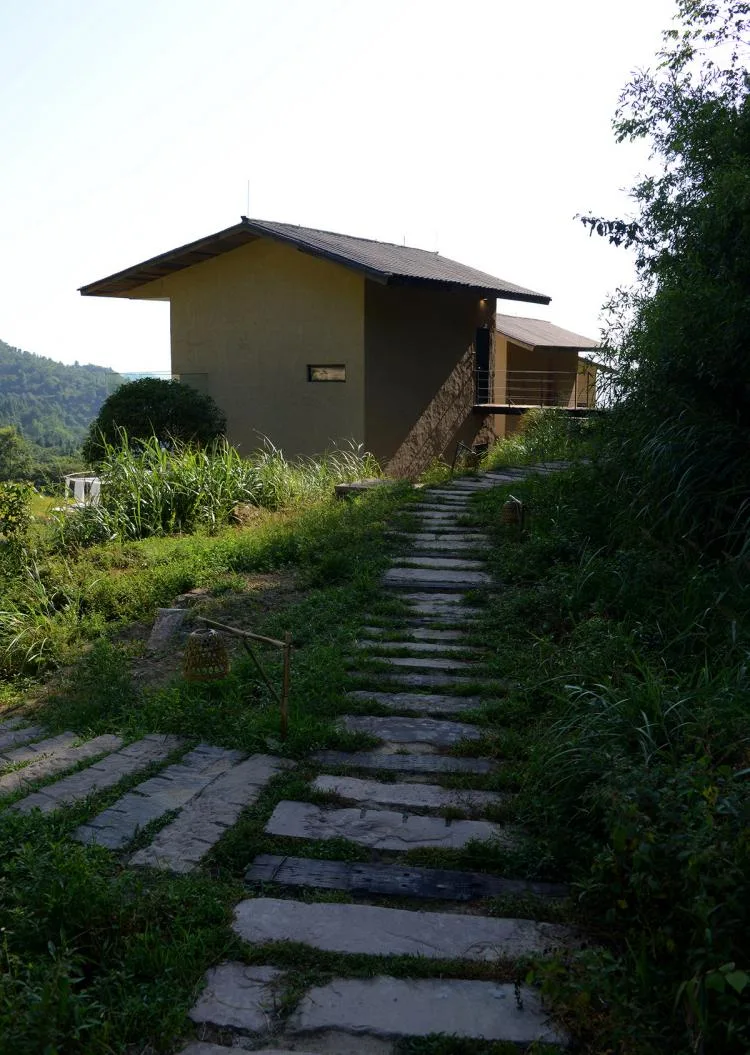
Trails paved with rootstocks and stone strips © He Wei
At night, simple light bulbs mounted on low bamboo poles along the rice fields provide soft illumination. Each bulb is covered by a bamboo woven shade that diffuses the light gently. This modest yet thoughtful lighting design embodies the project’s desired atmosphere.
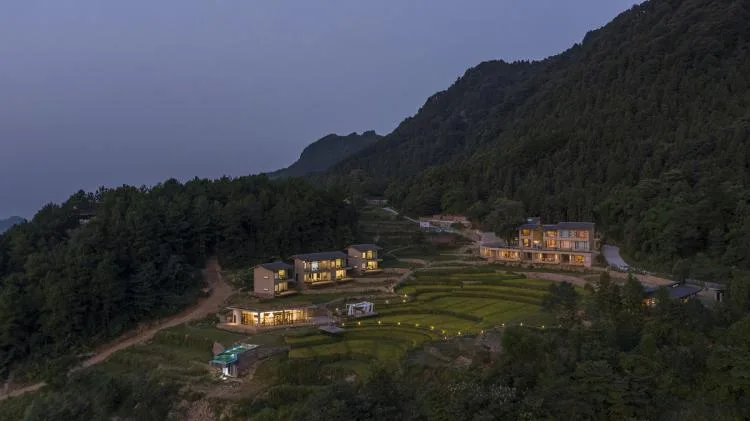
△ Night aerial view © Jin Weiqi
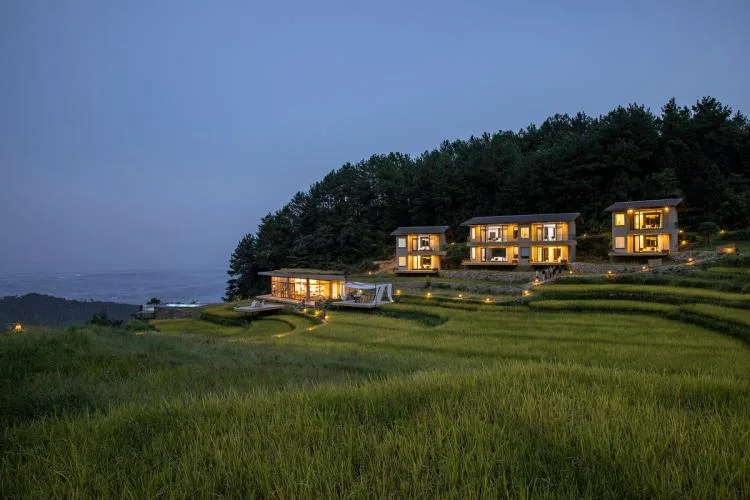
△ Lighting primarily relies on building interior transparency © Jin Weiqi
Conclusion: Blurring the Line Between Subject and Object—The Realm of Mountain People
Bagu Su Ji’s architectural design does not chase novelty but explores the relationship and interaction between architecture, nature, and people. The site’s original natural features are preserved as much as possible, while architecture is introduced as discrete points anchoring visual and behavioral experiences. Visitors wander amid buildings and landscape, gradually merging into the scenery, dissolving the boundary between subject and object. Time slows, and nature, architecture, and people become one—a realm echoing the ancient Chinese ideal of “mountain people.”
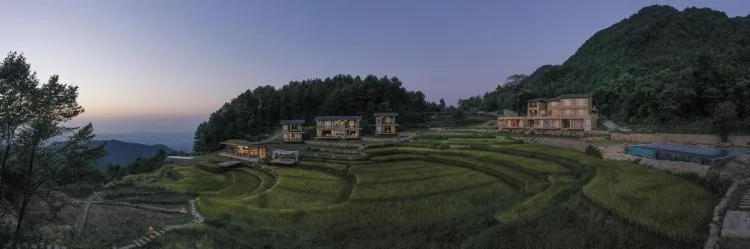
△ Panoramic view of Bagu Su Ji © Jin Weiqi
Since completion, Bagu Su Ji has quickly gained popularity for its exceptional natural environment, becoming a notable destination for tourists and a significant case study in rural revitalization through innovative use of idle assets. This success is credited to the collaborative efforts of government, property owners, operators, and designers, contributing valuable insights into local rural development under the “three changes reform policy.”
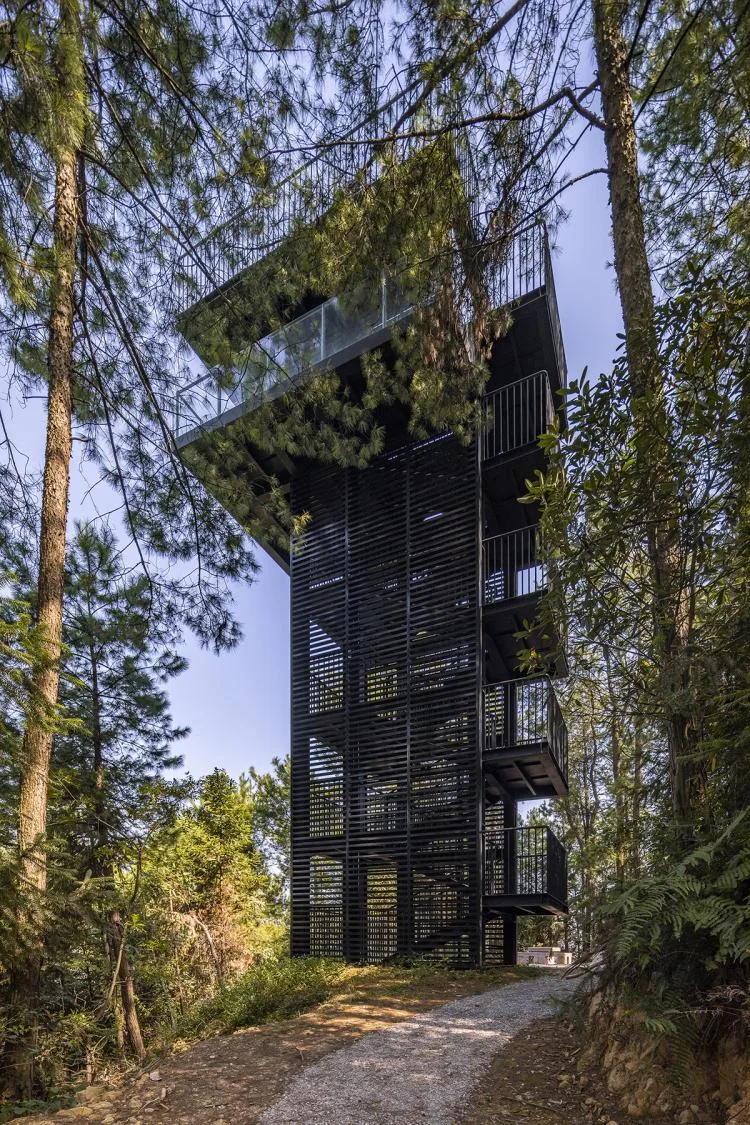
△ Watchtower © Jin Weiqi
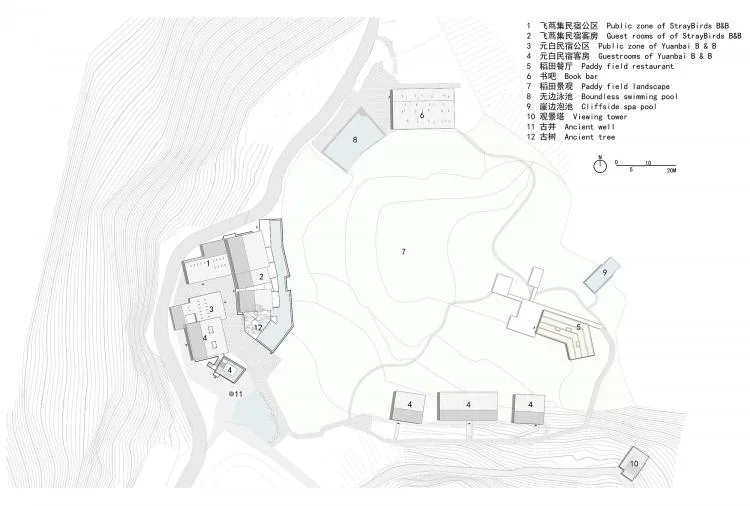
△ General layout plan
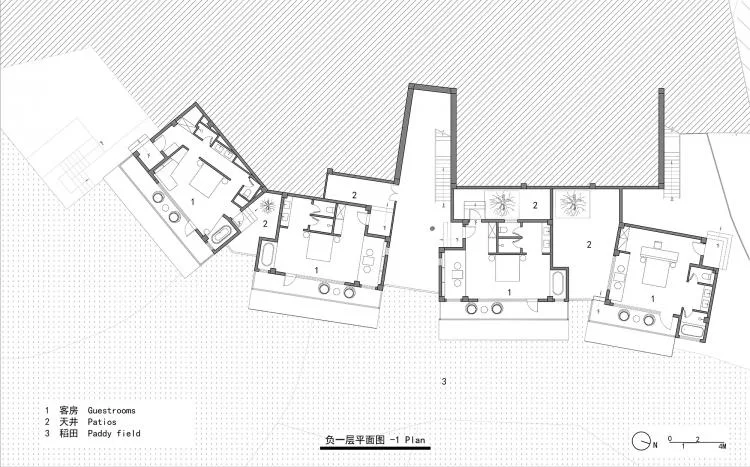
△ Basement floor plan of Feifuji Homestay
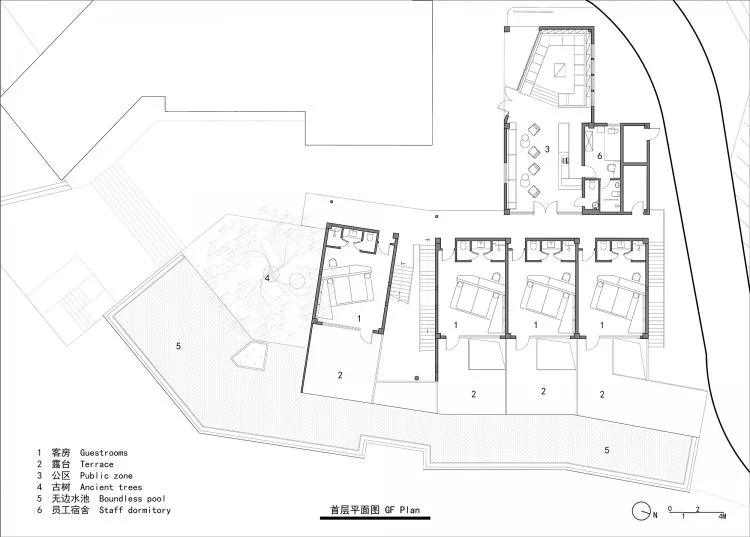
△ First floor plan of Feifuji Homestay
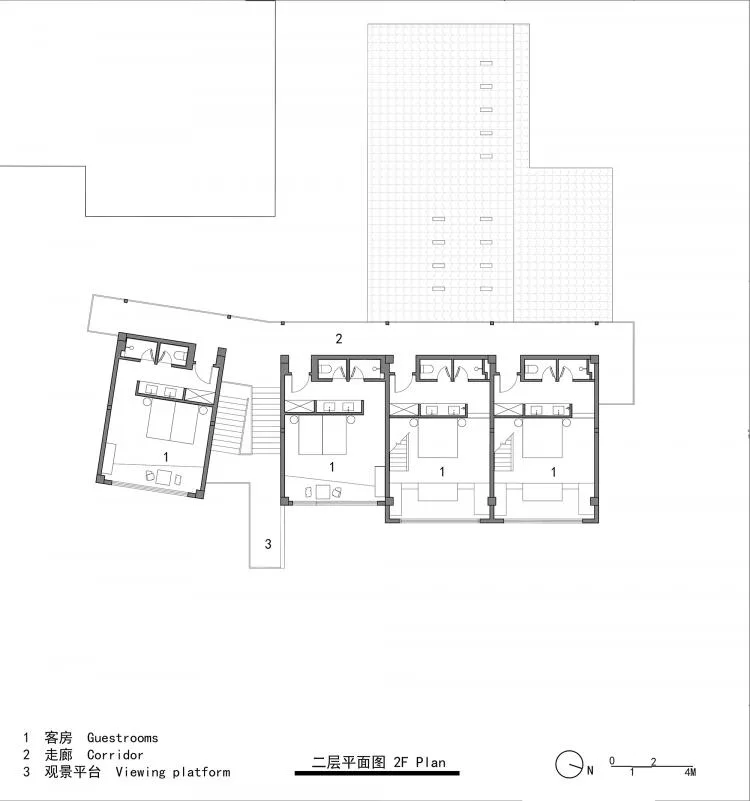
△ Second floor plan of Feifuji Homestay
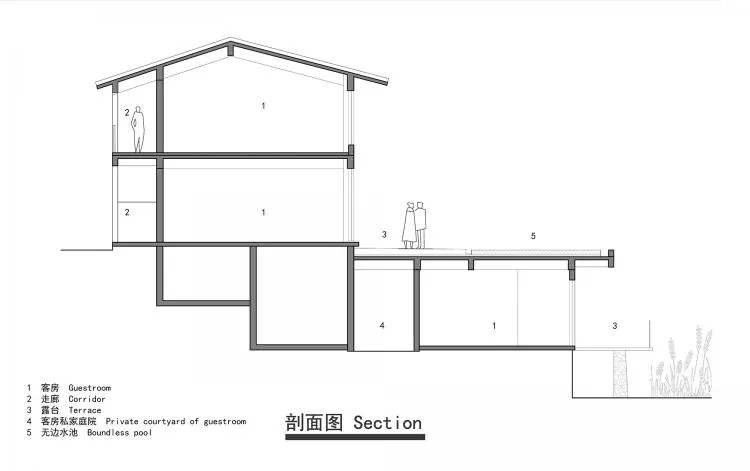
△ Feifuji Homestay profile
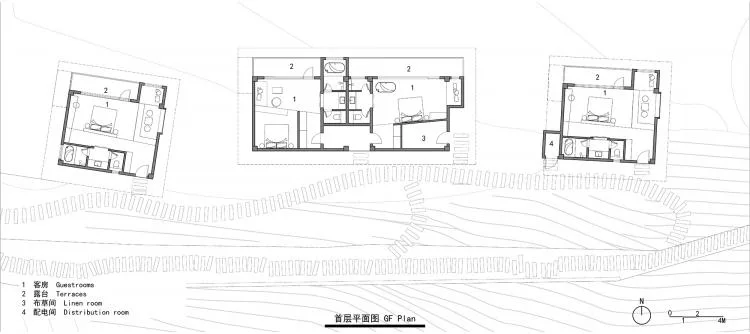
△ First floor plan of Yuanbai Homestay South District
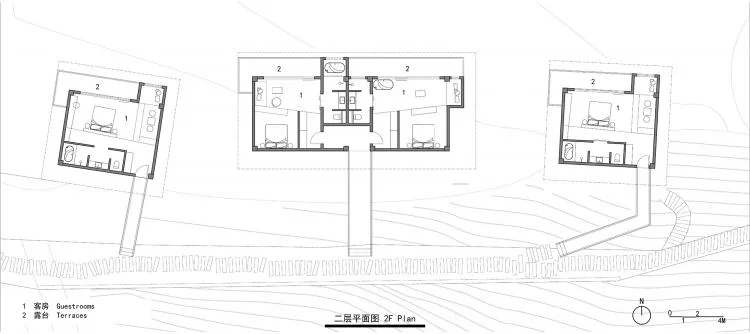
△ Second floor plan of Yuanbai Homestay South Area
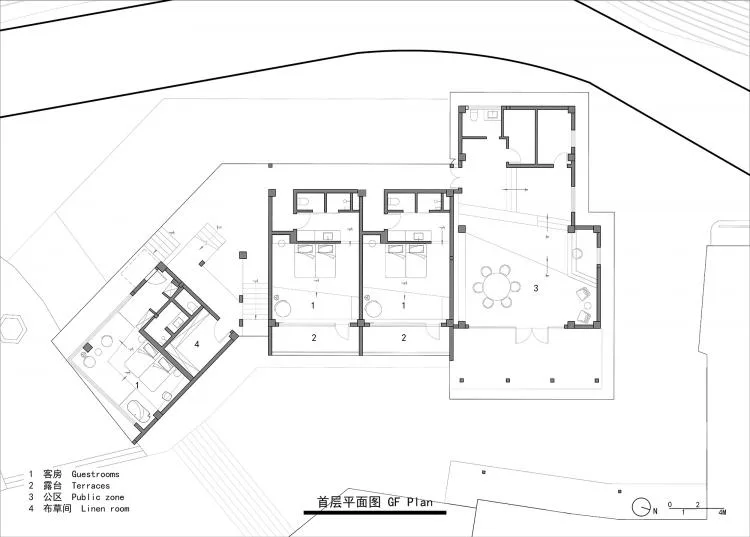
△ First floor plan of Yuanbai Homestay West Area
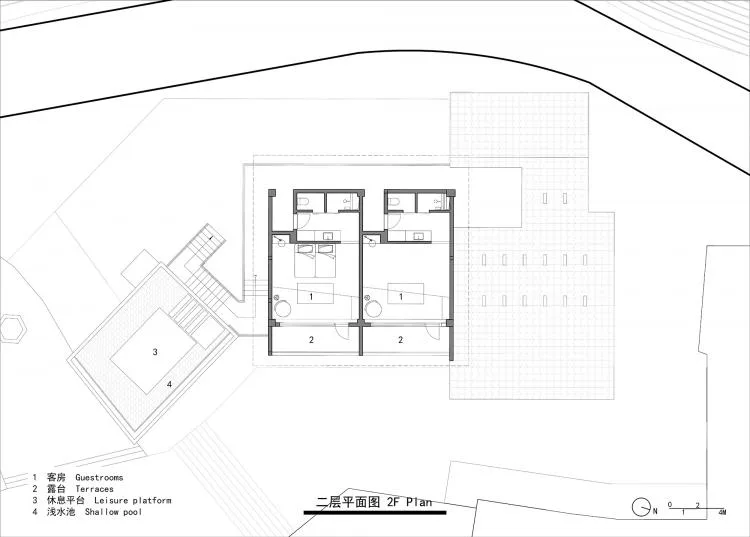
△ Second floor plan of Yuanbai Homestay West Area
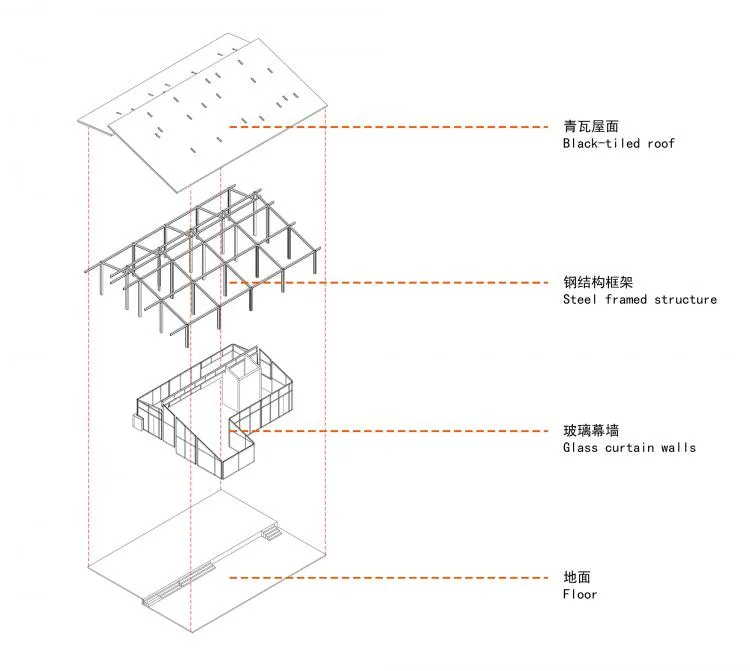
△ Exploded diagram of the book bar axis
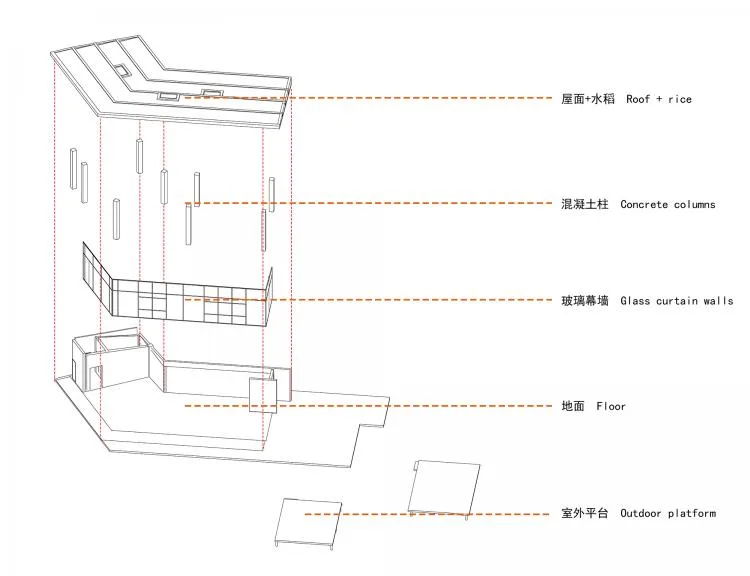
△ Exploded diagram of the restaurant axis side
Project Information
Project Name: Architectural Design of Ba Gu Su Ji in Dianjiang, Chongqing
Location: Shilu Village, Dianjiang County, Chongqing City
Owner: Dianjiang Xingdian Industrial Co., Ltd
Operator: Suji Construction Society
Lead Architects: He Wei, Chen Long
Project Architect: Liang Zhuyu
Scheme Design: Liu Mingyang, Sang Wanchen, Cao Shiqing, Li Wanting, Hua Xiaoying, Zhang Tianyan, Li Junqi, Li Hongyu (intern), Zong Zhenzhen (intern), Yin Xinyi (intern)
Detailed Design: Lin Shen (Architecture), Guo Jiansheng (Structure)
Resident Designer: Liu Mingyang
Collaborator: Beijing Huaju Architectural Planning and Design Institute Co., Ltd
Architecture and Landscape Design: Sanwen Architecture (www.3andwichdesign.com)
Interior Design: STUDIO QI, Rovvon Studio
Landscape Consultant: Li Guojun
Floor Area: 2,500 square meters
Design Period: 2019–2020
Construction Start: July 2020
Photography by: Jin Weiqi, He Wei












Must log in before commenting!
Sign Up