
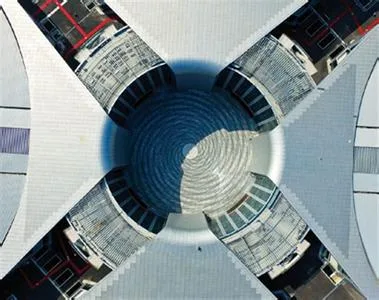
The “Four Leaf Clover” National Convention and Exhibition Center (referred to as the National Exhibition Center) measures 108 meters wide, 270 meters long, and boasts a maximum net height of 34 meters. It stands as the largest single building and exhibition complex in the world. Over the past year, Shanghai has successfully hosted several large-scale exhibitions exceeding 300,000 square meters, including the Shanghai Auto Show, China Medicine, and International Furniture. These events have significantly elevated Shanghai’s exhibition capabilities to a new level. Despite its massive size, this “behemoth” is actually a model of energy efficiency in the construction industry. How was this achieved? Our reporter spoke with a key official at the National Exhibition Center yesterday to find out.
160,000 Square Meters on the Second Floor Solidified with a “Single-Layer” Approach
Uniquely, container trucks can drive directly onto the second floor—a design feature unparalleled in exhibition venues, demanding exceptionally high load-bearing capacity.
The structural “hardness” of the exhibition hall directly influences the types and scale of exhibits it can support. According to Li Qing, a senior engineer and professor at Shanghai Expo Co., Ltd., as the national economy develops, high-end exhibitions increasingly require large, heavy-duty spaces. Typically, these exhibitions need areas over 200,000 square meters, with floor load capacities reaching 5 tons per square meter. Before the National Exhibition Center, no venue in Shanghai met these requirements.
The National Exhibition Center offers a net exhibition area of 400,000 square meters, including an additional 100,000 square meters of outdoor exhibition space, making it the “largest, most advanced, and most competitive” exhibition “super carrier.” Allowing vehicles to access the second floor directly creates an extra 160,000 square meters of prime exhibition space, making display setups on the second floor as convenient as the first.
The second floor itself is a vast exhibition hall spanning 160,000 square meters with column spacing of 27 by 36 meters. To accommodate truck access, the floor must support loads of up to 1.5 tons per square meter. However, ultra-long concrete floor structures often face cracking issues due to shrinkage and the complexities of tension end arrangements. To address this, the large-span floor uses a prestressed reinforced concrete structural system with segmented optimization of prestressed reinforcement, ensuring accurate, rapid construction and precise load-bearing control.
Elevators That Operate Safely During Power Outages
The National Exhibition Center is equipped with 50 supercapacitor elevators, six of which are the first in China to feature a safety function that prevents emergency stops during power outages.
These supercapacitor elevators represent a new concept in safety. Sudden emergency stops pose risks to passengers, but these elevators can continue operating for more than 15 meters during power failures by storing energy in supercapacitors.
The adoption of supercapacitor elevators draws from the successful demonstration of “supercapacitor” vehicles at the Shanghai World Expo Park. Authoritative testing showed that under simulated working conditions, these elevators achieve an average energy-saving rate of 25%, with peaks over 33%. Over 400 elevators utilize combined supercapacitor and feedback systems, saving approximately 3 million kilowatt-hours of electricity annually—equivalent to the yearly consumption of more than 3,500 Shanghai households.
Additionally, the China International Exhibition Center has installed 5,000 “LED intelligent safety lights,” a first for exhibition venues. These lights can operate independently during power outages, preventing total darkness in emergency situations when backup power circuits fail.
Applying BIM Technology Saves Millions in Investment
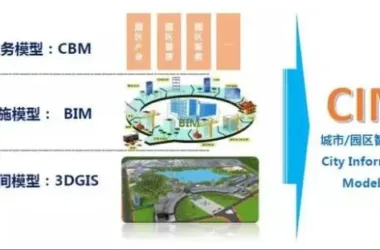
BIM, or Building Information Modeling, is regarded as the construction industry’s second “technological revolution” following CAD.
Engineering subprojects often involve multiple design departments and complex systems such as buildings, structures, water and electricity, environmental control, and fire protection. Spatial design conflicts are common. BIM technology allows these conflicts to be detected and resolved during the design phase, improving overall design quality. It also supports spatial site management to prevent on-site clashes.
However, BIM demands high modeling accuracy and rigorous operational management. It is a technology that requires deliberate adoption rather than haste. The National Exhibition Center has become a pioneer in this field. According to Li Qinglai, using BIM technology reduced the deepening design phase by three months and eliminated thousands of design conflicts through simulation, saving tens of millions of yuan in investment.
Su Yaokang, Vice President of Feile Audio, remarked that as a national demonstration project, the National Exhibition Center serves as a “barometer” for the construction industry. The technologies implemented here are likely to see widespread application across future construction projects.













Must log in before commenting!
Sign Up