
Editor’s note: To offer college readers a more structured reading experience, we dedicate one week each month to feature our content as a special topic. This week’s theme is “High-Quality Competition Works.” Today, we present an in-depth interpretation of the award-winning projects from the 2019 Tianzuo Cup.
Additionally, the School of Architecture is launching the “Creator Program” and inviting submissions for the “High-Quality Student Works” initiative. If you have outstanding competition entries and are interested in organizing your design process and methodology into an article, we warmly welcome your contributions. Each accepted article will receive a fee ranging from 300 to 1000 yuan (based on readership), and an annual prize of 10,000 yuan will be awarded to the best works. For more information, please leave us a message.
Competition Theme
The 2019 “Tianzuo Award” International College Student Architecture Design Competition, hosted by Architect magazine, focused on the concept of “Urban and Rural Areas of a Family.” Participating students shared their unique visions, portraying their own “Peach Blossom Spring” as a response to the challenges faced by today’s living environments and varied ideals of home amid rapid urban and rural transformation. From 281 submissions, students conveyed diverse ideas for modern rural living environments—ranging from modern reinterpretations of traditional building techniques to the integration of architecture with mechanical automation, or nostalgic returns to simplicity, reminiscent of the passage of time.
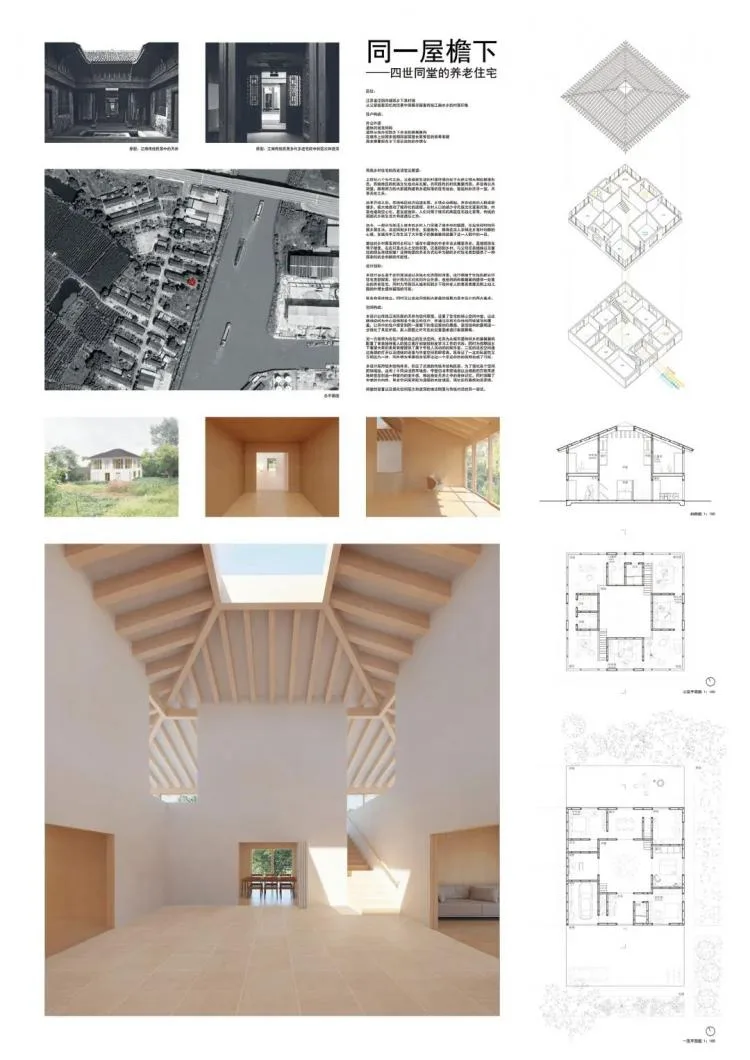
This article explores the third-place winning project, Under the Same Roof, by Huang Xinyang from the University of Stuttgart, Germany, through insights from the designer and competition judges.
Award-Winning Project

Huang Xinyang (University of Stuttgart, Germany)
This marks my second consecutive year participating in the Tianzuo Award, and I am honored to have received recognition once again. I sincerely thank the judges and mentors for their support and the thought-provoking challenge presented by this competition. Here, I would like to share some reflections on my design process.
I am passionate about travel, drawing much of my inspiration from visiting ancient architecture. Over time, countless fascinating and awe-inspiring sites have left a deep impression on me. Experiencing historic architecture often delivers powerful spatial encounters that are both moving and unforgettable. Unfortunately, many of these architectural gems have become anonymous and neglected over time, which is deeply regrettable. Transforming these spatial memories into contemporary design remains a key focus of my work.
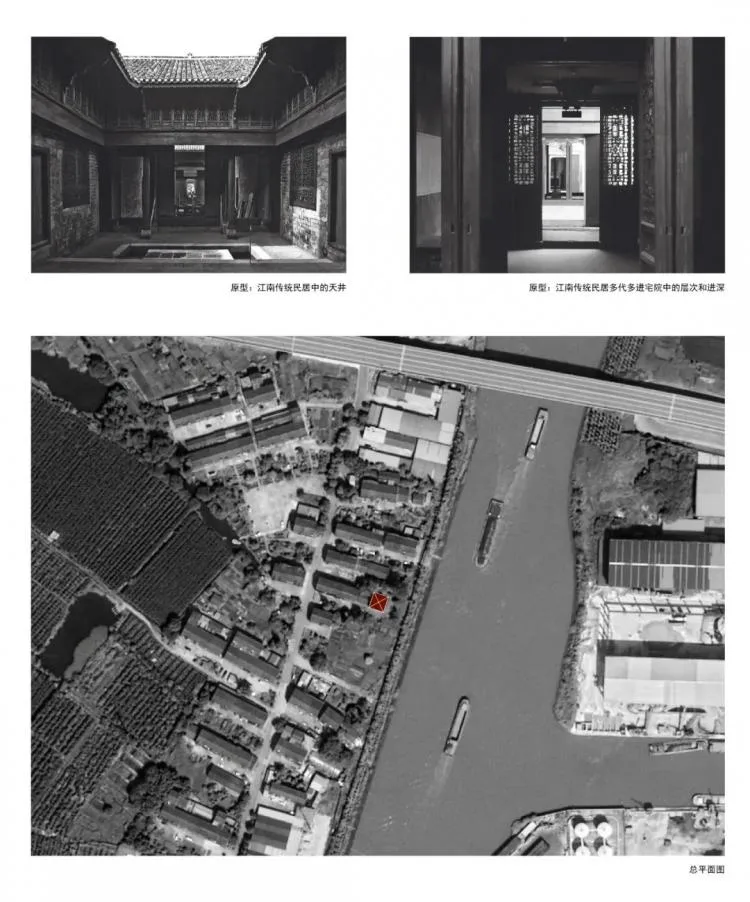
For instance, my 2018 Tianzuo Award-winning project—a modern temple inspired by ancient architecture in Shanxi and Hebei provinces—embodies this approach. Similarly, the multi-generational elderly care residence presented here reflects an interpretation and evolution of the traditional Jiangnan courtyard houses I recall, centered on interconnected courtyards.
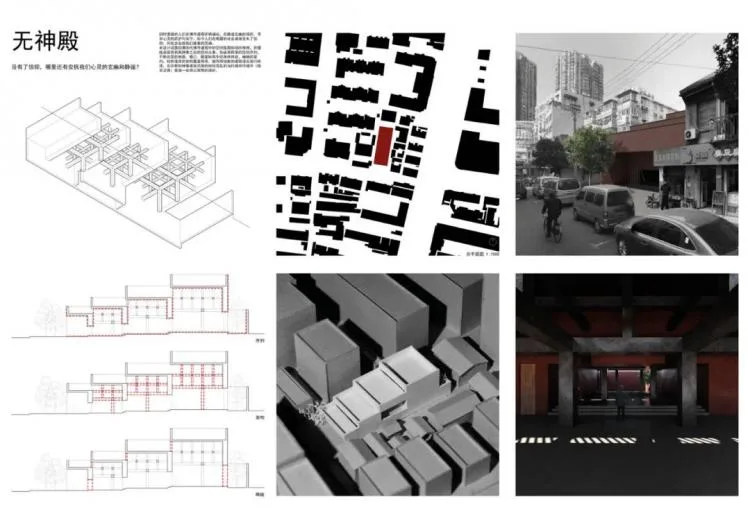
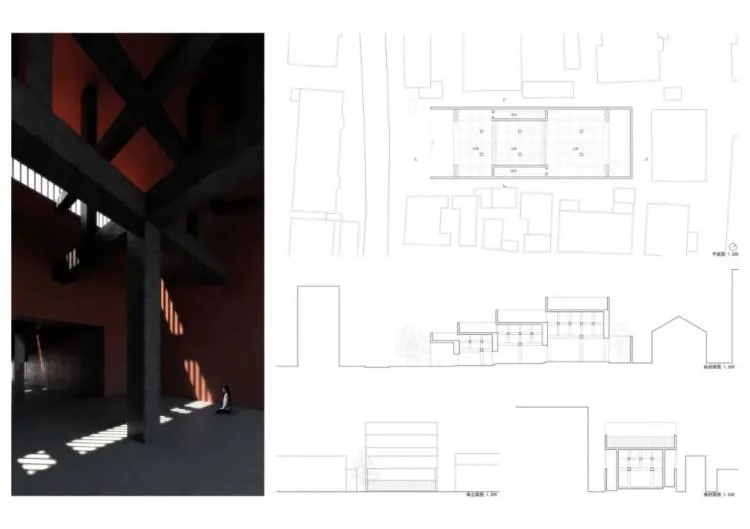
△ The author’s 2018 Tianzuo Award-winning project: Wushenmiao (Honorable Mention)
I was born in a rural village in southern Jiangsu. According to my elders, before the 1980s, the village environment reflected the late stage of agricultural civilization, with intact clan culture. Villagers sharing surnames gathered around public temples, and wealthy families built multi-courtyard residences where grandparents and grandchildren lived together harmoniously. Following the reform and opening-up period, the southern Jiangsu region experienced rapid economic development, with township enterprises rising and many people shifting from farming to business. This urbanization led to rural depopulation, the decline of clan culture, and the gradual hollowing out or abandonment of villages. Meanwhile, many moved into urban apartment complexes, and traditional rural lifestyles faced the threat of being forgotten.
Nowadays, some rural migrants who worked and lived in cities grow weary of urban hustle and bustle. They long for their rural roots and return to the countryside to enjoy peaceful retirement. This sentiment echoes the ancient philosophy of returning home in glory and reconnecting with one’s origins. The elderly “uncles and aunts” who have spent most of their lives in the city belong to this group.
What will become of former rural settlements? Where will retired middle-aged and elderly city dwellers spend their golden years? Should they remain in high-rise apartments surrounded by strangers, or return to rural communities to rebuild relationships with family and old friends? This group-based elderly care model offers a chance to explore new possibilities for rural housing.
Inspired by this social and urban transformation background, my design explores new rural housing rooted in tradition. The project provides a centralized retirement home for three couples—grandparents, parents, and uncle and aunt—while also accommodating cousins who visit from the city during holidays, as well as a niece just starting kindergarten.
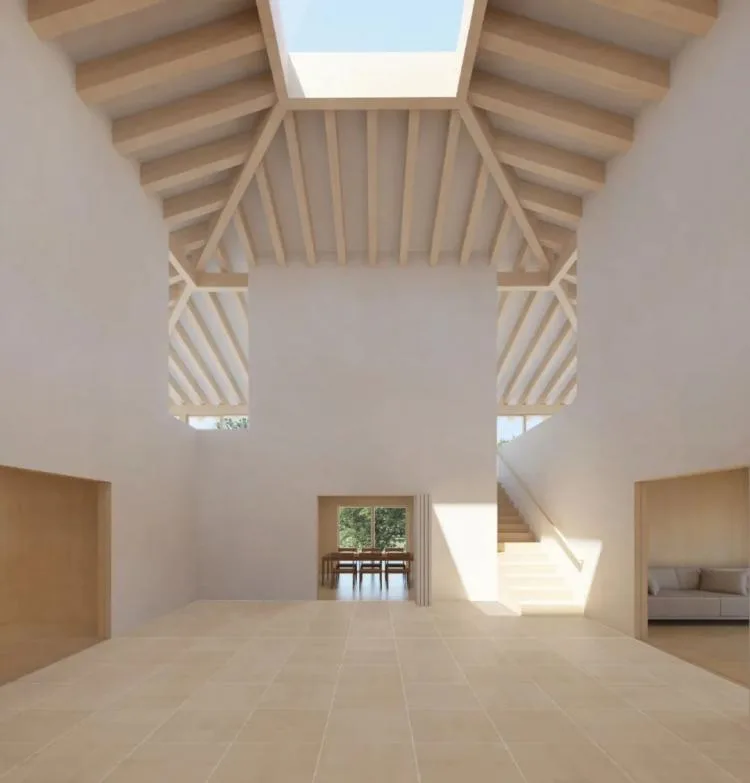
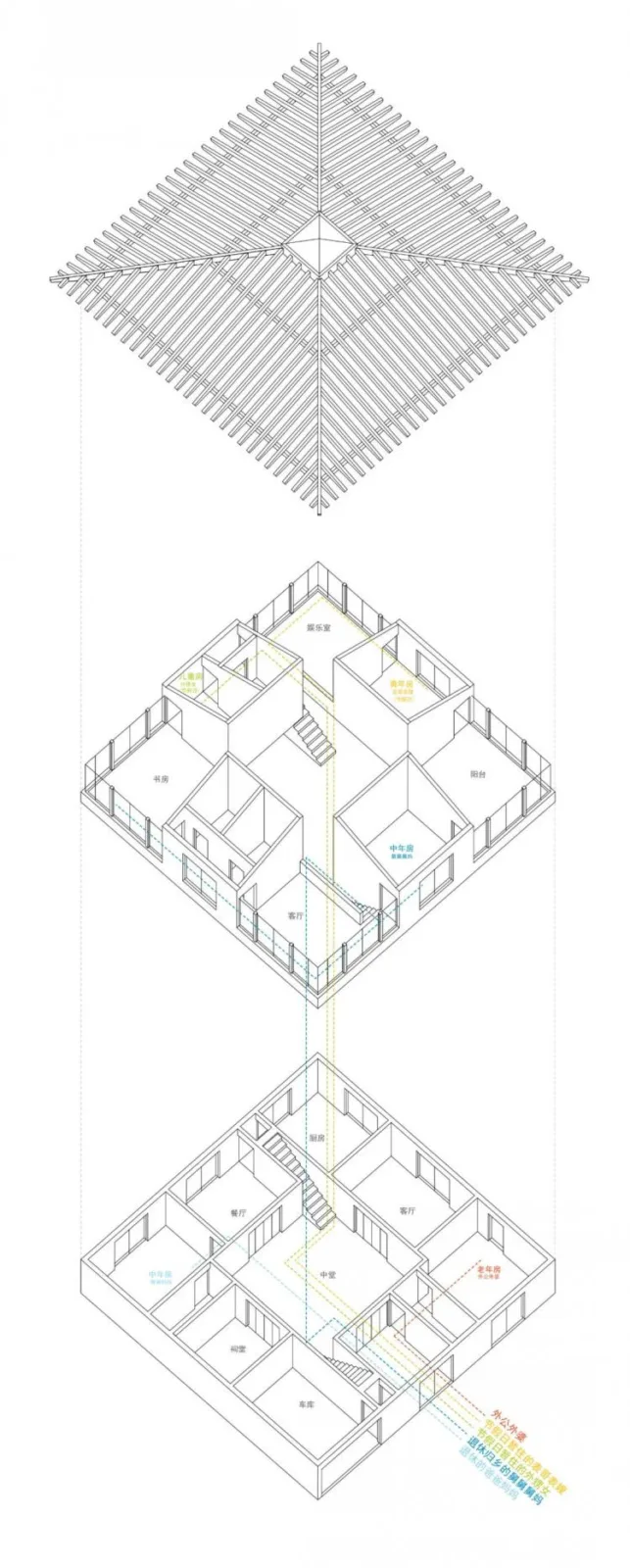
The design emphasizes maintaining individual independence while fostering a sense of family unity. Drawing from the traditional Jiangnan courtyard house as spatial inspiration, the residence features a central hall extending to each independent living unit, with a spiritual space at its core. A non-directional four-sided roof covers the structure, creating a feeling of closeness and shared belonging under one roof. The exposed roof structure further enhances a sense of shelter. During family gatherings, the central space allows for a round table to bring everyone together.
Each resident enjoys a private living space, especially uncles and aunts who have returned from city life, with separate living rooms for hosting guests and study rooms for light work or continued learning. Additionally, an entertainment room on the second floor provides a space for younger family members visiting during holidays. The design integrates these private areas with the central hall by opening corners and adding stairs, balancing privacy with interconnection. This setup also allows the niece to spend vacations close to nature alongside her ancestors.
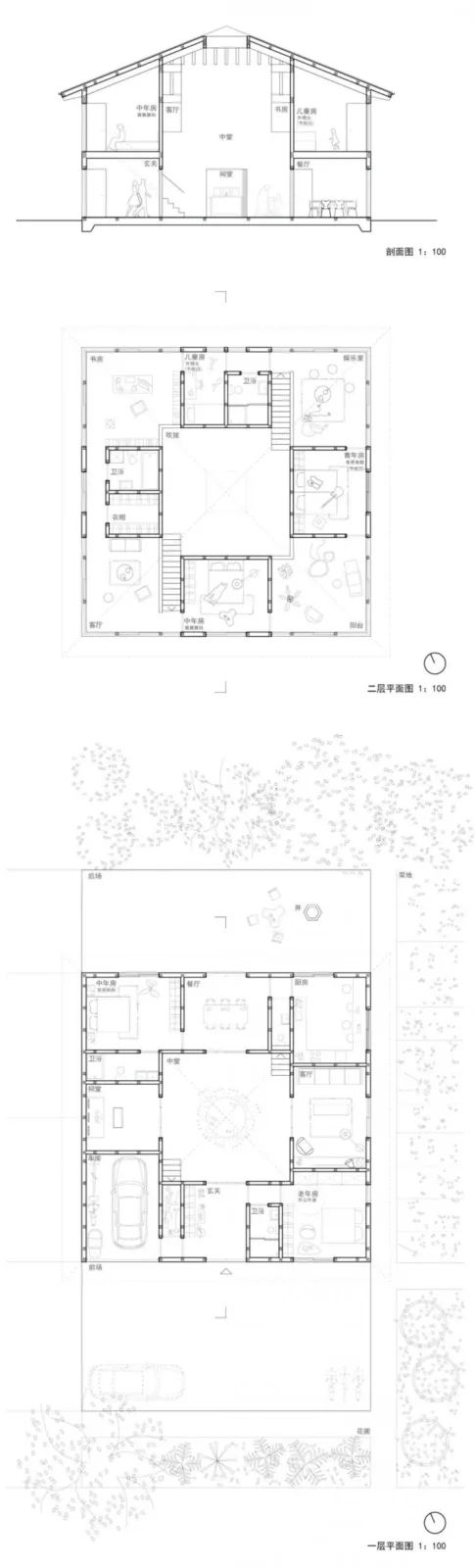
The design employs a lightweight wooden structural system, responding to the decline of traditional timber residential buildings. To enhance spatial identity, the project uses wooden walls of varying depths. White-painted wood grain walls and square wooden floor tiles in the central hall evoke a seamless indoor-outdoor atmosphere, stirring tactile memories of courtyard life and dissolving directional orientation. Other areas feature warmer wood tones to enhance intimacy and enclosure. The inclusion of ancestral halls and a layered spatial hierarchy further deepens the dialogue with tradition.
Tradition is at once distant and intimate; if approached superficially, design risks becoming mere imitation. Through systematic study and research, designers can avoid such pitfalls, drawing continuous inspiration from anonymous traditional architecture for future projects.
Judges’ Comments
The competition theme addresses three dimensions: first, the authentic rural environment—showcasing the relationship between homestead land, geography, and natural conditions, fully capturing the scene’s essence; second, the concept of “one family”—focusing on daily life across three generations, as reflected in the plan. A superficial “hollow shell” that ignores these aspects is irrelevant; third, the architectural carrier itself, including design details like accessibility for elderly residents. Life cannot be divorced from geography and human behavior, and these must be integrated into design.
Judges encouraged students to immerse themselves emotionally in the family scene rather than designing abstractly or for a hypothetical context. The “family” is the core element, and the possibility of a family living rurally in the future should guide a solid design. While complex, exploring specific aspects such as rural elderly care, cultural response, or vacant housing renovation in depth can also offer practical solutions. Ultimately, the competition prioritizes a comprehensive understanding of rural family life, which makes the design most relevant.
The submitted plan features a concise, compact square layout with a central courtyard mirroring the same shape. This effectively responds to the competition’s theme: urban and rural family life—a healthy home shared by multiple generations. The inward openness and layered spatial arrangement accommodate different age groups, while flexible usage divisions reinforce the theme. The architectural form presents a simple volume topped with a four-sided roof, inheriting the traditional lifestyle of southern Jiangsu rural residences. Overall, the design depicts a healthy home with four generations living under one roof.
—— Zhang Pengju
Professor at the School of Architecture, Inner Mongolia University of Technology
Content coordination: Chen Haijiao, Architect Magazine
Final content review: Li Ge, Architect Magazine
WeChat editor: Li Xue, Architect Magazine












Must log in before commenting!
Sign Up