
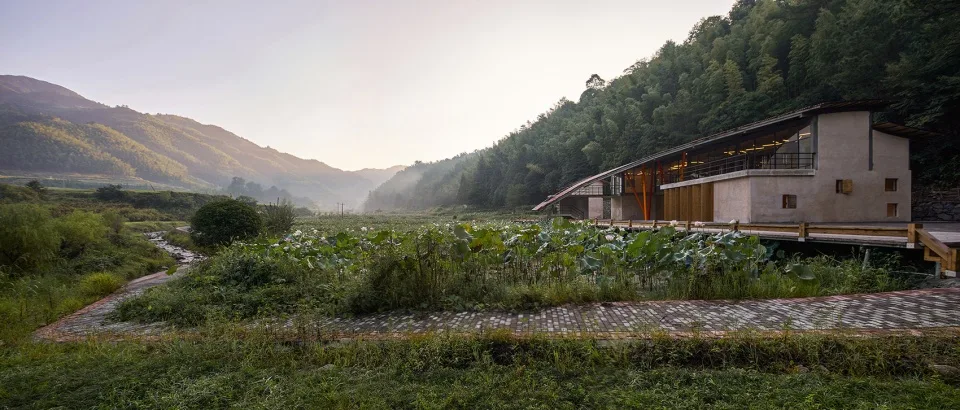
Project Background: Old Tobacco Curing Houses by the Village
This project is situated in Dutuan Village, Xiyuan Township, Jianning County, Fujian Province, China. The site lies approximately 500 meters from the village entrance, adjacent to a lotus pond along the roadside. On the property, there is a cluster of tobacco curing rooms—traditional production buildings used for drying tobacco—which have long been abandoned due to technological changes.
Tobacco curing rooms are typical Fujian production buildings, varying in size. The site contains two small traditional tobacco houses and one large tobacco house. The large tobacco curing room is a masonry structure composed of four independent, parallel rectangular spaces. Its flat roof, interconnected across these spaces, serves as storage for firewood and miscellaneous items. To keep the firewood dry, an asbestos tile canopy is installed atop the roof. The tobacco house faces the lotus pond while backed by the road and mountains, offering scenic views and a commanding presence.
Recent developments in Dutuan Village have brought new opportunities to this site: a water conservancy project has dredged surrounding streams, renovated the waterfront, and added a children’s play pool; a boardwalk has been constructed over the lotus pond, enhancing access and the agricultural landscape experience. These improvements have revitalized Dutuan Village and increased visitor numbers. Against this backdrop, the project aims to address gaps in village public service facilities by providing recreational spaces for residents and visitors alike.
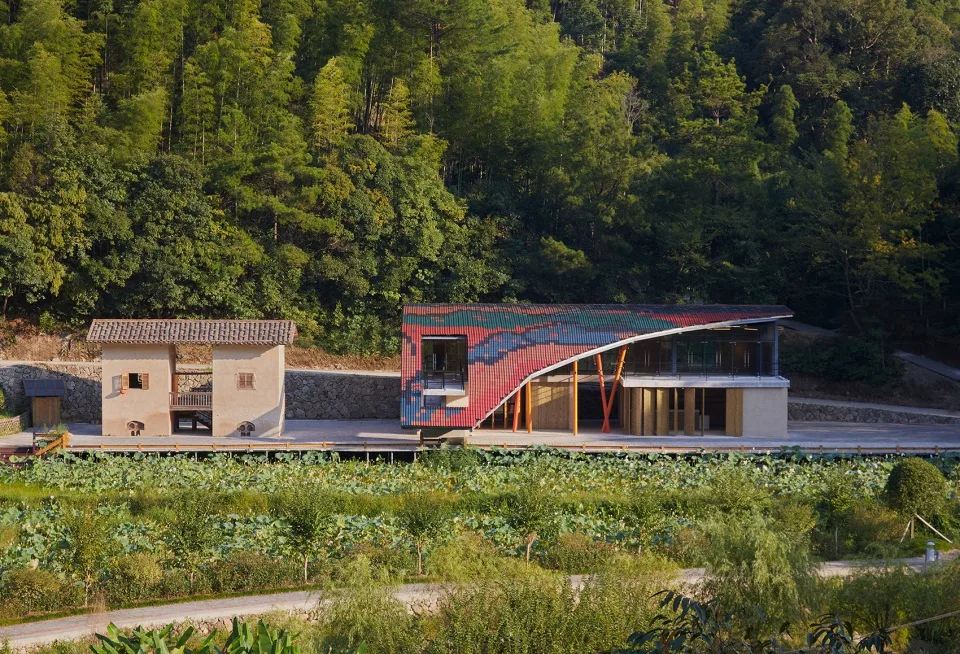
△ Project Exterior View @ Sanwen Architecture
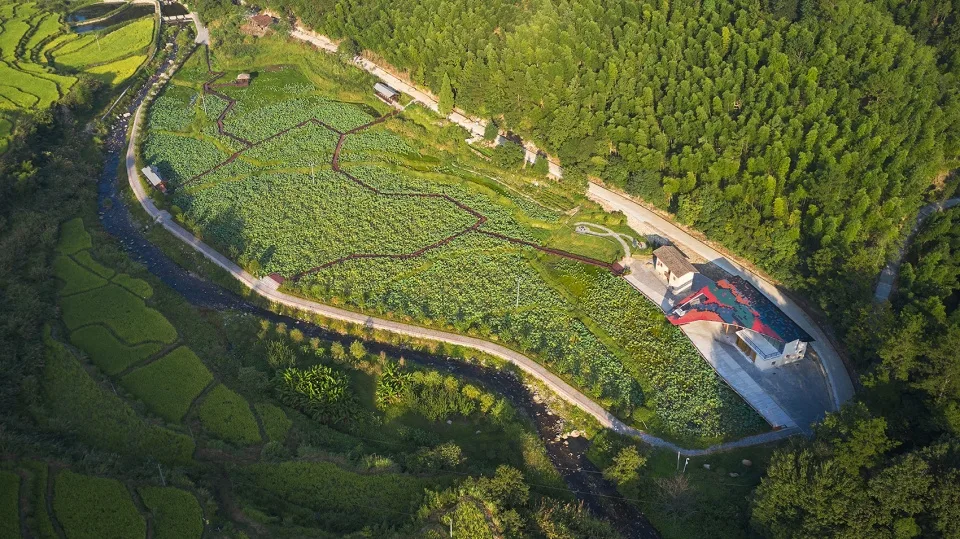
△ Aerial View from a Distance @ Sanwen Architecture
Spatial Layout: Artistic Reinterpretation of Production Space
The two small traditional tobacco houses have been preserved, with the primary design focus on the large tobacco house. The new building sits on the old structure’s footprint, borrowing its spatial logic while introducing artistic reinterpretation. The architects were particularly interested in the spontaneous nature of tobacco house construction.
On the floor plan, the original building features four parallel rectangular spaces of equal size, shape, and spacing, creating a clear and orderly layout. Vertically, the tobacco production and storage units occupy the first floor and the irregular “second floor” respectively. One notable feature is the canopy, a functional element that also disrupts the production unit’s orderly feel with a sense of casualness and scale.
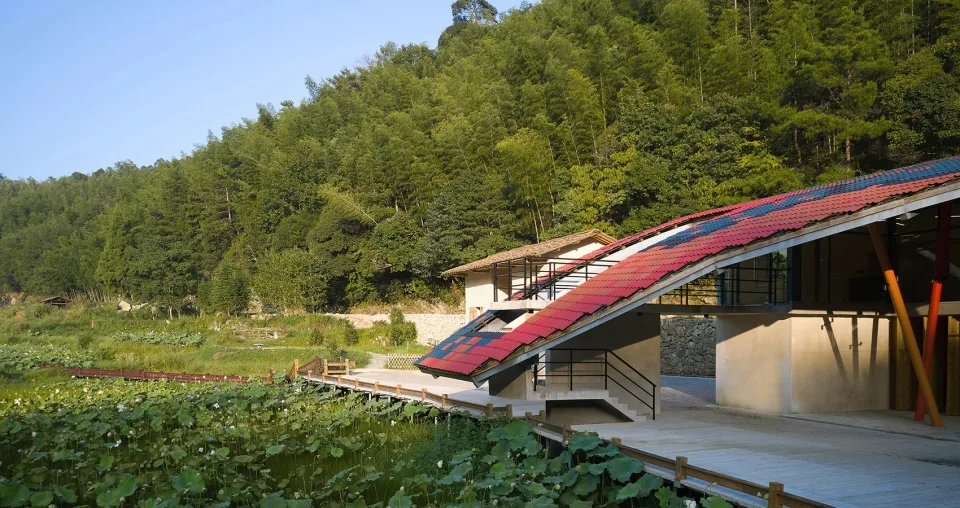
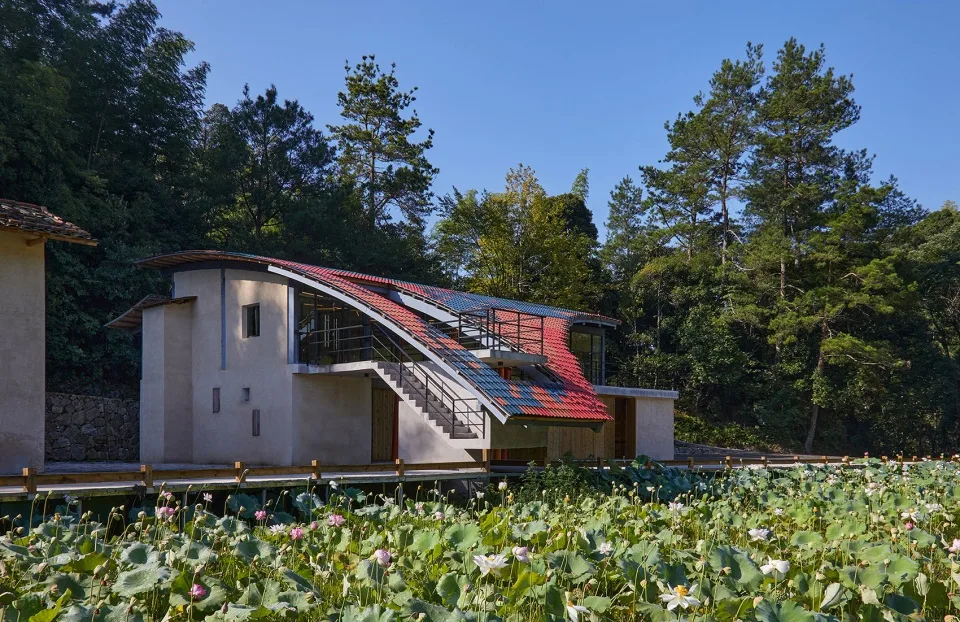
△ Project exterior, canopy covering the block structure @ Sanwen Architecture
The design process began by studying the spontaneous construction methods of the tobacco house. The new building retains the two-floor structure: the first floor contains multiple blocks including a community center, exhibition hall, conference room, and kitchen. This arrangement reflects the original building’s four rectangular prisms, but with modifications through reduction, addition, and combination to suit new functions.
The flat surfaces now present varied textures and spatial arrangements. Indoor areas meet modern functional needs, while the gaps between blocks create outdoor spaces for activities. The first-floor façade facing the lotus pond consists of tall wooden boards that can be fully opened, allowing free access from the building’s southwest side and blurring the boundary between inside and outside. The architect aimed to foster a sense of openness and freedom.
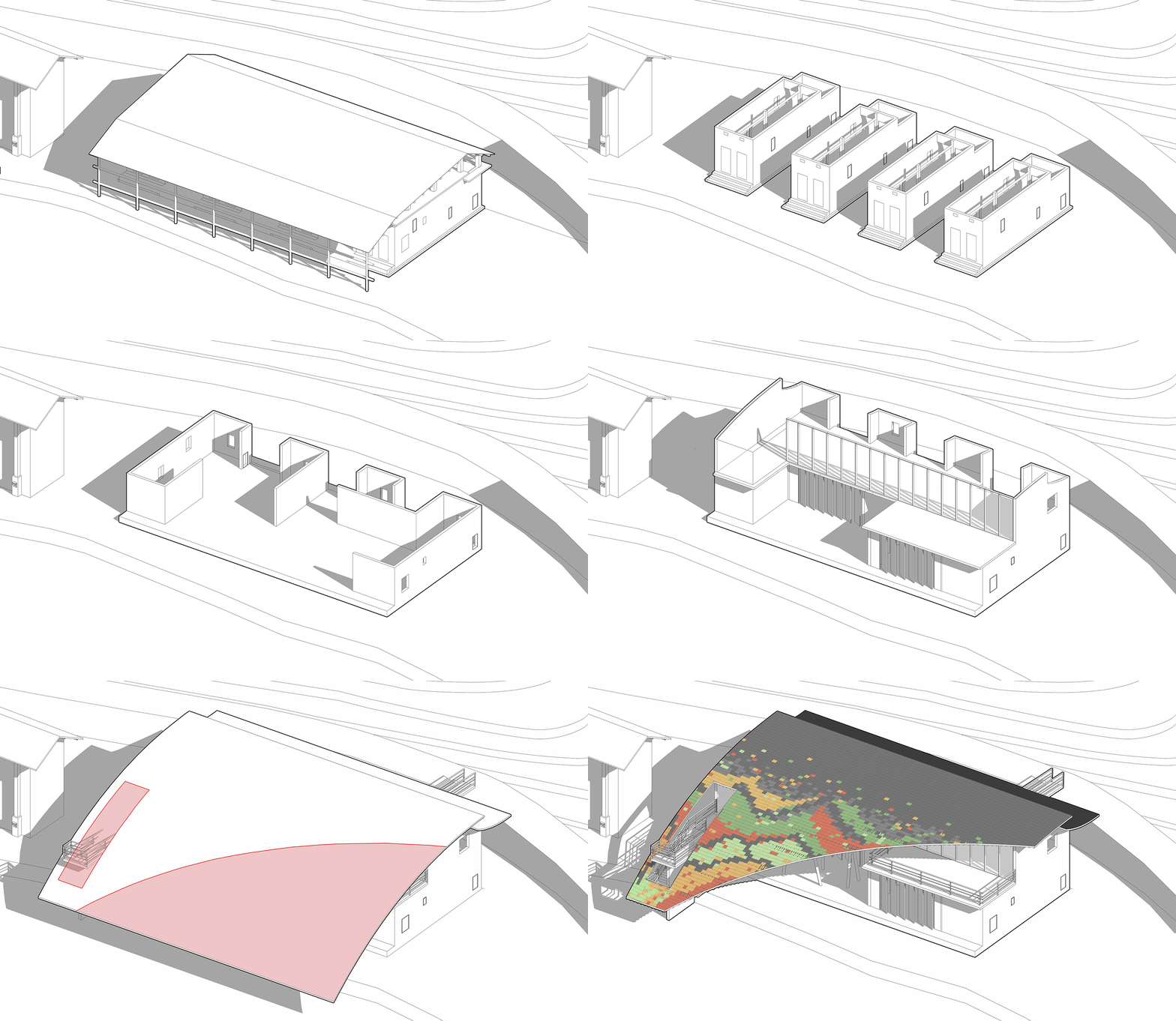
△ Design development process @ Sanwen Architecture
An outdoor staircase in the building’s northwest corner connects the first and second floors. The second floor is a large rectangular multifunctional hall that can serve as a restaurant or event space. Its west-facing façade is floor-to-ceiling glass, bringing the lotus pond’s landscape indoors. An outdoor platform in the southwest corner accommodates open-air dining.
The east façade is more enclosed, facing roads and forests, with a toothed design that echoes the original tobacco house’s form. Another entrance on the east side connects to the road by a bridge, facilitating evacuation and circulation.
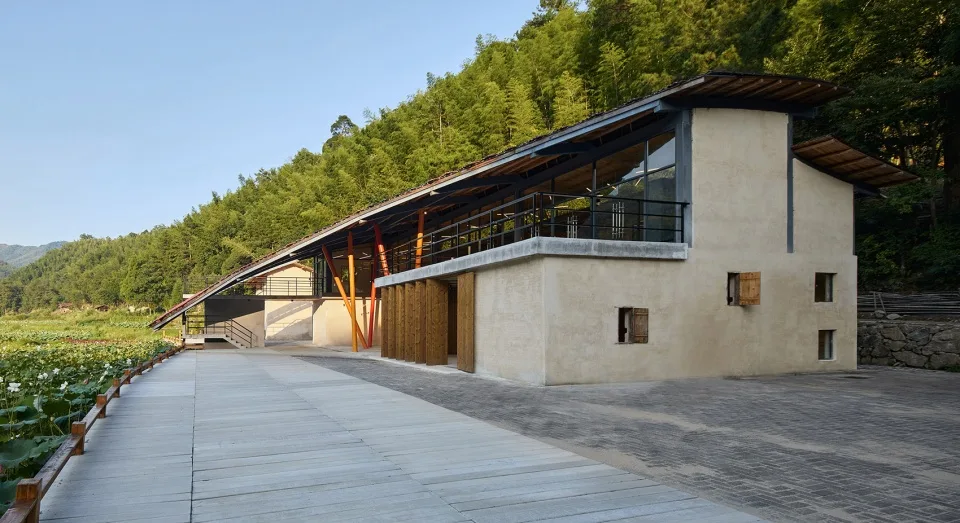
△ Building exterior, two floors connected by outdoor stairs @ Sanwen Architecture
The Grand Roof: Between Rationality and the Absurd
A key visual feature of the new building is its oversized, asymmetrical roof. The architect intentionally designed it to be exaggerated, enveloping the building and providing generous eaves that respond to the local rainy, humid climate. This roof is also a dramatic evolution of the original building’s canopy. The eaves are cut by arcs rather than following horizontal lines. The smaller southern roof contrasts with the larger, elongated northern roof, which extends nearly to the ground. The design team affectionately nicknamed it the “elephant nose.” The outdoor staircase passes through this roof, creating a striking spatial experience.
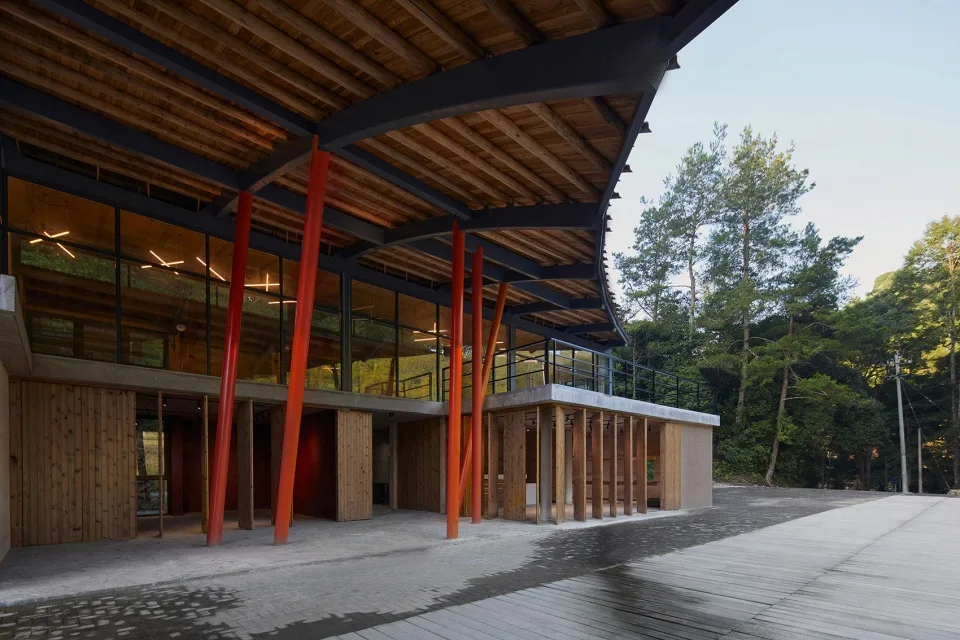
△ Space beneath the grand roof @ Sanwen Architecture
The arched roof is constructed with a steel framework, supported by columns that blend rationality and whimsy. Unlike typical vertical supports, these columns are inclined and non-parallel. Walking beneath the eaves and between the pillars evokes the sensation of moving through a bamboo forest. This deliberate misalignment is an intended effect by the architects.
Columns are categorized as either true structural supports or decorative elements, differentiated by color. This color coding adds a fashionable, unexpected touch, complementing the roof’s colorful glazed tiles—another bold architectural statement.
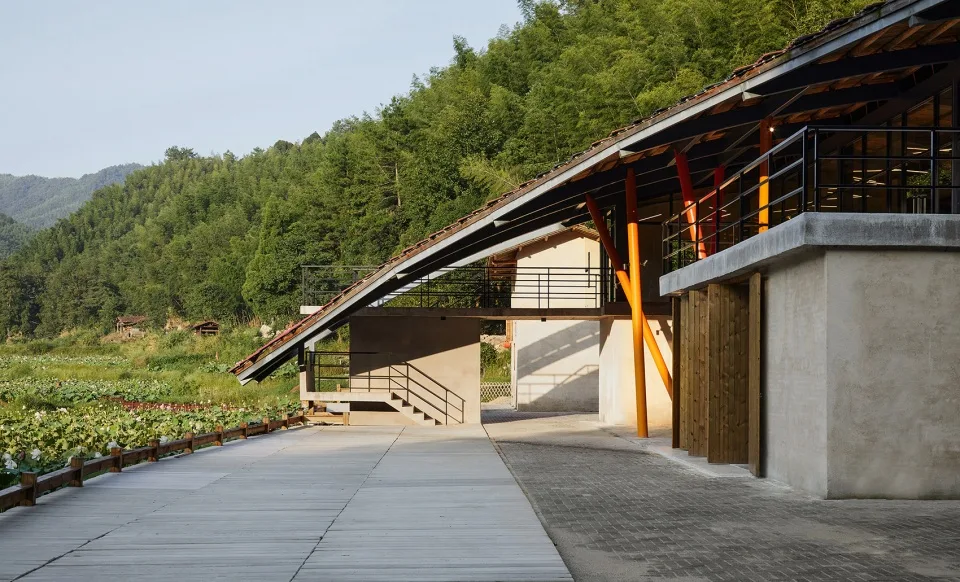
△ The roof is supported by inclined steel columns @ Sanwen Architecture
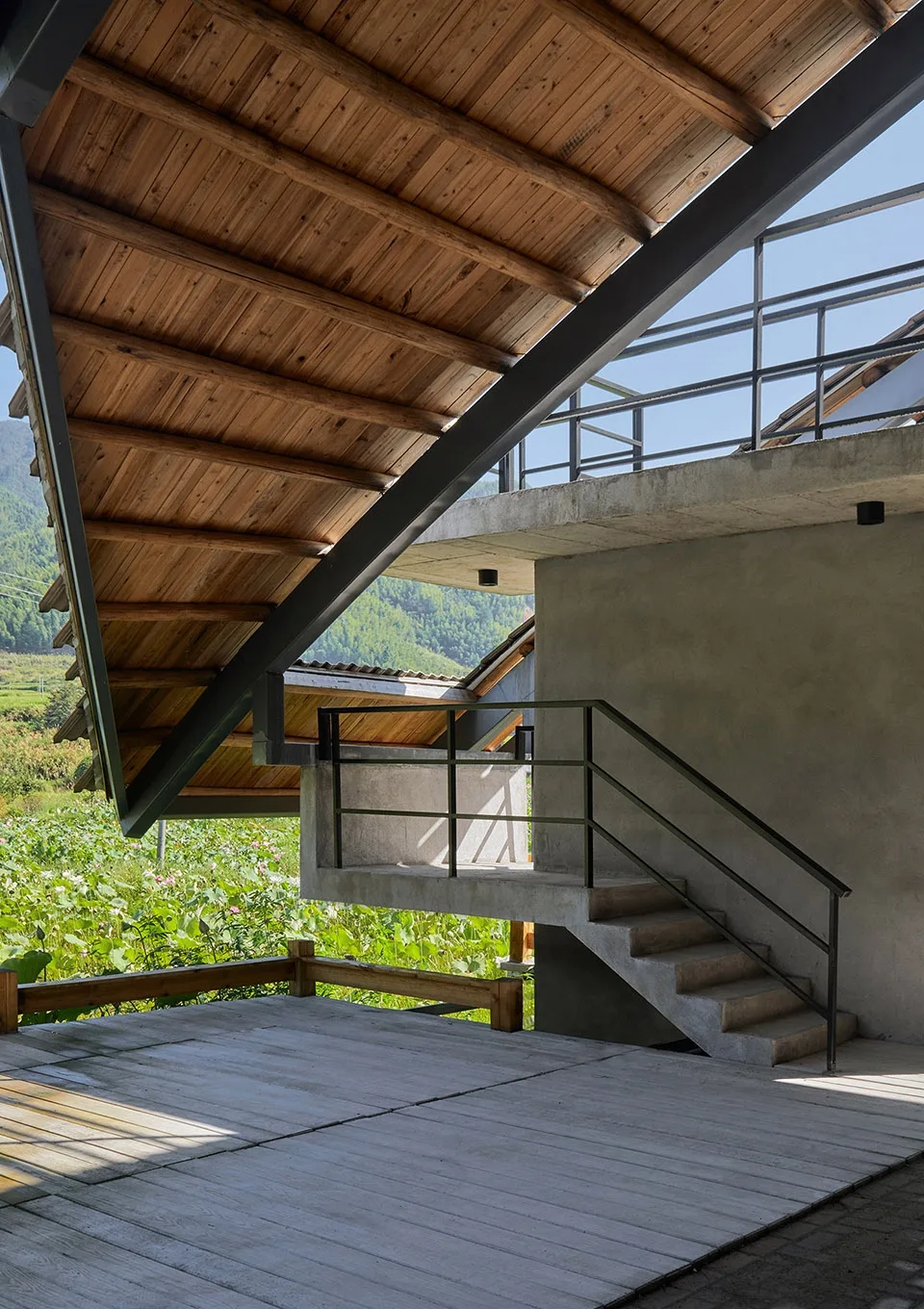
△ Outdoor staircase @ Sanwen Architecture
Glazed Tiles: Exploring Common Rural Materials
The roof features bright glazed tiles, creatively repurposing a material widely used in rural Chinese homes since the 1990s. Historically, before 1912, glazed tiles were reserved for palaces and temples, forbidden in residential architecture. As living standards improved and production costs dropped, glazed tiles became common in rural houses due to their strength, waterproof qualities, shiny appearance, vibrant colors, and royal connotations.
However, many architects and cultural scholars criticize glazed tiles and similar materials like ceramic tiles and metal sheds for eroding traditional rural aesthetics. This aesthetic divide highlights a tension: architects prefer simple, traditional materials, while villagers choose shiny, functional materials for practical and symbolic reasons. This dilemma raises important questions about rural architectural values and aesthetics.
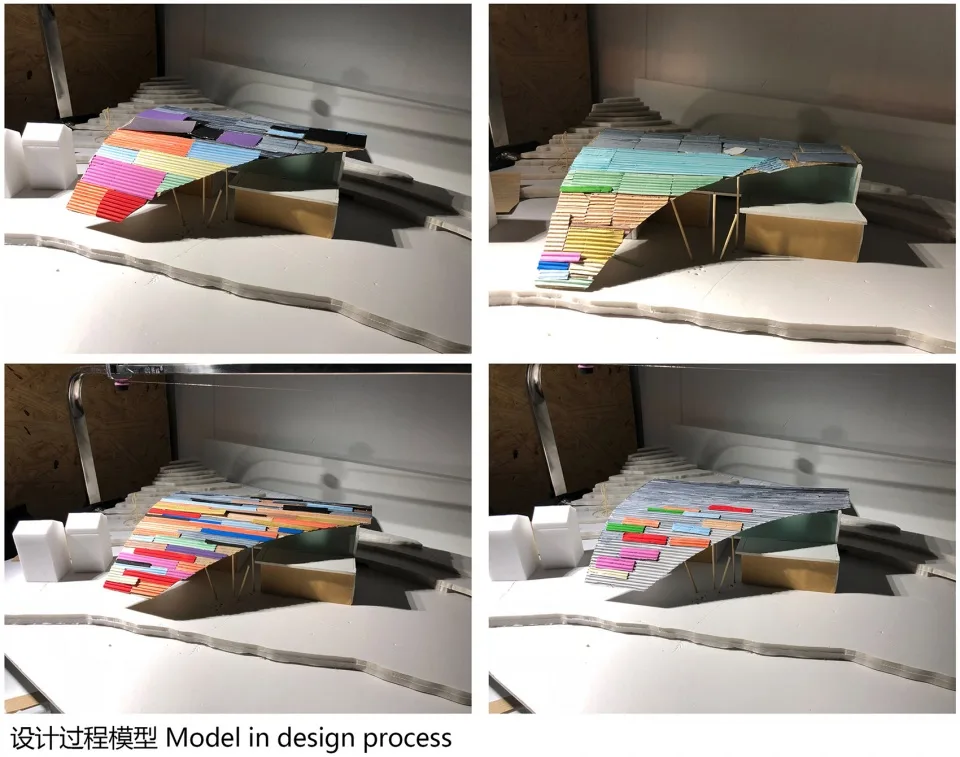
△ Roof design process @ Sanwen Architecture
The architects aim to explore how glazed tiles might achieve contemporary aesthetic status in rural architecture—balancing villagers’ desire for shiny materials with modern design sensibilities. This represents a bold, experimental approach.
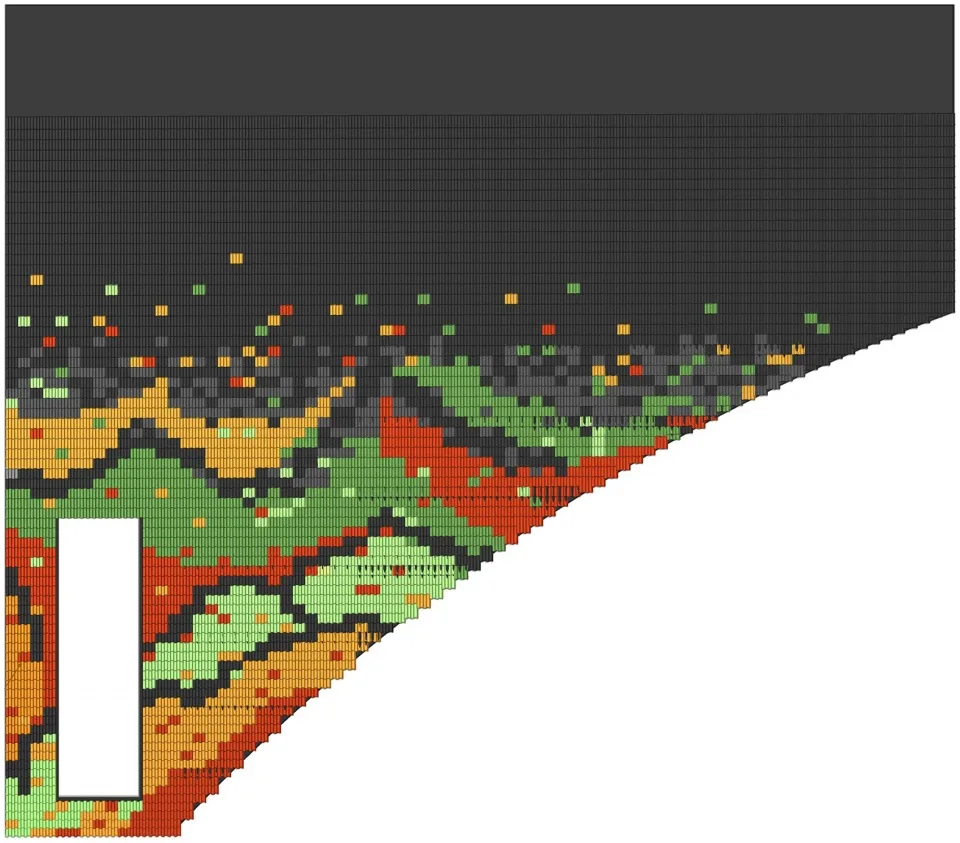
△ Roof Pattern @ Sanwen Architecture
The glazed tiles used in this project are common, mass-produced products sourced from Taobao. The architects experimented with various colors and arrangements, ultimately selecting black, gray, red, orange, dark green, and light blue. The upper roof is primarily black tiles, symbolizing the relationship between the building and the bamboo forest behind it, a traditional color pairing for roofs and forests.
Colorful tiles concentrate on the front and eaves of the roof, creating a distinctive facade when viewed from ground level. The tile arrangement is carefully patterned, inspired by aerial photographs of nearby lotus ponds and rice fields, but abstracted and adjusted for construction feasibility.
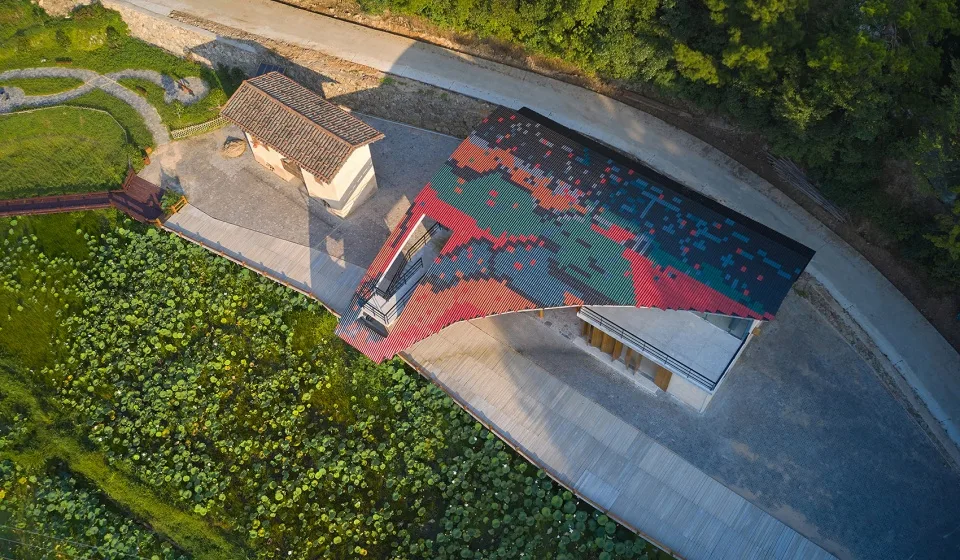
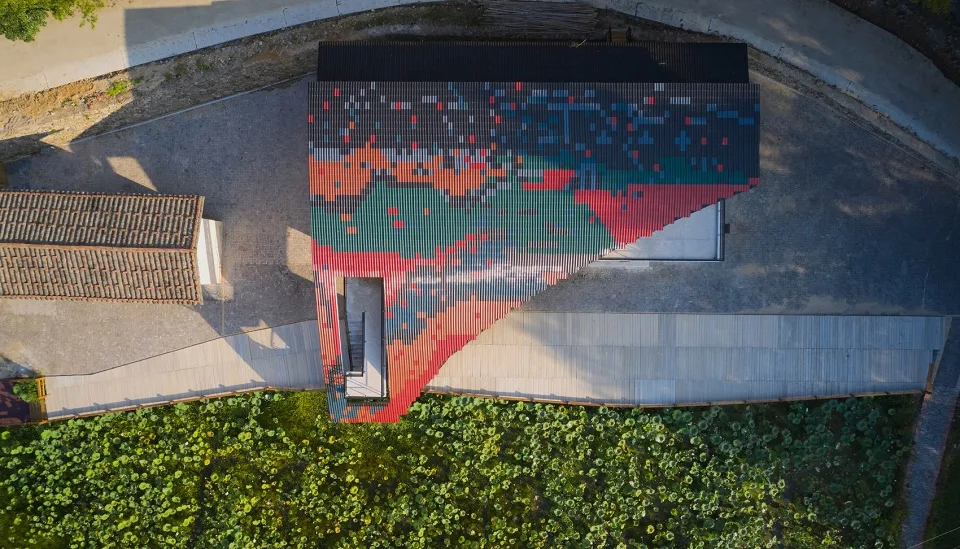
△ Aerial view showcasing the colorful glazed tile roof @ Sanwen Architecture
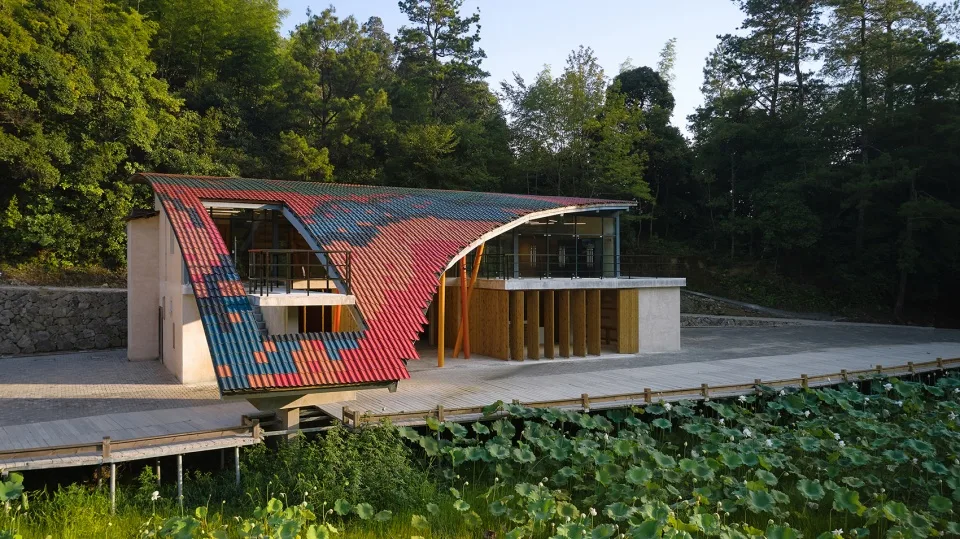
△ Colorful roof blending with the surrounding natural environment @ Sanwen Architecture
Interior: New Spaces Embracing Old Memories
The interior is straightforward and functional. The two-story building’s first floor contains multiple small spaces, all with public functions except the kitchen. The community center connects seamlessly with the exhibition hall, serving both residents and visitors as a relaxing space.
The exhibition hall preserves elements of the original tobacco curing room, such as the wooden frames for hanging tobacco and observation openings for the fire. It also includes display tables for local agricultural products and handicrafts, supporting future operational possibilities.
The community center features a service desk and flexible arrangements for tables and chairs, fostering community interaction. The conference room offers various services and can double as a private meeting room to accommodate diverse user needs.
Importantly, the boundary between indoor and outdoor spaces on the first floor is fluid. A rotatable wooden partition wall allows easy connection between internal and external areas, creating a flexible, scalable, and ambiguous spatial experience.
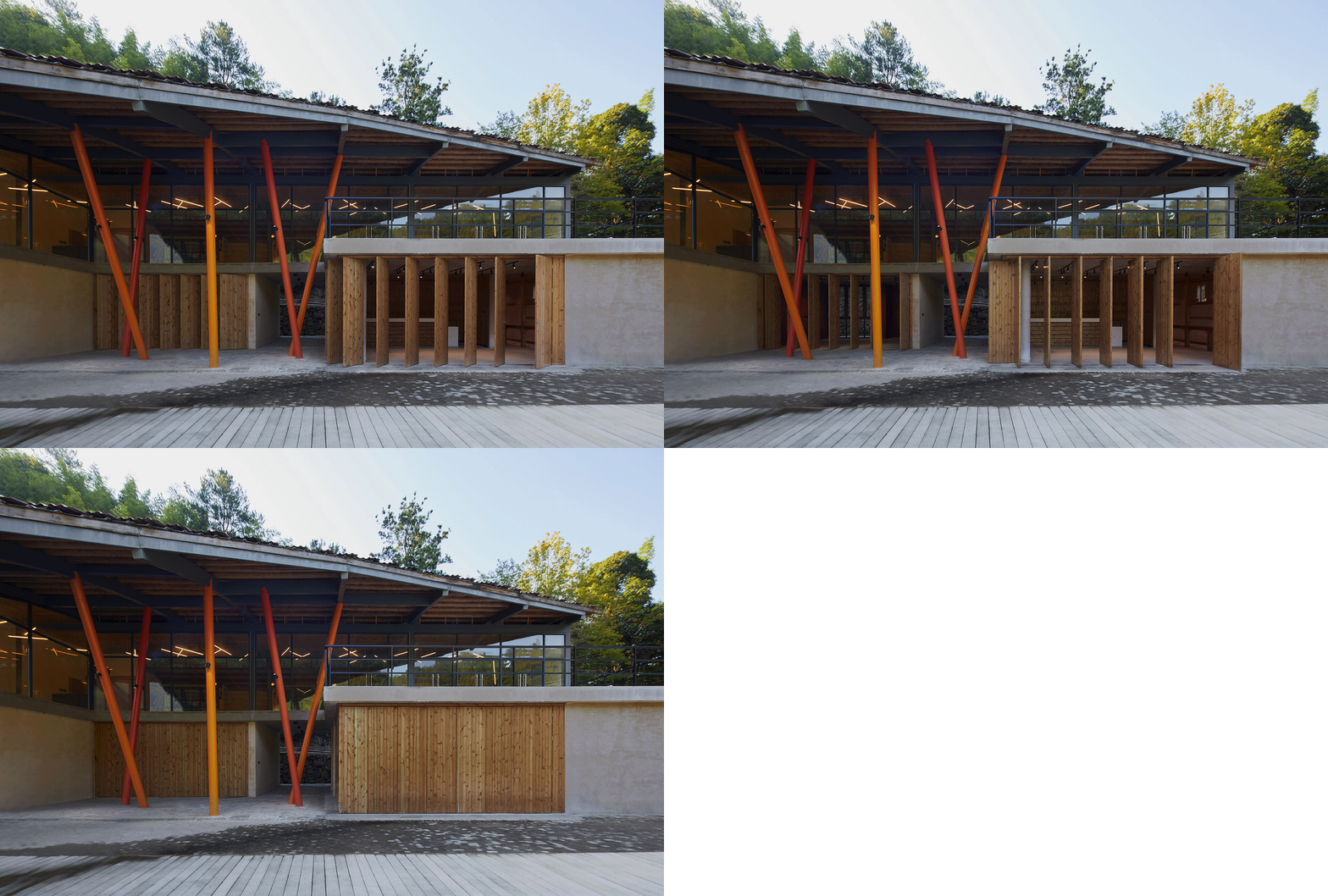
△ Rotating door blurring the boundary between inside and outside @ Sanwen Architecture
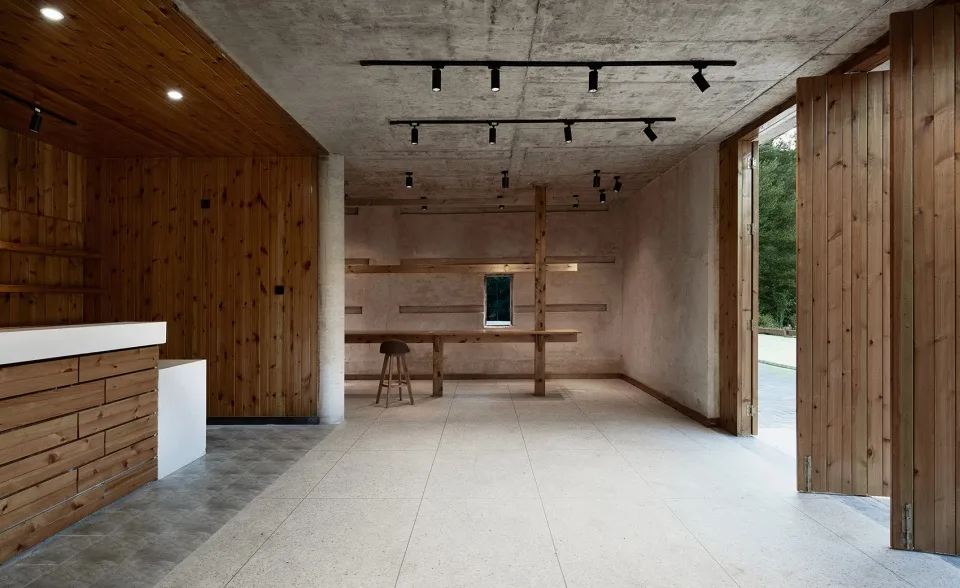
△ First Floor Community Center @ Sanwen Architecture
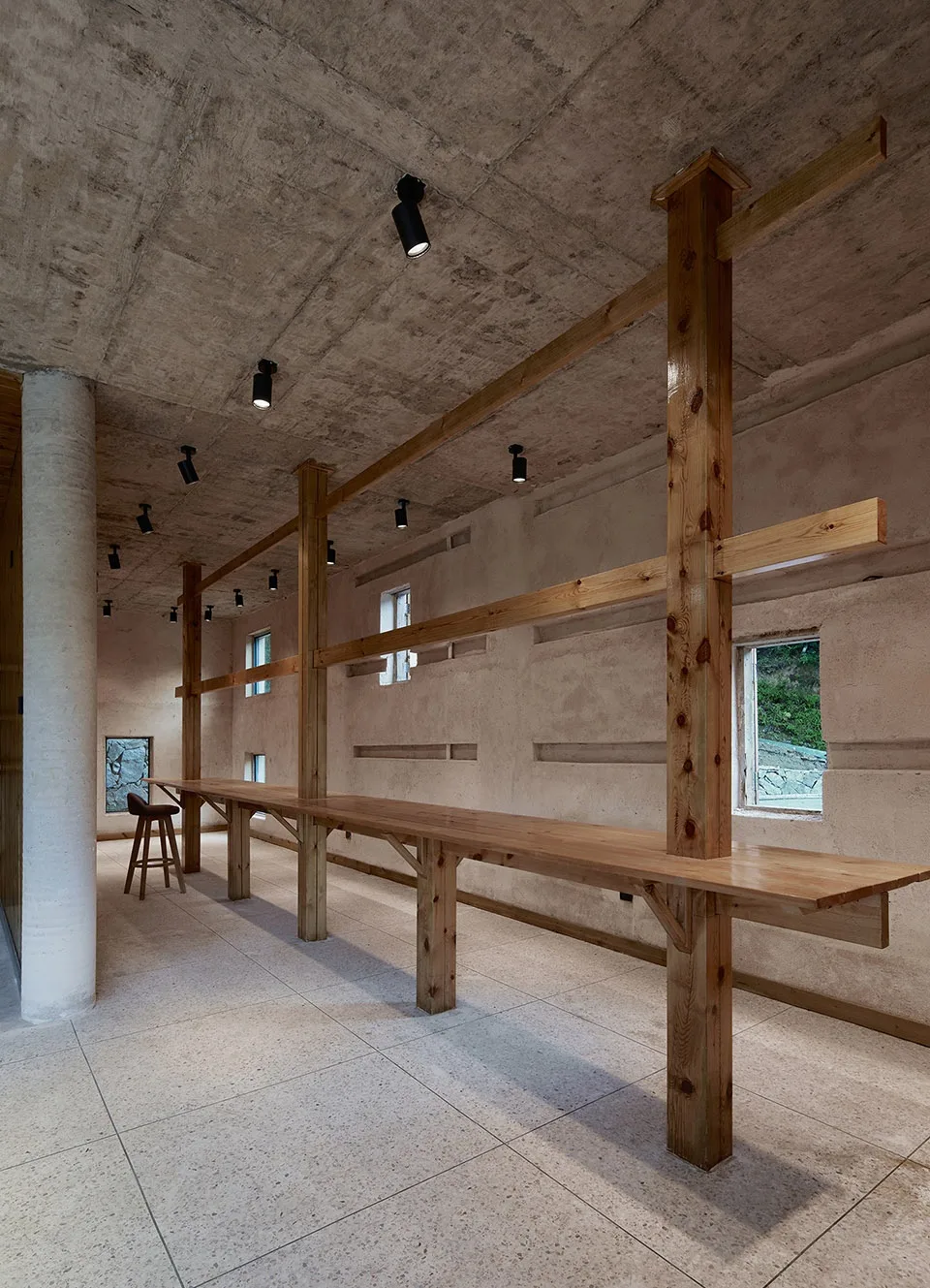
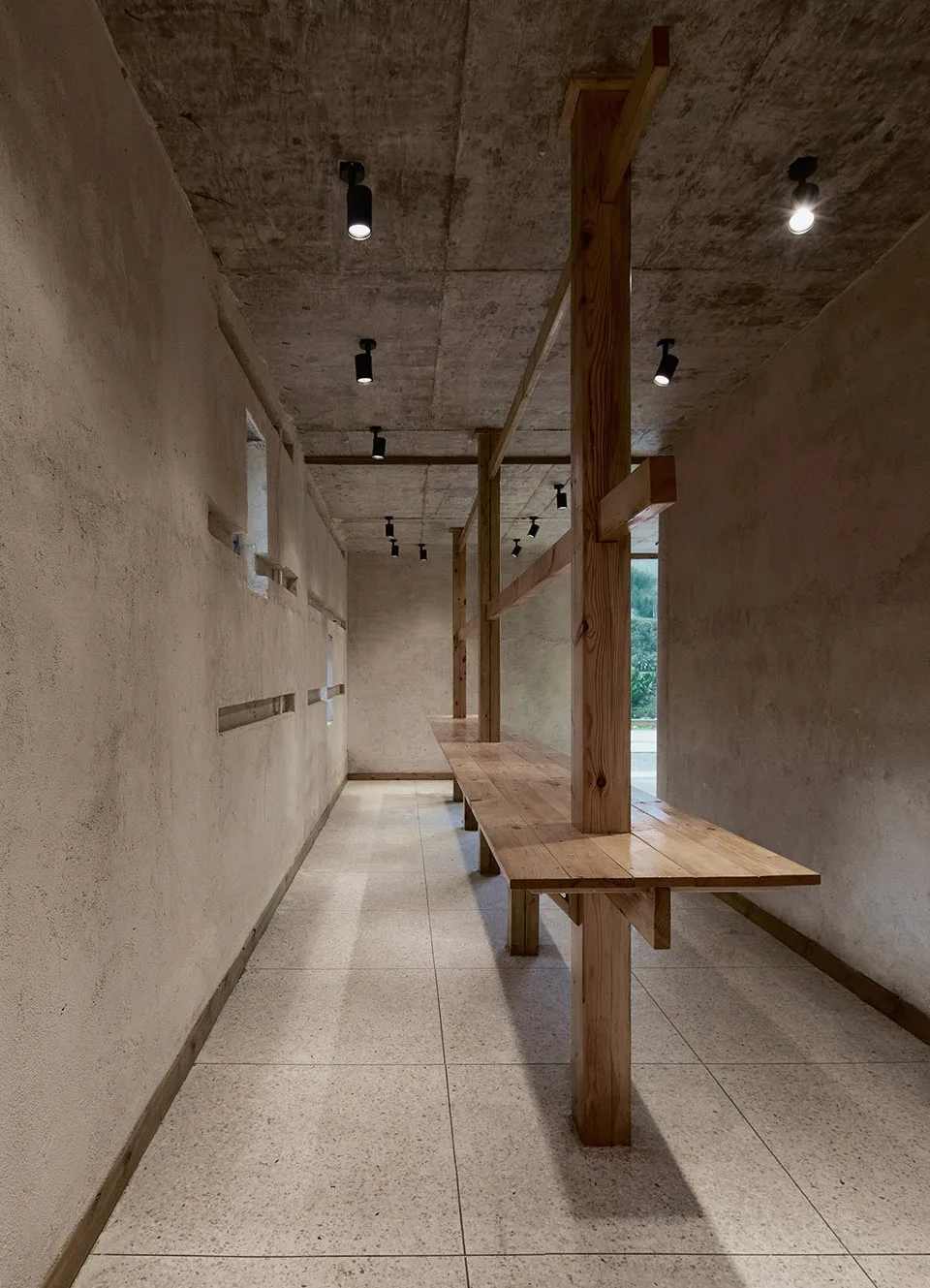
△ Exhibition Space @ Sanwen Architecture
The second floor serves as a multifunctional hall. Its east wall undulates in correspondence with the original tobacco factory’s four parallel production spaces, expressing memory through architectural form. The interior walls are clad in orange tiles that extend to the floor, ending at structural columns. The remaining floor areas are finished in terrazzo, distinguishing open and enclosed zones that align with future furniture layouts.
The ceiling follows the roof’s curved shape and is decorated with bamboo mats, reflecting local regional characteristics. Lighting is intentionally irregular; linear light fixtures provide basic illumination but are arranged in an irregular pattern under the ceiling, creating a dynamic composition and a contemporary atmosphere inside.
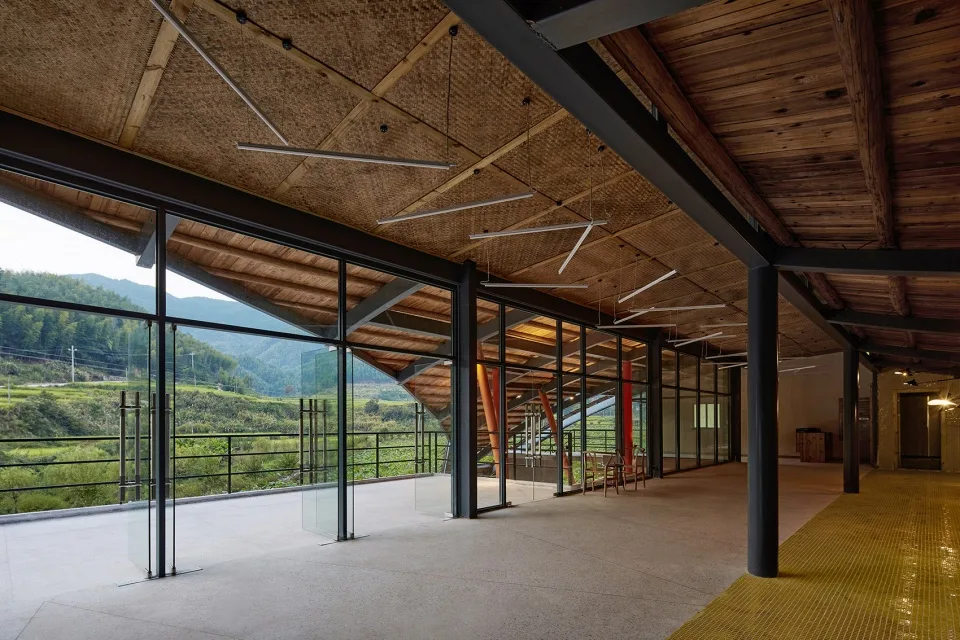
△ Second floor restaurant with full-height glass doors framing the outdoor scenery @ Sanwen Architecture
Conclusion and Reflection
The design and construction of this project spanned three years. We express our deep gratitude to the owner for their trust and support, which allowed for a research-driven design process. The topic of rural architecture in China is complex. Judging traditional versus contemporary, stylistic versus practical, and native rural versus imported forms with simple logic is challenging.
Architects and scholars often criticize the destruction of traditional rural landscapes, yet rarely empathize with why rural residents choose urban and modern forms and materials. They seldom consider the sociological and economic factors behind these choices or appreciate their value from a folk aesthetic perspective.
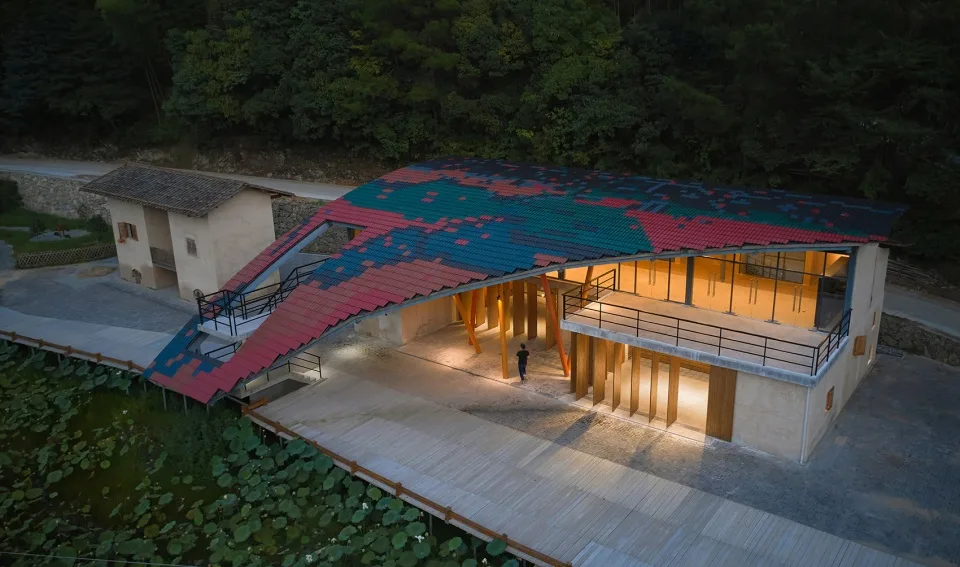
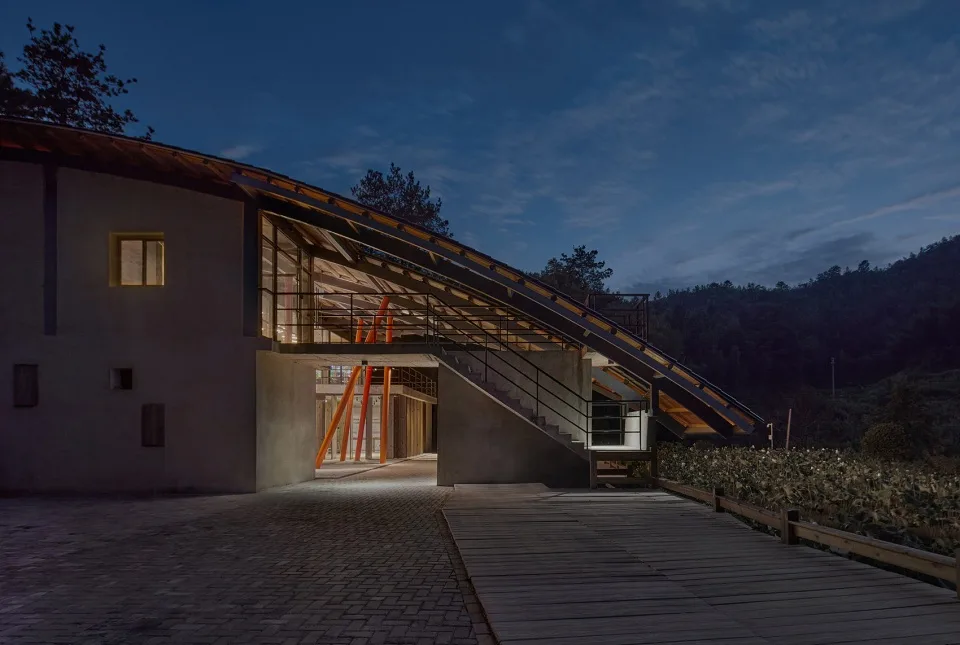
△ Night View @ Sanwen Architecture
In this design, the architects sought to learn spatial language from rural production buildings and to apply decorative approaches using common rural materials like glazed and ceramic tiles. This approach is neither mere copying nor outright rejection or acceptance, but rather a critical and creative reimagining.
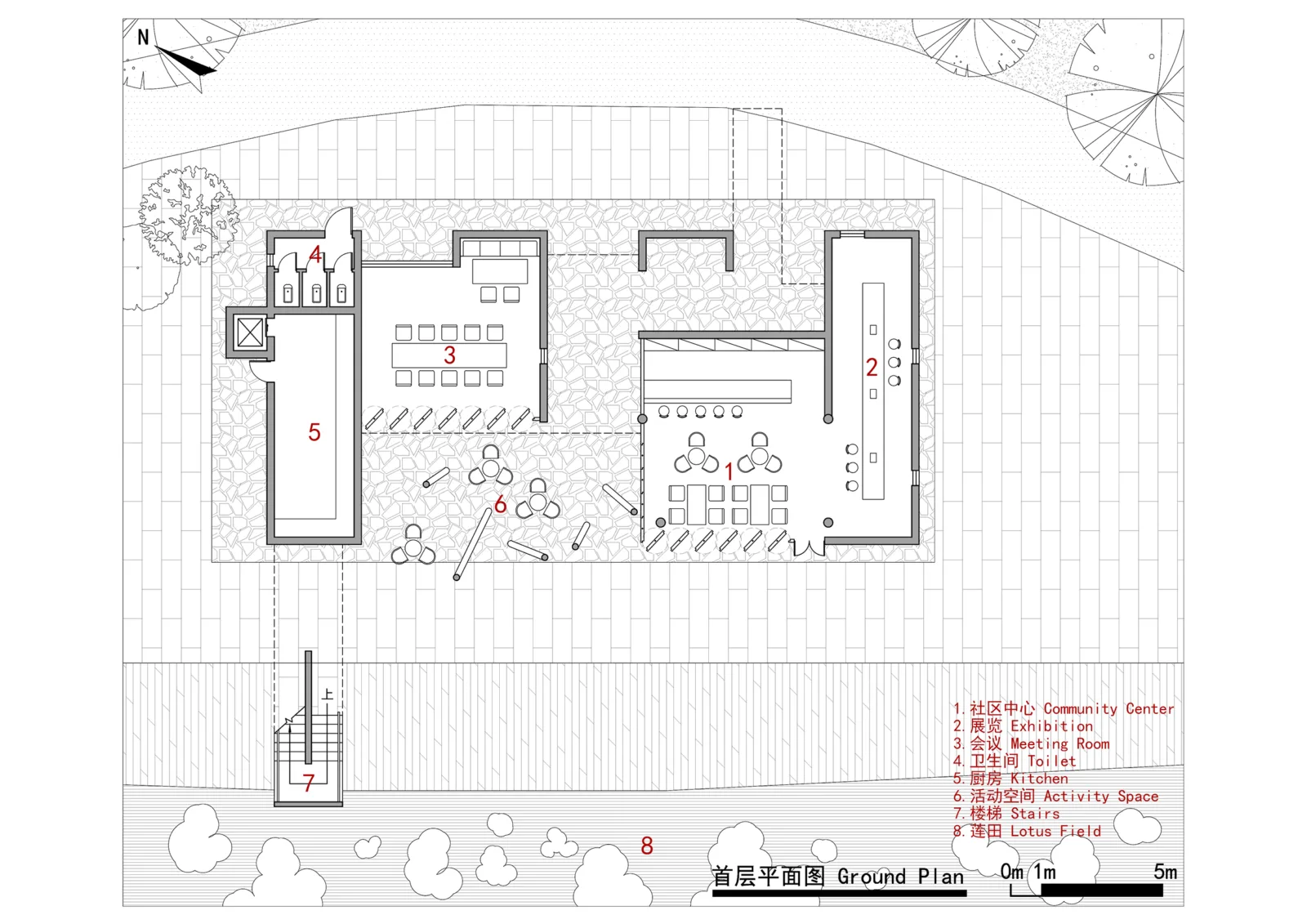
△ First Floor Plan @ Sanwen Architecture
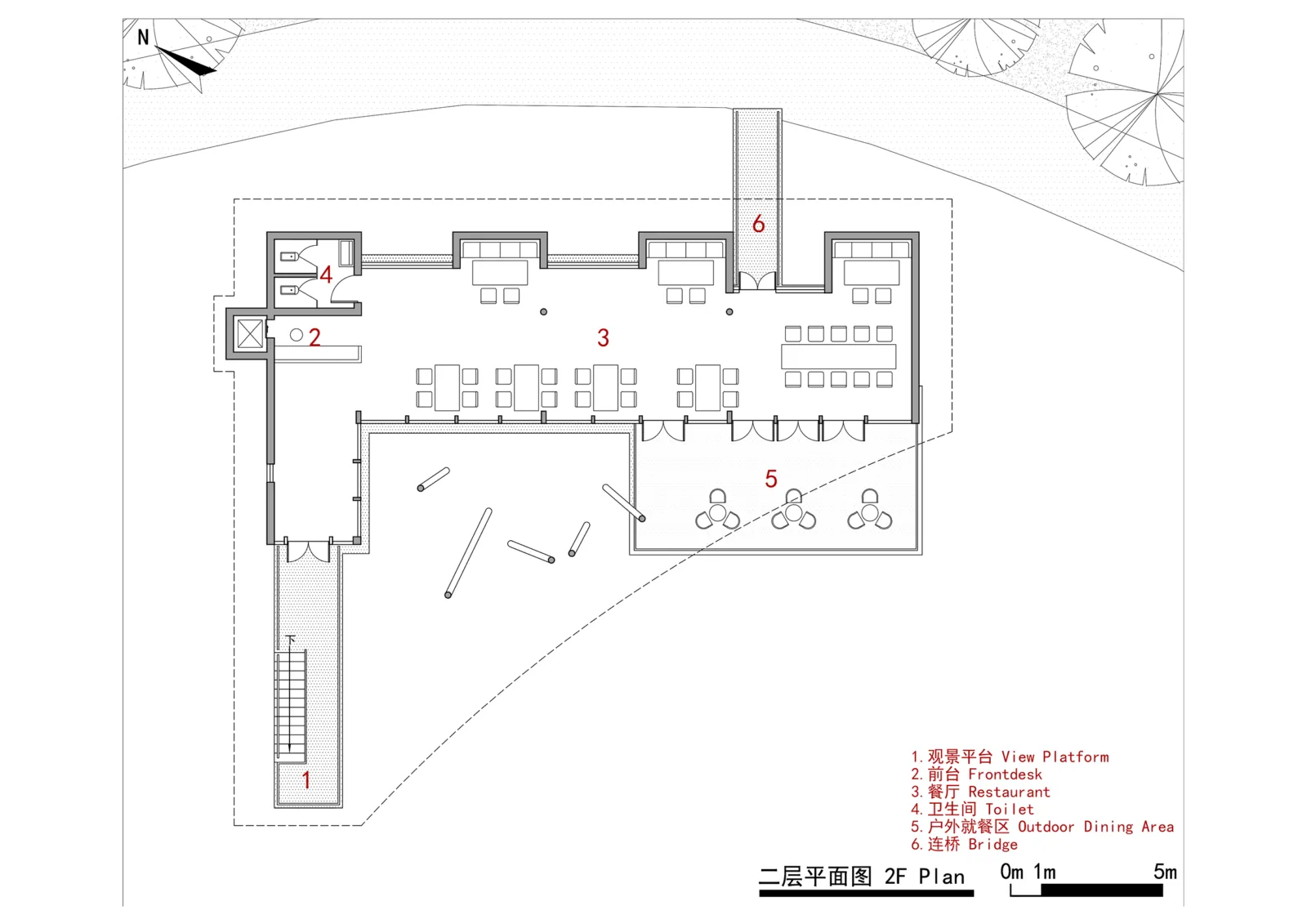
△ Second Floor Plan @ Sanwen Architecture
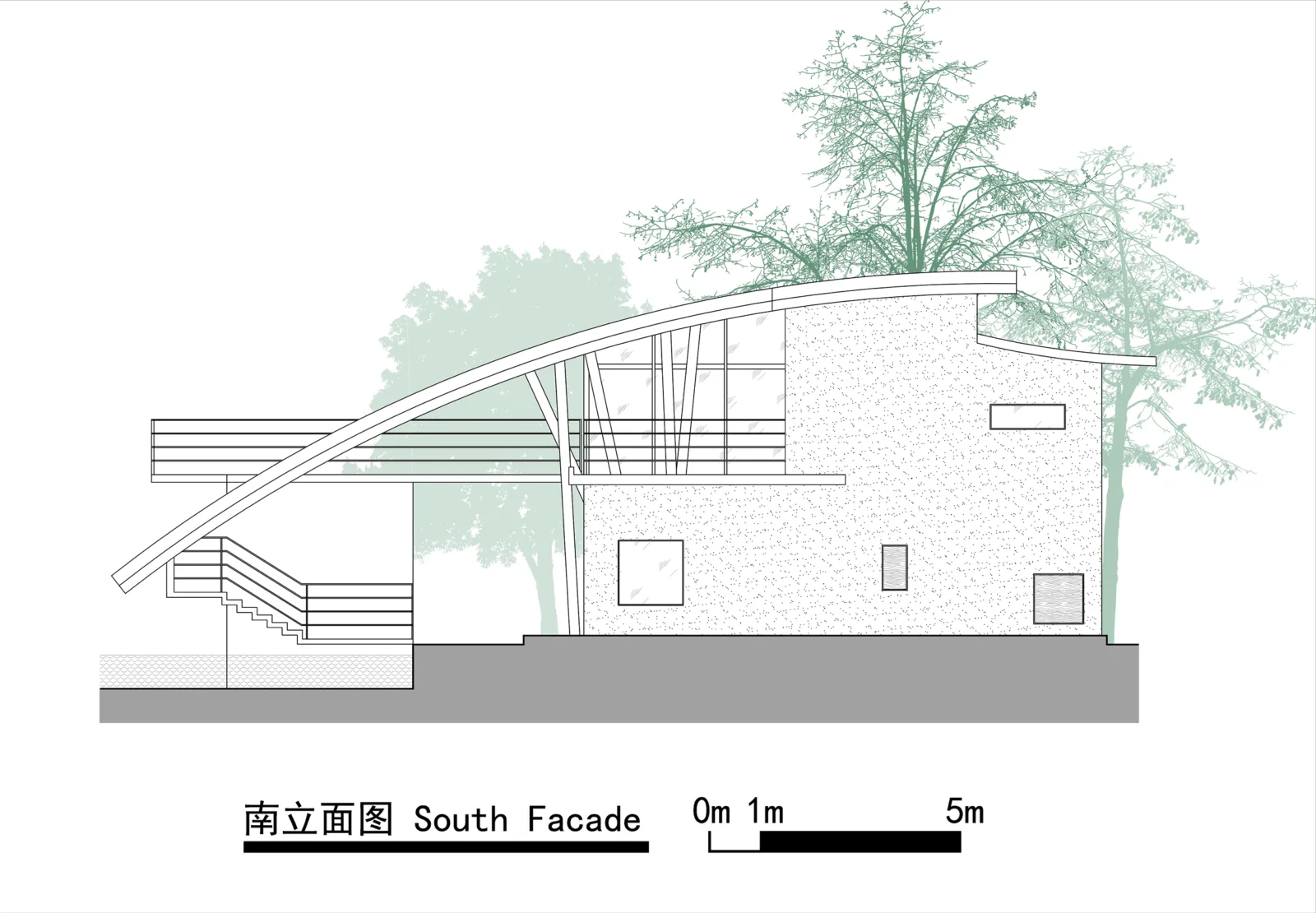
△ Building Facade @ Sanwen Architecture
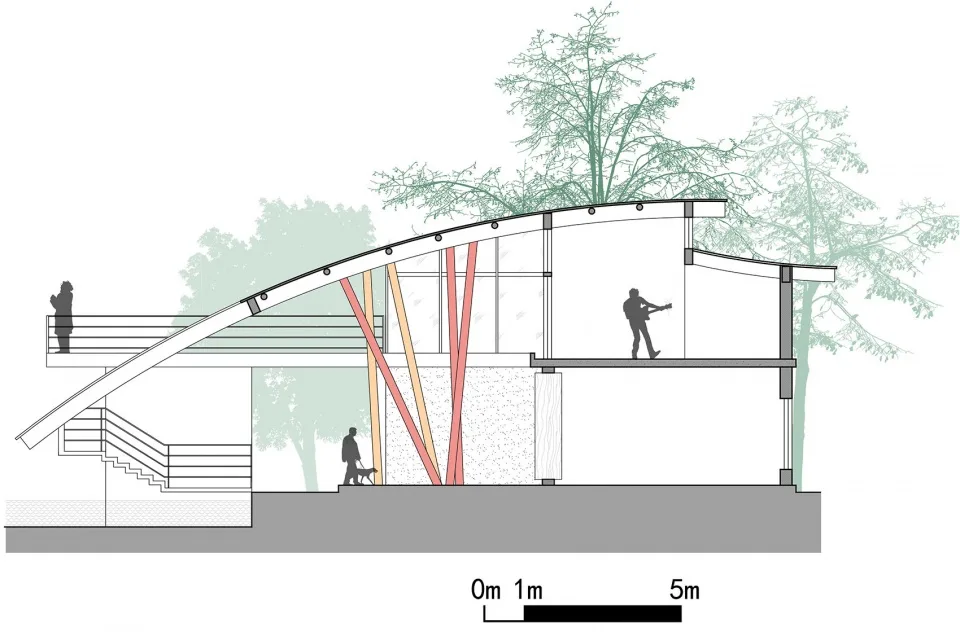
△ Section View @ Sanwen Architecture
Project Information:
Project Name: Dutuan Village Public Service Center
Location: Dutuan Village, Xiyuan Township, Jianning County, Fujian Province
Owner: Xiyuan Township People’s Government
Lead Architect: He Wei
Team Members: Chen Long, Li Qiang, Song Ke, Cao Shiqing, Zhao Xinze, Wu Lijun (Intern)
Structural Consultant: Pan Congjian
Architecture and Interior Design: Sanwen Architecture (www.3andwickdesign.com)
Building Area: 350 square meters
Design Period: 2017–2019
Completion: July 2020
Photography: Fang Liming, He Wei













Must log in before commenting!
Sign Up