
A Small Square Enclosed by an Open Corridor
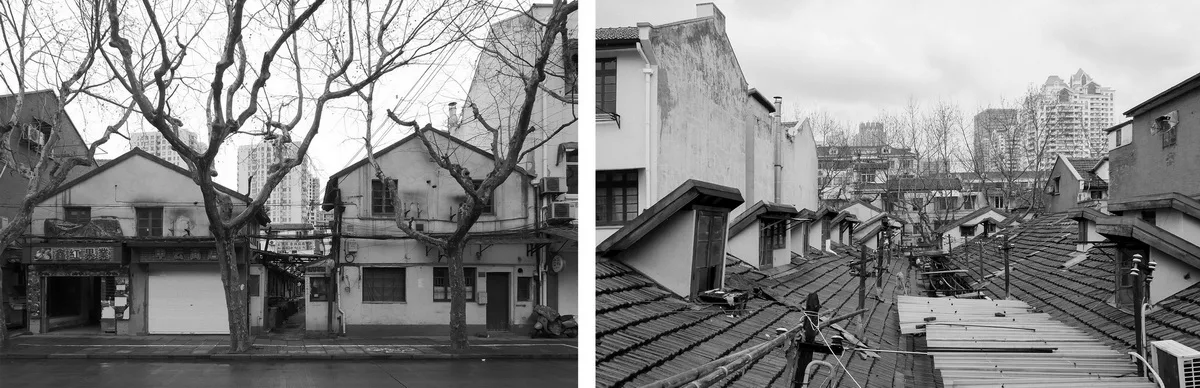
Yongjia Road is situated in the heart of Shanghai’s historic district, surrounded by numerous old residential neighborhoods. The street offers a pleasant scale, lined with dense greenery and a variety of small businesses that support everyday life, creating a vibrant community atmosphere. The site of the 309 Lane Pocket Park lies in the middle section of Yongjia Road. As part of the city’s urban renewal efforts, local authorities decided to remove two rows of dilapidated, fire-prone residential buildings and transform the space into a public urban area for nearby residents. Aside from the streets, there is a notable lack of accessible public spaces in the vicinity, making the creation of a thoughtfully scaled, functional public square a welcome addition to this neighborhood.
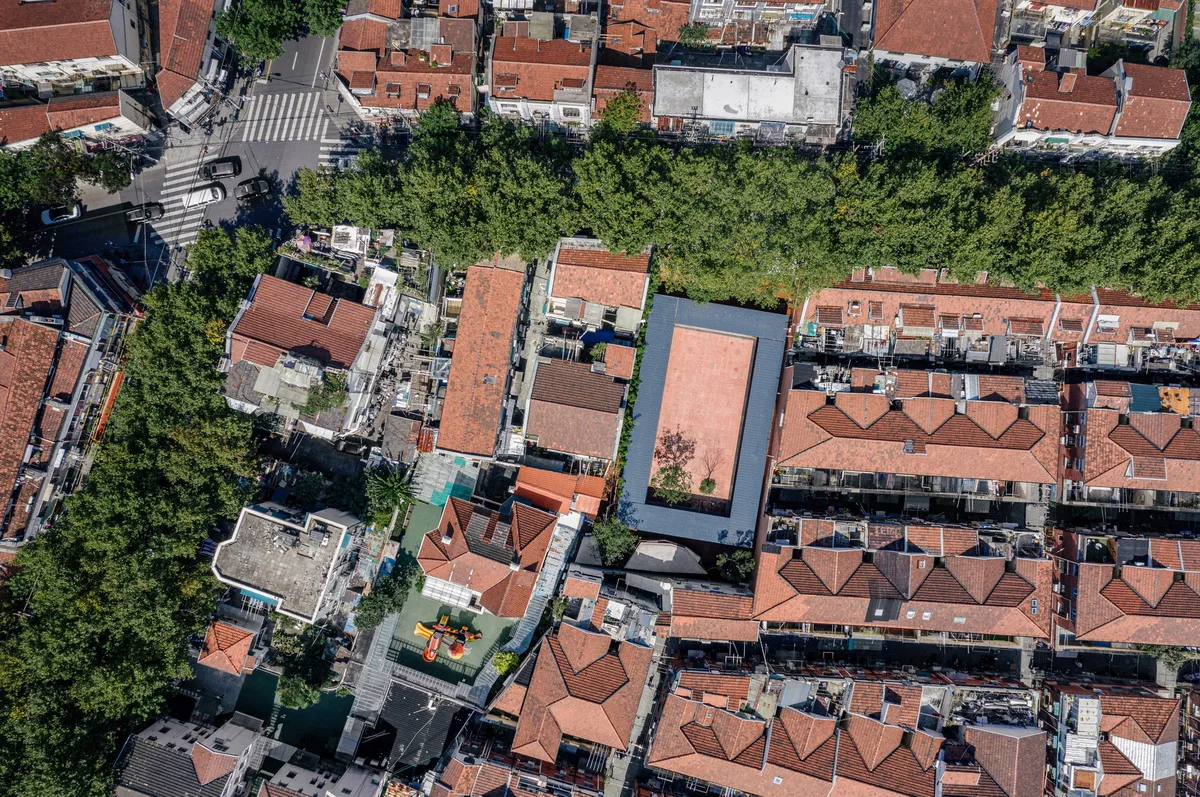
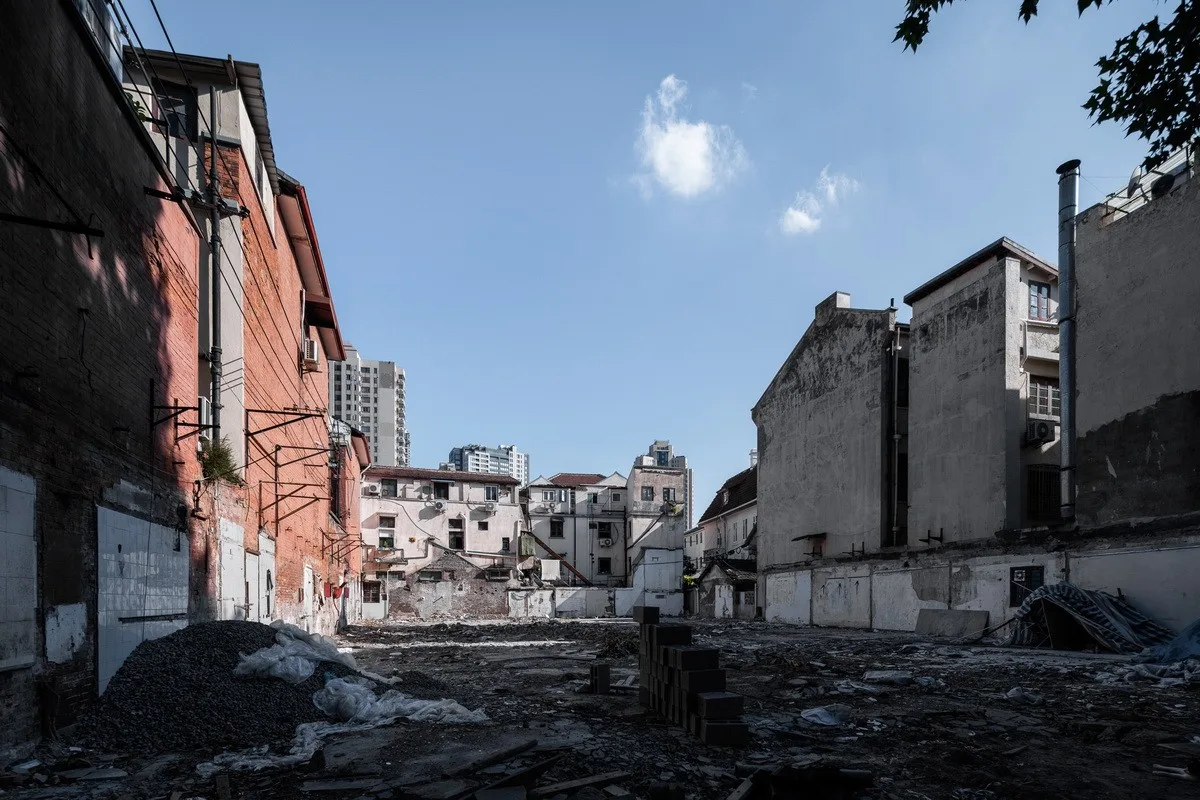
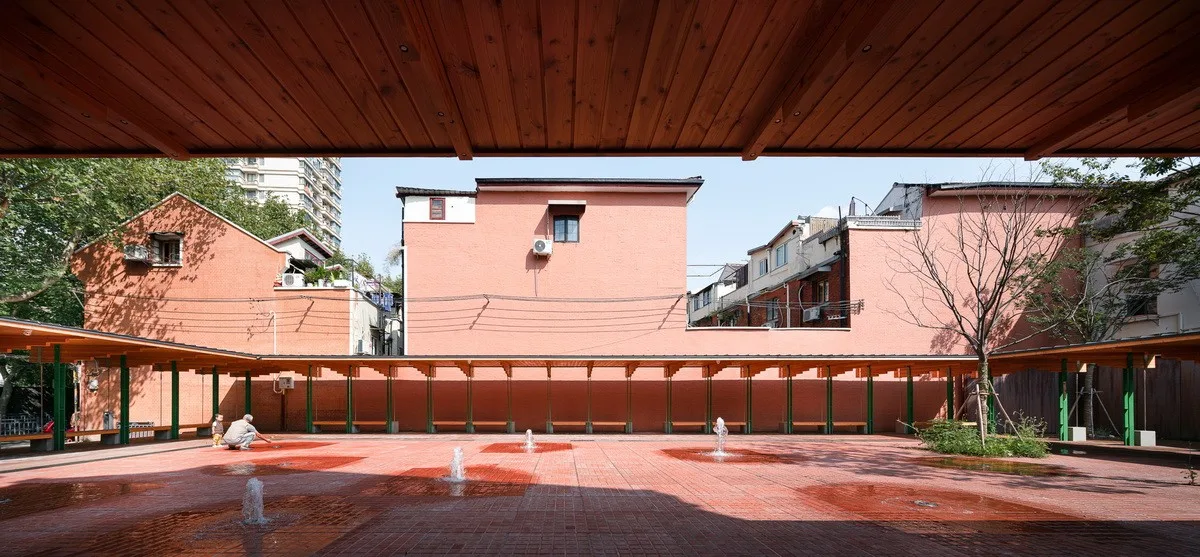
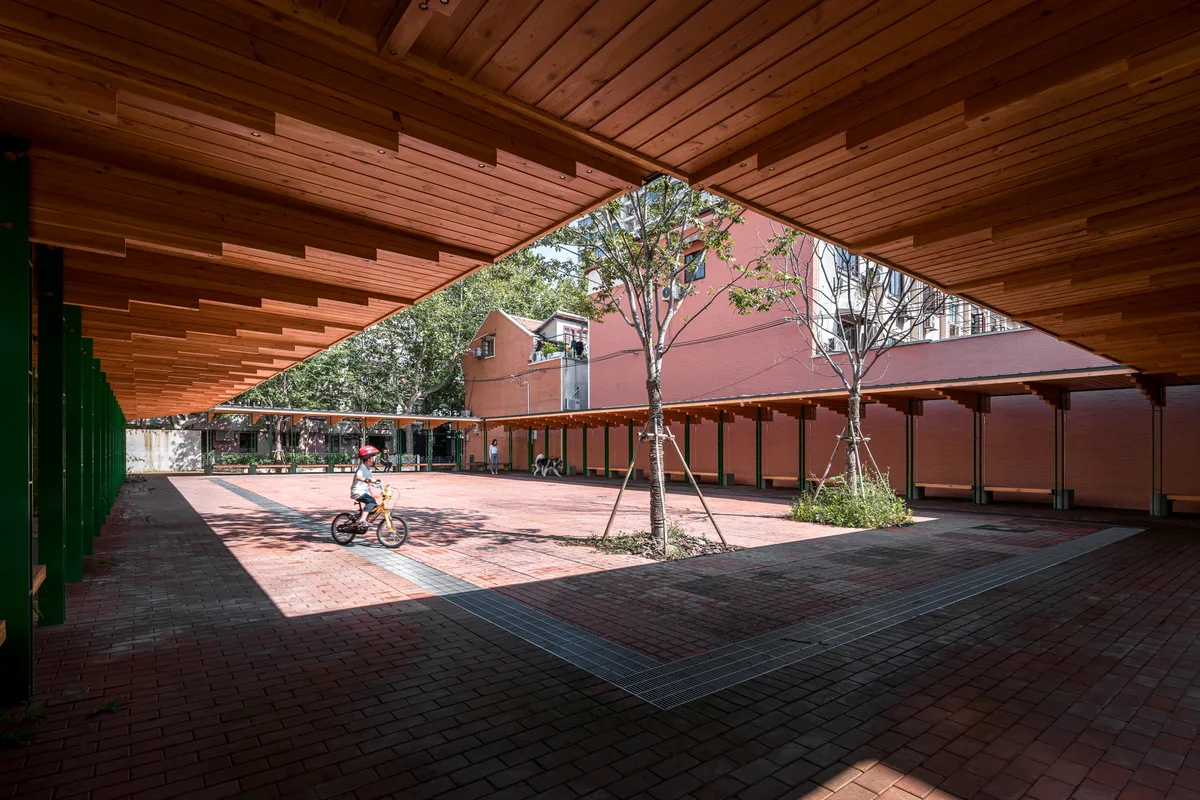
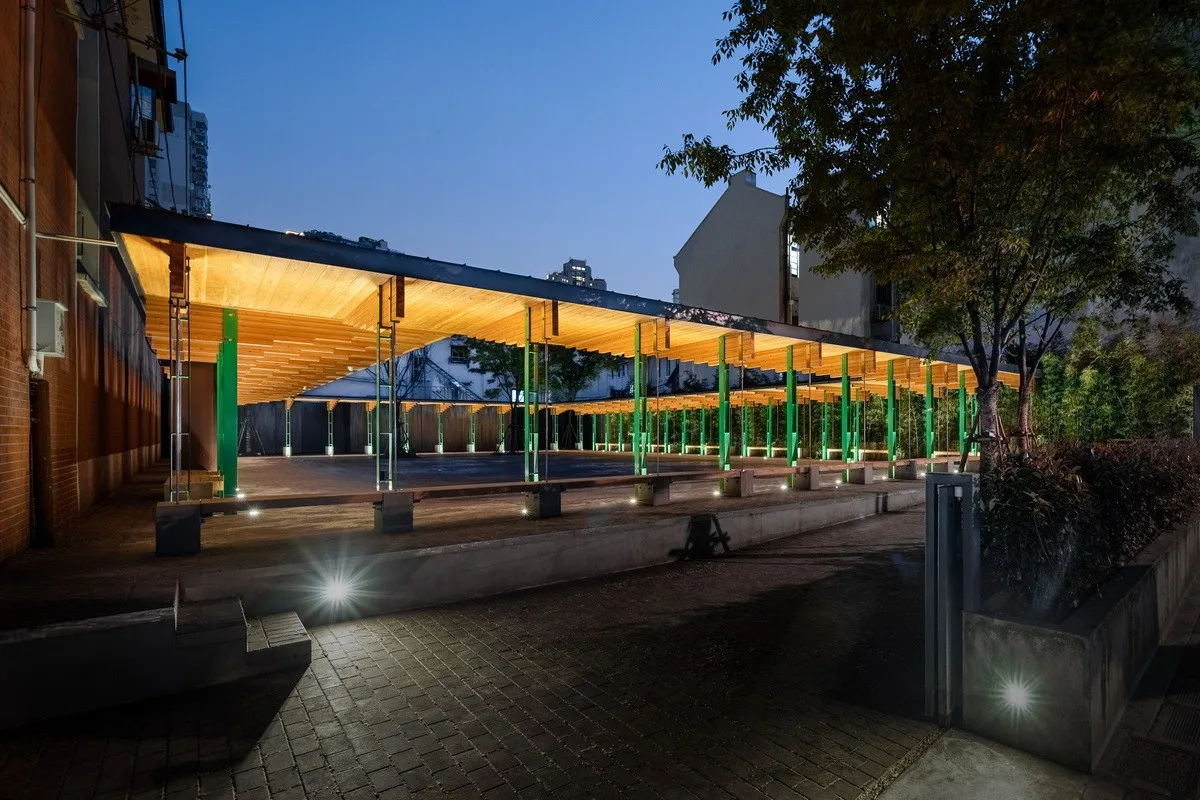
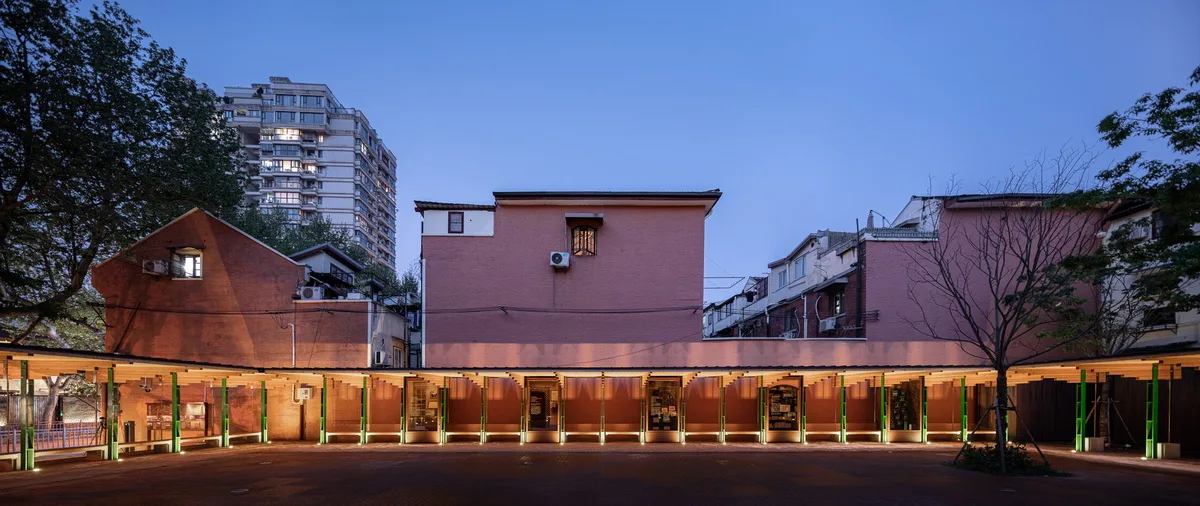
Following demolition, the site forms an approximately rectangular plot, about 18 meters wide along the street and 40 meters deep, almost perpendicular to the road. It is enclosed on three sides by residential buildings, creating a pocket-like space. The public area is designed as a small square surrounded by an open corridor. The square is elevated by 0.5 meters to enhance its presence and establish an engaging visual connection with the street. A dry spray system is installed in the square, capable of being turned on or off according to the time of day, allowing flexible use of the space. Two concealed auxiliary rooms occupy the southern end of the square, separated from the main area by a continuous, winding weather-resistant steel plate wall that acts as a boundary at the square’s edge.
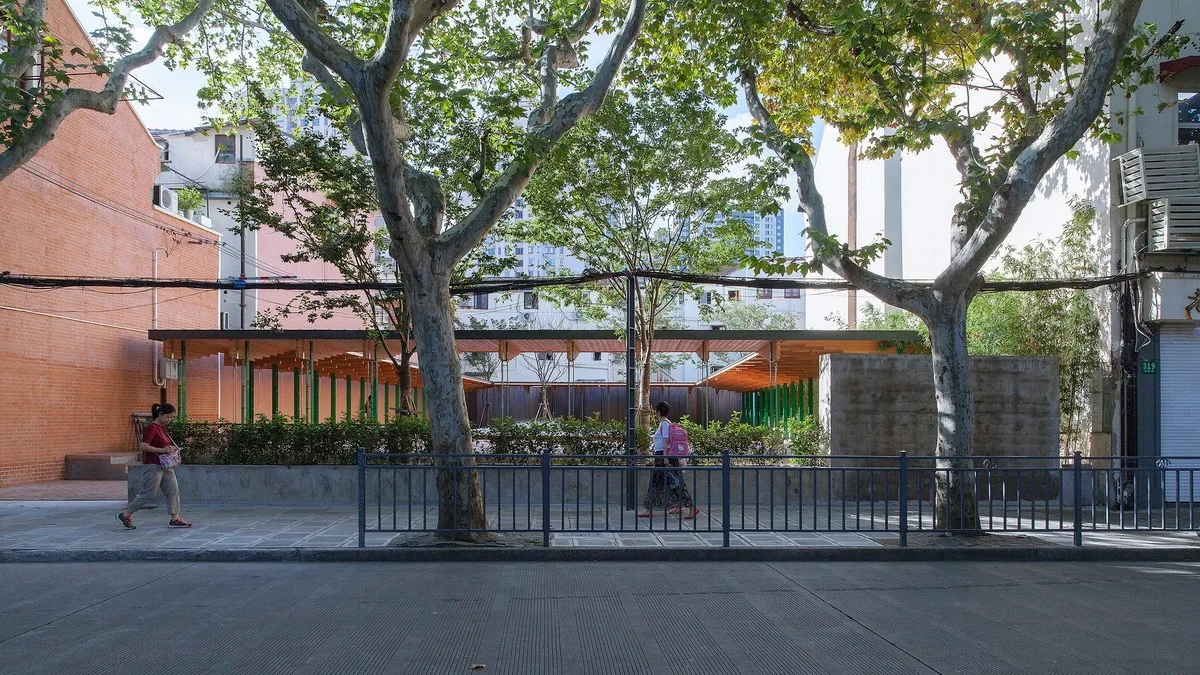
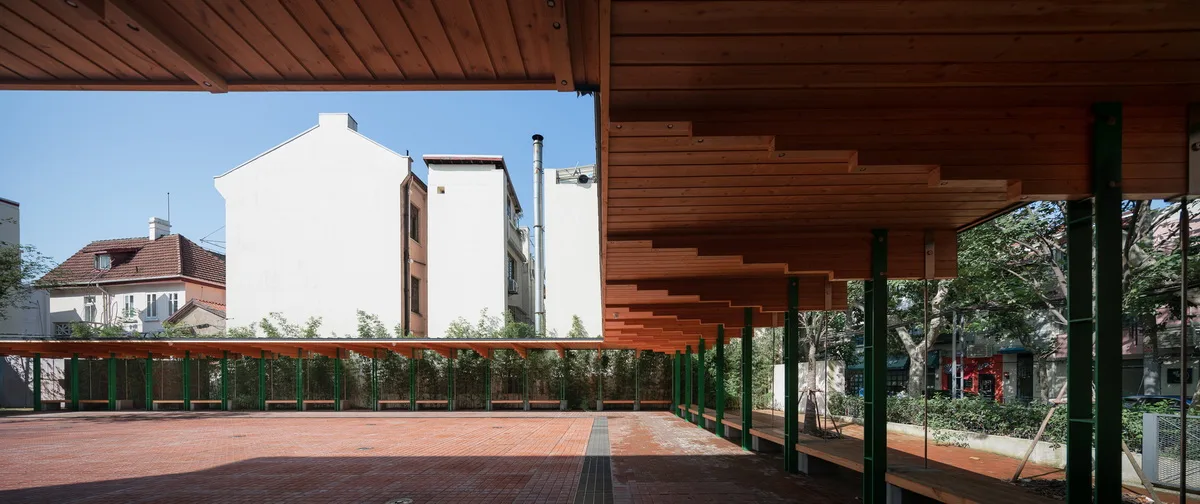
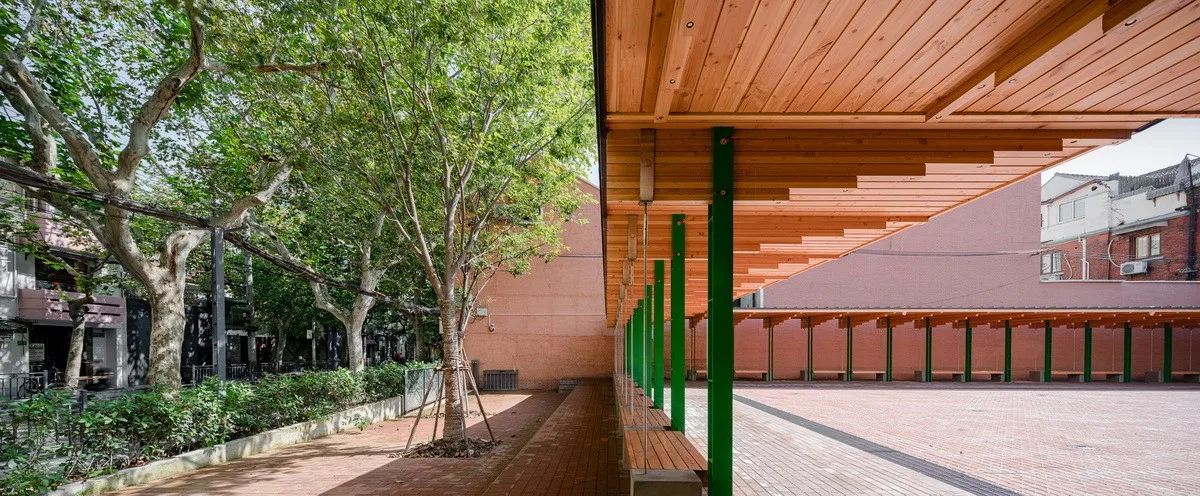
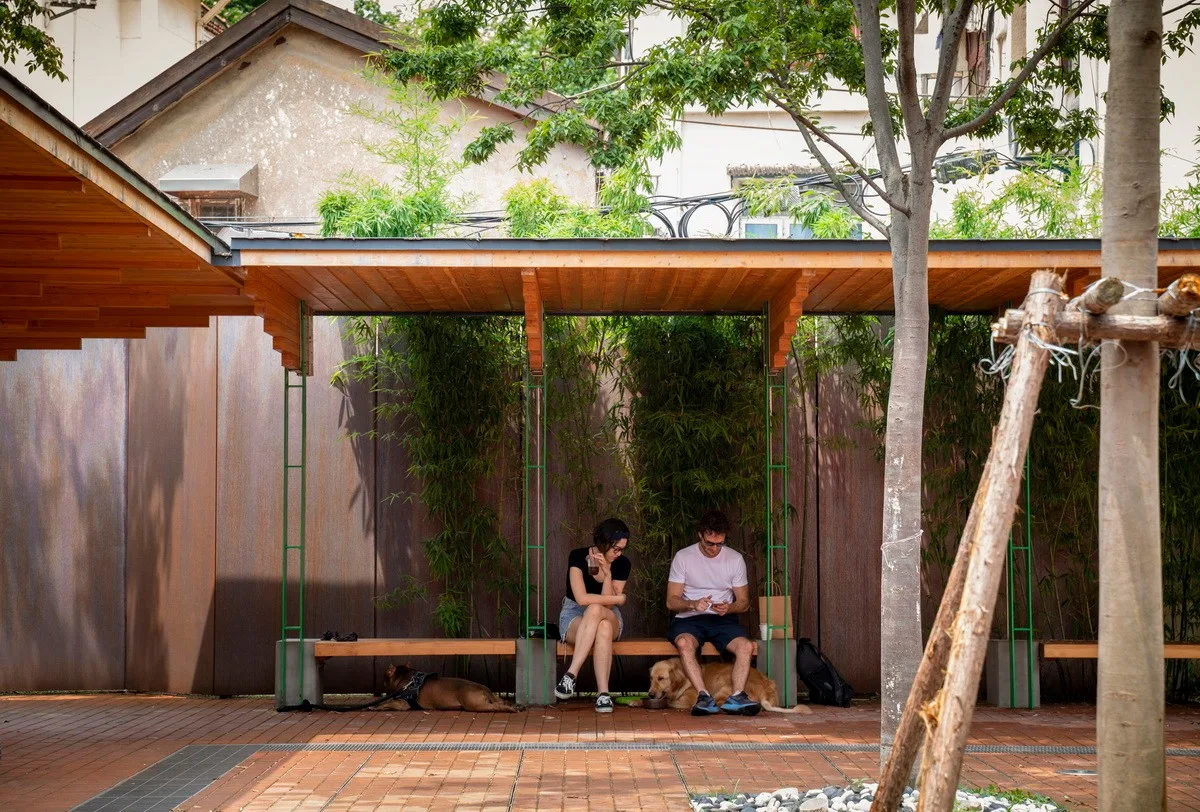
The open plaza connects gently to the street via a sloped entryway. Adjacent to the sidewalk, a sign wall and a low shrub flowerbed create a welcoming threshold. A convenient iron sliding gate is positioned at the northeast corner, with both the gate and shrubbery maintained at a height of 1.2 meters to preserve clear sightlines. The residential gable walls closely flank the square’s east and west sides. The eastern wall has been refreshed with a new coat of paint, while the western wall retains its original weathered texture, with a bamboo grove nestled behind the open corridor.
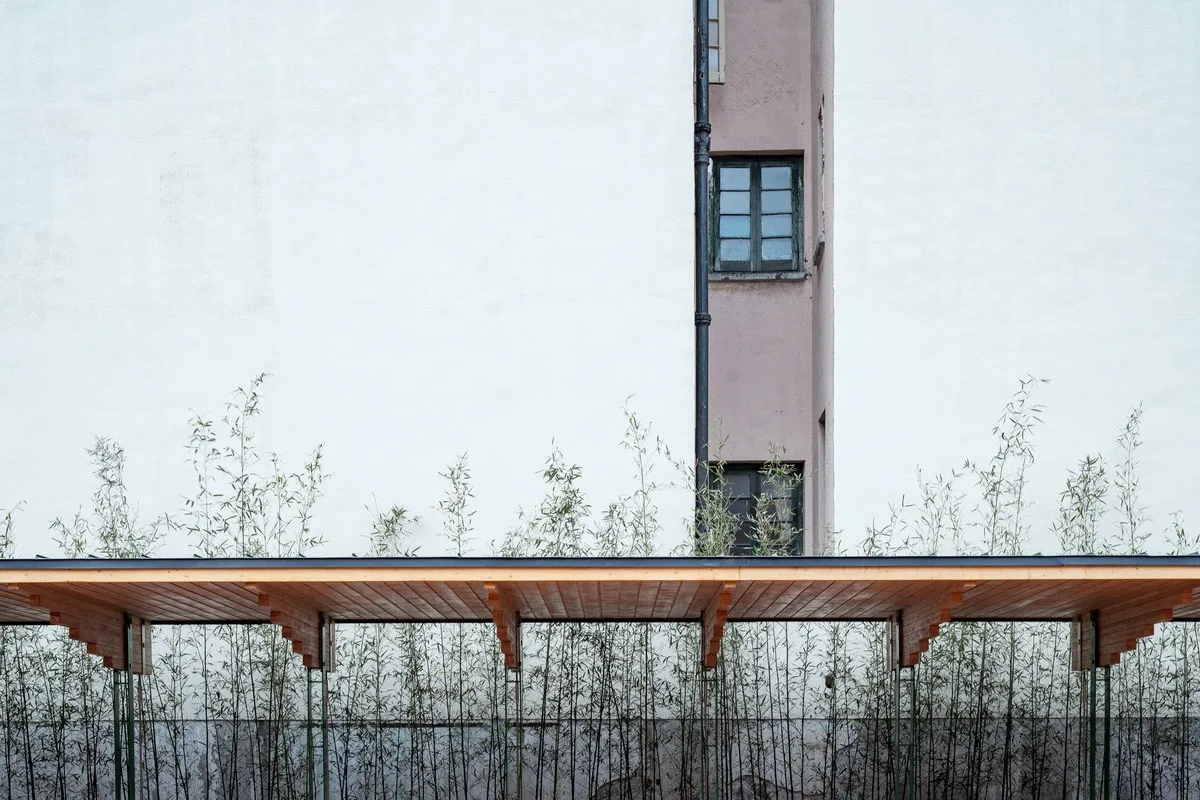
Steel-Wood Structure and Red Brick
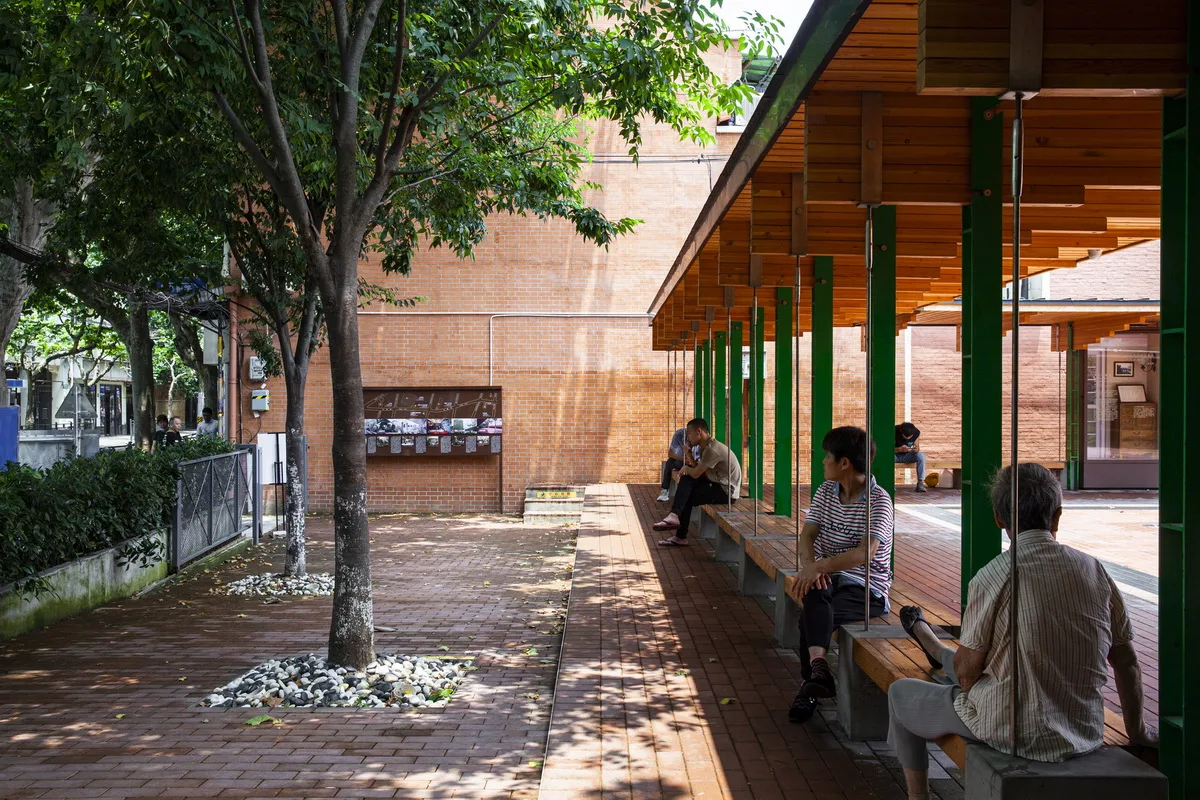
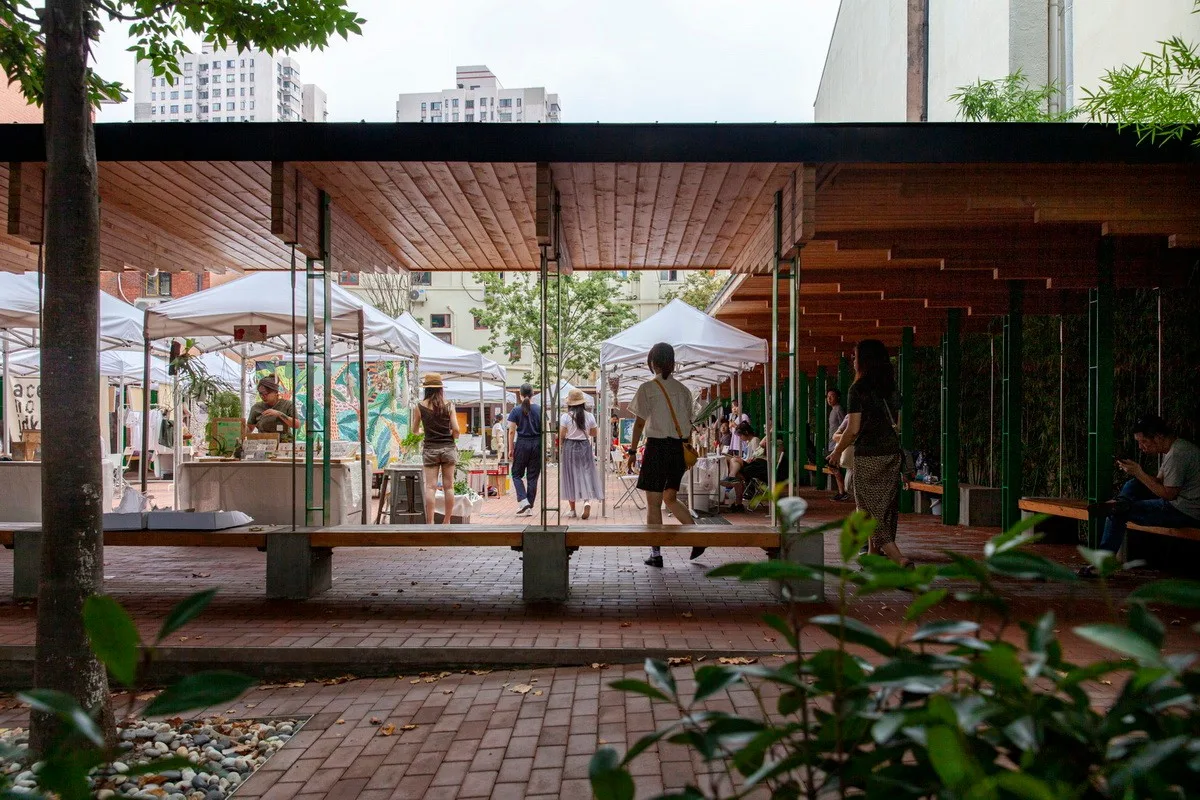
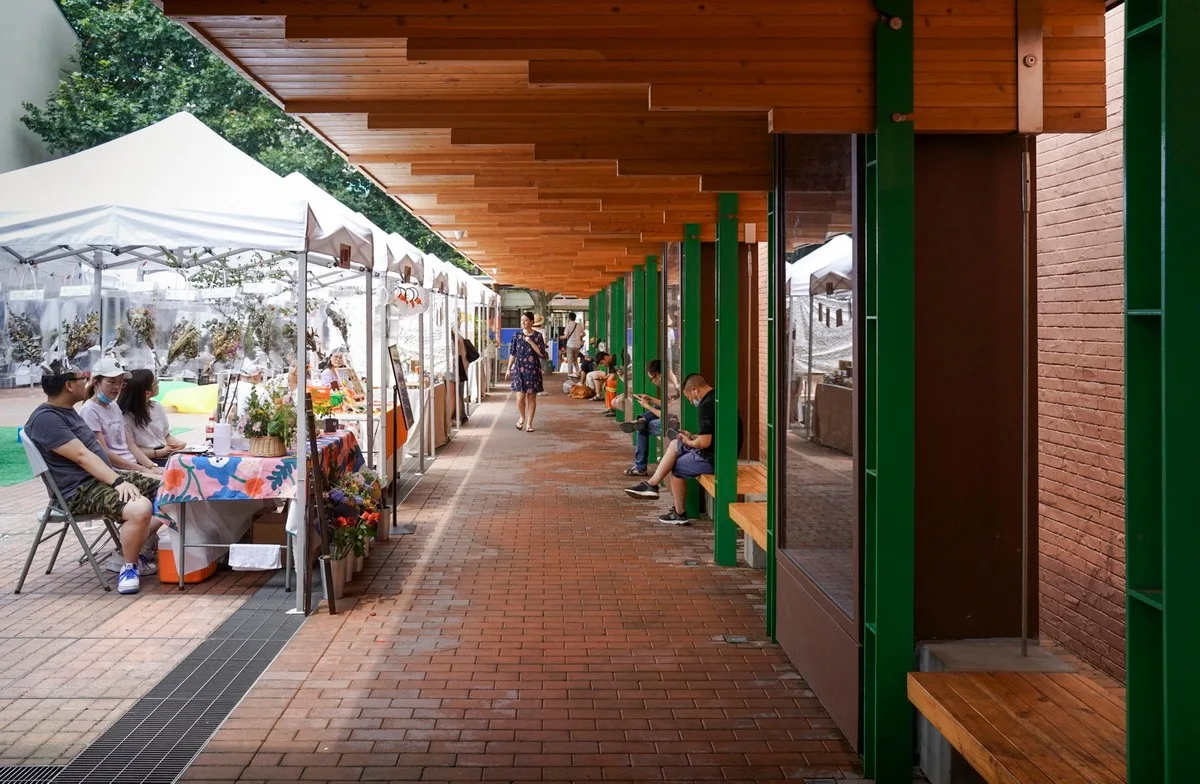
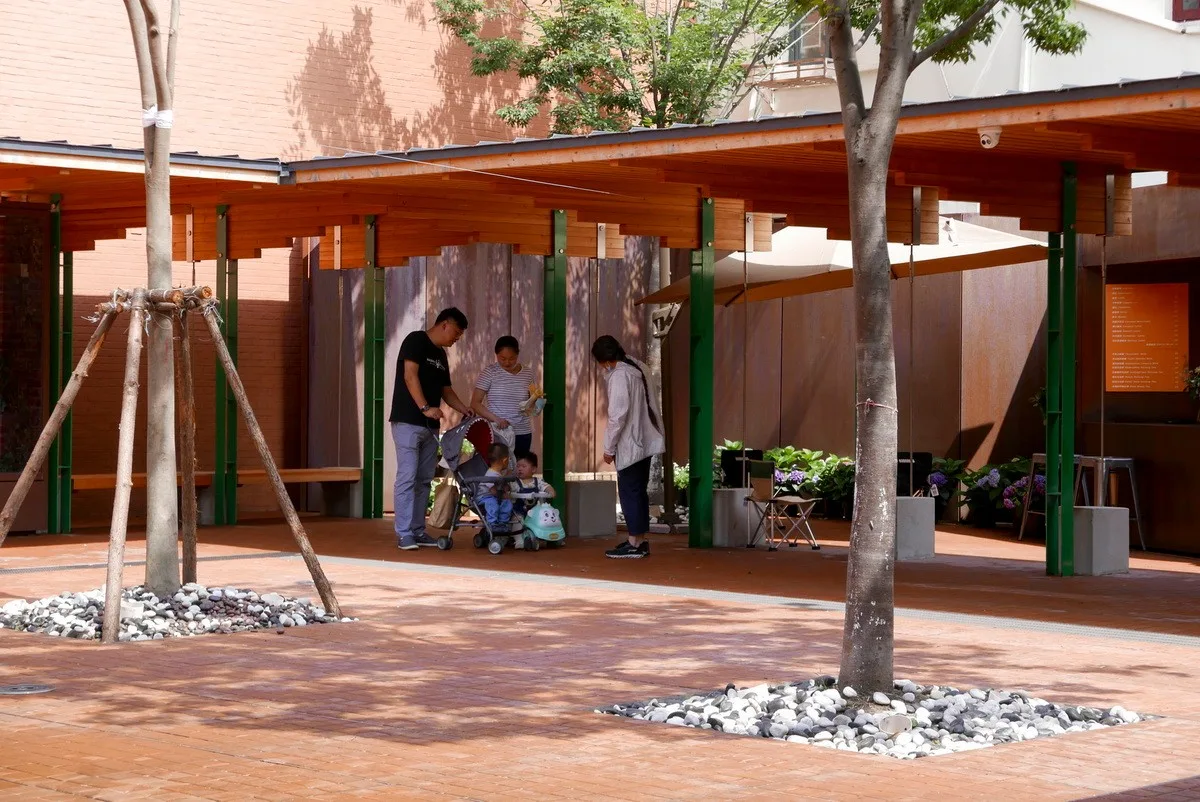
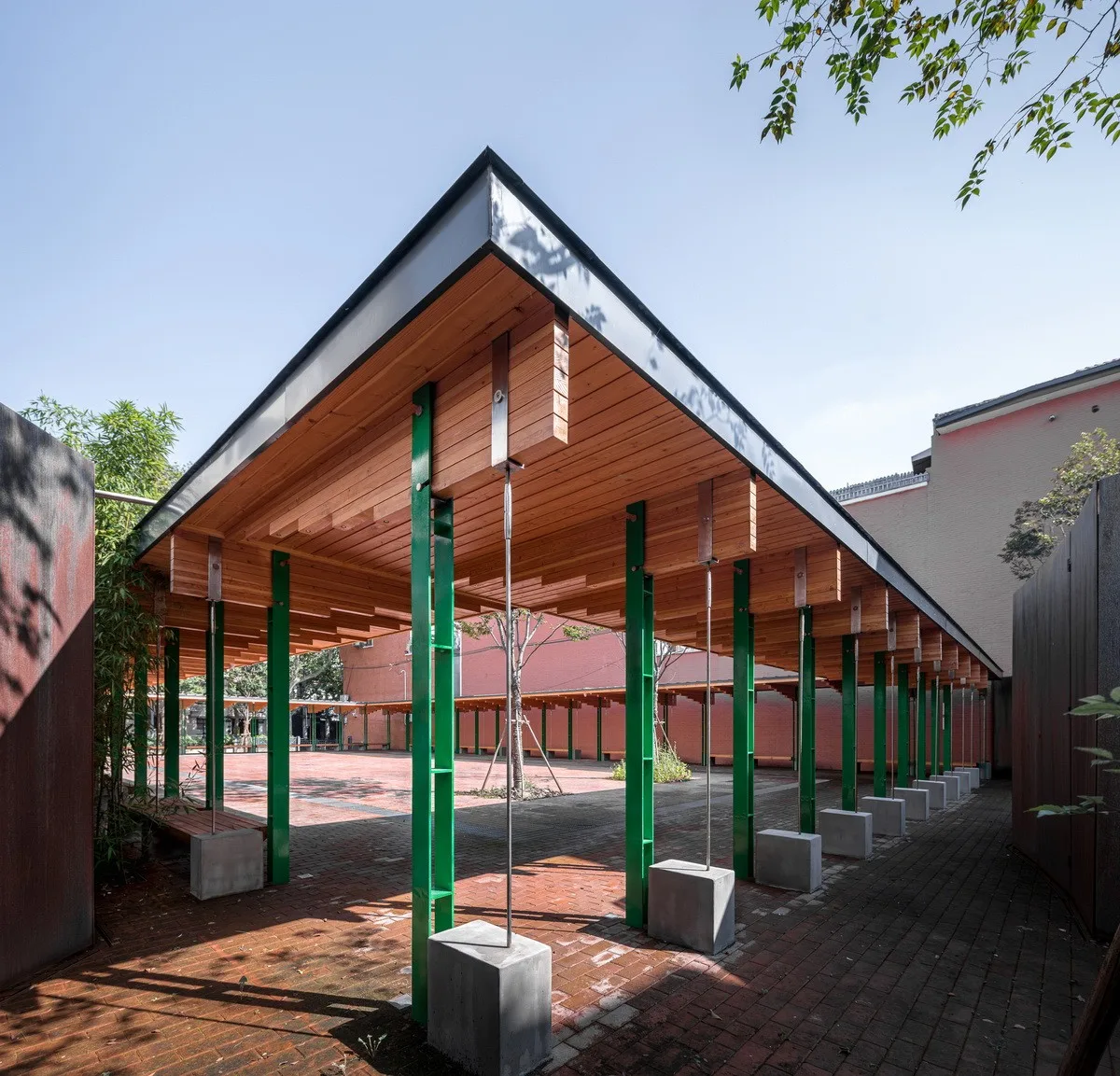
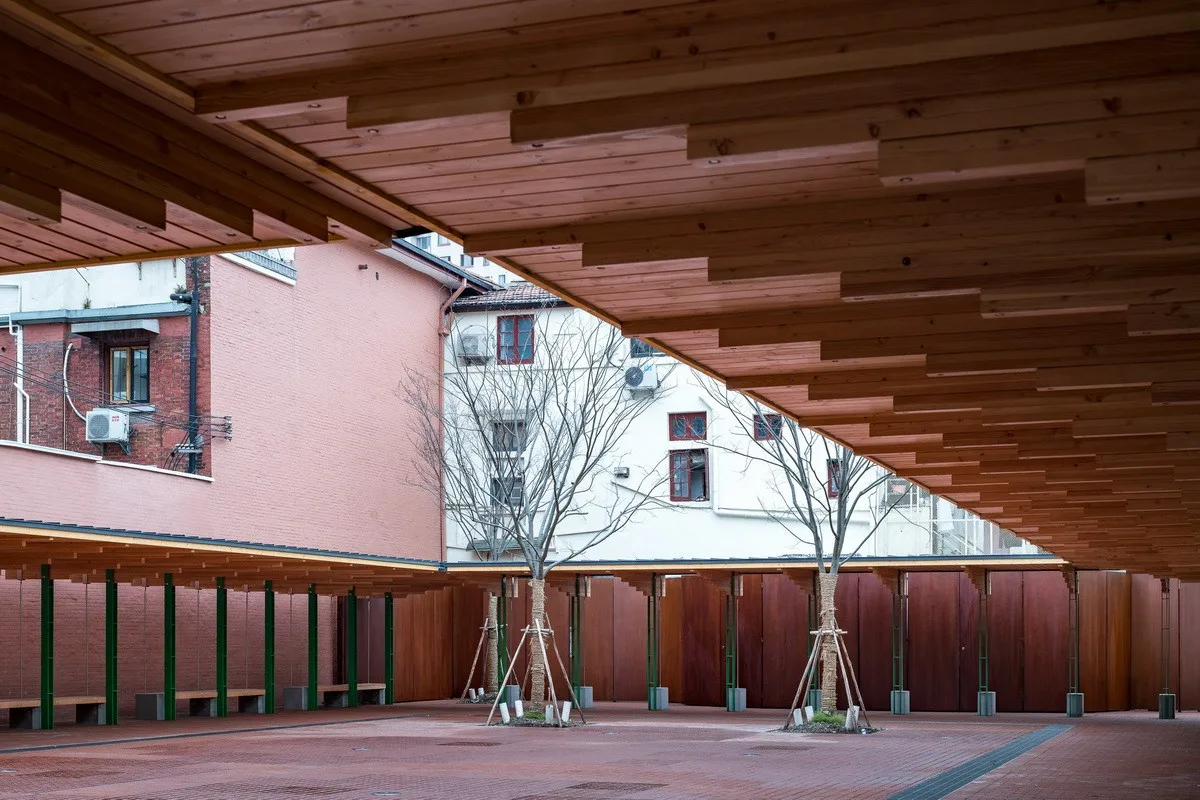
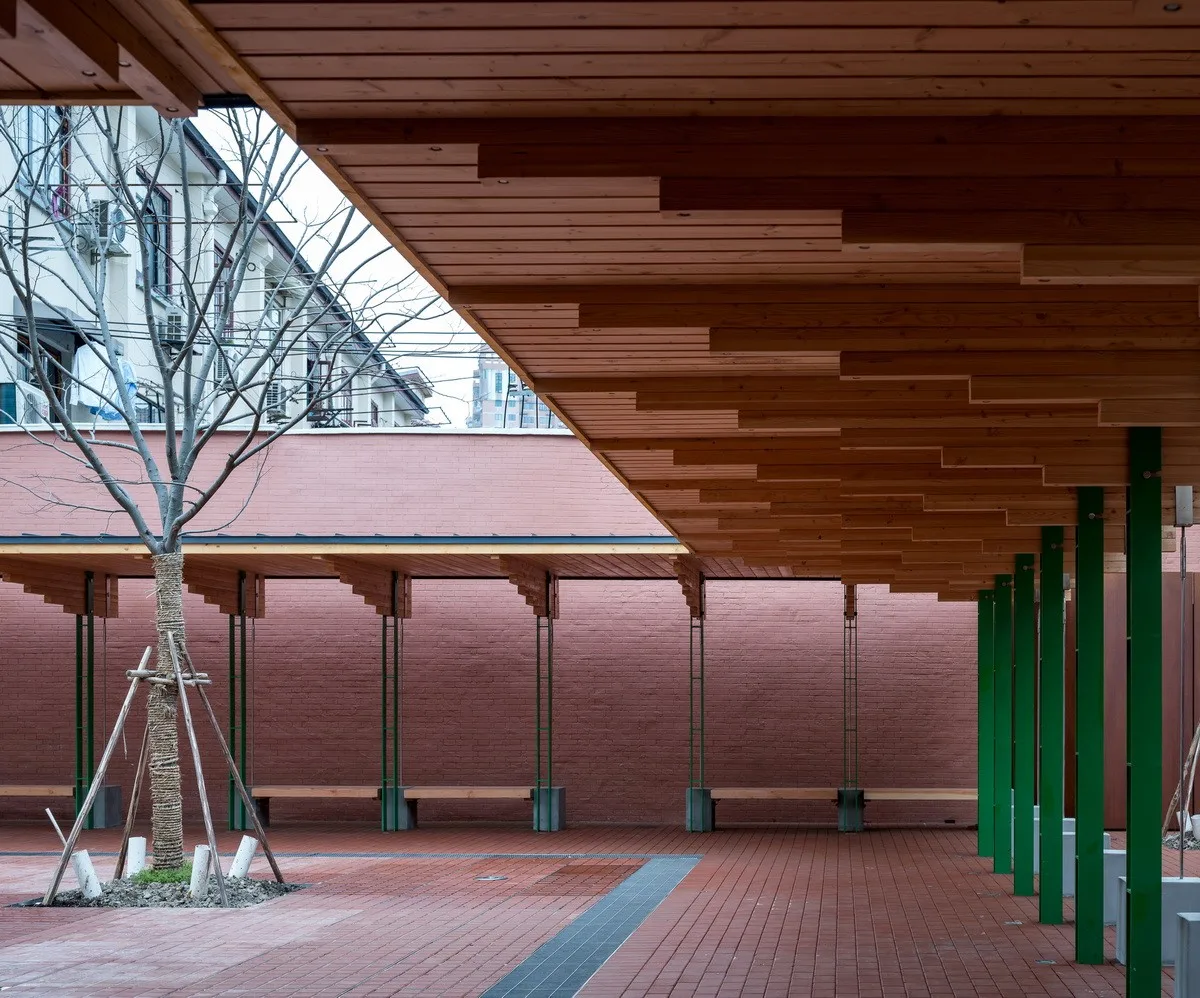
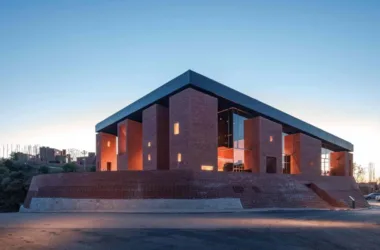
The open corridor serves as the main architectural feature, consisting of four elongated corridors arranged in a windmill pattern, enclosing a neatly shaped rectangular courtyard. The corridor height is deliberately kept low, between 2.1 and 2.7 meters, creating a welcoming scale while maintaining harmony with the surrounding buildings’ heights. This open corridor employs a refined steel-wood hybrid structure, balancing the practical needs of a residential public space with carefully crafted dramatic and dynamic details within a rational design framework.
Each typical steel-wood beam frame unit consists of steel columns, wooden beams, and steel tie rods. The steel columns are constructed from two flat steel plates, while the main wooden beams are composed of bundled, stacked timber beams that extend toward the central square to support the lightweight metal roof. The wooden beams rest on the steel columns, transferring the roof’s load accordingly. Steel tie rods at the rear of the beams counterbalance the weight of the overhanging front sections. The connection between wooden beams and steel columns is designed as a detachable assembly node, specifically engineered to allow one-way rotation. This limits beam rotation in the opposite direction, effectively counteracting the upward lifting forces generated by wind acting on the roof.
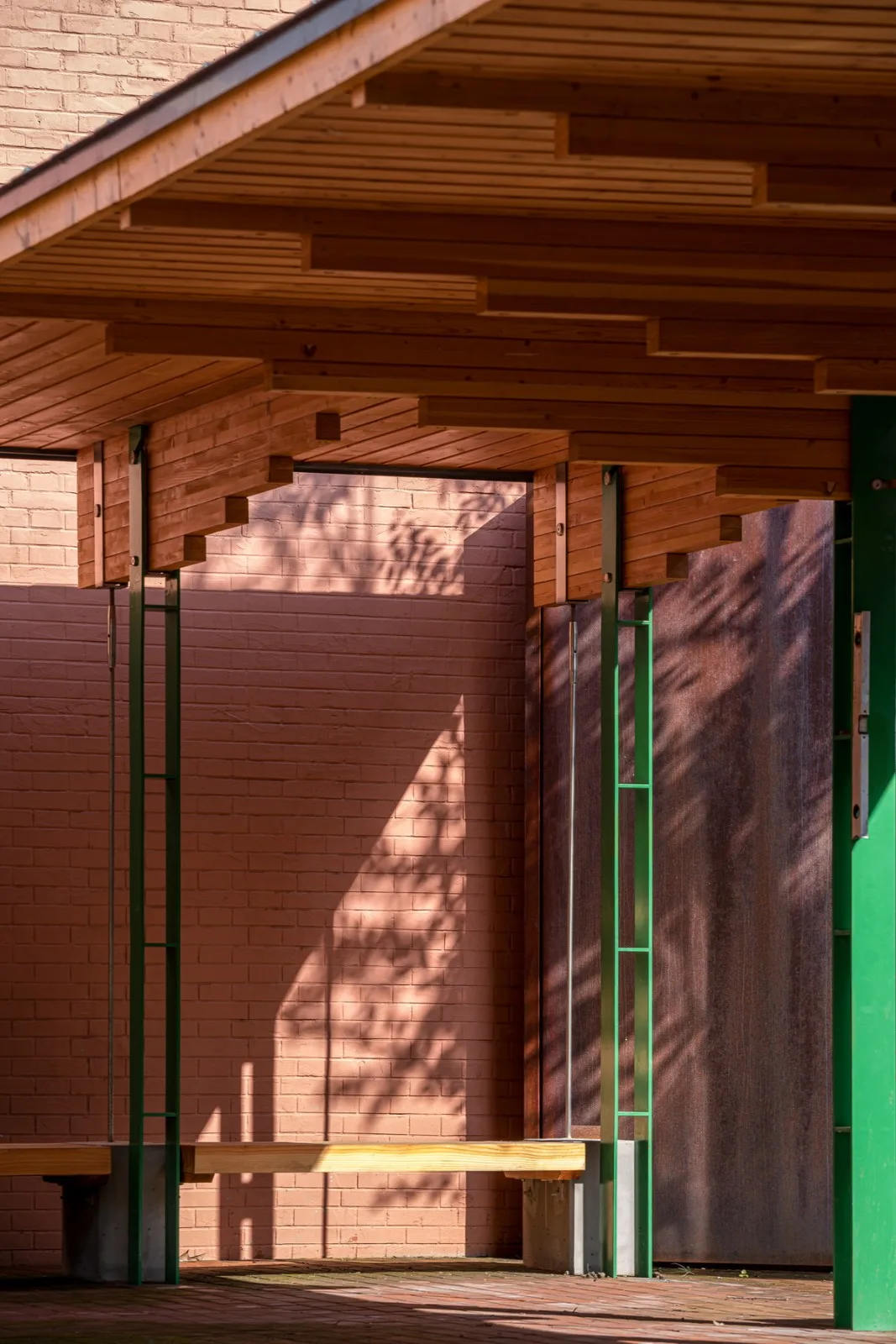
The surrounding residential buildings feature warm-toned finishes or plain bricks typical of Shanghai’s urban fabric. For the square’s flooring, traditional red permeable bricks were selected to complement this aesthetic. The wooden beams, roof undersides, and benches are crafted from light-colored timber, while the weather-resistant steel plate walls display a rust-red hue. Within this warm palette, the steel columns are coated in a vibrant green fluorocarbon paint, introducing a lively contrast that enhances the space’s relaxed, everyday character.
Design Drawings
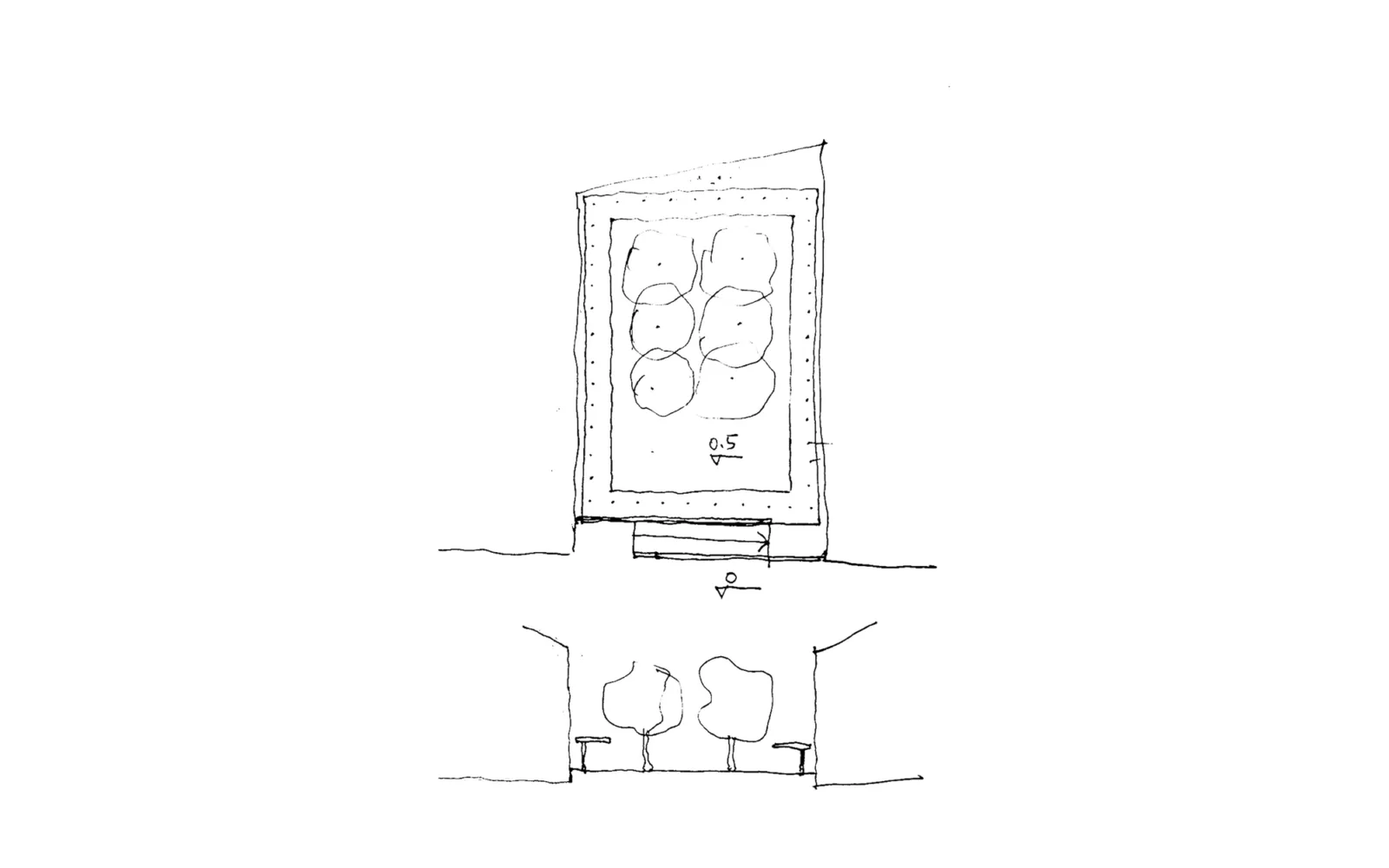
△ Sketch
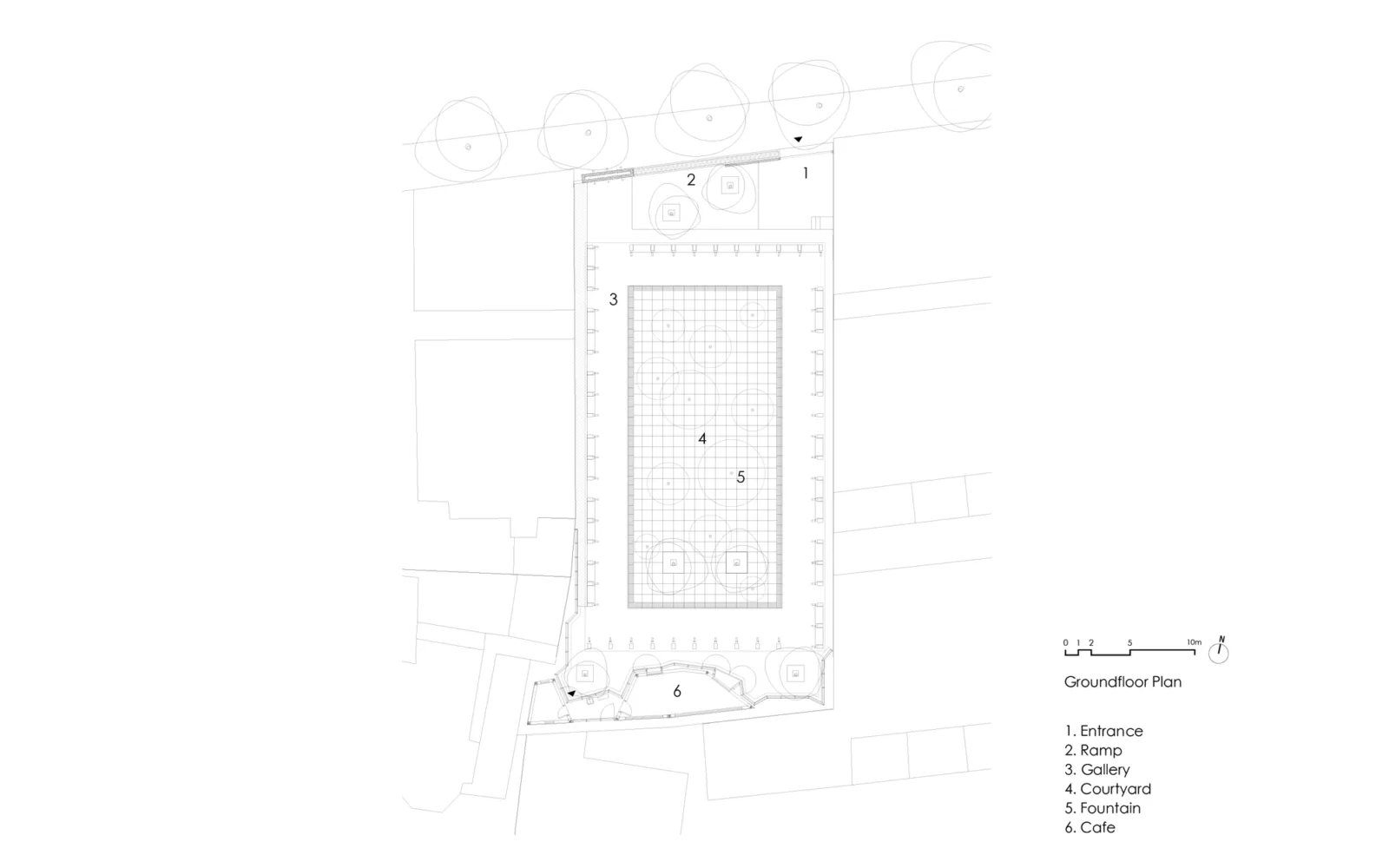
△ Plan View
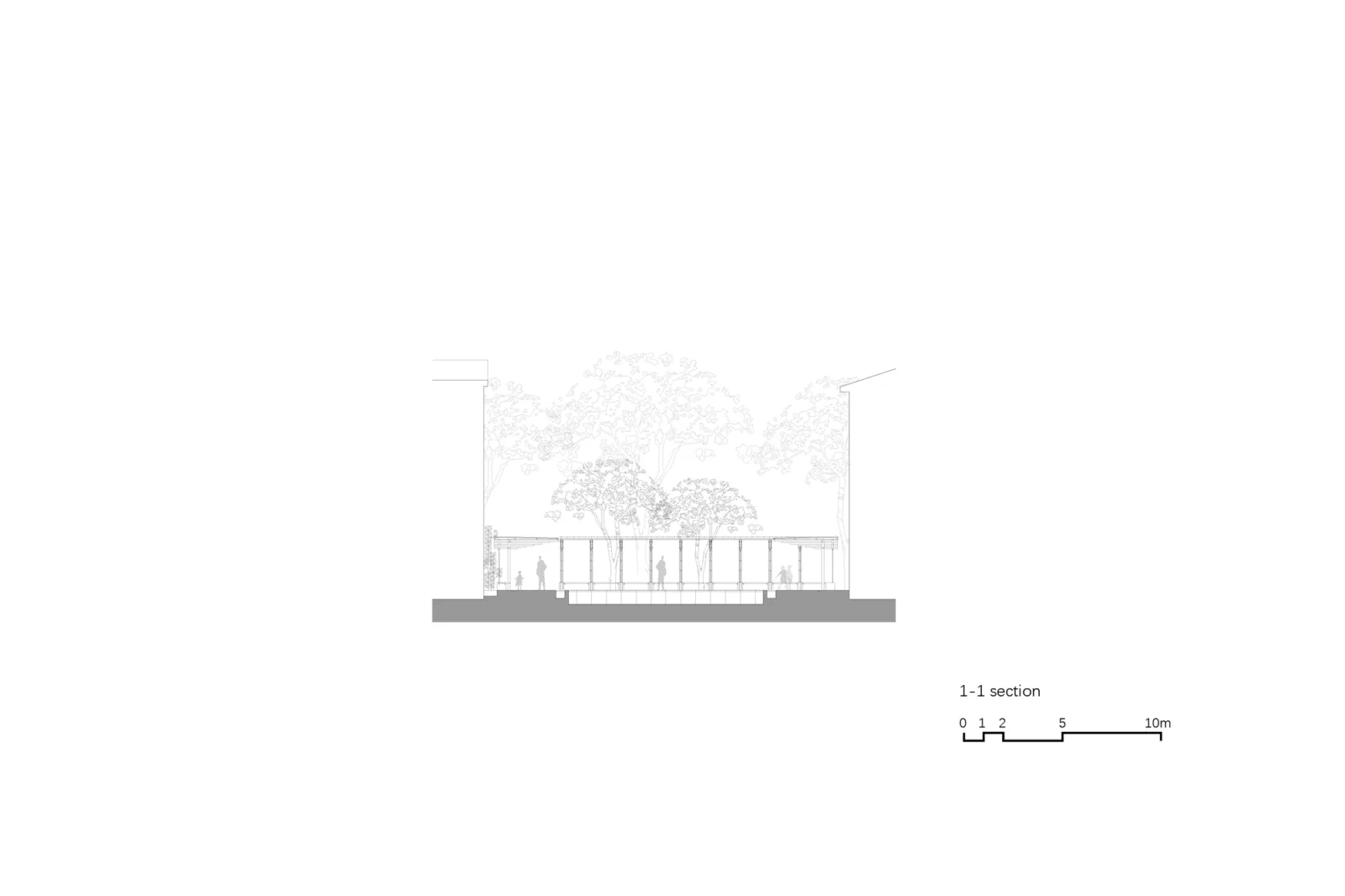
△ Section 1-1
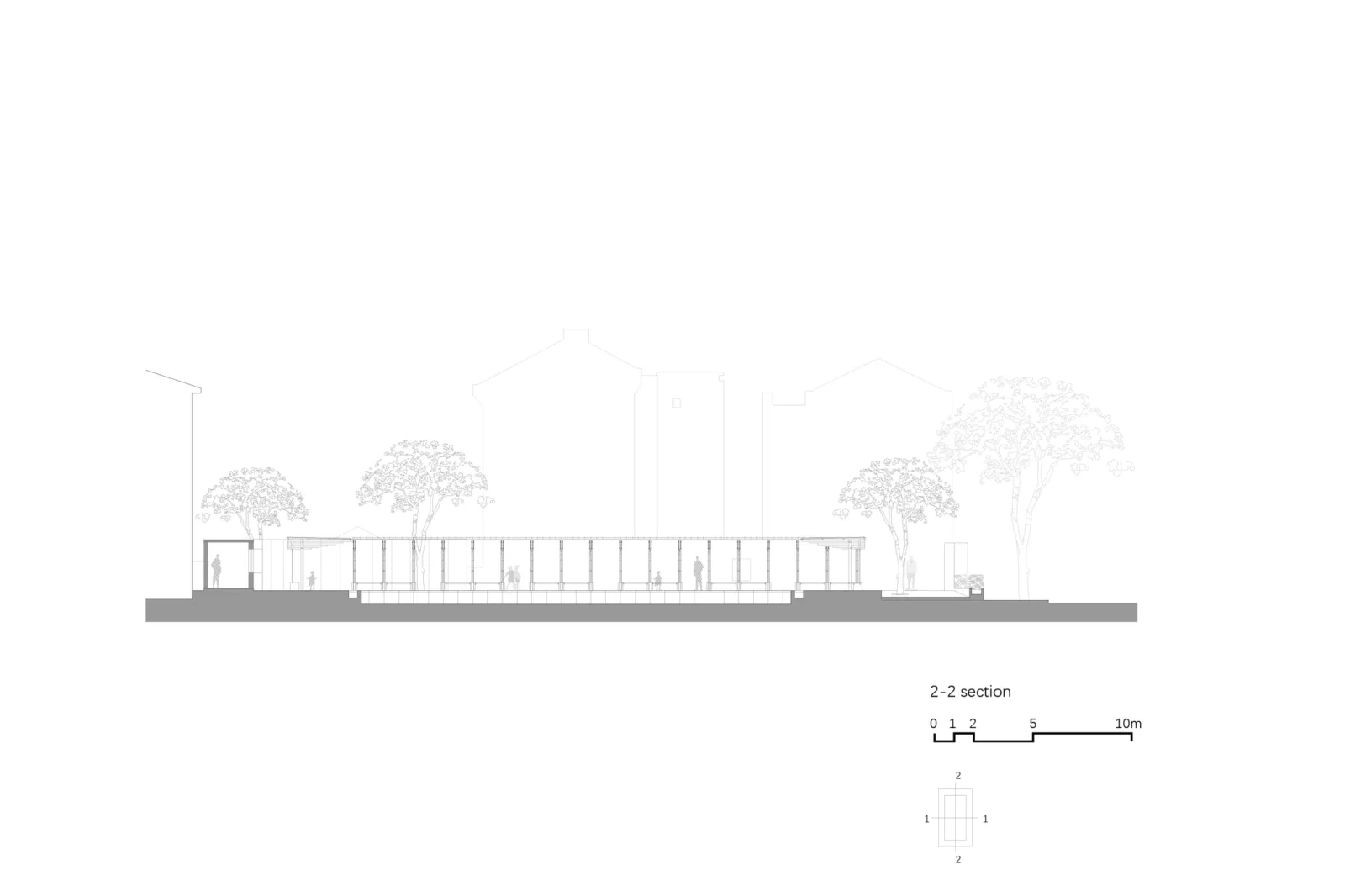
△ Section 2-2
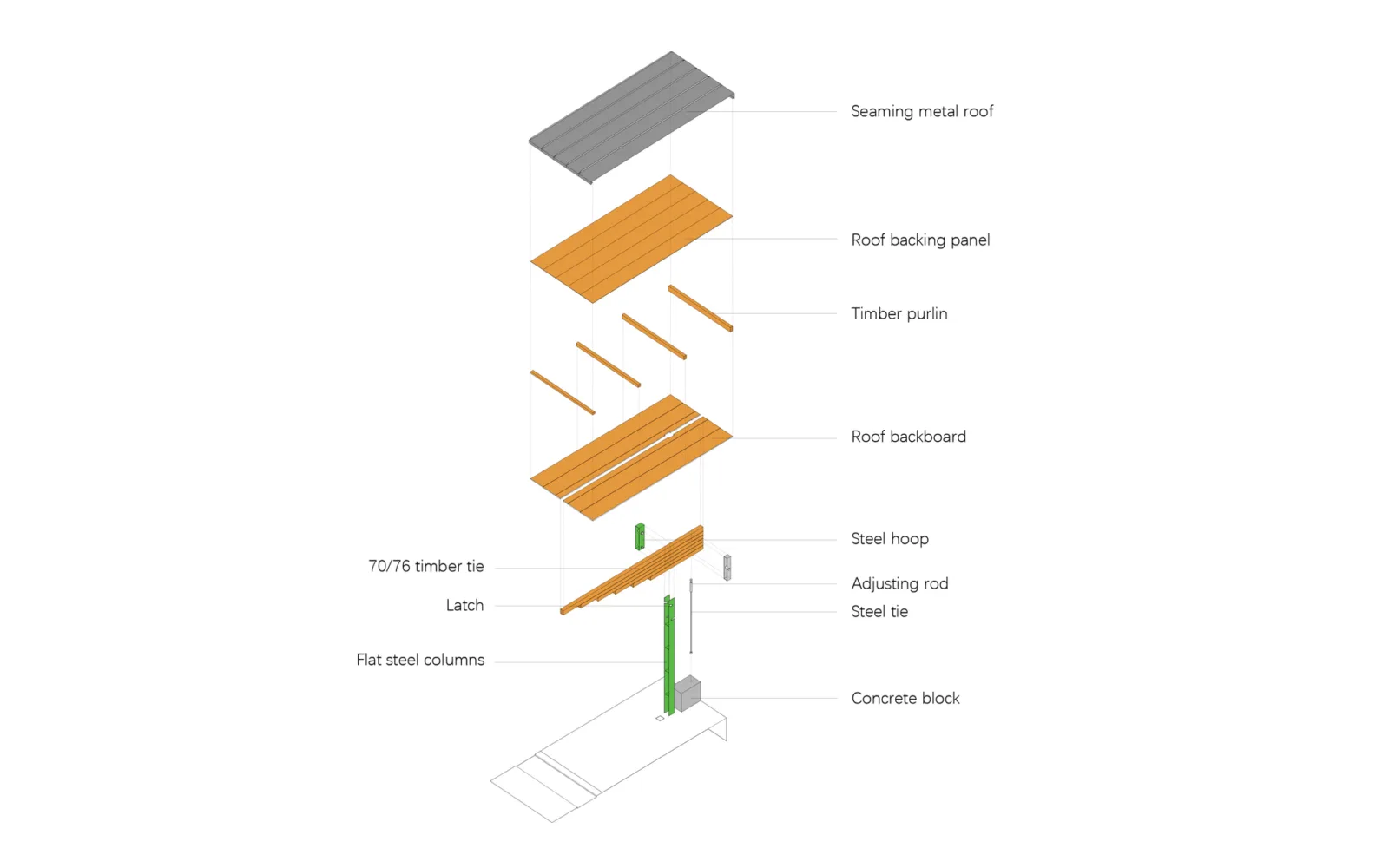
△ Axonometric Diagram of Unit Structure
Project Information
Project Type: Community Architecture
Location: Shanghai, China
Architectural Design: Shanghai Arkomixing Architectural Design Firm
Area: 773 m²
Year: 2019
Photography: Pingnan Chen, Yu Tang, Wu Qingshan, Lide Li
Manufacturers: Hong Di Lai, Shanghai SKF Builder, Shanghai Zijia Metal Decoration Co., Ltd.
Chief Creative Designers: Zhuang Shen, Ren Hao, Tang Yu, Zhu Jie
Design Team: Zhuang Shen, Zhu Jie, Li Lide, Ding Xinhui, Yin Jidong, Chen Hongbang, Lu Suijuan (intern), Qiu Xin (intern)
Client: Xuhui District Construction and Management Committee, Xuhui Tianping Road Sub-district Office, Shanghai












Must log in before commenting!
Sign Up