
BIM Q&A | What Are the Applications of BIM in Construction
Application 1: Design Review and Validation
A common challenge in China’s construction industry is that design drawings often cannot be used directly for construction. This issue extends to the BIM stage—not because BIM lacks value, but because the design and construction teams focus on different priorities. The construction team must further refine the design team’s models or drawings. During this phase, BIM software is used to verify and identify design errors by running clash detection tests and generating detailed reports. These reports provide feedback to the design team with modification suggestions. The models are then updated and re-tested until all design issues are resolved. Additionally, virtual simulations of critical construction stages, such as bridge building, are performed. Collisions are checked and reported automatically, allowing early detection and correction of errors in the drawings. This proactive approach helps avoid cost overruns and economic losses caused by project delays.
Application 2: Rapid Quantity Takeoff Generation
Traditional quantity takeoff in bridge engineering is a complex and time-consuming process due to numerous variables. Statisticians often need to make frequent manual adjustments, which is labor-intensive. With BIM, relevant data—such as part numbers, quantities, materials, weights, and specifications—can be imported directly into the model. Automated functions then generate the quantity takeoff, significantly reducing repetitive work. Furthermore, BIM models are dynamically linked, so any data changes automatically update the quantities in real time, ensuring consistency with the actual project. This improves both accuracy and efficiency in quantity estimation.
Application 3: Construction Process Simulation
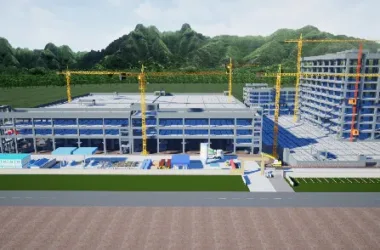
Construction teams can leverage BIM’s simulation capabilities to link bridge engineering models with construction methods and related data. This enables detailed simulation of construction processes and techniques. Through this, teams can easily identify challenges and critical points in the construction, making annotations to develop practical, feasible construction plans. The entire construction sequence can be simulated to optimize planning and provide on-site guidance. Using virtual walkthroughs and construction animations, BIM offers vivid, realistic guidance to construction personnel, helping ensure smooth progress and high-quality results.
Application 4: Progress Simulation and Cost Control
During construction, the original BIM model can be enhanced by adding time (4D) and cost (5D) dimensions. This allows simulation of project progress on daily, weekly, or monthly scales, enabling real-time adjustments based on site conditions. By analyzing different construction plans, teams can select the most efficient approach. Integrating cost data—such as materials and labor—supports simulation of material usage, workforce movement, and resource allocation. This comprehensive approach facilitates detailed cost management, improves project management precision, and helps eliminate unnecessary expenses.














Must log in before commenting!
Sign Up