
BIM Q&A | What Does Studying BIM Building Modeling Involve?
The introduction of Building Information Modeling (BIM) in China has sparked significant transformation in the architecture industry. The adoption of BIM technology across China’s construction sector has demonstrated immense social and economic benefits.
The Ministry of Housing and Urban-Rural Development’s releases, such as the “Several Opinions on the Development and Reform of the Construction Industry” and the “Guiding Opinions on Promoting the Application of Building Information Models”, emphasize the importance of advancing informatization in construction projects. This includes areas like planning, design, project management, and green building initiatives, which are key goals in the sector’s overall development.
Following these national directives, provincial and municipal regulatory bodies have issued their own guidelines to encourage BIM adoption. This marks the shift of China’s engineering projects, green energy conservation efforts, integrated housing, 3D printed buildings, and industrialized construction into the information age.
To further support this transition, after extensive discussions among industry experts, BIM professional skill assessment standards have been finalized. Administrative authorities have now officially launched the certification and skill evaluation programs for BIM technology.
What is BIM?
Building Information Modeling (BIM) is a technology that uses computer software and hardware to create, transmit, and share building information through digital models. It encompasses the processes of development, design, construction, and operation of buildings, spanning their entire lifecycle. (Definition adapted from the Design Standard for Civil Building Information Modeling DB11/T1069-2014)
By promoting BIM technology and harnessing its strengths—such as visualization, virtualization, collaborative management, and control over costs and schedules—the construction industry can significantly improve decision-making, planning, design, construction, and operation management. This leads to reduced rework and waste, shorter construction times, and enhanced project quality and investment efficiency.
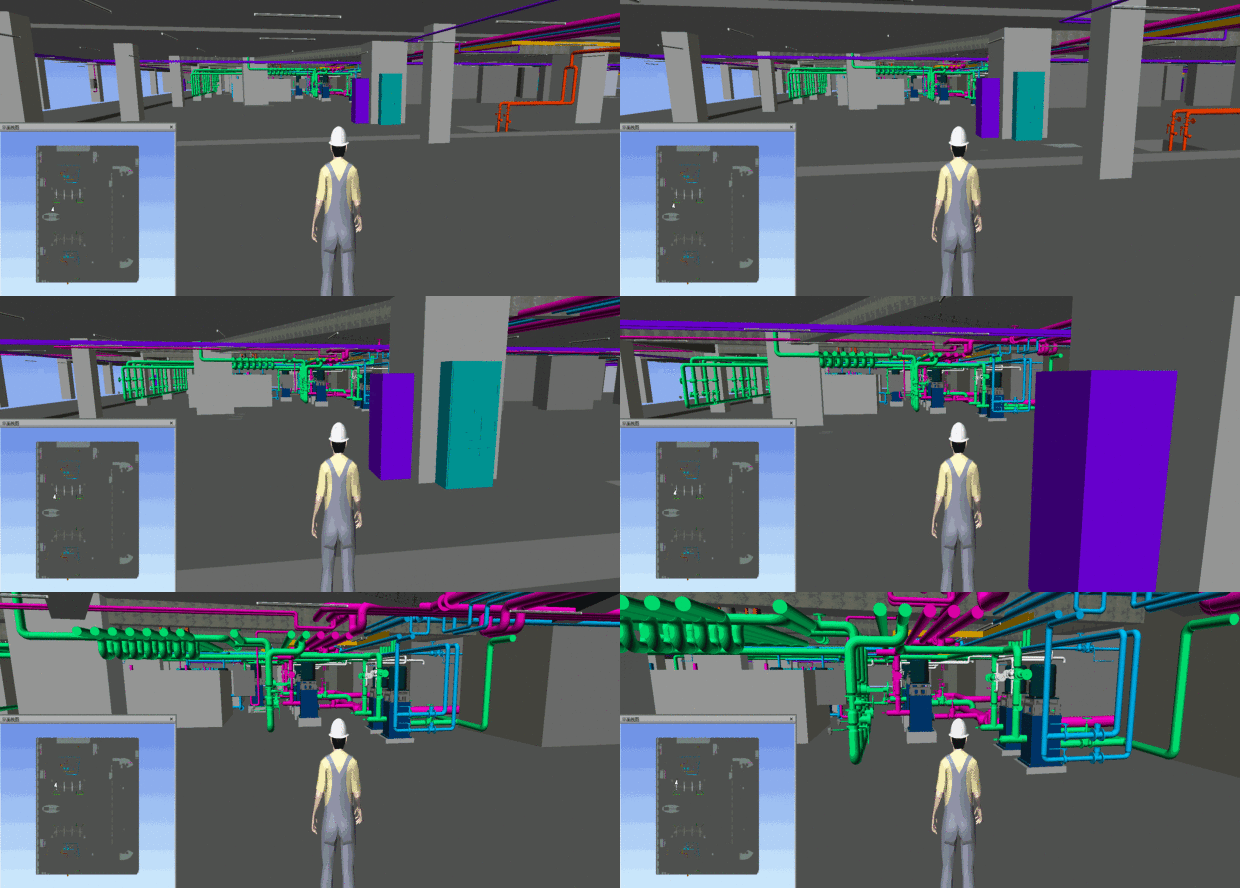
Understanding BIM Dimensions:
2D: Traditional plan views composed of points, lines, circles, and polygons. Currently, most conceptual, preliminary design, and construction drawings are presented in 2D.
3D: Represents all geometric, physical, functional, and performance data of an engineering project. This model supports various calculations, analyses, and simulations across different project phases. It is often referred to as virtual architecture.
3.5D: An intermediate form between BIM 3D and 4D that simulates the construction environment through animations.
4D: Integrates time-related information to simulate construction progress and scheduling.
5D: Combines 3D models with schedule and cost data, creating a five-dimensional BIM. This enables comprehensive project control over progress, investments, quality, contracts, and resources, fulfilling the goals of “digital three controls and two management” in project oversight.
6D: Focuses on simulation and analysis of building performance, including acoustics, lighting, airflow, water usage, and thermal conditions.














Must log in before commenting!
Sign Up