
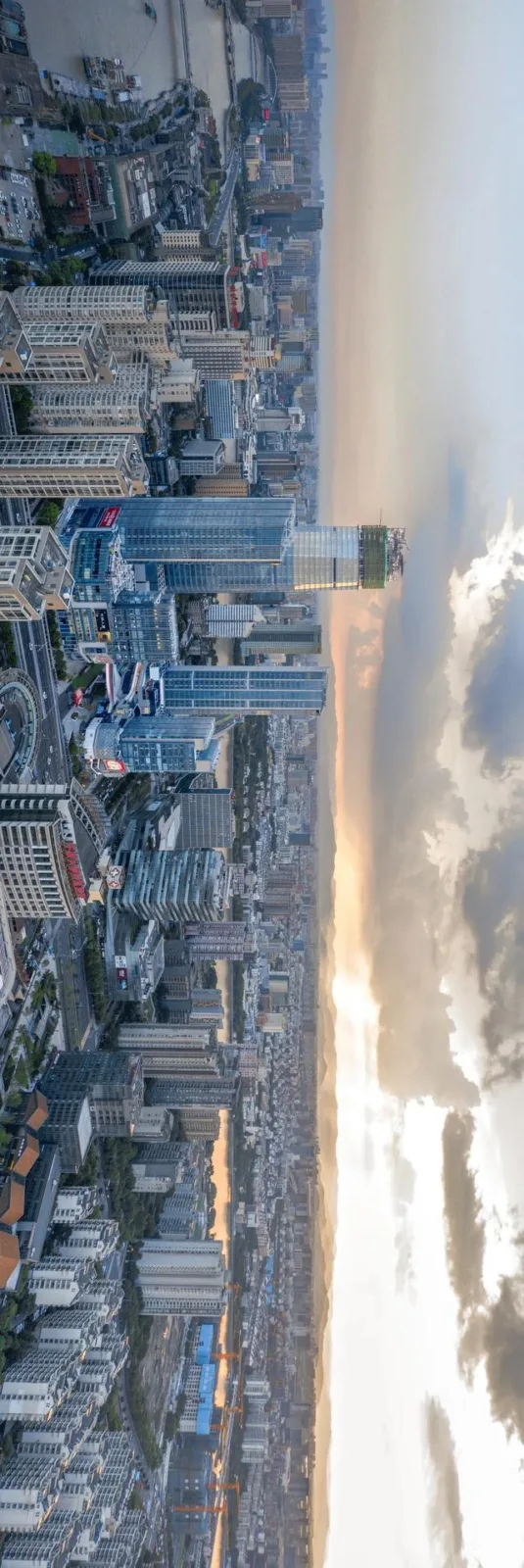
Please rotate your screen accordingly.
The 30th Greenland Center, part of Greenland Group’s global portfolio, has been a landmark at Sanjiangkou in Ningbo for eight years. It is now transforming the commercial district landscape of Sanjiang and Liu’an.
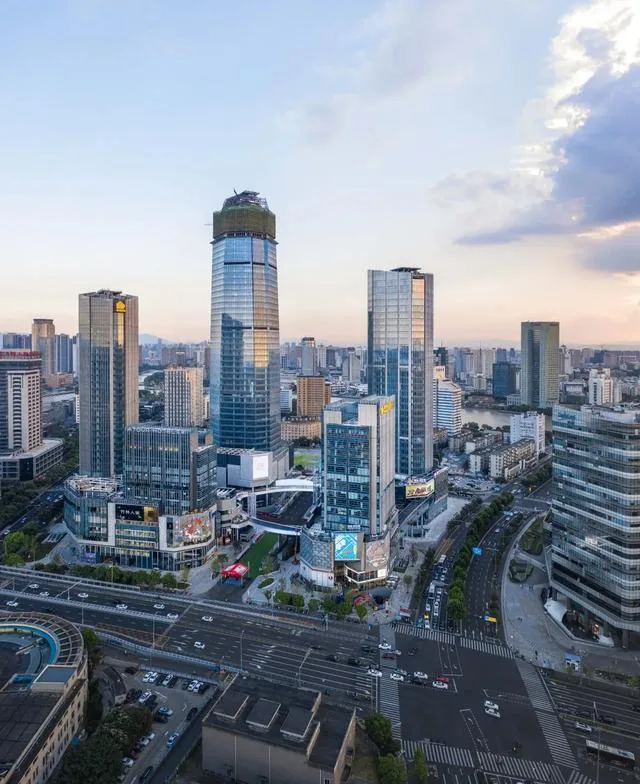
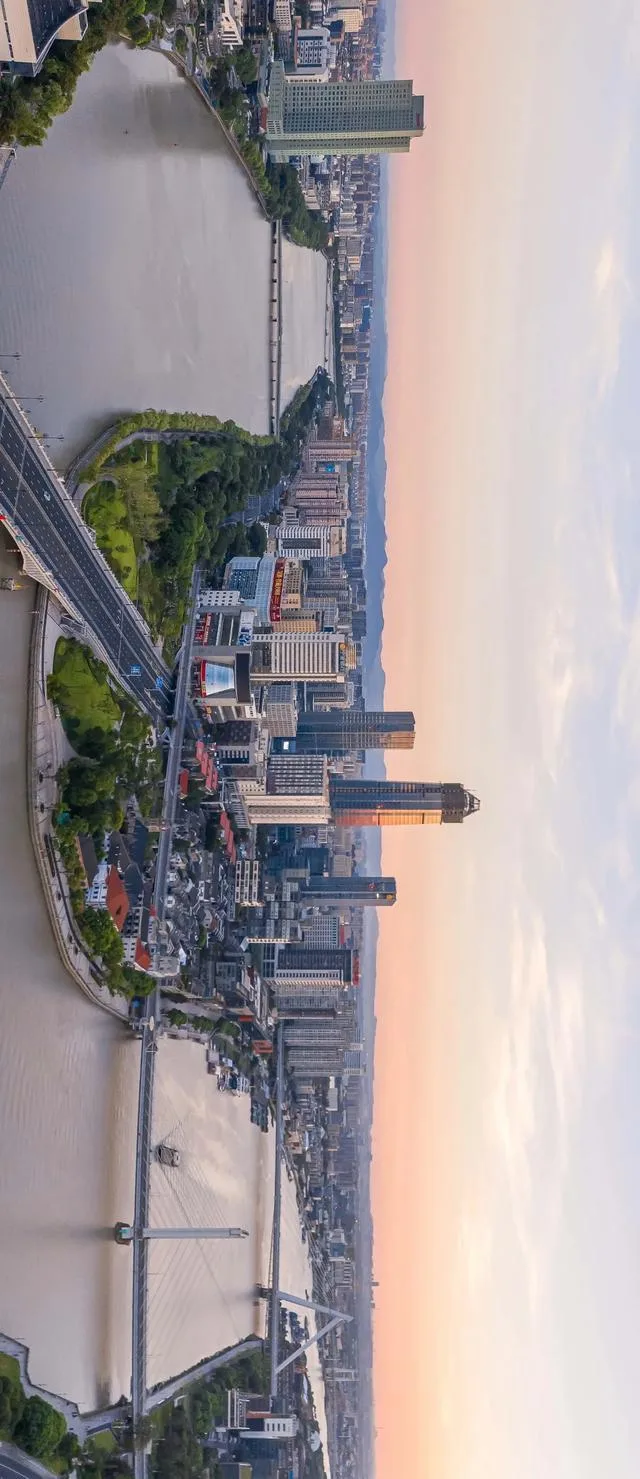
This panoramic view of Ningbo Greenland Center was captured by Liu Songkai.
The project began its bidding process in 2012. Greenland Group collaborated closely with San Yi China and a renowned Japanese design firm to tackle a variety of complex challenges. San Yi China has been fully engaged from the project’s inception. Construction officially started in 2013, but numerous practical challenges and repeated design modifications extended the original 3-4 year completion plan into an eight-year journey.
After years of refinement, the once-promising Sanjiangkou area has finally emerged with a tall, elegant skyline.
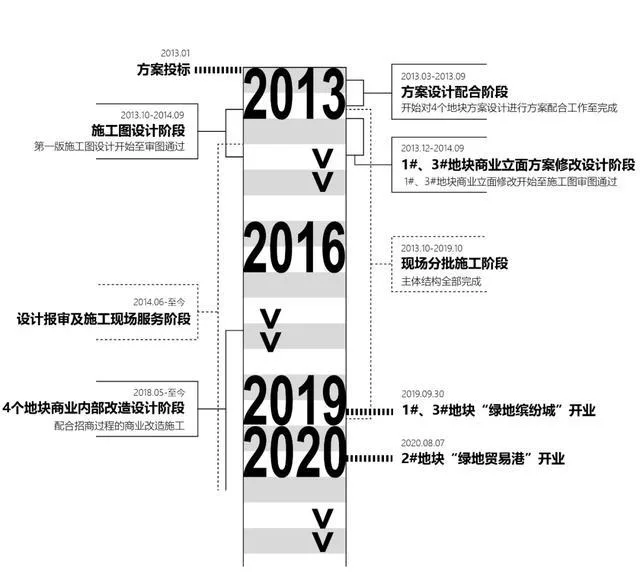
Greenland Center Project Timeline
The unique location and scale of the Greenland Center define its primary attribute: a city landmark.
In 2011, Harvard economics professor Edward Glaeser highlighted in his bestseller The Triumph of the City that urban landmark buildings should combine residences, restaurants, shops, and offices within a compact area. This integration facilitates transportation and enables multifunctional coexistence, embodying the city’s optimal state.
Urban landmark buildings serve as public spaces guided by consumption and functionality. They must respond accurately and promptly to population needs. These buildings are at the forefront of urban evolution, reflecting the spirit, values, social emotions, and future trends of their era, often preceding cultural, governmental, and other changes in city spaces.
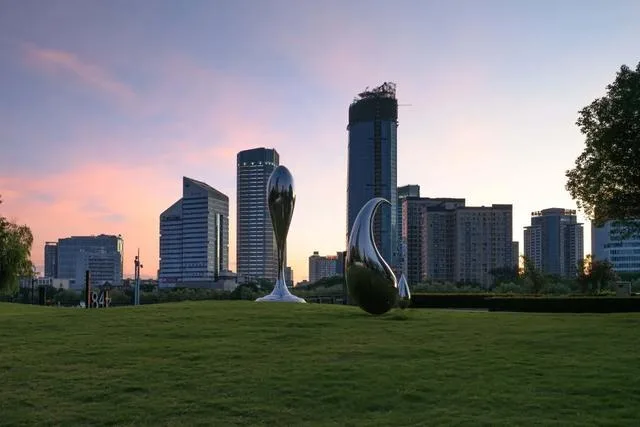
Landmark in the city, photographed by Liu Songkai
What defines a city landmark building? What elements make these structures iconic? How can architectural forms be both landmarks and public spaces that embody urban vitality in rapidly growing cities?
The design philosophy behind the Ningbo Greenland Center is rooted in these landmark principles.
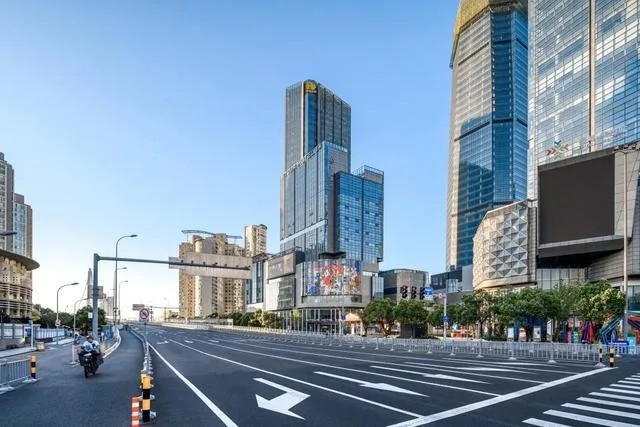
01. Organizing the Urban Network
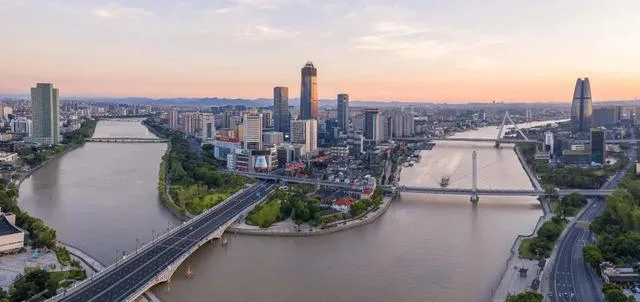
Standing in the heart of the green space at Sanjiangkou, photographed by Liu Songkai.
The Greenland Center sits in the Jiangwan area of Sanjiangkou, Zhongma Street, within Ningbo’s Old Bund commercial district. Two distinct urban axes are evident:
- First: The Yuyao and Fenghua Rivers merge into the Yong River at Sanjiangkou, flowing toward the East China Sea. This axis marks the origin of “Ningbo Gang,” symbolizing thousands of years of history along the Yangtze River.
- Second: Zhongshan East Road connects the eastern new city to Sanjiangkou, forming Ningbo’s busiest commercial district and creating a horizontal commercial axis perpendicular to the Fenghua River.
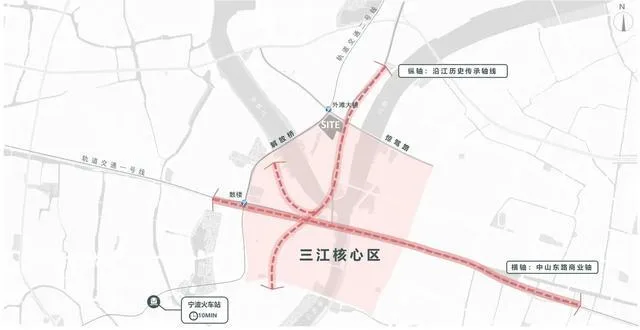
Ningbo urban axis
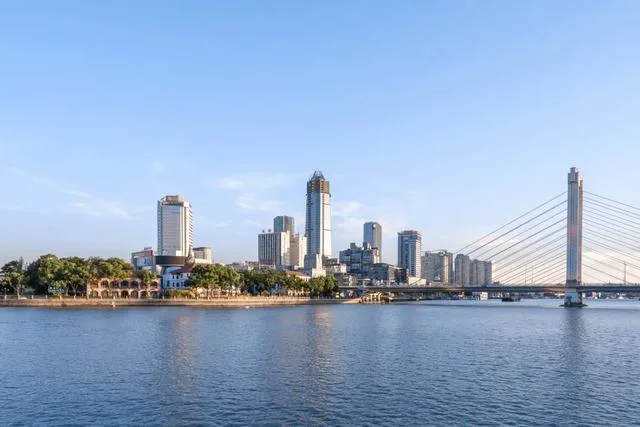
Overlooking the Greenland Center from the river, photo by Liu Songkai
Modern urban development demands more than horizontal expansion for regional revitalization and spatial evolution. Establishing a vertical commercial axis, alongside developing urban-style commercial landmarks that link the historic Bund district with the Sanjiangkou commercial district, is crucial for sustaining and enhancing urban functions.
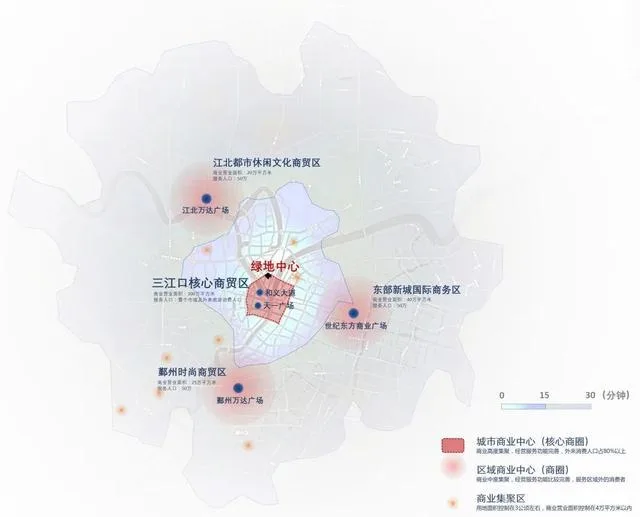
Ningbo Commercial Map
The green space center is strategically positioned at the intersection of these axes. To the east lie Raffles City and Diamond Plaza; to the south, urban green spaces like Jiangbei Park and Jiangbei People’s Square; and to the southeast, historic docks, Ningbo Art Museum, Planning Museum, Catholic Church, and the old Bund architectural complex including Banqiao Street.
This green space center functions as a multifunctional venue blending history, culture, and landscape. Thoughtful spatial organization enables the Green Center to become a lively “urban park,” creating layered urban spaces that provide high-quality office, residential, and retail environments where residents can naturally live and engage.
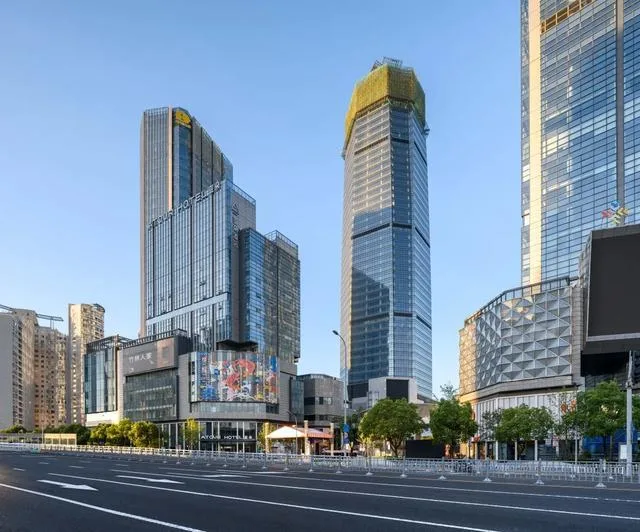
Green Center as an urban park, photo by Liu Songkai
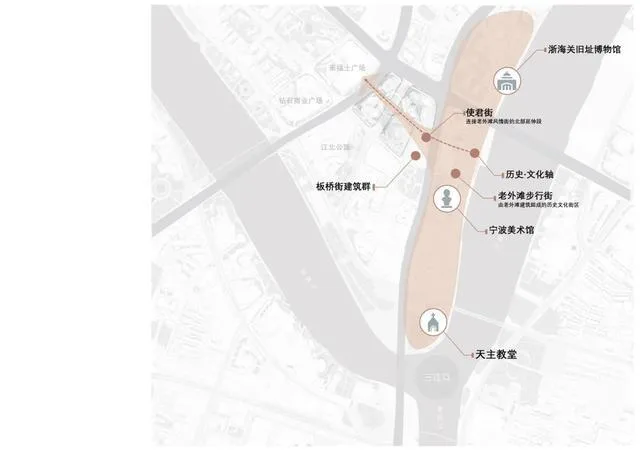
Urban Historical Context Analysis
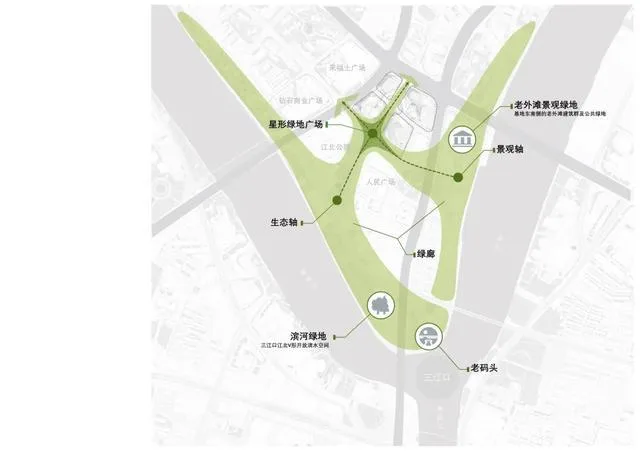
Urban green landscape analysis.
The project spans a land area of 36,800 square meters, divided into four plots by a cross-shaped municipal road. Daqing South Road and Renmin Road border the site, with the Bund Bridge approach to the north. The northwest and southeast corners house a subway station and bus stop respectively, generating significant pedestrian flow.
Nearby commercial hubs such as Raffles City, the Bund Building office tower, and Ningbo University School of Medicine’s affiliated hospital further contribute to directed flows of people. Historic buildings and parks provide foundations for consumer groups within the site.
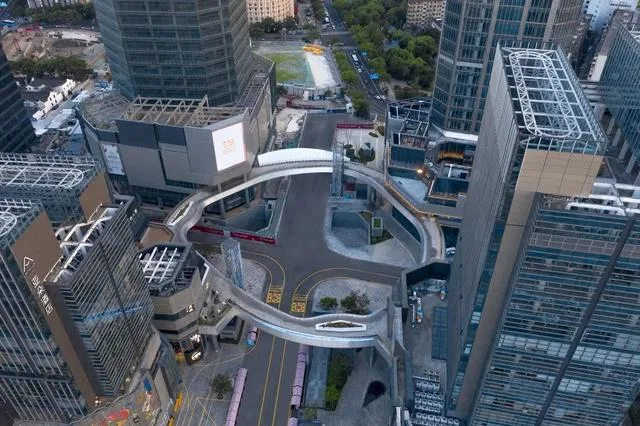
The Greenland Center divided into four plots, photo by Liu Songkai
Integrating scattered plots and guiding diverse visitor flows is a core challenge.
Unlike conventional commercial real estate, Greenland Center avoids a centralized hierarchical layout. Instead, it disperses multiple ambiguous spaces—such as plazas and green areas—within the site in a non-hierarchical pattern. This design allows pedestrians to easily access vibrant, engaging spaces while strolling, fostering continuous and close interaction with urban public spaces.
Numerous “small and micro public spaces” enhance the connection between urban fabric and the human experience.
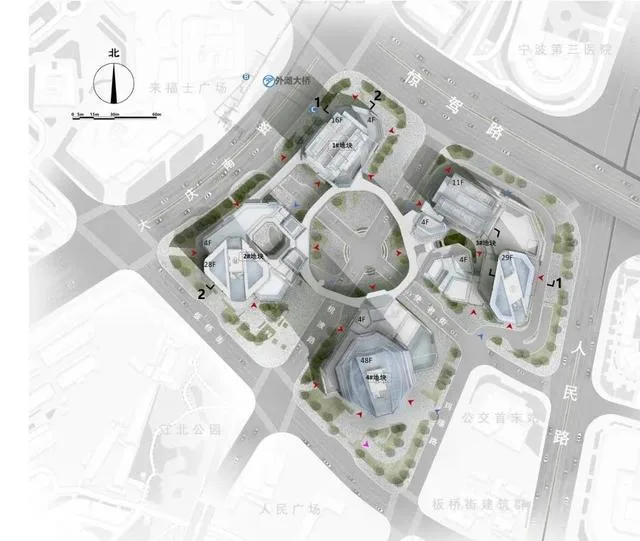
Master Plan
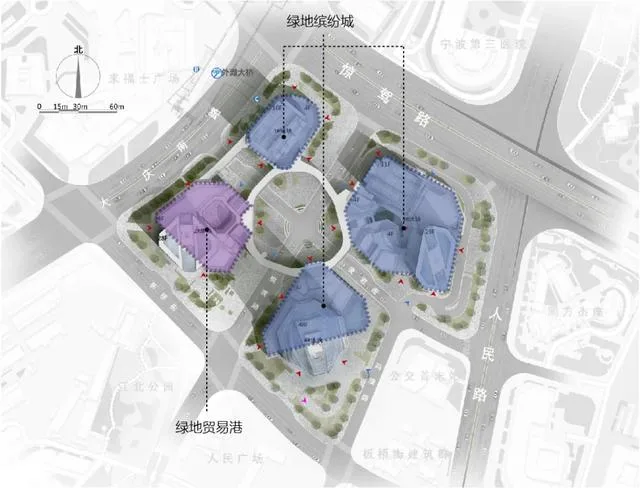
Podium commercial layout distribution
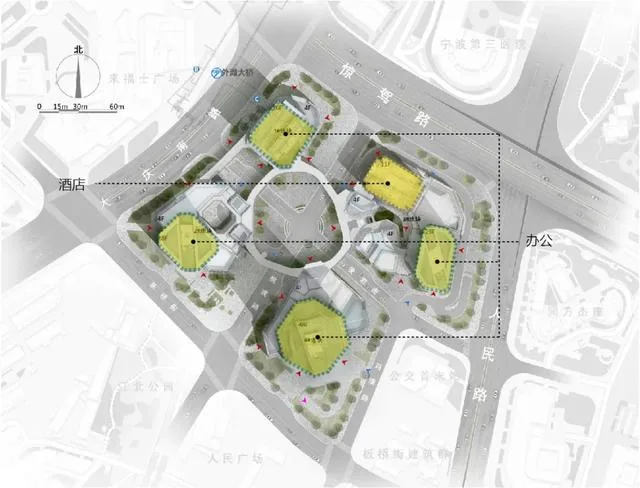
High-rise commercial layout distribution
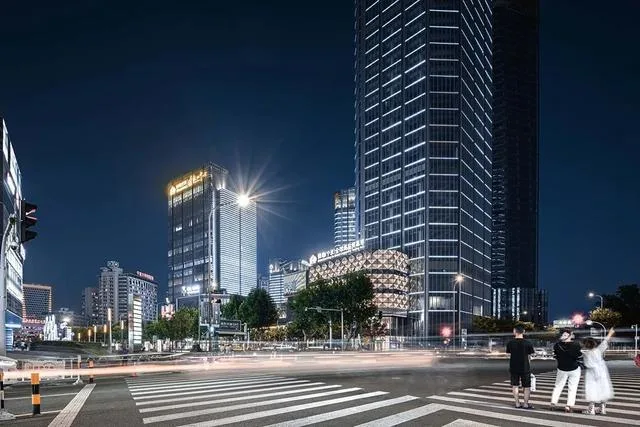
Daily life interaction, photo by Liu Songkai
02. Building a Three-Dimensional Urban Space
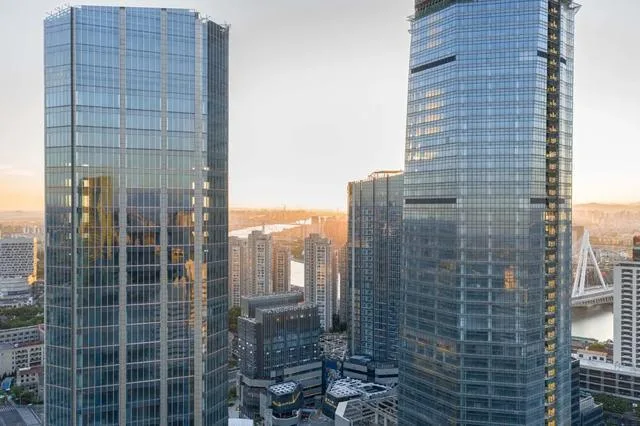
The Greenland Center soaring into the sky, photo by Liu Songkai
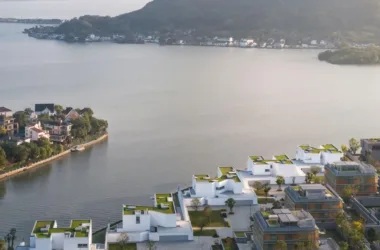
The Greenland Center consists of five towers spread across four plots, connected by elevated walkways forming linked podiums. Viewed from both sides of the strait, the towers’ varying heights create a “mountain-like” skyline, shaping a fresh urban landscape.
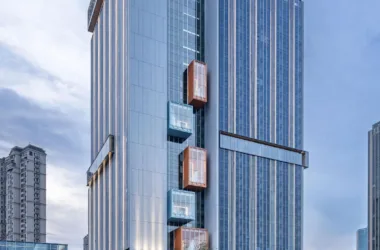
The tallest, a 240-meter super high-rise with 48 floors, dominates Sanjiangkou’s skyline. The remaining four towers form a “Y” shape with decreasing heights, creating a sequential urban cluster that reduces visual impact on surrounding historic buildings.
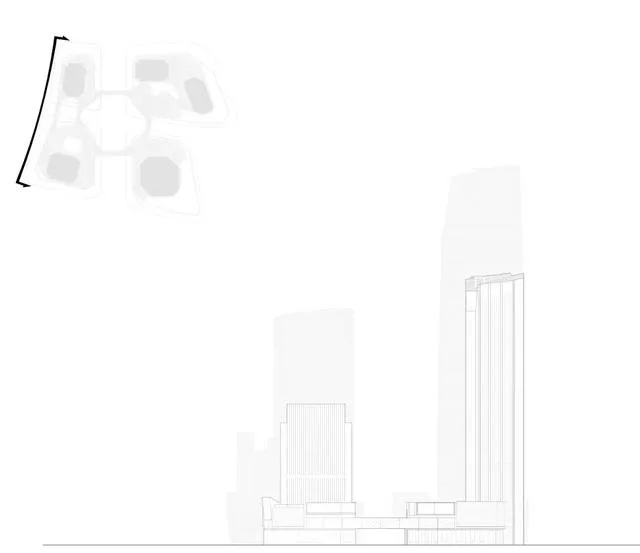
West Elevation
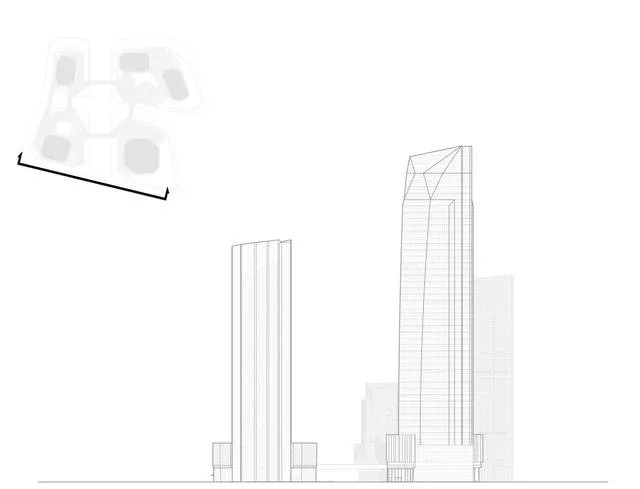
South Elevation
All five buildings face major city roads. Plots 1 and 2, featuring more display areas, focus on commercial use. The super high-rise landmark is located on Plot 4, facilitating phased development. Together, the four plots form a “one core, one belt, four nodes” structure: the central commercial square as the core, commercial atriums as nodes, and a commercial belt linking the subway and bus terminals.
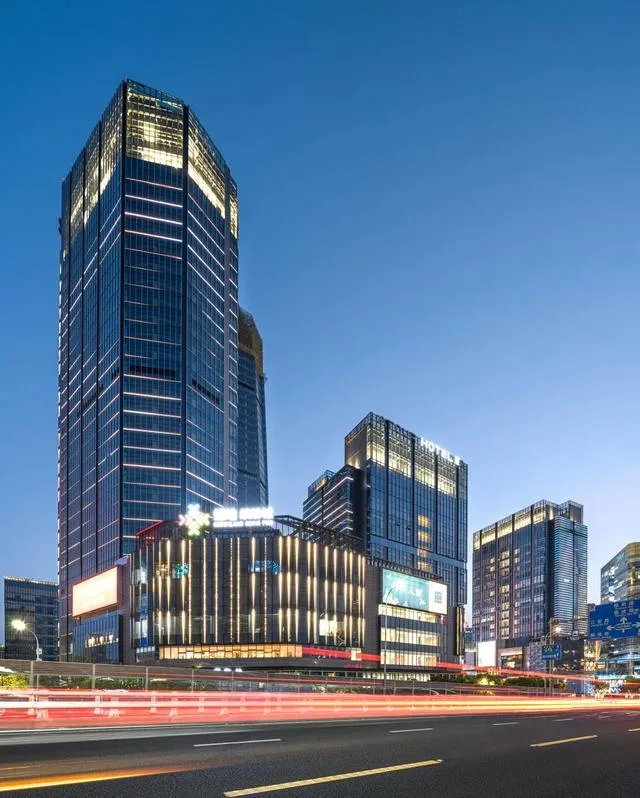
Panoramic view of Ningbo Greenland Center, photo by Liu Songkai
To complement the scale of surrounding low-rise buildings, the podium spaces have been segmented, respecting the urban context. Four block podiums connect as open blocks, mutually enhancing commercial potential. This loose, hierarchical, and fragmented spatial structure eliminates organizational disparities.
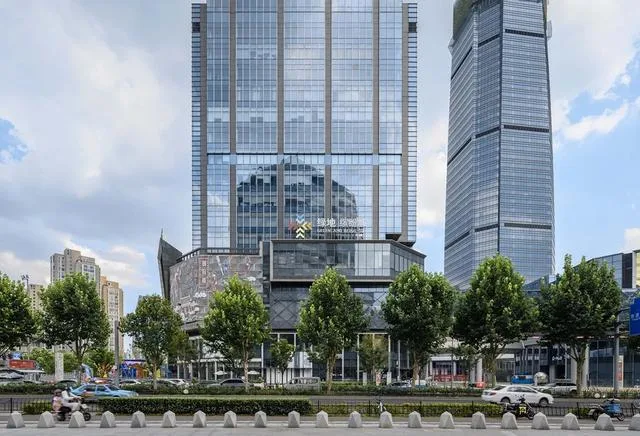
Ningbo Greenland Center street view, photo by Liu Songkai
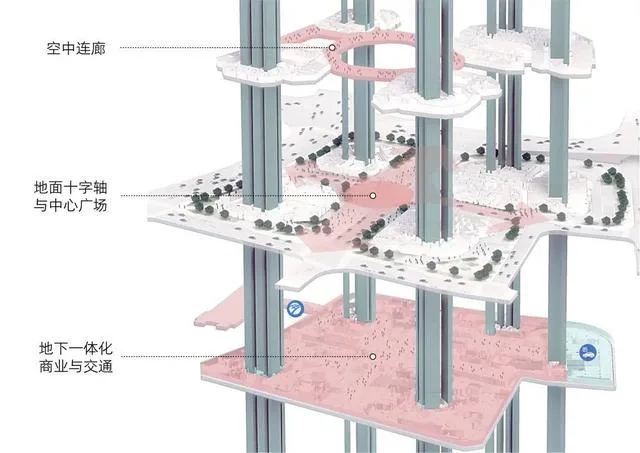
On the ground floor, visitors converge at the central square via four commercial nodes, seamlessly integrating the scattered plots through commercial activity. The second floor introduces pedestrian flow with five external escalators, internal vertical escalators, and atrium escalators. An aerial corridor links all four plots, boosting connectivity and creating overlapping pedestrian routes.
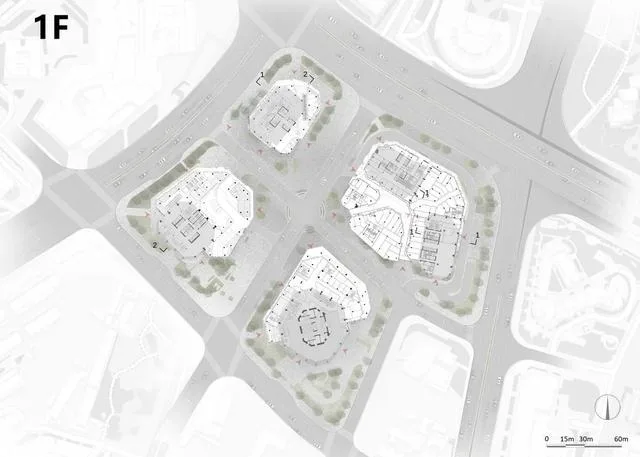
First floor plan
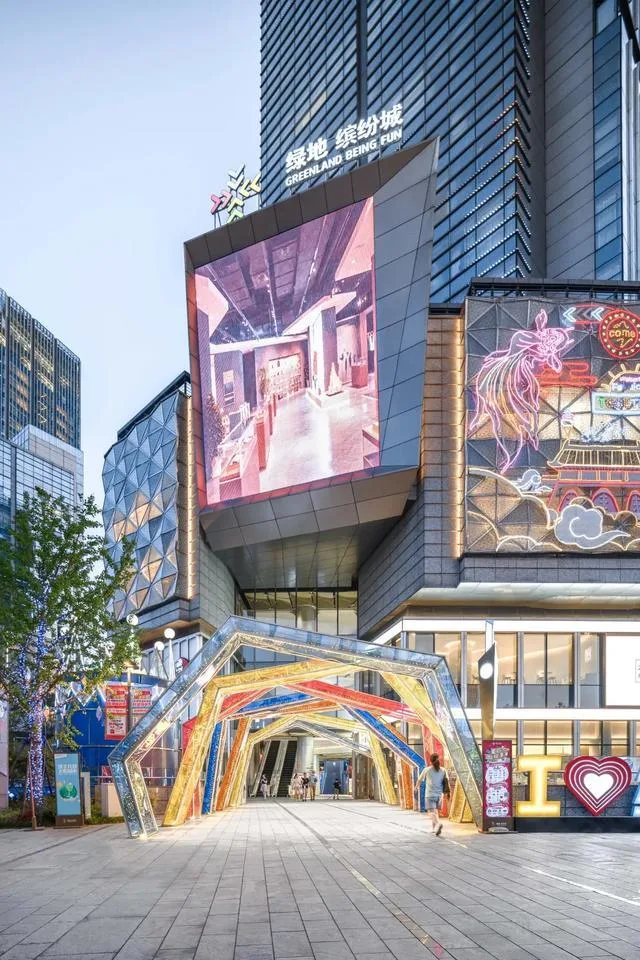
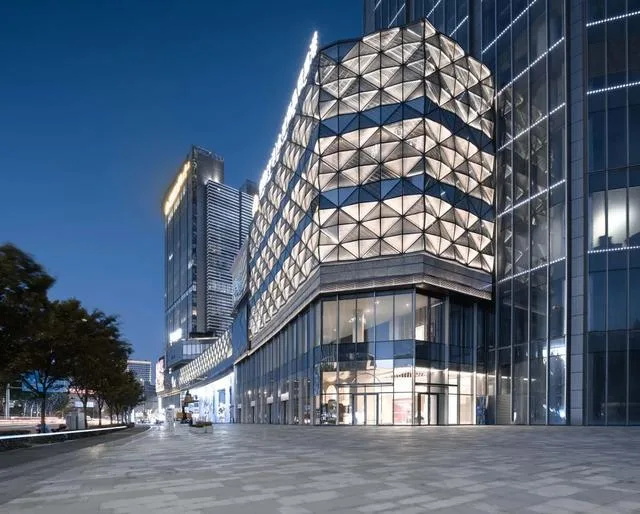
First-floor commercial node, photo by Liu Songkai
Below ground, seven sunken plazas connect the four plots, three building groups, and five towers. These subterranean spaces compensate for the above-ground limitations. Pedestrian flow is guided through subway exits and sunken plazas, with escalators in the three main courtyards.
Plots 1, 2, and 3 are linked by commercial streets underground, maximizing subway passenger flow to the old Bund. This underground network offers sheltered, convenient access among buildings, unaffected by weather.
03. Technical Execution of Urban Landmarks
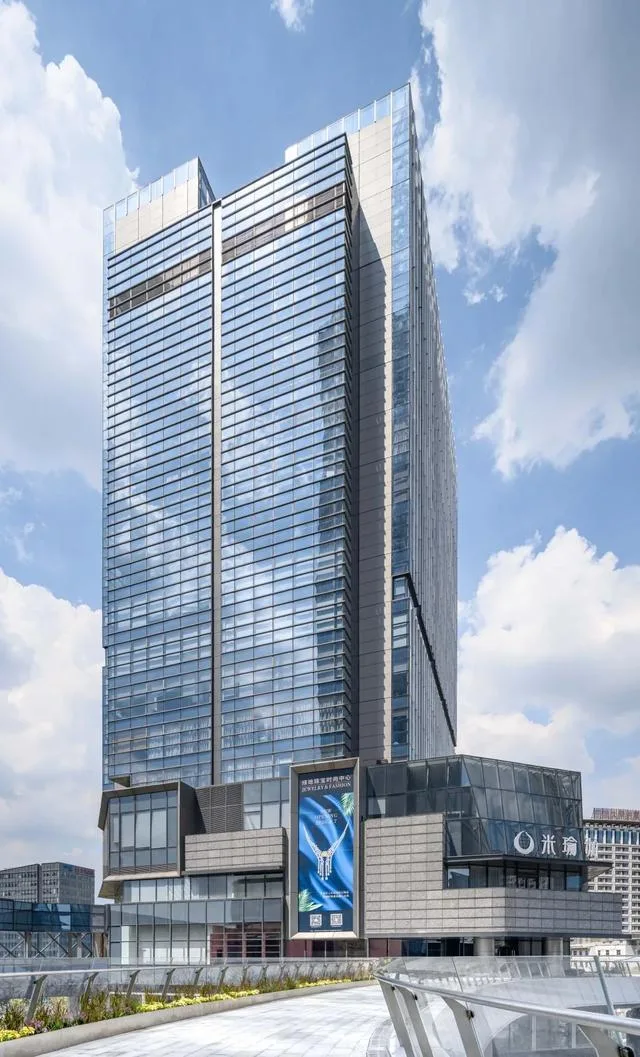
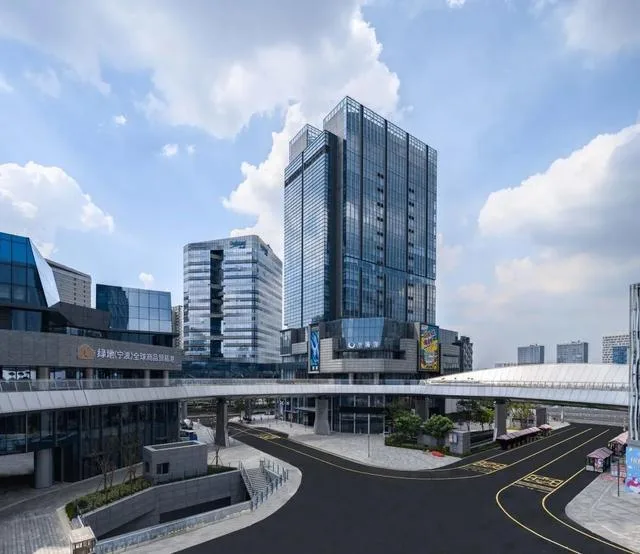
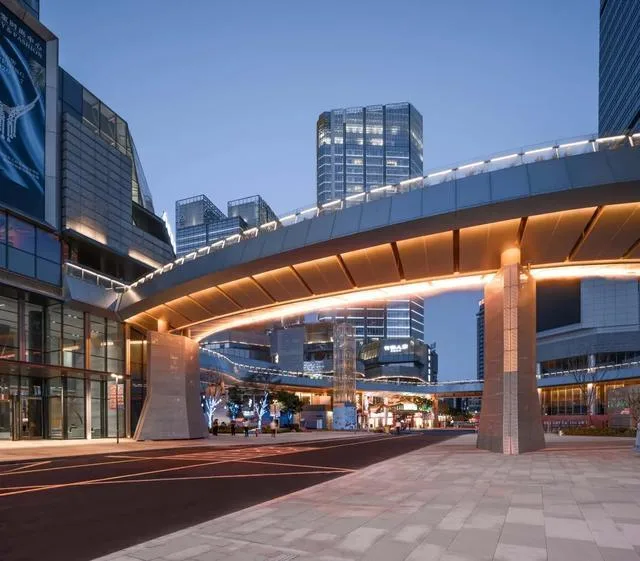
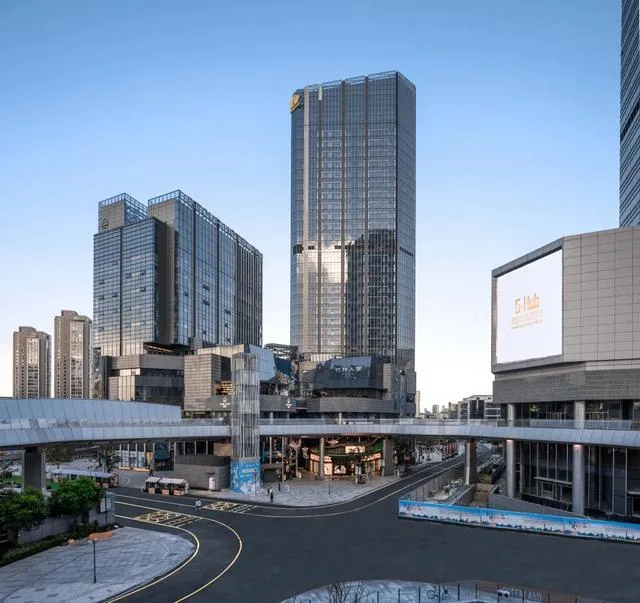
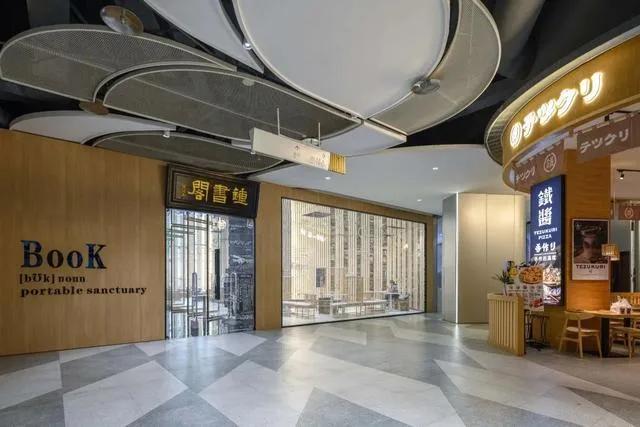
Stereoscopic space construction, photography by Liu Songkai
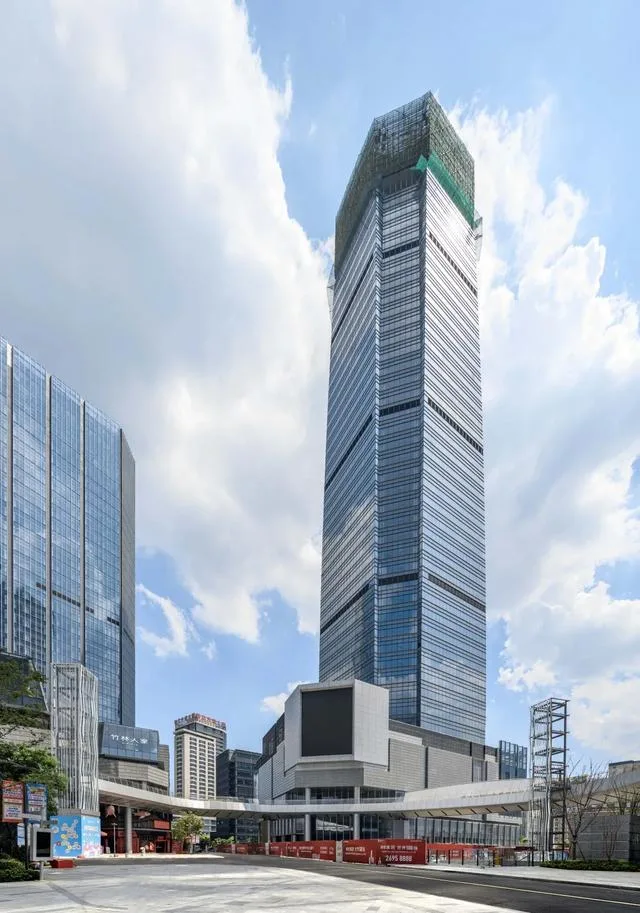
Near-completion city landmark, photographed by Liu Songkai
The Greenland Center project covers nearly 50,000 square meters, with a total built area exceeding 350,000 square meters. The challenges are immense: structural engineering for super high-rise towers, coordination among multiple subcontractors, complex site issues, and communication hurdles over the project’s extended timeline.
Since construction began in September 2013, San Yi Architecture has collaborated for eight years to resolve design issues across disciplines, ensuring smooth progress. Through high-quality design and patient communication, they strive to unify the building’s construction quality.
Early in the design process, specialized research focused on key structural challenges, particularly for the super high-rise tower.
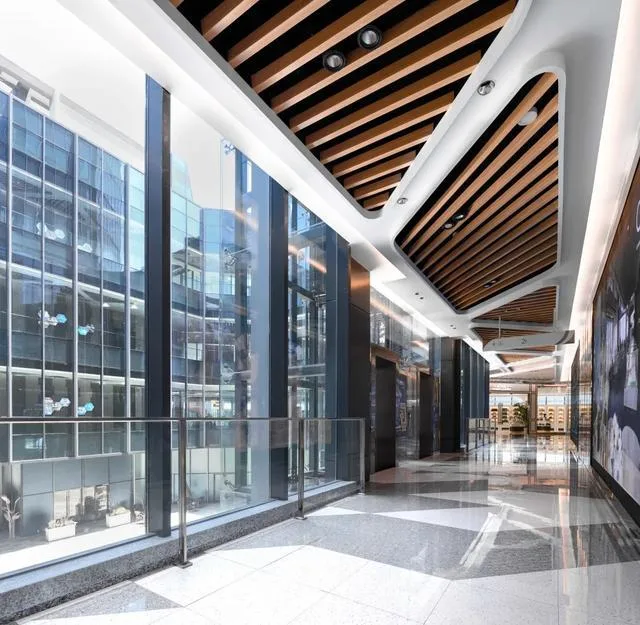
Indoor corridor of Greenland Center, photo by Liu Songkai
Structural Innovations
Inclined Wall Transfer System
The main tower’s height is significant, and the design vertically segments the building, with floor plates gradually shrinking inward at higher levels. This optimizes the towering form, enhancing the building’s visual height. To realize this facade, structural engineers developed an inclined wall transfer system, overcoming traditional structural constraints and increasing usable space.
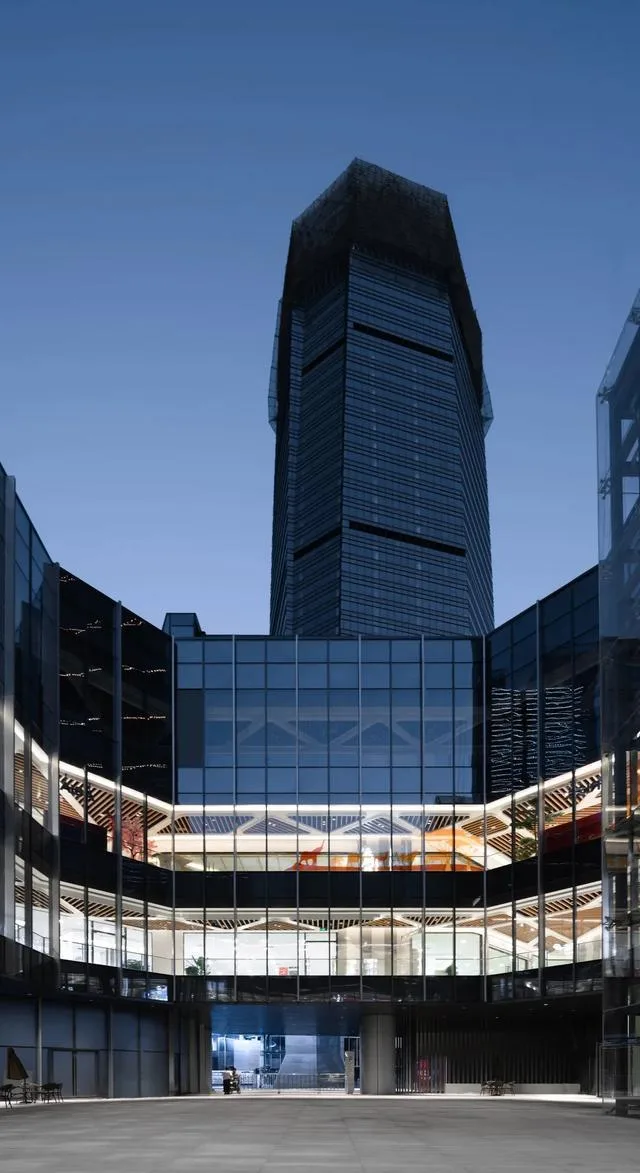
Vertically segmented main tower, photo by Liu Songkai
Simplifying by Eliminating the Superfluous — Ring Truss Strengthening Structure
The 240-meter main tower uses a dual lateral force-resisting structural system: steel-reinforced concrete frame, reinforced concrete core tube, and a reinforced ring truss layer to resist wind and seismic forces.
Unlike conventional cantilever and ring truss combinations, this project installed a 4.5-meter-high reinforced floor-ring truss on the 28th floor. This ring truss connects peripheral frame columns circumferentially with steel trusses, enhancing overall bending resistance and axial compression strength. This improves lateral stiffness, displacement control, strength, stability, and ductility.
This simplified structural system saved about 25 days of construction time and elevated the ring truss from a coordinating role to a decisive structural element.
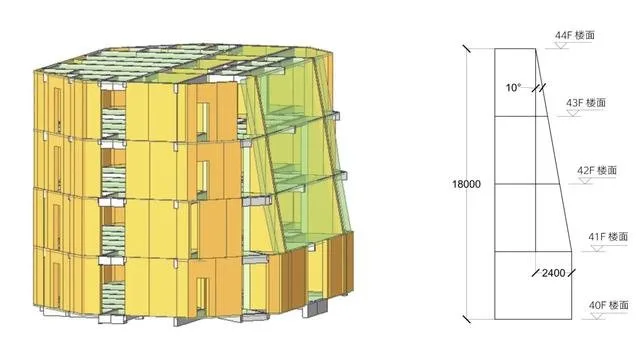
Inclined wall transfer system
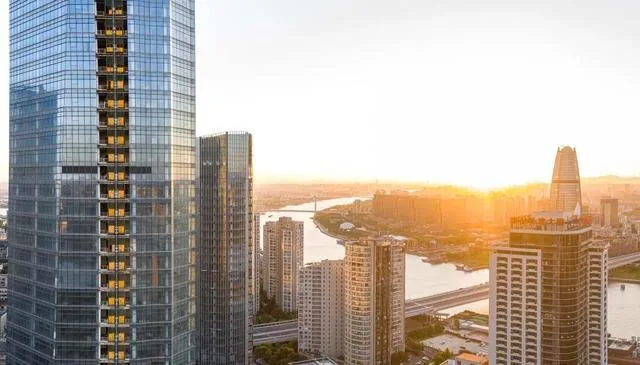
Overlooking the main tower of Ningbo city, photo by Liu Songkai
Innovative Tuned Liquid Damper (TLD)
For wind and earthquake resistance, the design repurposed the fire water tank atop Building 5 as a tuned liquid damper, saving nearly zero civil engineering costs and millions in engineering expenses. This innovation has earned a utility model patent and has applied for an invention patent.
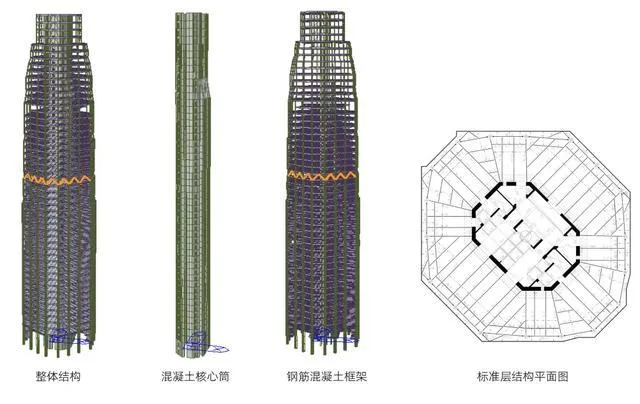
Circular belt truss
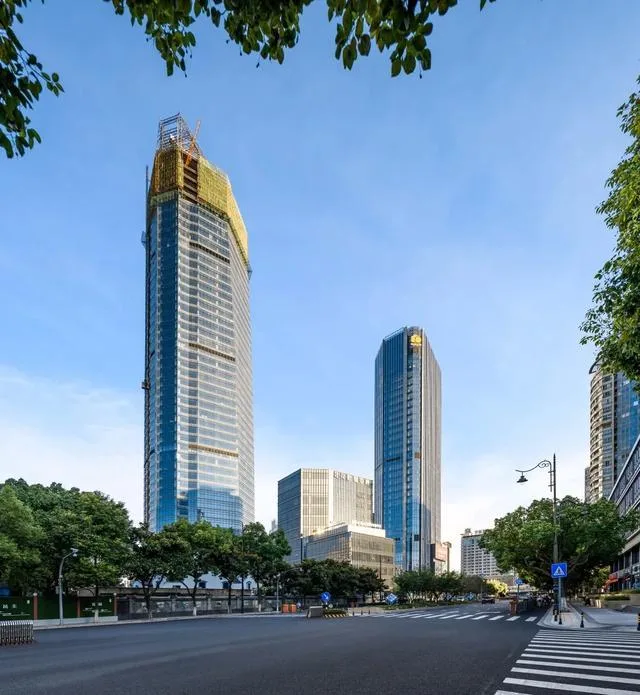
Rising urban skyscrapers, photo by Liu Songkai
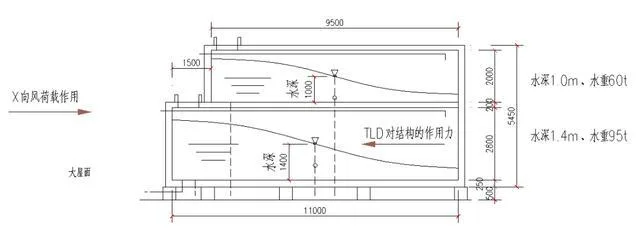
Multi-layer TLD water tank fire protection structure construction
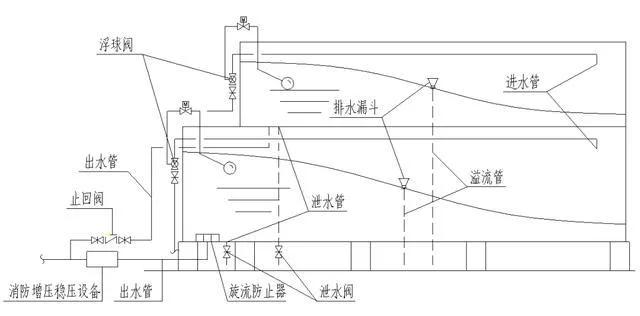
Multi-layer TLD water tank fire water supply structure
BIM Integration for Coordinated Execution
The Greenland Center’s complex spatial design presented significant coordination challenges among multidisciplinary teams. To ensure design fidelity and strict control, San Yi utilized BIM technology for comprehensive checks across building spaces, structural elements, equipment piping, and installation heights.
Each team provided timely feedback based on clash detection results, enhancing design and construction quality and efficiency. Continuous collaboration occurred with subcontractors like curtain wall facade and lighting specialists to refine facade effects, indoor/outdoor lighting analysis, and tower crown steel structure design. This process included deepening technical drawings and providing on-site construction guidance.
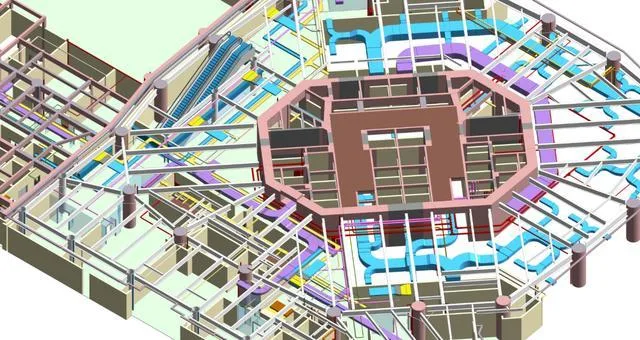
Using BIM to enhance design and construction quality and efficiency
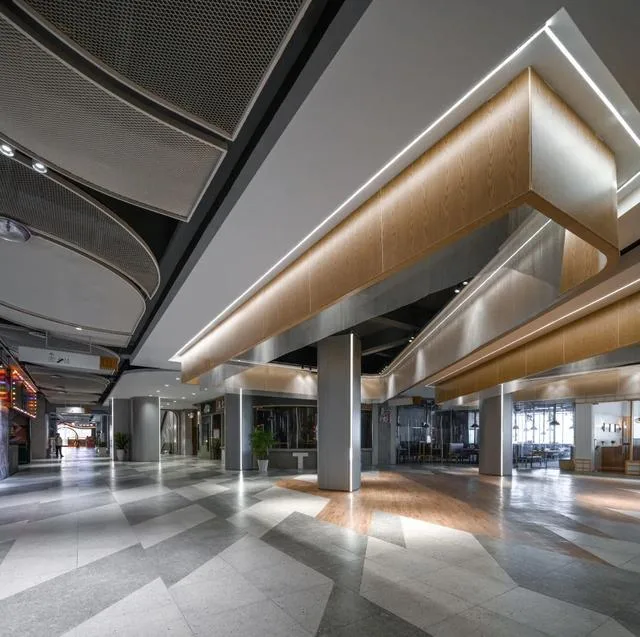
Interior corner of Greenland Center, photo by Liu Songkai
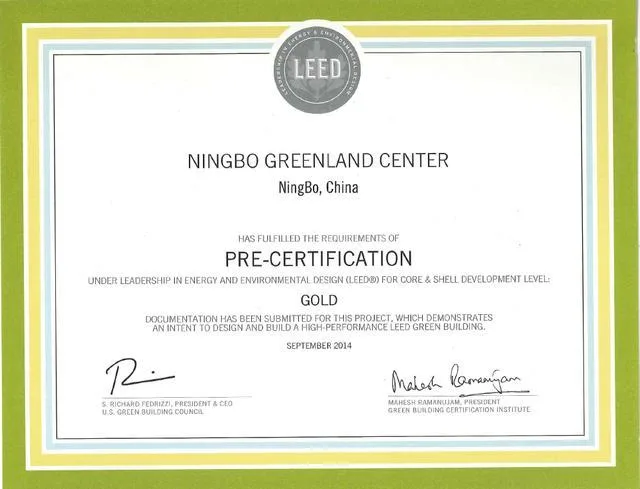
The Ningbo Greenland Center is a flagship project within Ningbo’s “Three Rivers and Six Banks” and “Two Rivers and North Banks” development zones. It is Greenland Group’s 30th global center and has attained LEED Gold certification from the United States.
By organizing contextual networks, building three-dimensional urban spaces, and applying advanced technologies, the project strengthens the direct connection between urban space and human experience. It creates richness and landmark status within the city and ensures delicacy and sustainability in the physical environment.
The “Greenland Center” delves into urban space dynamics, fostering a competitive partnership among the city, market, and residents, cementing its role as a city landmark.
Its super high-rise technology combines structural innovations to optimize traditional designs, balancing building value realization with construction cost reduction. This approach promotes sustainable urban development and offers innovative solutions for future super high-rise projects.
This monumental structure at the confluence of the Three Rivers defines the evolving skyline of Yongcheng.
Project Information
Project Name: Ningbo Greenland Center Project (Plots 1#–4# on Taodu Road)
Location: Jiangbei District, Ningbo City
Land Area: 36,752 square meters
Floor Area: Plots 1# and 3#: 152,572.12 square meters; Plots 2# and 4#: 231,673.29 square meters
Construction Timeline: Plots 1# and 3#: May 2019; Plots 2# and 4#: under construction
Developer: Ningbo Greenland Real Estate Co., Ltd.
Design Proposal: Japan Design Co., Ltd.
Architecture/Deepening/Structural/MEP Design: Shanghai Sanyi Architectural Design Co., Ltd.
Project Leader: Zheng Yan
Project Team:
- Architecture: Jiao Feng, Ding Beili, Peng Donghua, Li Jihong, Huang Lingrong, Du Yao, Yan Hongying, Hu Runyu
- Structure: Ha Minqiang, Chen Siqiang, Lu Chenying, Li Xuetao, Peng Ning
- MEP: Xu Weidong, Feng Juanjuan, Ding Hongmei, Yang Hui, Lan Wenli, Zhu Huimin, Dai Dan, Jiang Li, Sun Fu
- Technical Support: Wang Xiaohong, Zhao Bin, Chen Ying, Wang Weiqing, Chen Jianxin
- Drawing Coordination: Zuo Yongping, Li Zhong, Zhang Keran
- Landscape Design: Shanghai Naqian Landscape Environment Design Co., Ltd.
- Civil Defense: Ningbo Civil Defense Architectural Design Branch, Second Construction Engineering Responsibility Company of China Construction Third Engineering Bureau
- Construction Contractor: Beijing Construction Engineering Group Co., Ltd.
- Curtain Wall Contractors: Shanghai Banpeng Architectural Design Consulting Co., Ltd. (Plots 1# and 3#); Shanghai Xumilin Curtain Wall Co., Ltd. (Plots 2# and 4#)













Must log in before commenting!
Sign Up