
Marronnier Gate is situated on the edge of Tokyo’s Ginza district, an area renowned for its high-end luxury stores. Unlike the densely packed urban environment, this shopping mall is bordered by a wide main road and an elevated roadway. As a result, the mall presents two contrasting characteristics: one side features dense, fragmented commercial shops, while the other offers open views due to its proximity to Tokyo Station. Among the many existing developments, most stores are enclosed spatial blocks with little consideration for interaction with the surrounding site context.
Originally constructed in 1984, Marronnier Gate was Tokyo’s first large-scale store designed in a Parisian style. The architect employed a consistent structural design across each floor, aiming to create a unique commercial environment through innovative shopping experiences. To maximize retail space, service areas were placed around the building’s periphery. However, this layout hindered communication both between floors and between the interior, exterior, and the surrounding city. Additionally, the uniformly high ceilings somewhat concealed the building’s refined concrete structure and equipment pipelines. This relatively closed and disconnected spatial form contrasts with Uniqlo’s customer-centric store design philosophy.
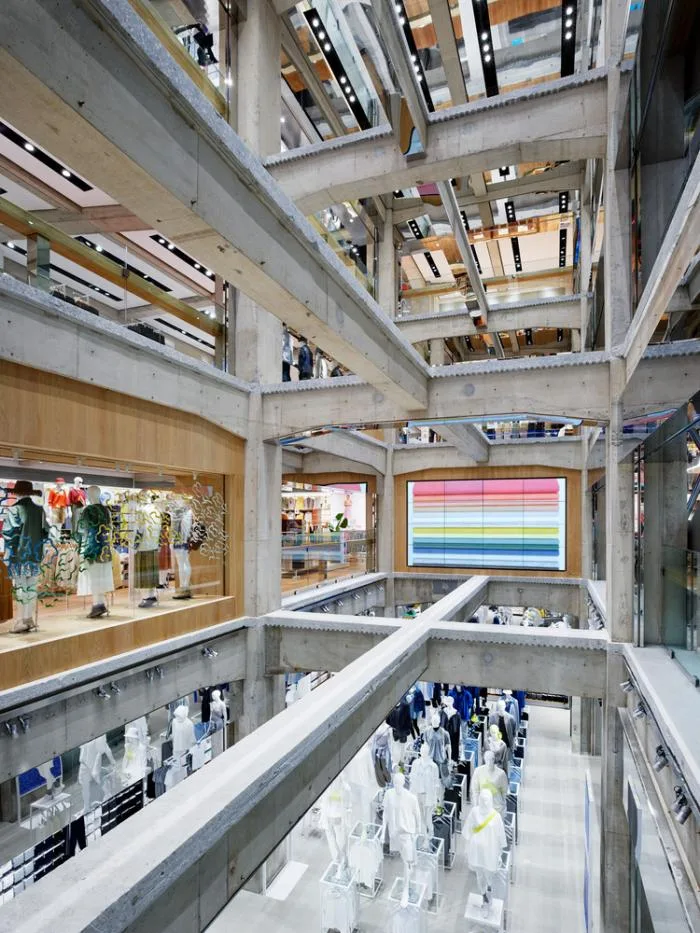
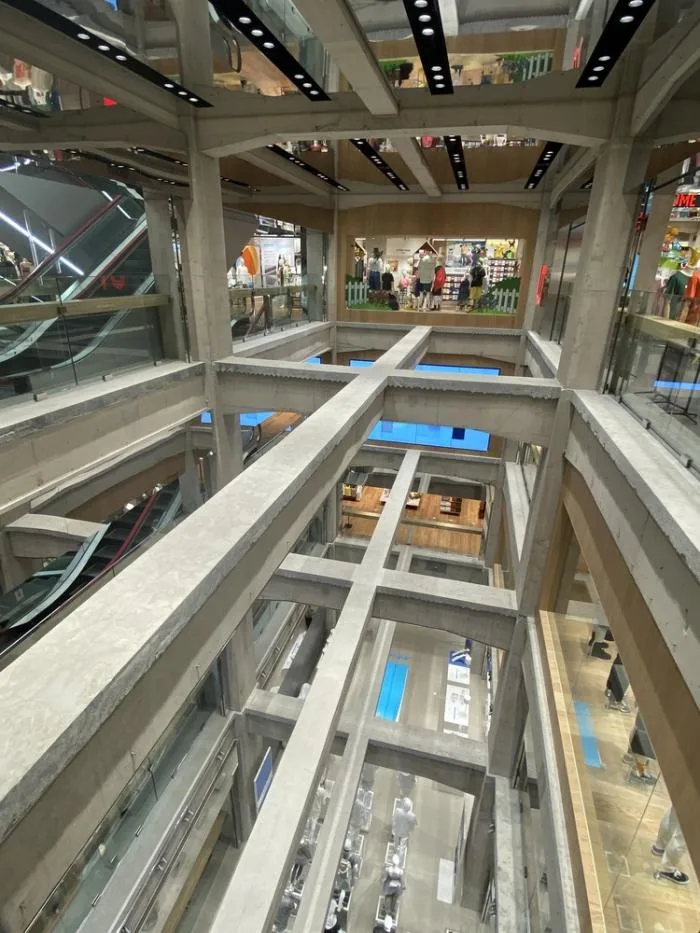
Through detailed analysis of the building’s structural drawings and on-site research, the architects discovered the inherent aesthetic appeal of the concrete frame structure. They decided to highlight and express these exposed structures both inside and outside the building. Consequently, all suspended ceilings, exterior wall panels, and related accessories were carefully removed. The design focuses on subtraction to reveal the building’s original structural features.
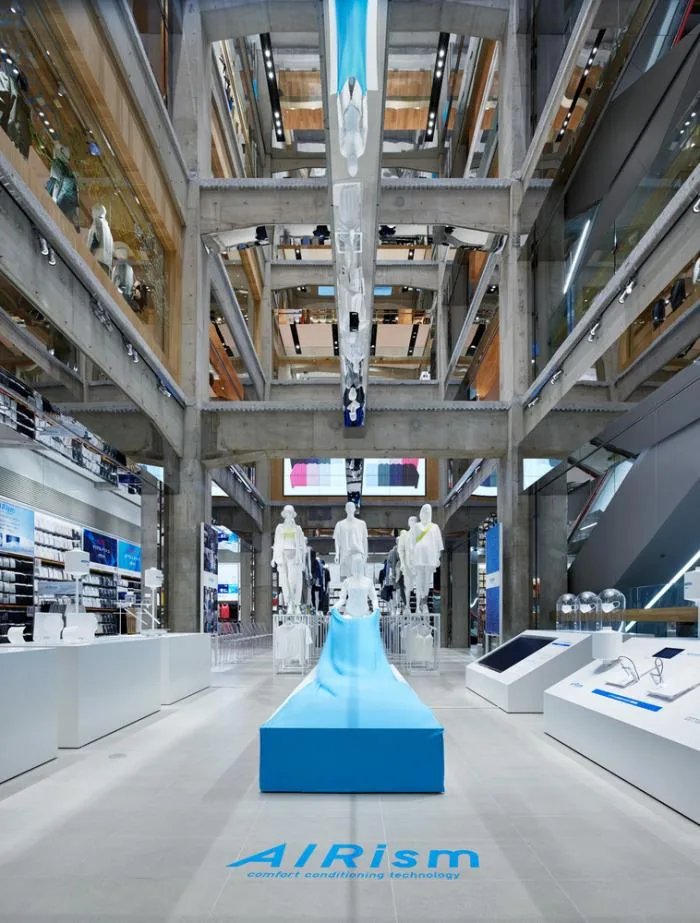
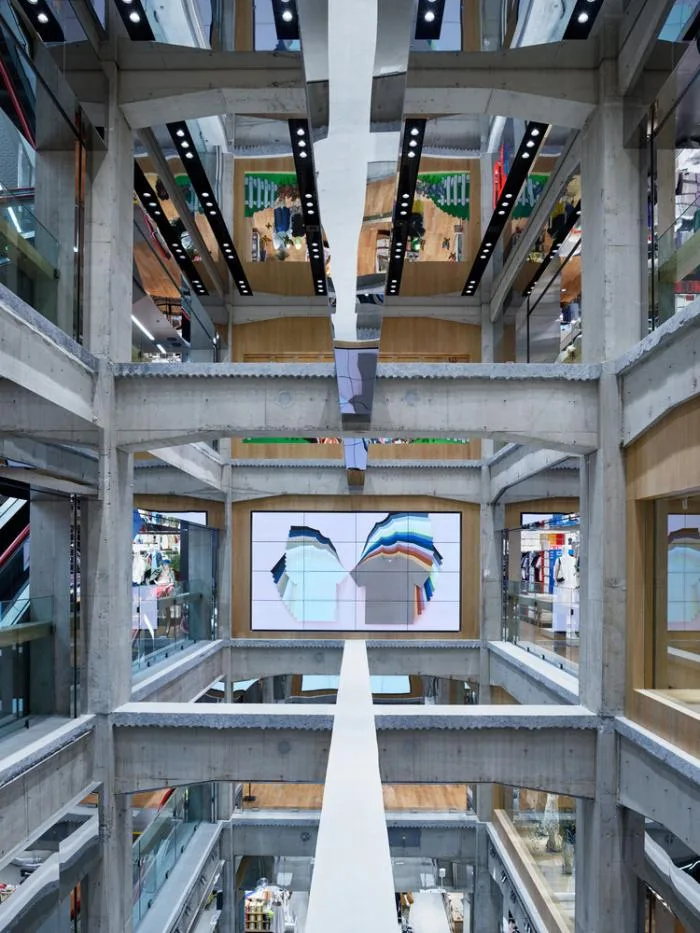
The exposed concrete grid also serves as a striking backdrop for Uniqlo’s vibrant product displays. Customers can easily see the beams and columns both inside the store and from the surrounding urban space. To reinforce this distinctive structure, the architects incorporated a selection of materials: stone, concrete, wood, and metal for flooring; mirrors and material panels on the ceiling; and a unique exterior facade crafted from glass combined with cement mixed with glass beads. This highly organized orthogonal framework introduces unexpected environmental qualities into conventional commercial retail spaces.
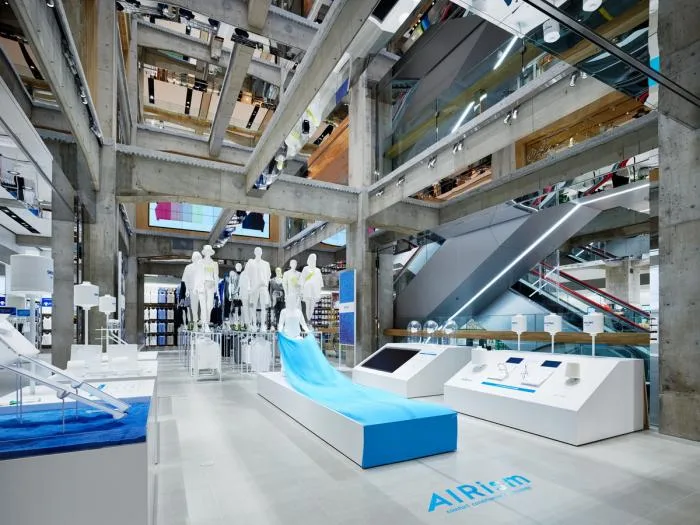
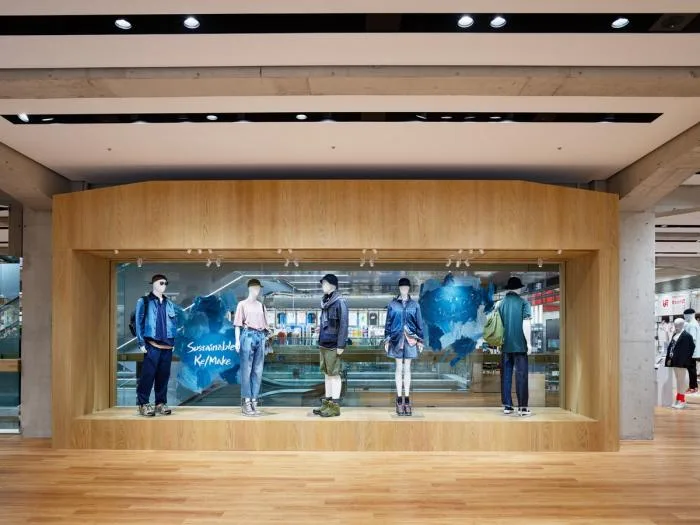
The architect also made precise modifications to each floor slab to establish dual spatial and visual connections. A double-height entrance and a four-story internal atrium were designed to harmonize with the neighborhood’s spatial vitality. To soften the visual impact of the atrium’s beams, mirrors were installed on their undersides, while the raw concrete and metal edges, unveiled by panel removal, were preserved. The design aims to create an open exhibition effect throughout the space, achieved by exposing concrete structures, using large wooden cabinets and glass display cases as screens, or integrating advanced digital screens.
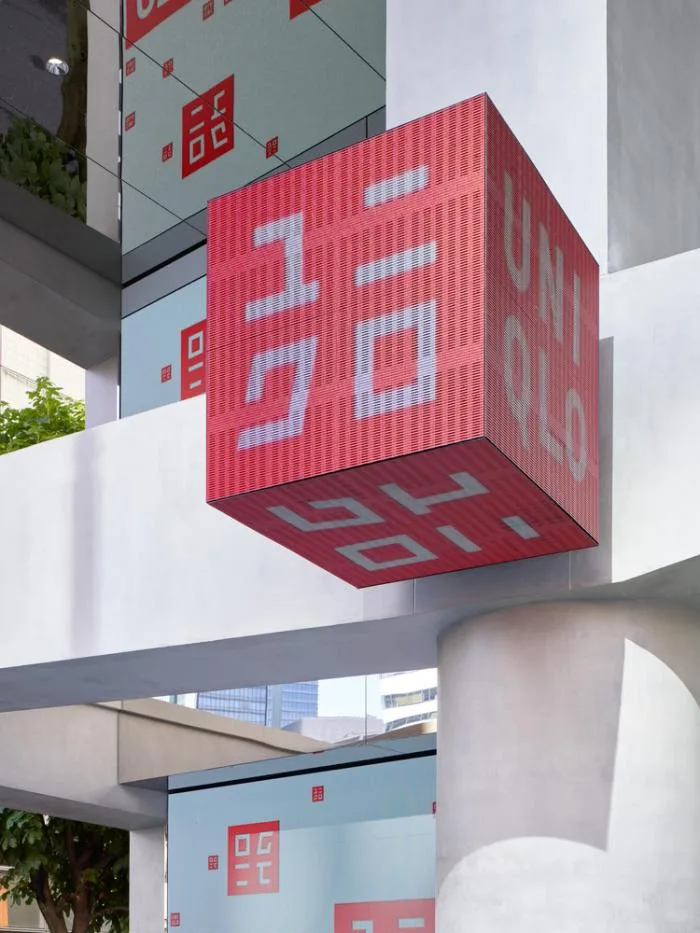
On the street-facing side, the exposed concrete structure is shaped into a welcoming arch, inviting pedestrians inside. Glass facades reflect the store’s interior displays, showcasing Uniqlo’s products to passersby. Additionally, small cubes adorned with brand visuals are mounted on the building’s exterior, not only highlighting the brand’s identity but also integrating seamlessly into Ginza’s vibrant nightlife atmosphere.
In summary, the architects have explored new spatial experiences and possibilities by reimagining the presentation of elegant architectural structures. The Uniqlo Tokyo flagship store and its products no longer remain isolated within the city’s hustle and bustle; instead, they engage in a shared dialogue with the urban environment.
Project Information
Project Type: Retail Architecture
Location: Tokyo, Japan
Architectural Design: Herzog & de Meuron
Area: 23,059 m²
Project Year: 2020
Partners: Jacques Herzog, Pierre de Meuron, Stefan Marbach (Partner in Charge)
Project Team: Dieter Mangold (Associate, Project Director), Yuko Himeno (Project Manager), Michal Baurycza (Visualizations), Marcelo Bernardi (Associate), Edoardo Cappella, Teeranop Chamnong, Massimo Corradi, Josh Helin, Ryoko Ikeda, Ekaterina Nuzhdina, Lukasz Pawlicki, Pedro Peña Jurado, Alan Pülz, Jos Reinders, Kilian Schellenberger, Martin Schulte (Design Technologies), Florian Tropp
Executive Architect: Takenaka Corporation
Executive Architect (Interior): Nomura Co., Ltd
Structural Engineer: Takenaka Corporation
Mechanical and Electrical Engineer: Takenaka Corporation
Lighting Consultant: FDS Co., Ltd
LED Guide Consultant: Hibino Chromatek Division
Digital Graphic Design: tha
Visual Presentation: Aron Lorincz Ateliers
Main Contractor: Takenaka Corporation
Main Contractor (Interior): Nomura Co., Ltd













Must log in before commenting!
Sign Up