
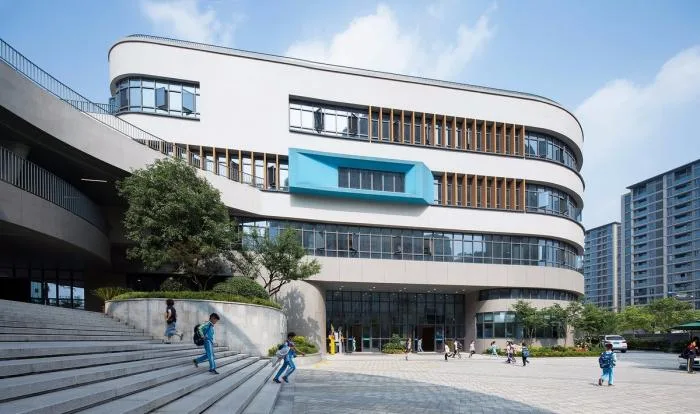
▲ Campus Entrance Square
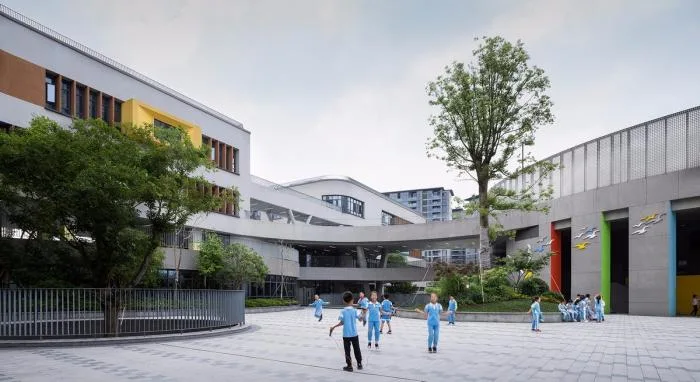
▲ Harmonious coexistence between mature trees and children
Formerly known as Zhejiang Experimental School, this newly established institution boasts a rich history, comprehensive facilities, innovative ideas, practical teaching methods, and high-quality education. Its roots trace back to Chongwen Academy, founded in the 27th year of Emperor Shenzong of the Ming Dynasty, making it one of the longest-standing schools in Zhejiang Province. The school’s educational philosophy centers on nurturing life and creating a campus that serves as a spiritual sanctuary where teachers and students grow together.
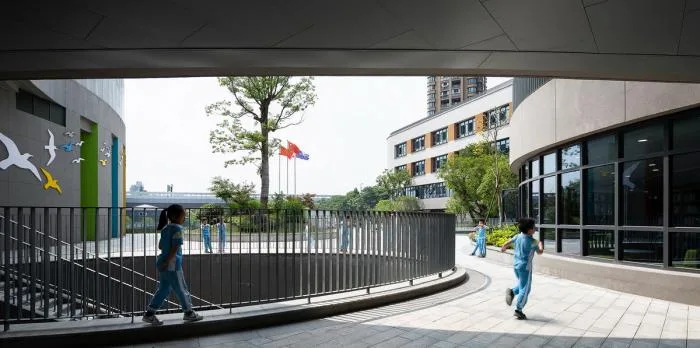
▲ Vibrant activity courtyard
The school is situated on the west side of an elevated road, surrounded on three sides by high-rise residential buildings. The site is narrow and irregular, classified as a “corner plot” within the city. The school’s functional requirements significantly exceed the land’s plot ratio. Our primary goal was to create low-density, comfortable educational spaces within a high-density urban environment. Resolving this contradiction became the core challenge of the planning process.
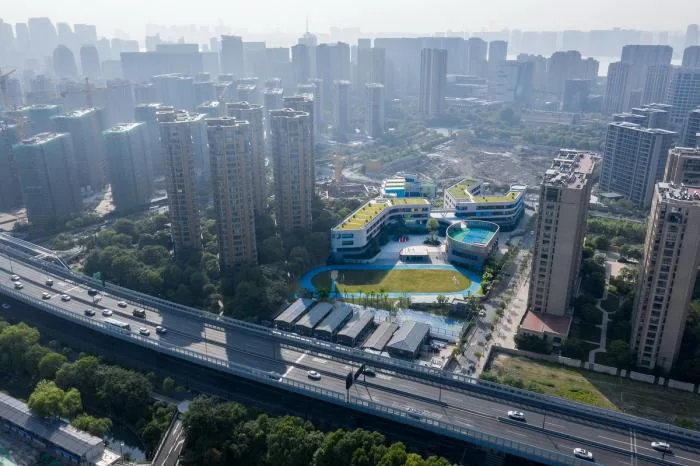
▲ Campus layout within a high-density urban setting
Intensive yet Decentralized Design
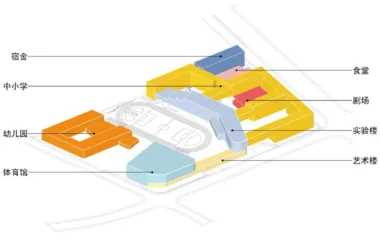
To address the challenge, we first categorized the school’s functions and volumes into two groups: above ground and underground, placing suitable activities below ground. The sports area is positioned on the western side, shielding the teaching spaces from the elevated road. From north to south, spaces are arranged according to privacy levels: public functions such as multi-purpose halls, basketball courts, and administrative offices are located adjacent to the southern city branch road, while standard classrooms occupy the northern side. East-west oriented public teaching buildings connect these zones, effectively dividing the campus into two squares—east and west. All functions are aligned along the site boundaries, concentrating the two campus squares in the center.
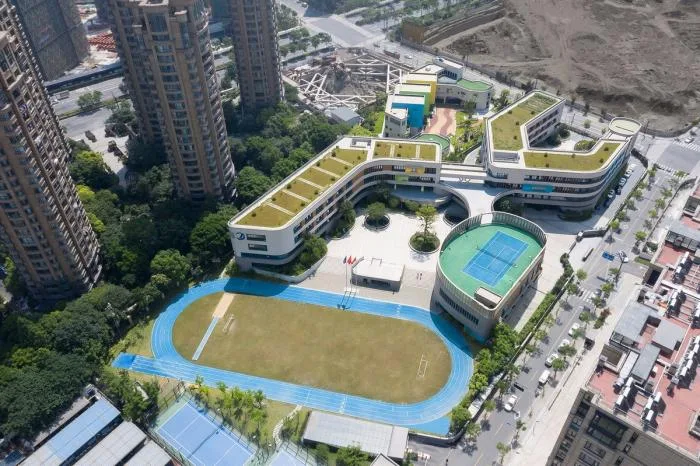
Southwest-facing aerial view of the campus
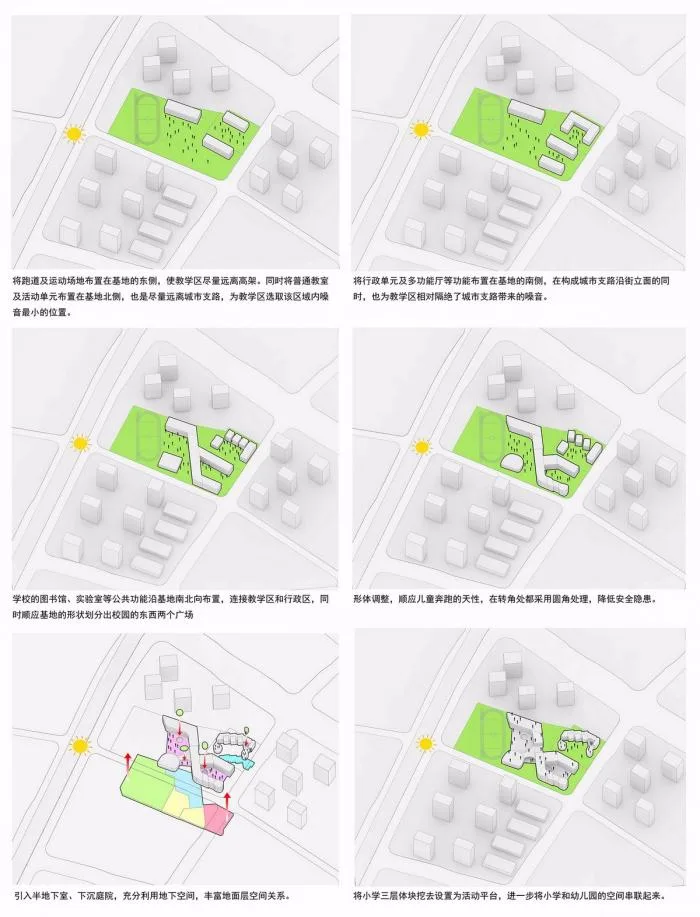
▲ Analysis of block generation
Campus as a Park
Viewed from the towering residential buildings, the campus appears as a sunken green space—a lively park within the city. The rooftops are designed as display surfaces facing the city, presenting a tidy, clean, and verdant image that acts as a small green lung amidst the urban environment.
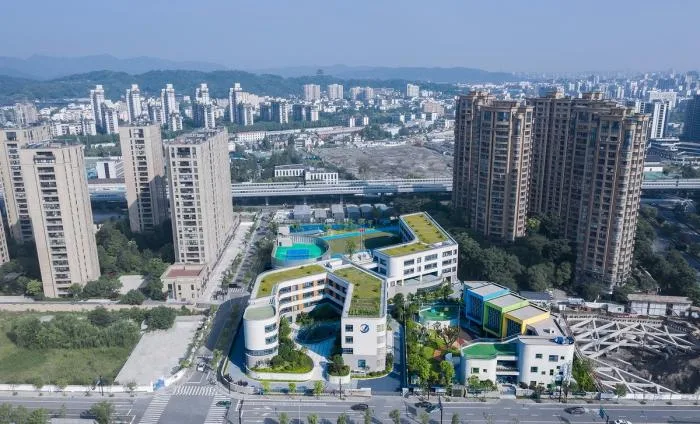
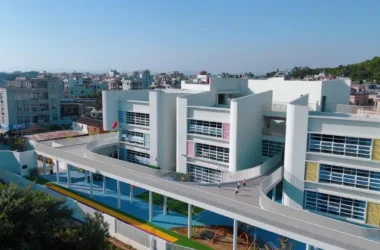
▲ East-facing aerial view of the campus and kindergarten
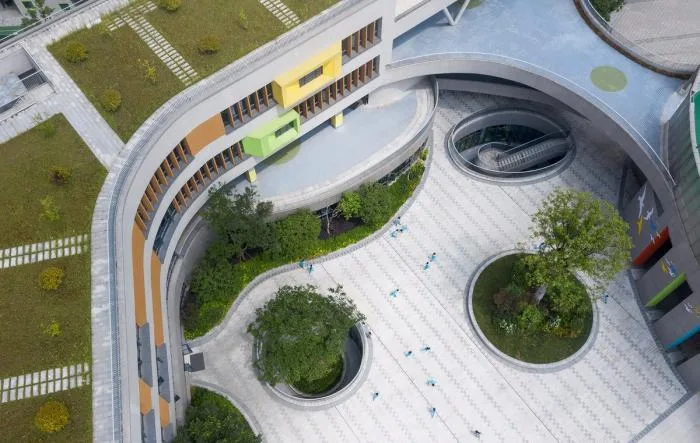
▲ Enclosed square space defined by surrounding buildings
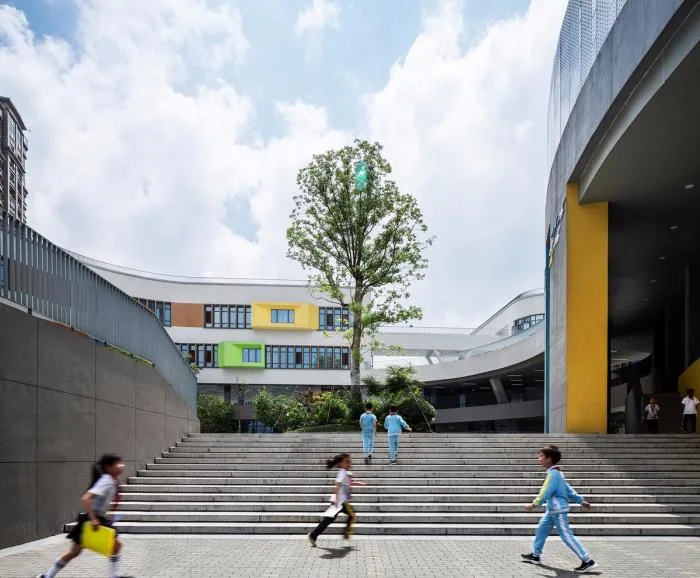
The steps serve not only to define outdoor spaces but also to add playful elements to activities.
Openness and Community Interaction
The design features a spacious entrance plaza at the main gate, open to the city. This area serves as a gathering spot for parents to pick up and drop off children and to socialize, reflecting care for families while enhancing local urban traffic flow and the city’s image. The basketball court, multipurpose hall, and rooftop tennis court are conveniently located on the west side of the entrance square, allowing easy public access during evenings and weekends.
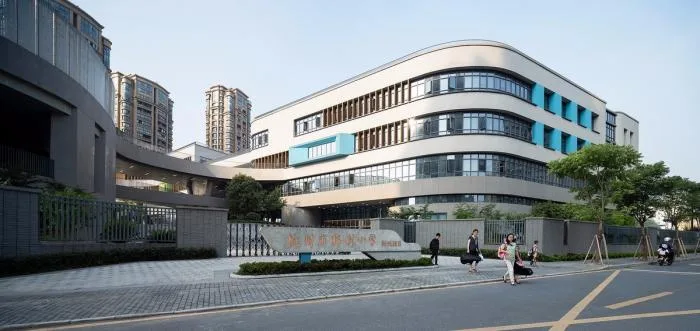
The main entrance pathway gracefully curves toward the city.
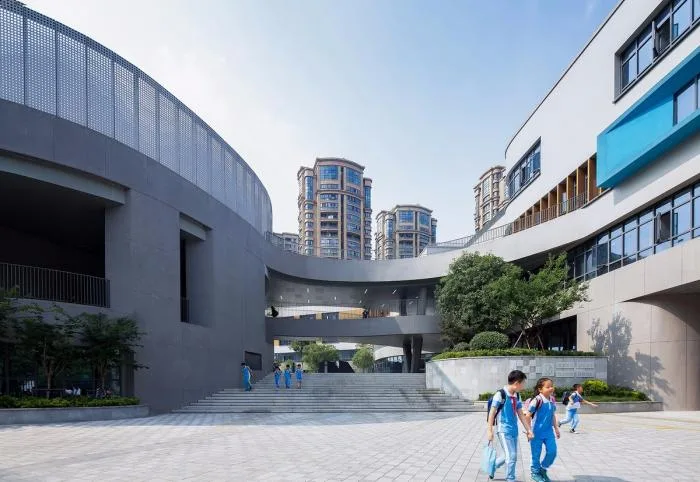
▲ The main entrance square surrounded by buildings of varying heights
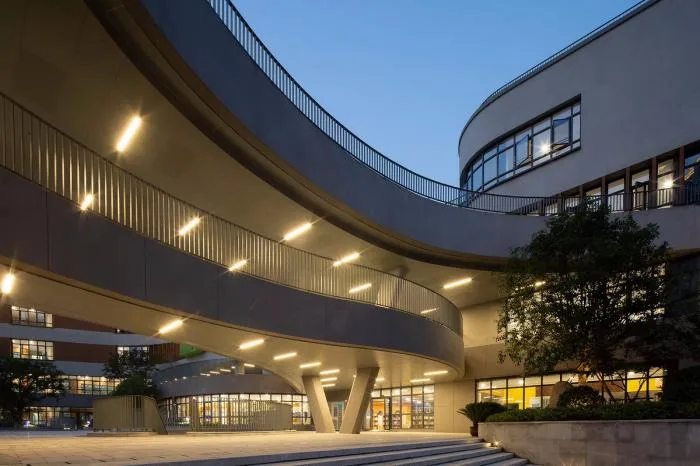
▲ A mobile activity platform
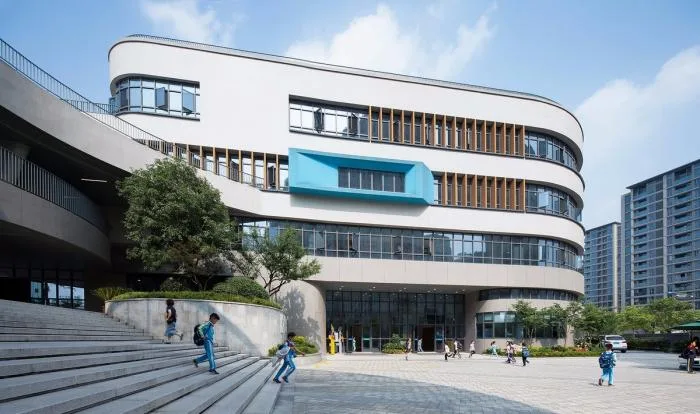
▲ Creating diverse campus microtopography by efficiently utilizing underground space
Visual Connection and Flow
The primary school and affiliated kindergarten each have clearly defined land boundaries that cannot be crossed or connected. Our design strategy embraces mutual observation and flow through elevated levels and activity platforms at varying heights, creating visual corridors between the two. This spatial arrangement guides interaction from the primary school to the kindergarten, reducing the pressure of continuous forms on the kindergarten and promoting a friendly, open relationship.
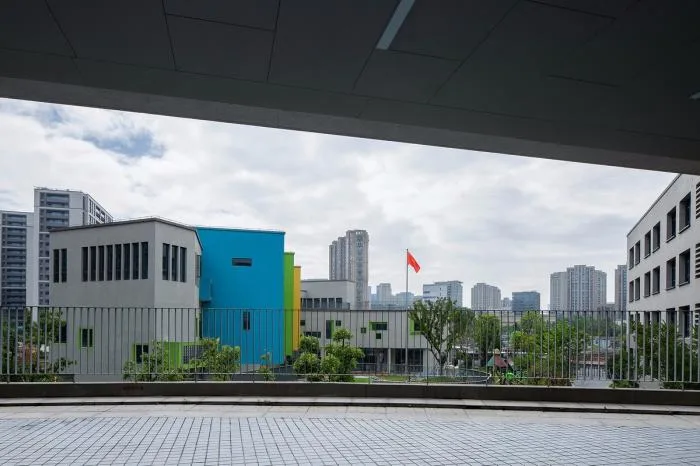
▲ Interactive space formed between the primary school’s second-floor open area and the kindergarten
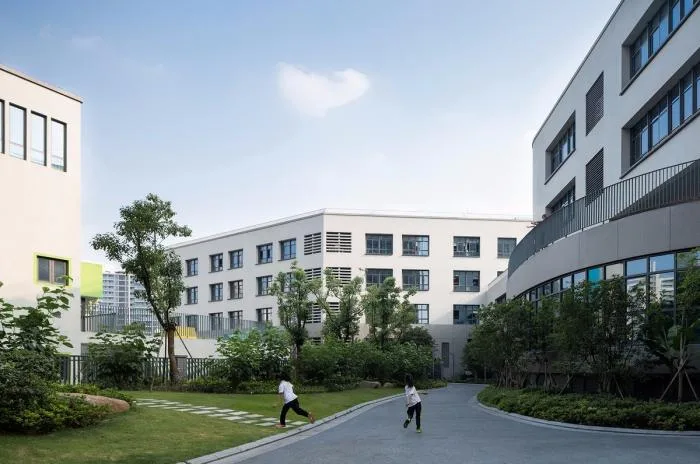
▲ Activity space connecting primary school and kindergarten
Color Palette and Design Rationale
Shengli Primary School’s traditional colors are yellow, blue, and gray. Consistent with our design philosophy of honoring tradition and maintaining simplicity, the campus buildings primarily feature dark and light gray tones that subtly complement the school’s traditional colors. This approach creates a coherent, elegant spatial experience. The kindergarten boldly adopts a combination of yellow, blue, and green for its three activity units, enhancing recognition and enlivening the inner courtyard spaces.
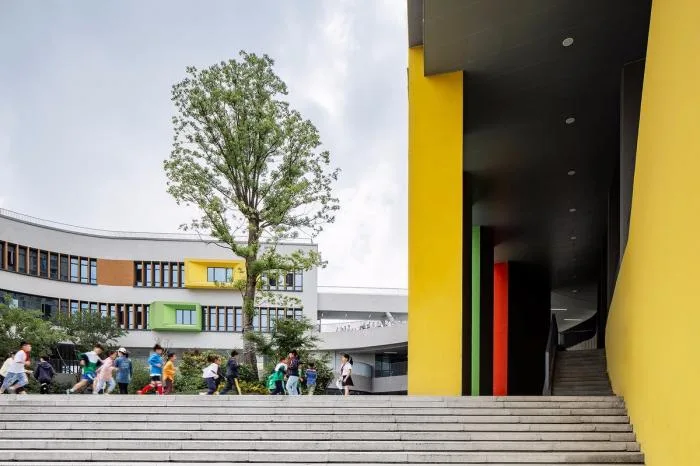
▲ Vibrant accent colors bring life to the campus
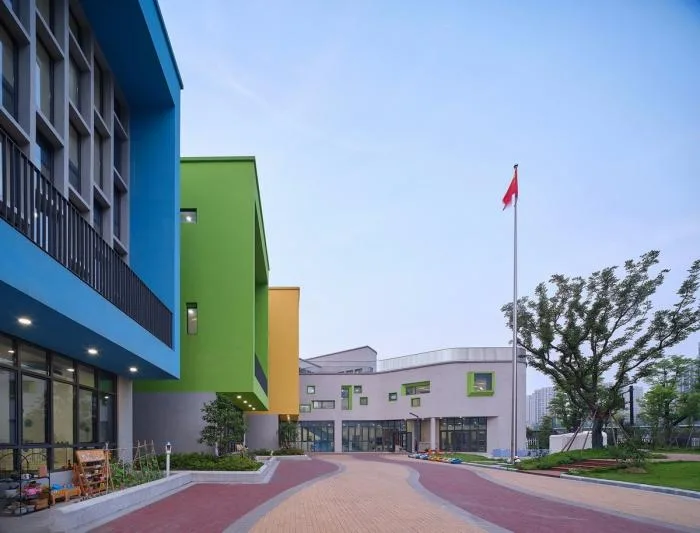
▲ Colored units enhance visual recognition
Innovative Use of Underground Spaces for Learning
To address the excess floor area ratio, the design incorporates semi-basement levels housing dining, sports, and arts facilities, each featuring appropriately scaled sunken courtyards. These spaces benefit from natural ventilation, lighting, and landscaping akin to above-ground areas. This vertical variation enriches the campus’s spatial dynamics near ground level while eliminating the need for additional civil defense structures and increasing usable space.
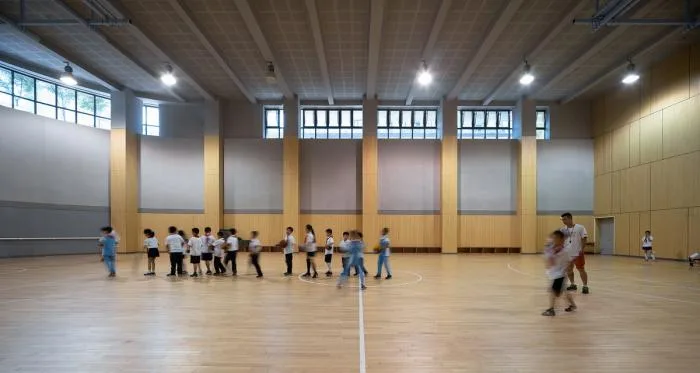
▲ Underground basketball court
Expanding Communal Spaces Above Ground
Beyond the sunken courtyards, the campus integrates numerous grey spaces, activity platforms, rooftop gardens, and tennis courts. These transitional and playful areas cater to children’s energetic nature, encouraging interaction across different levels and stimulating activity and engagement throughout the campus.
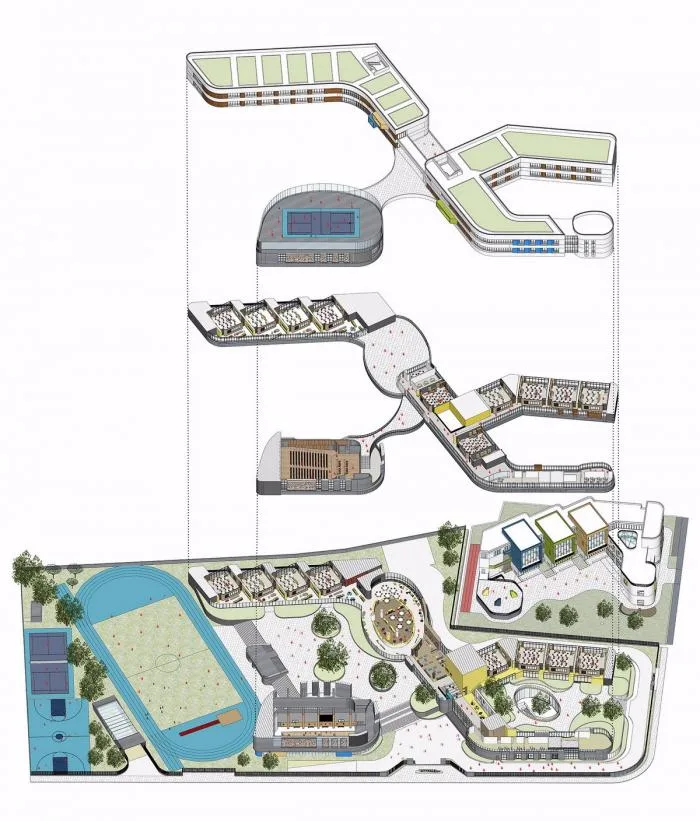
▲ Axial measurement analysis
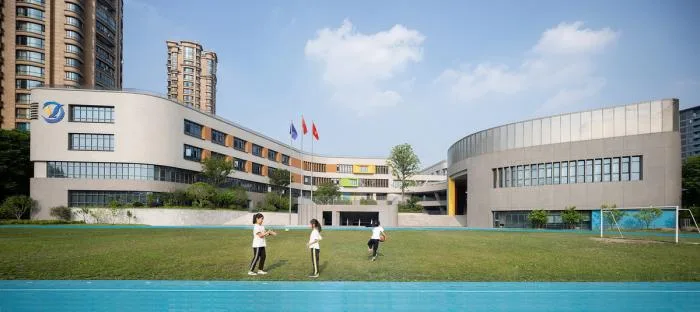
▲ The sports field and Chongwen Square create a continuous open space
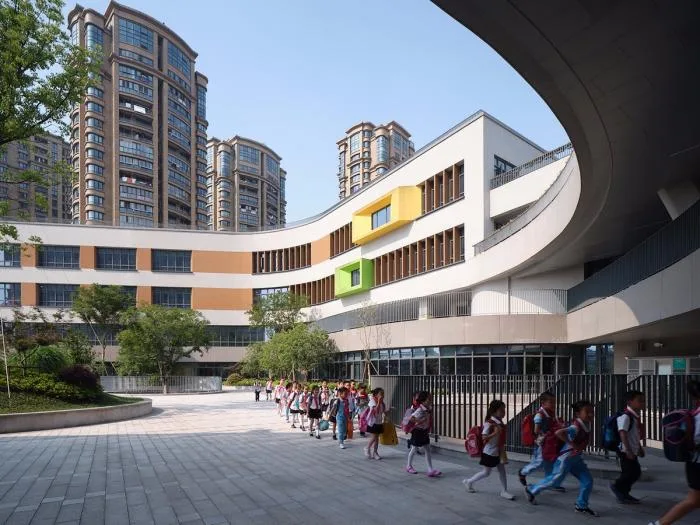
▲ Grey space formed by elevated platforms and sunken courtyards
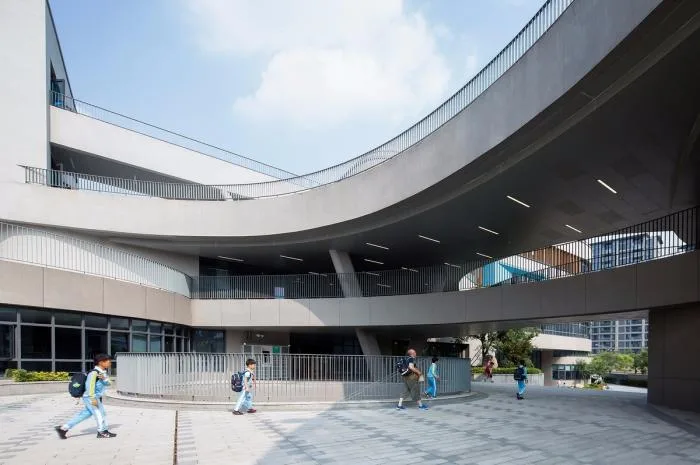
▲ A mobile activity platform
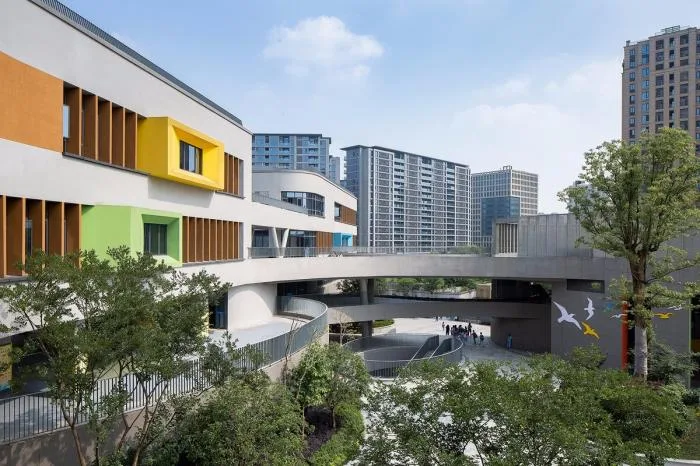
▲ View toward the elevated platform from the third floor
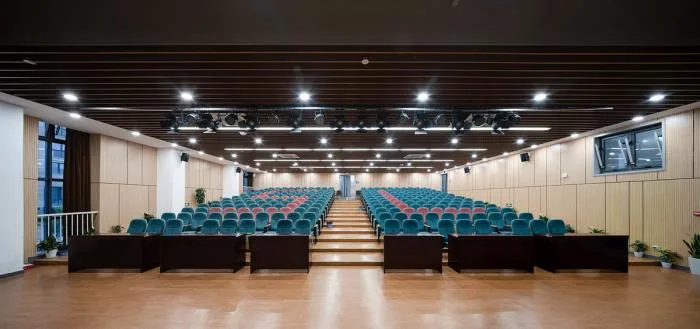
▲ Multi-functional lecture hall
Learning and Growth Beyond the Classroom
This design encourages children to engage with nature, enjoy sunlight, and experience the elements—not only indoors but also outdoors—to enrich their education and development. Two distinct activity venues were created: Chongwen Square, which seamlessly links indoor and outdoor spaces, sports areas, and underground facilities, serving as the campus hub where children of all ages run, play, and connect with the sky; and Shangde Garden, a quieter space connected to the arts cultivation area via a sunken courtyard, offering a peaceful setting for independent thought, relaxation, and martial arts practice.
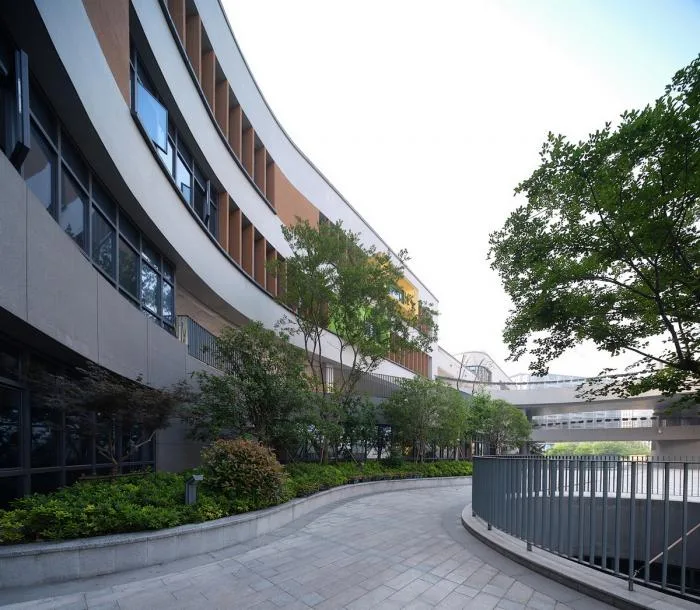
▲ Chongwen Square
Irregular corner spaces created by the offset between classrooms and corridors connect with hallways, forming complex, sequential areas. These spaces support informal teaching, communication, exhibitions, and even small children’s performances. The subtle design changes have sparked diverse behaviors among students, pleasantly surprising us.
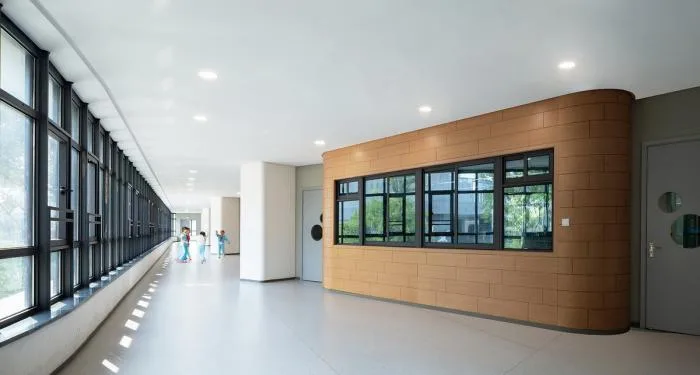
▲ Corridor expansion 1, designed as informal teaching space
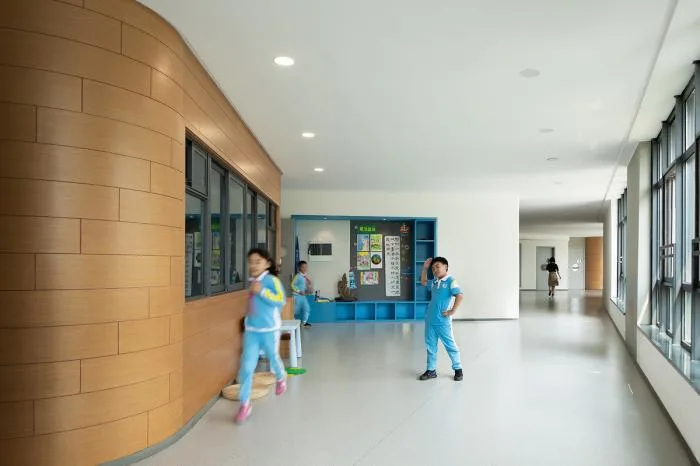
▲ Corridor expansion 2, designed as informal teaching space
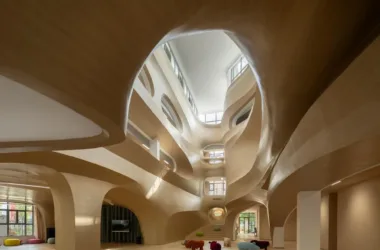
The library is designed as a boundary-free, open space located in the public area connecting teaching and administrative units on the first floor. Its oval-shaped pods, resembling water droplets, directly connect to corridors and entrance halls, embodying the concept of circulation and spatial flow within and beyond the campus. Activities such as borrowing, returning, and reading depend on children’s care and responsibility, fostering a sense of ownership.
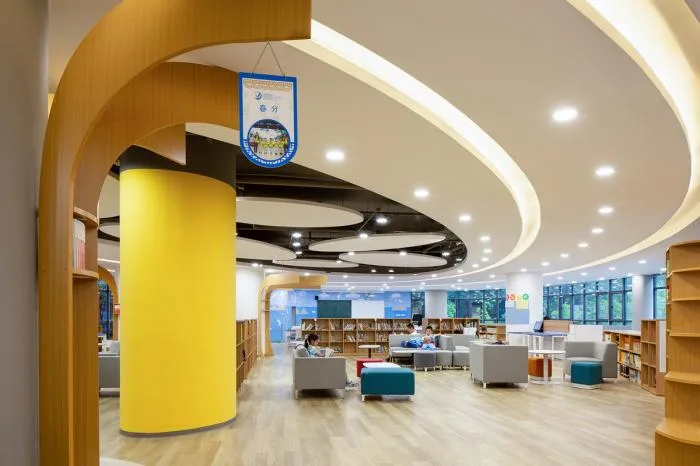
▲ Open library reading area
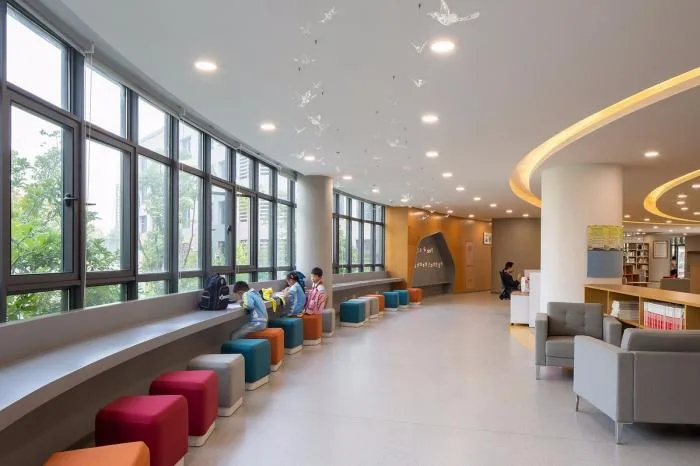
▲ Open library self-study area
The lobby’s functionality is maximized by integrating corridors, stairs, and a second-floor atrium to create a stepped shared hall. Combined with flexible indoor furniture arrangements and thoughtful elevation changes, this shared hall connects directly to the open library. It provides a versatile platform for teachers and students to engage in learning, socializing, discussions, and reading. The space can also accommodate small gatherings, exhibitions, performances, and other community activities.
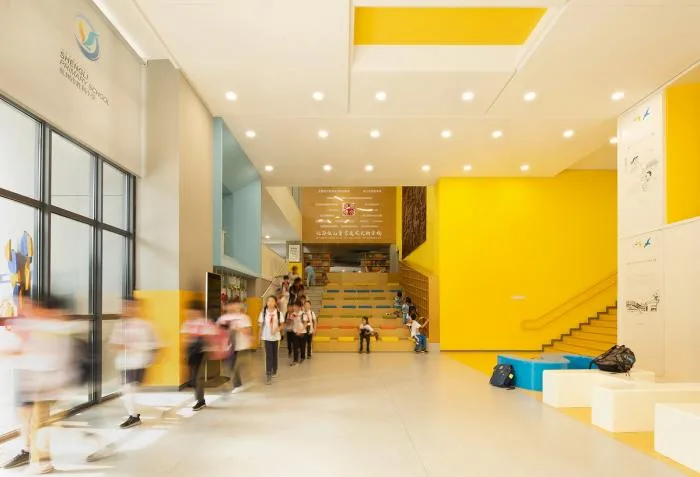
▲ Main entrance hall
Conclusion
The design process prioritized fundamental issues such as urban context, children’s behaviors, and teaching activities over the building’s façade. It focused on three key aspects: efficient land use, the balance between indoor spaces and outdoor activity areas, and both formal and informal teaching behaviors. This approach revisited the core architectural principle that “space inspires behavior.” The result is a new type of campus complex that satisfies all stakeholders, responds effectively to the city, and actively stimulates children’s cognitive development inside and outside the classroom, all while maintaining low costs.
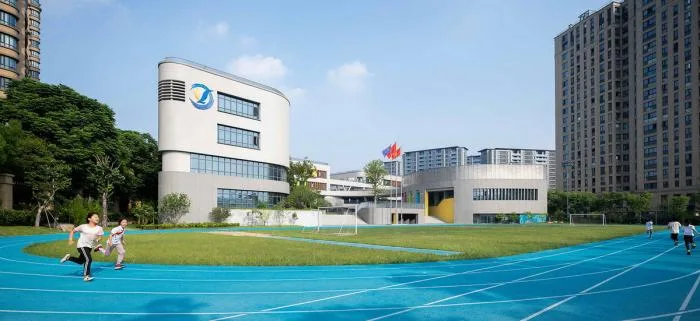
▲ Panoramic view of campus buildings on the northwest side
Project Drawings
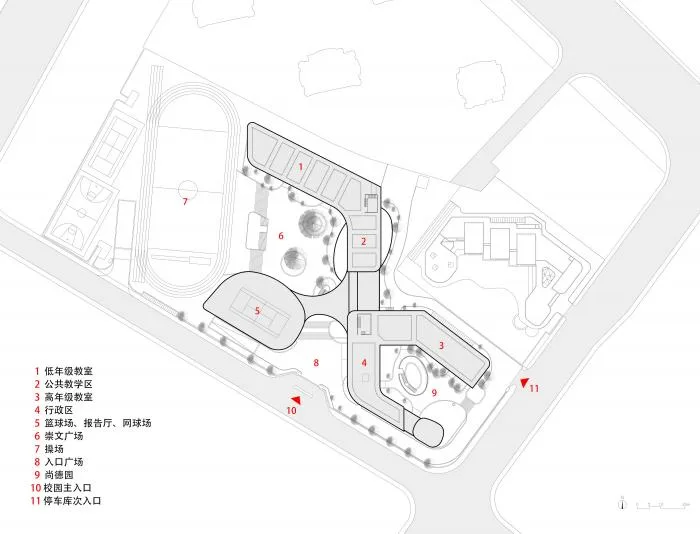
▲ General layout plan
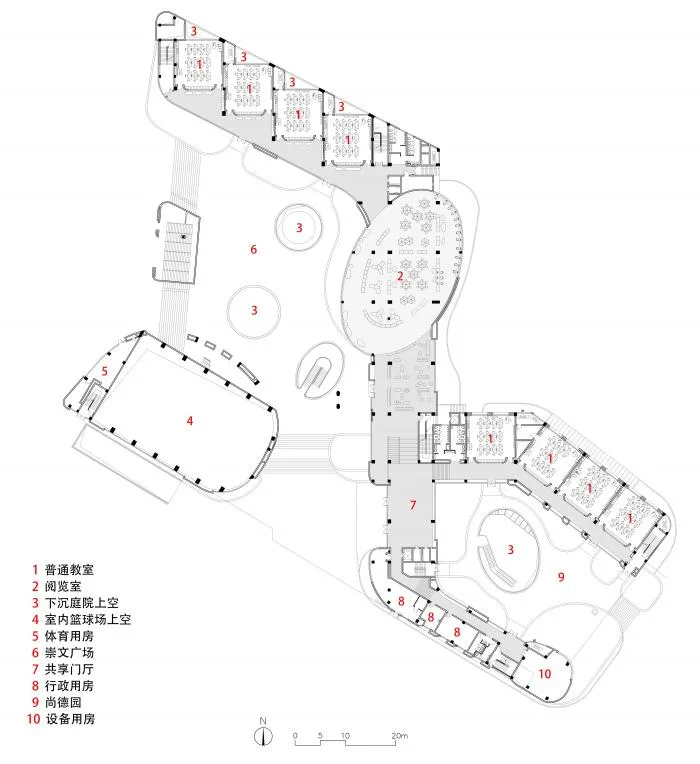
▲ First floor plan
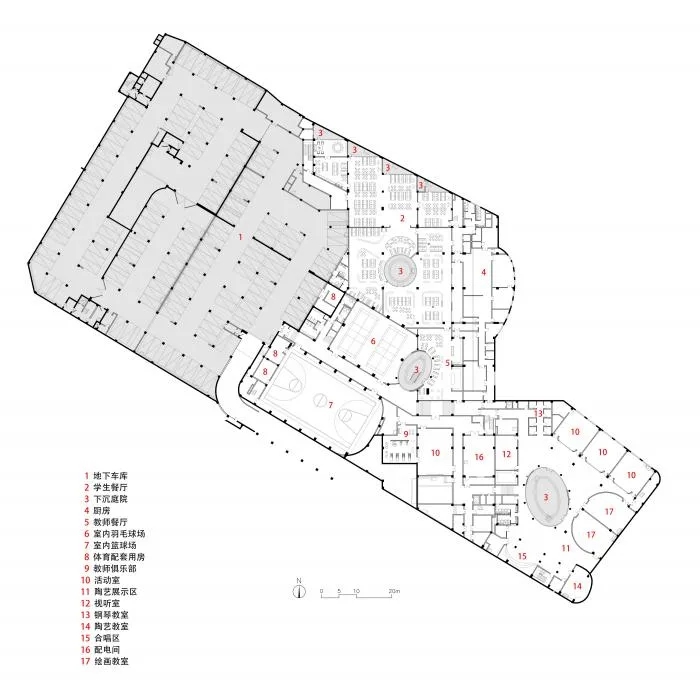
▲ Underground floor plan
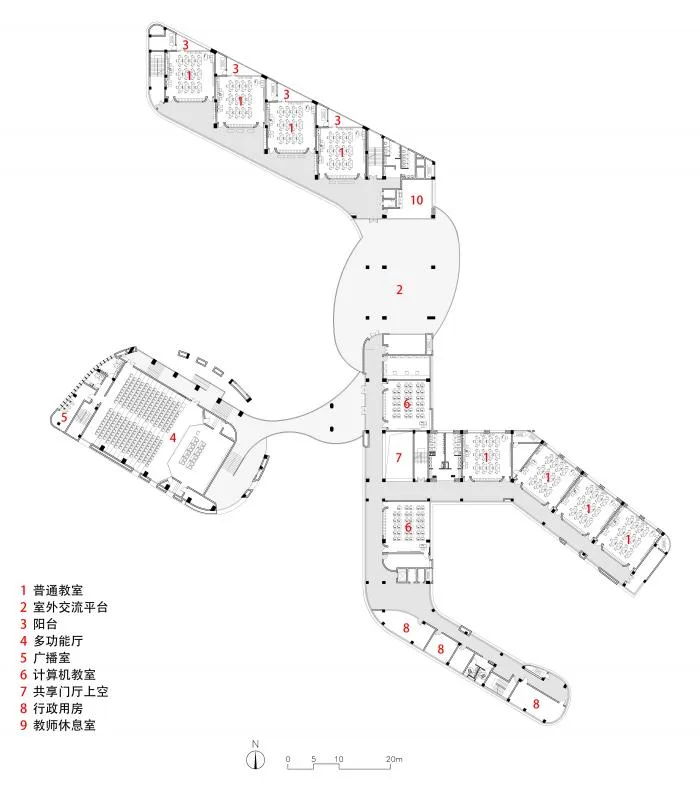
▲ Second floor plan
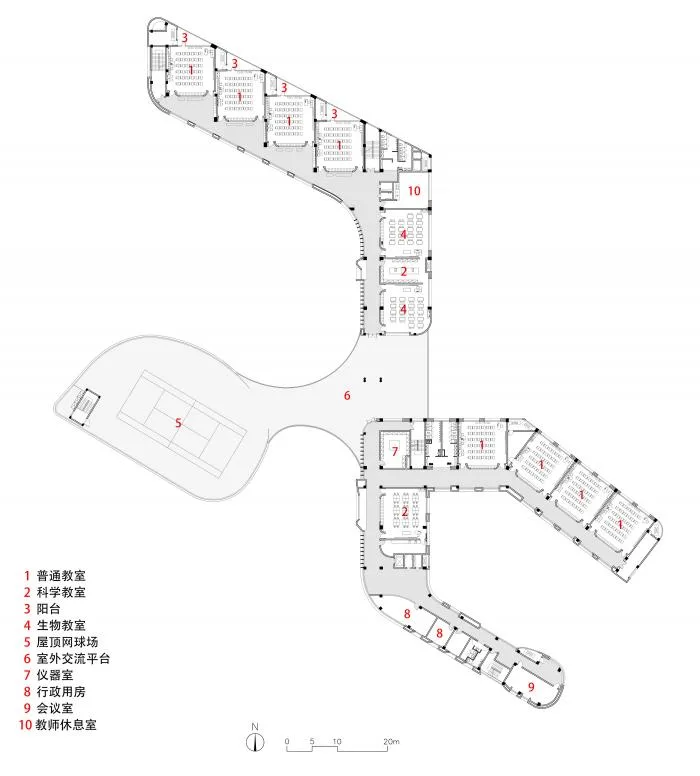
▲ Third floor plan
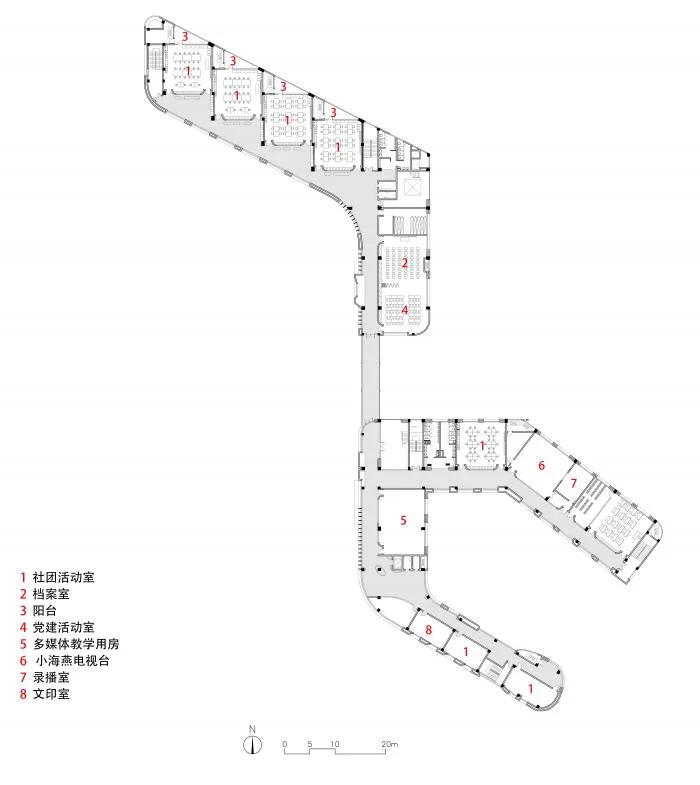
▲ Fourth floor plan
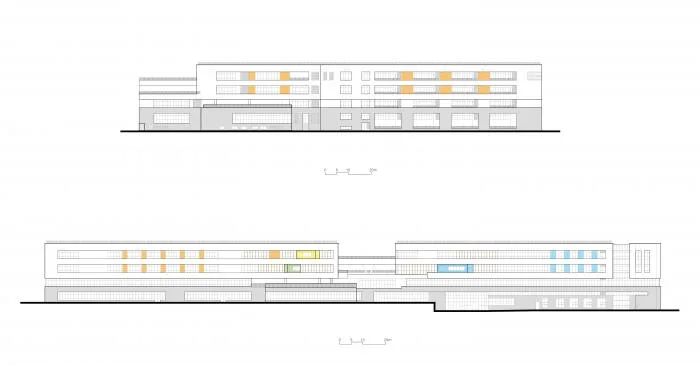
▲ Elevation view
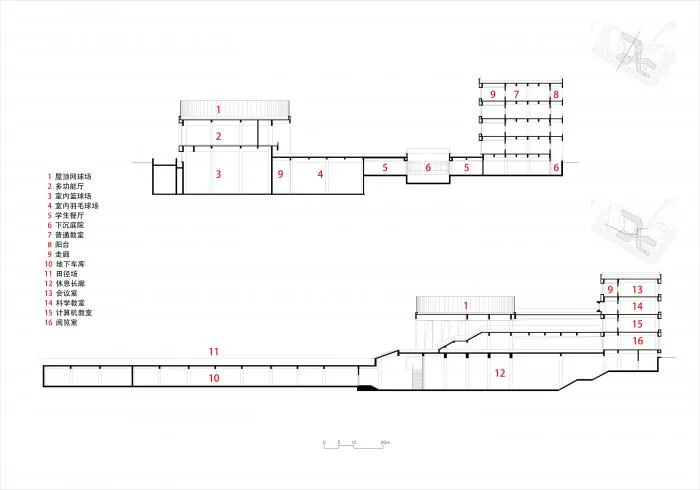
▲ Sectional view
Project Information
Project Name: Hangzhou Shengli Primary School New City Campus and Affiliated Kindergarten
Design Firm: Zhejiang University Architectural Design and Research Institute Co., Ltd
Design Period: October 2014 – November 2015
Construction Period: August 2016 – July 2018
Total Construction Area: 23,121 square meters
Ground Floor Area: 12,320 square meters
Lead Architects: Fan Xuzhuang, Zhang Yuansheng
Architectural Design Team: Fan Xuzhuang, Zhang Yuansheng, Wang Su, Xu Danhua
Structural Design Team: Jin Xingxin, Cheng Ke, Li Li, Li Shaohua, Chen Shengxian
Equipment Design Team: Fang Huoming, Chen Ji, Lin Lujia, Ren Xiaodong, Guo Yinan, Zheng Guoxing, Sun Dengfeng, Ding Li, Huang Qinpeng, Li Xiangqun, Zheng Hui, Ye Agile, Zhou Yanxin
Interior Design Team: Li Jingyuan, Hu Xu, Tian Ning, Zhu Lifeng, Wang Guancui, Zhu Xiaoyan, Ren Zhiyong
Landscape Design Team: Yao Haojun, Li Jiangfu, Zhou Wenqiang, Li Wenjiang
Client: Qianjiang New City Construction Command Center, Hangzhou
Photography Credit: Zhang Yong
Materials: Plastic flooring by Amshizhuang, Colorful real stone paint by Three Trees, Aluminum panels by Southwest Aluminum Industry












Must log in before commenting!
Sign Up