
As teaching methods evolve, China has gradually shifted from traditional rote learning to an open, student-centered approach. This shift demands new standards for the design of educational spaces, prompting architects to rethink how schools can best support development in the modern era.
Shanghai Qingpu Lansheng School, located in Zhujiajiao New Town, Qingpu District, integrates kindergarten, primary, junior high, and high school education. The campus spans approximately 53,581.15 square meters of land, with a total built area of about 79,726.92 square meters.
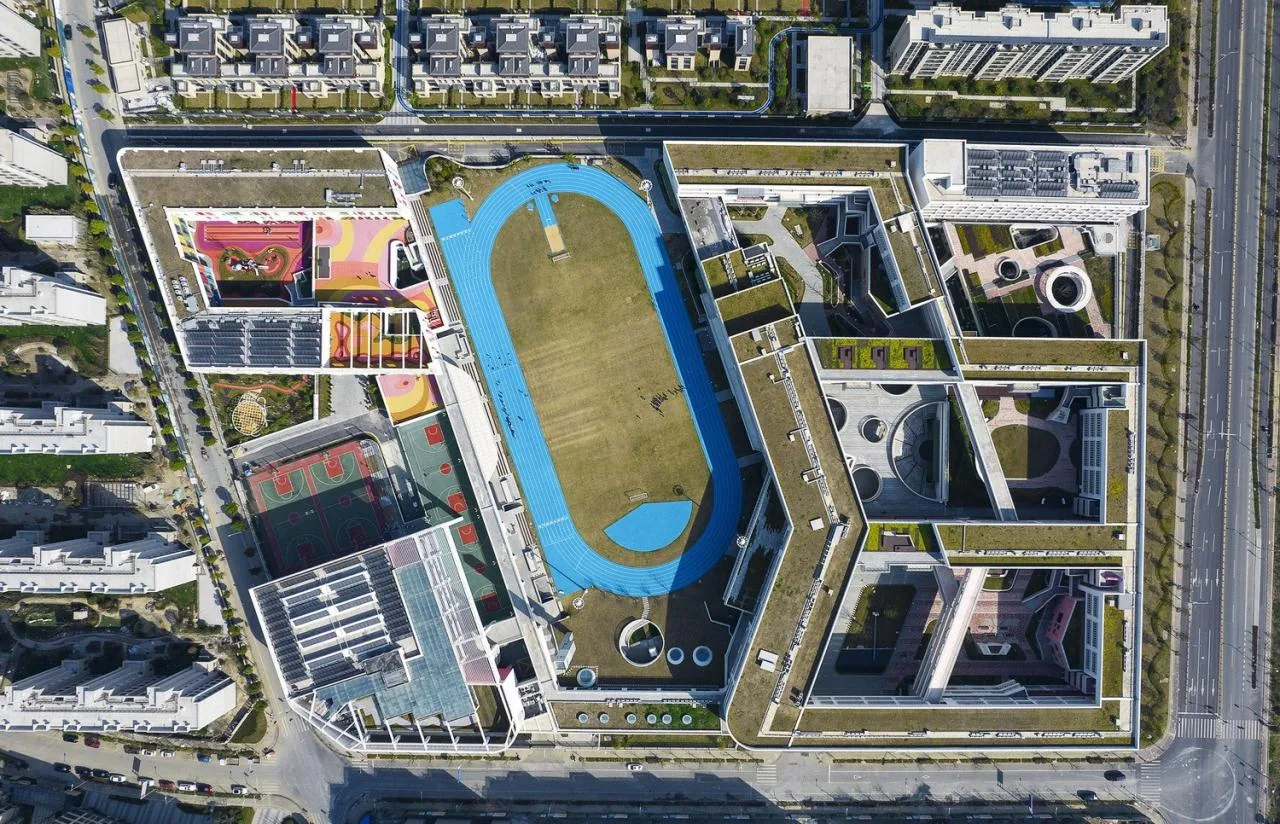
△ Aerial view © Luca Forteleoni
A Dynamic and Inviting Campus Layout
Multiple Courtyards Surrounding Activity Spaces
Traditional campuses often prioritize building orientation and lighting, arranging kindergarten through high school buildings in a centralized manner. Such layouts tend to have limited outdoor spaces with poor lighting, ventilation, and low engagement, as activity areas usually cluster on one side of teaching buildings.
In contrast, the new campus design incorporates multiple courtyards, significantly expanding student activity areas and introducing diversity in building arrangement. The project emphasizes the connection between sports and public activities by placing them centrally, linking the sports zone with teaching areas to enhance campus vitality. The kindergarten maintains independence with clear visibility, while activity spaces interact with teaching zones on three sides.
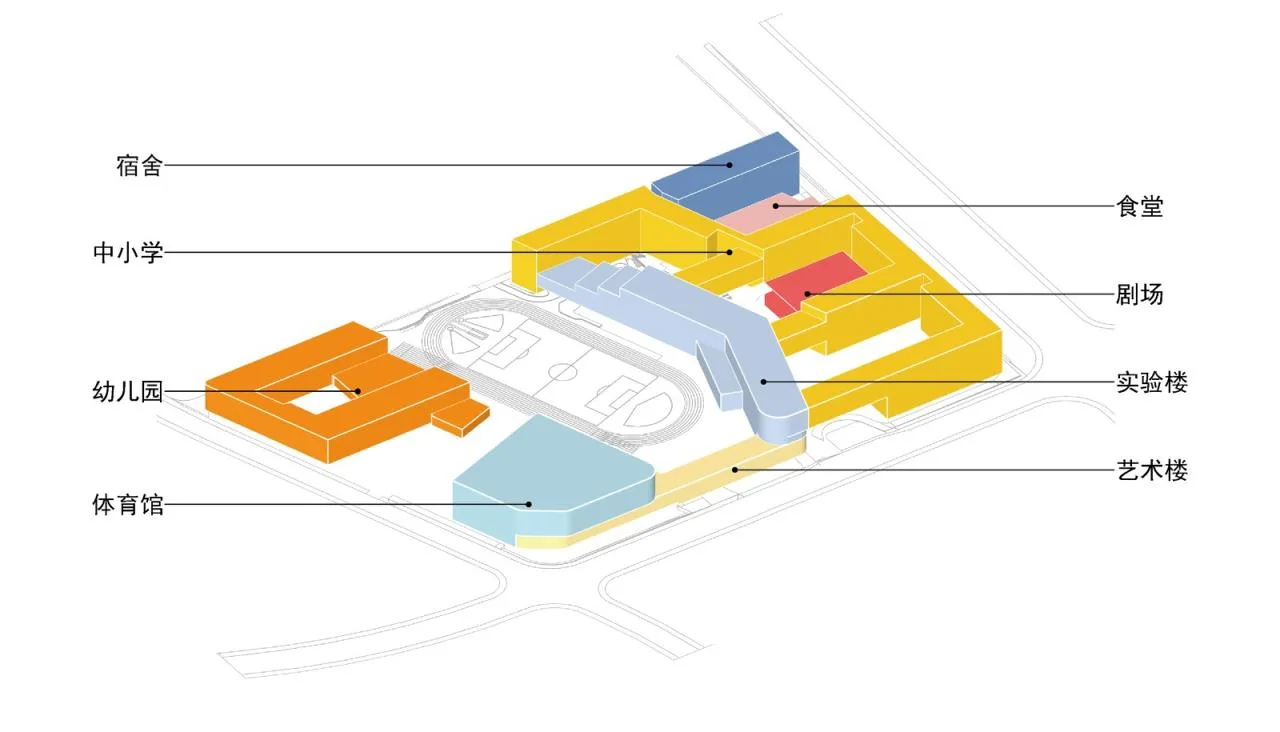
△ Functional zoning diagram
The campus features a large, shared central courtyard playground, complemented by smaller courtyards dedicated to different functions, offering privacy and focused spaces. These inner courtyards have a strong vertical orientation, effectively shielding the campus from urban noise and distractions, creating a tranquil and pure environment conducive to learning.
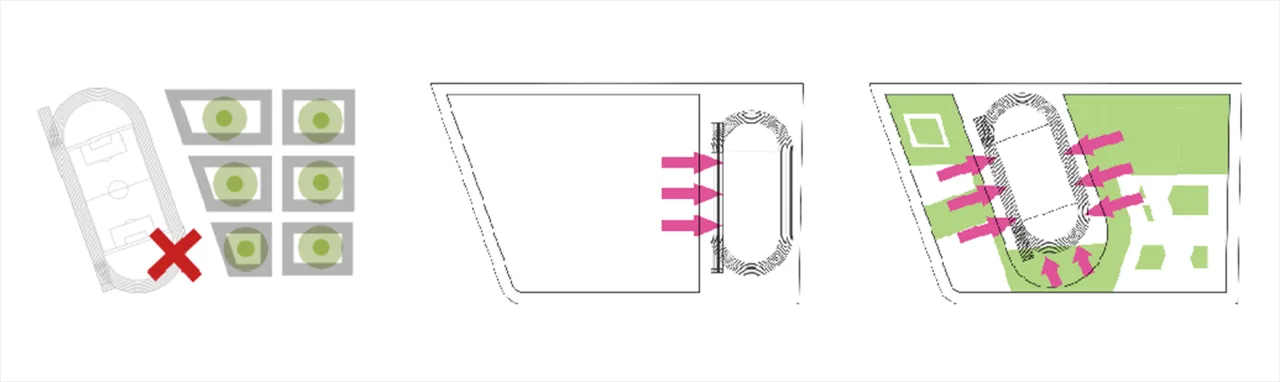
△ Playground layout generation logic
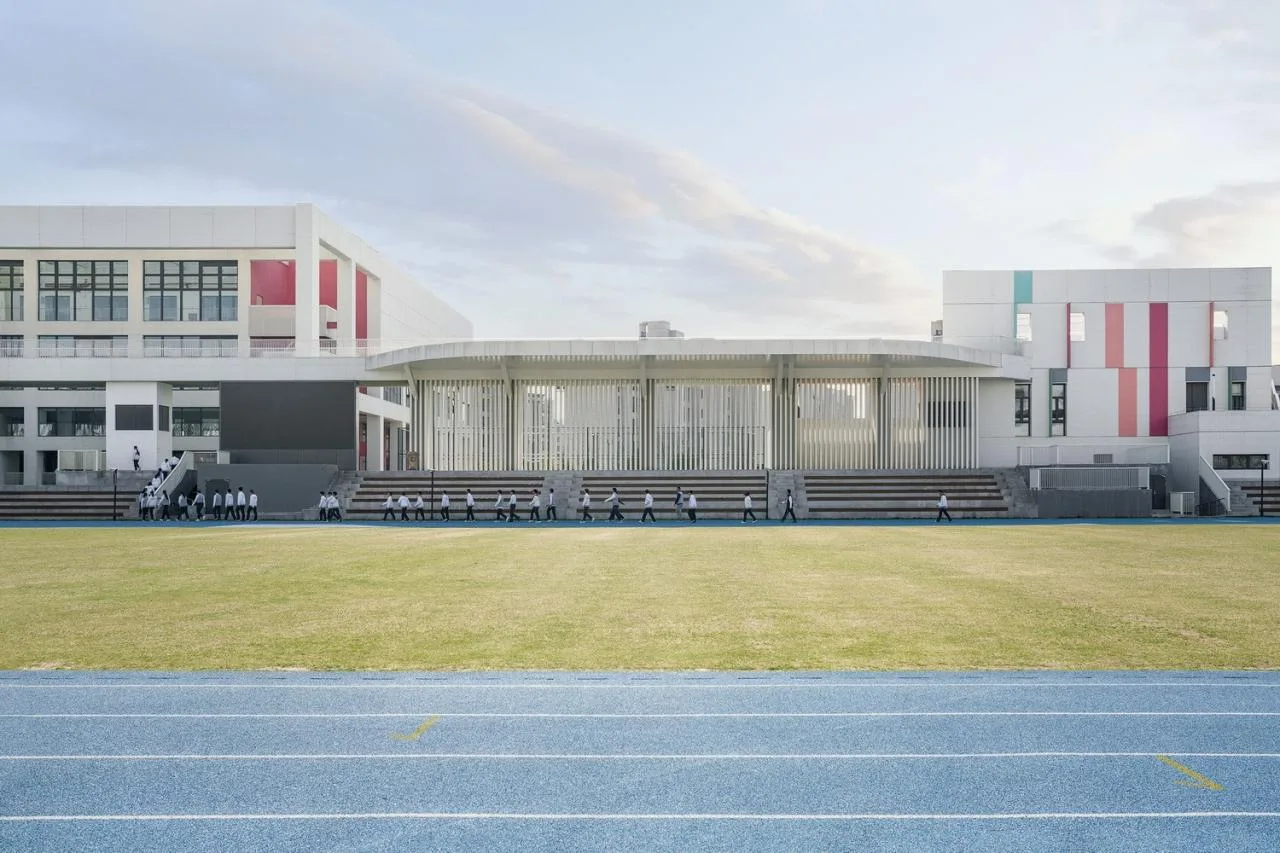
△ Central playground connecting various teaching areas
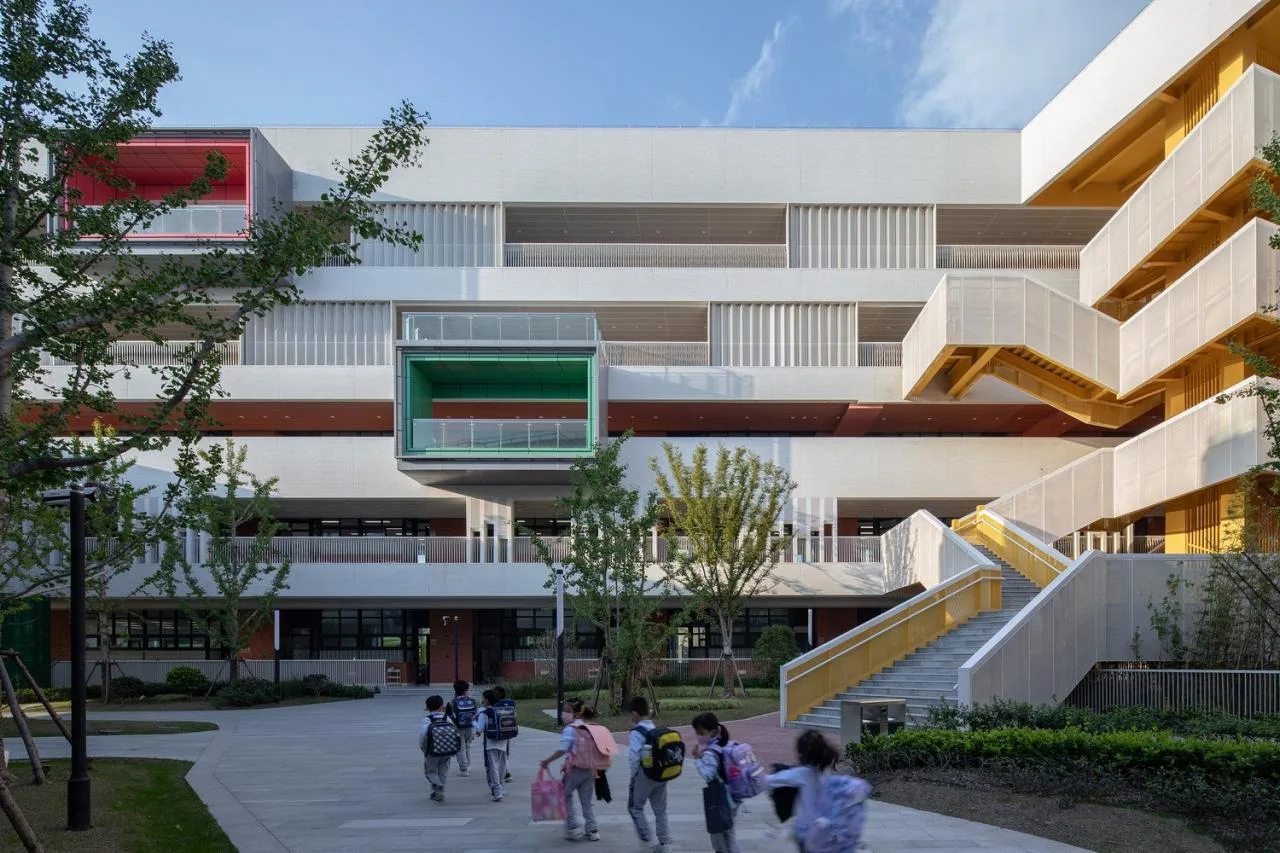
△ Interior campus courtyard © Tang Xuguo
Adapting to the Site’s Natural Features
The design preserves the site’s original elevation differences. A semi-underground parking and shuttle area occupies the lowest southwestern corner. Grass slopes and terraced playground steps transition smoothly with the terrain, integrating the building naturally into the landscape. This vertical adaptation not only reduces construction costs but also exemplifies thoughtful, efficient design.
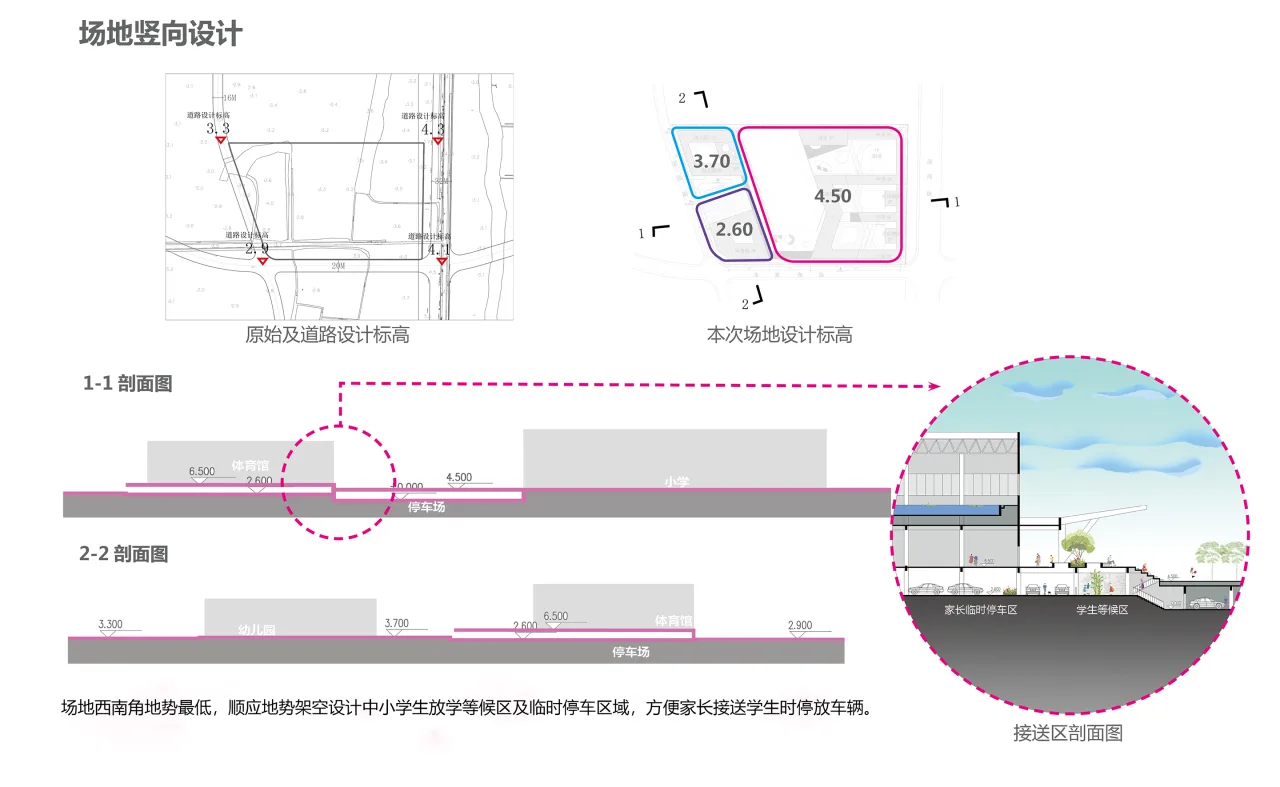
Vertical site design
Transforming the School into a Journey with Scenic Routes
Monotonous spatial layouts and linear circulation can stifle the imagination of young students. This project integrates landscape design throughout the campus, creating a “Vitality Link” — a continuous social space system connected by stairs, ramps, grand staircases, elevated floors, and roof gardens. Centered around the sports stadium, the Vitality Link connects seven key functional zones: kindergarten, gymnasium, Lansheng Dacaopo, art building, library, theater, and restaurant.
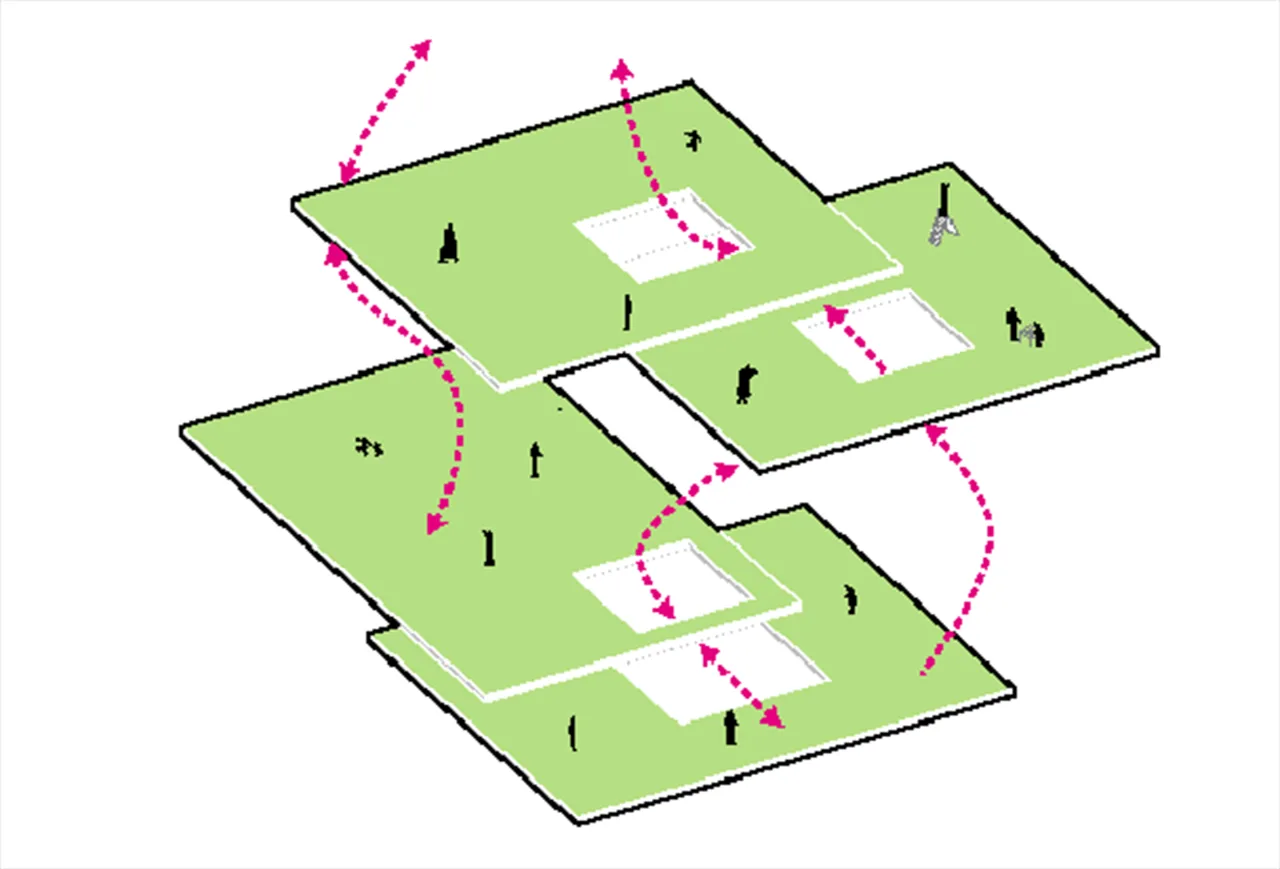
△ Concept of strolling through the courtyards
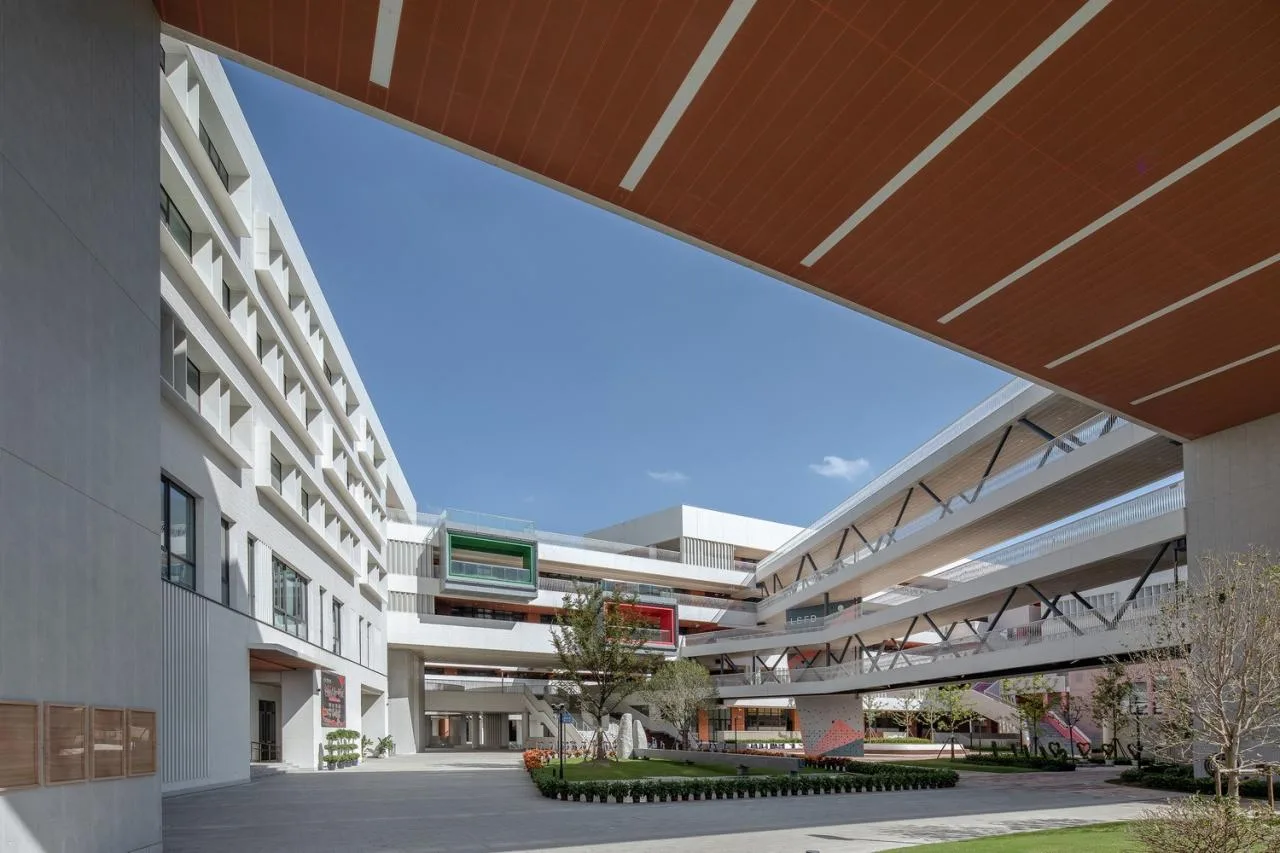
△ Horizontal circulation corridor © Tang Xuguo
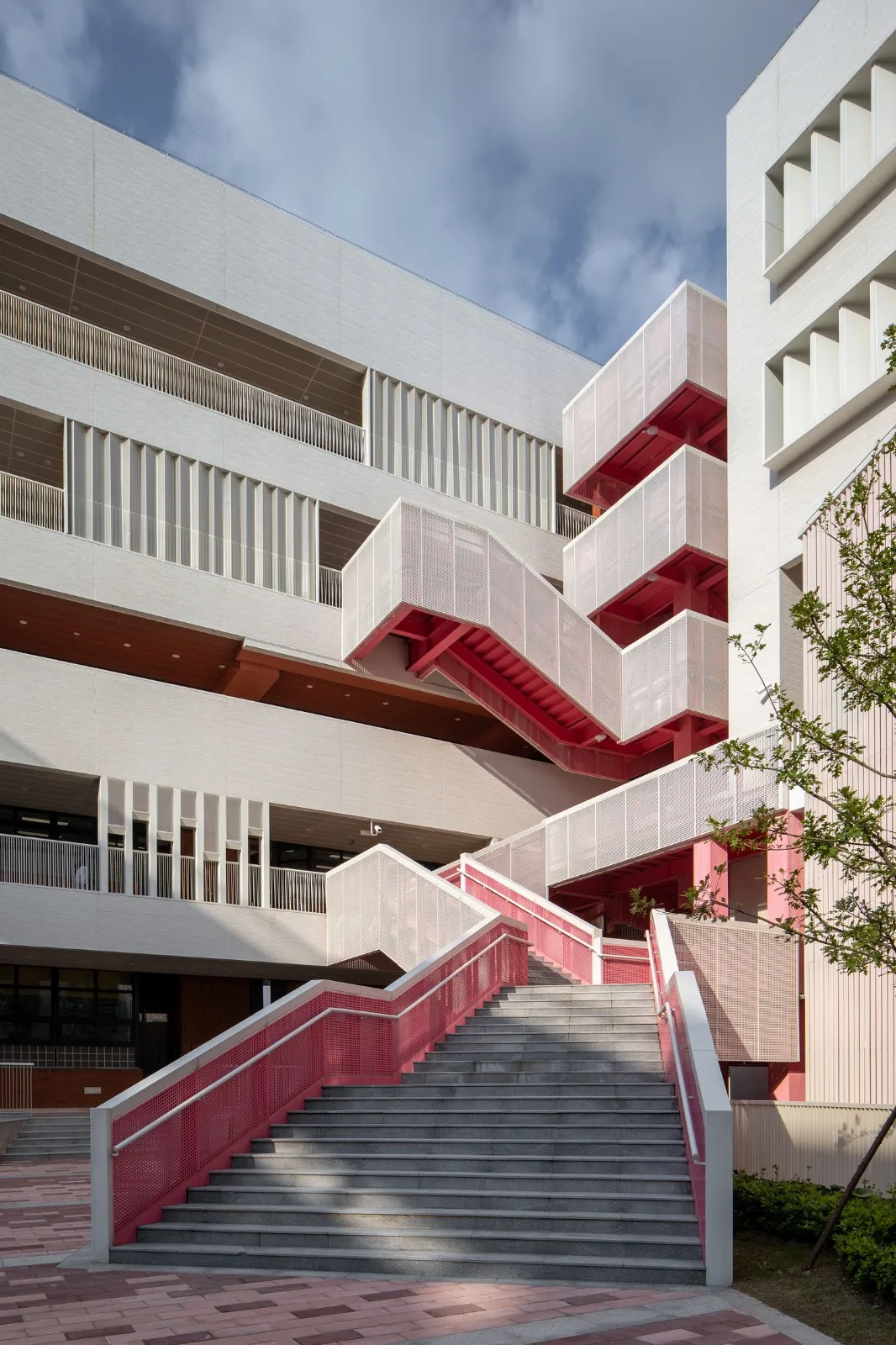
Vertical circulation © Tang Xuguo
This network of informal gathering spaces and innovative heuristic learning areas encourages spontaneous communication, sharing, and collaboration between teachers and students. The corridor system offers outdoor and semi-outdoor spaces varying in scale, height, views, and enclosure, establishing a versatile transportation system suitable for a vertical campus layout.
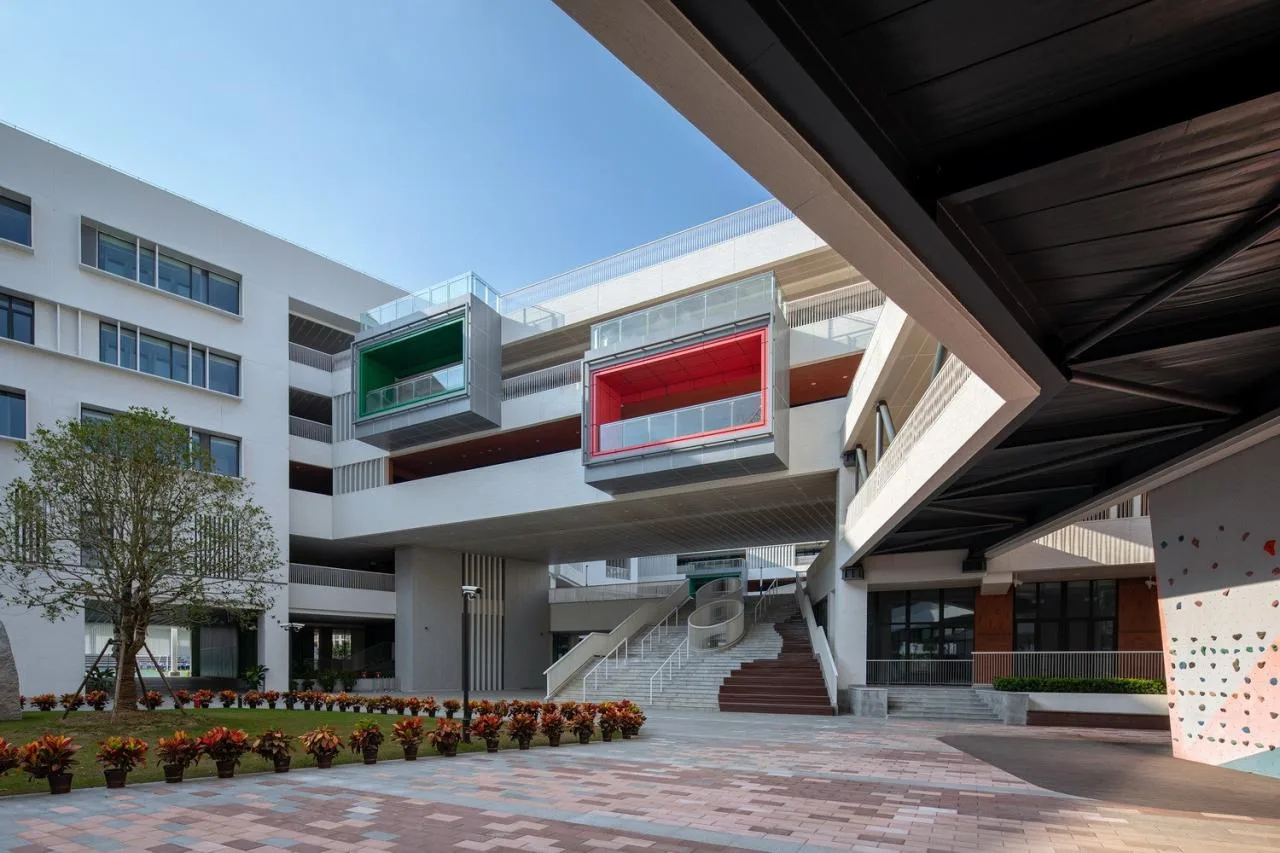
Vertical circulation ramp © Tang Xuguo
Unique and Engaging Spatial Nodes
Modern campuses require informal learning spaces to inspire self-directed learning. These areas provide spots for students to gather in groups, discuss, communicate, or engage in independent study. Varying in depth and scale, these spaces offer rich spatial experiences.
The bi-directional theater, featuring a spacious open area, fully stimulates students’ creativity and imagination. Meanwhile, the library offers a balanced environment where students can study quietly or engage in discussion and sharing.
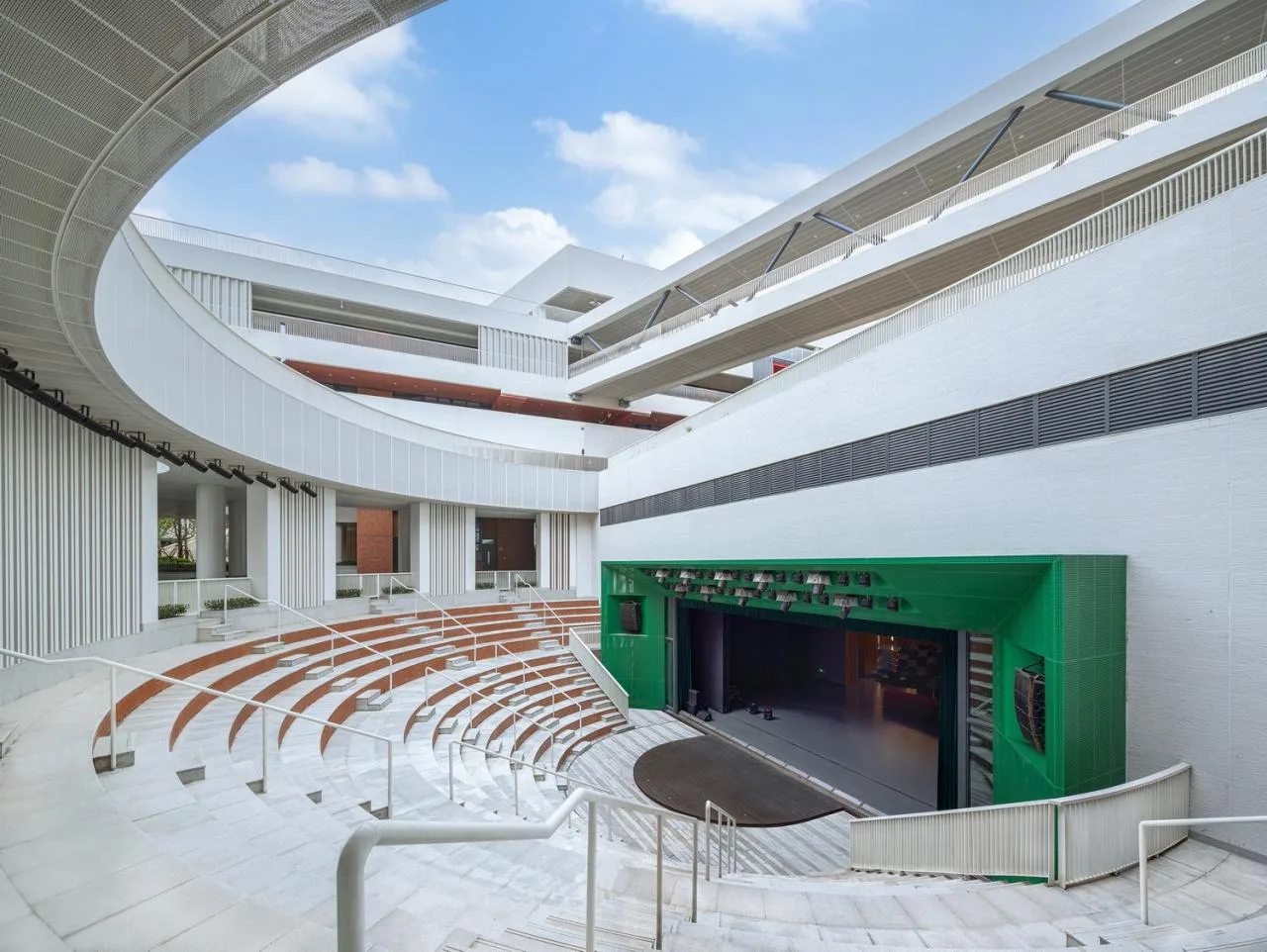
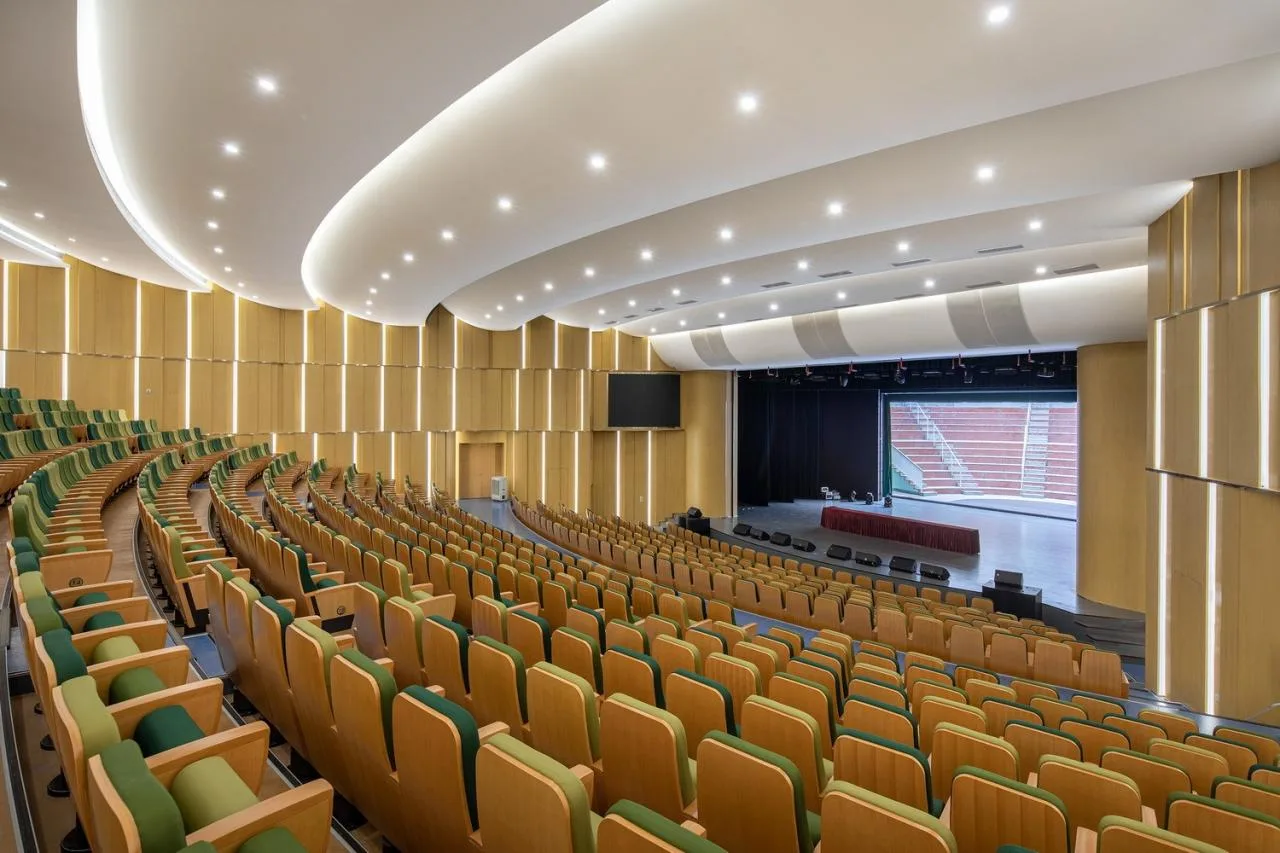
△ Bi-directional indoor theater © Tang Xuguo
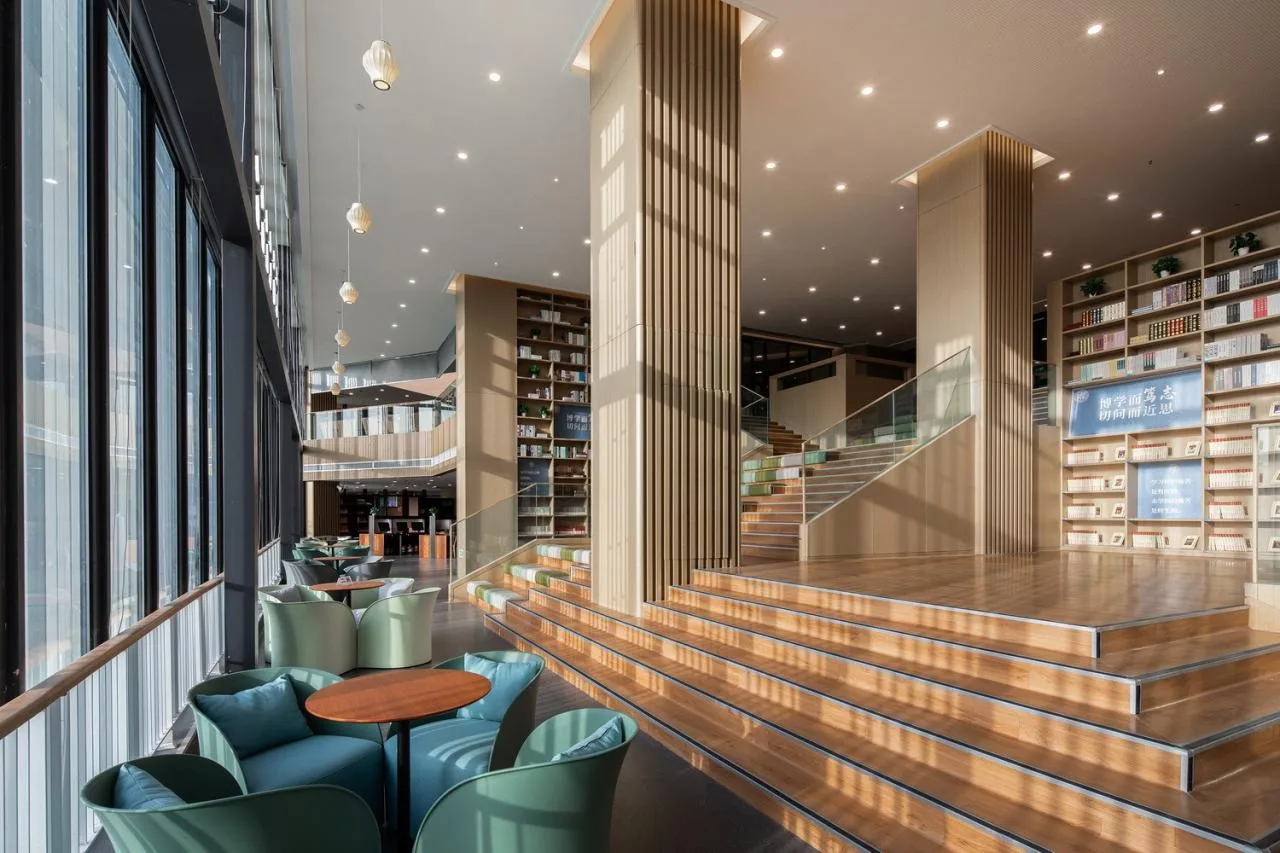
△ Learning space on the library’s grand staircase © Tang Xuguo
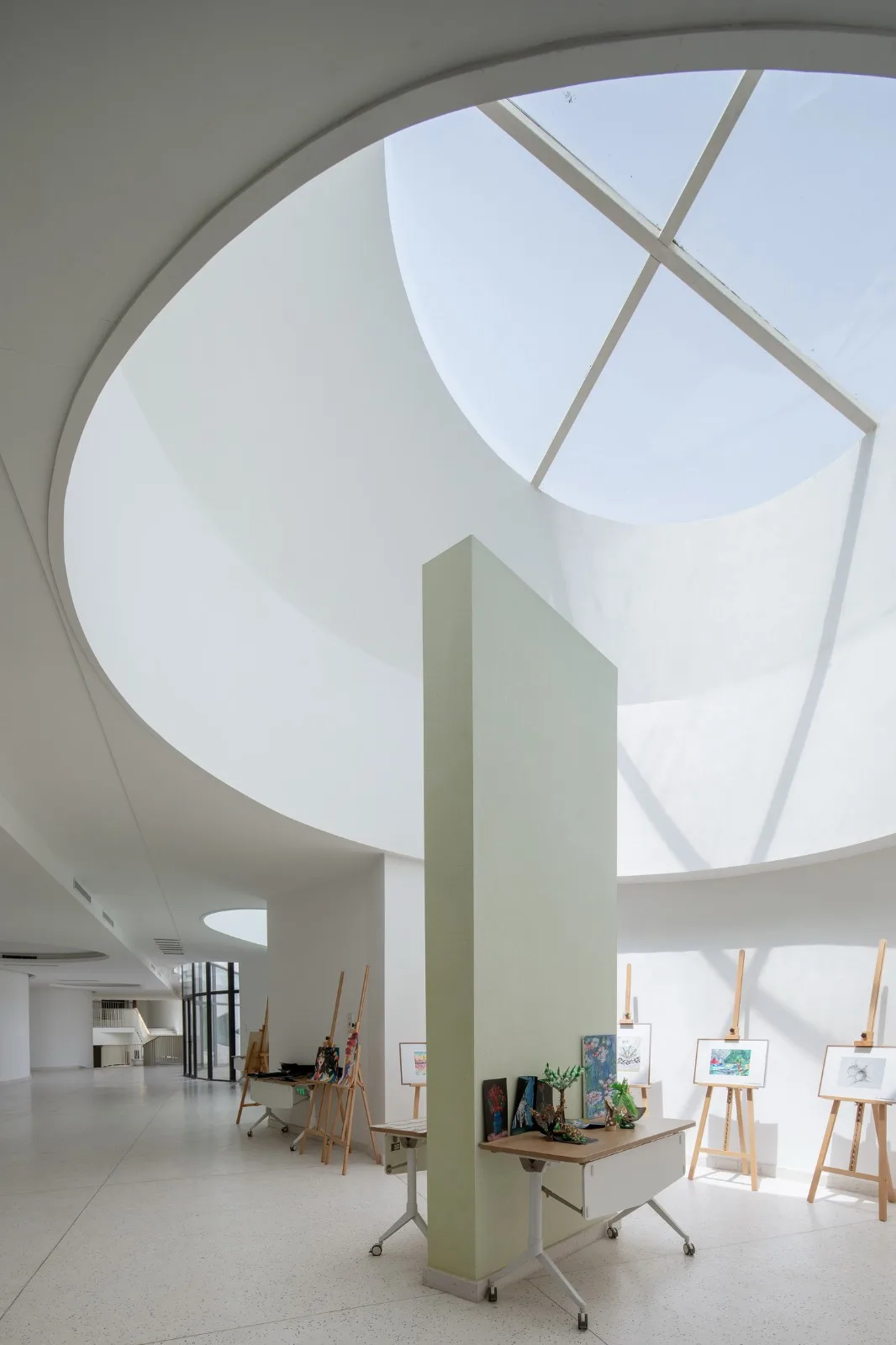
△ Naturally lit public spaces © Tang Xuguo
The elevated floors act as sheltered “grey spaces” that protect from rain and sun while providing private areas for children to socialize. Vertically oriented shared spaces and horizontally extended platforms overlooking natural landscapes offer a garden-like experience within the city.
This spatial richness helps students develop a keen sense of three-dimensional space, while the diverse landscape views subtly nurture their temperament.
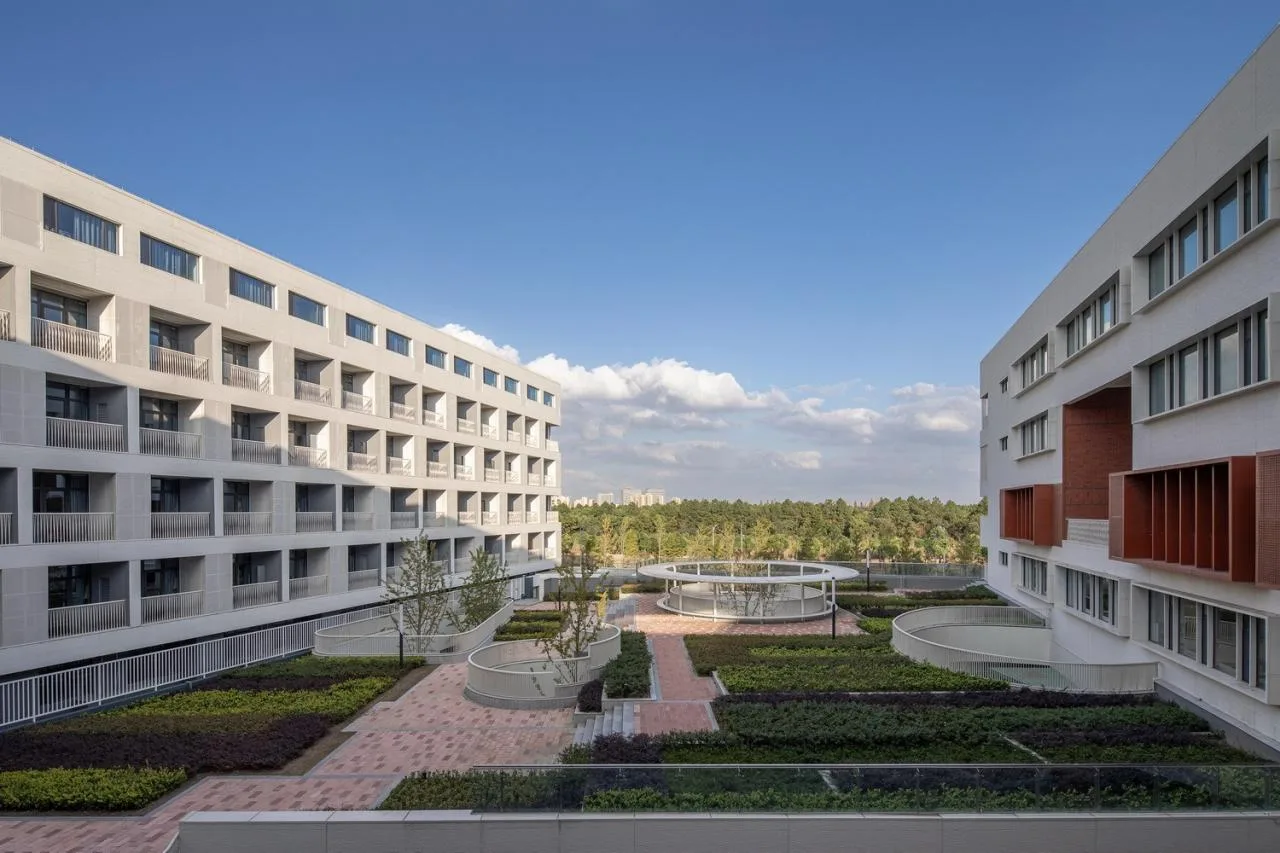
△ Rich spatial experience created by elevated floors and sky gardens © Tang Xuguo
Thoughtful Visual Design: Facade Details
Beyond spatial experience, facade details significantly influence children’s interaction with their environment. Door and window designs are customized according to ambient light direction, and color schemes vary to suit age groups in different functional zones. These nuanced features are unified by white lines that run throughout the campus, blending complexity with harmony.
The Power of Order: Continuous White Lines
The disciplined educational spirit of Qingpu Lansheng School has nurtured generations of outstanding students. The design transforms this sense of order into a defining architectural feature. Despite the project’s scale and diversity, sleek white lines run consistently throughout, symbolizing the school’s unity and focused spirit.
The lively sounds of learning in classrooms and orderly lines on the playground become lasting memories that students carry with them.
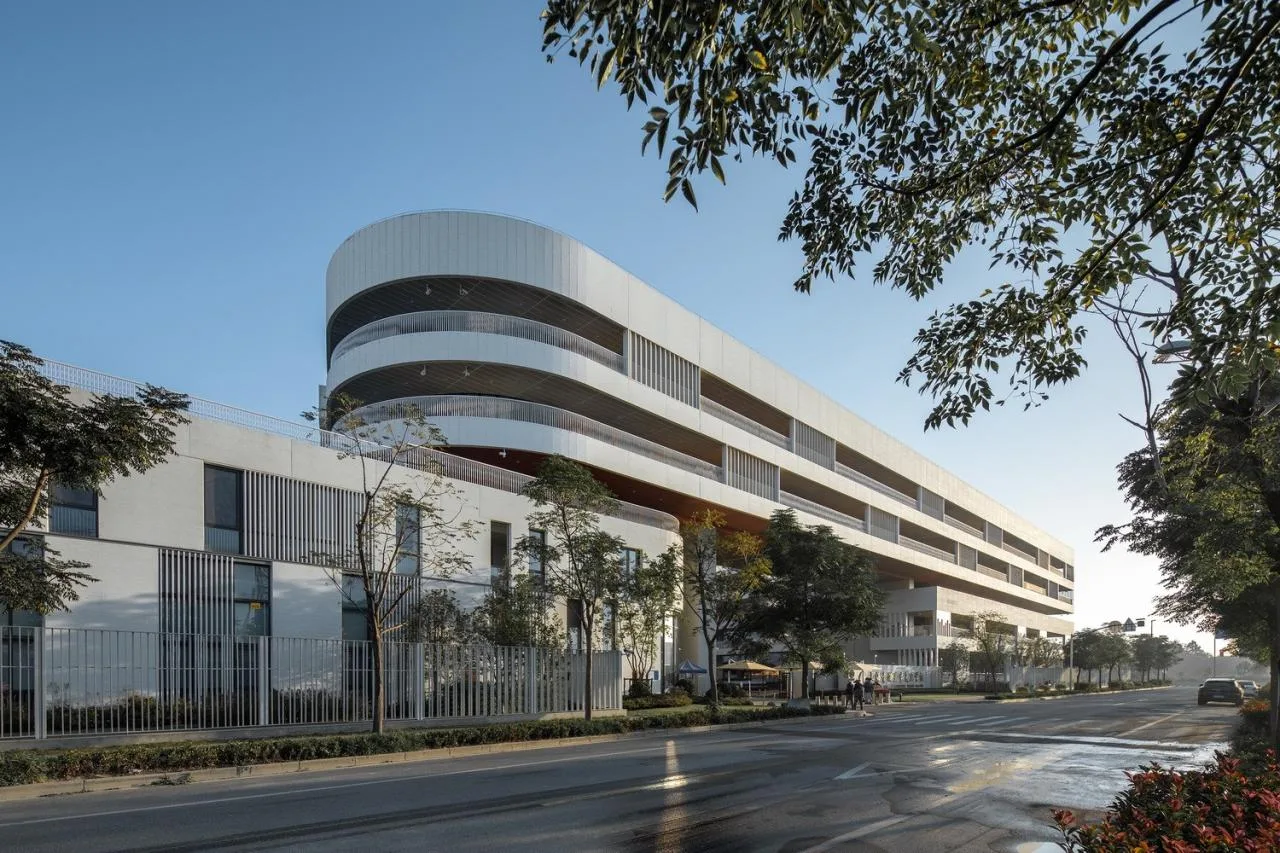
△ Real scene along Zhujiajiao Road © Tang Xuguo
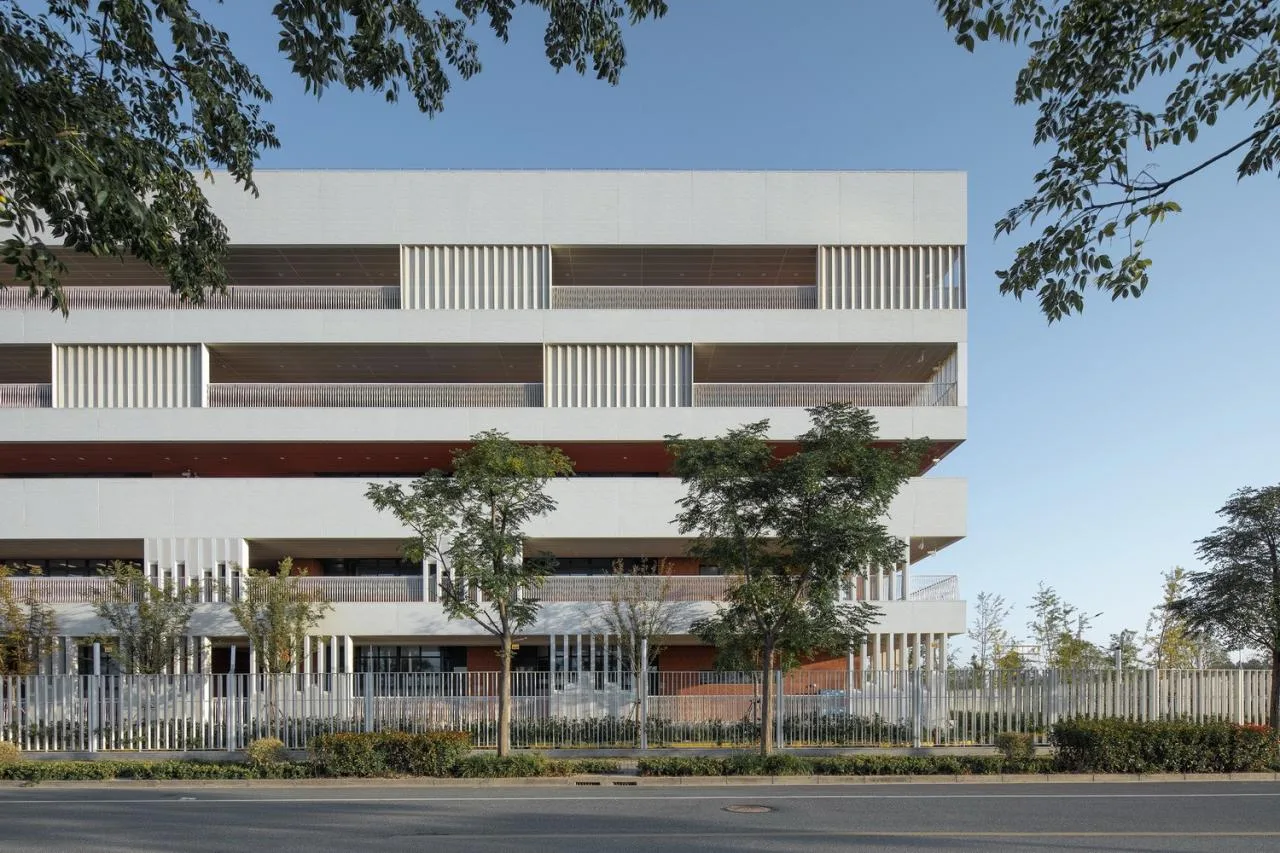
White elements weaving through the campus © Tang Xuguo
Customized Details: Adaptive Windows and Doors
While the overall door and window style maintains cohesion, subtle variations respond to environmental orientation. This approach enhances aesthetic refinement and humanizes the design.
The traditional dark corridors that separate teaching buildings from the campus landscape are replaced by bay windows, varied window openings, and differently sized viewfinder glass panels. These features turn window frames into picture frames and the campus into a living scenic area. Large gridded glass windows allow gentle sunlight to permeate classrooms, easing students’ academic stress.
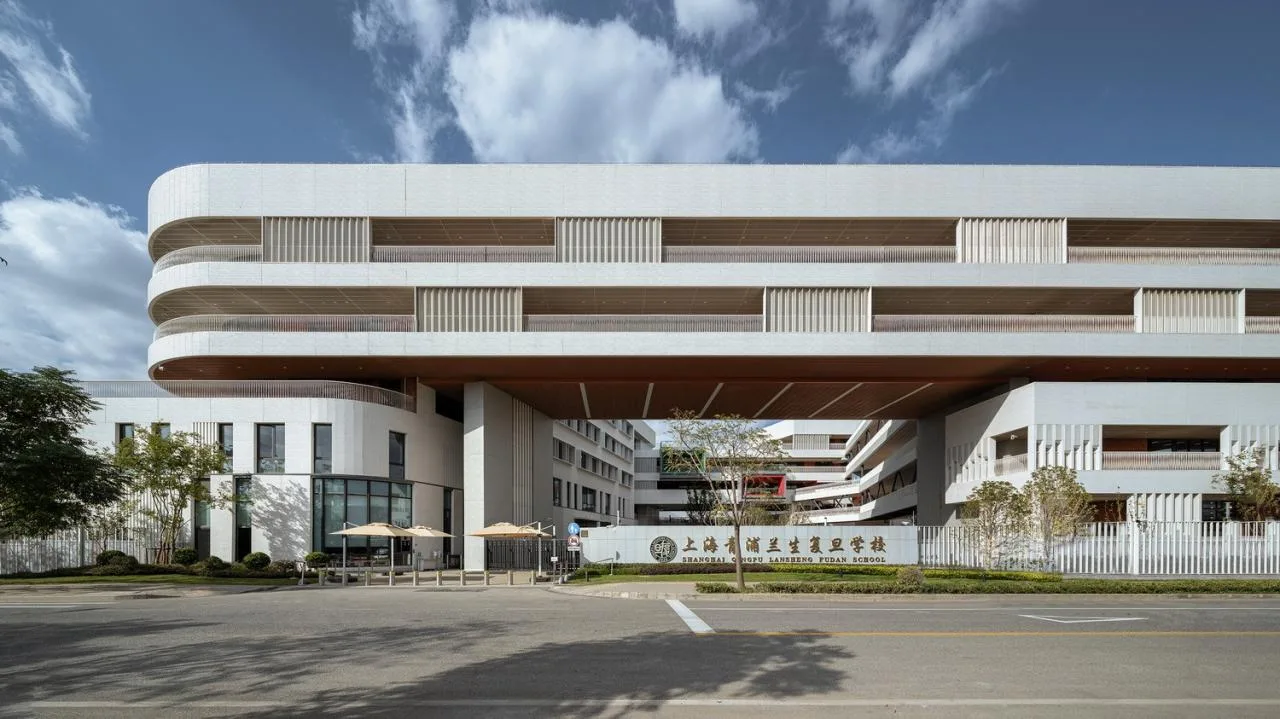
The southern teaching building features corridors where soft sunlight filters into classrooms © Tang Xuguo
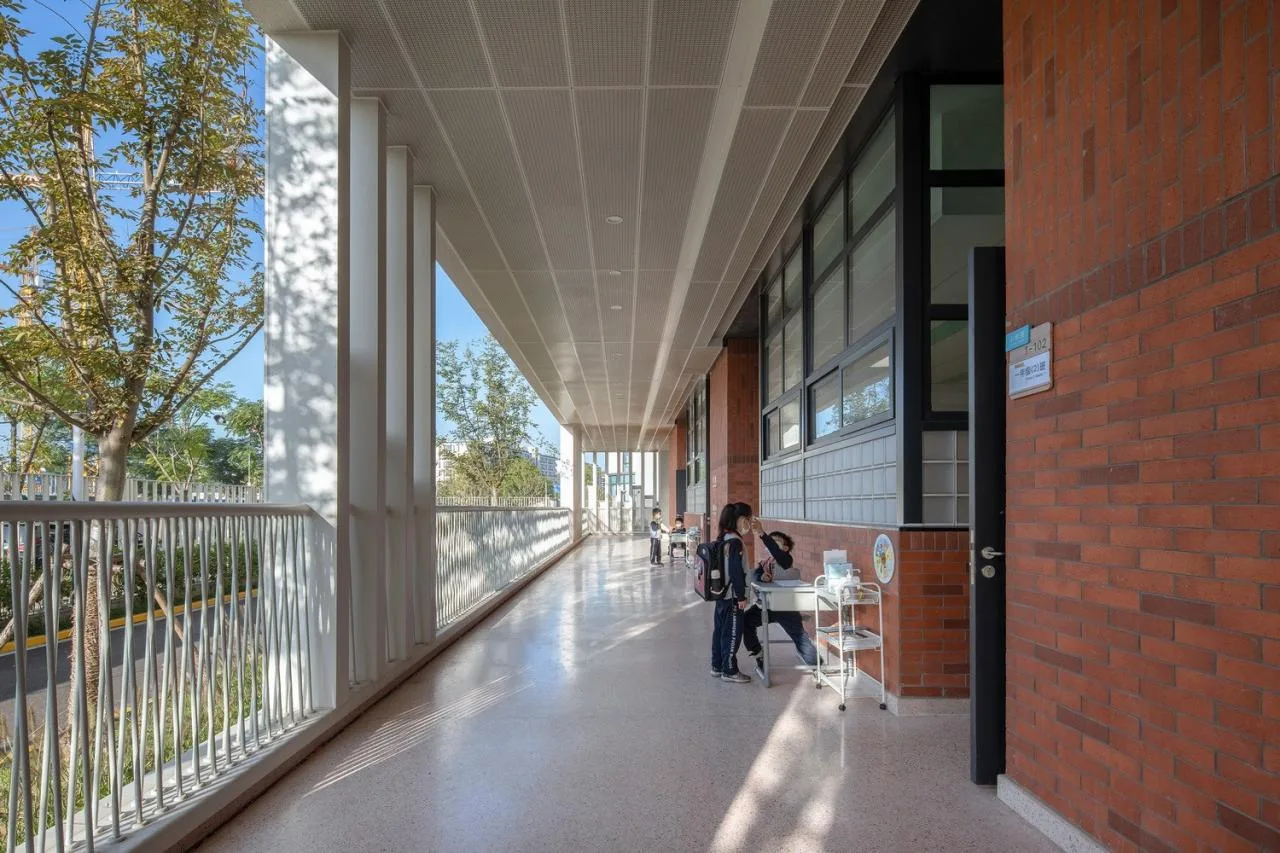
△ Teaching building corridor © Tang Xuguo
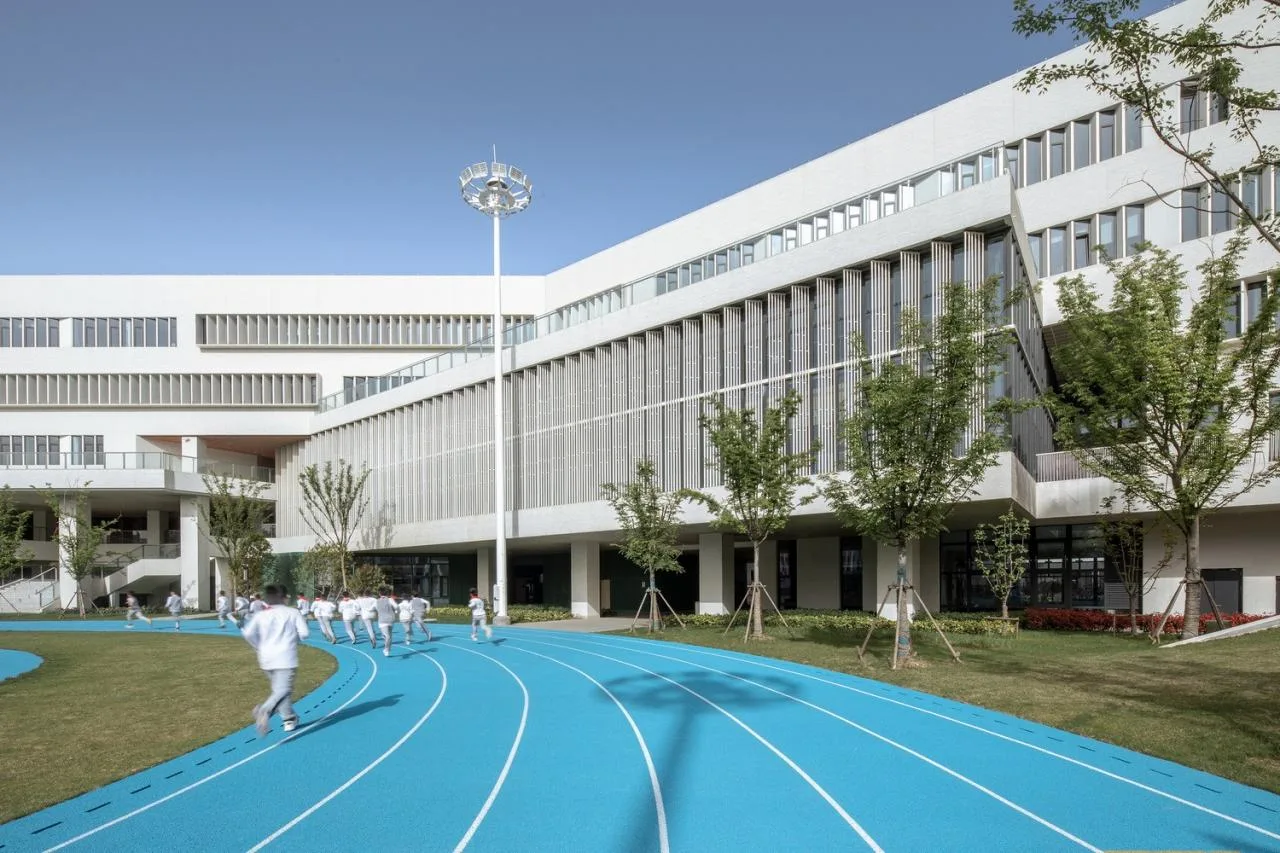
An angled partition on the west side minimizes unwanted light and heat from the afternoon sun © Tang Xuguo
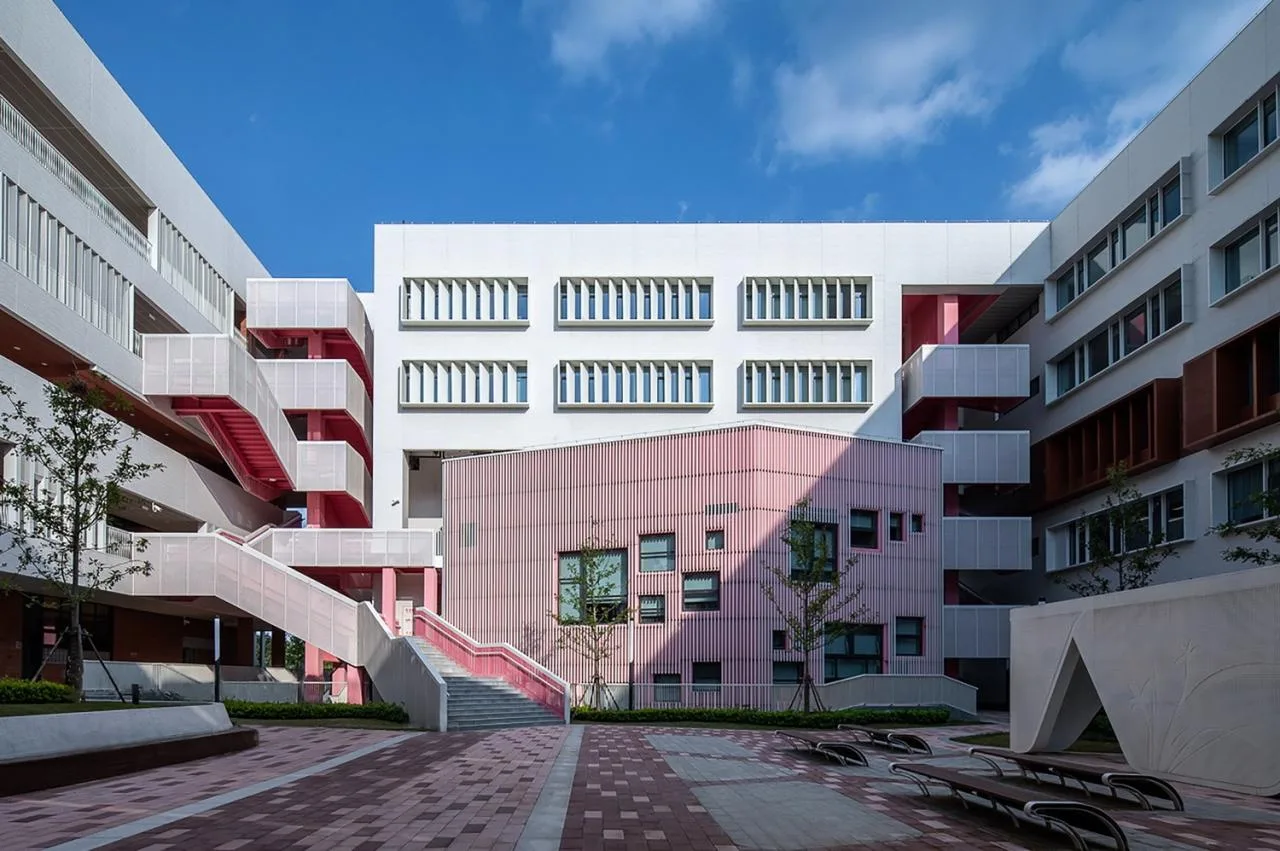
△ Staircase classrooms with creatively arranged windows
Inspiring Imagination: Varied Grille Designs
Young children respond positively to vibrant spaces and colorful surroundings. The campus facade incorporates colorful hanging boxes and perforated aluminum windows with musical patterns, adding warmth and playfulness to the environment.
Children possess a primal energy that transcends adult limitations. The rhythmic interplay of colors and styles fosters a joyful, imaginative “paradise” within the architecture.
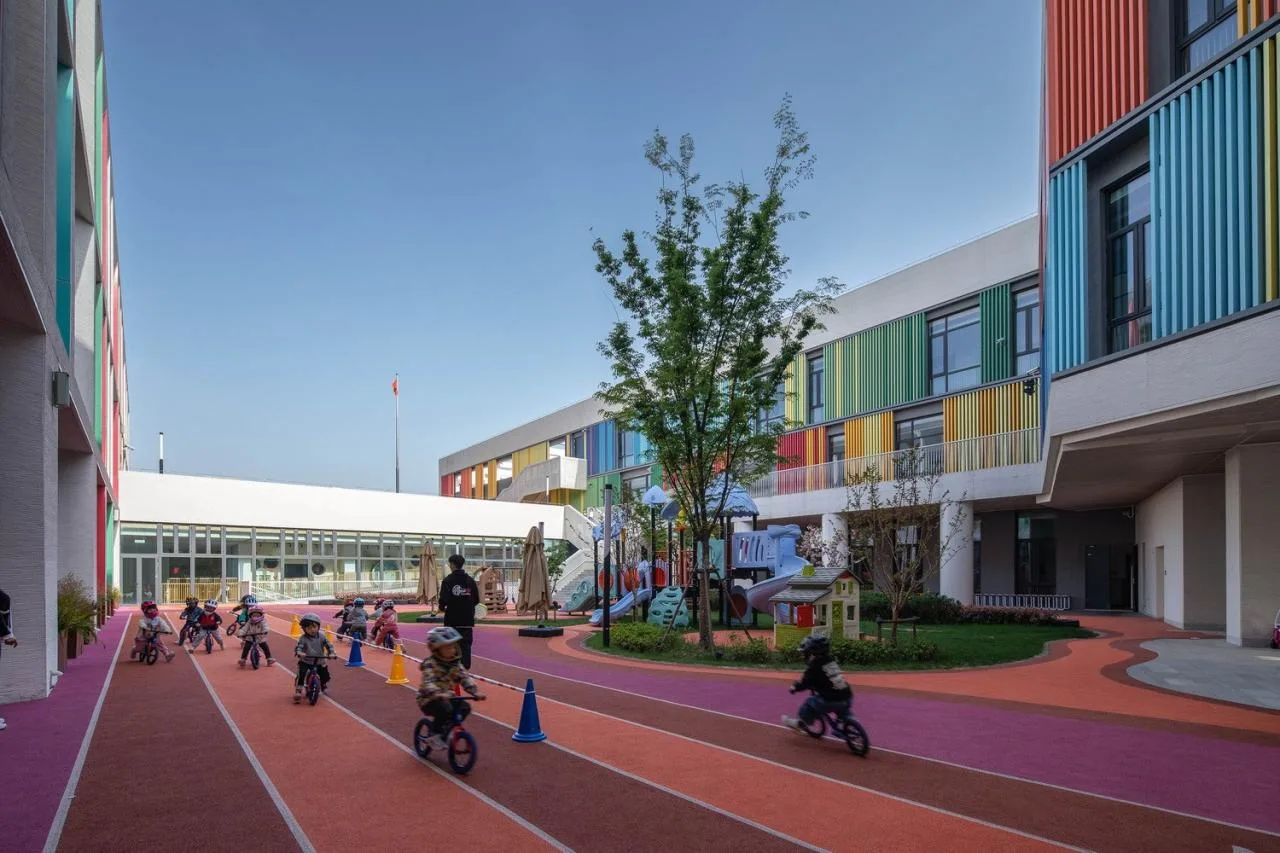
△ Colorful boxes decorating white lines © Tang Xuguo
Conclusion: Supporting Growth and Expanding Possibilities
Innovative teaching and scenic courtyards are not the final goals. What truly matters is creating a unique childhood experience. Sometimes, it’s a ray of light filtering through leaves; other times, a leaf tucked quietly inside a book. These moments may later become the kindness and softness within a person’s heart.
The diverse and open spaces provide flexibility for future use, evolving alongside children as they grow. Amidst rapid urbanization, the campus offers a natural sanctuary where children can thrive and create lasting memories.
Project Information
Project Name: Shanghai Qingpu Lansheng School
Location: Qingpu District, Shanghai
Architectural Design: Shanghai Huadu Architectural Planning and Design Co., Ltd. (HDD)
Land Area: 53,581.15 square meters
Building Area: 79,726.92 square meters
Design Start: September 2018
Construction Start: December 2021
Project Leader: Dong Weiwei
Architectural Design Team: Shen Yi, Dong Weiwei, He Yuwei, Su Kang, Yang Tao, Wu Ying, Wang Shijie, Zhou Zhaomin, Yu Lu, Zhao Feiyao, Cai Baiyang, Zhou Jun, Feng Xiaolong
Structural Design Team: Zhang Yongqiang, Xu Bingbing, Chai Jingyuan, Pu Yitong
Water Supply and Drainage Team: Jiang Yi, Wu Wenwen, Liu Miaomiao, Wang Yikun, Zhang Ting
HVAC Team: Chai Yunliang, Dong Yunfeng, Ma Yiming, Qiao Xueliang, Liu Jiani
Electrical Design Team: Zhang Xiaoqing, Zhang Yi, Wei Quan, Yuan Jiangfeng, Han Kejun, Xiong Tang
Interior Design Team: Ge Qing, Ai Jingwen, Liu Haitao, Liu Sihan, Wang Yijia
Landscape Design Team: Zhu Yiyu, Wang Dandan, Chen Si, Fei Yidong, Yang Gang, Li Xinlei, Sun Heqiao
Construction Economics Team: Yang Qinglin, Zhuang Qin
Photography: Tang Xuguo, Luca Forteleoni
Text: Wang Shijie, Zhu Ying, Chen Fan















Must log in before commenting!
Sign Up