
1. Characteristics of Prefabricated Buildings
1.1 Prefabricated buildings involve manufacturing main components in a factory, followed by on-site assembly using mechanized lifting methods. This approach allows construction to proceed concurrently with other specialized trades, effectively avoiding delays caused by weather conditions common in traditional building projects. As a result, prefabricated construction is characterized by shorter construction cycles and faster completion times.
1.2 The production of large-frame prefabricated components uses standardized flat template construction. For elements with special requirements—such as doors, windows, and decorative features—processes like mold fabrication, mechanical spraying, or baking are employed for one-time molding. This enhances production efficiency and product quality while reducing costs and material waste.
1.3 On-site assembly is carried out by construction workers following precise construction drawings after transporting prefabricated components to the site. This method ensures accuracy, quality assurance, safety, and environmental friendliness throughout the construction process.
1.4 Prefabricated buildings utilize lightweight partition walls to flexibly customize room sizes and can be built with prefabricated finishes, moving away from rough, unfinished interiors. This adaptability supports residents’ daily living and working needs. Additionally, these buildings offer energy efficiency, sound insulation, and earthquake resistance.
However, prefabricated buildings also present challenges. For instance, structures requiring corrosion resistance, waterproofing, and fireproofing tend to have higher overall costs. Components may be susceptible to cracking, ventilation issues, and thermal bridging. Furthermore, strict requirements for component joint connections demand high construction quality. Additional limitations include restrictions on the size and placement of openings.
2. Applications of Prefabricated Buildings
Prefabricated building development is advanced in countries such as the United States, Canada, Japan, and parts of Europe. In the early 20th century, North American countries initiated research and application of these building methods, leading to widespread promotion and adaptation. Extensive practical experience has demonstrated the advantages of prefabricated buildings, including high quality, efficiency, and economic durability.
Japan has achieved a global leadership position in prefabricated construction, supported by well-established standards and regulations. These buildings are widely used in high-rise and super high-rise structures in earthquake-prone regions, where their seismic resilience provides critical safety during sudden earthquakes.
In Europe, prefabricated buildings date back to the 17th century, with early adoption and continuous improvement driven by scientific development and technological innovation. Comprehensive standards and manuals have been developed to advance prefabricated construction methods effectively.
China began researching and applying prefabricated buildings in the 1950s and 1960s, initially focusing on prefabricated roof beams, hollow floor slabs, large panel buildings, crane beams, and roof panels. However, challenges remain, such as limited overall component performance, weak load-bearing capacity, poor ductility, small component spans, and restrictions on physical properties and functionality. By the mid-1990s, fully cast-in-place concrete systems largely replaced prefabricated concrete buildings. Following rapid economic growth and improvements in construction technology and management, prefabricated building use has resurged with promising trends. Leading Chinese construction firms like Shanghai Vanke Group, Nantong Construction Engineering General Contracting Co., Ltd., and Shanghai Rui’an Group actively employ prefabricated methods, achieving notable practical results and serving as industry examples.
In Hong Kong and Taiwan, prefabricated buildings are widely utilized with comprehensive design and construction standards. High-rise residential buildings commonly use composite floor slabs, prefabricated stairs, and exterior walls, while factories often employ prefabricated frame or steel structures. Taiwan’s architectural system shares similarities with Japan and South Korea, featuring mature research and application in node connection structures, seismic resistance, and isolation technologies. The widespread use of prefabricated frame beams, columns, and exterior wall cladding reflects a high level of professional construction management, emphasizing quality and rapid construction.
3. Classification and Development of Prefabricated Buildings
3.1 Classification of Prefabricated Buildings
- Block Buildings: Constructed from prefabricated block materials for walls, block buildings feature simple production processes, ease of construction, and relatively low costs.
- Panel Buildings: These use large prefabricated interior and exterior wall panels, floor slabs, roof panels, and other components. Common in fully prefabricated construction, panel buildings benefit from reduced structural weight, increased usable space, and enhanced seismic resistance. Interior wall panels are generally solid or hollow reinforced concrete slabs, while exterior walls typically consist of reinforced concrete composite panels with thermal insulation or lightweight materials like foam concrete or macroporous concrete with facing layers.
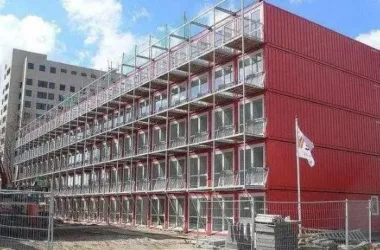
- Modular Architecture: Developed from sheet metal construction, modular buildings offer high industrialization and rapid on-site installation. Despite these advantages, they require significant investment, complex transportation, and heavy lifting equipment, which limits widespread adoption.
- Frame Light Board Buildings: Combining boards and prefabricated skeletons—often reinforced concrete but sometimes steel or wood—this structure type can be assembled fully prefabricated or through a combination of prefabricated and cast-in-place methods. Ensuring structural stiffness relies heavily on the quality of component connections. Design and construction decisions should be based on specific structural requirements and site conditions, supported by engineering calculations.
- Rising Slab and Floor Construction: This method involves repeatedly pouring floor slabs and roof panels over the existing concrete base while erecting prefabricated reinforced concrete columns. The columns guide the lifting and securing of slabs and panels to their designed height. Sliding formwork may be lifted during floor slab installation to facilitate exterior wall pouring. High-rise buildings typically feature wider column spacing and strong floor slab load capacity. An alternative is installing prefabricated interior and exterior walls on ground level before lifting them together with floor slabs, accelerating construction and benefiting sites with limited space.
3.2 Development of Prefabricated Buildings
To accelerate industrialization in modern urban construction, China aims to learn from developed countries’ experiences. This includes strengthening foundational research, refining and expanding technical standards related to prefabricated buildings, and analyzing the transformative impact of widespread prefabricated construction. Developing supportive policies, improving the standard system, and actively promoting integrated technologies are crucial steps.
Establishing a comprehensive set of production, technical, management, and acceptance standards is essential. Standardized implementation must cover the entire industrial chain—from design and manufacturing to sales and after-sales service. Efforts should focus on integrating mature technologies into these standards, enforcing them rigorously, and increasing investment in technological innovation. By rapidly advancing the promotion of prefabricated building technologies, China seeks to establish a modern construction system featuring diverse prefabricated structural forms.















Must log in before commenting!
Sign Up