
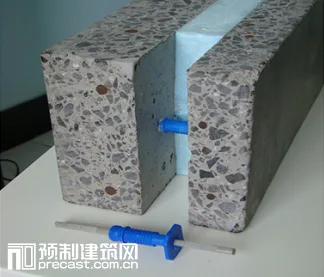
Insulated concrete wall panel connectors are specially designed for manufacturing non-composite insulated concrete sandwich wall panels. These connectors allow the inner and outer layers of the sandwich panels to slide relative to each other, effectively eliminating expansion stresses caused by temperature changes. They offer benefits such as high strength, low thermal conductivity, and resistance to chemical corrosion.
By threading the connector through a pre-drilled insulation board and pouring concrete between the two layers, a sandwich wall panel is easily formed.
Because concrete and insulation boards have different material properties, it’s challenging to bond them into a unified structure. The insulated concrete wall panel connector ensures that the two concrete layers securely sandwich the rigid insulation board in the middle, creating a cohesive three-layer system.
This structural design significantly improves the R-value of the wall panels, providing much higher thermal resistance than a single concrete wall panel or conventional insulation systems applied after construction (such as thin polystyrene plastering).
For example, a 200 mm (8-inch) thick concrete wall panel without insulation has an R-value of 0.113 m²·K/W (0.64 ft²·h·°F/BTU). In comparison, a 25 mm (1-inch) thick extruded polystyrene insulation board has an R-value of 0.881 m²·K/W (5.0 ft²·h·°F/BTU). This means that just a 25 mm insulation board can provide insulation equivalent to that of a 1.5-meter thick ordinary concrete wall.
Today, energy-efficient building designs are required in most regions, making insulation systems essential for concrete exterior walls.
Supplier
Thermomass
China General Agent
Shenzhen Modern Construction Technology Co., Ltd
















Must log in before commenting!
Sign Up