
01
Classification of Concrete Composite Floor Slabs
Based on the specific stress conditions, concrete composite floor slabs are categorized into unidirectional and bidirectional composite slabs.
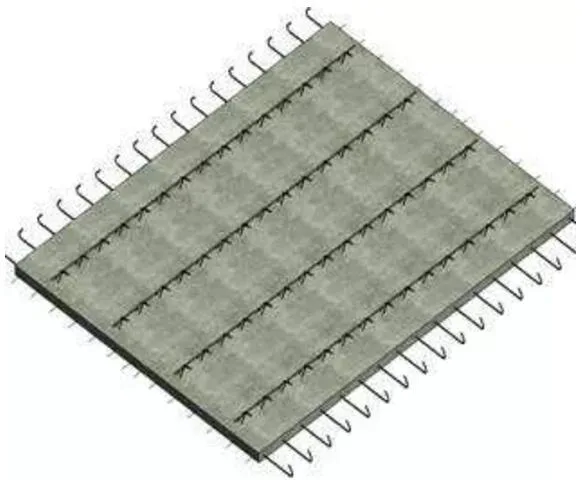
Prefabricated baseplates are classified as either “bearded bars” or “unshaped bars,” depending on the presence or absence of protruding steel bars.
Regarding connection methods, joints are either separate joints (also called “tight joints,” where bottom plates are closely connected but not pulled apart) or integral joints, which include post-poured concrete strips between the bottom plates.
Classification of Prefabricated Baseplates
Prefabricated baseplates are divided into precast concrete baseplates and precast prestressed concrete baseplates based on the type of steel reinforcement used. For precast concrete baseplates with non-prestressed steel bars, truss-reinforced concrete baseplates are commonly used to improve stiffness.
Prefabricated prestressed concrete baseplates can take the form of flat plates, ribbed plates, or hollow slabs.
Design Principles
For spans exceeding 3 meters, prefabricated baseplates should use either truss-reinforced concrete baseplates or prestressed concrete flat plates. For spans over 6 meters, prestressed concrete ribbed baseplates or prestressed concrete hollow slabs are recommended. When the composite floor slab thickness exceeds 180mm, prestressed concrete hollow composite slabs should be employed.
The key design consideration for precast concrete composite floor slabs is ensuring that the concrete on both sides of the composite surface can bear and coordinate loads effectively. This is typically achieved through surface roughness and the use of shear-resistant structural steel bars at the interface.
The installation of reliable supports during construction determines the design calculation approach for composite panels. Properly supported composite panels should not deform under the weight of post-poured concrete and construction loads, allowing design calculations to treat them as integral bending components.
For unsupported composite panels, the weight and construction loads of the secondary poured concrete affect internal forces and deformations. These panels should be designed and calculated considering the two-stage stress behavior of composite components.
02
Technical Standards
The design and construction of precast concrete composite floor slabs must comply with national standards, including GB 50010-2010 “Code for Design of Concrete Structures,” JGJ 1-2014 “Technical Specification for Prefabricated Concrete Structures,” and GB/T 51231-2016 “Technical Standard for Prefabricated Concrete Buildings.” Production, construction, and temporary design of prefabricated baseplates should follow GB 50666-2011 “Code for Construction of Concrete Structures.” Construction acceptance must meet the requirements of GB 50204-2015 “Code for Acceptance of Construction Quality of Concrete Structures.”
Relevant national building standard design drawings include 15G366-1 “Reinforced Concrete Composite Panel for Truss (60mm thick bottom plate),” 14G443 “Prefabricated Ribbed Bottom Plate Concrete Composite Panel,” and 06SG439-1 “Prestressed Concrete Composite Panel (50mm, 60mm solid bottom plate).”
The concrete strength grade for prefabricated concrete baseplates should be no less than C30. For prefabricated prestressed concrete baseplates, the strength should be at least C40 for building industrialization, or no less than C30 otherwise. The post-poured concrete composite layer should have a minimum strength grade of C25.

The thickness of the prefabricated baseplate should be at least 60mm, with the post-poured concrete composite layer also no less than 60mm thick.
The joint surface between the prefabricated baseplate and the post-poured concrete composite layer must be rough, covering at least 80% of the joint surface area, with a concave-convex depth of no less than 4mm. For truss-reinforced baseplates, the surface should be naturally rough.
When the prefabricated baseplate span exceeds 4 meters, or when longitudinal steel bars on the upper part of cantilever plates and adjacent cantilever plates are anchored in the cantilever layer, truss steel bars or other types of shear-resistant structural steel bars must be installed.
Reliable measures should be taken to control reverse arching when using prefabricated prestressed baseplates.
03
Scope of Application
This floor structure is especially suitable for residential and public buildings of various types.
















Must log in before commenting!
Sign Up