
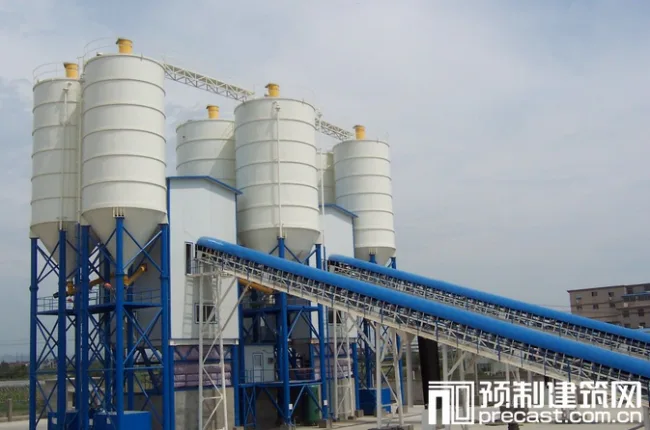
The concrete mixing plant primarily consists of five major systems: the mixing host, material weighing system, material conveying system, material storage system, and control system, along with other auxiliary facilities. By eliminating four intermediate steps compared to station aggregate measurement and incorporating vertical feeding measurement, the process saves significant time, greatly enhancing production efficiency. For the same model, the mixing plant’s efficiency is approximately one-third higher than that of a mixing station. For instance, the production capacity of an HLS90 plant equals that of an HZS120 station; HLS120 matches HZS180, and HLS180 corresponds to HZS240.
Introduction:
A concrete mixing plant is a combined system designed for centralized concrete mixing, often referred to as a concrete prefabrication yard. Thanks to its high level of mechanization and automation, it offers high productivity, ensures concrete quality, and reduces cement consumption. It is widely used in large and medium-sized projects such as water conservancy, power, bridges, and others that require significant concrete volumes, extended construction periods, and concentrated work sites. With the growth of urban construction, centralized mixing plants supplying commercial concrete have seen rapid development, enabling efficient concrete pumping operations and seamless integration of mixing, conveying, and pouring machinery.
The key difference between a mixing plant and a mixing station lies in production capacity and mobility: mixing plants have smaller capacities, are easy to disassemble, can form container transfer points, and suit construction sites. Conversely, mixing stations feature larger volumes and higher productivity, functioning as fixed installations ideal for large-scale water projects or supplying large amounts of commercial concrete.
Components of a Mixing Plant:
The concrete mixing plant mainly includes the material storage system, material weighing system, material conveying system, mixing system, powder storage system, powder conveying system, powder metering system, water and admixture metering system, control system, and various auxiliary facilities.
Mixing Machine
The mixing host is classified into forced mixing and self-falling mixing based on the mixing method. Forced mixers are the mainstream choice both domestically and internationally, capable of mixing a variety of concrete types, including flowable, semi-dry hard, and dry hard concrete. Self-falling mixers are mainly used for flowable concrete and are rarely found in mixing plants.
Forced mixers are further divided by structure into main shaft planetary mixers, single horizontal shaft mixers, and double horizontal shaft mixers. Among these, the double horizontal shaft forced mixer offers the best overall performance.
Material Weighing System
This system is crucial for concrete quality and cost control, comprising aggregate weighing, powder weighing, and liquid weighing. Mixing plants with capacities under 20 cubic meters per hour typically use stacking weighing, where aggregates (sand, stone) are weighed on one scale, cement and fly ash on another, and water and liquid additives separately. Liquid additives are then combined with water in a pre-mixing hopper. For plants exceeding 50 cubic meters per hour, independent weighing for each material is standard, employing electronic scales and microcomputer controls. Aggregate weighing accuracy is within 2%, while cement, powder, water, and additives achieve 1% or better.
Material Conveying System
Material conveying is divided into three parts:
- Aggregate Conveying: Two methods exist: hopper conveying and belt conveying. Hopper conveying offers a small footprint and simple structure, while belt conveyors support longer distances, higher efficiency, and lower failure rates, suitable for plants with temporary aggregate storage.
- Powder Conveying: Cement, fly ash, and mineral powder are typically transported via screw conveyors. Larger plants may use pneumatic or scraper conveying. Screw conveyors are favored for their simple structure, low cost, and reliability.
- Liquid Conveying: Water and liquid additives are transported using water pumps.
Material Storage System
Materials for concrete are stored similarly: aggregates are stacked outdoors (or in enclosed silos for large urban plants); powder materials are stored in fully enclosed steel silos; admixtures are kept in steel containers.
Control System
The control system acts as the central nervous system of the plant. Its complexity varies based on user needs and plant size. Small construction site plants have simpler control systems, whereas large plants utilize more sophisticated setups.
Features
A concrete mixing plant is a manufacturing system composed of five major components: mixing host, material weighing, conveying, storage, and control systems, plus other auxiliary equipment. Its core principle involves using cement as a binder to mix raw materials like sand, lime, and coal slag, ultimately producing concrete used as a building material.
Since their introduction, concrete mixing plants have played a vital role in China’s construction and building materials industries, thanks to their superior features.
The plant comprises four main sections: sand and gravel feeding, powder feeding, water and admixture feeding, and transmission mixing and storage. Constructed with integral steel structures using high-quality H-beams, the plant not only presents an aesthetic appearance but also offers enhanced structural strength. It is easy to install and adaptable to various complex terrains.
The mixing plant features excellent mixing performance with a spiral double horizontal shaft forced mixer, capable of effectively mixing dry, plastic, and varied concrete proportions with high efficiency and uniformity.
Beyond the mixer, the plant includes sophisticated accessories such as screw conveyors, measuring sensors, and pneumatic components, ensuring high reliability, precise measurements, and long service life. Maintenance access is convenient, with walkways, inspection ladders, and a high-pressure automatic cleaning system equipped with alarms for oil shortage and overheating.
Environmental protection is also prioritized. Powder operations are fully enclosed, and efficient dust collectors and mist spraying systems significantly reduce dust pollution. Noise reduction devices are installed on exhaust and discharge equipment to minimize noise pollution.
Key Considerations When Purchasing
- Concrete performance grade: Choose the appropriate mixing host based on project requirements. Forced mixing hosts are essential for water conservancy projects. Batching stations and storage bins should align with the concrete materials used.
- Workload and construction duration: Calculate the required plant size using the formula: X = M / (T × H × K), where M is total concrete quantity, T is pouring days, H is daily working hours, and K is utilization coefficient (0.7–0.9). Consider transport methods, such as direct pumping or vehicle delivery, and vehicle volume when selecting the plant.
- Construction environment and target: Assess site conditions to ensure smooth operations and quality. For large single pours with high quality demands and no nearby plants, consider dual smaller plants or a main and auxiliary setup. For sites with difficult transport and limited maintenance access, dual smaller plants or ample spare parts are advisable. For dispersed sites within short driving distances, centralized mixing with multiple job numbers enhances utilization and cost-effectiveness.
- Operator expertise: Smaller plants have simpler systems and lower skill requirements; larger plants are more complex and require skilled operators. Consider this in your purchase decision.
- Configuration selection: Manufacturers offer mature product lines with customizable options. Avoid over-specification to prevent economic waste. Pay attention to component quality and manufacturer reputation to select the most suitable and cost-effective model.
Continuous Concrete Mixing Plant
Most commercial plants operate intermittently: raw materials are batched in quantities not exceeding mixer capacity, mixed, then discharged into transport vehicles.
Process:
- Production begins with uniform batching of each raw material according to its distance from the mixer inlet, synchronizing at the mixing tank inlet.
- Materials enter the mixer inlet evenly in proportion.
- The mixer stirs and pushes the material from inlet to outlet, producing finished concrete.
- Upon reaching the set volume, materials stop batching in reverse order of distance from the inlet.
- Batching, mixing, and discharging occur continuously throughout production.
Features:
- Smooth operation: raw materials feed evenly over time, avoiding sudden surges.
- Consistent product loading: concrete is loaded uniformly without intermittent surges.
- Compact footprint: requires less space due to reduced hopper sizes and low height.
- Low wear: smooth mixing reduces wear on components.
- Energy-efficient: small installed power and steady feed facilitate even mixing.
- Low maintenance: fewer parts and shorter belts contribute to smooth operation.
Five Major System Components:
- Sand and Gravel System: Includes three sand and gravel feeding buckets (two or four depending on requirements), each with collection hopper, weighing sensor, reducer, feeding belt, and accessories.
- Powder System: Consists of storage bins, butterfly valves, lifting screws, measuring bins, disc feeders, and others. Industrial storage warehouses include main and secondary silos (100T-300T each) equipped with automatic arch-breaking and level indication. Dust removal systems are also installed.
- Water and Admixture System: Comprises admixture tanks, water tanks, pump stations, weighing hoppers, and pipelines.
- Transmission, Mixing, and Storage System: Includes belt conveyors, mixers, and mixing frames. Aggregates are batched onto belts and fed into the mixer; fly ash and cement are directly fed through disc feeders and screw conveyors.
- Electrical and Automatic Control System: Features power cabinets, sensors, and control centers.
Advantages:
- High output and efficiency: continuous and stable operation with large single-machine output.
- Uniform mixing: materials enter the mixer evenly, allowing shorter mixing times.
- No leakage and minimal wear: dry material feeding and reverse screws prevent leakage and reduce wear.
- Low failure rate: fewer start/stop cycles extend equipment life and reduce breakdowns.
Intermittent Mixing Plant System Composition:
- Mixing System: Double horizontal shaft mixer assembled with imported components; other foreign mixers can be specified.
- Measurement System: Aggregate measured by incremental or electronic scale methods; powder metered via cement and fly ash buckets above the mixer. Standard plants control screw conveyors with AC contactors; improved plants use frequency converters for coarse and fine batching. Water measurement uses a three-point suspension weighing mechanism with matching circuits to ensure accuracy. Additives are measured with sensor loads, separate boxes, and pipelines for precision.
- Dust Removal System: Independent centralized dust collectors prevent negative pressure in the mixing chamber, preserving measurement accuracy. Aggregate feeding employs belt conveyors lifting materials to storage hoppers, characterized by compact structure, reliability, and ease of maintenance.
- Automatic Control System: Distributed computer system enables centralized management and high reliability.
Technical Advantages of Improved Concrete Mixing Plants (“Five Highs”):
- High customization: high-end systems include internationally renowned brand components or domestically assembled mixers with imported parts.
- High accuracy: frequency conversion technology enables coarse blending (90–95%) and precision blending with less than 0.5% ingredient error.
- High reliability: reduced cylinder action frequency and soft start with frequency converters minimize wear and failure.
- High productivity assurance.
- High cost-effectiveness: performance comparable to mixing towers at only one-third to one-half the price.
Two Practical Applications:
- A robust data management system saves real-time production data, supports complex queries, generates various reports, and prints delivery notes automatically.
- A slump monitoring system visually assesses concrete slump based on real-time mixer current curves.
Structural Characteristics of Intermittent Cement Concrete Mixing Plants:
- Large unloading ports prevent material arching without requiring vibrators.
- Fast unloading and short feeding times enable producing one concrete truck per feed.
- Low cylinder action frequency extends service life.
- Material transfer from storage bin to measuring hopper does not affect ingredient accuracy.
- Combined batching and lifting times provide sensors with stable response, minimizing overshoot and load.
- Computer-controlled belt speed with frequency converters enables smooth starts/stops and reduces material adhesion.
- High-precision batching is achievable quickly via frequency converter speed regulation.
Supplier:
Taika Machinery (Taicang) Co., Ltd













Must log in before commenting!
Sign Up