
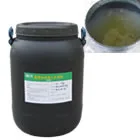
Exposed aggregate concrete technology plays a crucial role in seamlessly connecting new concrete to old. By exposing the coarse aggregate within the concrete, a naturally rough, graded surface is created. This allows the mortar in the freshly poured concrete to firmly bond with the aggregate in the existing concrete, ensuring a strong, unified joint.
There are generally two types of water washing agents used for exposed aggregate concrete:
The first type has a paste-like consistency and is applied to a mold. After removing the mold, the concrete surface is washed with water to reveal the aggregate beneath.
The second type is a liquid, sprayed directly onto the concrete surface. After a set period, it is washed off with water, exposing the aggregate on the surface.
When used properly, these washing agents only delay the final setting time of the concrete without compromising its solidification, long-term strength, or the bond between steel reinforcement and concrete.
For the paste-type washing agent, a thick layer is applied to the mold using a brush or roller and allowed to air dry. After about an hour, this forms a rough, water-soluble film on the mold surface. When concrete is poured, water dissolves this film, releasing the agent at the interface. Typically, the desired exposure depth is achieved by demolding and rinsing within 72 hours.
For the spray-type agent, after the initial bleed water evaporates from the concrete, the agent is sprayed evenly until the surface is fully covered. It gradually penetrates the concrete, with an application rate of 0.2–0.3 liters per square meter. The usual rinsing time ranges from 6 to 8 hours, and both rinsing time and dosage can be adjusted to control the depth of aggregate exposure.
The depth of exposed aggregate depends on how deeply the washing agent penetrates. Factors influencing this include the amount of agent used, cement type and quantity, admixtures, ambient temperature, and rinsing duration. Therefore, testing samples is recommended to optimize results, especially in prefabricated housing applications.
These washing agents are also effective for creating decorative concrete surfaces by controlling the exposure depth of the aggregate, particularly when using specific aggregates in the decorative layer.
Additionally, exposed aggregate concrete washing agents can be utilized in producing concrete pavements designed for noise reduction and improved skid resistance.
The formulation of these agents can be tailored to meet specific requirements, such as environmental conditions and desired exposure depth—ranging from a subtle acid-wash texture to a fully exposed aggregate surface up to 30 millimeters deep.
This technology is versatile and widely applicable, including surface treatment for precast component joints, cast-in-place concrete construction joints, and connections between new and old concrete. It also enhances the surface decoration of concrete elements and the production of exposed aggregate pavements. The method is convenient, time-saving, labor-efficient, and cost-effective.
Important Notes:
1. Since the exposed aggregate area often coincides with where new concrete is poured, high surface dimension accuracy is typically not required. Therefore, it is not necessary to clean cement residues from the mold surface every time. Applying the agent directly onto the cement surface allows better adhesion and drying. This also enables a gradual slow-release effect, improving performance while reducing the amount of agent needed.
2. When applying the agent on a new mold with a very smooth surface, adhesion may be weak. To improve this, first apply a thin layer (~1mm) of plain cement paste to the mold, allow it to dry completely, and then apply the washing agent. This enhances both adhesion and permeability.
3. For steam curing, use high-temperature resistant agents and choose an appropriate rinsing schedule. (High-temperature agents should be customized separately.)
4. If demolding is delayed beyond 24 hours, use a long-lasting coating agent capable of maintaining the required exposure depth even after 72 hours of rinsing. (Long-lasting agents require separate customization.)
5. For structural connection surfaces, it is recommended to expose one-third to one-half of the stones or combine keyways with water washing surfaces.
Suppliers:
Zhongshan Kuaierju Residential Industry Co., Ltd
Shenzhen Modern Construction Technology Co., Ltd













Must log in before commenting!
Sign Up