
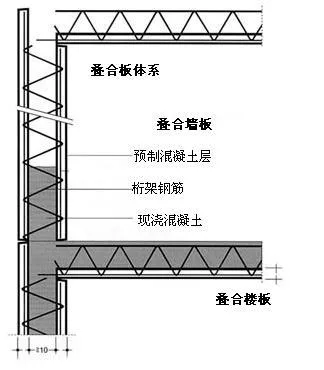
Definition of Composite Panels
Composite panels consist of prefabricated and cast-in-place components, also referred to as semi-prefabricated systems. They integrate the advantages of both prefabricated and cast-in-place concrete.
Background and Reasons for Developing Composite Panels
Cast-in-place slabs offer excellent overall integrity and seismic performance but require extensive labor, numerous formworks, and long construction times, making industrialization difficult. Prefabricated panels, on the other hand, facilitate industrialized building processes through standardized design, industrial manufacturing, and mechanized installation. Their production is not constrained by seasonal or weather conditions, which enhances component quality. Additionally, they enable faster construction and reduce the need for formworks and supports. However, prefabricated panels generally lack strong overall integrity, which negatively impacts earthquake resistance and waterproofing. Composite panels were developed to combine the strengths of both cast-in-place and prefabricated slabs.
Composition of Composite Panels
Composite panels are made up of two parts: the prefabricated elements, usually thin plates manufactured in a factory and installed on-site, and the cast-in-place layers added on top of the prefabricated surface. The prefabricated thin plates act as permanent formwork, eliminating the need for temporary formworks, and contribute to the floor’s load-bearing capacity.
Types of Composite Panels
Continuous composite panels, new composite panels, bidirectional composite panels, hollow composite panels, prestressed concrete composite panels, PK prestressed composite panels, prestressed concrete bidirectional composite panels.
Key Research Areas on Composite Panels Worldwide
Seismic performance, flexural behavior, ductility, computational analysis and design, energy efficiency, and crack resistance.
Development and Research Progress of Composite Panels in China
China started producing prefabricated integral components like prestressed bars, thin plates, and double-layer hollow slabs in 1957, primarily for civil buildings. In 1961, Zhu Bolong from Tongji University developed an assembled integral ribbed floor slab featuring a prefabricated lower flange on an I-shaped small beam. This design offered economic efficiency, lightweight components, and ease of construction and production.
During the 1970s, China’s concrete composite roofs combined prestressed precast small beams with cast-in-place slabs. Numerous buildings using this system were constructed across Guangdong, Zhejiang, Tianjin, and other provinces, demonstrating strong economic benefits. In 1975, Zhejiang Provincial Standard Design Station published the roof atlas for prestressed concrete precast small beams and cast-in-place slab composites (Zhejiang G103.103-1).
By the 1980s, with economic reforms and the tourism boom, high-rise buildings rapidly emerged in major cities. Due to seismic requirements, most used cast-in-place roofing structures, but many also incorporated prefabricated integral composite panel systems. Between 1975 and 1995, nearly 30 projects partially or fully utilized composite structures, including multi-story public and high-rise buildings.
Over 20 buildings, such as the Beijing International Building, Xiyuan Hotel, Wuhan Jinyuan World Center, and Wuhan Friendship Building, adopted these methods. In smaller cities, traditional hollow floor roofs were replaced by prefabricated prestressed concrete composite roofs to improve waterproofing and facilitate transportation and installation, accelerating construction and reducing costs. Prefabricated composite beam sections vary widely, including groove-shaped, inverted T-shaped, basket-shaped, and L-shaped designs.
Chengdu (Sichuan) and Nanning (Guangxi) have also implemented numerous prefabricated integral roofs combining prestressed thin plates and hollow slabs with cast-in-place concrete. The China Academy of Building Technology’s Standards Institute has compiled a standard atlas for these structures, facilitating their broader adoption.
Prestressed concrete composite hollow panels are widely used in regions with high seismic requirements and in floors demanding strong integrity and fire resistance. Typically, the prestressed concrete hollow slab is installed first, followed by a 40-60mm thick cast-in-place concrete composite layer on the slab’s corner columns. Within this layer, double-sided steel mesh (6mm diameter spaced at 200mm) connects adjacent slabs to ensure unified load-bearing.
To study the mechanical behavior of this integrated structure, Cui Guangren and Sun Fuying performed experimental analyses on prestressed concrete hollow slab composite slabs, validating the interaction between adjacent slabs and the improved flexural capacity through nonlinear finite element modeling.
In the 1990s, China’s Electric Power Construction Research Institute conducted experiments on glass fiber reinforced mortar composite panels and steel-reinforced glass fiber cement composite panels. The bottom layer of these panels consists of GRC (glass fiber reinforced cement) panels, replacing profiled steel sheets as permanent formworks for heavy-duty floors. GRC panels offer excellent stiffness, crack control, and sufficient bearing capacity, reinforcing corrugated valleys before casting concrete to form composite decks. These panels demonstrate high stiffness, late and evenly distributed cracking, and strong crack resistance, alongside flexible shaping, high overall quality, rapid construction, durability, and no need for bottom decoration.
Professor Wu Fangbo researched the PK prestressed concrete floor, a new prefabricated integral hyperstatic structure composed of high-strength steel wires and high-grade concrete. Factory-precast prestressed ribbed thin plates and groove-ribbed beams are assembled on-site and topped with cast-in-place concrete, offering excellent integrity, simplified construction, reduced formwork and support, shortened schedules, industrial production benefits, and strong economic advantages.
Liu Hanchao and colleagues studied inverted T-shaped composite panels. The prefabricated component is an inverted T-shaped panel with ribs at their final design thickness. Post-cast composite concrete fills the grooves between these ribs. Unlike traditional thin plate composite panels, where mid-span tension reinforcement is installed in one stage with prestressed steel bars, the inverted T-shaped design allows sequential placement of mid-span tensile steel bars between the precast slab and the cast composite layer (referred to as secondary reinforcement). This reduces the amount of prestressing needed and simplifies production.
Experimental conclusions include:
- (a) Adequate size and roughness of overlapping surfaces ensure strong bonding and cooperation between concrete parts.
- (b) Installing non-prestressed secondary reinforcement in the post-cast layer improves mid-span bending capacity and significantly enhances ductility and seismic performance.
- (c) Secondary reinforcement affects load-bearing capacity primarily during later loading stages.
- (d) Compared to cast-in-place slabs, inverted T-shaped composite panels are ideal structural forms.
Zhou Youxiang and colleagues developed a reinforced concrete two-way ribbed composite slab combining prestressed hollow slab technology with two-way ribbed slab features. This design reduces formwork, accelerates construction, and offers lightweight, good integrity, thermal insulation, and cost savings, showing strong potential for widespread use.
Jiang Xinliang and Yue Jianwei studied the bearing capacity of ceramic composite laminates. Their theoretical and experimental results showed that unsupported groove-bottom plates and laminates had bending and crack resistance exceeding calculated values, indicating strong elastic recovery. The ceramic composite layer reduces weight, while the groove-shaped bottom plate ensures support-free construction. Groove-shaped composites also offer better shear resistance than rectangular ones. Engineering applications demonstrated that unsupported composite panels meet the short construction period requirements of steel structure projects with notable economic benefits.
Professor Nie Jianguo and his team examined how different composite surface treatments affect the shear performance of high-strength and ordinary concrete composite panels. High-strength concrete offers durability, high strength, low deformation, frost resistance, and impermeability, suiting modern large-span, heavy-load structures in harsh environments.
Recently, steel plate concrete composite floors have seen increasing use in buildings, especially super high-rises. Tests show that closed steel plate concrete composite slabs developed recently perform excellently and are favored by owners and designers.
Professor Nie Jianguo’s team studied the longitudinal shear behavior of closed profiled steel reinforced concrete and bending performance of corresponding composite slabs, proposing calculation formulas and refining bearing capacity design methods for these new composite slab types.
Professor Wang Zuen compared bearing capacities of different profiled steel plate concrete composite floor slab forms, providing guidance for optimal selection. Generally, these panels fall into two categories: profiled steel sheet concrete composite panels and profiled steel sheet concrete composite panels.
International Development and Research Progress of Composite Panels
In the 1920s, concrete composite technology was first applied in bridge construction abroad. By the 1940s, it had been introduced in housing, with significant development occurring in the 1950s. Early composite systems combined structural steel beams with cast-in-place slabs, initially using wooden beams. Later advancements integrated prefabricated reinforced concrete components and prestressed concrete elements with cast-in-place slabs.
For residential buildings, the most common international practice involves composite structures using industrially produced prestressed bars and thin plates topped with low-strength concrete.
In single- and multi-story industrial plants, concrete composite integral structures began widespread use in the 1950s, expanded in the 1960s, and moved towards standardization and systematization by the 1970s. Two prevalent floor systems abroad are:
- Prefabricated beams and slabs topped with integral concrete, common in countries like England, France, and Italy for assembling integral floor slabs.
- Precast slabs fully cast-in-place—for example, in Poland, 7-10cm thick concrete is poured atop 6m prestressed beams, connected by steel bars extending from the beams, supporting large live loads (10kN/m, 15kN/m, 20kN/m).
Recently, Japan’s Kumagaya Group developed semi-prefabricated beam systems using stacked prefabricated components as floor slabs, with concrete poured onsite to create an integrated structure.
Japanese PC laminated panel components are widely used in industrial plants, public buildings, multi-story, and high-rise buildings, especially for floors in high-seismic zones. These systems provide excellent overall integrity and allow pre-embedding of pipelines in the cast-in-place floor layer, facilitating installation.
Early applications of profiled steel sheet concrete composite panels in Europe and the US mainly used steel sheets as permanent formworks and construction platforms. To support the concrete’s self-weight and live loads during construction, steel sheets were formed with ribs for strength and stiffness. Initial designs considered only the reinforced concrete slab’s role during service. However, research revealed that the profiled steel enhances slab bearing capacity when bonded well with concrete. The steel can replace tensile reinforcement, reducing steel use and lowering production, installation, and construction costs.
Consequently, composite panel research has grown extensively. Professor Ekberg Porter and colleagues in the United States first proposed an experimental-based calculation method for the longitudinal shear capacity of composite panels, advancing design theories and promoting global adoption.
Krustolovic Opara N, Dorgan E, Uang Chia Ming, and Haghyeghi A investigated bending performance of components made from high-strength permeable cementitious steel fibers.
Research by Krustulovic Opara N, Malak S, and Jamal Al Hannag M on high-strength permeable cement slurry steel fiber materials demonstrated superior tensile and compressive strength, stiffness, crack control, and ease of construction compared to conventional concrete. These materials can serve as permanent bottom plates and provide structural reinforcement for bending and shear with excellent outcomes.
They also studied composite beams formed by precast beams combined with cast-in-place concrete strips, finding early strength gain, excellent fatigue resistance, improved crack resistance, and high strength and stiffness.
Bayasi Z, Kaiser H, and Gonzals M experimented with using high-strength permeable cement slurry steel fibers to create corrugated bottom plates replacing profiled steel sheets in composite slabs. This approach eliminates sliding issues between steel and concrete, as well as corrosion and fire concerns associated with steel sheets. With proper steel fiber volume, corrugated plates made from this material exhibit high strength and ductility, and when reinforced in the post-cast concrete, produce composite slabs with high load capacity and crack resistance.















Must log in before commenting!
Sign Up