
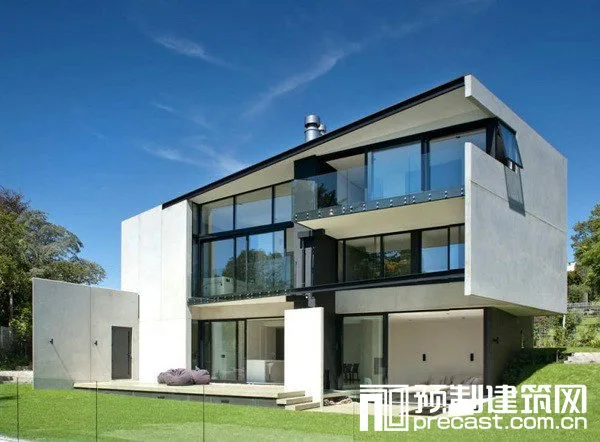
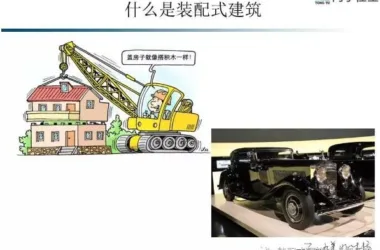
The term prefabricated house refers to residential buildings constructed using industrialized production methods. These buildings are made by manufacturing some or all components in a factory, which are then transported to the construction site for assembly using reliable connection techniques. In Europe, America, and Japan, this approach is known as industrialized housing. Unlike the common misconception that prefabricated houses are assembled like “building blocks,” many components are poured on-site similar to traditional construction methods. As a result, once completed, prefabricated houses are visually indistinguishable from conventional homes.
Structure
Prefabricated buildings typically use reinforced concrete, wood, or lightweight steel structures.
Standards
For example, Japan’s “Industrial Housing Performance Certification System,” established in 1973, regulates the quality and performance of industrialized housing. Managed by the Ministry of Construction (similar to the Ministry of Housing and Urban-Rural Development), since 1987, the Japan Construction Center has been responsible for evaluating these homes. This certification applies to all types of prefabricated houses rather than individual designs. Residential buildings that do not meet these standards cannot be marketed as industrialized housing.
In Beijing, China, efforts are underway to develop a local standard system for industrialized residential buildings within three years, covering design, construction, and acceptance criteria.
Features
1. Based on current production estimates (before scaling up), the construction of prefabricated or “assembled” houses is approximately 30% faster than traditional building methods.
2. Safety is fully ensured. Prefabricated components such as stairs and exterior walls are reinforced with concrete and steel bars on-site, creating a very sturdy structure rather than just being connected.
3. Prefabricated houses offer higher component precision compared to traditional buildings. This reduces common issues like wall cracking and water leakage, while enhancing overall safety, fire resistance, and durability. They also use lightweight partition walls, allowing homeowners to customize interiors easily.
4. Prefabricated houses are more energy-efficient and environmentally friendly. Improved insulation layers provide better thermal performance, allowing homeowners to maintain comfortable temperatures at lower heating levels, which saves energy and reduces heating costs.
5. Factory production combined with on-site assembly significantly cuts construction waste, noise, harmful gas and dust emissions, and reduces the number of on-site workers. Overall, this method can save about 20% of materials and roughly 60% of water usage.
6. Industrialized housing benefits developers by improving capital flow and speeding up housing availability, which helps address market supply shortages and stabilizes the housing market. Large-scale adoption can lower construction costs and help moderate housing prices.
7. Currently, the construction cost of prefabricated houses is approximately 400 yuan per square meter higher than traditional methods. However, costs are expected to decrease as production scales up.













Must log in before commenting!
Sign Up