
Definition
Architectural industrialization refers to the adoption of modern manufacturing, transportation, installation, and scientific management methods typical of large-scale industrial production. This approach replaces the traditional construction industry’s fragmented, low-efficiency, and labor-intensive handicraft methods. Its key features include standardized architectural design, standardized production and assembly of components and fittings, mechanized construction processes, and scientific organizational management.
Fundamental Aspects of Architectural Industrialization
The core of architectural industrialization lies in employing advanced and practical technologies, processes, and equipment to organize construction scientifically and efficiently. This involves fostering specialization in construction, enhancing mechanization, and minimizing heavy manual labor and wet operations. It also emphasizes the production of building components, products, and equipment on a moderate scale, supplying a range of universal building components and products to the market.
Additionally, architectural industrialization focuses on developing unified building modules and essential standards—such as module coordination, tolerances, fits, reasonable building parameters, and connection details—to balance standardization with diversification. This includes establishing and refining product standards, process standards, enterprise management standards, and construction methods to continuously advance building standardization.
Modern management techniques optimize resource allocation and implement scientific organization and management. Furthermore, cultivating technology markets and information management systems aligns construction practices with the evolving demands of a socialist market economy.
Characteristics of Building Industrialization
1. Systematic Design and Construction: Every project phase, from market analysis to completion, follows a carefully planned and coordinated approach.
2. Repeatability in Construction and Production: Mass production of components requires standardization, enabling their application across buildings of various scales, functions, and environments.
3. Batch Production of Components and Accessories: Since no single industrial structure can meet all building needs, industrialization provides a series of components capable of forming diverse building types.
Residential Industrialization and Architectural Style
Industrialized construction involves using standardized components and large-scale tools (such as standardized steel plates). Depending on where residential components are produced, industrialized construction divides into two categories: factory construction and on-site construction.
Factory Construction
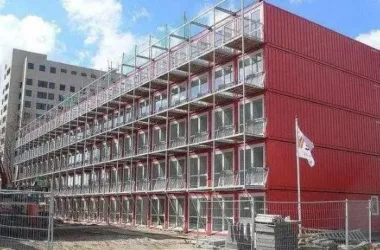
Factory construction entails designing components according to unified standards, producing them in batches at factories, and transporting them to construction sites for mechanical assembly into houses. Such homes are known as prefabricated modular houses and include types like large block houses, large wall panel houses, frame light panel houses, and modular houses.
Advantages of prefabricated residential buildings include high factory production efficiency, consistent quality, reduced seasonal impacts, and rapid on-site installation. However, this method requires substantial initial investment in material and component production bases. Once components are finalized, flexibility decreases, risking monotonous and rigid designs. Moreover, these structures often have weaker overall integrity and seismic resistance.
To address seismic weaknesses, Japan enhances prefabricated concrete buildings by casting connection nodes in place, improving overall strength and stability. This technique, known as precast concrete structure (PC), is also being tested and refined by companies like Vanke in China. Changsha Yuanda Residential Industry Co., Ltd. uses internationally advanced PC components for industrial residential production.
On-Site Construction
On-site construction produces components directly at the construction location, assembling them simultaneously. Though production and assembly are integrated, factory-grade large tools and management standards are still applied throughout. On-site industrialized residences typically use large templates, sliding templates, or tunnel templates.
Highly mechanized template use replaces heavy manual labor. Compared to prefabricated factory assembly, on-site construction requires less upfront investment, adapts better to environmental conditions, supports diverse building forms, and offers stronger structural integrity. Its drawbacks include higher labor demands and increased template usage, making it more vulnerable to seasonal influences.
Strategies to Achieve Construction Industrialization
Construction industrialization should begin with design and structural innovation, establishing new systems like steel structures and prefabricated assembly systems. Factory production should be implemented for most building components, including both finished and semi-finished products.
Key steps include:
- Transitioning multi-story buildings from traditional brick and concrete to prefabricated frame structures;
- Developing high-rise and mid-rise buildings using shear walls or steel structures;
- Shifting construction methods from on-site pouring to prefabricated components and assembly;
- Balancing on-site and factory production methods for building components and products.
Accelerating research into new construction technologies focuses on innovations in formwork, supports, scaffolding, and reducing wet operations on-site. Advances have been made in plain concrete construction, new formwork and support systems, and suspended scaffolding. There is also a strong push for the development and application of new wall materials within enclosure systems.
Promoting the “four new” achievements and reducing manual labor through mechanization and improved assembly methods is vital. This includes enhancing the assembly of components and construction mechanization based on the Ministry of Construction’s ten new technologies.
Within new structural systems, rapid adoption of steel structures is essential. China, as the world’s leading steel producer for eight consecutive years, has built numerous steel structure buildings and issued relevant design standards and quality specifications. Steel structures offer fast construction, excellent seismic resistance, and high safety. Their usage has grown over 4% compared to reinforced concrete, significantly shortening construction timelines.
Steel construction also supports building industrialization, boosting related industries such as metallurgy, building materials, and decoration. It encourages advancements in fireproofing, corrosion resistance, insulation, wall materials, and kitchen and bathroom product technologies. Additionally, steel structures are recyclable, energy-efficient, and environmentally friendly, supporting sustainable economic development.
Prefabricated assembly structures should be promoted actively. Currently, many concrete structures are poured on site, causing environmental pollution, noise, increased labor intensity, and quality control challenges. The prefabricated modular structural system, or “Shi Gou System,” introduced by Nanjing Dadi Construction Company from France, uses prefabricated reinforced concrete columns, prestressed concrete beams and slabs, and integrates these via reinforced concrete casting at joints. This system reduces component cross-sections and structural weight, facilitates factory production, and speeds construction. It has been successfully applied in multiple projects in Nanjing.
Composite wood structures also warrant rapid development. Suitable for large-span buildings as well as rural homes and villas of two to three stories, composite wood offers environmentally friendly and humanized building solutions. Taking advantage of the fast growth and renewability of poplar trees, efforts should focus on deep processing technologies like wood treatment, composites, and molding to produce durable, insect- and fire-resistant, and easy-to-assemble building components such as columns, beams, and slabs.
Wide adoption of composite wood structures reduces demand for steel, cement, and stone, helping conserve resources. It also creates valuable markets for poplar growers, enhancing economic opportunities and contributing to poverty alleviation. As technology matures, composite wood structures are expected to revolutionize China’s construction industry.
The Development of Building Industrialization
History
In 1900, the United States developed machinery capable of producing large standard reinforced concrete hollow precast floor slabs. Using these standardized components, assembled houses were constructed, marking the beginning of construction industrialization. Initially applied to schools, residences, and factories, industrialized building systems significantly accelerated construction speed, reduced worker labor intensity, and improved efficiency.
However, early industrial buildings often appeared monotonous and lacked variety. To address this, industrialized building systems separated houses into structural and decorative components. The structure provided large industrialized spaces, while flexible interior decoration allowed for varied appearances and functions to meet diverse needs.
Development
Construction industrialization is the future direction of China’s construction industry. Recent reforms and expansion have strengthened the industry’s material and technological base, but productivity gains remain modest, quality issues persist, and technological progress is slow.
To improve quality, optimize industrial structure, accelerate construction, enhance labor conditions, and boost productivity, it is essential to draw from decades of Chinese experience and successful international practices. Considering regional disparities and abundant labor resources, efforts must align with market demands and ongoing industry reforms.
The primary focus is housing construction—especially large-scale, widely used residential buildings directly impacting living standards—to ensure the construction industry becomes a pillar of the national economy.














Must log in before commenting!
Sign Up