
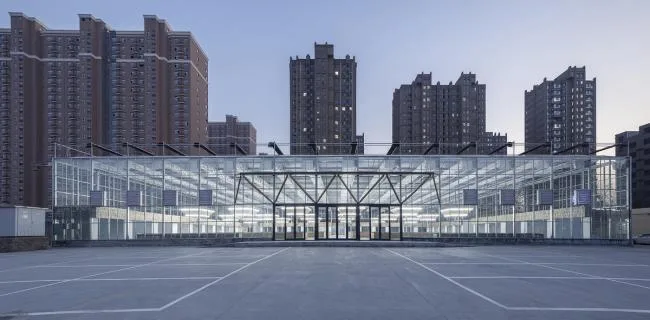
▲ Entrance Square at Dusk
The original Shengli Market is situated in one of the earliest urban development zones. Over decades, this old market, which once fulfilled basic living needs, has gradually become congested, chaotic, and unhygienic. With the rise of BIM learning and urban renewal efforts, there is an urgent need to renovate the old market district. However, demolition and reconstruction are lengthy processes, and the daily life and food supply the market provides are essential.
Therefore, quickly constructing a temporary market that fulfills the community’s needs and replaces the original during renovation has become a critical and urgent task.
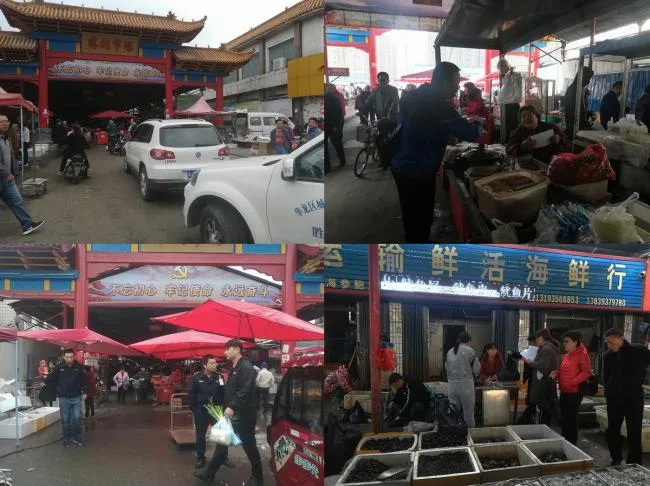
▲ Old Market
Opposite the old market lies a vacant plot of land, currently unused and available for temporary lease. This site, adjacent to the old market, offers convenience for merchants to relocate and for citizens to continue their shopping routines.
The old market borders a main urban road, but its original design did not anticipate the popularity of motor vehicles, often causing traffic congestion at nearby intersections. The temporary site is designed within urban road boundaries and includes a dedicated parking area.
The new land use plan adopts a square layout. Since this site is significantly smaller than the original market, the construction strategy prioritizes efficient space utilization.
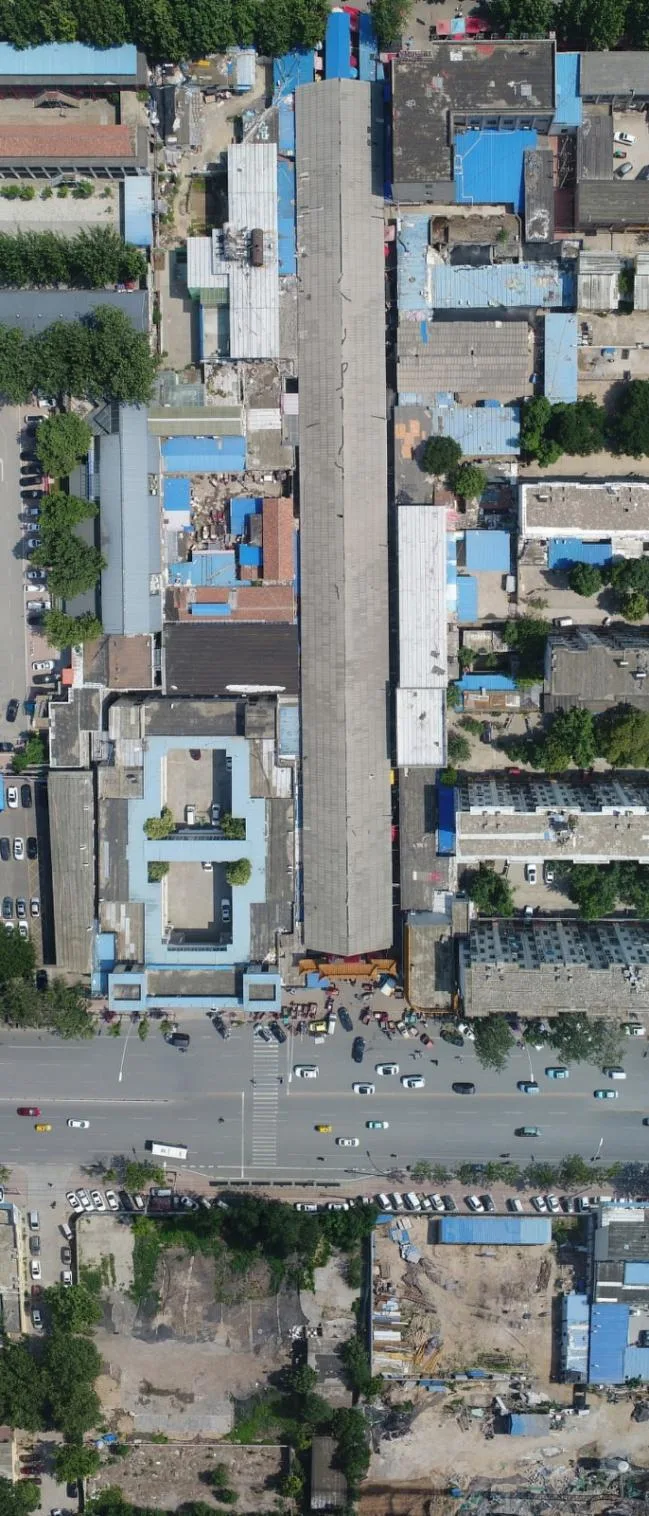
▲ Current aerial view
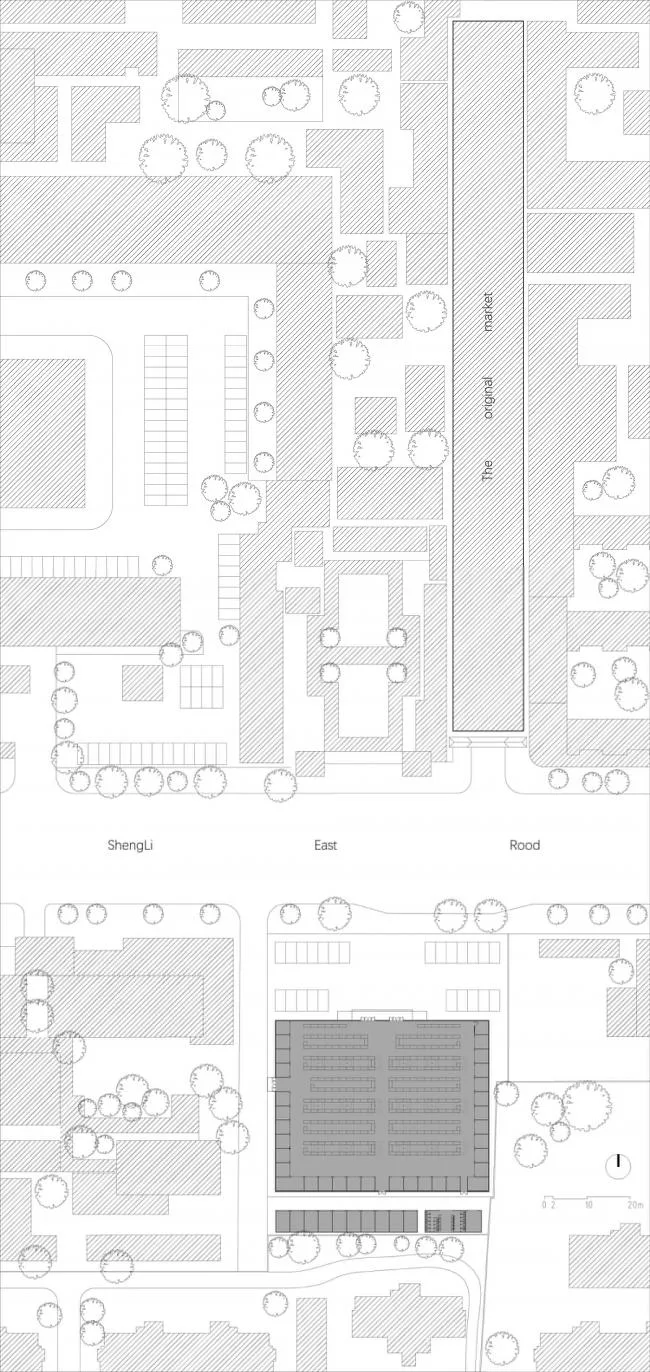
▲ Overall layout
Temporary Structures & Sustainable Use
The client’s primary requirement was rapid construction at minimal cost. As designers, we aimed to balance this with sustainability—enabling functional conversion and reuse after the temporary period ends.
Considering cost-efficiency, speed, and space requirements, a “square” floor plan was essential. The preferred approach incorporated fully industrialized, standardized vegetable greenhouse techniques. These modular, lightweight components allow for fast assembly, provide ample space at low cost, and can be dismantled for off-site reuse. The standardized rods are recyclable and reusable.
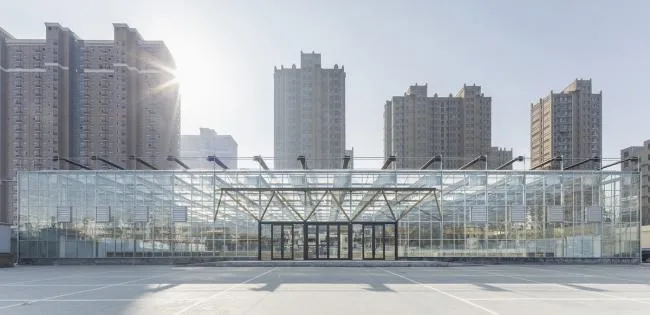
▲ Entrance Square
From Disorder to Organized Space
The standard industrial greenhouse layout is uniform but lacks order. Vegetable markets typically face challenges with spatial confusion. Our second design goal was to introduce order through strategic additions, improving sales management and customer experience.
These additions had to respect the existing modular structure while using low-cost, non-standard components with limited reusability. Three key elements were incorporated: enclosed shops, open shelves, and entrance canopies.
Enclosed shops feature three-sided walls, minimizing closure on one side. Aligning with the modular structure, each shop is 4m by 4m with a large opening and depth. These shops accommodate larger vendors selling dry goods, prepared foods, spices, etc., each with a rolling shutter door topped by a protective eave supported by angle steel and wooden grilles. Uniform signage is installed throughout.
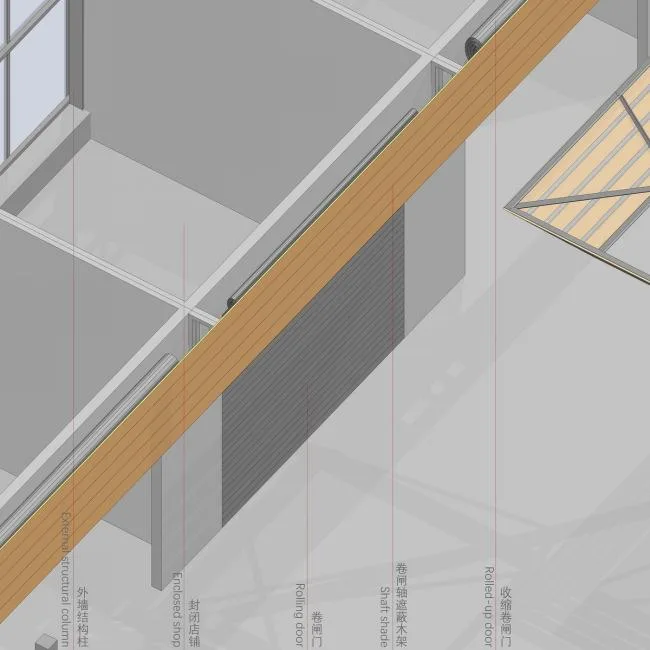
▲ Enclosed shop shelving
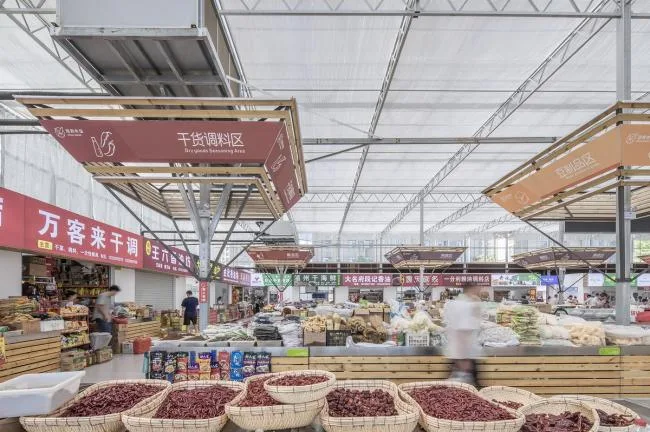
▲ Dry seasoning area
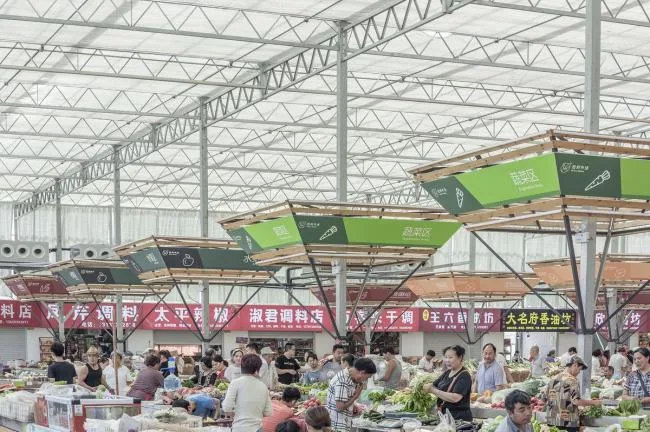
▲ Signage system
Open shelves differ from enclosed shops as vendors share space. Each vendor typically occupies about two 2-meter stalls, making traditional shelf labeling ineffective. To address this, umbrella-shaped inverted four-sided cone steel and wooden shelves were installed around the structural columns. These support various market signs and lighting fixtures, enhancing visibility and organization.
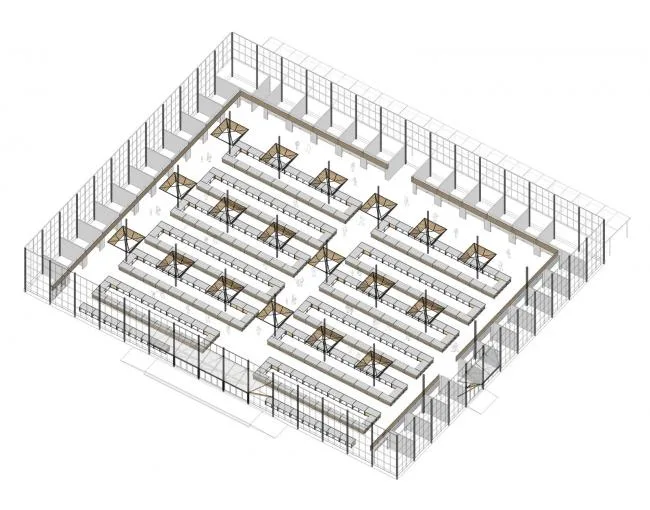
▲ Axonometric analysis
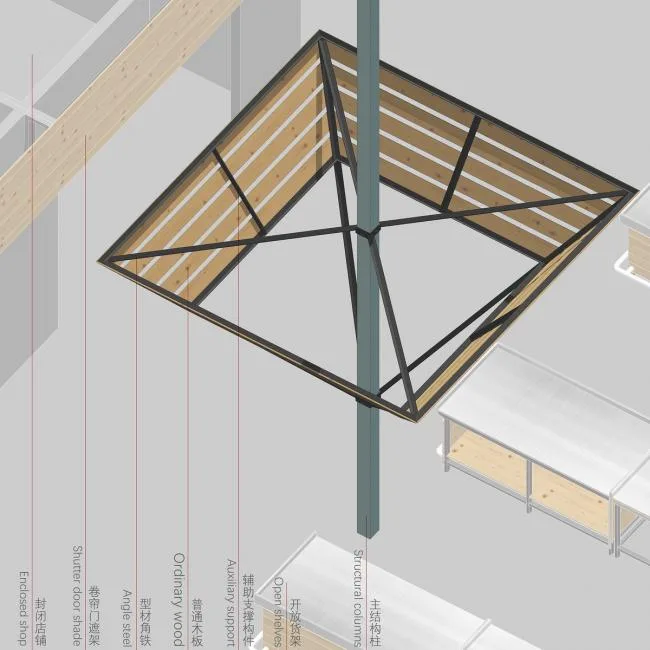
▲ Structural column umbrella frame
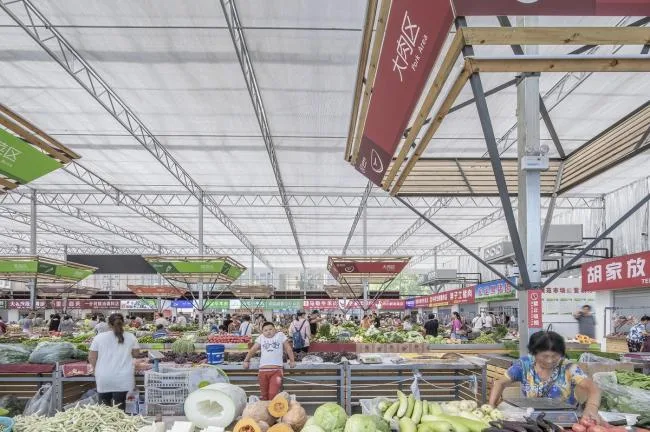
▲ Open shelving
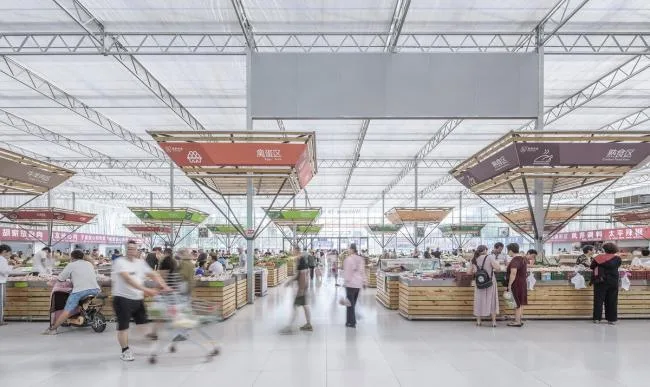
▲ Poultry and egg section
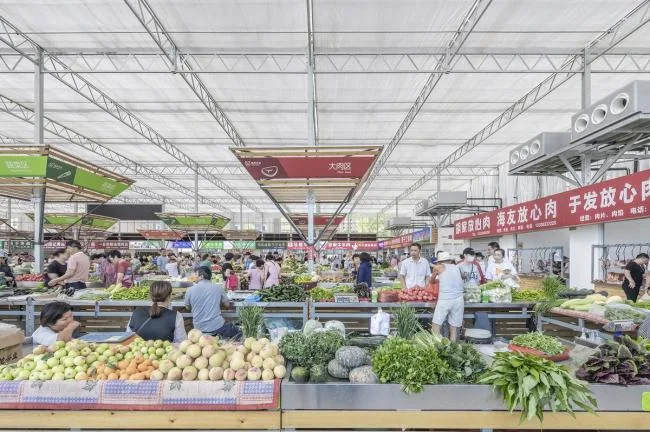
▲ Meat section
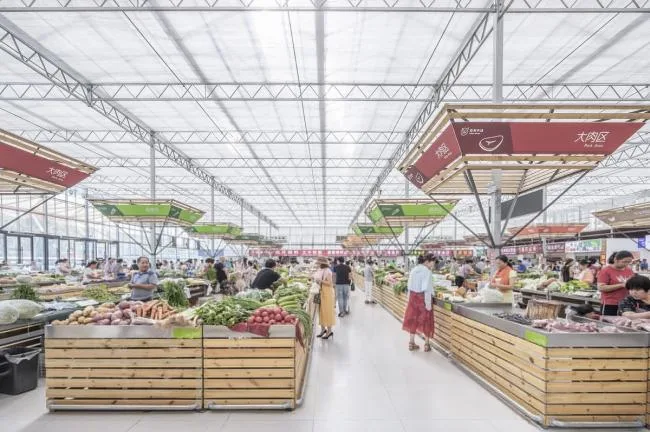
▲ Vegetable shelves (BIM)
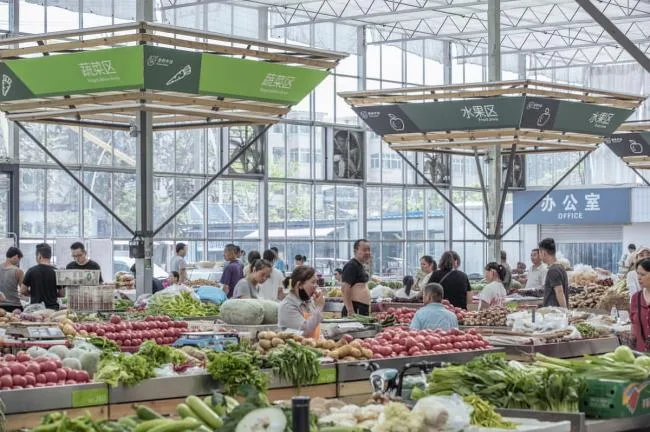
▲ Vegetable and fruit section
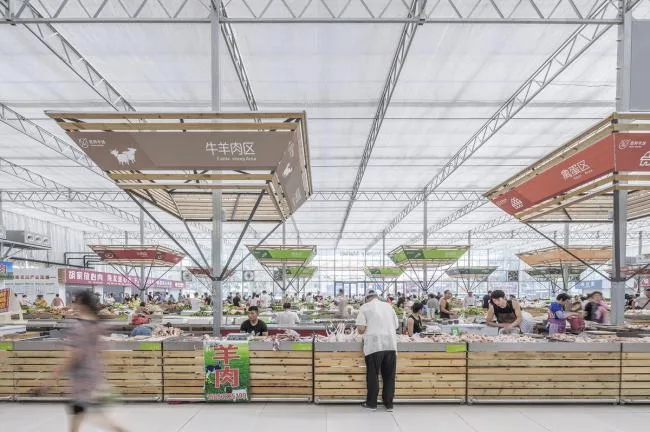
▲ Beef and lamb section
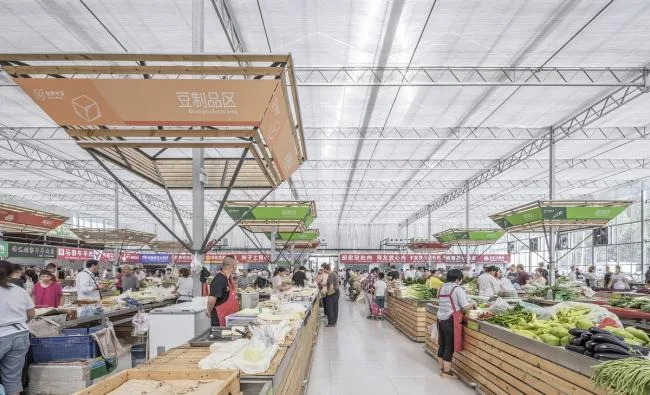
▲ Bean products area
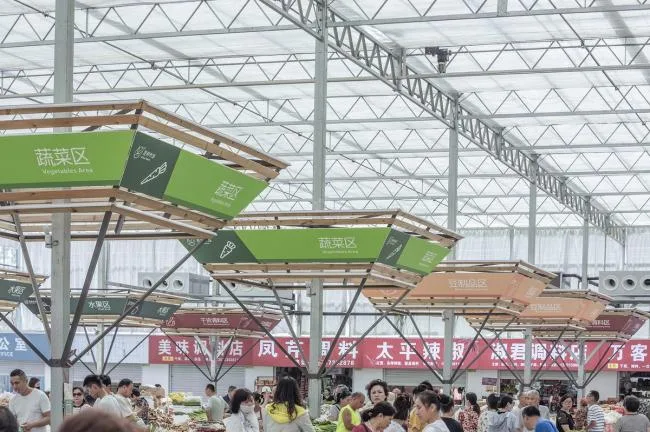
▲ Umbrella pole signage
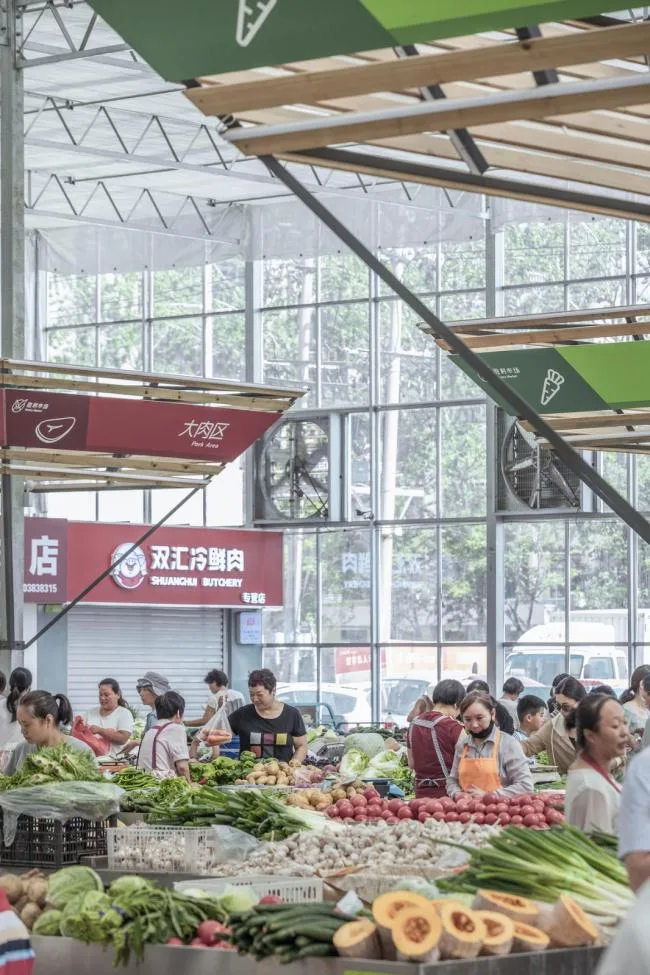
▲ Umbrella poles and shelves
The entrance canopy was designed based on the spacing between vertical modules and horizontal window sashes. It features a stable, material-efficient four-sided cone structure.
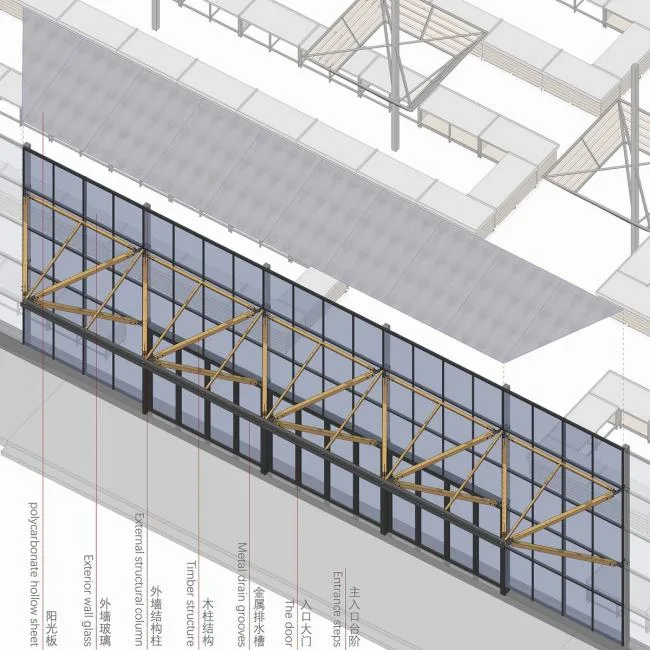
▲ Gate canopy
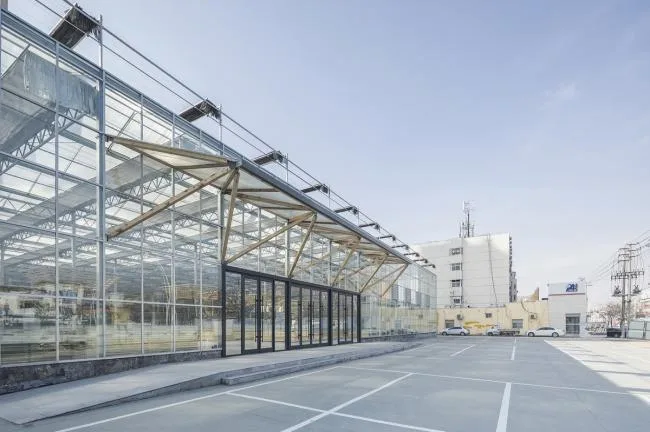
▲ Entrance area in the morning
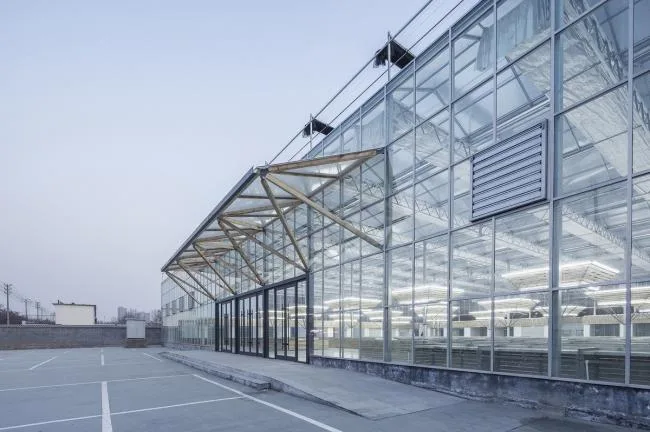
▲ Entrance canopy
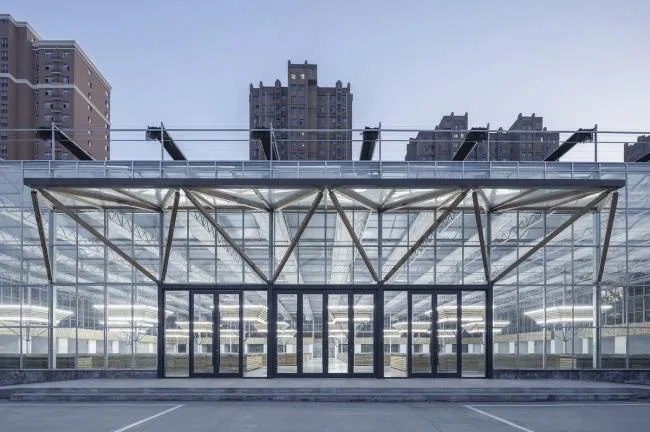
▲ Entrance facade
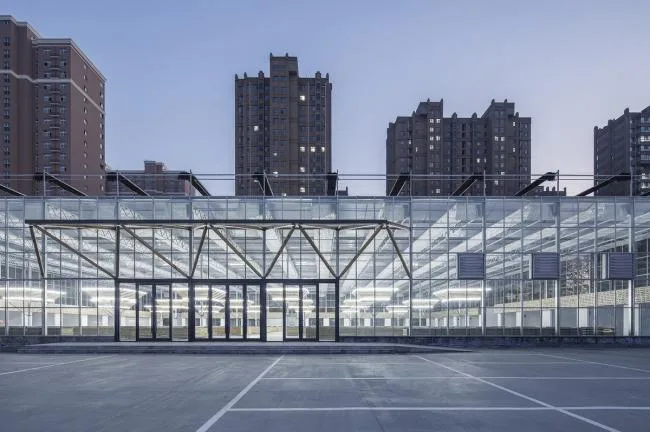
▲ Parking area viewed from indoors
Construction materials were carefully selected for affordability and availability, including ordinary wood, lightweight steel, cement boards, finished angle steel, and polycarbonate panels. These materials ease installation and construction. Natural, warm-toned wood is used on the bottom open shelves, the eaves of enclosed shops, and the structural columns and umbrella frames above, helping to organize the space, enhance signage, and bring order to the market.
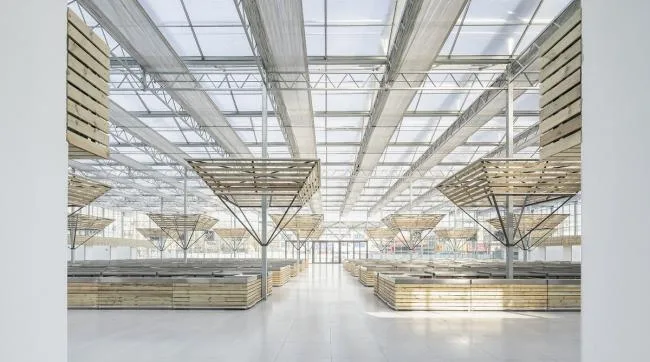
▲ Central aisle
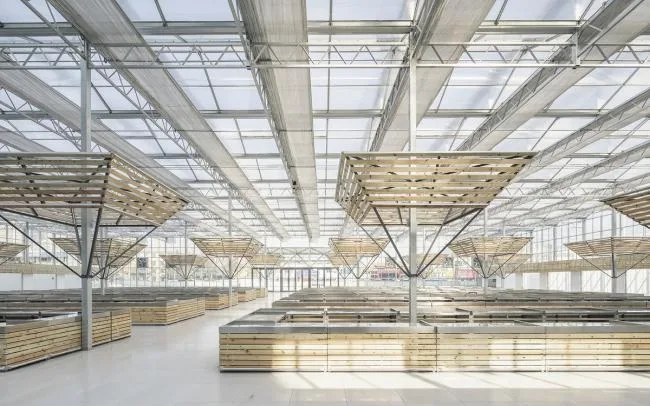
▲ Umbrella poles and shelves
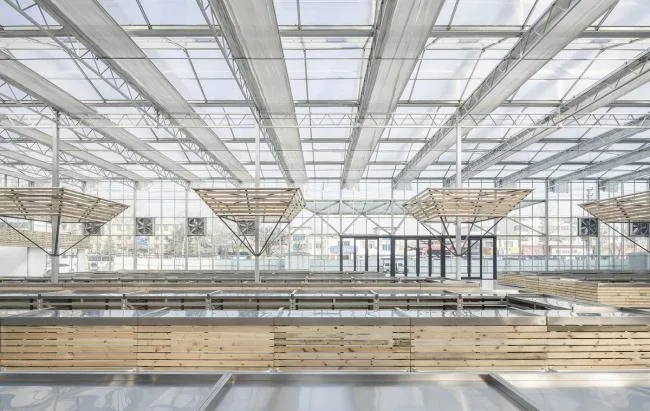
▲ Open shelving area
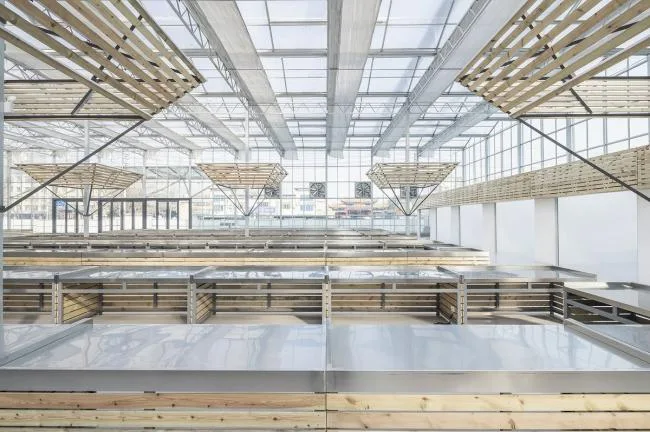
▲ East side interior
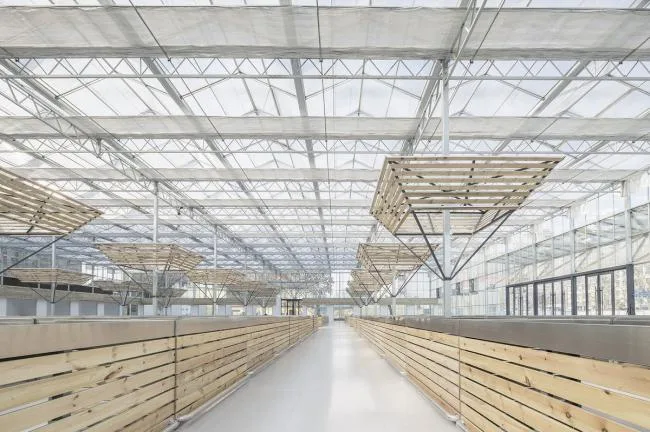
▲ View westward from the east
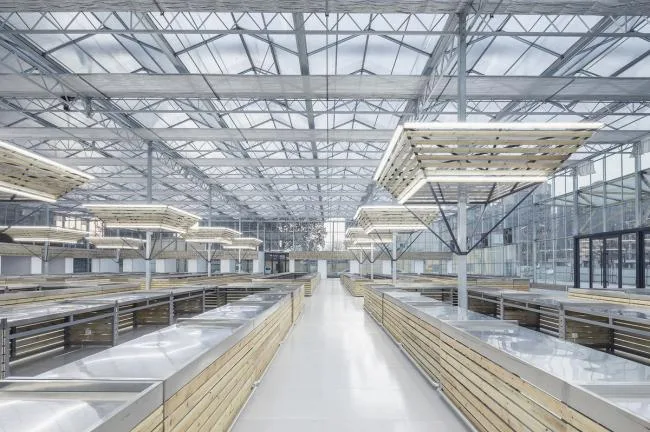
▲ Umbrella pole lighting
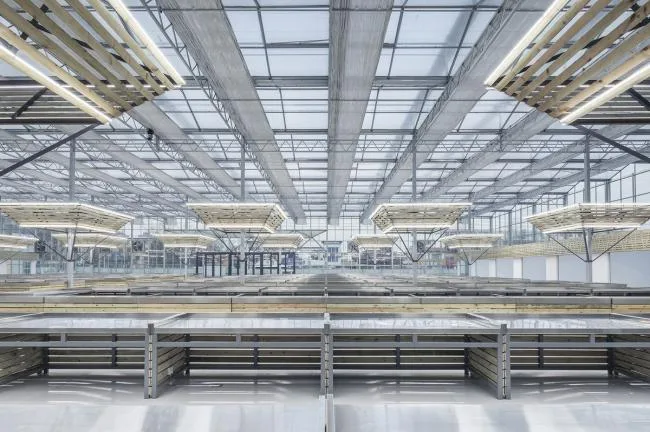
▲ Shelf lighting
Project Drawings
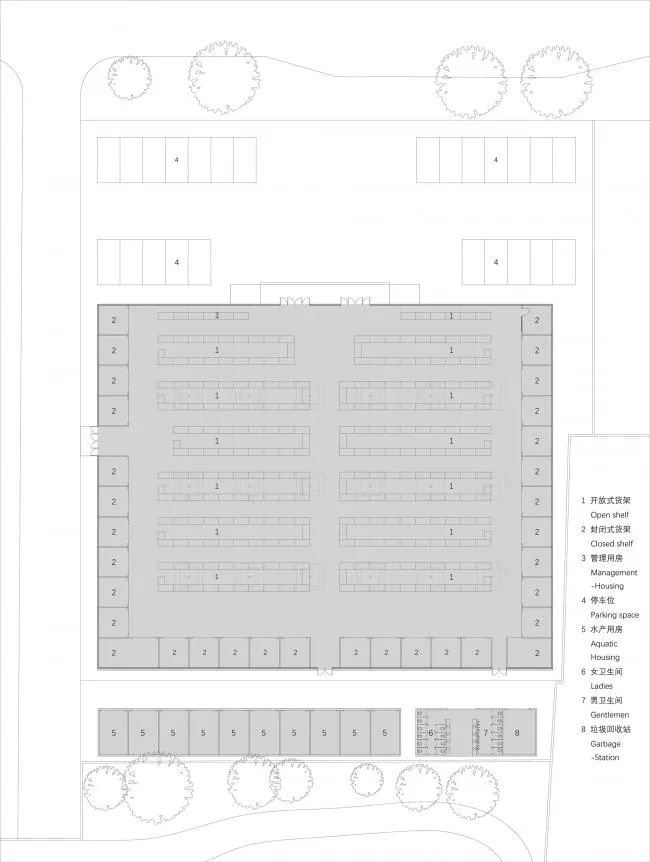
▲ First floor plan
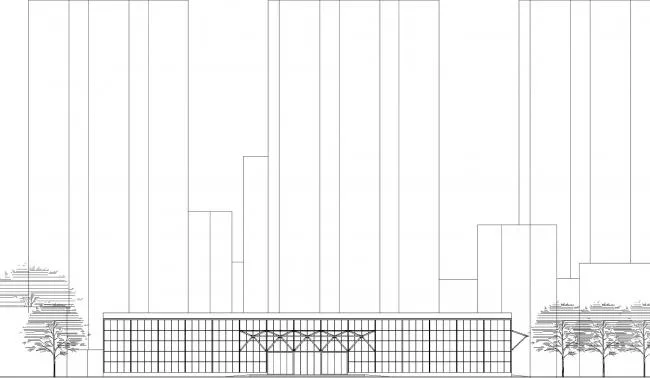
▲ Elevation view
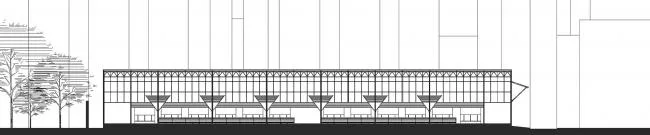
▲ Sectional view
Project Information
Designer: Luo Yujie Studio
Location: Shengli Road Office, Hualong District, Puyang City, Henan Province, China
Category: Market
Lead Architect: Luo Yujie
Co-designer: Wei Wenjing
Building Area: 2,902 square meters
Year: 2019
Photographers: Jin Weiqi, Luo Yujie
Design Collaboration: Shanghai Qiwu Architectural Design Consulting Co., Ltd
Owner: Shengli Road Office, Hualong District, Puyang City, Henan Province
Construction Contractor: Puyang Jingyi Architectural Decoration Design Engineering Co., Ltd












Must log in before commenting!
Sign Up