
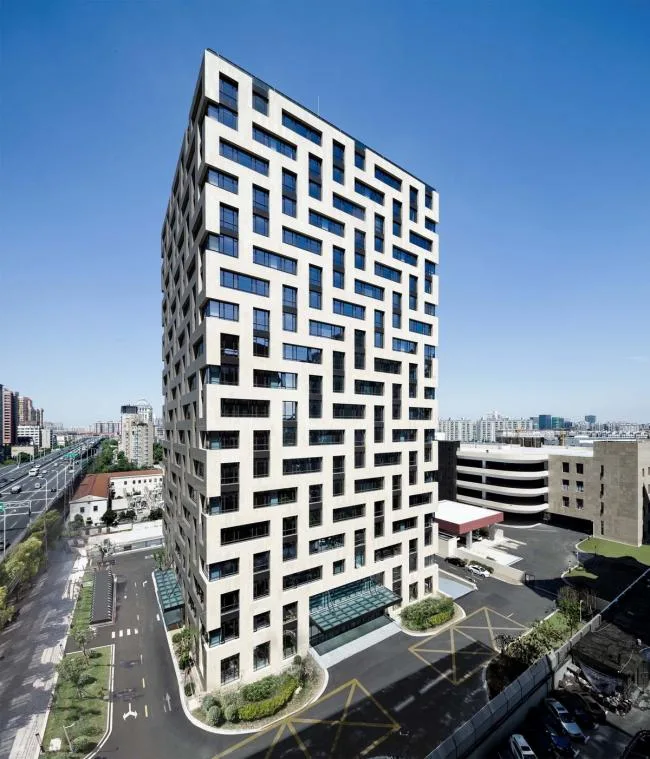
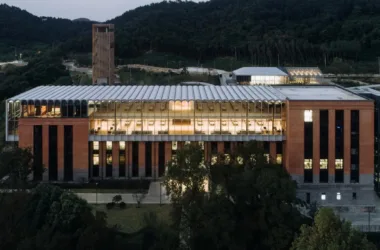
▲ Southwest Transportation Business Building
Overview
Located at the intersection of Yixian Road and Memorial Road in Shanghai’s Yangpu District, this site covers a construction area of 26,536 square meters. Originally an open-air bus parking and maintenance yard built in the early 1970s, it has been transformed into a comprehensive facility that includes a 352-bus parking and maintenance building, a diesel gas station, and a high-rise transportation business building. The total construction area now spans 91,967 square meters.
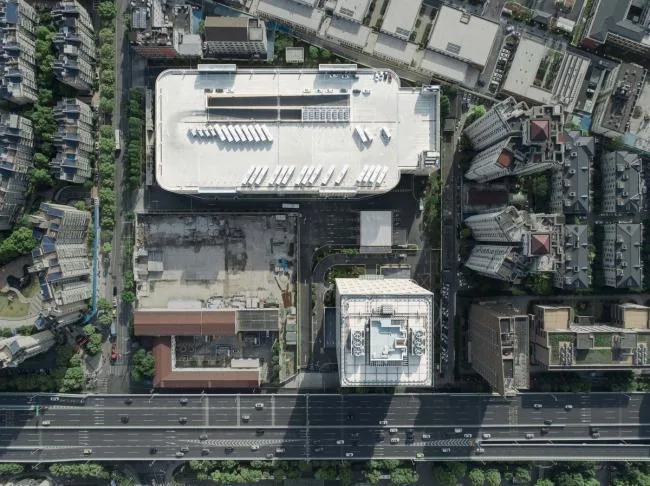
▲ Overall top-down view
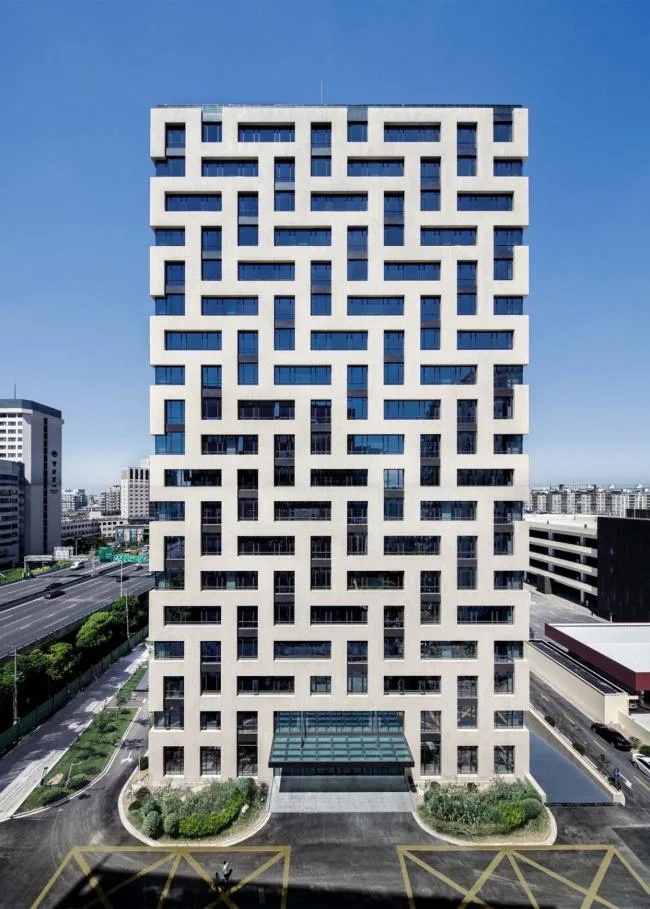
▲ South facade of the transportation business building
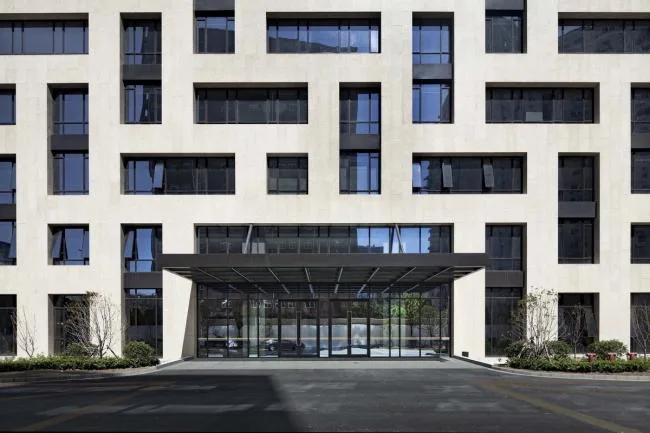
▲ Business poster entrance
Site Analysis
The site is surrounded by several sensitive structures, including two residential communities, a 220KV substation, a large building materials market with a low fire resistance rating, and urban elevated roads. The project itself includes sensitive elements such as a gas station, extensive parking and maintenance facilities, and dense bus charging stations. These factors posed significant design challenges that needed to be addressed carefully.
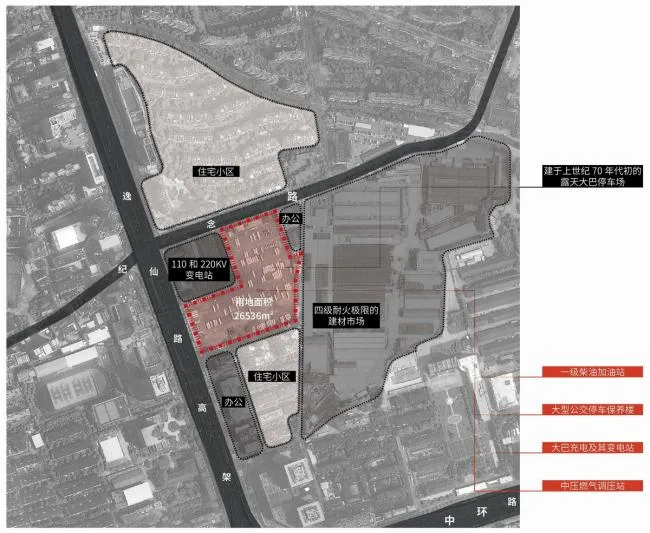
▲ Analysis of the current site conditions
Design Challenges
- Ensuring safety and health standards;
- Organizing efficient bus routing;
- Maximizing building utilization and parking efficiency within limited space;
- Meeting the owner’s requirement of “no new appearance at the start and no old appearance after many years”;
- Focusing on green ecology and energy conservation.
Overall Layout
The 352-bus parking garage is designed as a rectangular structure with a length-to-width ratio of approximately 2:1 and a height nearing 24 meters. To minimize sunlight impact on the northern residential community, the multi-level parking garage is positioned vertically along the east side of the site. The high-rise transportation business building is placed on the east side of the Yixian Road viaduct, with a two-story substation to its north, enhancing the public transportation company’s visibility.
In compliance with fire safety regulations, the gas station is located centrally within the site, away from residential areas, substations, and elevated roads to minimize safety risks.
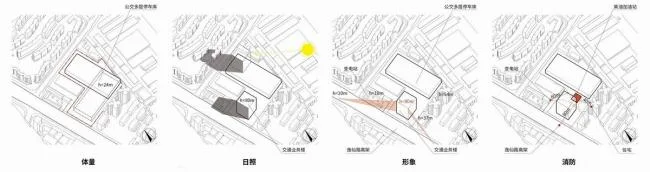
▲ Overall layout analysis
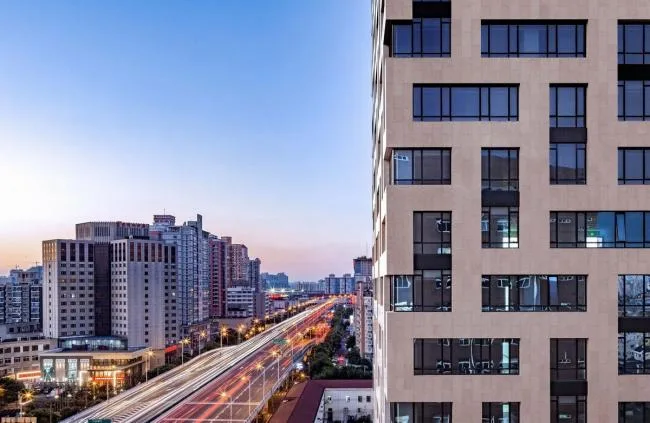
(BIM Tutorial) ▲ Business building and Yixian Road Elevated
Bus Traffic Flow
Buses enter the facility from Memorial Road and Yixian Road, proceeding through a 100-meter storage lane to refuel at the gas station. After refueling, buses turn left and head east to an intersection where they stop briefly before turning left into the multi-level parking garage for parking or maintenance. Departing buses exit northwards from the parking garage and leave the site via the bus exit on Memorial Road.
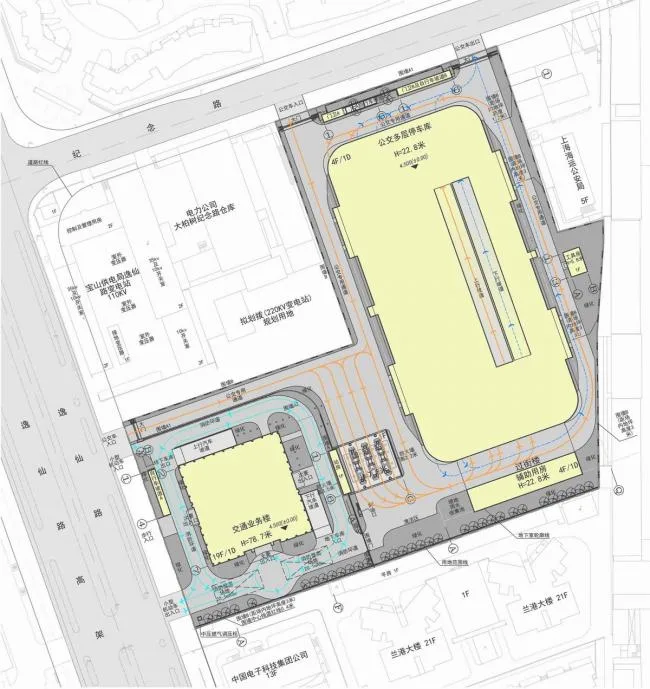
▲ General layout and traffic flow analysis
Multi-Story Bus Parking Garage
Due to the need for safe distances between buildings and the large dimensions of bus turning radii, the available land is quite constrained. Traditional parking buildings with ramps and inner courtyards were not feasible. Instead, a novel design integrating built-in ramps and firewalls was implemented, which minimizes the footprint while maintaining parking capacity.
Noise reduction is addressed by using rubber ramp plates that significantly reduce the sound generated by buses moving uphill and downhill inside the parking structure.
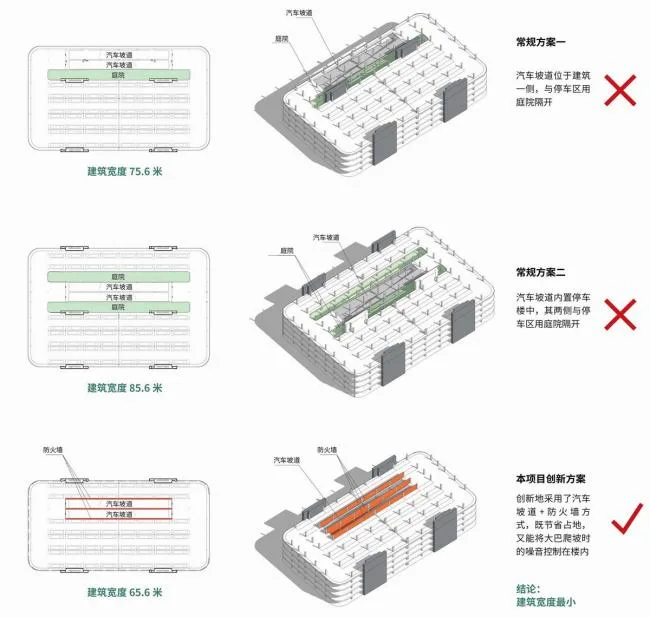
▲ The multi-level bus parking garage features built-in ramps and firewalls
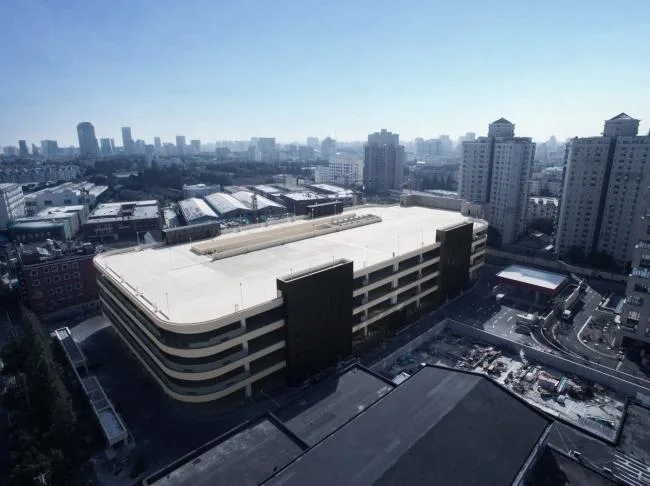
▲ Multi-story bus parking garage exterior
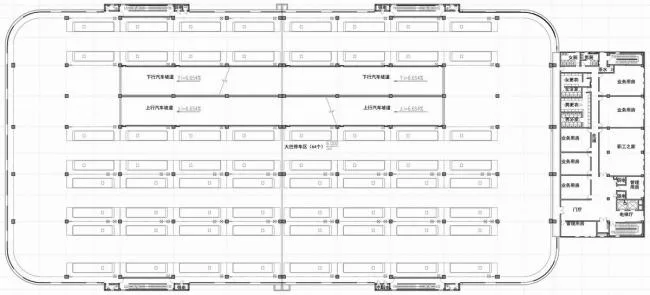
▲ Standard floor plan of the multi-level bus parking garage
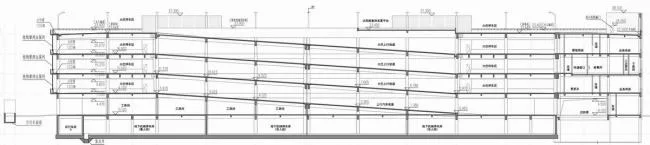
▲ Section view of the multi-story bus parking garage
Transportation Business Building
The building’s standard floor covers 1,800 square meters with a total above-ground area of 35,000 square meters. It features six passenger elevators and two combined fire and passenger elevators. The shared lobby connects directly to the elevator hall, with eight elevators reducing wait times during peak hours and enhancing space efficiency.
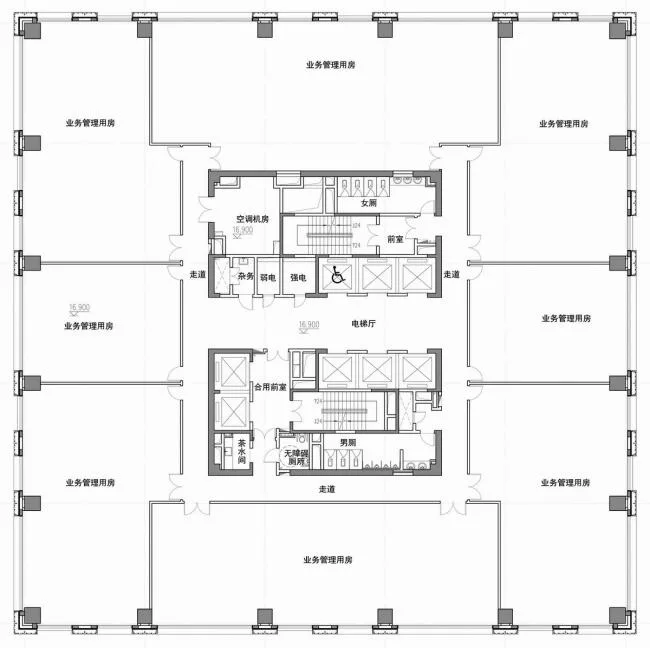
▲ Standard floor plan of the transportation business building
The building profile features a standard floor height of 4.05 meters after integrating pipelines. Deducting the overhead network floor structure’s 100mm drop, the net indoor ceiling height measures at least 2.85 meters. This design meets the 80-meter height limit and adds an extra floor compared to conventional layouts, improving land use efficiency.
Facade Design
The facade concept is inspired by three elements: the diagonal parking pattern that facilitates bus entry and exit; the interwoven tread patterns of bus tires; and the orderly urban grid road network. The building’s facade coordinates with the rugged aesthetics of the bus stop and gas station.
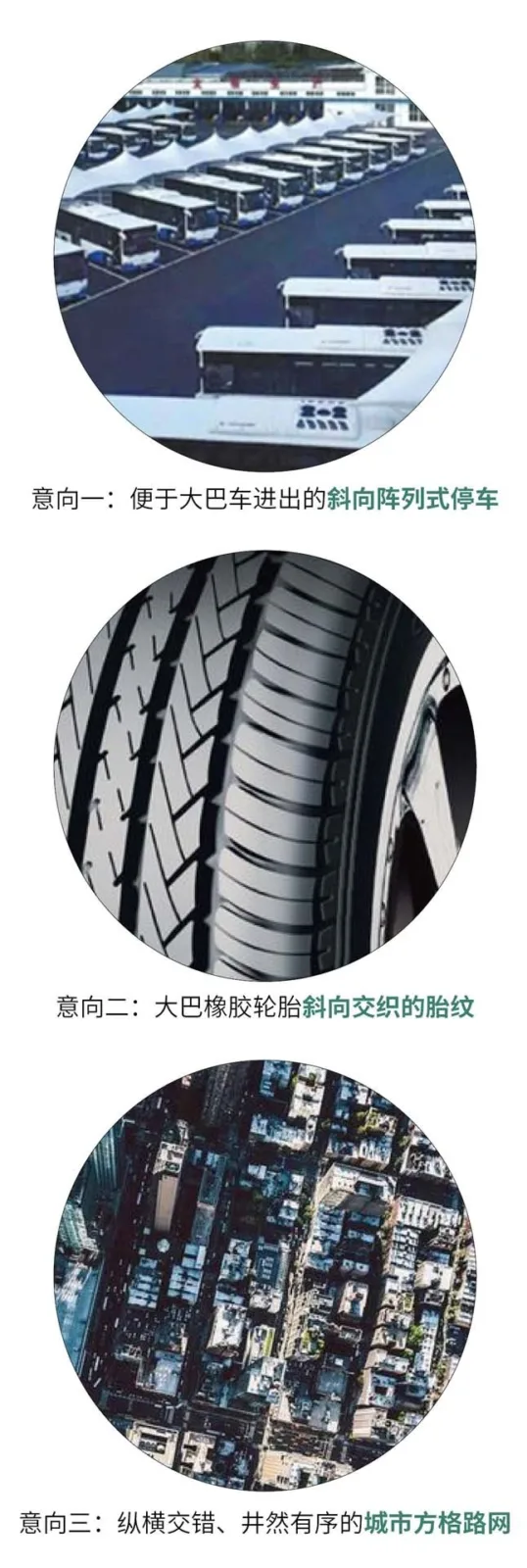
▲ Design intentions for the three facades of the transportation business building
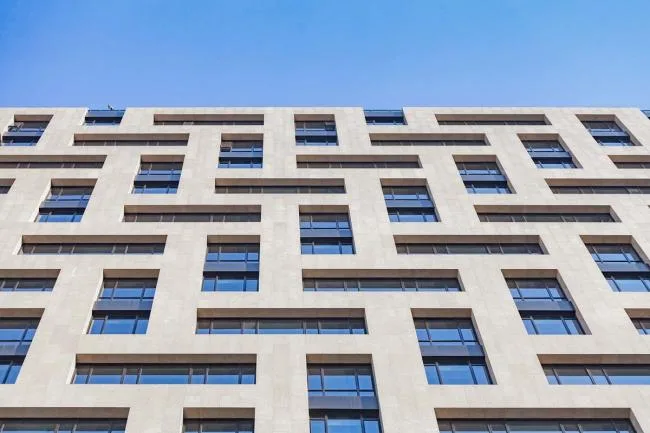
▲ Looking up at the vertical grid of the business building
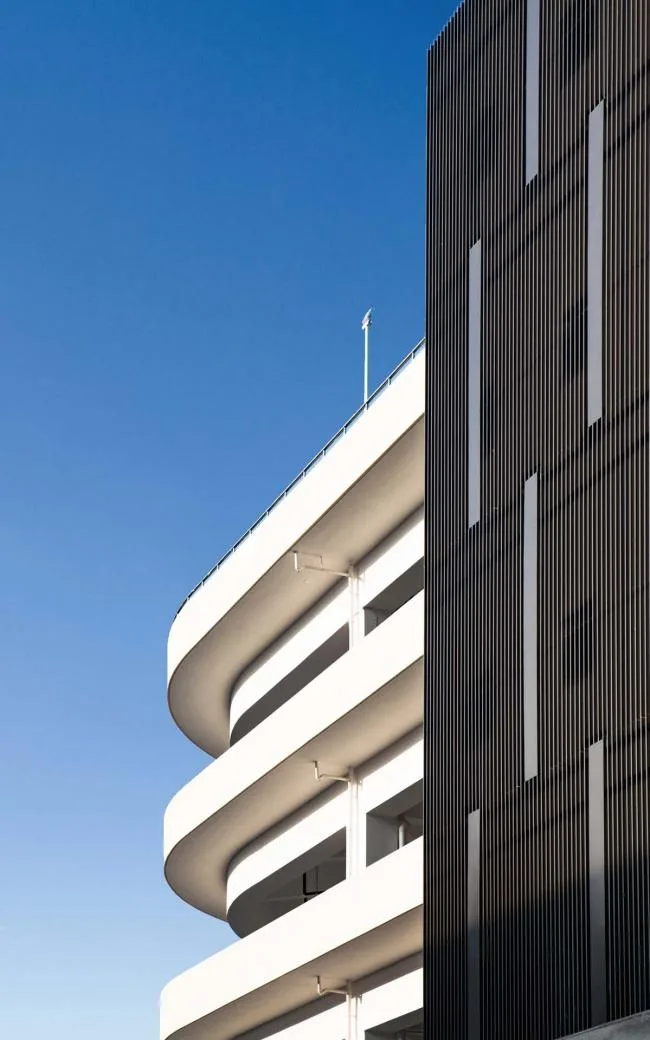
▲ Partial view of the rugged garage facade
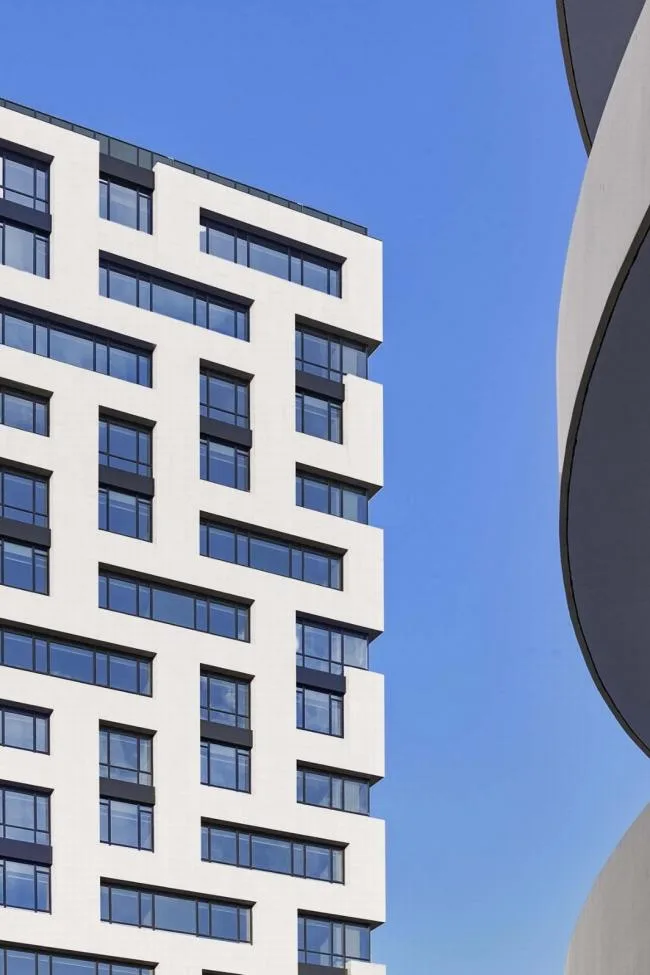
▲ The business building’s square grid aligns with the garage’s curved form
Exterior Wall
Due to the proximity of sensitive buildings, glass curtain walls were deemed unsuitable. Instead, the facade employs a combination of windows and a dry-hanging stone curtain wall system. Controlling the window-to-wall ratio between 0.4 and 0.5 ensures ample natural light, ventilation, and visibility, while maximizing energy efficiency.
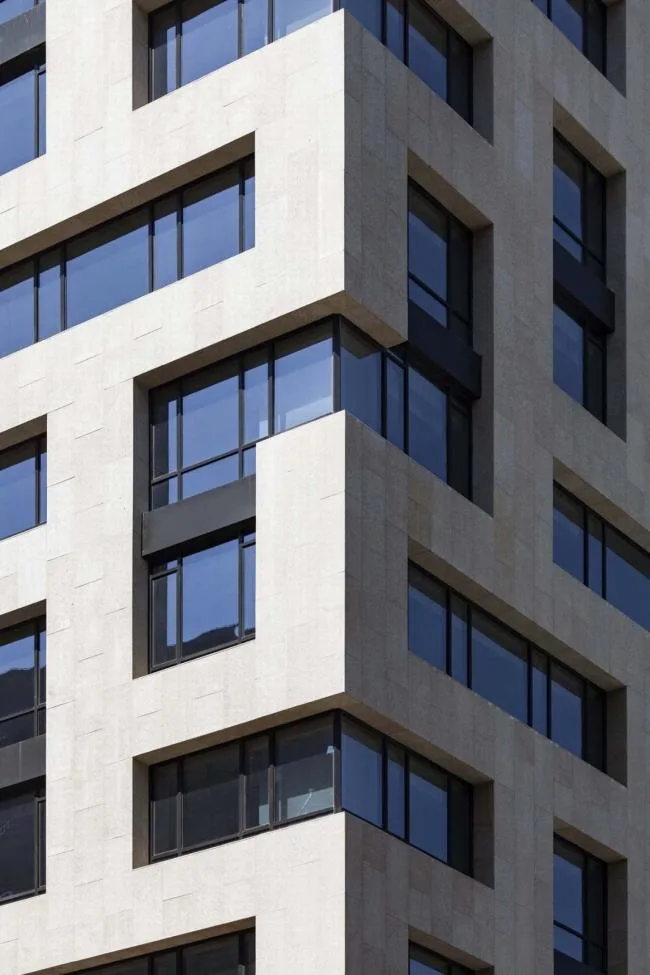
▲ Corner detail of the business building facade grid
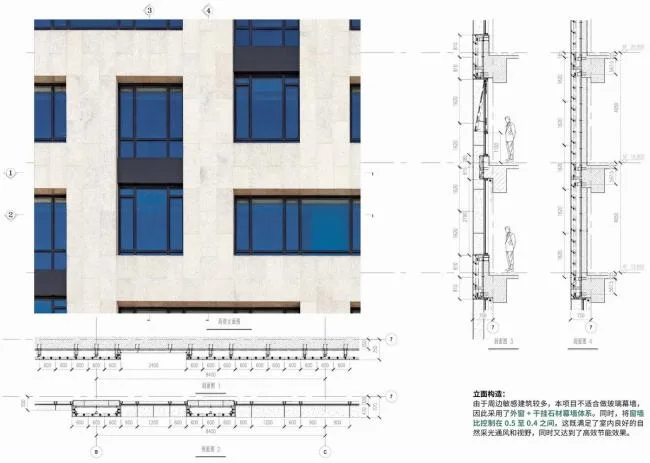
▲ Exterior wall detail drawing
Material
The exterior walls are clad with 600 x 1620 x 30 mm dry-hanging polished granite panels in beige, speckled uniformly with dark spots. From a distance, the texture resembles lychee stone. This material is dirt-resistant, easy to clean, and gives the building a simple, dignified, and modern appearance, reflecting the public transportation company’s orderly and pragmatic image within the complex urban environment.
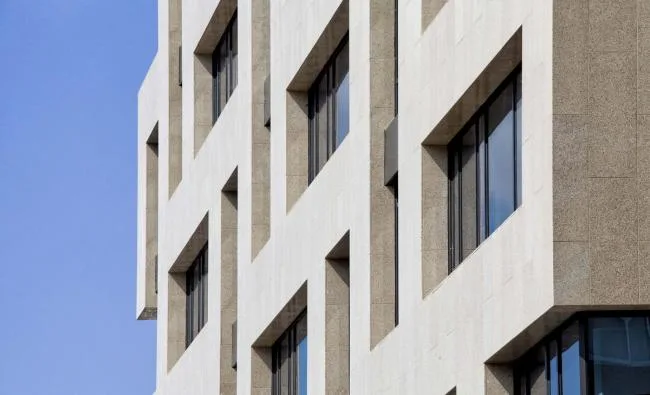
▲ Texture of the business building facade material
Focus on Green Ecology and Energy Conservation
Taking into account Shanghai’s climate and project characteristics, several green and energy-saving design features were implemented:
- Use of a steel-structured prefabricated foundation pit support system to minimize impacts on nearby residents;
- Incorporation of built-in bus ramps with noise-reducing rubber plates to lower sound levels from bus movements;
- Installation of a 20 mm thick ultra-thin insulated vacuum board on the roof, designed to support heavy-duty buses;
- Flower troughs with drought-resistant plants adorn the exterior walls of the bus parking garage, enhancing the microenvironment and facade aesthetics;
- Light conduits installed on the top plates of basement entrances and exits to reduce glare;
- Adoption of energy tower technology to improve energy efficiency compared to traditional cooling tower systems;
- Additional measures include rainwater harvesting and solar hot water systems.
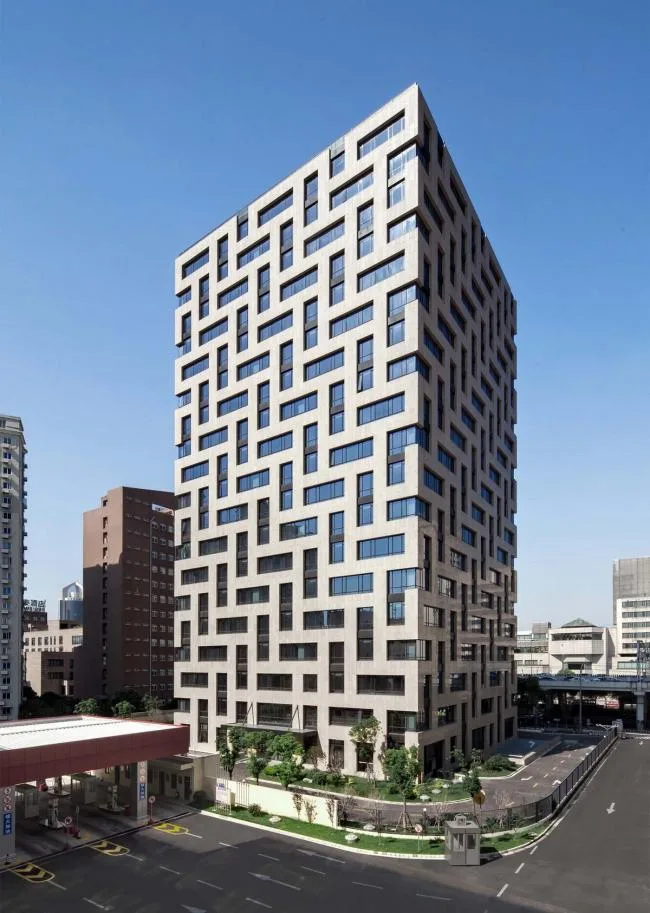
▲ Northeast Transportation Business Building
Conclusion
This project earned the Green Building Two-Star Design Label from the Ministry of Housing and Urban-Rural Development in 2015. In 2017, it received the “Magnolia Award (Observation Level Project)” for high-quality engineering in Shanghai and the “Golden Stone Award” for curtain walls in the Yangtze River Delta. It was also honored with the National Quality Engineering Award in 2018.
The development enhances public transportation services in northeast Shanghai, establishes a modern corporate image for the public transit company, and embodies a commitment to serving the community.
Project Information:
Architect: Tongji University BIM Design Institute
Location: Shanghai, China
Project Type: Renovation
Project Manager: Wang Wensheng
Chief Architect & Project Manager: Shi Wei
Building Area: 91,967 m²
Year: 2016
Photographer: Ma Yuan
Structure Engineers: Geng Yaoming, Zhang Siqi, Zou Cheng
Water Supply & Drainage: Feng Wei, Li Wei, Shen Jiayu
HVAC: Xu Huan, Yang Muhe
Electrical: Wang Jian, Liao Shulong, Xu Erfeng
Client: Shanghai Jiaotou Station Enterprise Management Co., Ltd.












Must log in before commenting!
Sign Up