
BIM Technology and Sports Architecture Design
1.1 Parameterized Design — The Foundation of BIM in Sports Architecture
Before BIM became widely recognized, parameterization served as a key technique to enhance design efficiency, manage complex irregular structures, and enable modular segmentation of surfaces. In sports venues, parametric tools primarily drive the exterior and facade design. By creating a building information model, designers can virtually analyze structural integrity and optimize the form, as well as determine the quantity and dimensions of exterior materials. Parameterization has revolutionized traditional sports architecture design by improving accuracy and significantly reducing the design timeline.
1.2 BIM and Intelligent Sports Architecture
The advancement of sports architecture towards intelligent buildings depends heavily on BIM technology. “Intelligent” here refers to the ability to analyze, judge, and act purposefully on objective factors while effectively addressing environmental challenges. Intelligent analysis during early design stages helps develop building forms and spatial configurations that comply with sports architecture standards through parameter model assessment. During operation, intelligence enables objective evaluation of the building’s lifecycle. BIM introduces a new design paradigm, shifting from traditional sensory-based data analysis to a rational, comprehensive method for analyzing sports buildings.
2 Case Studies
2.1 Avia Sports Venue Design — Parameterized Design in BIM
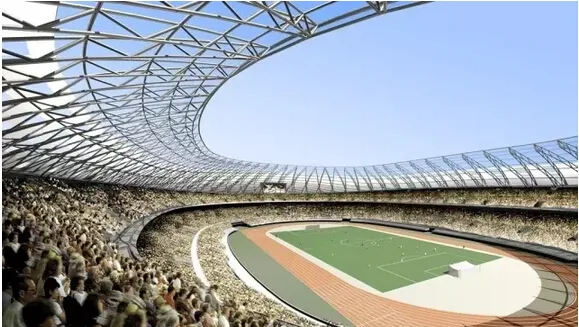
Completed in 2010 and seating 50,000 spectators, the Avia Sports Stadium was designed by Populous (formerly HOKSport) and stands as the first stadium entirely created through parametric design. The goal was to establish a local landmark that harmonizes with its environment. The design features freeform curves developed using Bentley’s Generative Components (GC) software, comparing multiple schemes to minimize environmental impact. Transparent materials for the facade maximize sunlight exposure, helping the building blend naturally with its surroundings.
The design integrates the roof structure and facade into a unified form enveloping the main structure, breaking away from traditional approaches that treat them separately. The process began with a 3D model in Rhino to quickly establish and optimize the building’s planar form. This model was then imported into GC via a generated script, producing a highly modifiable design that structural engineers could refine. Structural data was seamlessly integrated into the model, allowing architects to focus on the skin and form, while engineers adjusted structural components.
All parameter adjustments and model information were managed through an Excel spreadsheet, enabling real-time updates. Collaboration extended to curtain wall consultants, who used SolidWorks to develop detailed curtain wall node models based on the structural centerline, optimizing panel design. Parametric analysis revealed that a 3mm polycarbonate sheet could replace the initially specified 8mm sheet, reducing roof material weight from 200 tons to 80 tons and cutting material costs by approximately 40%. This approach saved about $3.5 million in labor and materials.
Additionally, BIM models facilitated energy analysis to enhance sustainability goals. For internationally staffed projects, parameterized models improve cross-company collaboration, accelerating design and coordination. The architect led the process, and the finalized BIM contained comprehensive building data, allowing facade panel adjustments during construction, significantly lowering onsite labor and material costs.
2.2 Hangzhou Olympic Sports Center Main Stadium — BIM from Concept to Construction

Located at the confluence of the Qiantang and Qijia Rivers, the Hangzhou Olympic Sports Center’s main stadium covers 229,000 square meters and seats 80,000. Its exterior is based on standardized modular steel grids, requiring parametric techniques to manage complex geometric shapes collaboratively.
During conceptual design, parameterized modeling was essential to define spatial relationships of the facade and assess structural rationality. BIM platforms then facilitated efficient communication and collaboration throughout detailed design stages, helping realize complex forms economically.
Early design utilized Rhinoceros 3D and Grasshopper. After form generation in Rhino, models were analyzed with Kangaroo structural analysis software for optimization. The finalized 3D model was transferred to Revit for 2D drawing production.
Due to the curved surfaces, traditional curtain wall quantity and sizing calculations were difficult; parametric tools enabled precise counting and detailed panel information, including curvature and dimensions.
In construction documentation, the Rhino model was imported into Revit, where detailed BIMs including structural grids, mechanical systems, and building functions were established. Sports venues demand rigorous fire safety, evacuation, acoustics, and temperature control, analyzed through IES software for energy efficiency.
BIM technology also transformed coordination by simulating construction sequences, enabling 4D visual briefings that replaced traditional 2D flat plans and manual reviews, reducing errors and improving team communication.
2.3 Singapore Sports Centre — BIM-Standard Sports Venue
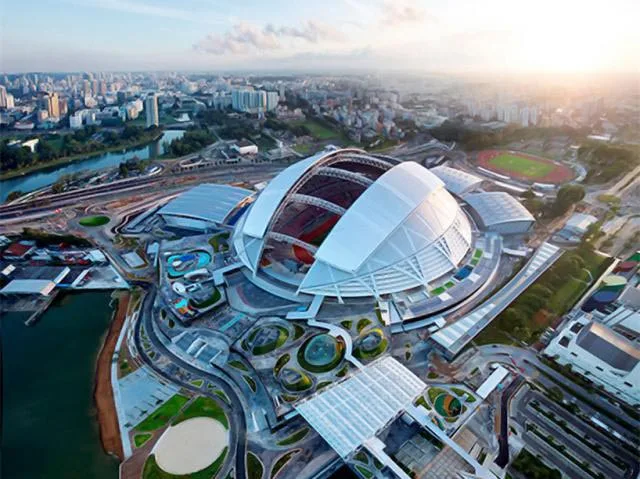
The Singapore Sports Centre, completed in 2014, is a green, energy-efficient venue designed for tropical climates. As an international competition and entertainment center with a 55,000-seat capacity, it operates year-round. The complex integrates multiple sports facilities on a unified platform, including a stadium, multipurpose center, indoor pool, and water park.
Featuring the world’s largest arched roof span, steel savings were a key design objective. Singapore’s BIM standards governed the entire process from design through construction.
Coordinating multiple buildings required a robust construction management system. The most challenging element was the complex retractable roof, which involved intricate lighting and movement considerations. BIM provided construction models, professional coordination, automated precise profile generation, clash detection, and virtual walkthroughs.
BIM also enabled rapid access to performance data, thermal efficiency, and lifecycle analysis. The project utilized a Public-Private Partnership (PPP) delivery model, where private partners handled design and construction under fixed prices aligned with public specifications. Arup led architectural design, employing Dassault Systemes’ CATIA, Gerry Technologies’ Digital Project, and Microsoft Office 2007.
CATIA’s 3D models integrated Excel 2007 to manage data, allowing quick incorporation of structural feedback and rapid model updates across disciplines. Large firms like Arup benefit from building design databases, reusing data to accelerate similar projects and improve accuracy.
Early involvement of curtain wall contractors through BIM enhanced design precision and reduced labor and time during construction by facilitating earlier curtain wall integration into the building design.
3 Case Summary
These three sports architecture projects illustrate that venues must meet predefined size and visibility requirements. Early design stages establish a foundational model incorporating cultural and environmental context, generating conceptual forms based on rational analysis, not mere aesthetics.
For Chinese architects, BIM improves design accuracy, reduces interdisciplinary coordination time, and minimizes human error. Structural engineers leverage BIM’s rich data to innovate forms and precisely estimate steel quantities. Equipment engineers benefit from 3D pipeline coordination to identify and resolve conflicts early, avoiding waste.
Common clash detection tools include Autodesk Navisworks, Bentley ProjectWise, Navigator, and Solibri Model Checker. Beyond 2D drawings, all team members use 3D models to better understand project details and collaborate efficiently, reducing wasted time and costs.
BIM also enhances design review accuracy. Given the complexity of sports building documentation, even experienced reviewers may overlook issues. BIM-based clash detection facilitates thorough problem identification.
4 Conclusion
Future sports buildings will be smarter and more controllable. Architects must consider form, function, construction, operation, and lifecycle design. BIM expands architects’ roles in overall coordination and enables innovative structural and formal designs. By simulating projects virtually, BIM predicts challenges related to airflow, lighting, wind, and solar exposure before construction.
BIM not only offers architects new tools but also introduces innovative design methodologies. As globalization accelerates, BIM is increasingly suited for large-scale, integrated sports projects spanning regions and countries, leveraging global resources for superior design outcomes.
















Must log in before commenting!
Sign Up