
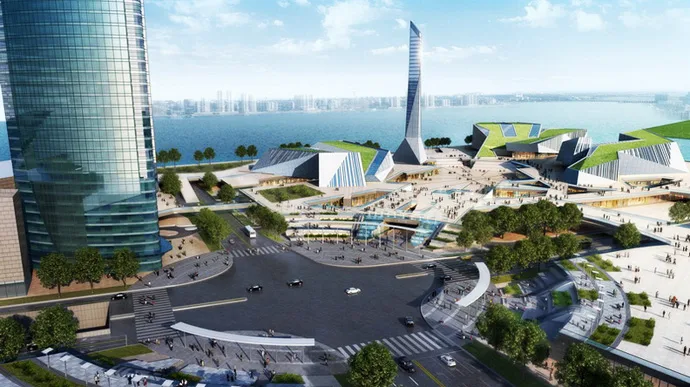
The “Three Pavilions and One Hall” in Changsha is set to open some of its venues to the public starting from the National Day holiday.
According to a representative from the Changsha Municipal Engineering Bureau, the project has incorporated multiple internationally advanced technologies and is preparing to apply for the China Construction Engineering Luban Award. This complex stands as a landmark cultural architectural ensemble in Hunan Province, designed with exceptional innovation and integrating cutting-edge construction technologies.
What makes this large-scale complex so remarkable despite the time and cost involved? What technical innovations does it hold? On September 14th, a reporter from Sanxiang Metropolis Daily provided an exclusive insight into the project’s secrets.
Technological Innovations
Advanced Structural Techniques
The complex features ultra-large span steel structures without internal partition walls. Viewed from above, each pavilion and hall forms a three-dimensional polygon, showcasing creative architectural design. Overcoming numerous construction challenges, the project employs two of the most advanced industry technologies: the ultra-large span steel frame structure and the prefabricated clear water concrete hanging board system for the exterior walls.
Each building lacks internal load-bearing walls, relying entirely on steel frame structures designed according to mechanical principles. For example, the music hall contains almost no traditional vertical walls, resulting in highly variable internal spaces. This requires structural designs that exceed typical standards for load factors, seismic resistance, stress performance, and overall safety, necessitating specialized testing and research.
This innovative ultra-large span steel frame system was developed through theoretical analysis, model experiments, and rigorous validation, marking it as a pioneering technology within China.
Following the steel framework installation, the exterior walls are constructed using prefabricated plain concrete hanging boards. These boards are custom-made with irregular shapes and sizes, requiring complex manufacturing and precise installation. The exterior design reflects various cultural elements, while internally meeting stringent requirements for insulation, waterproofing, soundproofing, and fire safety. This application is unprecedented in China.
Innovative Flooring Inspired by the Sydney Opera House
At the central square, the most striking feature is the expansive floor tiling. Although these tiles may seem ordinary, they represent a domestic first in craftsmanship, comparable globally only to the outdoor paving of the Sydney Opera House.
The flooring consists of wear-resistant, high-precision artistic concrete prefabricated PC tiles. By mixing different colors, textures, and irregular patterns, the design imitates natural materials such as marble, granite, brick, tile, and wood. The result is a visually stunning surface with vivid, durable colors and a robust texture.
The sunken central square covers 10,900 square meters and serves as a major gathering and dispersal area. The use of this durable flooring both enhances aesthetics and ensures long-lasting wear resistance.
High-Performance Glass Curtain Walls
The complex’s large exterior wall areas, including the landscape tower, feature advanced composite vacuum glass developed by Beijing Xinliji Company. This glass has a heat transfer coefficient only one-third that of traditional insulated glass, contributing to green, energy-saving building standards.
The glass consists of three or four layers with all air removed during manufacturing. Without air as a heat conduction medium, the glass significantly reduces heat transfer. Additionally, the coated vacuum glass offers superior sound insulation compared to traditional hollow glass. This marks the first large-scale public construction use of such glass in the province.
Innovative Urban Design and Land Use
Located at the Xinhe Delta, where the Liuyang and Xiangjiang Rivers meet, the project covers 186 acres with approximately 150,000 square meters of constructed area. It adopts a comprehensive “separation of pedestrians and vehicles” and “three-dimensional development” approach. The roadway is set at an elevation of 33 meters, while pedestrian walkways are at 38.85 meters, effectively separating traffic flows without interference.
This efficient land use model has been recognized as a national demonstration pilot for intensive and economical land development. It has also been included in the Ministry of Land and Resources’ “Eleventh Five Year Plan” for National Science and Technology Innovation projects.
State-of-the-Art Intelligent Control System
The complex integrates diverse functions including book reading, cultural relics display, planning exhibitions, and music performances. Its intelligent control system comprises 26 subsystems, allowing each hall to operate independently or in a coordinated manner. The weak current engineering system is highly integrated and complex, making it one of the most sophisticated intelligent control systems in China, with extremely high design standards.
Functional Highlights
Architectural Expression
The design concept of the “Three Pavilions and One Hall” symbolizes a pile of sand and gravel accumulated by a river, blending harmoniously with the natural environment through the use of “Stubborn Stone” forms inspired by the Shazhou pattern.
Concert Hall
The 1,446-seat concert hall features a terraced valley design with scattered pavilions around the stage. Unlike typical theaters, it requires no amplification equipment, offering equal acoustic quality from every seat. Once completed, it will rank among the top music halls in central and southern China.
The exterior wall pattern is inspired by “Xiao Xiang Shui Yun,” a famous song composed by Guo Mian, a Southern Song dynasty guqin performer and educator during his exile in Hengyang. The pattern combines traditional Chinese reduced character musical notation with transformed Western symbols, reflecting rich cultural significance.
Museum
The museum building includes exhibition halls and a planning hall located on a 33-meter elevated level in a shared atrium. Around the planning hall are auxiliary spaces equipped with advanced sound, light, and multimedia technology to support interactive exhibitions showcasing Changsha’s urban planning.
The museum houses five exhibition halls across two floors, displaying cultural relics, calligraphy, and paintings native to Changsha.
The exterior wall design is based on a 20th-century map of Changsha when it was first established as a port. The map, styled in Old Song fashion, highlights 18 famous local landmarks such as Baishajing, Pozi Street, Tianxin Pavilion, Dingwangtai, Qingshuitang, Yuelu Academy, Hongpailou, and Orange Island.
Library
Facing the Xiang River, the library is a poetic and inviting space that houses approximately 1.4 million books and can accommodate 2,000 visitors simultaneously. It features various reading rooms, a multimedia audiovisual center, and a large animation hall, all equipped with advanced facilities.
Landscape Tower
Standing 118 meters tall, the landscape tower is a prominent landmark and a key feature of the riverside area. Visitors can enjoy panoramic views of northern Changsha from the tower.
The design reflects local cultural characteristics and the site’s context, with the concept of “Breaking through the Pillars of the Sky.” The tower’s wall excavation incorporates elements from the Eight Scenic Spots of Xiaoxiang, symbolizing Changsha’s rapid development.
Project Background
The project has spanned eight years with a total investment of approximately 1.376 billion yuan. Originally starting as the Changsha Planning Exhibition Hall, it has since expanded and upgraded to become the “Three Pavilions and One Hall,” highly appreciated by the citizens of Changsha.












Must log in before commenting!
Sign Up