
Project Origin
Yuleshanfang is a longstanding farmhouse operated by a farmer couple on their own land at the source of Taihu Lake in Lin’an, Hangzhou. Over the past decade, the establishment has built an excellent reputation. However, with a meal and accommodation rate of 200 yuan, maintaining the business became increasingly difficult. The couple struggled with the drastic fluctuation in guest numbers between peak and off-peak seasons, and the low quality of clientele left them exhausted. To address these challenges, they decided to renovate the mountain house, enhancing profitability and creating a superior vacation experience. Their goal was to transition the farmhouse into a high-end homestay.
Jiushe Construction Studio was invited by the owners to lead the architectural and interior renovation of the mountain house.
Original Condition of the Site
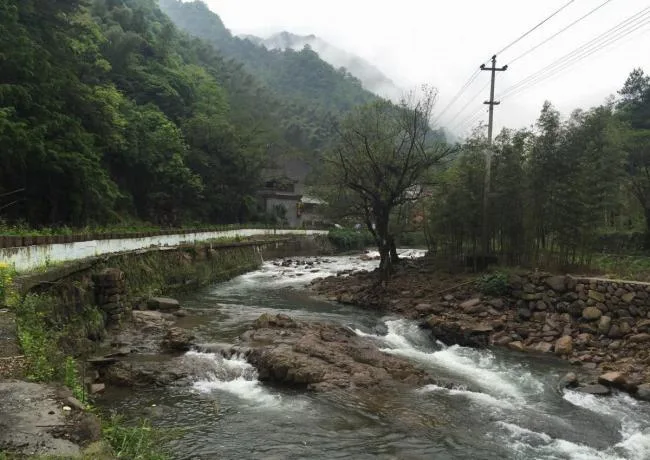
▲ The forest and fast-flowing stream adjacent to the site © Jiushe Construction Studio
Unlike new construction, renovation projects often face more complex challenges.
Baisha Village, where the mountain house is located, sits beside the source stream of Taihu Lake, surrounded by the Tianmu Mountains. It connects to the outside world only via a provincial road, creating a secluded environment reminiscent of a utopian garden. The village, with many scenic spots and an early-developed tourism industry, is dotted with farmhouses of various sizes and shapes.
The main building stands in the southern portion of the site, oriented south-north, backed by mountains and forests. It is a four-and-a-half story, five-bay structure. Around the year 2000, the building adopted the so-called “Chinese style” rural agritainment aesthetic, characterized by green brick veneers, sloping roofs, and intricately carved lattice doors and windows, reflecting popular tourist architecture trends of the time.
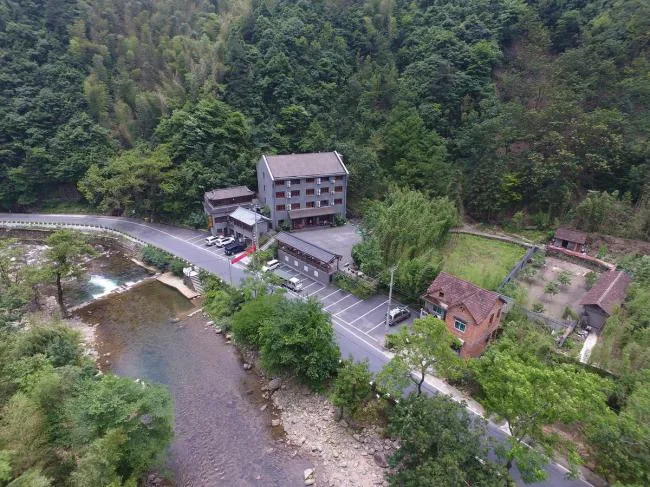
▲ Aerial view of the original site, showing the relationship between the creek, provincial road, nearby residences, and height differences © Jiushe Construction Studio
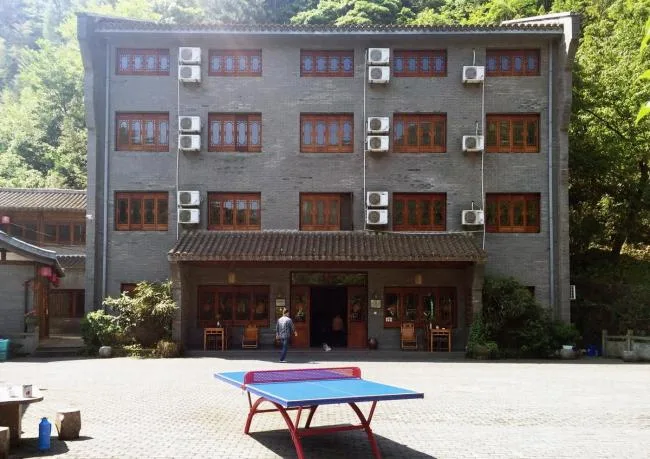
▲ Front (North) facade of the building before renovation © Jiushe Construction Studio
The terrace courtyard on the north side of the building is approximately 15 meters square, separated from the western mountain field by a drainage ditch. Mountain water is collected through this culvert and discharged into the stream. On the north side, a bamboo forest separates the courtyard from neighboring red brick houses. The eastern edge of the courtyard sits nearly three meters above the adjacent provincial road, forming a terrace. A traditional double-slope wooden pavilion and a restaurant private room building define the terrace boundary. A three-meter wide staircase is embedded in the terrace, serving as the main entrance and connecting to the lower provincial road. Additionally, there is a two-story dining auxiliary building in the southeast corner of the terrace, accessed via an external staircase. These buildings, arranged along the plateau’s edge, present a façade height of two to three stories toward the provincial road, while the main building’s gable wall is even larger in scale.
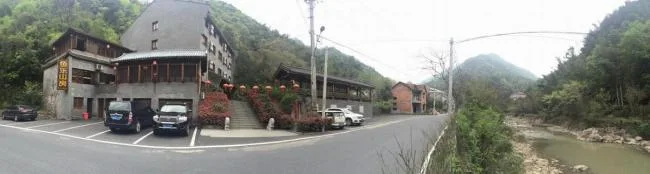
Relationship between buildings, terraces, provincial roads, and streams © Jiushe Construction Studio
The stream flows from north to south on the east side of the site, roughly three meters below the provincial road. As one of Taihu Lake’s main sources, it swells during rain and can be heard from within the original building. The provincial road, sandwiched between the site and the stream, brings busy traffic and noise.
Returning to the Mountains and Rivers
We identified the unique landscape and elevation differences as the site’s most valuable resources.
The noisy provincial roads, indistinct site boundaries, and closed room layouts caused guests to remain caught up in everyday life and overlook the scenery. The mountains and waters became mere background, not an experience to be savored.
It was essential to filter out the “blind” landscape from the chaotic environment and transform it into the focal point of the spatial experience. Only then could these large buildings in the mountain valley justify their existence: they should harmonize with the landscape, not stand apart like other tourism buildings that ignore the mountains. Our transformation aimed to “see the mountains and rivers again.”
In Chinese tradition, landscape is regarded as both a physical and spiritual home. Throughout history, space creators have sought to imitate and reproduce landscapes, especially in Jiangnan gardens that transcend the secular world. Although our site is located in the mountains and forests, its perimeter is closed, the surrounding village houses are poorly constructed and unattractive, and the provincial roads disrupt the spatial atmosphere.
Therefore, we needed to create a mountain house as a small, independent universe. Entry should feel like passing through a wormhole, leaving the outside world behind and breathing in harmony with the mountains and waters.
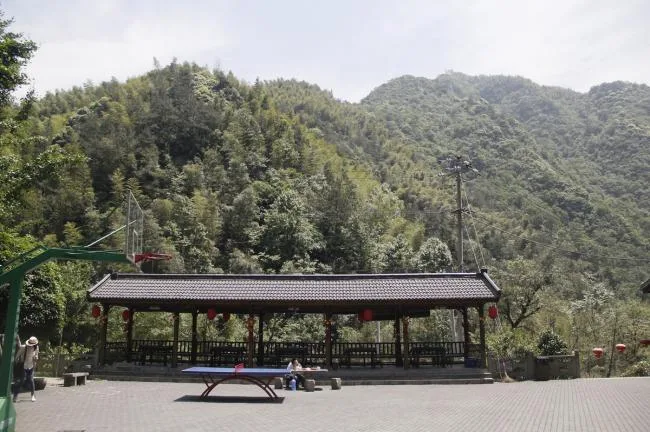
▲ Mountain scenery at the site © Jiushe Construction Studio
Defining the Venue
Due to the large building volumes, the exterior site was fragmented, mixed with provincial roads, vegetable fields, and wild forests at the mountain’s base. This fragmentation hindered the creation of an independent and effective atmosphere. The first step in renovation was to redefine the site.
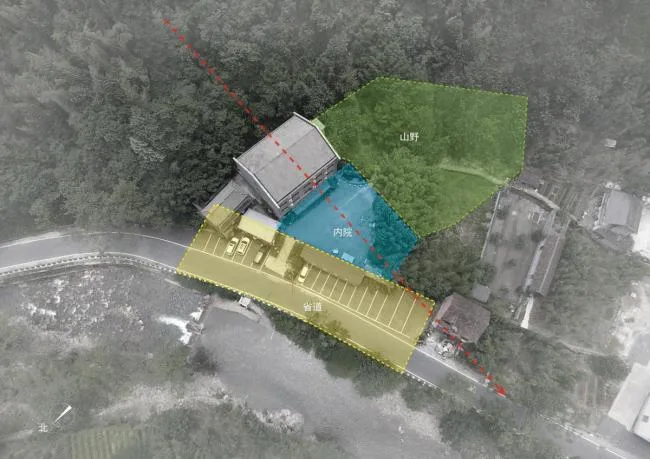
▲ Reshaping the venue © Jiushe Construction Studio
Utilizing the natural elevation differences, we divided the site into three areas: the outer provincial road, the inner courtyard facing the main building, and the mountainous terrain on the slope. The provincial road, site entrance, and parking area mark the boundary with the outside world. The terrace’s inner courtyard, facing the main building, serves as the primary area for mountain living. The inner courtyard and main building form an implicit axis and a direct viewing direction. Clear boundaries separate the inner courtyard from the provincial roads and mountains, with distinct dynamic and static zones. The mountainous area offers various spaces for activities, and the sloping terrain naturally divides these spaces by elevation.
With this new definition, the site gains clarity—inside and outside, movement and stillness, independence and order.
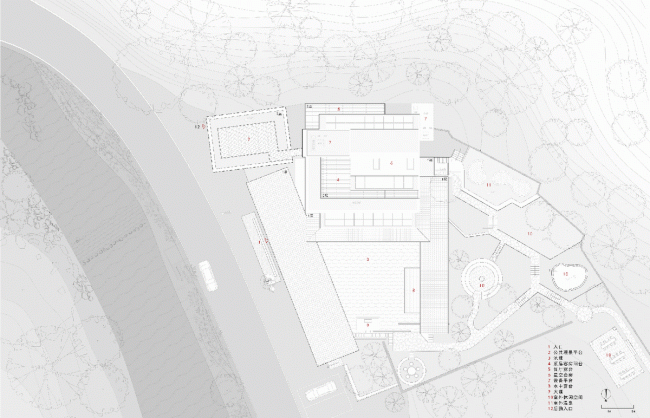
▲ Overall plan after renovation © Jiushe Construction Studio
Deep and Quiet Flow
The original entrance route was direct, rushing from the provincial road into the terrace’s inner courtyard and crossing the small courtyard. The main lobby’s view was constantly interrupted by guests coming and going. Entering from the noisy road lacked any transition, making it difficult to quickly embrace the tranquility of mountain living.
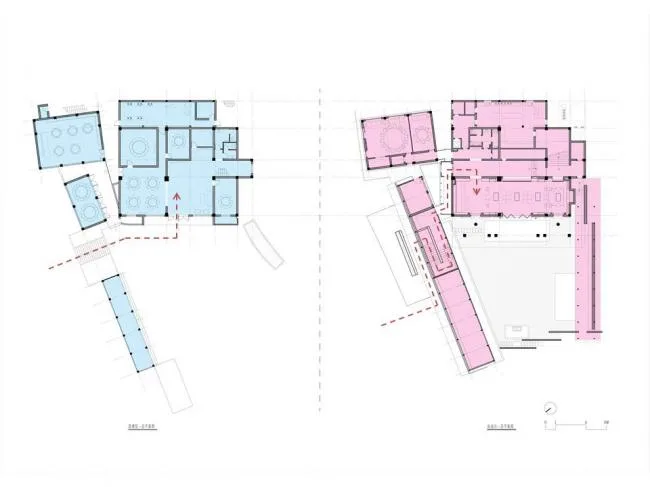
▲ Comparison of entrance flow before and after renovation © Jiushe Construction Studio
During renovation, we retained the main entrance’s location, hiding it behind a new shadow wall between terrace and road. Steps, once perpendicular to the platform, were reoriented to run parallel along the platform’s edge under a modern wooden frame. This corridor, extending along the provincial road, replaced the traditional pavilion and restaurant room, integrating entrance steps, pavilion, and a new office into a 30-meter long horizontal interface. Openable wooden grille window sashes unify the corridor’s functions from the facade, while continuous wooden rafters imply depth and soften the main building’s visual height. Horizontal eaves further reduce the entrance facade’s perceived height, visually hinting at the terrace’s elevation.
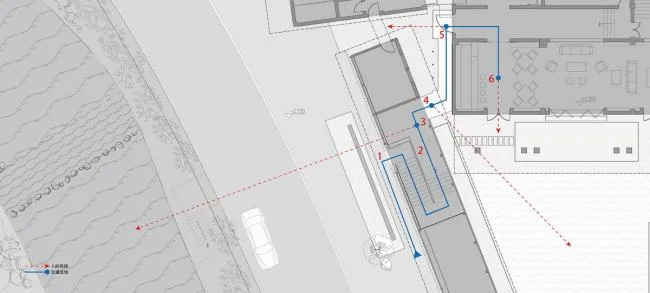
▲ Post-renovation entrance flow and sightlines © Jiushe Construction Studio
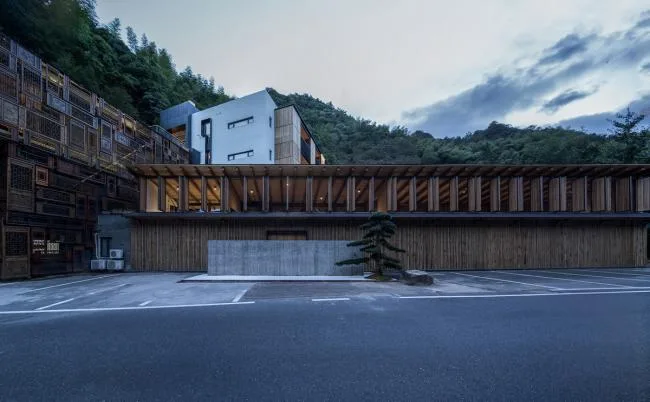
▲ Entrance facade © Zhao Yilong
As guests enter the corridor, the staircase’s ascent and the sloping roof amplify the terrain’s elevation and mountain views. The shadow wall, wooden corridor base, and stone wall between two folding steps greatly reduce the road’s noise.
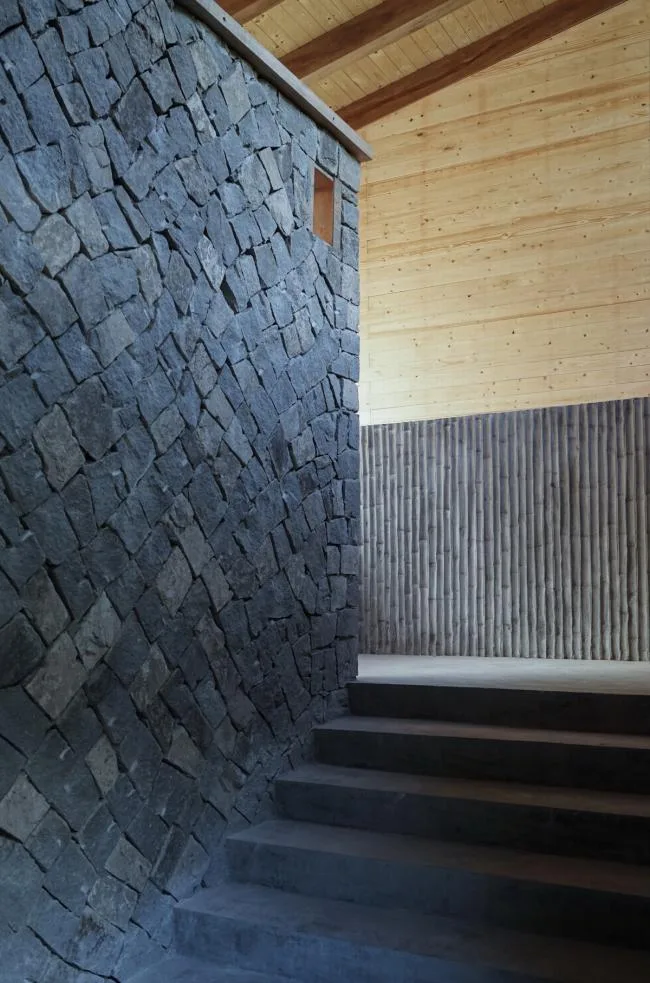
▲ Entrance staircase, with sky light flowing into the inner courtyard behind the stone wall © Fan Jiujiang
As guests climb, mountain scenery and sky light pour in through the corridor’s windows, while the road’s traffic is blocked by the wall. The sound of the stream echoes, gradually immersing guests in the mountain atmosphere. Light and shadow from the courtyard filter through wooden grilles, further emphasizing the tranquil ambiance.
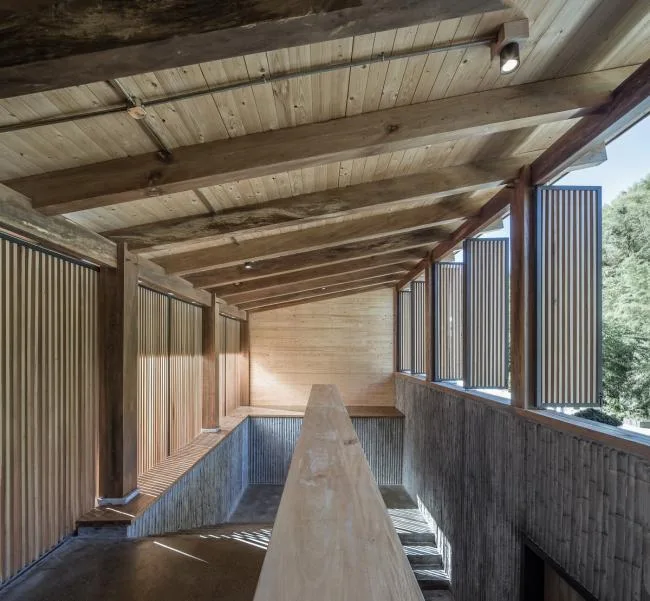
▲ Mountain-colored sky light entering from the wall under the window and sloping roof; courtyard light filtered through wooden grille © Zhao Yilong
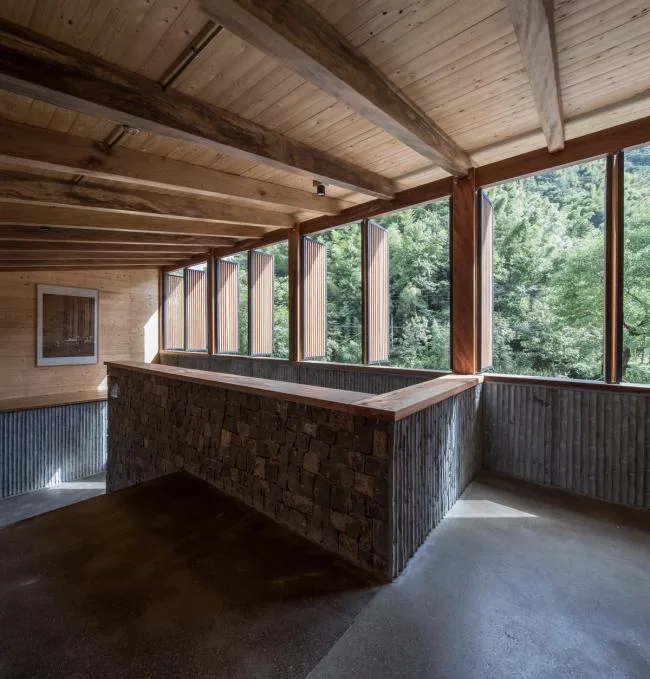
▲ Mountain scenery flowing from the entrance steps © Zhao Yilong
The main entrance of the four-story building was moved from the north facade to the east gable, within a triangular area defined by the wooden corridor, auxiliary building, and main building. The staircase leads to the edge of the mountain wall, creating a non-orthogonal transition in the flow. This integrates the angle between the slope and the gable, divides the plateau’s space into entrance triangle courtyard and inner water courtyard, and features a horizontal window for glimpses into the tranquil courtyard.
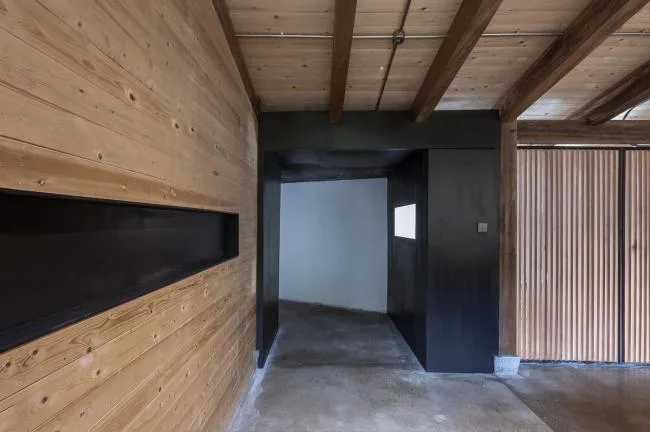
▲ Non-orthogonal transition from staircase to main building gable © Zhao Yilong
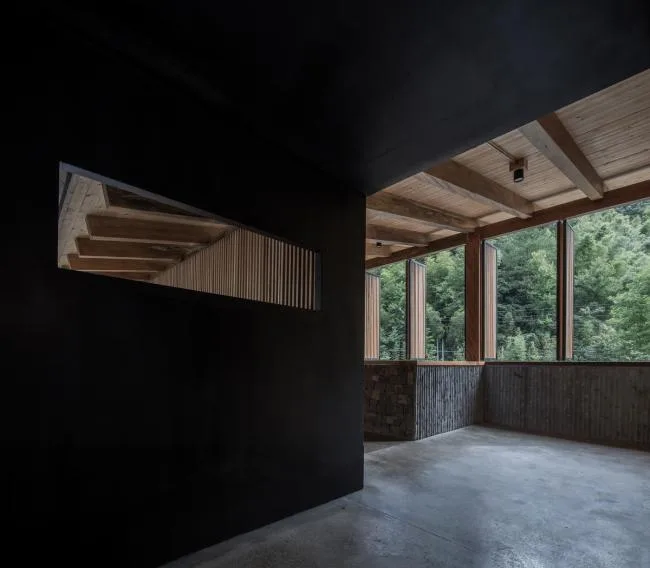
At the top of the entrance staircase, looking back reveals mountain scenery across the stream through open window sashes © Zhao Yilong
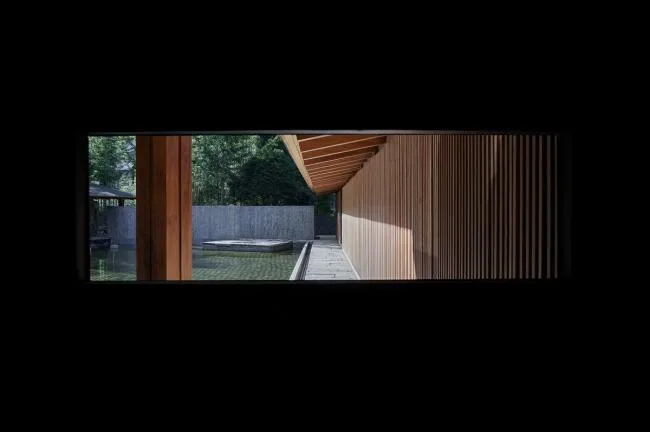
▲ Glimpse of the inner courtyard from the corridor turn © Fan Jiujiang
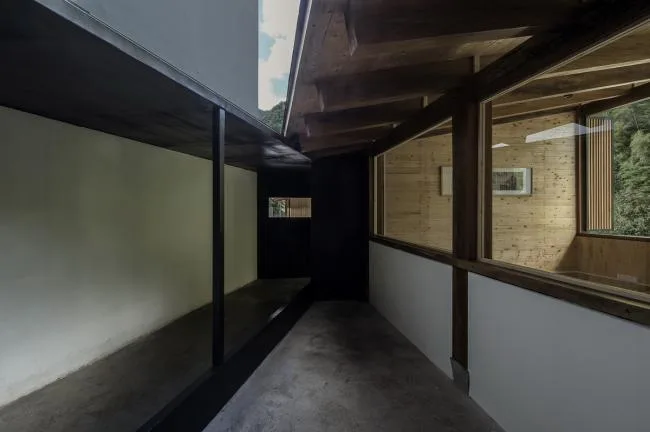
▲ View of the corridor turn from the triangular courtyard (white wall behind left corridor is the main building gable) © Zhao Yilong
Past the triangle courtyard, the corridor inside the main building becomes darker, lit only by reflected exterior sunlight. Turning right, guests enter the reception hall, where the view opens to a calm water surface, distant mountains, bamboo forests, and reflected landscapes. The fine wooden grid interfaces, lowered eaves, symmetrical columns, and bluestone platform evoke a peaceful, ceremonial mountain atmosphere.
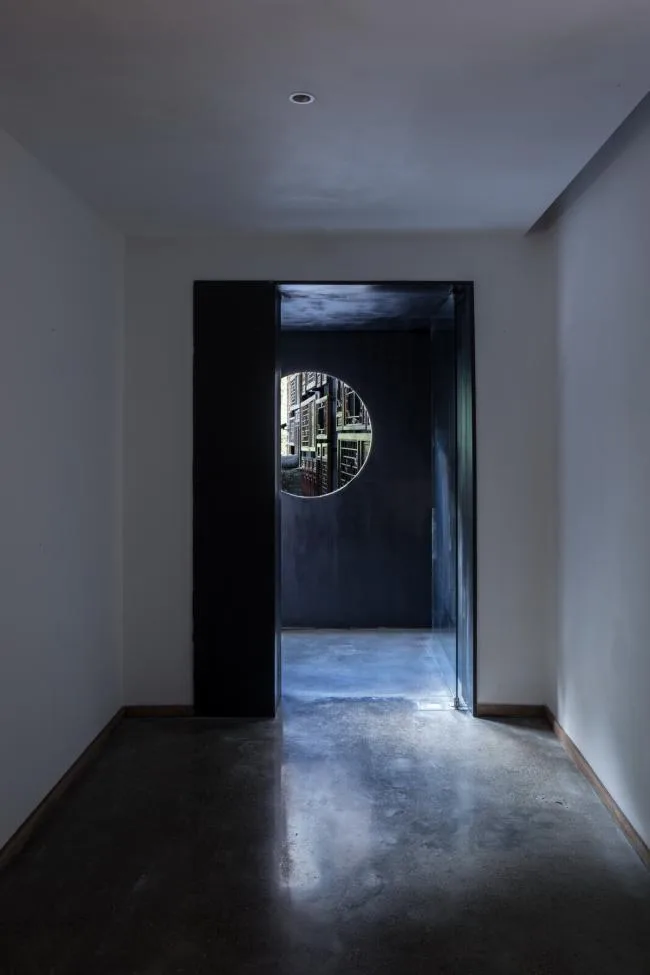
▲ Looking back at the corridor inside the main building (second floor auxiliary building visible in circular window) © Zhao Yilong
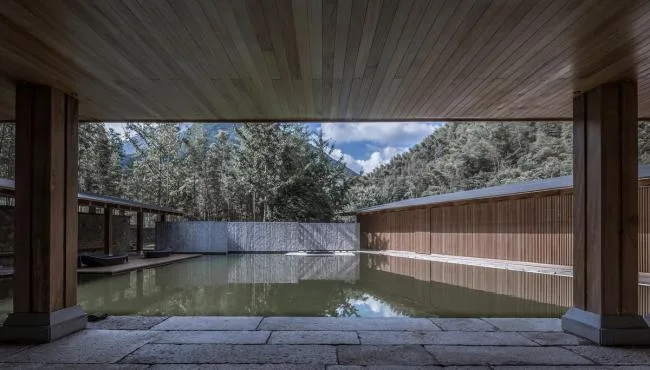
▲ Main northern view from the hall © Zhao Yilong
The entire entrance sequence reaches its climax through a series of concealment, turning, ascension, pauses, glimpses, withdrawal, entry, and release.
This new entrance route reveals the landscape—mountains, courtyard, and building—in progressive scenes. Controlled lighting and narrative moments accentuate changes in terrain, sound, weight, height, and light, stimulating curiosity and anticipation. Multiple twists extend the psychological distance from entrance to main building, establishing an independent world within the mountains.
Jingyuan and Dongyuan
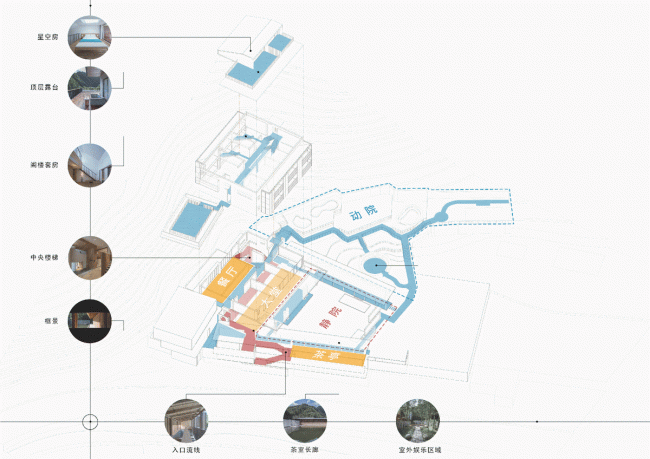
▲ Overall flow / static and dynamic courtyards © Jiushe Construction Studio
Jingyuan and Dongyuan are separated by an open corridor with a frosted stone wall—one flat, one sloped; one tranquil, one active—forming distinct themes of observing the scenery in stillness and wandering through the forest.
1. Jingyuan: The Tranquil Courtyard
The shallow water pool in front of the lobby forms the heart of the tranquil courtyard. It embodies the Zen concept of “emptiness,” reflecting mountains, forests, and sky, allowing guests to see both their reflection and the pool bottom tiled with materials from the original roof. The peaceful square pond inspires ethereal landscapes. Meanwhile, the stream’s rumbling reminds guests of external reality, blending imagination and memory to set the courtyard’s atmosphere.
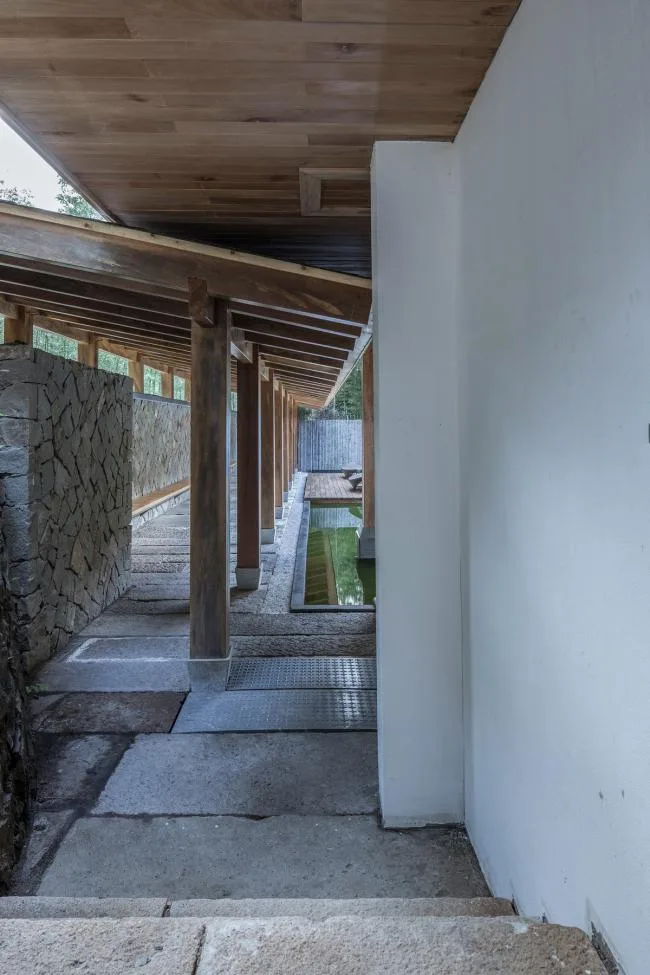
The open corridor on the west side of the main building, separated by a cobblestone wall with benches, divides the tranquil and active courtyards © Zhao Yilong
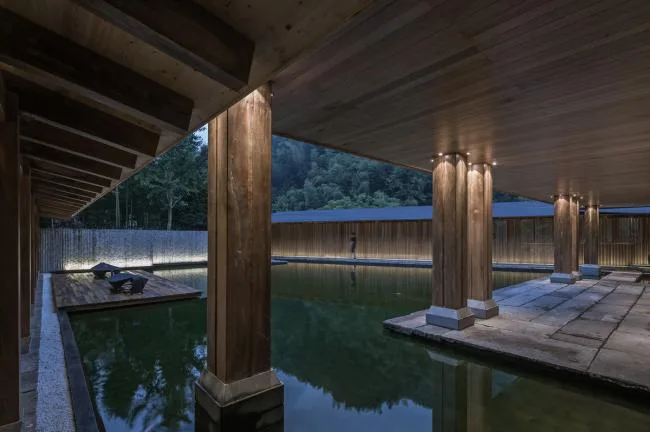
The square pond in the tranquil courtyard reflects mountains, forest, and sky © Zhao Yilong
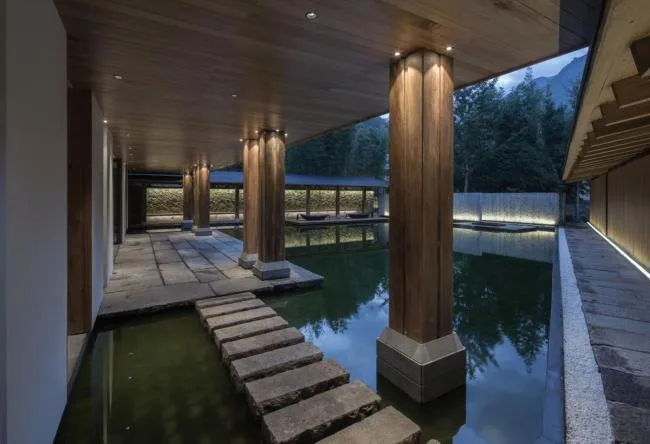
▲ Water surface extends beneath eaves and corridors; tea pavilion corridor on the right © Zhao Yilong
The pathway in the tranquil courtyard circles the water. Under the main building’s eaves, a bluestone platform leads to the tea pavilion’s outer corridor, enclosed by wooden grids and sloping eaves. Opposite, the open corridor’s rough stone wall evokes a wild forest atmosphere. From the open corridor, the tea pavilion’s fine grid interface acts like a curtain, filtering the forest’s brightness across the river in the eaves’ shadow.
Sightlines in the courtyard are pressed toward the water and the opposite bank. Tea pavilion, open corridor, and forest sky are reflected in the water, becoming the focal point. The horizontal volumes block external interference, intertwining mountain scenery with internal landscape. The four-story main building is hidden by lowered eaves.
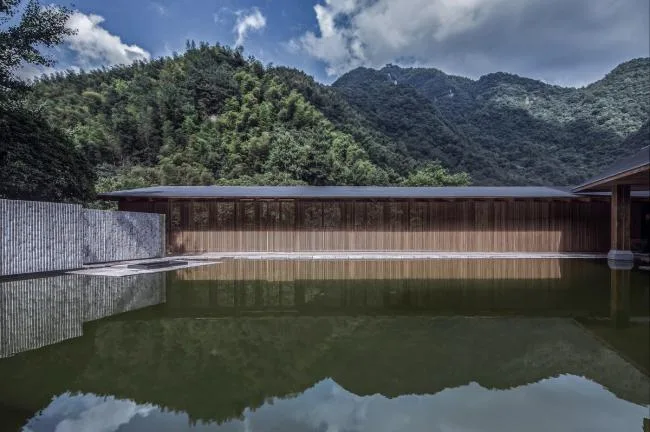
The mountain scenery behind the eastern tea pavilion reflected on the tranquil courtyard surface © Zhao Yilong
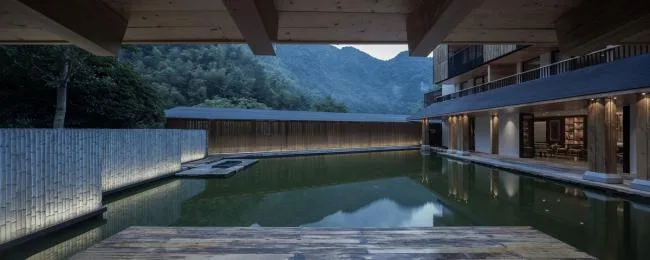
From the open corridor, only a partial view of the main building’s ground floor is visible © Zhao Yilong
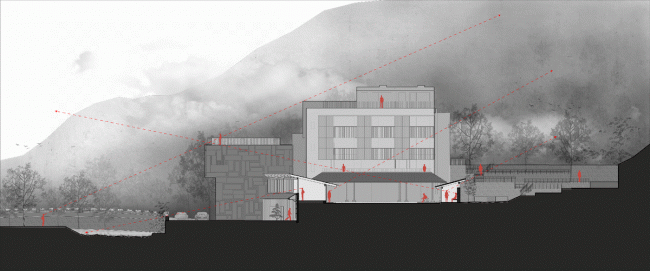
▲ East-West site profile and sight control © Jiushe Construction Studio
Only when stepping out onto the water terrace can the main building be fully seen, with visual control allowing for proper viewing distance and further retreat through reflection. The sloping roof, replaced by a flat one, presses the upper contour within the southern mountain forest outline. The first-floor’s solid wood columns and eaves contrast with panelized balconies on upper floors, dissolving the main building’s volume and highlighting the dominance of the mountains.
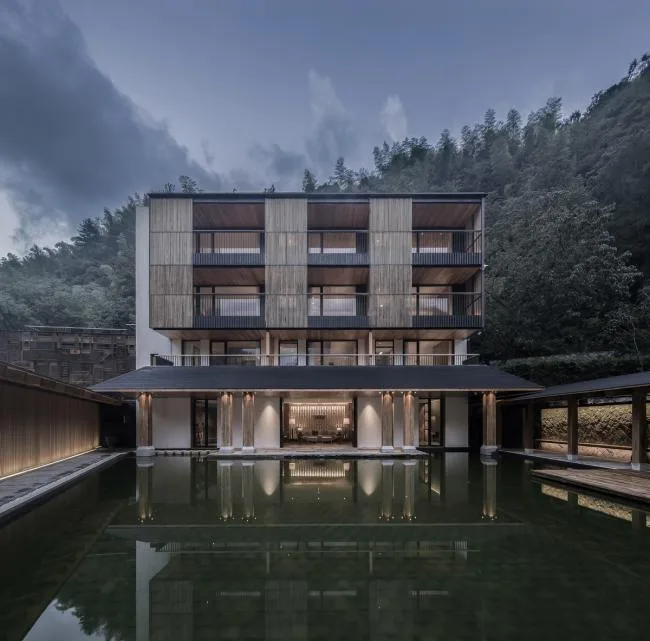
▲ Looking back at the main building from the terrace across the hall © Zhao Yilong
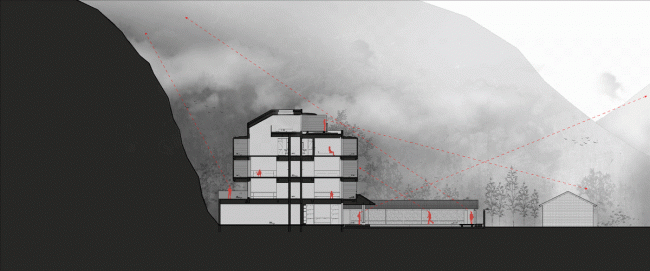
▲ North-South site profile and sight control © Jiushe Construction Studio
2. Dongyuan: The Active Courtyard
The animal courtyard, originally a steep slope at the foot of the mountain, was transformed using stacked stone terraces to resolve height differences. These terraces became social activity spaces, such as barbecue and hot spring areas, connected by paths and arranged for privacy. The lower end abuts the open corridor’s rubble wall, while the upper end connects to the main building’s stair rest platform. Steps lead to a three-level terrace on the hillside. The terrace contours and heights, combined with the suspended roof of the open corridor, ensure visual connection between tranquil and active courtyards without disrupting their distinct atmospheres.
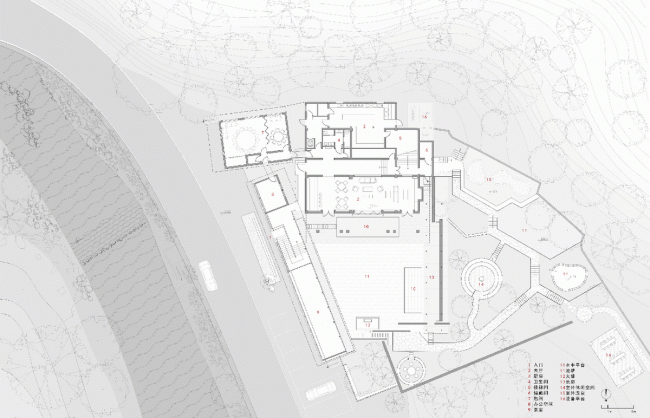
▲ First floor plan with site environment © Jiushe Construction Studio
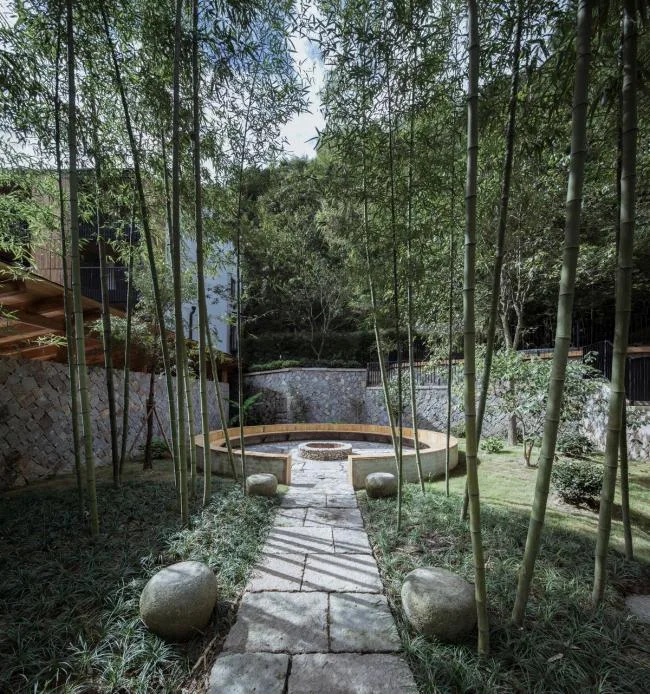
▲ Barbecue area in the bamboo forest at the bottom of the mountain area © Zhao Yilong
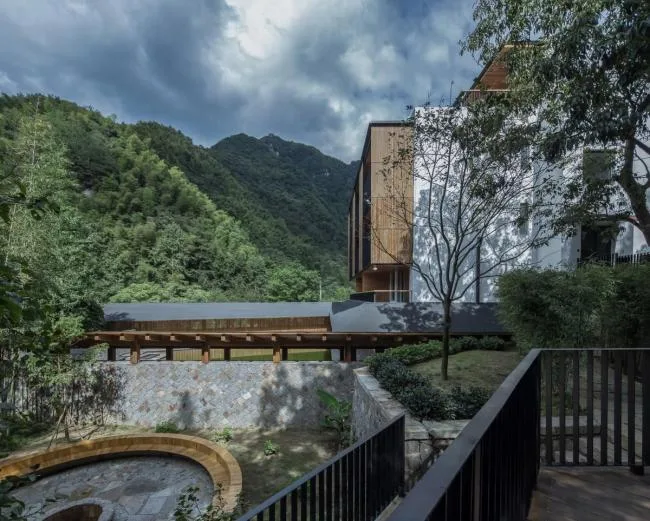
▲ Three-tiered terrace and distant mountains at high altitude in the animal courtyard © Zhao Yilong
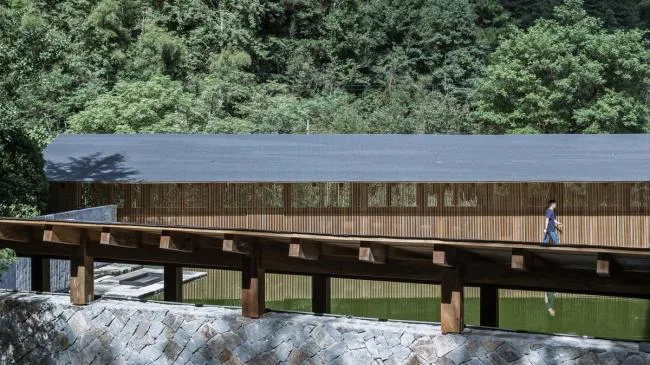
▲ View of the open corridor and tea pavilion from the plateau © Zhao Yilong
Penetrating Interface
In traditional landscape concepts, the boundary between architecture and nature is open and fluid. To convey this, a major renovation action was to open the original building’s closed interfaces, introducing landscape into the interior. At the same time, we needed to address noise, visual interference, and privacy concerns. An interface system was introduced.
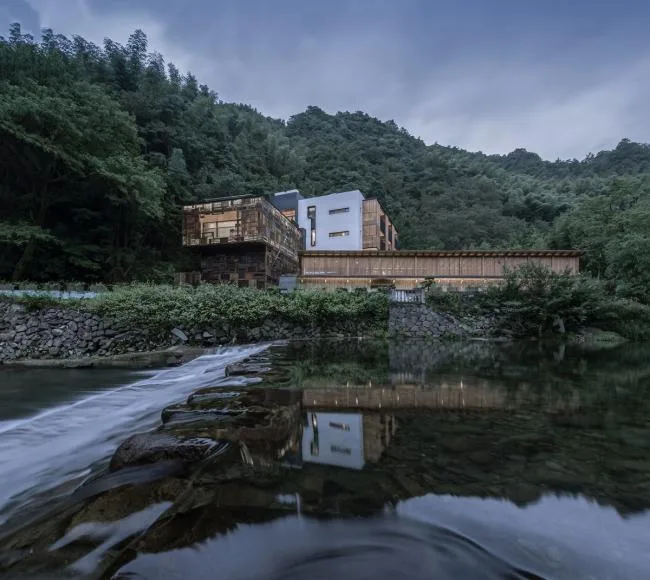
▲ View of the stream at Taihu Lake source © Zhao Yilong
1. Tea Pavilion Interface
As the boundary between the site and provincial road, the tea pavilion’s interfaces address both the lower provincial road and higher water courtyard.
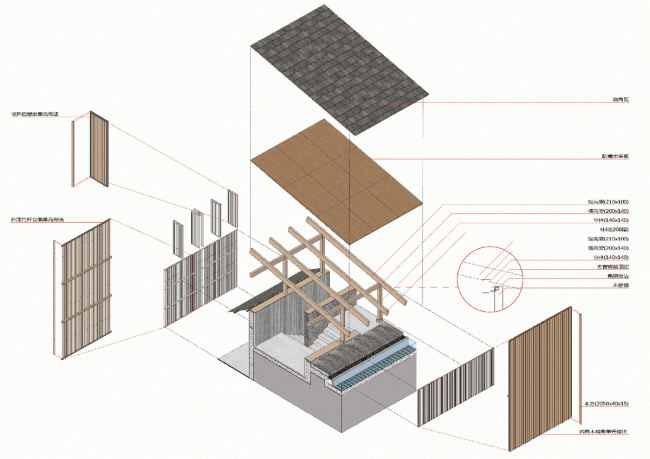
▲ Structural decomposition of tea pavilion along provincial road © Jiushe Construction Studio
The exterior interface sits at a high point along the provincial road, serving as both the mountain house’s main street side and viewing surface within the tea pavilion. A continuous window sash, fully openable, was designed using angle steel and wooden strips. A one-meter-high window wall, part of a bamboo-decorated base, visually separates inside and outside. From inside, the mountain shields the road and traffic, allowing only mountain forest views to flow in along the sloping roof.
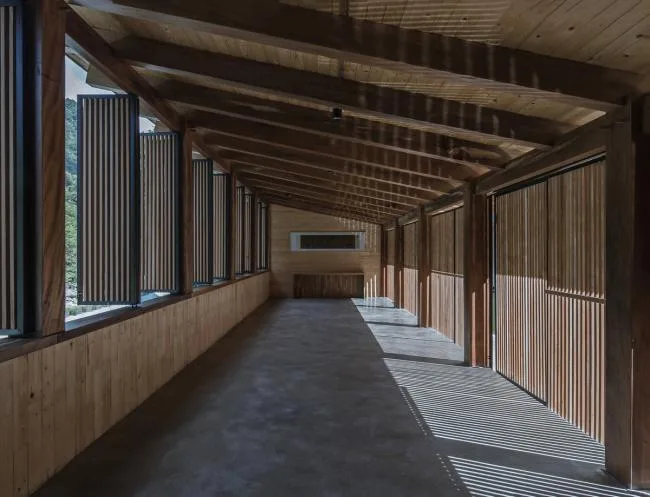
▲ Interface on both sides of the single slope water pavilion (wooden corridor) © Zhao Yilong
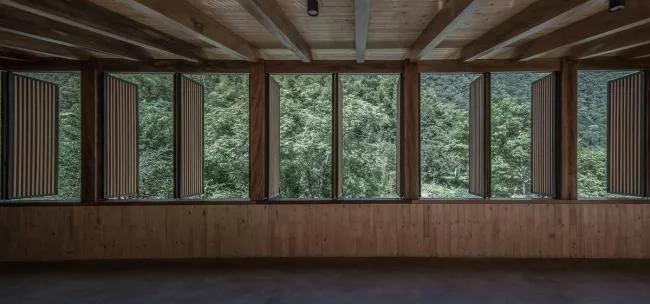
▲ Water pavilion’s continuous openable window sashes facing outward © Zhao Yilong
The inner interface is a continuous fine wood grille, concealing the tea pavilion’s structural columns and highlighting the forest landscape in the inner courtyard. This interface filters water and sky light, projecting fine shadows and presenting the water courtyard as a blurred, dreamlike boundary.
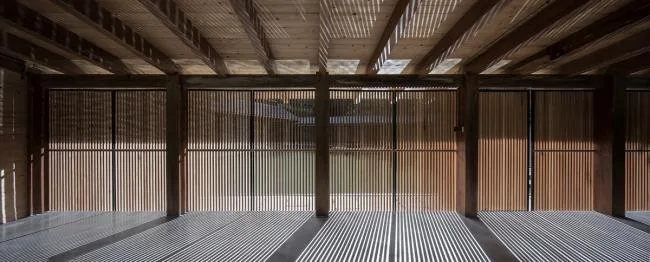
▲ Fine wood grid interface on inner side of water pavilion © Zhao Yilong
2. Balcony Interface
The original building had no balconies, only square window openings. During renovation, all exterior infill walls were opened and double-layer insulated, soundproof floor-to-ceiling windows were installed. Balconies were added through the structural framework, with guest rooms reduced from 30 to 15. Rooms and bathrooms on the front facade gained landscape views. Fine wood grilles were added to the exterior of third and fourth floor balconies, blocking direct views into bathrooms and hiding conventional components, creating a light, plate-like interface. The balconies’ ultra-thin, two-story cantilevered structure greatly diminished the building’s mass. The proximity between landscape and guests on the balcony was also enhanced.
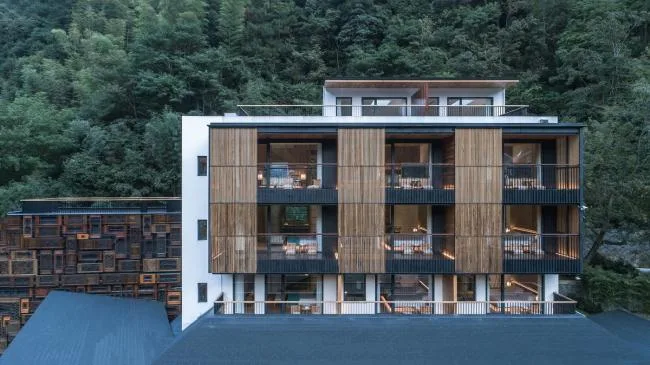
A complete laminated block composed of balconies on floors 3-4 © Zhao Yilong
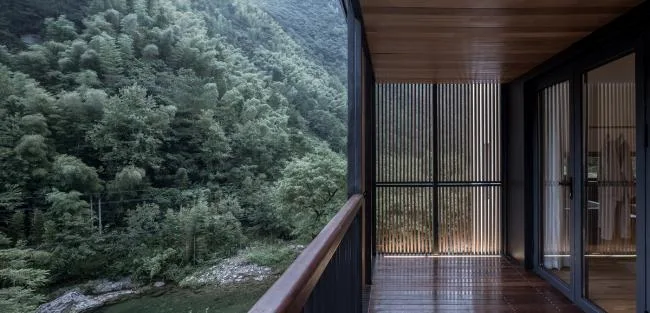
▲ From inside the balcony, one sees mountains, forests, stream, and water; guest room facade fully opened on right © Zhao Yilong
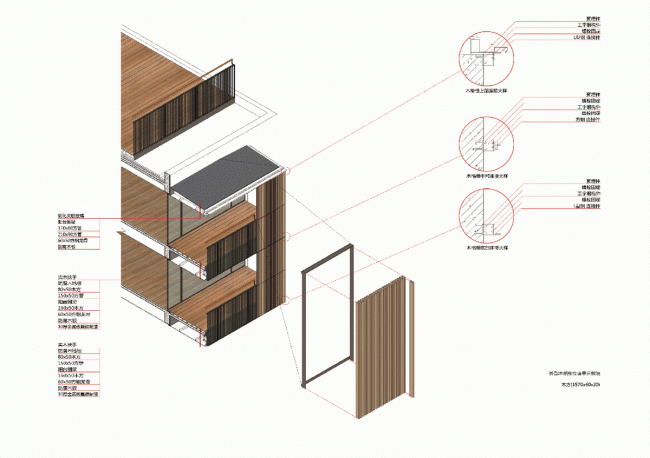
▲ Balcony Structure and Interface Decomposition Diagram © Jiushe Construction Studio
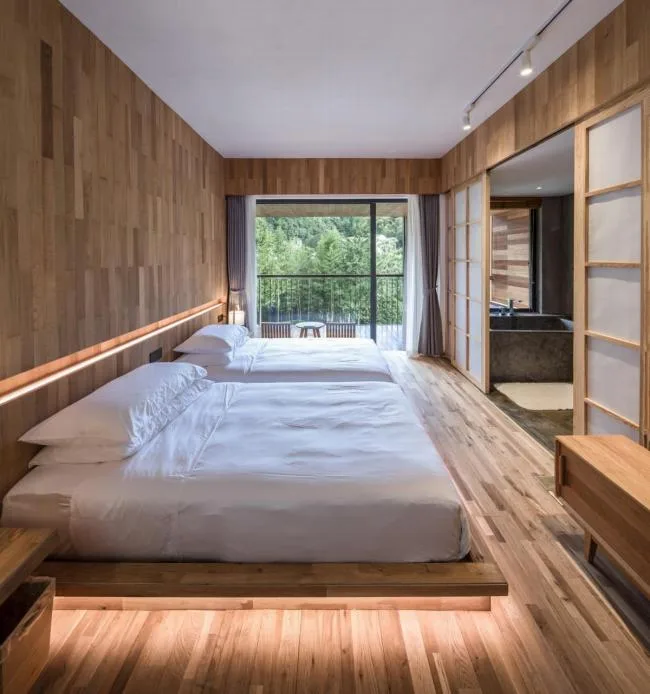
▲ Ordinary guest room with mountain view; bathroom pool adjacent to mountain view on right © Zhao Yilong
3. Xifang Interface
The second-floor dining room of the original auxiliary building became an independent stream-view guest room. Old carved doors, windows, and sashes salvaged from the original building were weathered and collaged onto the facade as curtain walls, creating color variation and imaginative connections between body and building scale. The stream-view balcony pierces this collage, resembling a cave opening along the provincial road. Viewing from this balcony evokes the feeling of observing mountains and waters from inside a cave.
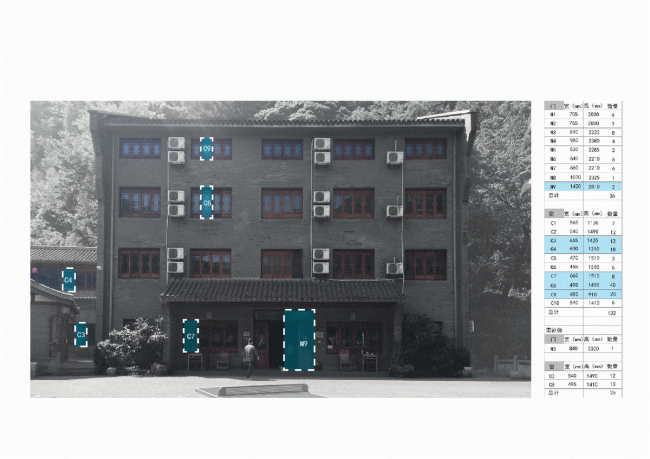
▲ Survey of carved wooden doors and window sashes from the original building © Jiushe Construction Studio
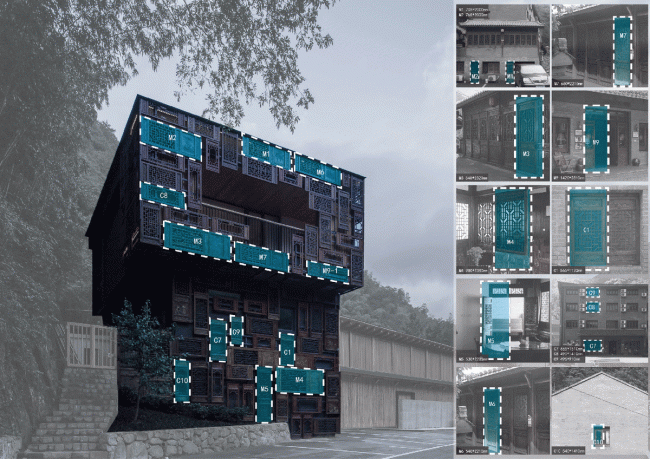
▲ Wooden door and window sash unit collage © Jiushe Construction Studio
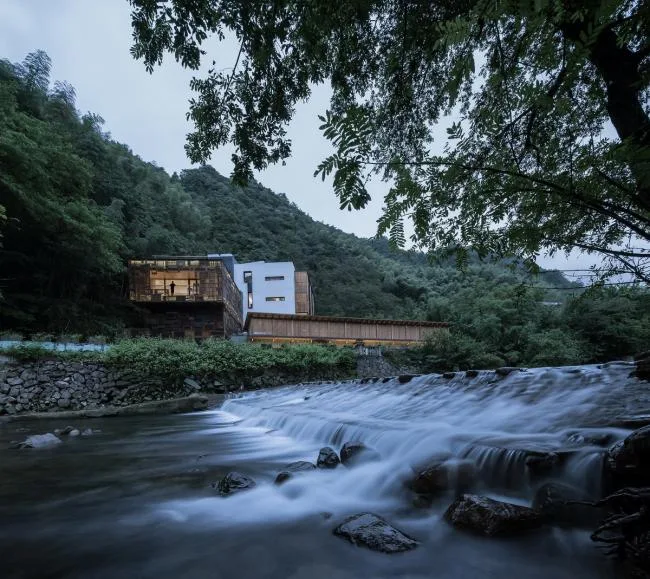
▲ View across the stream © Zhao Yilong
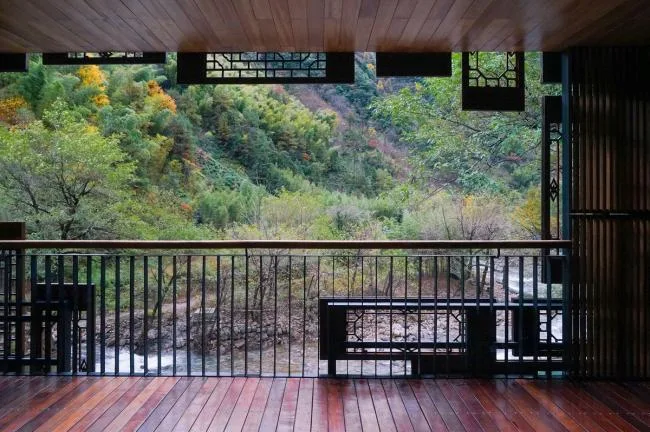
▲ Interior view of Xifang balcony, with visible stream below © Zhao Yilong
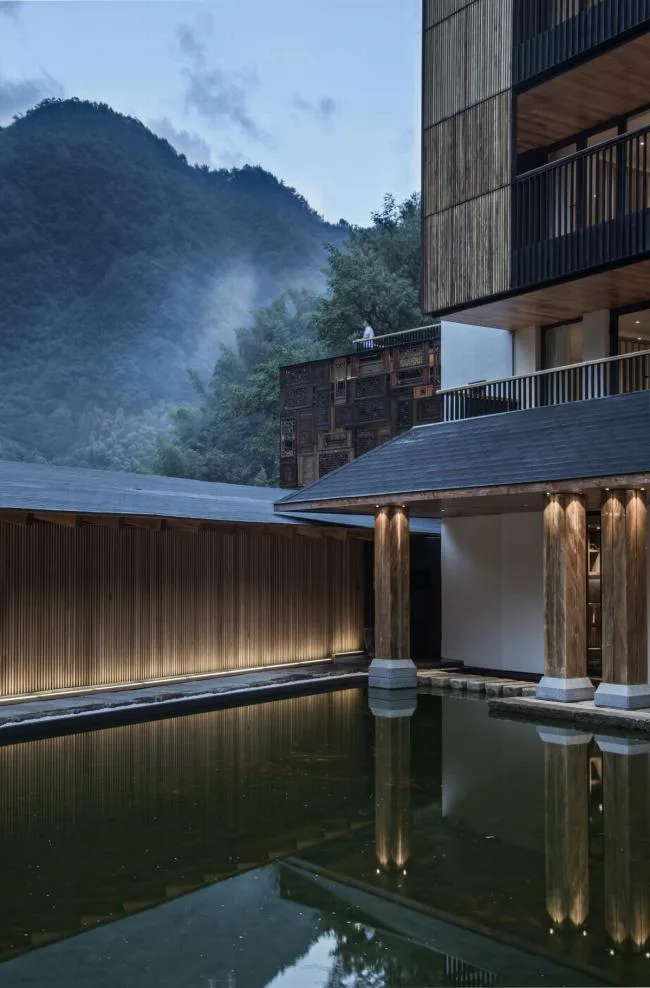
▲ Looking back at the stream house from the water terrace outside the courtyard pavilion © Zhao Yilong
The interface system—tea pavilion, balcony, and stream house—creates a buffer between the natural environment and the building interior. The landscape and interior are no longer strictly divided but interconnected through various strategies.
Structure and Interior
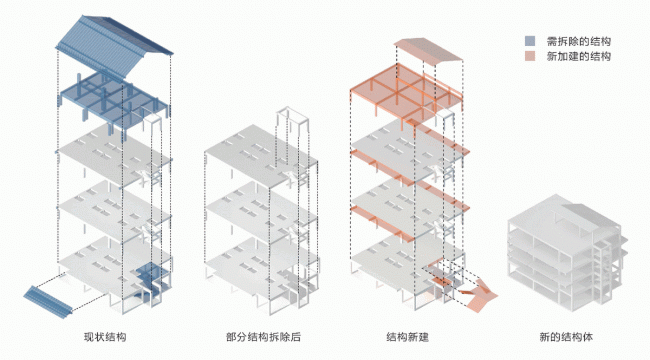
▲ Operations on the original framework structure © Jiushe Construction Studio
The original building used a concrete frame, with five identical guest rooms per floor dividing the space evenly east-west. To expand room size and meet the homestay room limit (15 rooms), we redistributed layouts, creating three rooms per floor and added balconies penetrating the landscape. Five second-floor rooms were removed, slabs on the east side were eliminated, and part of the evacuation staircase was dismantled, resulting in a two-story circulation system and oversized internal public space. This space, wrapped by wood-faced walls, connects the breakfast hall and guest rooms without interference, creating a branching, cave-like interior.
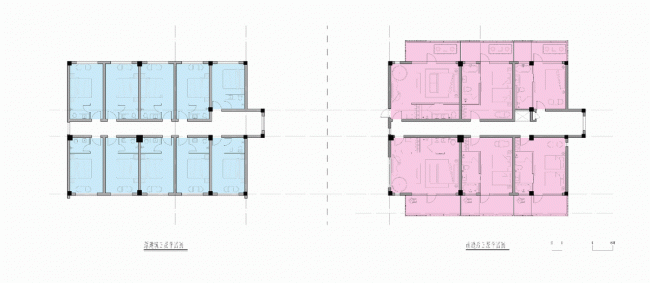
▲ Comparison of room floor plans and column grid before and after renovation © Jiushe Construction Studio
The guest room partition walls in the restaurant were removed to form a continuous space facing the mountain, with an independent area for mountain room catering. The top-floor west corridor guest rooms were merged into a fully enclosed suite with three balconies and mountain views, while the stream-view suite occupies the auxiliary building’s second floor. The original 30 guest rooms were reduced to 15, meeting local government requirements.
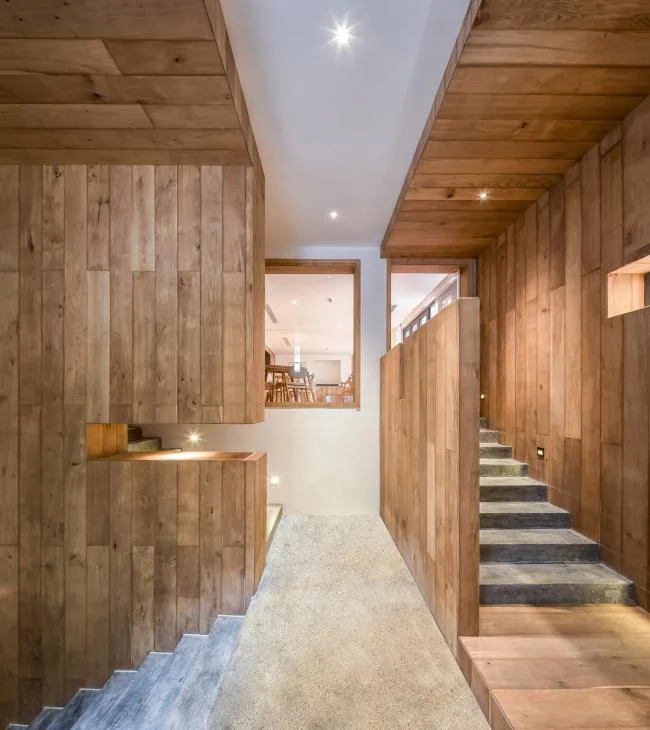
▲ Staircase space; breakfast room behind glass window © Zhao Yilong
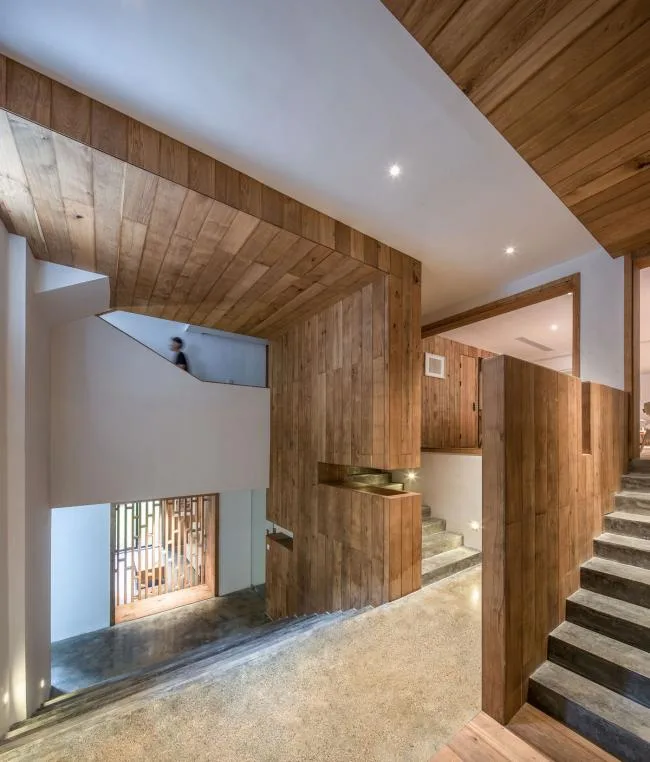
▲ Public nature of two floors with tall stairs © Zhao Yilong
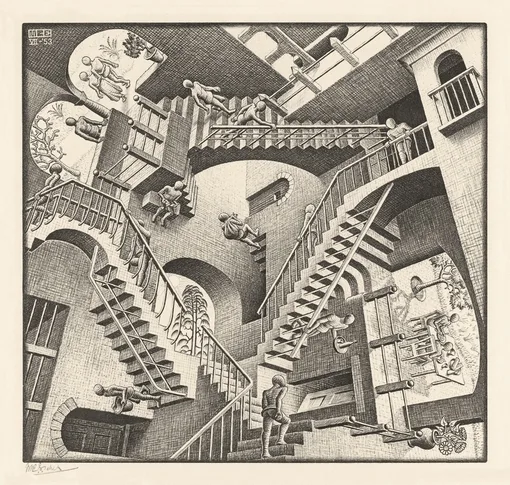
M.C. Escher, Relativity, 1953
The restaurant’s guest room partitions were removed, forming a multi-span space facing the mountain. The rooftop terrace provides independent space with forest views for catering. Top-floor rooms were merged into suites, and guest rooms reduced to 15.
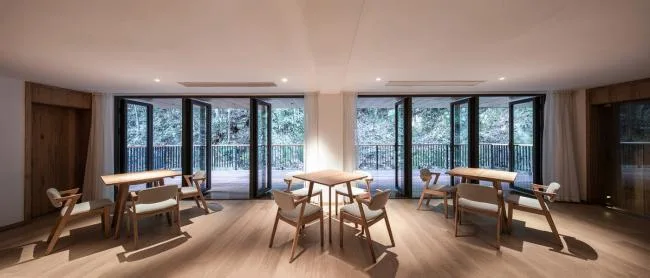
▲ Restaurant and exterior mountain terrace © Zhao Yilong
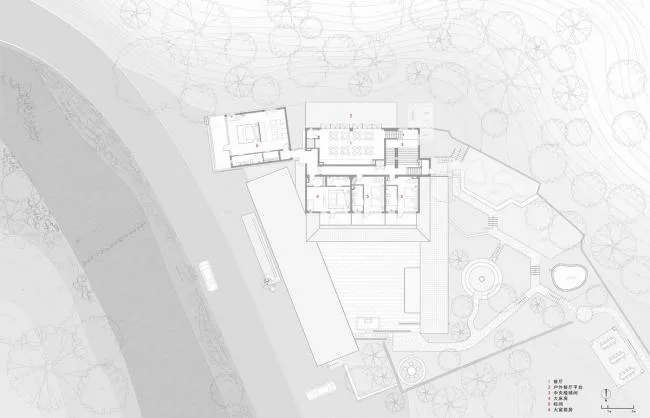
▲ Second floor plan after renovation © Jiushe Construction Studio
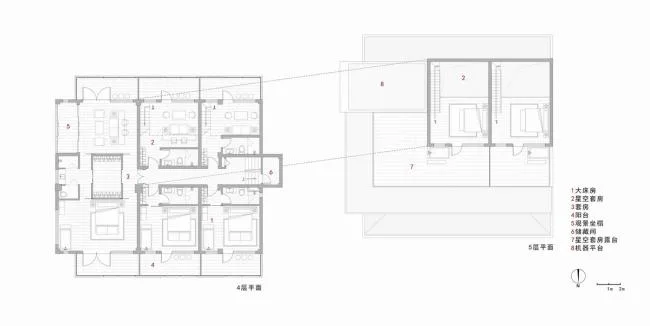
▲ Renovated fourth floor and loft attic plan © Jiushe Construction Studio
The original roof, previously used for storage, was removed along with the facade’s lowered flat roof. End columns were raised with steel structures, new steel flat roofs installed, and two loft rooms added in the southwest corner. The rooftop terrace serves as private space for these rooms, with the farthest facade outline unchanged.
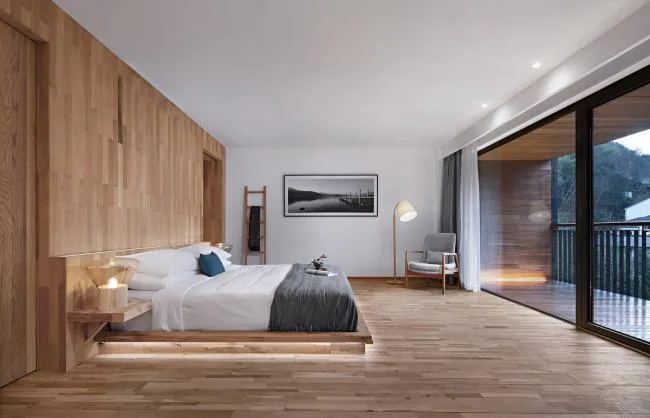
▲ Top floor oversized suite © Zhao Hongfei
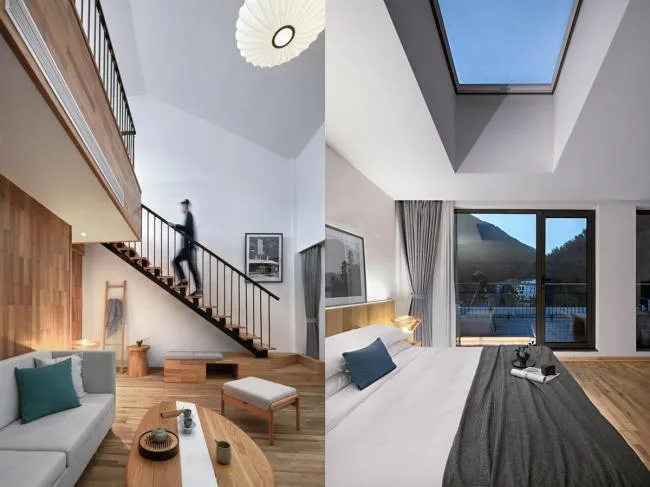
▲ Interior of loft room © Zhao Hongfei
Summary
Through site redefinition, flow transformation, interface infiltration, structural changes, and interior adjustments, the previously ignored landscape is now visible from both inside and outside. Architecture and site merge into the environment, coexisting with the landscape. Mountains and waters are not only “seen” again but are “reconstructed” as well.
Postscript
The renovation of Yuleshan House took over two years from design to completion and operation, far exceeding the initial estimate of one year. This provided valuable experience and lessons for non-professional construction projects in rural conditions. Many times, the project almost failed to be implemented.
Thanks to the unwavering support of the owners and strong government policy backing, this small but complex project was completed. Without professional construction companies, owners and designers worked together, solving issues such as construction errors, material changes, and on-site structural modifications. The design team leveraged all available resources for design, materials, construction, and installation. The final completion rate was about 70%, a fortunate outcome.
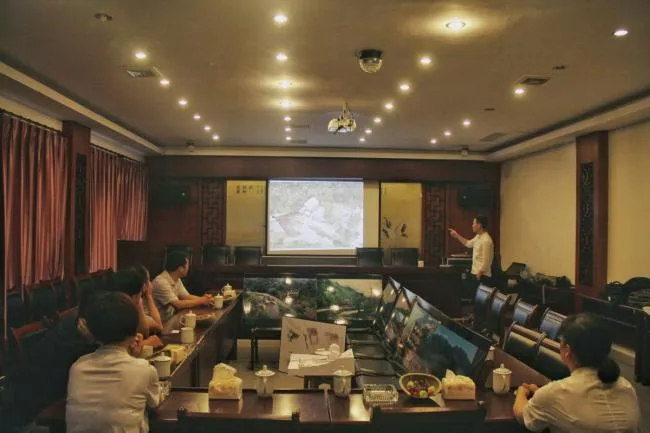
Reporting the plan at an on-site government meeting; approach determined via meeting minutes © Jiushe Construction Studio
After six months of operation, a follow-up visit revealed that although the occupancy rate was lower than expected due to the overall poor environment of the local homestay industry, the mountain house’s income increased significantly, thanks to higher room prices and improved dining features. The quality of guests also rose, and the renovated space attracted more high-quality guests and groups. This improvement positively affected the homeowners’ living conditions, bringing great satisfaction to the design team.
Project Information:
Project Name: Integrated Interior Renovation Design of Yuleshanfang Building
Design Unit: Jiushe Construction Studio (www.continuation-studio.com)
Project Design & Completion Year: 2016-2018
Lead Architects: Fan Jiujiang, Zhai Wenting
Design Team: Yu Kai, Chen Kaixiong, Huang He, Li Ting, Sun Fudong, Lv Shuanger, Dong Runjin (intern)
Project Address: Yuanzhen Town, Taihu Lake, Lin’an District, Hangzhou, Zhejiang Province
Building Area: approx. 1,100 sqm
Photography: Zhao Yilong, Zhao Hongfei, Fan Jiujiang
Lighting Design: Shanghai Pinguang Lighting Design
Soft Decoration Design: Shenzhen Wenhua Design
Structural Reinforcement & Construction: Neng Xiaowen team
Clients: Xia Juping, Jiang Yongshui
Main Materials & Brands:
Wood Veneer: Zhenzang Ancient Wood
Others: On-site production












Must log in before commenting!
Sign Up