
The author of this article is a practicing BIM engineer who primarily uses BIM technology to support architects during the architectural design phase. In his spare time, he studies the construction techniques of ancient wooden buildings. The Golden Hall and Five Towers of Falong Temple are structural system models he created using Revit software, drawing references from books such as Falong Temple by Maolong in the Palace and Selected Works of Fu Xinian’s Architectural History by Fu Xinian.
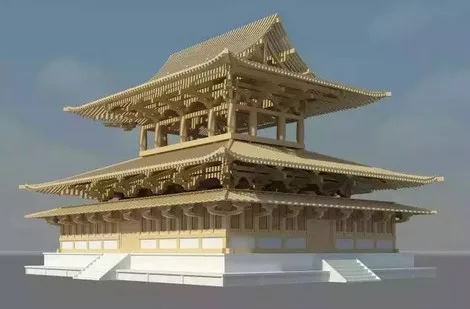
Falong Temple is located in Banjiucho, Ikoma Gun, Nara, Japan. It is a Buddhist wooden temple built by Prince Shōtoku during the Asuka period. Its defining feature is the cloud arch structure, making it a representative example of the Asuka architectural style. The Golden Hall and Five Towers stand in the west courtyard of Falong Temple and constitute the oldest wooden building complex in the world.

The Golden Hall has two floors. The first floor measures five bays wide by four bays deep, while the second floor is reduced by one bay in both width and depth. At the peak, prisms replace the traditional rainbow beams. The eaves are wide—with the lower level eaves extending 5.6 meters and columns approximately 4.5 meters tall. Because the second-floor eaves columns rest atop the lower-level gold columns, they shrink significantly, creating an impression of very deep eaves.

The wooden arches in the Golden Hall and the Five Towers are typically made of cloud arches and cloud buckets, which are not strictly uniform in shape. They often consist of single arches rather than double, crafted with intuitive skill rather than precise calculation. This characteristic became a hallmark of wooden architecture in later Japanese structures. The corner rafters are arranged parallel rather than in a fan shape, with only the rear ends fixed to the corner beams—a technique that has been used in Japanese architecture for centuries.
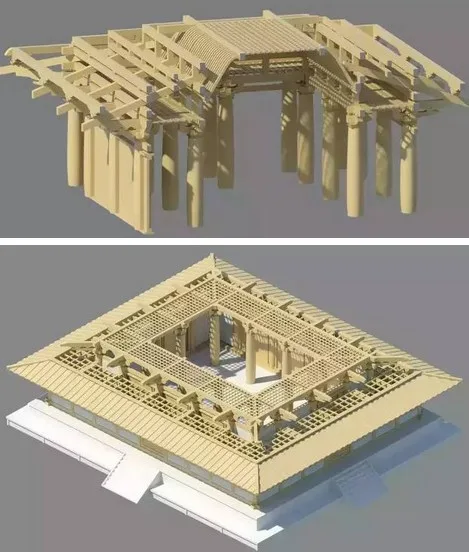
The Five Towers employ a stacked construction method. This means that the shafts and eaves of each floor are built layer by layer, much like stacking pencil caps one on top of another. The bottom three floors each measure three bays square, while the fifth floor measures two bays.

A central column runs straight through the entire height of the pagoda from the ground up. The total height of the tower is 32.45 meters, with the wheels measuring approximately 9 meters tall. Each floor is relatively narrow, and the floor heights are low—the bottom columns stand just over 3 meters tall, while the second-floor columns are only 1.4 meters. However, the overhanging eaves are quite large, extending 4.2 meters from the base. This design gives the appearance of multiple overlapping eaves, each one smaller than the one below, creating a sense of lightness and graceful upward movement. The tower evokes the image of a great Peng bird descending from the sky, its wings still spread wide, ready to take flight.
Author: Li Beibei















Must log in before commenting!
Sign Up