
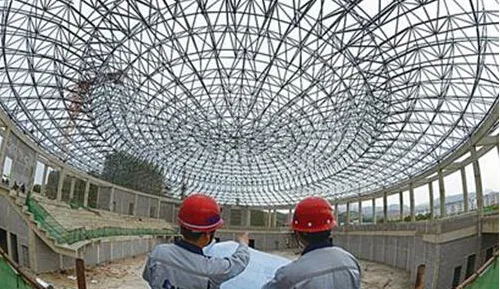
A brand-new, modern school is emerging on Qingdao’s west coast, set to become a key hub for nurturing artistic talent in the region.
Yesterday morning, our reporter visited the construction site of Qingdao Art School (also known as Qingdao No. 6 Middle School), located at the intersection of Zhusong Road West and Huaihe West Road North in Huangdao District. The main structures of all individual buildings have topped out, while internal and external wall plastering and exterior insulation work are currently underway. Fine decoration is expected to begin next month, with project completion and handover scheduled for January 2016. After several months of ventilation to release construction-related odors, the school is planned to open for the autumn semester.
As a major school relocation project in Qingdao, Qingdao Art School spans 263 acres. It will accommodate 120 classes and enroll approximately 6,000 students, with construction taking place in two phases. The first phase includes facilities for 48 classes and consists of teaching buildings, an art museum, library, dedicated art spaces, dormitories, apartments for staff, a sports hall, and a swimming pool.
“As a center for cultivating artistic talent, the school’s design is truly distinctive,” said Chen Xianliang, project manager from Qingjian Corporation. He explained that the iconic buildings are designed to reflect Qingdao’s maritime character, featuring organic curved shapes that evoke marine elements such as waves, water droplets, and bays. The Rainbow Bridge, an overhead pedestrian bridge, connects the various functional zones and buildings from south to north, symbolizing the teachers and students painting a rainbow and envisioning a bright future together.
The use of BIM (Building Information Modeling) technology in constructing the sports facilities is particularly noteworthy. Installation manager Xiao Jie shared with reporters that this is the first full-scale application of BIM in Qingdao’s construction industry, enabling oversight of the entire building process. Before construction begins, a detailed digital model is created, allowing all work to be planned and managed virtually. BIM is especially valuable for collision detection between components and pipelines, helping identify and resolve design or installation conflicts early to avoid costly rework and save funds.
“BIM also allows us to closely monitor the construction progress,” Xiao Jie explained as he demonstrated the BIM online software on his phone to check the status of issue rectifications. He showed two automatically generated images — one before and one after corrections — which clearly illustrate the improvements. This system ensures that even while traveling, the team can stay fully informed without any delays in addressing problems.”
















Must log in before commenting!
Sign Up