
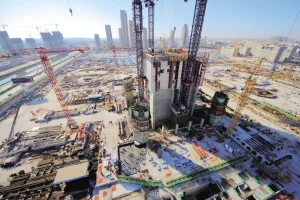
Data photo: Installation of the lifting formwork system completed
Milestones in Construction
- May 31, 2015: Reached 550 meters
- January 19, 2015: Surpassed 500 meters
- September 3, 2014: Passed 400 meters
- May 26, 2014: Surged past 300 meters
- December 29, 2013: Broke 200 meters
- July 5, 2013: Surpassed 100 meters
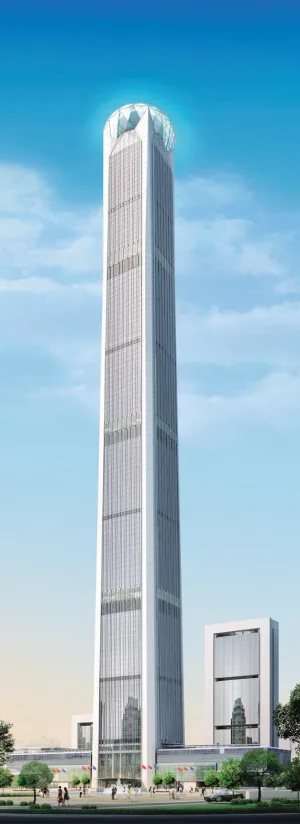
Driving along Jinjing Road in the Binhai High-Tech Zone, the slender silhouette of Building 117 commands the skyline from a distance. The ancient poetic imagination of towering heights and reaching for the stars has become a tangible reality. Located at the intersection of Jinjing Highway and Haitai North-South Street, Building 117 stands as the eighth tallest skyscraper globally, fifth in China, and the first in northern China to exceed 500 meters.
Recently, our reporter visited this remarkable structure—the tallest building in China by structural height—to uncover the secrets behind its rapid ascent.
117 Building: China’s Tallest Structural Marvel
On May 31, 2015, northern China’s skyline rose higher than ever before. The concrete pour for the 113th floor of Building 117’s main tower, constructed by China Construction Third Engineering Bureau, was successfully completed. The core tube now reaches a height of 553.095 meters, surpassing the 541-meter One World Trade Center in the United States.
This achievement also eclipses other renowned buildings such as Shanghai’s 420.5-meter Jinmao Tower, Guangzhou’s 440-meter West Tower, Jingji 100 at 441.8 meters, Kuala Lumpur Twin Towers at 451.9 meters, Shanghai World Financial Center at 492 meters, Taipei 101 at 509 meters, and Guangzhou East Tower at 539 meters.
Standing atop the 500-meter elevated steel platform, Tianjin’s cityscape unfolds beneath. The Tianjin Radio and Television Tower lies below, with planes streaming overhead. Hou Yujie, Executive General Manager of the 117 Building Project, shares that structural topping out is expected in the second half of the year, reaching an eaves height of 597 meters, making it China’s tallest building.
Building dreams among the clouds, the Gaoyin Financial Central Business District, anchored by the 117 Building, is poised to become a new landmark and business hub in Tianjin and the Beijing-Tianjin region.
Vertical Transport: Overcoming Height Challenges
Channel Tower Elevator: The 500-Meter High Transport Artery
Our reporter rode the passageway tower elevator, reaching over 500 meters in about 10 minutes. While the average medium-speed construction elevator climbs at 50 meters per minute, this passage tower elevator can reach up to 90 meters per minute.
Each floor is connected by a 5-meter-wide passageway, serving as a vital artery for people, machinery, and materials to enter the main tower. Vertical transportation poses major challenges in skyscraper construction, especially as Building 117 requires 191,000 cubic meters of concrete, 40,000 tons of steel bars, and 143,000 tons of steel components. At peak periods, over 2,500 workers rely heavily on this transport system.
The project pioneered channel tower technology in mainland China, employing factory prefabrication, on-site assembly, and overall hoisting. The channel tower measures 5 by 9 meters, with five double-cage construction elevators on three sides, ensuring efficient, time-shared, and layered movement of people and materials.
Rapid Construction: The Power of the “Diamond Shield”
At the building’s summit, a 20-meter-high “Diamond Shield” structure envelops the core tube like a castle in the clouds. Unlike traditional scaffolding, this modular low-level lifting steel platform formwork system is the largest of its kind in China.
Chief Engineer Yu Dihua explains that the system consists of a steel platform, hanger system, hydraulic support, formwork, protective measures, and safety monitoring. The top mold—measuring 35 meters long, 32 meters wide, and 21 meters high, weighing about 1100 tons—can simultaneously support three-dimensional construction across three core tubes.
The steel platform supports up to 1 ton per square meter, accommodating machinery and materials, effectively serving as an aerial storage yard. It includes a hydraulic control room, equipment room, rest area, and restroom for workers. Enclosed by galvanized steel mesh, the hanger system ensures worker safety at extreme heights. Four hydraulic cylinders raise the entire formwork system, supported by four 19-meter steel columns, enabling rapid, multi-floor construction of the core tube.
Since its first lift on March 24, 2013, the top mold system has been operated by a dedicated five-person team. Despite challenges like strong winds forcing shutdowns and trapping workers temporarily, the team takes pride in managing China’s largest top mold system.
Building 117’s Purpose
With 117 floors above ground and 4 underground, the 597-meter-tall Tianjin 117 Building covers 847,000 square meters, making it the largest skyscraper by construction area worldwide. It integrates Grade A offices, luxury hotels, tourism, sightseeing, and retail.
The base floor spans 4,200 square meters and gradually tapers upwards at a 0.88-degree angle, with the top floor covering 2,100 square meters.
Architecturally, the design blends traditional Chinese culture with modern aesthetics. The building anchors the Gaoyin Central Business District, which also includes boutique commercial structures, financial headquarters, twin office towers, exhibition centers, serviced apartments, high-end residences, and villas.
A 338-meter-long commercial corridor connects the 117 Building to the financial headquarters, featuring six diamond-shaped circular halls that echo the main tower’s distinctive diamond-shaped roof.
Executive Vice General Manager Li Ganchun notes the inclusion of Grade A office spaces targeting multinational corporations, plus a six-star hotel on floors 94 to 104, built to Dubai’s Sail Hotel standards. A luxurious swimming pool on the 115th floor at 564 meters will set a world record as the highest indoor pool.
The 116th-floor mezzanine will house the world’s tallest observation hall inside a diamond-shaped interior at 579 meters, surpassing the Shanghai World Financial Center’s 474-meter record for the highest tourist hall. Visitors will enjoy panoramic views of Tianjin’s skyline.
Addressing Complex Geological Conditions
Building 117’s site rests on a complex geological foundation of silty sand, silt, and silty clay from marine and terrestrial sediment layers. To ensure stability, 941 piles, each 120 meters long, were driven deep, marking the longest pile foundation in domestic housing construction.
Some piles pass through multiple aquifers, requiring precise verticality control within 1/300 to prevent collapse, maintain sediment thickness under 10 cm, ensure concrete protective layers, and enable smooth underwater concrete pouring.
China Construction Third Engineering Bureau leveraged its experience from coastal and river foundation projects and employed advanced drilling rigs and techniques, including gas lift reverse circulation and deep drilling mud control. Continuous parameter adjustments allowed successful completion of first-class standard piles, establishing a solid base with 65,000 cubic meters of large base plate concrete.
Structural Integrity of the Skyscraper
The structure combines reinforced concrete core tubes with steel mega-frames — the most advanced design for super tall buildings. Pure steel is generally unsuitable for structures above 400 meters due to weight and stability concerns.
Building 117 features four mega columns, eight of China’s largest buckling-restrained braces, nine ring belt trusses, eight massive slant supports, and 153,000 tons of steel forming a robust “spine”.
The mega columns, positioned at the tower’s corners, have a hexagonal shape with 26 internal cavities. The largest cross-section measures 45 square meters, the biggest worldwide for super tall building columns. The thickest steel plate is 120 millimeters, and the largest cross-sectional area reaches 180 square meters. Extending from the basement to 583.65 meters high, these columns act as the building’s towering pillars.
Earthquake Resilience
Eight buckling-restrained braces, each approximately 48 meters long and weighing 210 tons, provide lateral stiffness and strength. Designed to withstand strong winds and earthquakes, these braces deform minimally, protecting the main structure and enhancing seismic performance.
The building’s nine circular belt trusses—comprising three double-layer and six single-layer trusses—use 2,106 tons of steel in the third layer alone, making it the largest double-layer truss in China. These trusses tightly embrace the building, resembling belts securing the structure.
Tests by the China Academy of Building Research show that under an 8-magnitude earthquake, the maximum inter-story drift angle is about 1/76, with the structure maintaining integrity and key components intact. The building’s ductility and deformation capacity provide seismic reserve capacity.
Even in a catastrophic event similar to the 9/11 attacks, the design ensures that should one mega column collapse, the building will not topple.
Related Achievements
As the general contractor, China Construction Third Engineering Bureau has overcome numerous challenges since construction began on September 10, 2008, achieving several world and national records:
- 597 meters — Tallest structural height in China
- 120 meters — Longest pile foundation in domestic housing construction
- 210 tons — Heaviest single anti-buckling steel support in China
- 847,000 square meters — Largest skyscraper construction area worldwide
- 65,000 cubic meters — Tallest concrete floor volume for super high-rise buildings
- 578 meters — Highest channel tower in the world
- 594 meters — Highest operating height for a single well worldwide
- 3 megapascals — Highest water pipe pressure in super high-rise buildings
- 45 square meters — Largest cross-sectional size of super tall giant columns
- 564 meters — Tallest indoor swimming pool in the world
- 579 meters — Highest observation platform globally
Innovation: The Driving Force Behind Height
Hou Yujie, Executive General Manager of the 117 Building Project and head of the 117 Project Innovation Studio, credits continuous innovation as the key to the building’s success. The studio serves as a think tank, analyzing transportation efficiency and developing new technologies.
The Innovation Studio displays numerous models and documents highlighting technological breakthroughs, including the independently developed modular low-level lifting steel platform formwork system. Through careful design and process optimization, the team maximizes construction efficiency and coordination.
The modest top mold, an ordinary iron structure, has transformed into a “Transformer,” symbolizing the studio’s innovative spirit. The team has secured six national utility patents, nine national invention patents, and multiple provincial science and technology awards.
Hou emphasizes that innovation is an ongoing process, achieved through dedication and labor, allowing the project to rise from underground foundations to over 550 meters today.
Fire Safety: Ingenious Solutions for Life Protection
Fire safety in super tall buildings is a global challenge, especially regarding evacuation. Descending nearly 600 meters—higher than Xianglu Peak in Beijing—can take over an hour, even for fit individuals.
Building 117 addresses this with ten refuge floors strategically located every 15 floors, totaling approximately 3,625 square meters at the largest. These refuge levels are integrated within nine trusses at floors 6, 18, 32, 32 mezzanine, 47, 63, 63 mezzanine, 78, 93, and 105, creating ten firewalls on the building’s facade. In case of fire, occupants can reach the nearest refuge within one minute.
All steel surfaces are coated with 3 to 5 cm of fire-resistant materials, capable of withstanding high temperatures for three hours. The building features over 22,000 square meters of fire-resistant rolling shutters, over 21,000 square meters of steel fire doors, and over 4,700 square meters of wooden fire doors. Evacuation corridors and stairwells have self-closing fire doors that automatically shut after evacuation, with signals monitored by the fire control center.












Must log in before commenting!
Sign Up