
The West Kowloon Reclamation Area Substation is the first environmentally friendly substation to incorporate BIM models in its project design. This innovative approach earned it the 8th Autodesk Hong Kong Building Information Simulation Design Award. Designed and developed by China Power Company Limited, the project aims to seamlessly integrate the substation into the environment of the West Kowloon Cultural District, ensuring it complements the community’s surroundings.
Despite its ambitious objectives, the project faced significant challenges. The schedule was tight, with a compressed timeline from design to completion. Additionally, the limited project area imposed restrictions on cable entry and exit points. The building’s appearance and its harmonious coordination with the surrounding environment were also major considerations throughout development.
To address these challenges, the CLP team enlisted Hong Kong Internet Cube as a BIM consultant. They established a comprehensive BIM model and leveraged BIM technology to closely monitor the project’s progress, striving to create a design that is both efficient and well-integrated with its surroundings.
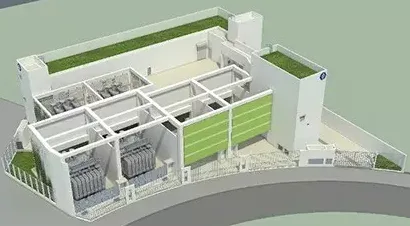
Design Visualization — Fully Presenting Design Concepts
Throughout the design process, BIM models played a crucial role in determining the optimal placement of heavy equipment while maximizing the use of limited space. The project team—including high-voltage electrical and line design engineers as well as architects—used BIM to refine the substation’s design collaboratively. This technology eliminated misunderstandings and communication barriers often caused by relying solely on 2D drawings, significantly improving communication efficiency across the team.
As a result, the design concepts were presented clearly, intuitively, and comprehensively to all stakeholders, ensuring everyone shared a unified vision of the project.
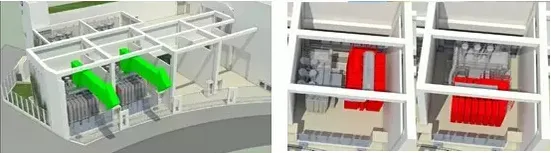
Design Optimization & Simulation for Installation and Maintenance — Anticipating Project Feasibility
The substation will house two transformers, each weighing up to 100 tons. Using BIM animation, the project team evaluated various placement options to determine the safest and most efficient installation and transportation methods. Moreover, BIM construction simulation was employed to assess the feasibility of replacing and repairing equipment within the substation.
This approach also streamlined cable routing design, resulting in a neater layout and more efficient installation processes.
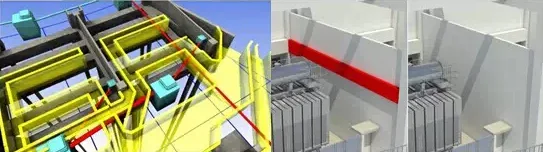
Collision Detection — Minimizing Project Risks
BIM models help identify and reduce design conflicts early on. They enable detection and resolution of issues that are difficult to spot in traditional 2D drawings, such as clashes between structural beams and pipelines. By optimizing pipeline layouts in advance, BIM ensures precise placement while reserving adequate space for future access by operations and maintenance personnel.
Additionally, BIM allows for animated walkthroughs, enabling the project team to identify potential risks before construction begins. Detecting problems early improves design quality, saves time, and enhances overall project efficiency.
The use of BIM technology has not only elevated the design quality but also optimized the project’s timeline. The BIM data generated throughout the project will serve as valuable assets for future operations, maintenance, and even new construction projects.
The West Kowloon Reclamation Substation project is progressing smoothly and is expected to be completed in 2016. By blending seamlessly with the cultural district’s environment, this eco-friendly substation showcases the significant role of BIM in design optimization and highlights the extensive potential applications of BIM technology.














Must log in before commenting!
Sign Up