
Editor’s Note
To facilitate the rapid and effective dissemination of innovative industry highlights—including new policies, concepts, technologies, materials, products, projects, and experiences—and to promote the sustainable development of prefabricated buildings, our industry platform has launched a new column called “Architecture Talk” since November last year.
This column features text recordings of dialogues among key figures, along with audio, video, and images. Its content covers local discussions, expert interviews, corporate insights, and project analyses. Over 20 issues have been published so far.
We warmly invite prefabricated building demonstration cities, industry base enterprises, members of the National Prefabricated Building Industry Technology Innovation Alliance, experts, demonstration projects, and technology innovation bases nationwide to actively contribute articles or provide interview leads.
Contact Email: 546665581@qq.com
Contact Phone: 010-66238815
Featured in this issue:
Highlighting China’s first school project to adopt a prefabricated steel and concrete composite structural system — the pioneering prefabricated school project in Shenzhen
With the steady progress of Shenzhen’s “Eastward Expansion Strategy” and the establishment of the Pingshan Administrative Region, Pingshan District has entered a phase of rapid, high-quality development. The influx of residents has brought attention to the shortage of academic facilities. In response, the People’s Government of Pingshan District has expedited the construction of several schools, including the “Three Schools Project”: Pingshan Experimental School South Campus Phase II, Zhukeng School, and Jinlong School. These projects are overseen by the Pingshan District Construction and Engineering Bureau and built by China Construction Technology Co., Ltd. under an EPC (Engineering, Procurement, and Construction) general contracting model.
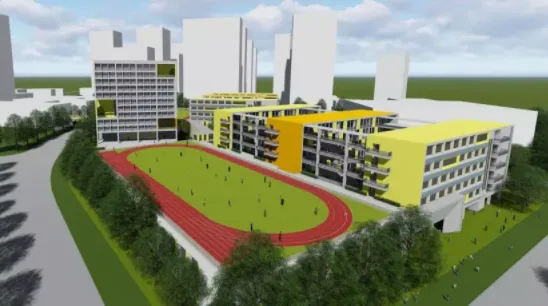
The Pingshan Three Schools Project marks Shenzhen’s first prefabricated school initiative. It faces two main challenges: limited land availability versus teaching demands, and a tight construction schedule. To overcome these, the project employs a high-density campus design alongside the EPC management model.
Design-wise, the project is driven by a “people-oriented, healthy campus” philosophy. It respects the natural environment and adapts to site conditions, integrating buildings and surroundings to create vibrant campus activity spaces.
The EPC model streamlines design, approvals, procurement, manufacturing, and construction phases, significantly shortening the timeline. Leveraging prefabricated building advantages enables rapid assembly, positioning the Three Schools Project as a benchmark for Shenzhen’s international school projects, standardized prefabricated schools, high floor area ratio developments, and BIM-driven high-quality school engineering.
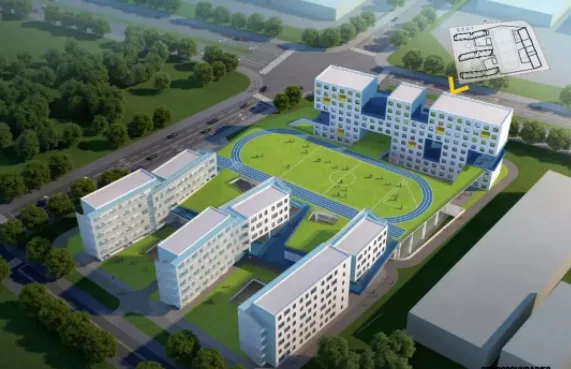
The total area of the Three Schools Project is nearly 250,000 square meters. The schools are scheduled to open for enrollment in August 2019, with full delivery of furnished buildings within a strict 9.5-month contract period.
To ensure high-quality and rapid construction, the project integrates innovations from the national 13th Five-Year Plan’s key industrial building design research. It adopts a prefabricated steel and concrete composite structural system, featuring innovative node connections and achieving an assembly rate of 86.5%, meeting the national 3A-level standard for prefabricated buildings.
This is the first school project in China to use such a prefabricated composite system and serves as a key demonstration project promoting school construction standardization in Pingshan District.
In April 2019, the Three Schools Project was officially designated a demonstration project under the National 13th Five-Year Key R&D Plan.
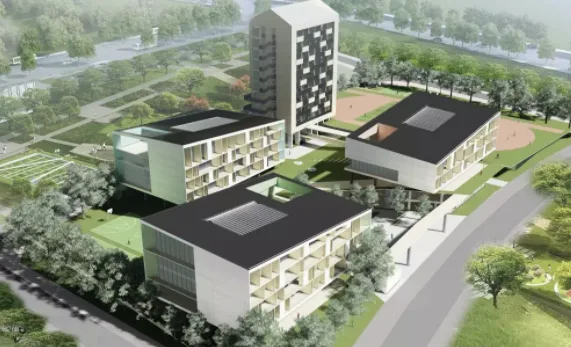
1. Project Overview
1. Pingshan Experimental School South Campus Phase II:
Located at the intersection of Lanzhu West Road and Xinhe Fourth Road, this project consists of two independent primary schools with a total of 72 classes (36 per school). The contract value is 579 million yuan.
Main construction includes teaching and auxiliary buildings, office facilities, living services, shared classrooms, theaters, dormitories, canteens, and basements.
The site covers 33,187 square meters, with a total construction area of 101,531 square meters. Building heights range between 23m and 49m, including six six-story office buildings and one 14-story dormitory building.
The project features 35,559 square meters of basic school buildings, 19,302 square meters of additional rooms and facilities, and a 26,374 square meter fully paved basement.
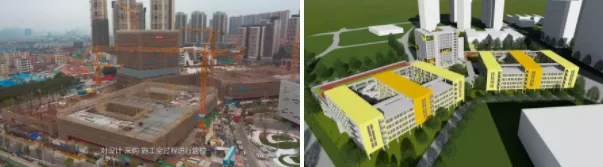
2. Jinlong School:
Situated at the intersection of Jinlong Avenue and Kehuan Road, Jinlong School plans for 36 primary school classes with an additional 6 reserved classes. The contract is valued at 334.8 million yuan.
The scope covers teaching and auxiliary buildings, office and living service buildings, shared classrooms, theaters, dormitories, canteens, and basements.
The site area is 16,172 square meters, with a total construction area of 54,465 square meters. Building heights range from 24m to 47m, featuring three six-story office buildings and one 12-story dormitory.
Basic school buildings cover 19,799 square meters, additional rooms and ancillary facilities 19,302 square meters, with a 15,363 square meter fully paved basement.
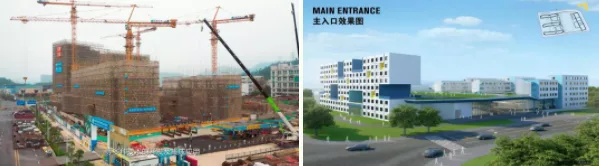
3. Zhukeng School:
Located south of Jinniu East Road and east of Chuangjing Road in Zhukeng, Pingshan District, this project borders affordable housing. It accommodates 48 classes for a nine-year integrated school (27 primary and 18 middle school classes).
The contract amount is 475 million yuan. Main construction includes teaching and auxiliary buildings, office and living service buildings, shared classrooms, theaters, dormitories, canteens, and basements.
The site covers 22,800 square meters with a building area of 75,715 square meters. Building heights range from 24m to 47m, comprising three six-story teaching buildings and one 12-story dormitory.
Basic school buildings cover 19,799 square meters, additional rooms and facilities 19,302 square meters, and a 15,363 square meter fully paved basement.
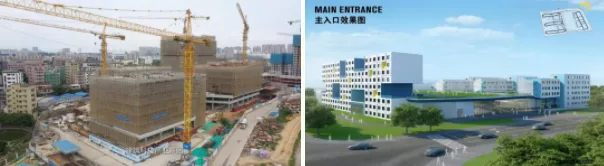
2. Design Highlights
1. Experimental School South Campus Phase II
- Designed with respect for the terrain and inspired by the concept of “academy culture,” the buildings align with the site’s topography, creating interconnected public activity spaces across districts and achieving organic integration of the entire campus.
- Teaching units are arranged in six rows, creating a “public three-dimensional” spatial experience that follows the gentle incline from north to south.
- Corridors and public activity levels link buildings to form cohesive functional zones, with the central area featuring a unique circular corridor and open activity space.
- Utilizing rooftops of large spaces such as stair classrooms and covered playgrounds, two elevated levels are created. A public activity platform on the third level expands green areas and social spaces. Teaching building groups are arranged inward, centered around courtyard layouts.
2. Jinlong School
- Due to terrain and space constraints, the school is designed as a “three-dimensional campus” to ease the psychological impact of high-density environments while maximizing functional space usage.
- Public playgrounds are elevated, integrating art and specialty classrooms within teaching and dormitory areas to create a multifunctional complex that serves as the campus core, activating the entire site.
3. Zhukeng School
- Inspired by the concepts of “comprehensive learning mode” and “3D social textbook,” the design promotes experiential teaching focused on students’ physical and mental development, featuring unique craftsmanship in classrooms and public spaces.
- Regular classrooms include silica-covered sound-absorbing ceilings. BIM tutorial rooms feature openable cork partition walls for flexible use of adjacent classrooms.
- Classroom furniture is adaptable to different needs. The large indoor staircase serves as a shared classroom and group activity space. Connected to the library, it also functions as a reading area, equipped with display walls for multimedia teaching.
3. Project Implementation Process
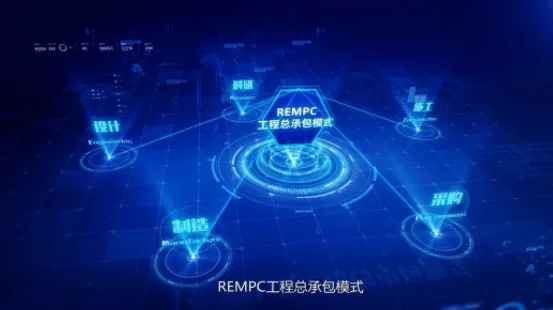
The REMPC management model and philosophy have been consistently applied throughout the construction of the Experimental School South Campus Phase II, Zhukeng School, and Jinlong School projects.
Research Phase
Innovations were made based on project requirements, developing technical systems such as standardized connection nodes for prefabricated steel-concrete composite structures, prefabricated card flanges, stairs, and dry work decoration systems, all of which have been implemented successfully.
Design Phase
Zhongjian Technology oversees unified control and management of architectural, structural, plumbing, HVAC, and other disciplines. Using BIM technology, the project employs collaborative design to enhance management efficiency.
Collision detection tools analyze design conflicts early, enabling timely corrections and preventing production and assembly issues. This process also helps control on-site progress and costs.
Manufacturing Phase
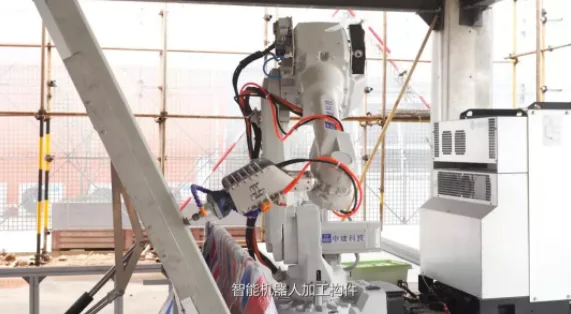
Prefabricated components such as temporary walls, floor tiles, site road paving, stairs, beams, slabs, columns, and exterior walls are produced by China Construction Technology’s proprietary Shenshan PC Factory, creating a full prefabricated construction industry chain.
This integrated approach ensures effective project cost, quality, and schedule management. Dedicated on-site management personnel oversee quality and production progress to maintain strict control over manufacturing.
Procurement Phase
Based on different EPC contract pricing models with the owner, targeted bidding strategies are employed for subcontractors. The China Construction Cloud Network facilitates a fast and efficient bidding process.

Construction Phase
The project team, led by the engineering and technical departments, collaborates with the business, design, and administrative offices to manage on-site quality, safety, progress, and costs comprehensively.
Each area has designated responsible personnel who coordinate with general contractors and subcontractors to address all issues effectively. This REMPC model has proven successful in achieving the project goals for all three schools.
4. Prefabricated Buildings
1. Technical Advantages
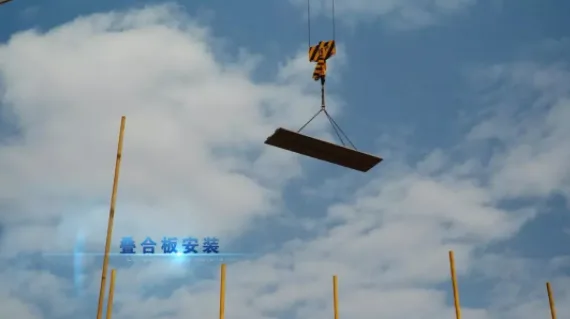
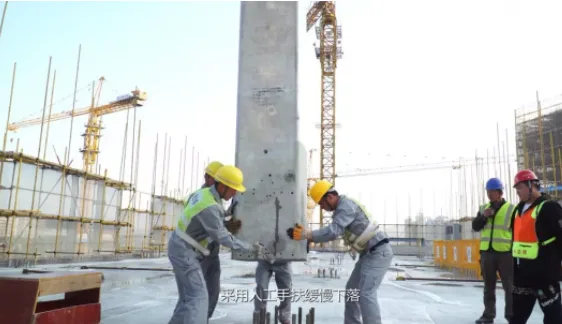
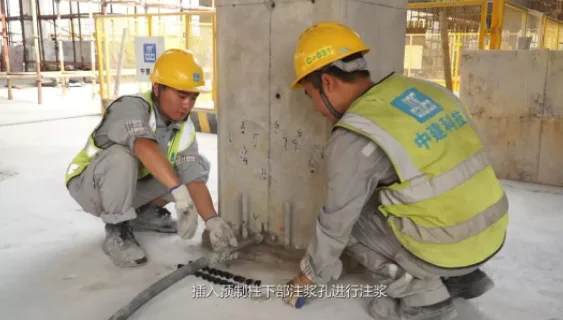
Prefabricated buildings are constructed by assembling factory-produced components on-site. Through standardized design, factory production, prefabricated construction, integrated decoration, and information-driven process management, the quality and efficiency of construction are significantly enhanced, promoting sustainable development.
This construction method represents a major shift, supporting supply-side structural reform and new urbanization. It helps conserve resources and energy, reduce pollution, improve labor productivity, and enhance safety and quality.
Furthermore, it fosters the integration of construction with information technology, cultivates new industries and economic drivers, addresses overcapacity, and advances sustainable social development.
2. Assembly Rates
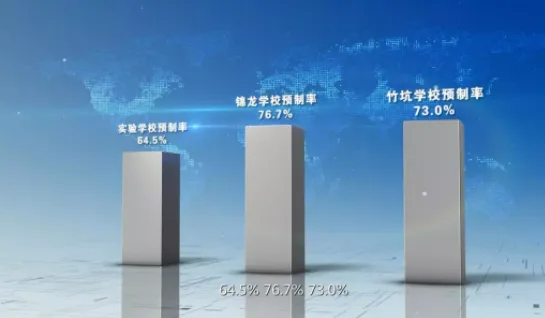
- Jinlong School: Three teaching buildings (3-1, 3-2, 3-3) use prefabricated construction. According to Shenzhen Prefabricated Building Rating Rules, their assembly rate is 72.1%, qualifying them as A-level prefabricated buildings.
- Zhukeng School: Teaching buildings 2#, 3#, and 4# are prefabricated, with a 78.0% assembly rate, earning an AA-level rating.
- Experimental School: Teaching buildings 2# and 3# implement prefabricated construction with a 77% assembly rate, also rated AA-level.

5. BIM Technology
Meaning of BIM Technology:
BIM (Building Information Modeling) is a data-driven tool applied to engineering design and construction management. It integrates comprehensive project information via parametric models, sharing and transmitting data across the entire lifecycle—from planning to operation and maintenance.
This enables engineers and technical teams to understand project details accurately and respond efficiently, facilitating collaboration among design teams, construction entities, and building operators. BIM significantly boosts productivity, reduces costs, and shortens construction timelines.
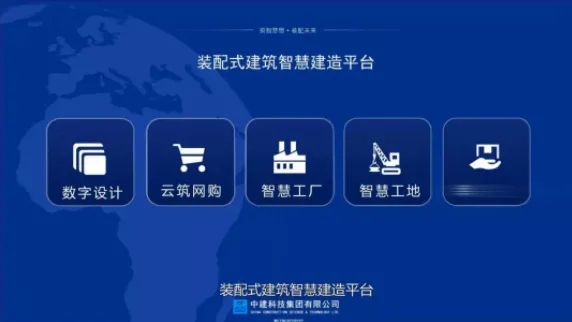
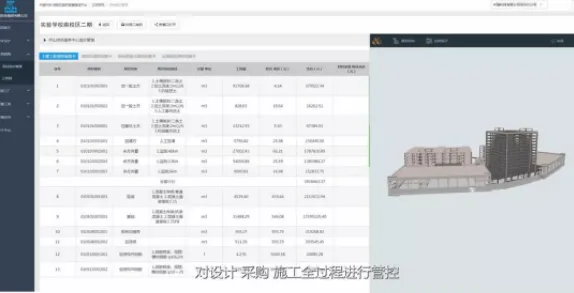
In this project, based on the EPC general contracting management model, BIM technology is used to oversee design, production, construction, and operation comprehensively.
Key BIM applications during the design stage include modeling, collision detection, quantity takeoffs, detailed prefabricated component design, performance-based design, and proprietary library creation.
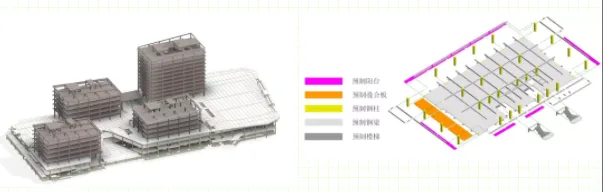
Prefabricated Component Assembly Diagram for Teaching Buildings 1# and 2#
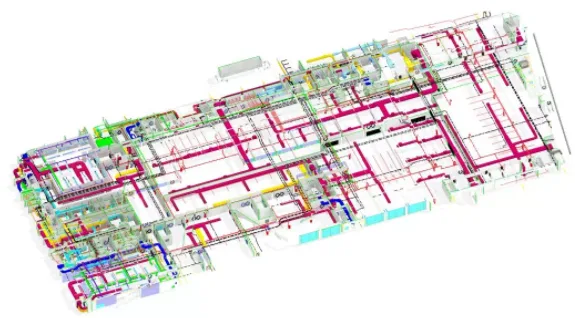
Using BIM for comprehensive pipeline design and collision detection (basement)
6. New Materials
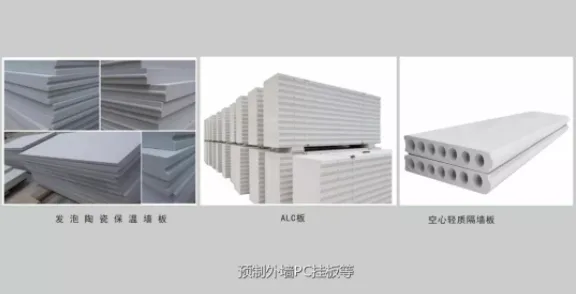
The three school projects incorporated innovative materials such as hollow concrete slabs, ALC (autoclaved lightweight concrete) slabs, and foam ceramic slabs.
The interior designs actively embrace new building assembly technologies promoted industry-wide. The design process thoroughly considers integration with material processing and assembly factories, as well as on-site construction requirements.
Many decorative materials and construction processes are factory-processed and assembled on-site, maximizing assembly rates. Hollow concrete slabs, ALC slabs, and foam ceramic slabs are precisely measured, laid out, and positioned on-site according to detailed design.
This off-site processing and on-site assembly approach improves production efficiency and minimizes material waste and environmental pollution typically caused by on-site cutting and processing.
Shenzhen Pingshan Three Schools Project Promotion Video
Aerial Photography of Pingshan Schools













Must log in before commenting!
Sign Up