
In the “Several Opinions of the Central Committee of the Communist Party of China and the State Council on Further Strengthening the Management of Urban Planning and Construction,” there is a strong call to vigorously promote prefabricated buildings. The policy encourages construction enterprises to engage in prefabricated construction and on-site assembly, while also increasing policy support. The goal is to have prefabricated buildings comprise 30% of new constructions within approximately 10 years.

In China, prefabricated buildings are rapidly emerging, much like mushrooms after rain. Although prefabricated construction is not a new concept globally, in China, this technology is still in its early stages. Currently, prefabricated buildings account for only about 5% of the total construction area. Many architectural design, construction, and supervision firms lack extensive experience with prefabricated building technology, and some professionals have not received adequate training. For these practitioners, adapting to new building technologies and construction environments poses significant challenges.
Prefabricated construction serves as a key indicator of industrial modernization, offering benefits such as speed, efficiency, and environmental friendliness. It represents a shift toward large-scale industrial production, making safety management especially critical compared to traditional, small-scale handcrafted construction methods.
Hazards are the root cause of production accidents and carry potential risks. By identifying hazards in engineering processes, stakeholders can be alerted to implement targeted safety measures and risk mitigation strategies. This approach helps focus safety investments and governance efforts more effectively, enhancing the rigor of safety inspections. Ultimately, this prevents hazards from developing into hidden dangers, eliminates accidents at an early stage, and achieves the goal of preventing accidents before they happen—thereby reducing casualties and property damage.
According to accident mechanisms, hazards can be classified into two categories: Class I hazards and Class II hazards (see Figure 1).
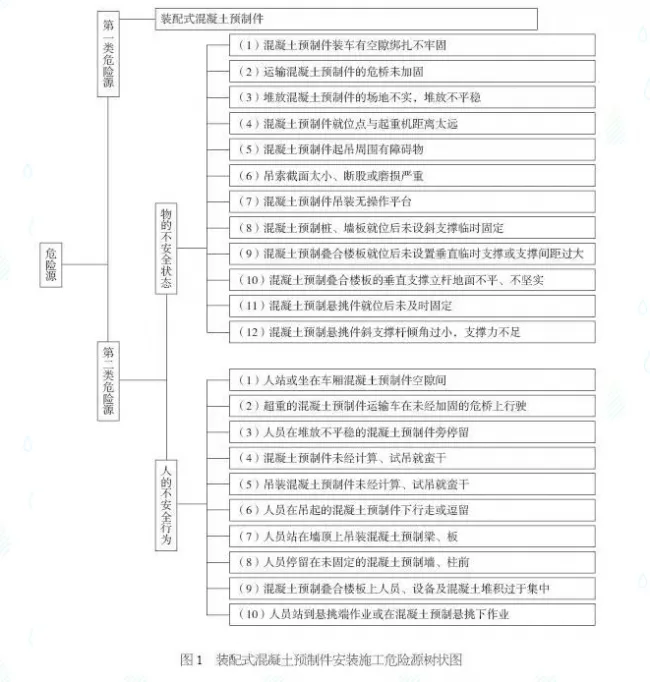
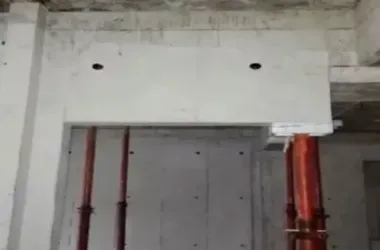
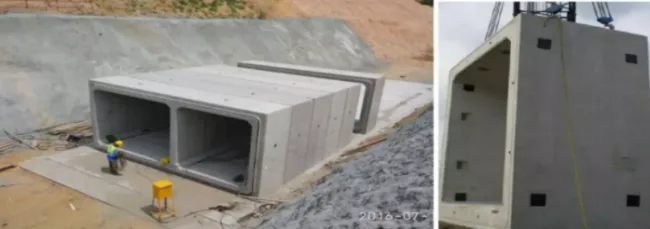
The first category of hazard refers to the potential accidental release of energy or hazardous substances, often involving physical entities. In this context, it relates to prefabricated concrete components, which include items such as wall panels, columns, beams, residential panels, roof panels, stairs, balconies, sun visors, canopy panels, air conditioning panels, eaves panels, daughter wall panels, railings, doors, windows, bathrooms, kitchens, storage rooms, ducts, ventilation shafts, and smoke exhaust ducts.
The second category encompasses various unsafe factors that lead to the failure or breakdown of constraints on energy or hazardous substances. The presence of this type of hazard determines the likelihood of accidents occurring. In other words, Class I hazards are necessary but not sufficient alone for accidents, while Class II hazards provide the sufficient conditions for accidents to happen in conjunction with Class I hazards.
As shown in Figure 1, Class II hazards are further divided into two subcategories: the unsafe state of objects and unsafe human behaviors. Here, “objects” include not only the prefabricated concrete components themselves but also related transportation, lifting equipment, construction facilities, tools, materials, and more. Accidents occur only when both unsafe object conditions and unsafe human actions coexist.
The above analysis focuses specifically on identifying potential hazards during the installation and construction phases of prefabricated concrete components. This work aims to advance safety production practices and provide stakeholders with a framework for graded control and preventive measures, ensuring safer construction sites.
Article source: Architectural Technology Magazine













Must log in before commenting!
Sign Up