
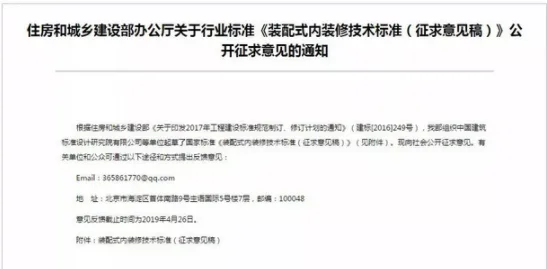
Recently, the Ministry of Housing and Urban-Rural Development of the People’s Republic of China released a draft for public consultation on the industry standard titled “Technical Standards for Prefabricated Interior Decoration (Draft for Comments)”. This document provides detailed guidelines on the technical standards for prefabricated interior decoration. Below is an excerpt focusing on the design requirements for integrated kitchens.
The design of integrated kitchens must adhere to the following regulations:
1. Integrated kitchens should be harmonized with the overall interior design and coordinated with structural systems, peripheral protection systems, public utilities, and pipeline infrastructure.
2. The design must consider ergonomic principles, ensuring a reasonable layout, and follow standardized, modular, and refined design practices.
3. Integrated kitchens should accommodate the needs of aging populations.
4. The design should facilitate easy maintenance and allow for future updates.
5. Kitchen dimensions must comply with the current national standard “Basic Parameters of Residential Kitchen and Related Equipment” (GB/T 11228) as well as the industry standard “Dimensional Coordination Standard for Industrialized Residential Buildings” (JGJ/T 445).
6. The kitchen layout can be configured in various styles, including single-row, double-row, L-shaped, U-shaped, or cabinet types. The net kitchen size should comply with modular coordination and standardized design requirements.
7. All kitchen elements such as sinks, stoves, range hoods, electrical appliances, cabinets, and wall-mounted units should be integrated and designed cohesively. Cabinets should align with prefabricated wall designs.
8. Kitchen furniture and cabinets must be securely fastened to walls, with additional reinforcement applied when attaching to lightweight partition walls.
9. Walls and floors within the kitchen should be constructed from easy-to-clean materials, with flooring being slip-resistant. Integrated cabinets should be made from fire-resistant, water-resistant, wear-resistant, corrosion-resistant, and easy-to-clean materials.
10. The decoration style of walls, floors, cabinets, and interior systems within the kitchen should be consistent, with particular attention given to the design of closure structure nodes.
11. The design of kitchen pipelines should be comprehensive. Except for gas pipelines, all others should be routed behind kitchen cabinets or within the ceiling space. Water meters, gas meters, water purification units, and similar equipment in residential kitchens should be centrally located for easy inspection and maintenance.
Furthermore, when the kitchen exhaust pipe passes through an exterior wall and discharges horizontally outside, it must comply with oil fume purification efficiency and emission standards. Reliable measures should be implemented to prevent oil fume contamination on the building’s exterior walls.













Must log in before commenting!
Sign Up