
The term “No Waste City” emerged as a new buzzword in the construction industry in 2019. Recently, the Notice of the General Office of the State Council on Issuing the Pilot Work Plan for the Construction of ‘Waste Free Cities’ (hereafter referred to as the “Notice”) provided detailed standards and requirements. After careful review, it is clear that the construction industry plays a crucial role in achieving a waste-free city.
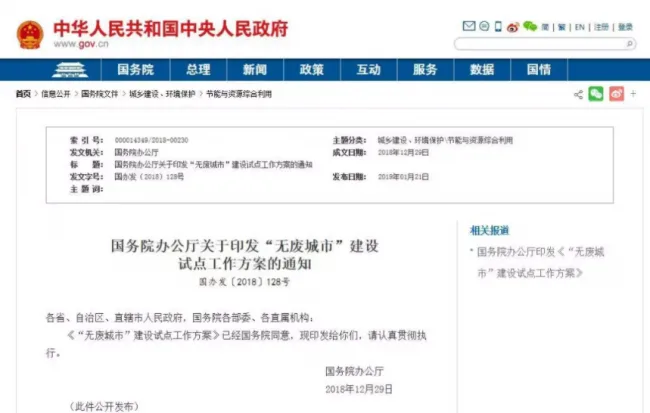
1. Led by Multiple Ministries with Clear Responsibilities and Authority
The “Pilot Work Plan for the Construction of ‘Waste Free Cities'” outlines six main tasks, many directly related to the construction sector.
(1) Strengthen Top-Level Design and Leverage Government Macro-Guidance
An indicator system for the construction of a “waste free city” will be established to guide and lead efforts. By June 2019, research will set up a construction indicator system focused on solid waste reduction and recycling rates, integrating it with green development and ecological civilization assessment systems. A robust solid waste statistics system will also be established, standardizing the scope and methods for industrial solid waste data collection, and enhancing statistics for agricultural and construction waste. This initiative is led by the Ministry of Ecology and Environment with participation from the National Development and Reform Commission, Ministry of Industry and Information Technology, Ministry of Housing and Urban-Rural Development, Ministry of Agriculture and Rural Affairs, and the National Bureau of Statistics.
The plan calls for strengthening institutional policy integration and innovation to enhance the systematic nature of pilot programs. It includes implementing reforms from the Overall Plan for Ecological Civilization System Reform and integrating policies related to circular economy, clean production, resource utilization, and rural revitalization. Pilot cities will develop implementation plans for “zero waste cities,” aligning with urban construction and management, clarifying reform tasks, and promoting systematic, collaborative reforms across related fields. This effort is guided by multiple ministries including Ecology and Environment, Development and Reform, Industry and Information Technology, Finance, Natural Resources, Housing and Urban-Rural Development, Agriculture and Rural Affairs, Commerce, Health Commission, and the National Bureau of Statistics.
Furthermore, urban development will be coordinated with solid waste management to optimize industrial structure layout. This includes surveying regional solid waste utilization and disposal capacity, strictly controlling projects that generate large amounts of solid waste without effective utilization or harmless disposal, and building hierarchical and circular resource and energy utilization systems across industry, agriculture, and daily life. Material flow analysis will promote circular economy industrial chains for prefabricated assembly within and between enterprises and regions. Urban infrastructure planning will clearly define support capacity for solid waste classification, collection, and harmless disposal—including household waste, sewage sludge, construction waste, tires, hazardous waste, agricultural waste, and scrapped vehicles—to ensure adequate land use for related facilities. This is coordinated by the National Development and Reform Commission, Ministry of Industry and Information Technology, Ministry of Natural Resources, Ministry of Ecology and Environment, Ministry of Housing and Urban-Rural Development, Ministry of Agriculture and Rural Affairs, and Ministry of Commerce.

(4) Promote Green Lifestyles and Encourage Reduction and Recycling of Household Waste at Source
Construction waste management will be enhanced to improve source reduction and resource utilization. Understanding the current status and trends of construction waste generation is a priority, along with managing the entire lifecycle of construction waste. This includes better planning for transportation, consumption, disposal, and recycling facilities, accelerating facility construction to meet urban development needs, and conducting stockpile management with ecological restoration where applicable. In suitable areas, resource utilization will be promoted to improve the quality of recycled construction waste products. These efforts are led by the Ministry of Housing and Urban-Rural Development, National Development and Reform Commission, and Ministry of Industry and Information Technology.
(6) Stimulate Market Vitality and Cultivate New Industrial Development Models
Incentive and constraint mechanisms will be accelerated to encourage solid waste reduction, resource utilization, and harmless treatment. Government-invested public projects will prioritize using comprehensive utilization products derived from bulk industrial solid waste and promote green building materials such as new wall materials. The plan explores mandatory use of building waste resource utilization products, clarifying quality requirements, application scope, and usage proportions. This is guided by the National Development and Reform Commission, Ministry of Industry and Information Technology, Ministry of Housing and Urban-Rural Development, and State Administration for Market Regulation.
From the above, it is clear that significant progress is expected in statistics, treatment, and supervision of construction waste, along with advances in reuse and harmless processing methods.
2. Green Construction Requires Information Management
The Notice calls for the development of an “Internet plus” solid waste treatment industry, promoting new recycling technologies and models. It encourages cooperation between manufacturers and distributors, optimizes reverse logistics systems, supports renewable resource recycling enterprises in establishing online trading platforms, improves offline recycling outlets, and integrates online waste exchange with offline collection.
An information exchange mechanism between government solid waste environmental management platforms and market-oriented solid waste public trading platforms will be established. Technologies such as the Internet of Things and GPS will be leveraged to realize information-based and visualized processes for solid waste collection, transfer, and disposal, improving supervision efficiency and management levels.
In the digital age, the solid waste treatment industry is expected to develop in a more scientific and orderly manner, with industry enterprises distributed along the industrial chain. Effective waste disposal requires addressing the source, intervening early to reduce downstream burden and improve processing efficiency.
The Notice also emphasizes implementing green design and green supply chain construction to promote solid waste reduction and recycling. Green design will be vigorously promoted to improve product disassembly and recyclability, reduce toxic and harmful raw material use, and cultivate green design demonstration enterprises. Green supply chain management will be advanced by leveraging the influence of large enterprises and retailers to foster demonstration enterprises with low solid waste generation and high recycling rates.
3. Time Is Pressing and Urgent
The Notice outlines pilot objectives and scope. While the exact cooperation models, leading enterprises, and technologies that will emerge in the next two years are unpredictable, the construction industry is set to move towards greener, more scientific, and economical development.
(1) Pilot Objectives
By 2020, an indicator system for “waste free city” construction will be established, along with comprehensive management and technical systems. Pilot cities are expected to make significant progress in key areas of solid waste management. Goals include near-zero growth in total storage and disposal of bulk industrial solid waste, full utilization of major agricultural waste, comprehensive improvement in household waste resource utilization, full implementation of hazardous waste safety controls, and zero illegal solid waste transfer or dumping incidents. Several backbone enterprises specializing in solid waste resource utilization will be cultivated. By deepening solid waste comprehensive management reforms in pilot cities, summarizing pilot experiences, and creating replicable and promotable demonstration models, a solid foundation will be laid for promoting a “waste free society.”
(2) Pilot Scope
Approximately 10 cities nationwide, selected based on conditions, foundation, and scale, will carry out city-wide pilot projects for “zero waste cities.” Selection will consider regional differences, development levels, industrial characteristics, and local government enthusiasm. Priority will be given to cities in provinces meeting criteria for national ecological civilization pilot zones, circular economy demonstration cities, industrial resource comprehensive utilization bases, and cities with positive results in pilot projects for harmless disposal and recycling of various solid wastes.
4. Prepare Early and Align with Industry Benchmarks
Since the pilot phase is expected to complete by 2020 and may expand if requirements are met, construction companies must prepare early. They should actively follow industry benchmark enterprises, identify gaps, and introduce both “software” and “hardware” improvements.
“Software” refers to organizational elements such as green construction management systems, standards, and cooperation frameworks. Emphasis should be placed on construction waste treatment—both maximizing recycling and reuse to recover residual value and actively collaborating with solid waste treatment enterprises through strategic partnerships to lead waste treatment efforts.
“Hardware” refers to green construction technologies. Currently, construction industrialization includes waste recycling technologies such as recycling steel bar waste, scrap wood, and formwork, alongside green construction methods mainly focused on the “Four Saves and One Environmental Protection” principle. However, many promising areas remain for research and experimentation, including “smart construction,” “Internet Plus + Big Data Supervision,” and others. These innovations aim to reduce costs, improve environmental outcomes, and support sustainable enterprise operations.













Must log in before commenting!
Sign Up