
BIM Software Tip: How to Achieve the Perfect Fusion Effect in a REVIT Family
Most users start by using the fusion command in REVIT, and I initially tried a simple fusion myself. However, the default fusion result often falls short of expectations, so I made some adjustments to improve it.
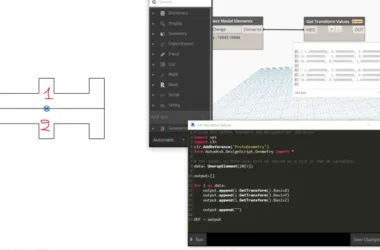
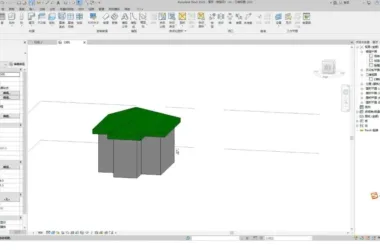
1. To begin, I fused a rectangle and a circle (see Figure 1). Upon closer inspection, I noticed that the four corners of the rectangle were merged with two points on the circle’s diameter. When viewed in 3D, the fusion effect was clearly not ideal. So, how can we improve this?
2. Let’s consider the principle behind this. The fusion connected the rectangle’s four corners with just two points on the circle, which means these connections weren’t at the closest distances. For the most seamless fusion, each corner of the bottom shape should be positioned as close as possible to the contour of the shape above. Unfortunately, this can’t be achieved simply by editing vertices.
3. The correct approach starts with positioning reference planes. Then, identify the closest intersection points between the rectangle’s corners and the upper contour. Use the break function to split these points, and then adjust them using the edit vertex or low point tools until the desired fusion effect is achieved.
Finally, adding additional points to both the bottom and top contours can further enhance the fusion quality, as illustrated in the figure below:













Must log in before commenting!
Sign Up