
1. Project Overview
Basic Project Information

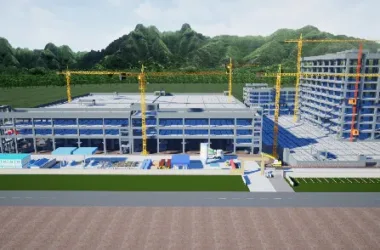
Rendering of the Beijing Urban Sub Center Administrative Office Area
The Beijing Sub Center Administrative Office Area is situated in Lucheng Town, Tongzhou District. The project mainly consists of office buildings divided into Areas A, B, C, and D, among others. The Engineering Construction Office, acting on behalf of the Municipal Party Committee and Government, is responsible for unified supervision throughout the construction process of multiple projects. The general contractors involved are Beijing Urban Construction Group, Beijing Construction Engineering Group, Beijing Housing and Urban Rural Development Group, and China Construction First Engineering Bureau.
Project Challenges
- Large scale and tight schedule: For example, in Project A1, it takes only 92 days to complete all main structures for a single project, reaching 61 underground flow sections. Even during winter, construction must maintain a pace of “four days per floor” for above-ground structures.
- Frequent drawing revisions: Due to the project’s size and complexity, changes to drawings occur often and are hard to coordinate uniformly across specialties.
- Numerous subcontractors: With 35 subcontracting engineering units per project, including comprehensive mechanical and electrical specialties, coordination and control are challenging. The pipeline layout is complex, with many reservations and embedded components.
- Complex and oversized spaces: Project A1 features a sloped curved roof with a 41° inclination, 160m in length, 40.5m wide, and a height of 6,300 square meters, all constructed during winter. There are also 20 over-limit structures, requiring high standards for formwork construction.
Application Objectives
- Technical Management: Deploy construction and control technical quality based on project characteristics. Develop technical solutions for complex steel structures and establish mechanisms for collaborative and on-site management.
- Talent Development: Train BIM modeling professionals capable of establishing models in civil, mechanical, electrical, and decoration fields. Develop BIM management personnel to coordinate all parties for collaborative management using the platform.
- Methodology and Verification: Standardize institutional construction, information resource management, and technical execution processes to unify actions and ensure data consistency across disciplines.
- Exploring New Technologies: Develop a multi-project intelligent supervision platform for centralized management of progress, design, quality, safety, labor, and materials. Achieve statistical analysis based on real-time data to enhance supervision capabilities.
2. BIM Application Solution
BIM Application Content
- Utilize BIM technology for 3D construction site layout and planning to address tight schedules and complex on-site arrangements.
- Create specialized 3D models for building structures, HVAC, electrical, plumbing, etc. using software such as Revit and MagiCAD, and conduct collision checks to resolve frequent changes and conflicts in drawings.
- Simulate construction plans with BIM’s visualization features, providing intuitive and accurate plan disclosure for complex nodes.
- Use BIM5D software for flow segment division and schedule association, visually expressing construction progress to ensure timely project completion.
- Apply BIM+cloud technology to manage large volumes of construction data and facilitate coordinated control.
BIM Application Planning
- Software Configuration: Project departments purchase modeling software such as Revit, Tekla, ArchiCAD, and MagiCAD for accurate modeling and comprehensive integration. For collaborative management, Guanglian Da BIM5D and related platforms are used.
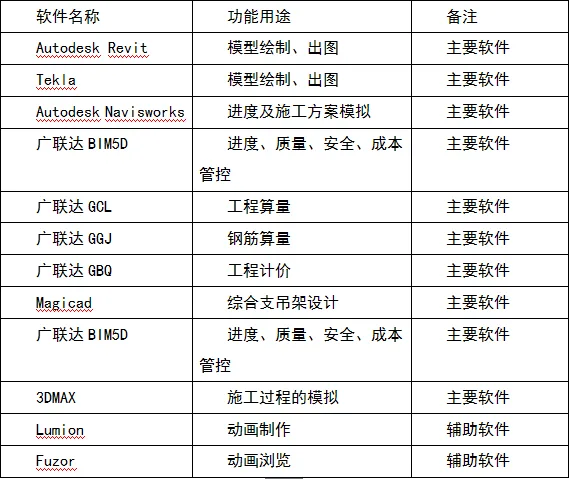
- Organizational Structure:
- The Engineering Construction Office acts as Party A’s representative, overseeing multiple projects and coordinating BIM resources.
- General contractors establish BIM centers staffed with modeling and platform management personnel from various specialties.
- Guanglianda Technology Co., Ltd. supports training and promotes BIM application in project departments.
- All professional subcontractors have dedicated BIM technicians to support general contractor implementation.
- Application Sequence: Establish a collaborative management organization led by the engineering office. Each project acquires necessary software and equipment, cultivates BIM talent, and implements biweekly meetings and accountability systems to ensure smooth application.
3. BIM Implementation Process
BIM Application Preparation
- Regular Meetings: The engineering office has instituted a strict biweekly meeting system, assigning responsibility for BIM modules to each project. This ensures regular progress summaries and timely problem-solving, facilitating effective implementation across all parties.
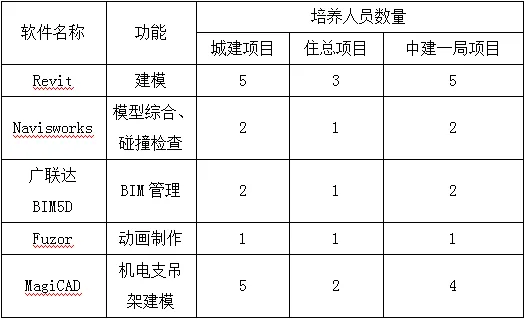
- Software Training: Training is conducted for general contractors and organizational systems on professional software such as Revit, Navisworks, Magicad, Fuzor, Lumion, BIM5D, etc., resulting in a skilled workforce proficient in BIM modeling and coordination management.
- Model Creation: BIM technology is used to create building, structural, mechanical, electrical, steel structure, and curtain wall models, laying the foundation for subsequent BIM applications.
BIM Application Process
- 3D Site Layout: BIM enables three-dimensional site planning, facilitating the early detection of safety hazards and preventing construction issues. This minimizes secondary handling and solves scheduling and layout difficulties.
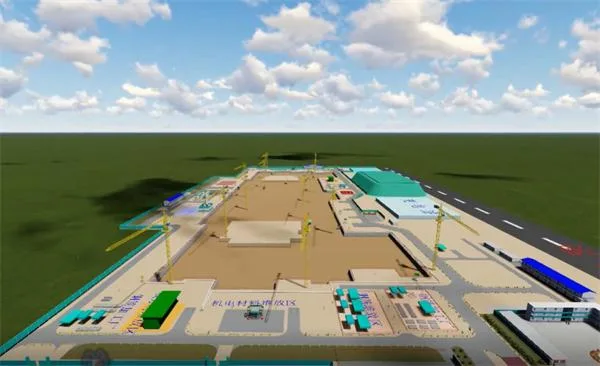
3D field layout
- Collision Detection: Using Revit, MagiCAD, and other software, multidisciplinary 3D models are created for optimization discussions. Based on collision detection reports, models are adjusted to meet construction requirements, especially for key pipelines and critical components.
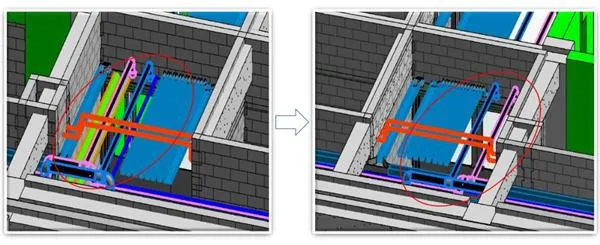
Weak current cable tray layout
- Reserved Hole Setting: Traditionally, reserved holes for mechanical and electrical pipelines are scattered across drawings, leading to omissions and inaccuracies. By using MagiCAD, reserved holes can be quickly and accurately generated, avoiding secondary drilling, saving time and resources, and improving site organization.
- Construction Plan Simulation: BIM visualization simulates construction plans, especially complex nodes such as inclined roof trusses, providing precise and intuitive disclosure. Construction steps and animations facilitate understanding and ensure construction quality.
- Progress Control: Project A1 includes 61 underground and 39 above-ground structure flow sections. BIM5D software is used for flow segment division and schedule simulation. Comparing planned and actual progress enables timely analysis and corrective actions, ensuring project completion.
- Automatic Brick Laying: With a tight schedule and large volume, traditional CAD brick laying is inefficient. BIM5D automates brick arrangement, adds structural columns, ring beams, and openings, and allows fine adjustments. Efficiency improved tenfold, costs reduced by 3%, and construction quality enhanced.
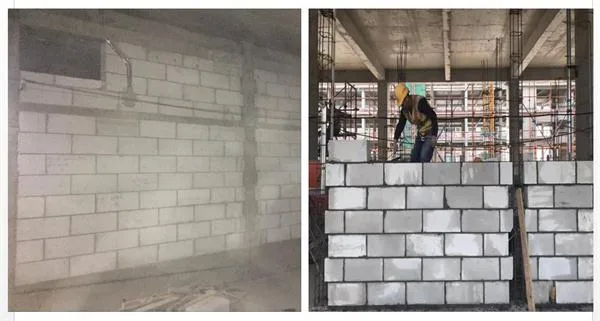
On-site brick arrangement effect
- Data Collaboration: Large volumes of construction data require improved management. Traditional data management is often delayed and lacks structure. BIM+cloud technology allows real-time uploading and structuring of data such as drawings, safety information, and meeting minutes, ensuring authenticity, timeliness, and permanent storage.
- Quality and Safety: The project’s scale and number of participants present many quality and safety challenges. BIM enables real-time issue reporting via mobile devices, uploading problems to the cloud for immediate visibility and analysis. This supports timely management decisions and reduces disputes.
- Smart Engineering Management Platform: The smart supervision platform integrates technical processes with actual management methods. It consists of three layers:
- Application Layer: Used by project departments for BIM5D management, labor, material, equipment, technical quality, and safety management. Utilizes RFID, sensors, cameras, and smart devices for real-time monitoring and data collection.
- Control Layer: The command center’s unified supervision platform integrates business data from all projects, establishing modules for progress, labor, quality, safety, and intelligent monitoring.
- Display Layer: Aggregates models, data, and videos from different platforms, presenting construction status and analysis visually for upward reporting.
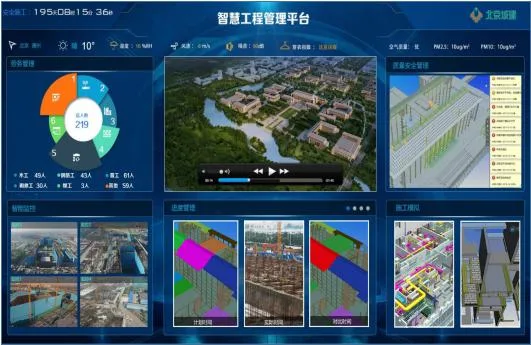
Smart Engineering Management Platform
4. Summary of BIM Application
1. Summary of Application Effects
- BIM 3D modeling and visual disclosure were used to control key part quality, refine engineering quantity calculations, and trace material usage. This resulted in significant improvements in cost, quality, and schedule.
- In Projects B1 and B2, 8,129 collision checkpoints were identified through multidisciplinary design inspections, saving 35 days in construction and reducing costs by 7.5 million yuan.
- For Projects A3 and A4, BIM application improved comprehensive effects by about 5 percentage points over targets, achieving 84 hours of structural construction per floor and accumulating nearly 3 million yuan in cost savings.
- Thanks to BIM achievements in this project, all general contractors received the Beijing BIM Application Benchmark Project title and excelled in competitions such as the China Construction Engineering BIM Competition, promoting BIM in other company projects.
2. Summary of BIM Application Methods
- Developed BIM model standards and management methods, including steel structure modeling standards, BIM model management standards, BIM technology implementation plans, civil engineering model guidelines, modeling workflows, mechanical/electrical modeling guidelines, and 3D design schemes.
- Focused on BIM talent development: training professionals capable of independent modeling in civil, mechanical, electrical, and decoration fields, and cultivating BIM managers for collaborative project management. These core personnel support BIM promotion in future projects.
- Standardized management coordination across projects:
- Institutional Construction: Established management system and information usage standards, clarified processes and responsibilities, and ensured law-based management.
- Information Resource Standardization: Unified coding for project structure, organization, and documents. Established business data and interface standards to enable data exchange between platforms.
- Process Standardization: Unified technical execution, including data collection methods, hardware specifications, information sharing and network requirements, platform integration, and BIM model usage standards.












Must log in before commenting!
Sign Up