
Complex construction conditions are a defining feature of building engineering projects. They often present significant challenges during construction and can negatively impact safety and project quality. Despite these complexities, careful analysis, adaptation to local circumstances, and making full use of favorable on-site conditions can help overcome these challenges. By thoroughly considering safety, quality, and economic factors, developing effective construction plans, and rigorously implementing them, difficulties can be resolved successfully. Below, I share three case studies for discussion and mutual learning.
Case One
After completing the concrete frame structure of a deflection coil factory in Shaanxi, the exterior walls on both sides lacked enclosure, and all four floors housed lightweight, fully automatic mechanical equipment. The equipment consisted of vertical refrigerators and cabinet air conditioners, measuring 2.7 meters in height, with weights ranging from 1 to 4 tons. Each floor contained 13 to 15 units, and the owner imposed strict requirements prohibiting horizontal lifting of the equipment. Although a 20-ton truck crane was parked beside the workshop, it was not allowed for direct use.
The author visited the site to measure the clear height next to the outer wall and the maximum vertical dimension of the equipment. The vertical gap between the equipment’s top and the frame beam was only 10 cm. To address this, a suspender was installed on the middle concrete column, fastened at the bottom with steel wire ropes but capable of rotation. It was protected at the column corner, with a chain block attached at the top, allowing vertical movement, angle adjustment, and rotation. A 3-ton winch was installed on the ground.
After installation, a trial lift was conducted with equipment of similar height and weight (5 tons), which was successful. The major challenge was maneuvering the equipment smoothly indoors when lifted to the predetermined height, as its center of gravity was outside. When lifted to the calculated height, the equipment paused. To resolve this, a soft rope was tied around the equipment’s waist, and a 48 steel pipe was placed beneath its edge. Two people then gently pulled the rope, allowing the equipment to slide smoothly into the building. Although the owner requested completion within a week, the task was finished in just 2.5 days.
Case Two
The Hanzhong Commercial and Trade Center in Shaanxi is surrounded by multi-story buildings on all sides: a 6-floor building to the east and 4-floor commercial buildings to the south, north, and west. The commercial center features a ceiling with a 2.4-meter-wide passage near a skylight on the east side. Five columns support the skylight, connected at the top by concrete beams measuring 240mm × 300mm. On the west side is a 20-meter-wide, 4-story flat roof with 1.2-meter-wide skirt wall assembly structures on the west, south, and north sides. Five symmetrical concrete columns embedded with bolts fix the steel roof truss at the top. The roof spans 17.6 meters east-west and 26 meters north-south, with column top elevation at 18.000 meters. The steel roof truss to be installed is 3.8 meters high, weighs 2.4 tons, and is topped with lightweight square steel pipe purlins and glass. The south and north roofs are of equal height and connected to the west roof, which is 8 meters wide.
The challenges for installing the steel roof trusses included:
- Large gates on the south side and a small gate on the north, preventing access by an 8-ton truck crane.
- The surrounding buildings limited space, making it impossible to use a 50-ton crane for outside lifts.
- Setting up a single-legged mast was uneconomical due to material shortages, low workload, and high labor and time demands.
- Full scaffolding could solve the lifting problem but was expensive and labor-intensive due to its large area and high installation height.
After thorough on-site inspection, the west roof provided ample space for steel roof truss fabrication and installation:
- After fabricating the roof truss, two 150mm diameter steel pipes were placed on the floor. Several workers lifted the top of the roof truss and pushed it toward the northern section.
- On the roof, two wooden boards (3m long, 250mm wide, 50mm thick) were placed diagonally. The steel roof truss was lifted against the wall and then erected. A sliding rope was tied at the top and pulled from both north and south sides to stabilize the truss during installation.
- A channel steel was placed on each east-west concrete beam on the roof with the plane facing down, allowing the steel roof truss to be easily pried into position. Once the first steel roof truss was securely fixed, subsequent trusses were installed in the same efficient manner.
This method ensured the entire lifting process was safe, fast, labor-saving, and economical.
Case Three
A factory building suffered severe damage from an earthquake and required reinforcement. While the concrete columns in the workshop remained intact, the roof truss was damaged and needed replacement with a new steel structure. The workshop was 14.5 meters wide. To ensure the building’s overall safety, a “steel vest” reinforcement was required on the upper part of the concrete columns supporting the crane. The steel vest weighed 380 kN, exceeding the lifting capacity of the bridge crane. The truck crane could not enter, and ground equipment could not be removed.
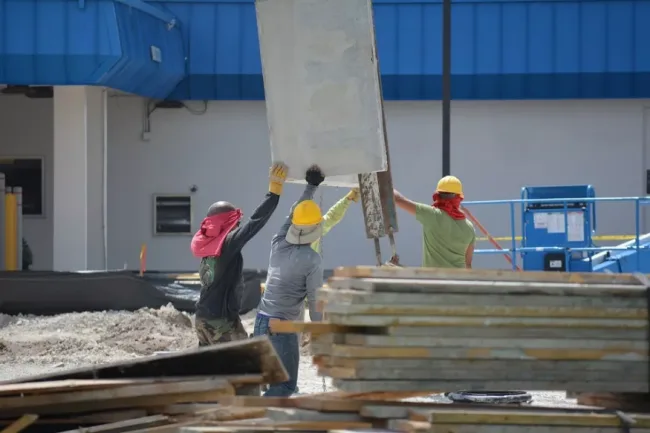
Initially, manual lifting, dragging, and pulling were used to reinforce two columns. Although several dangerous situations occurred, no accidents took place. The author carefully measured all dimensions on site, developed a construction plan, and held a briefing with six workers.
A 1-ton small winch was installed opposite the reinforced column, with a pulley system threaded and secured to the upper end of the reinforcement. Two workers hung the pulley system firmly on the “steel vest,” while two others clamped and fixed it with bolts. One person operated the winch on the ground, and another hooked the steel roof truss to prepare for lifting and assisted in moving the winch.
On the first day, it took only six hours to test lift and install reinforcements on six columns. On the second day, twelve columns were reinforced. The project was completed safely, quickly, and with high quality.
Article source: Architectural Technology Magazine













Must log in before commenting!
Sign Up