
The use of frame structure systems is widespread in engineering, with frame columns serving as crucial load-bearing elements within these systems. While specifications and drawings provide detailed guidance on the construction of steel reinforcement for frame columns in reinforced concrete structures, practical challenges often arise due to varying skill levels among construction personnel. This article offers a comprehensive overview of the selection, batching, processing, assembly, connection, and installation of steel bars for frame columns.
(1) Longitudinal Steel Bars for Frame Columns
1. Steel Bar Selection
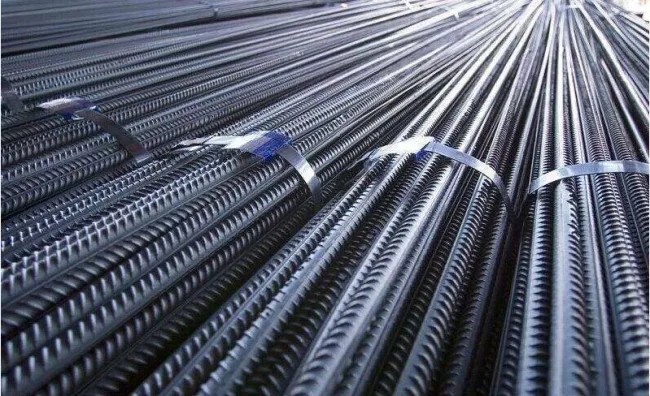
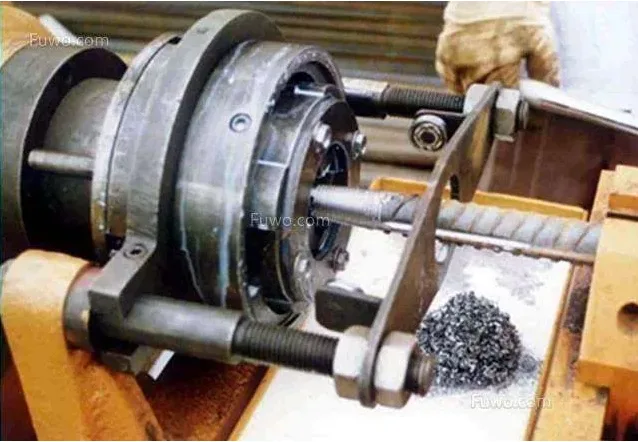
Before fabricating steel bars, selecting appropriate raw materials is essential. Steel bars must comply with design drawings regarding size and grade. After confirming the specifications and prefabrication level, the steel bars’ surface quality must be inspected. Any bars with dirt, oil stains, rust, or other defects should be rejected. If necessary, surfaces must be thoroughly cleaned. For light rust, removal can be done using wire brushes or cold drawing techniques.
2. Steel Bar Length Determination
The length of longitudinal steel bars in frame columns is primarily determined by the positioning of steel bar joints, following the standards outlined in the 05 Series Jiangsu Province Engineering Construction Standard Design Atlas “Common Node Atlas of Building Structures” (Su G01) and the “Drawing Rules and Construction Details of Concrete Structure Construction Drawing Plan Overall Representation Method” (03G101-1).
For cutting lengths below the longitudinal steel bar joint at the bottom of the frame column:
L ≥ Lae + Hn/3 (Formula ①)
For cutting lengths below the longitudinal steel bar joint at the bottom of the frame column with staggered joints:
L ≥ Lae + Hn/3 + l (Formula ②)
For cutting lengths above the longitudinal steel bar joint of the floor frame column:
L ≥ H (Formula ③)
Where:
- Lae: Anchorage length within the foundation;
- Hn: Net height from the top of the foundation to the bottom of the upper frame beam;
- l: Required staggered distance between steel bar joints;
- H: Height of each upper floor.
Note: Different joint types require varying staggered heights; refer to the third item for details. When calculating cutting lengths below the longitudinal steel bar joint at the bottom of the same frame column, half of the steel bars should be calculated using Formula ①, and the other half with Formula ②.
(2) Frame Column Hoop Reinforcement
1. Reinforcement Processing
According to the “Code for Acceptance of Construction Quality of Concrete Structures” (GB50204), stirrup ends must be hooked unless they are welded closed, with hooks conforming to design specifications. If unspecified, the following guidelines apply:
(1) Hoop hook bending angles should be no less than 90° for general structures and 135° for seismic-resistant structures;
(2) The inner radius of the hook bend must be at least four times the steel bar diameter and not less than the diameter of the tensioned bar;
(3) The straight length after bending should be at least five times the stirrup diameter for general structures and ten times for seismic structures.
2. Cutting Length of Hoop Reinforcement
The cutting length of hoop reinforcement is calculated as the sum of the inner circumference of the hoop, an adjustment value for fitting, and the additional length for bent hooks.
3. Hoop Reinforcement Configuration
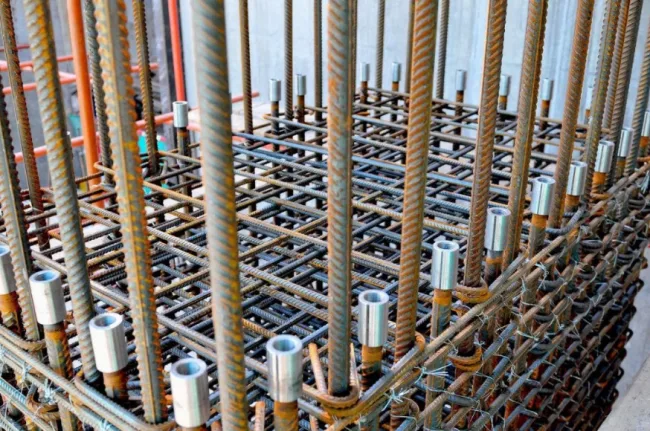
The type of hoop reinforcement depends on the number of longitudinal bars within the frame column. The typical rectangular composite hoop reinforcement method includes:
(1) Around the perimeter, local overlapping of hoop reinforcement should not exceed two layers. The outermost closed hoops are supplemented with transverse hoops below or above and longitudinal hoops positioned accordingly inside the column.
(2) Composite hoops inside the column can be reinforced with tension bars, which must hook both the longitudinal bars and the peripheral hoops.
(3) To limit hoop overlap to two layers at the edges, adjacent hoops can be staggered vertically based on their plane positions.
4. Reinforcement Placement
Hoop reinforcement placement for frame columns must follow the design drawings and comply with the “Drawing Rules and Construction Details of Concrete Structure Construction Drawing Plane Integral Representation Method” (03G101-1), along with these requirements:
(1) Stirrups at frame column corners must be densely spaced along the full height;
(2) The reinforcement zone at the bottom part of the frame column must cover at least one-third of the net height between the foundation top and the bottom of the upper frame beam;
(3) The reinforcement zone at the upper part of the bottom frame column and at the top and bottom of other floor columns must be at least one-third of the column’s net height, no less than 500 mm, and not less than the column’s maximum long-side dimension;
(4) If longitudinal bars are joined by binding on each floor, stirrups must be densely arranged within the connection zone.
(3) Connection of Longitudinal Steel Bars in Frame Columns
1. Connection Types
Longitudinal steel bars are connected using one of three methods:
- Binding connection;
- Mechanical connection, including sleeve and cone-thread connections;
- Welding connection, such as electric slag pressure welding, flash butt welding, lap welding, and tie bar welding. Note that electric slag pressure welding is suitable only for vertical components.
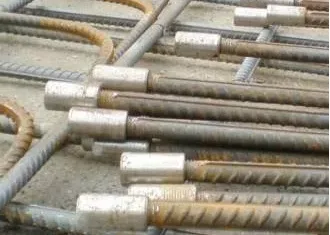
Among these methods, binding connection is the most common for small to medium bars, sleeve connection is widely used in mechanical joining, and electric slag pressure welding is preferred for medium to large diameter bars. Each connection type comes with specific quality standards.
According to the “Code for Acceptance of Construction Quality of Concrete Structures” (GB50204), overlapping length for binding longitudinal bars should be between 1.2 to 1.6 times the anchorage length, depending on the overlap percentage. For 50% overlap of stressed bars, a factor of 1.4 applies. Bars must be tightly tied at both ends and the midpoint of the overlap.
Per China’s industry standard JGJ18, electric slag pressure welds must meet these criteria:
(1) The weld’s protrusion height should be at least 4 mm;
(2) The steel bar and electrode contact area must be free of burn defects;
(3) The joint bending angle must not exceed 3°;
(4) Axis offset at the joint must be less than 0.1 times the bar diameter and no more than 2 mm.
When choosing a connection method for longitudinal steel bars, factors like construction machinery, personnel skill level, and site conditions must be considered to select a reliable, cost-effective, user-friendly, and technically mature solution.
2. Connection Requirements
Per the “Code for Design of Concrete Structures” (GB50010) and “Drawing Rules and Construction Details for Overall Representation of Concrete Structure Construction Drawings” (03G101-1), the following connection requirements apply:
(1) For bottom frame columns, joints should be located above the lower third of the net height from the foundation top to the bottom of the upper frame beam;
(2) For frame columns above the second floor, joints must be positioned at least one-third of the net height from the floor, no less than 500 mm, and no shorter than the column length;
(3) Longitudinal bar joints should be staggered, with the joint area in any section not exceeding 50% of the steel bar cross-section.
(4) Reinforcement Layout of Frame Columns in Foundations
1. Positioning of Frame Columns within the Foundation
Construction must strictly follow design drawings. Frame columns should be accurately positioned and clearly marked with colored lines or paint during foundation layout. The geometric dimensions, reinforcement specifications, and stirrup quantities must be recorded. Proper orientation and section dimensions must be confirmed before assembling frame column reinforcement.
2. Fixing Steel Bars in the Foundation
Steel bars within the foundation must be securely fixed. The column base can be welded, and 2 to 3 stirrups should be embedded in the foundation concrete to stabilize the longitudinal bars, ensuring correct positioning and vertical alignment without deviation.
According to the 05 Series Jiangsu Province Engineering Construction Standard Design Atlas “Common Node Atlas of Building Structures” (Su G01), the number of foundation stirrups is determined as illustrated below:
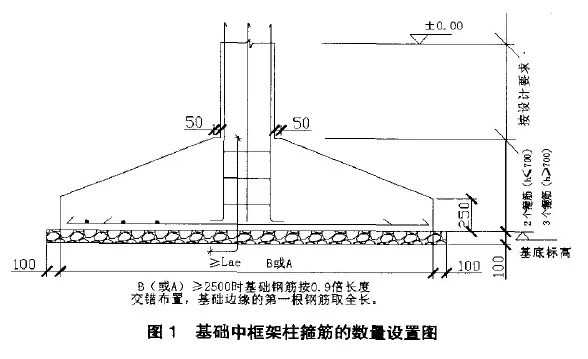
(5) Reinforcement Layout in the Core Area of Frame Beams and Columns
1. Stirrup Arrangement in Core Areas
Nodes where frame beams and columns intersect are critical load-bearing zones, requiring high resistance to shear, bending, and seismic forces. Therefore, steel bar construction here is vital. All stirrups in the core area must be densely arranged according to “Drawing Rules and Construction Details of Concrete Structure Construction Drawing Plan Overall Representation Method” (03G101-1).
2. Longitudinal Steel Bar Arrangement in Core Areas
For frame columns with uniform cross-sections, emphasis should be on dense hoop reinforcement in the core. For columns with changing cross-sections, hoop reinforcement densification is critical, alongside careful structural treatment of longitudinal bars in the varying sections.
Per the “Code for Design of Concrete Structures” (GB50010) and 03G101-1 standards, steel bar placement in beam-column core areas should meet the requirements shown below:
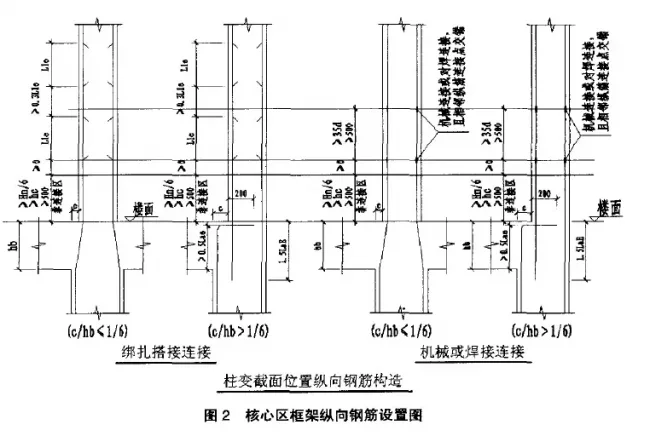
(6) Construction of Steel Bars for Top Frame Columns
1. Reinforcement Construction for Top Frame Side Columns
In compliance with the “Code for Design of Concrete Structures” (GB50010) and 03G101-1, the steel reinforcement for edge columns at the top frame level must adhere to the construction requirements illustrated below:
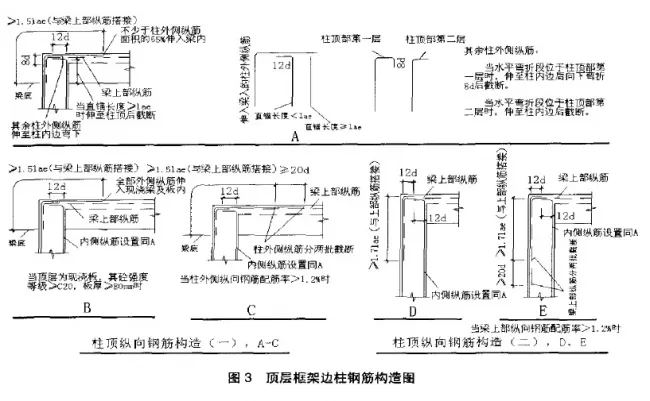
2. Construction of Steel Bars for Middle Columns at the Top Floor
According to the same codes, the steel bars for the middle columns of the top concrete frame must satisfy the construction requirements shown here:
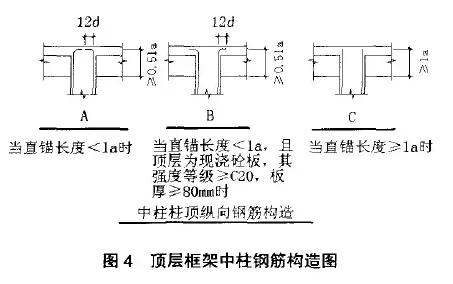
In frame structure systems, frame columns bear all upper loads, including vertical loads, external lateral forces, internal bending moments, and shear forces. They transmit these loads to the foundation, making their role indispensable. During loading, frame columns work synergistically with their internal steel reinforcement and concrete. The steel bars compensate for concrete’s low tensile strength and bear tensile forces arising from various stresses. Therefore, meticulous construction of frame column steel bars, adhering to technical standards, is essential to ensure project quality.













Must log in before commenting!
Sign Up