
BIM technology significantly enhances the efficiency of collaborative design in prefabricated buildings. It helps reduce design errors, optimize the production process of prefabricated components, improve inventory management, simulate and optimize construction workflows, and supports quality and energy consumption management during the operation and maintenance phases. Overall, BIM effectively boosts the efficiency of design, production, and construction for prefabricated buildings.
The Application Value of BIM Technology in the Design Stage of Prefabricated Buildings
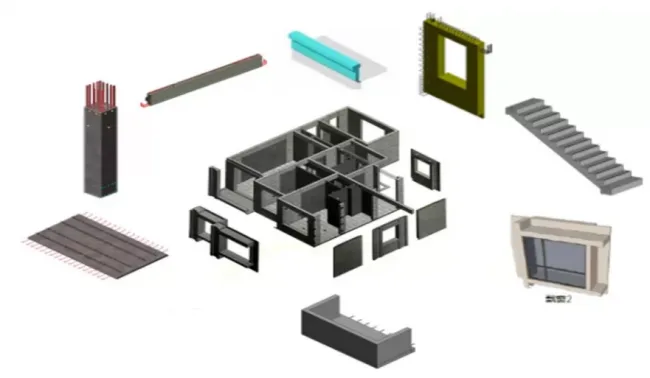
Standardizing the Design of Prefabricated Components
BIM technology enables open and shared access to design information. Designers can upload their prefabricated building schemes to a project’s cloud server, integrating data such as dimensions and styles. This process helps create a comprehensive “family” library of prefabricated components—like doors, windows, and more. As this library grows and evolves, designers can compare and optimize similar components to establish standardized shapes and module sizes for prefabricated construction elements.
Creating a prefabricated component “family” library supports the development of universal design specifications and standards. Utilizing these standardized libraries allows designers to accumulate and enhance layout designs efficiently, saving time on planning and adjustments. This approach enriches the variety of prefabricated building layouts, better catering to the diverse needs of residents.
Simulating Lifting Construction and Adjusting Schedules
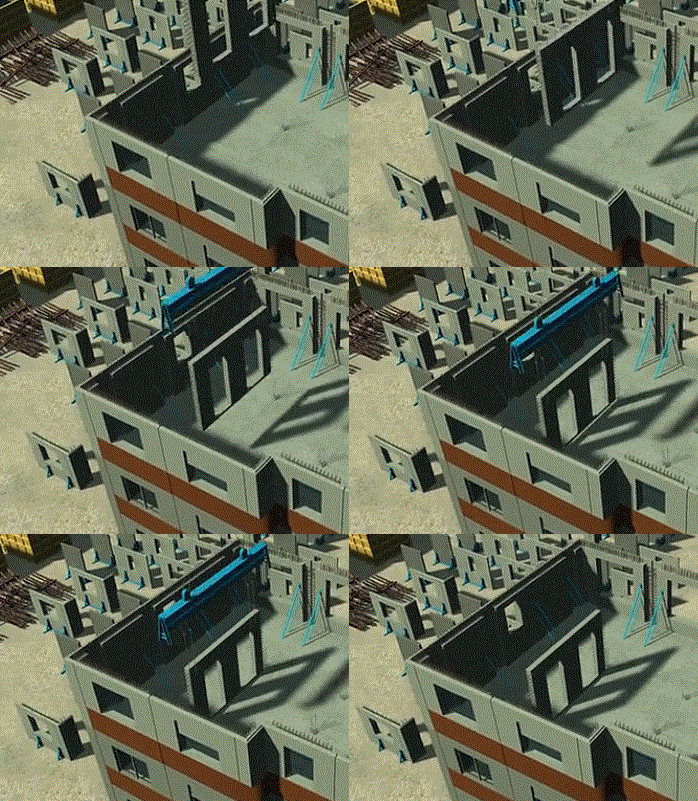
By breaking down prefabricated components and extracting relevant details, BIM provides accurate data for their production. Within BIM models, the processes of component manufacturing, transportation, and lifting are linked with corresponding timelines, enabling 3D dynamic simulations of lifting plans. Integrating the BIM model with project schedules facilitates 5D project management, allowing stakeholders to compare planned versus actual progress to control and optimize the project timeline.
BIM can simulate the construction site environment to pre-plan crane directions and approaches. This enhances workers’ accuracy and directly influences the precision of construction equipment, ultimately delivering optimal construction plans.
Collaborative Work and Issue Resolution
The core strength of BIM lies in its informatization and collaborative capabilities, providing a 3D information exchange platform for all stakeholders. Different professional models can be merged and coordinated within the same channel, enabling multidisciplinary collaboration. Problem review in BIM targets integrated planning throughout the entire building process. Each discipline imports the BIM model into dedicated review software to simulate construction, identify conflicts, and analyze issues. This process addresses clashes caused by insufficient information exchange, optimizes project planning, and preemptively resolves problems to reduce design changes and rework during construction.
The Application Value of BIM Technology in the Construction Stage of Prefabricated Buildings
Enhancing Inventory Management and On-Site Handling of Prefabricated Components
By integrating BIM with RFID technology, RFID chips embedded in prefabricated components capture detailed location and usage information. This allows inspectors and logistics personnel to directly access component data, enabling real-time electronic comparisons. This process reduces errors such as incorrect inspection counts, improper stacking orientations, and inaccurate outbound records typical in manual systems, resulting in significant cost savings.
On-Site Hoisting and Remote Visual Monitoring of Industrialized Construction
Once the construction plan is finalized, the BIM model containing details like lifting directions and sequencing is loaded onto tablet devices for on-site reference. This facilitates paperless, visual support for component hoisting. Before lifting, components undergo verification and identification. The daily construction plan is updated via handheld devices, and components in the yard are scanned for accurate identification before hoisting and recording their construction times.
Upon placement, inspectors verify the orientation and other construction details of each lifted component. After passing inspection, the component’s RFID chip is scanned with a handheld device to confirm installation and log completion time. The system records the assembly sequence, component orientation, and construction timeline, enabling easy tracking. This method reduces errors and boosts construction efficiency.
Application in the Installation of Prefabricated Components
During production, prefabricated components may need to be transported from the factory to the construction site. BIM facilitates accurate and efficient transportation of various types, sizes, and quantities of components through an information control system that links multiple departments for seamless data sharing.
The construction site’s project team uses the BIM platform to communicate installation requirements to the prefabricated component company’s control system. Factory management prepares accordingly by monitoring inventory in real time, completing production, stacking, and shipping tasks on schedule to ensure timely delivery to the site.
Each component is encoded with a unique label, and its transportation status is tracked via the control system. Construction teams can verify installation statuses at any time using handheld devices. The system visualizes construction progress through virtual models, allowing project managers to monitor advancement continuously.
Before construction, BIM enables simulation of PC component lifting. By creating manufacturing and lifting simulations aligned with the construction plan, the project team can optimize the assembly sequence. Since components are often numerous and complex, these simulations vividly demonstrate the construction process at the specification layer, serving as a practical guide. Additionally, potential issues can be identified during simulation, allowing for necessary adjustments before on-site lifting begins.
Article source: Grassroots Construction















Must log in before commenting!
Sign Up