

In modern concrete engineering, numerous quality issues arise, especially with structures that cannot be completed in a single pour and require reprocessing. Some concrete elements may be small but have many corners, which increases the likelihood of construction problems.
1. “Rotten Roots” in Concrete
This issue occurs when the surface of columns or wall foundations within the formwork support area is uneven, and large gaps exist between the formwork base and the foundation surface. Vibrating the concrete at the base of columns or walls can cause severe grout leakage, resulting in excessive stones and insufficient grout, leading to “rotten roots.”
To prevent this, the surface must be flat, and gaps between the foundation and formwork should be filled with wooden chips or sponge strips to stop grout leakage.
Prevention and Control: Before pouring concrete, apply a 5-10 cm thick “slurry” bonding layer at the bottom. This helps avoid segregation during cutting, which can cause stone concentration at the bottom and mortar deficiency during vibration, resulting in “rotten roots.” Use cement mortar of equal or higher strength than the concrete, and unload it properly to prevent this issue.
2. Formwork Expansion and Deformation During Concrete Pouring
Prevention and Control Methods:
- Pour concrete starting from the corners, then move to the middle. For walls, begin with the outer wall, followed by the inner wall, to maintain verticality.
- Pour in layers: no thicker than 35 cm for manual vibration, 50 cm for vibrator vibration, and 30 cm for lightweight aggregate concrete.
- For walls under 3 meters tall, concrete can be discharged from the top into slabs, with a hopper buffer installed to prevent segregation. For walls with narrow cross-sections and dense reinforcement, create openings on the side formwork and feed concrete via inclined chutes, not exceeding 2 meters in height. Walls taller than 3 meters require feeding openings every 2 meters.
- For walls with door, window, or process openings, feed concrete symmetrically from both sides to prevent deformation of the formwork.

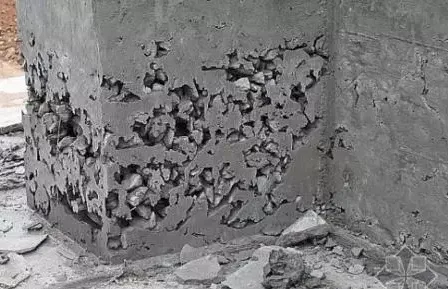
3. Corner Concrete Leakage and Honeycombing
This problem often results from excessive gaps during template assembly and prolonged vibration, leading to stone leakage.
Prevention and Control: Use sponge strips or sealing joints during template assembly, or employ stepped joints to reduce grout leakage. Limit vibration time to 2-3 minutes. Control concrete mix proportions strictly and use tremies or chutes to ensure consistent mixing during pouring to avoid segregation.
4. Thick Mortar Layer Appearing at the Top
This occurs when concrete is poured to the top and a thick mortar layer forms on the upper part. It is mainly caused by reduced friction and adhesion between stones after vibration, causing stones to settle and mortar to rise. Additionally, the mortar laid at the bottom can float upward during vibration.
Prevention and Control: The bottom mortar layer should not be excessively thick—just enough to meet requirements. Because the slurry lacks stones, its strength is lower than designed. To reinforce this weak layer, add clean stones of the same particle size to the top mortar or remove floating slurry during secondary pouring.

5. Vertical Deviation of Walls or Columns
Vertical misalignment mainly arises from lateral pressure of concrete against the side formwork during pouring. If one side’s slant support is unstable and sinks, lateral displacement can occur.
Prevention and Control:
- Ensure formwork support for columns or walls is firm and reliable, meeting design and construction specifications.
- Pour walls or columns from both ends toward the middle to prevent uneven lateral pressure buildup. Incorrect pouring sequences can cause bending deformation and vertical deviation at the column’s end.

6. Concrete Detachment at Column-to-Beam Connections
Prevention and Control: When pouring columns and beams as a whole, allow a rest period of 1 to 1.5 hours (no more than 2 hours) after pouring the concrete columns to let them settle initially before pouring beam concrete. Continuous pouring without rest can cause “necking” defects at the connection.
Set the construction joint for secondary pouring 20-30 mm below the foundation surface or beam bottom. Remove any loose stones or floating slurry from the top of the column before secondary pouring to ensure design strength is met.
Article source: Architectural Technology Magazine
















Must log in before commenting!
Sign Up