
Source: PC Building Sealant
Prefabricated Building
Residential industrialization is an innovative production method that integrates the entire industrial chain of design, manufacturing, and construction. It is characterized by prefabricated component production and assembly, standardized designs, component modularity, and mechanized construction processes. This approach aims to promote energy efficiency, environmental sustainability, and maximize the full lifecycle value of residential products.
The advancement of prefabricated housing is essential for achieving housing industrialization. The industrialized production of precast concrete (PC) components serves as a key indicator of this progress. Compared to traditional construction methods, industrialized residential building methods enable large-scale production, faster construction, and cost reduction. For complex structural joints, PC components effectively balance construction efficiency and quality control, preventing common issues such as leaks and cracks.
In March 2017, the Ministry of Housing and Urban-Rural Development issued the Action Plan for Prefabricated Buildings during the 13th Five-Year Plan. The plan set ambitious targets for 2020: prefabricated buildings should account for over 15% of new construction in China, with key promotion areas reaching more than 20%, active promotion areas surpassing 15%, and encouraged promotion areas exceeding 10%. The plan also calls for cultivating over 50 demonstration cities, more than 200 industrial bases, over 500 demonstration projects, and establishing more than 30 technological innovation bases for prefabricated buildings.
About PC Building Sealant
Sealants are critical joint materials used for PC exterior wall expansion joints, and their demand is expected to grow rapidly alongside the development of prefabricated buildings. This article addresses common misconceptions regarding the sealing of PC exterior wall construction joints, clarifies the preferred types of adhesives for PC exterior walls, compares single-component and two-component MS building sealants, and discusses the current standard limitations and lack of application cases that hinder the promotion of single-component MS sealants. Finally, it presents typical methods for waterproofing PC building exterior walls.
Common Misconceptions in Sealing PC Exterior Wall Construction
Although PC engineering is widely used internationally, its domestic adoption came relatively late. The industrial chain is still developing, and there is a shortage of specialized skills, leading to inappropriate choices and applications of sealants. Domestic architectural design and construction teams often invest little in waterproofing, lack awareness, and fail to give it sufficient attention. Common issues in sealing PC exterior wall joints include:
① The mistaken belief that the tongue-and-groove design of PC exterior wall construction joints (as shown in Figure 1, illustrating the height difference between the interior and exterior transverse joints) alone provides adequate waterproofing. Consequently, mortar is directly used to fill the joints. After thermal expansion and contraction, cracks appear in the joint fillers, compromising waterproofing and resulting in leakage.
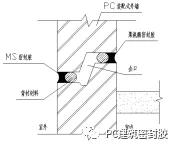
Figure 1
② SR (Silicone Rubber) building sealant, known for its excellent weather resistance, is often used directly for sealing PC exterior walls. However, its unpaintable surface contaminates the substrate, negatively affecting the project’s aesthetics.
③ PU (Polyurethane) building sealant is recognized for waterproofing concrete joints but is poorly resistant to weather and unsuitable for exterior wall joints. Its misuse often results in powdering, cracking, and subsequent water leakage.
2. Choosing the Right Sealant for PC Exterior Walls
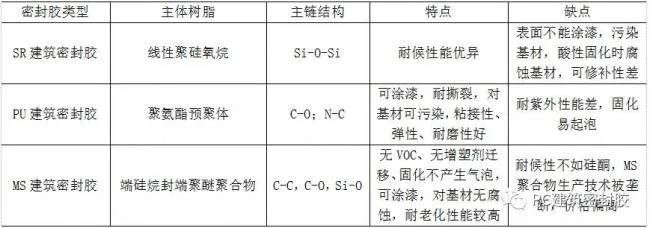
The most common sealants include silicone (SR), polyurethane (PU), and silane-modified polyether (MS) building sealants. Table 1 compares their structures, advantages, and disadvantages.
SR sealants consist mainly of linear polysiloxane with a Si-O-Si backbone (bond energy: 444 kJ/mol). During curing, crosslinking forms a Si-O-Si network, providing excellent weather resistance, making SR sealants ideal for glass curtain walls. However, their surfaces cannot be painted, and silicone oil migration causes dust accumulation and pollution.
PU sealants are based on polyurethane prepolymers, primarily with C-O (bond energy: 339 kJ/mol) and N-C (bond energy: 284 kJ/mol) bonds. They are paintable, non-polluting to substrates, and adhere well to concrete but suffer from poor aging resistance.
MS sealants are derived from silane-terminated polyether resin, with C-O, C-C (bond energy: 348 kJ/mol), and Si-O-Si bonds. They cure without bubble formation, offer good workability, can be painted, and meet weather resistance requirements in most curtain wall applications, except glass curtain walls.
Table 1: Comparison of Common Building Sealants’ Structures and Properties
PC exterior walls are precast concrete structures made of relatively porous substrates and are exposed directly to sunlight, where ultraviolet radiation can reach 399 kJ/mol. Therefore, sealants must exhibit high weather resistance. SR sealants risk contamination and hinder later painting, while PU sealants age poorly, leading to powdering and hardening, resulting in waterproof failure.
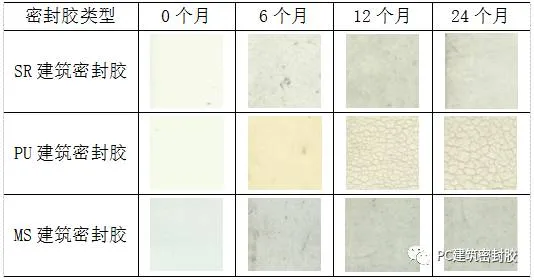
Table 2 shows that after 12 months of exposure, PU sealants exhibit significant cracking, whereas SR and MS sealants maintain good appearance even after 24 months without cracking. Based on this comprehensive comparison, MS sealants are recommended as the first choice for PC exterior wall sealing.
Table 2: Natural Exposure and Aging Appearance of Various Sealants
Internationally, MS sealants have a mature development history and are widely accepted for PC exterior wall waterproofing. In Japan, over 80% of PC exterior wall joints are sealed with MS sealant. For instance, the Hilton Hotel in Osaka (completed in 1986) and the Jonghwa Building in Tokyo have utilized MS sealants for approximately 30 years without showing significant aging, powdering, or cracking. This proven track record confirms MS sealants’ excellent performance and suitability for PC exterior wall joints.
Comparison of Single-Component versus Two-Component MS Sealants
MS sealants originated in Japan as two-component products, combining MS polymer resin with fillers, plasticizers, and catalysts. These two-component sealants offer excellent aging resistance and are widely used for sealing and waterproofing PC exterior wall joints. However, they exhibit poor adhesion to concrete substrates without a primer, require pre-mixing before application, and are less convenient to use.
In contrast, single-component MS sealants have emerged from ongoing research. They offer comparable performance to two-component types but provide easier application with minimal equipment.
PC construction joints undergo shrinkage over time, causing joint widths to increase and imposing increased tensile stress on the sealant-substrate bond. Figure 2 illustrates the stress relaxation behavior of MS sealants under 60% elongation.
After 24 hours, single-component MS sealants demonstrate a 68.11% reduction in tensile stress, outperforming two-component MS sealants, which show a 54.55% reduction. This superior stress relaxation helps maintain bond integrity and reduces the risk of interface damage and water leakage.
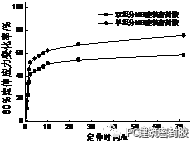
Figure 2
4. Limitations in Testing Standards for Single-Component MS Sealants
Building adhesive standards typically classify products based on polymer chemistry, including silicone structural, silicone building, polysulfide, polyurethane, and acrylic sealants. However, there is no specific standard for MS polymers in China. Internationally, no polymer-based standard for MS sealants exists either. In Japan, the JIS A 5758-2004 standard applies to sealants for building joints and door/window glass based on application fields.
Table 3: Performance Comparison of Several Single-Component MS Sealants in the Market
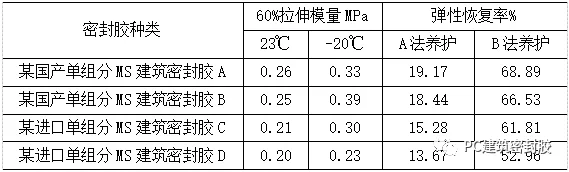
Single-component MS sealants have relatively low polymer reaction activity and require longer curing times. Insufficient curing leads to incomplete crosslinking and low elastic recovery. Testing using JC/T 881-2001 (Table 3) shows that many products fail to meet standard elastic recovery requirements when cured by method A. Under GB/T 22083-2008 standards, the best-performing products only qualify as plastic materials, which contradicts the elastic nature of MS sealants.
However, when cured by method B, elastic recovery rates exceed 60%, meeting the 20LM type requirements of GB/T 22083-2008, indicating elastic behavior. These findings highlight the inadequacy of current standards for MS sealants, especially single-component types, which significantly hampers their promotion and adoption in PC exterior wall sealing.
5. Typical Waterproofing Methods for PC Exterior Walls
Water leakage in prefabricated concrete (PC) exterior walls occurs due to three factors: water presence, gaps, and water pressure forces. For water, designs should minimize gap exposure by incorporating features such as drip edges. To address gaps, efforts must prevent cracking caused by manufacturing, transport, or construction processes. Water pressure forces—including gravity, surface tension, airflow, and pressure differentials—are mitigated through structural designs like slopes, drip lines, tongue-and-groove joints, flashing, and equal pressure chambers.
Therefore, waterproofing of prefabricated building exterior wall joints requires a combined drainage and water conduction system.
Vertical joints on exterior walls should feature a double-seal system with a cavity between seals and drainage outlets every 3–4 floors (Figure 3). Sealants are applied on both interior and exterior sides. The outer sealant is weather-resistant, protecting against UV radiation, rain, and snow. The inner sealant typically uses low-modulus polyurethane to block moisture intrusion and prevent indoor leaks caused by decoration water. This inner layer is protected from direct exposure, enhancing durability.
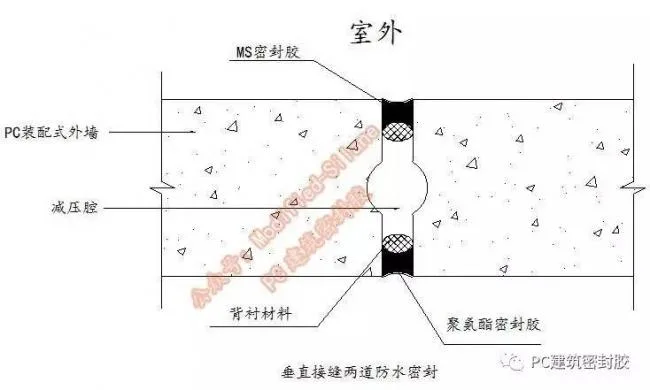
Figure 3
Horizontal exterior wall joints should incorporate three layers: waterproofing on both interior and exterior sides plus structural waterproofing. The tongue-and-groove design, with the interior edge higher than the exterior, prevents water ingress if the exterior seal fails. This cavity also facilitates water drainage toward vertical outlets (Figure 4).
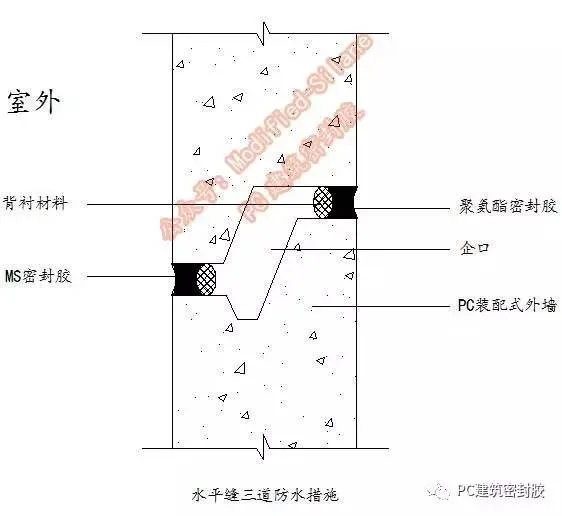
Figure 4
6. Conclusion
Housing industrialization is becoming the dominant trend in China’s housing industry. For PC exterior wall expansion joints, MS building sealants should be the preferred choice. However, due to limited experience, misuse often leads to quality issues. While two-component MS sealants have a mature application history, the promotion of single-component MS sealants remains weak, despite their superior bonding interface security.
The lack of specific testing standards for MS sealants, particularly single-component types, restricts their market adoption. Manufacturers may shift focus back to two-component sealants after unsuccessful efforts to promote single-component products, potentially resulting in the abandonment of single-component MS sealants. This outcome would hinder the diversified development of sealing materials in the market.














Must log in before commenting!
Sign Up