
BIM Software Tip: Smart Techniques for Spatial Measurement in Revit
Many users find spatial measurement in Revit to be slow and cumbersome. Often, it requires drawing sections and multiple auxiliary lines, which can be time-consuming. However, there’s a much simpler way to achieve this. Let me show you how I did it.
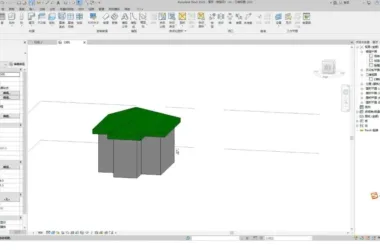
For example, in the image below, I need to determine the length of a particular space. Specifically, the spatial distance from the top of a diagonal column to the tops of the lower right and upper right corner columns, as well as the spatial length between the diagonal column and the two columns located halfway along its height.
To begin, open the structural analysis model in your current 3D view. Then, use the built-in model to select the volume function. Notice something important here?
It’s actually quite straightforward. The model lines within the volume have 3D snapping capabilities, which you must enable. This feature is incredibly practical, as shown in the image below:
Next, you can directly use the 3D snap function to pinpoint the spatial points mentioned earlier.
Now, why is it necessary to open the analysis model first? The reason is that capturing the center point at half the height of the inclined column is much easier in the analysis model, as illustrated in the following figure.
Returning to the main topic — spatial length measurement. So, where is the length value? Since all the spatial lines are already drawn, the length is naturally an attribute of these lines, as shown in the image below with length values displayed.
You might wonder: the 3D spatial snap function isn’t limited to model lines in volumes; beams also support spatial snapping. So, why not use the length value from beams instead?
Here’s the reason: when beams and columns intersect, shear behavior occurs, meaning the beam’s length represents the shear length. Therefore, I prefer using the spatial model lines from the volume for more accurate measurements.
Of course, this feature can measure distances in many positions. For example, I can measure the spatial distance between the corner vertex of my stair landing platform and the vertex of a specific column, as shown in the image below.
Viewing it from a different angle, isn’t this method pretty cool?













Must log in before commenting!
Sign Up