
Bohai University of Science and Technology Gymnasium
The Bohai University of Science and Technology – Weiqiao Guoke Advanced Technology Research Institute (Binzhou) is situated in Binzhou City, Shandong Province. The campus is divided into two zones, north and south, with the Qinhuang River National Wetland Park to the east, offering exceptional urban landscape resources.
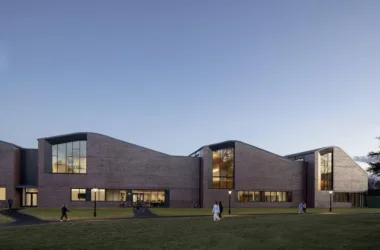
The sports center cluster occupies the southeast side of the North Campus, directly opposite Qinhuanghe Park. The gymnasium faces the North Campus entrance, serving as a landmark along the campus’s north-south axis. As the main sports venue on campus, the gymnasium incorporates a competition hall, training hall, and swimming pool. Classified as a Grade B venue, it meets the standards for hosting national and provincial events. Adjacent to the east is a standard 400-meter sports stadium, surrounded by basketball and volleyball courts, collectively forming a vibrant “vitality island” focused on sports within the campus.
△ Bohai University of Science and Technology Gymnasium animation © Chinese Academy of Sciences Architectural Design and Research Institute Co., Ltd
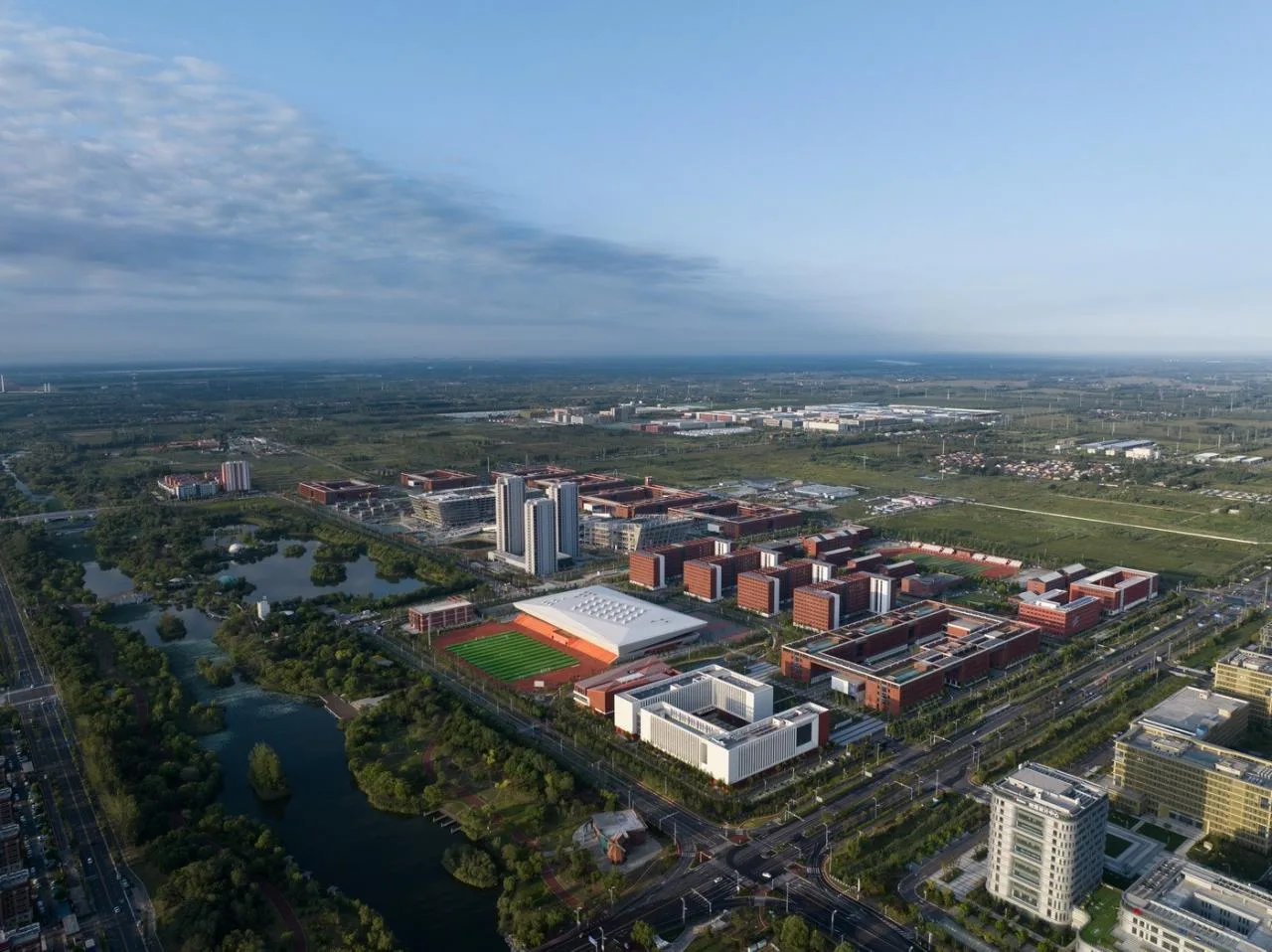
Northeast-facing aerial view © Literal translation of architectural photography
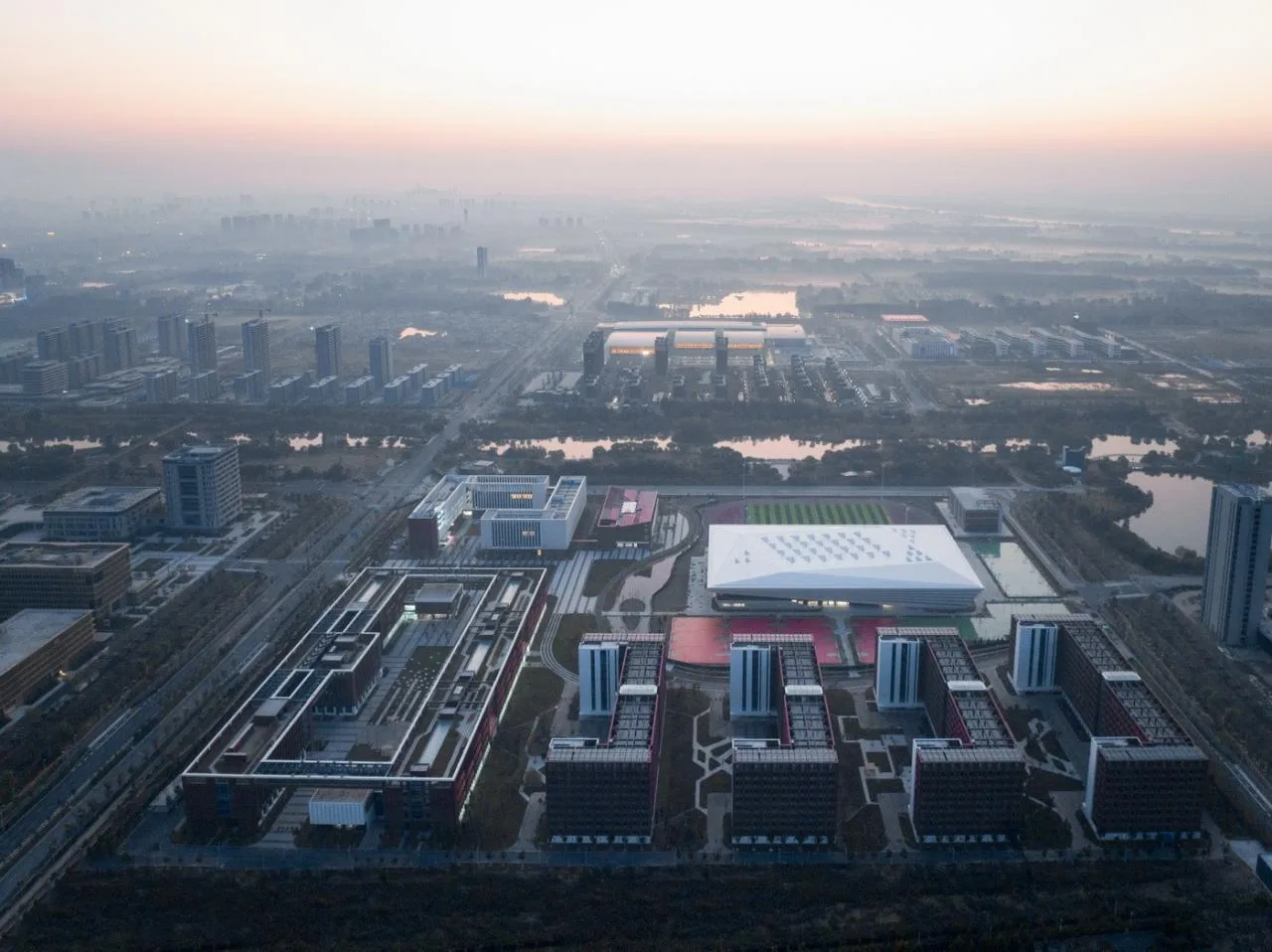
△ East-side aerial view © Literal translation of architectural photography
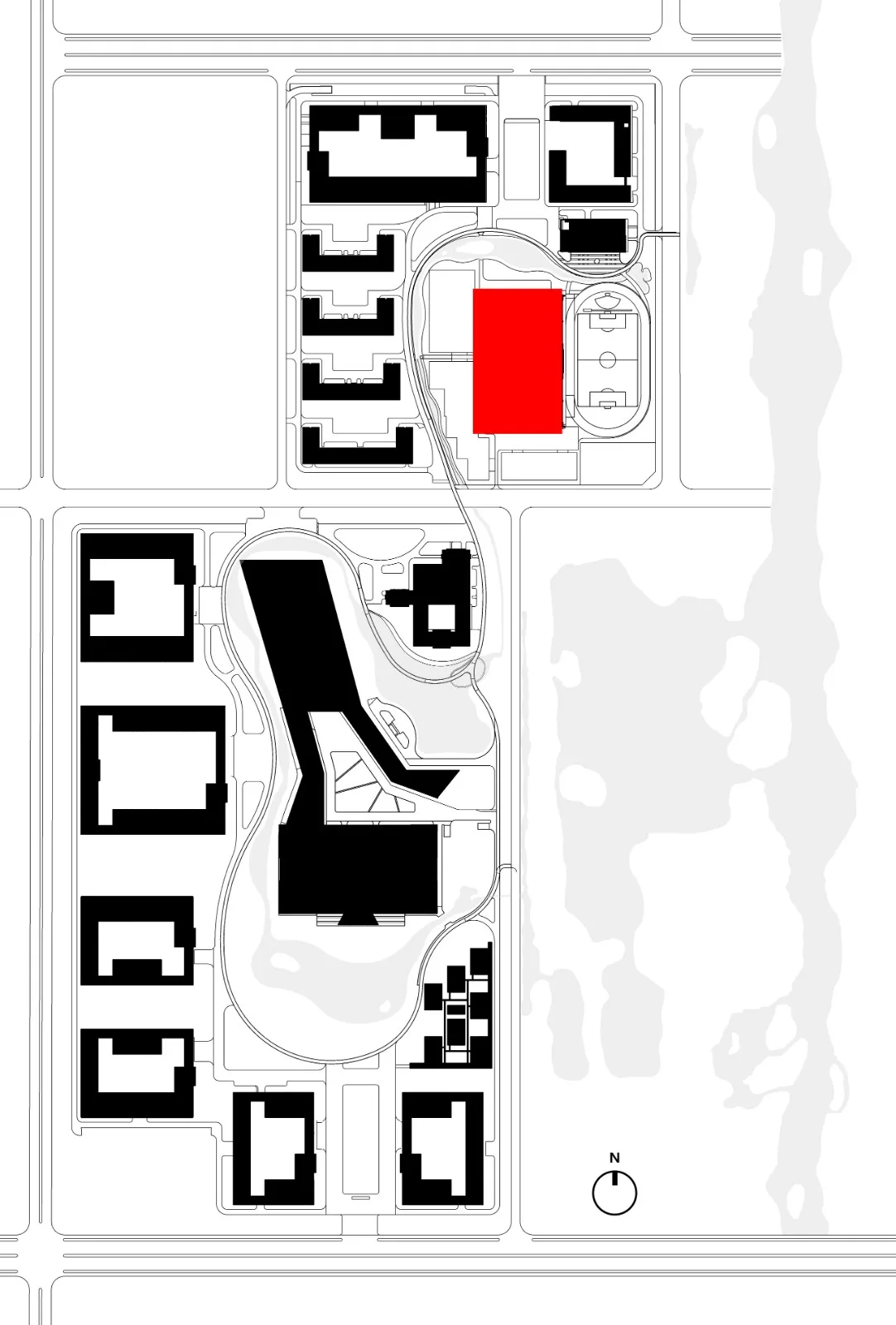
Overall architectural layout and sports arena location © Chinese Academy of Sciences Architectural Design and Research Institute Co., Ltd
White Egret Exhibition Wings · A Dynamic Campus
The college building cluster at Bohai University of Science and Technology draws inspiration from traditional Chinese academies, preserving their cultural heritage. The buildings predominantly feature red brick facades. As a major public structure on campus, the sports architecture injects energy and futuristic technology, transforming traditional forms into a contemporary, dynamic space. This design creates a lively atmosphere, fostering vitality across the campus.
Located adjacent to the Qinhuang River National Wetland Park, the sports arena is envisioned not only as a campus landmark but also as a central landscape structure visible from the park. The architectural form employs volume subtraction to maintain integrity and sculptural appeal, expressing dynamism through diagonal elements.
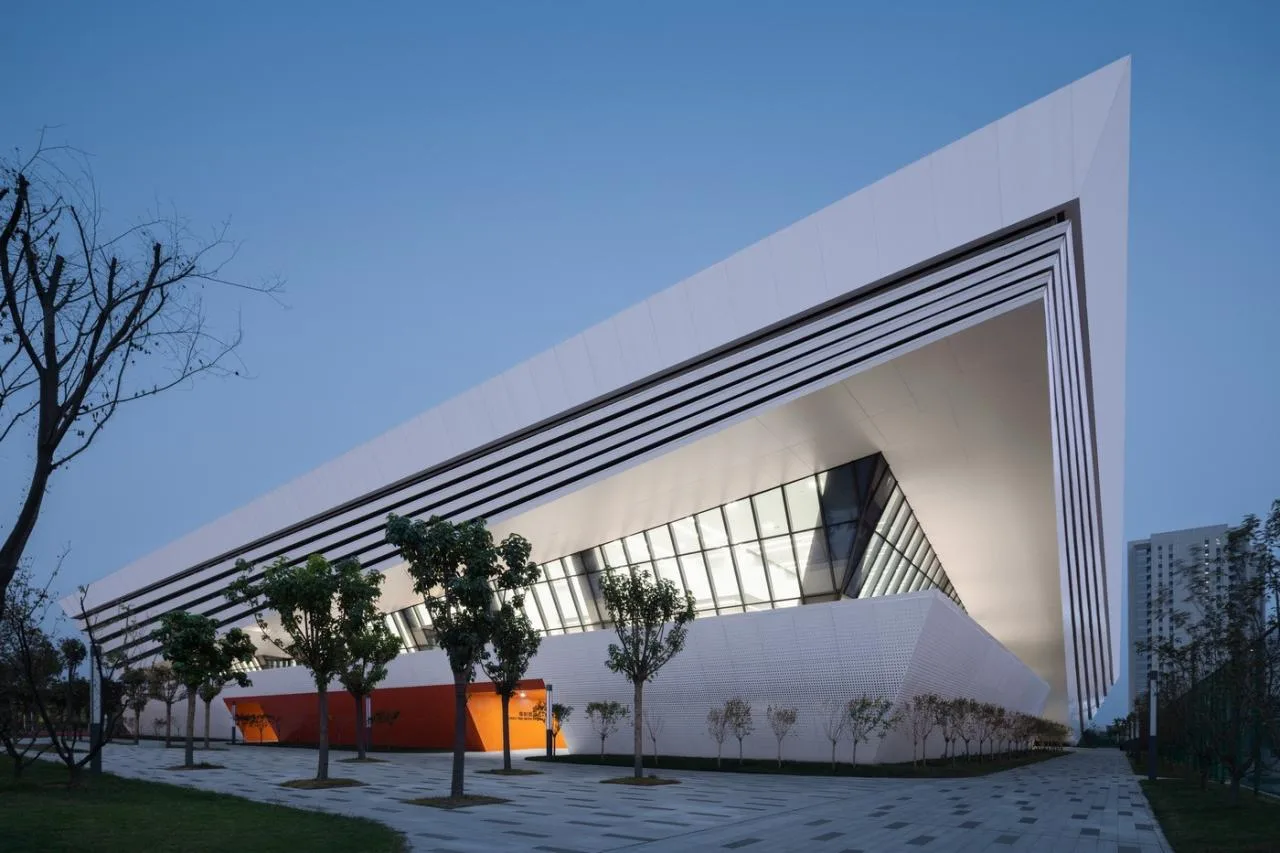
Inspired by the white egrets inhabiting the wetland park, the façade is clad in silver-white honeycomb aluminum panels. A ribbon-like, gradient skin spirals around the venue, lending the gymnasium a light and graceful presence, as if floating over the wetlands. This design metaphorically reflects the egrets spreading their wings, flying low and circling, creating an aesthetically pleasing vision.
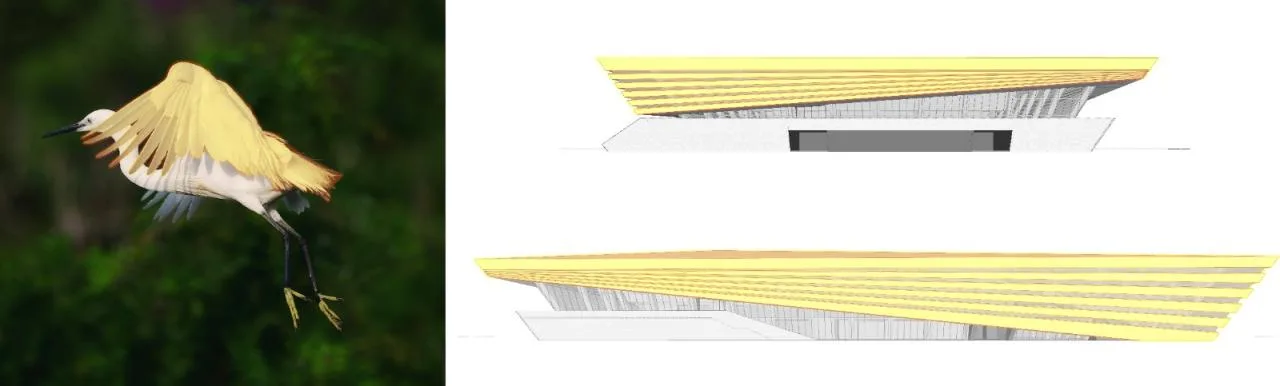
The ‘spreading wings’ metaphor © Chinese Academy of Sciences Architectural Design and Research Institute Co., Ltd
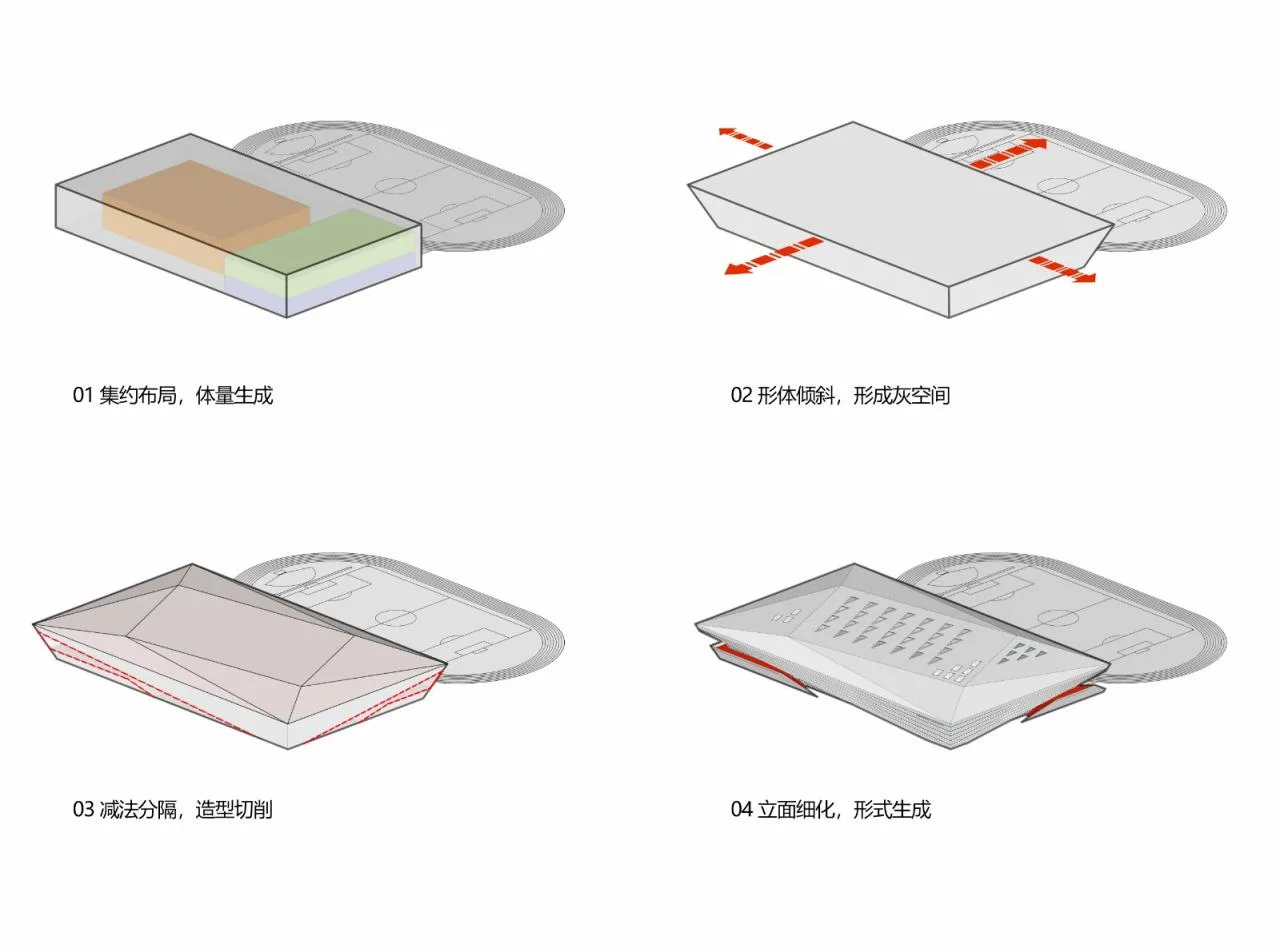
△ Evolution of shape © Chinese Academy of Sciences Architectural Design and Research Institute Co., Ltd
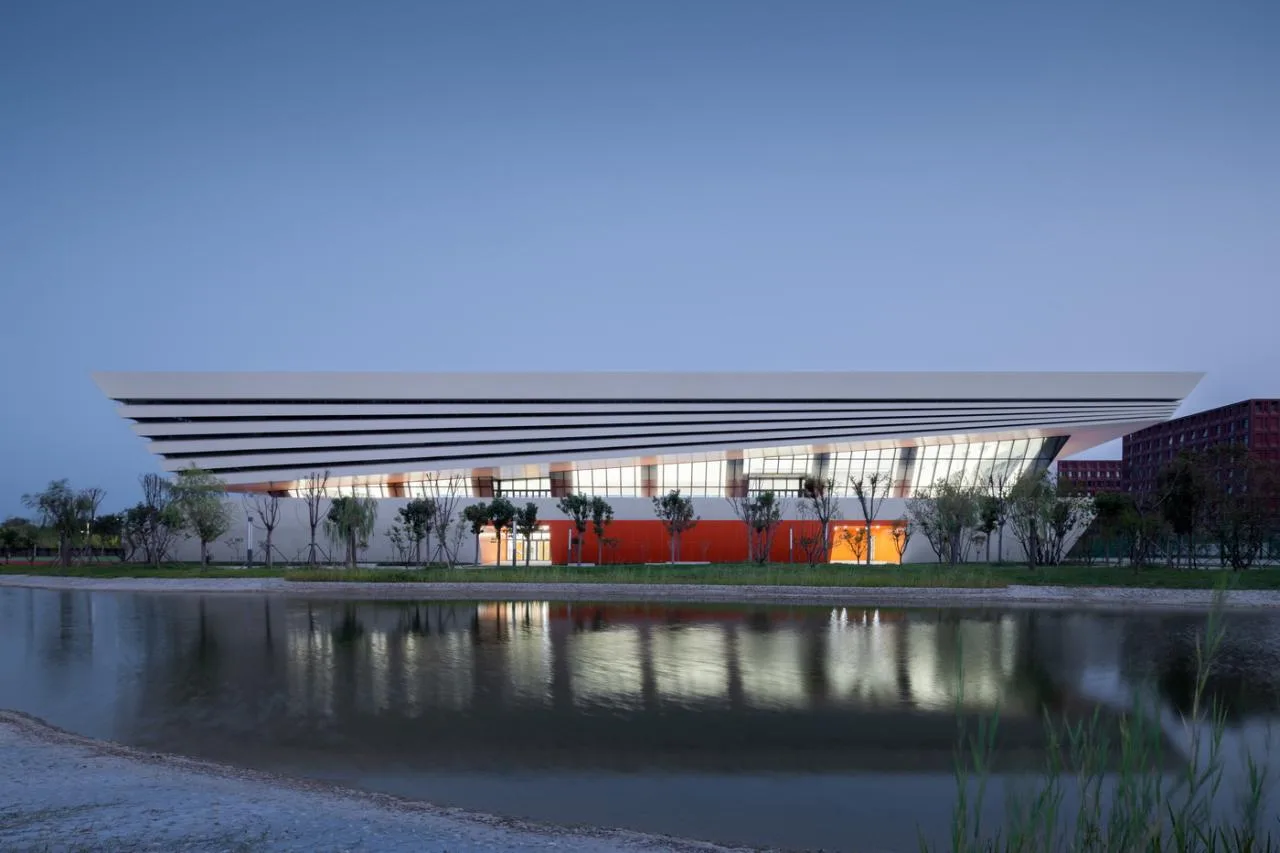
△ North-side view © Literal translation of architectural photography
△ Sports center illuminated under the night sky © Literal translation of architectural photography
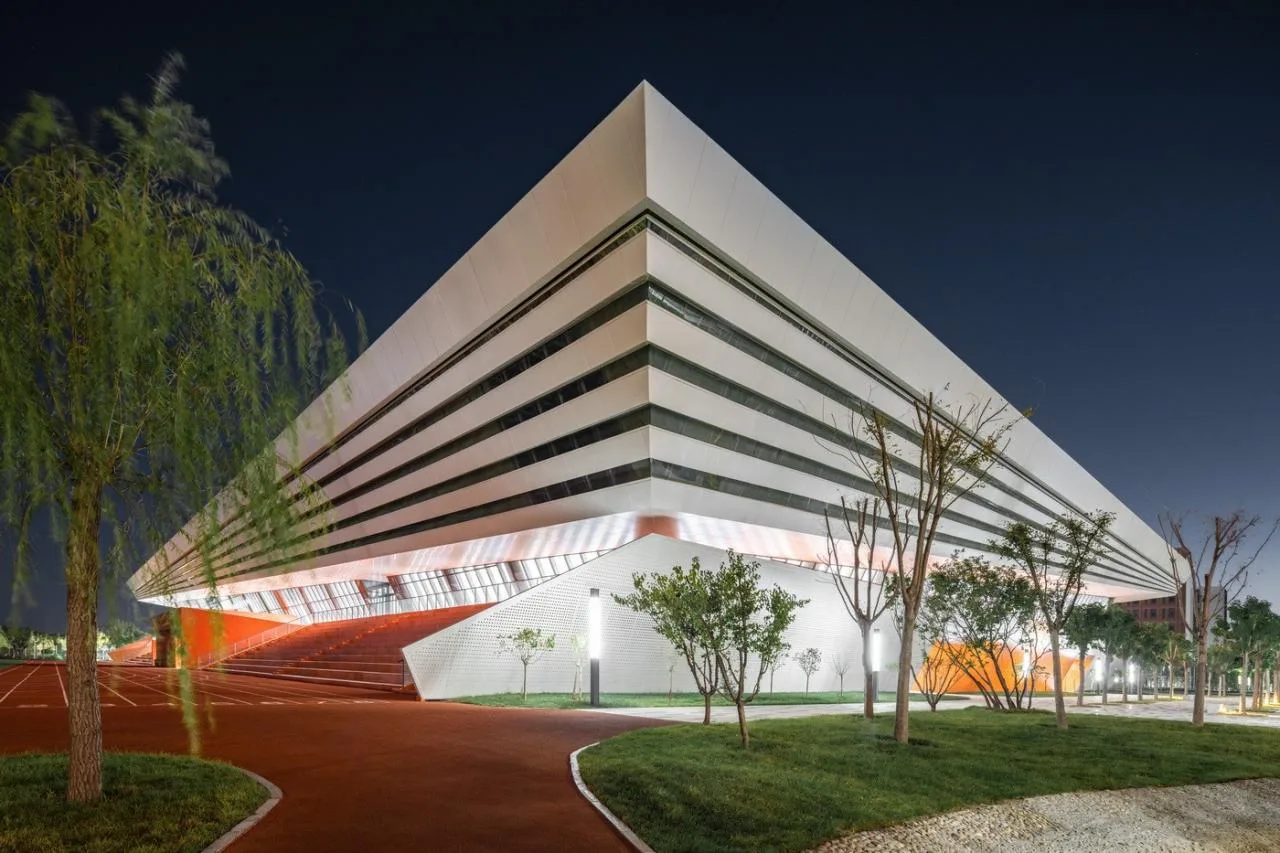
△ Surrounding gradient façade lines © Literal translation of architectural photography
Ping Sai Multipurpose · Campus and Community Sharing
Campus sports buildings differ from professional venues by emphasizing teaching, fitness, and community engagement over pure competition. From the project’s inception, dual-purpose use during and after events was a key objective. This ensures the design meets high competition standards while supporting multifunctional, low-maintenance use for the university.
Positioned near the campus’s north entrance, the sports arena offers shared facilities for the city, complementing urban sports venues and promoting public fitness.
Functionally, the arena includes a competition hall, training hall, and swimming pool. The competition hall measures 40m by 70m, seats 3,000 people with 70% active seating, and features fixed seats on only one side. This layout supports versatile uses such as fitness, teaching, competitions, performances, lectures, and ceremonies while minimizing construction and maintenance costs.
A U-shaped side hall on the second floor acts as a transitional space, serving as a buffer during competitions and supporting exhibitions, activities, seminars, and teaching. Adjacent to the track and field, this hall also serves as a large “private room” for students to watch events indoors, acting as a campus viewpoint and a social “living room” after classes.
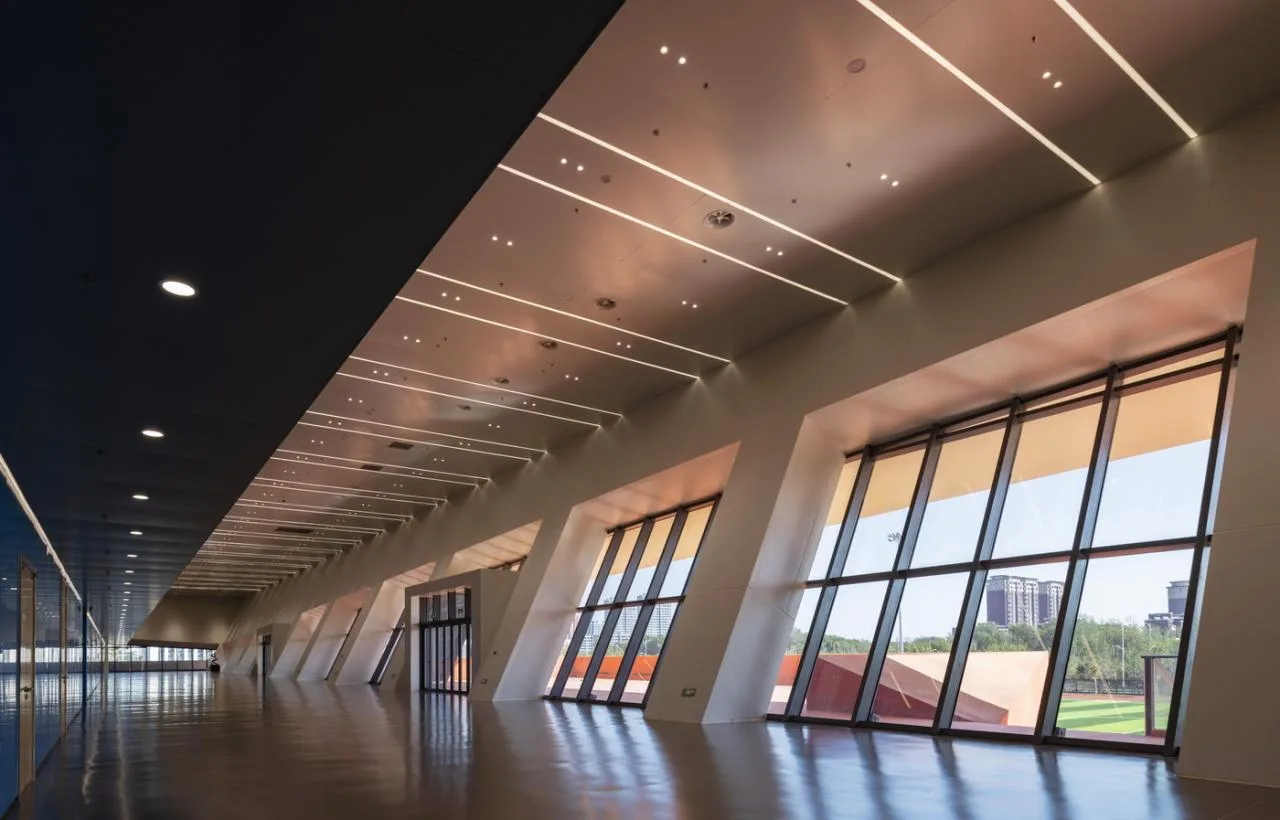
Multifunctional side hall connecting to the track and field © Literal translation of architectural photography
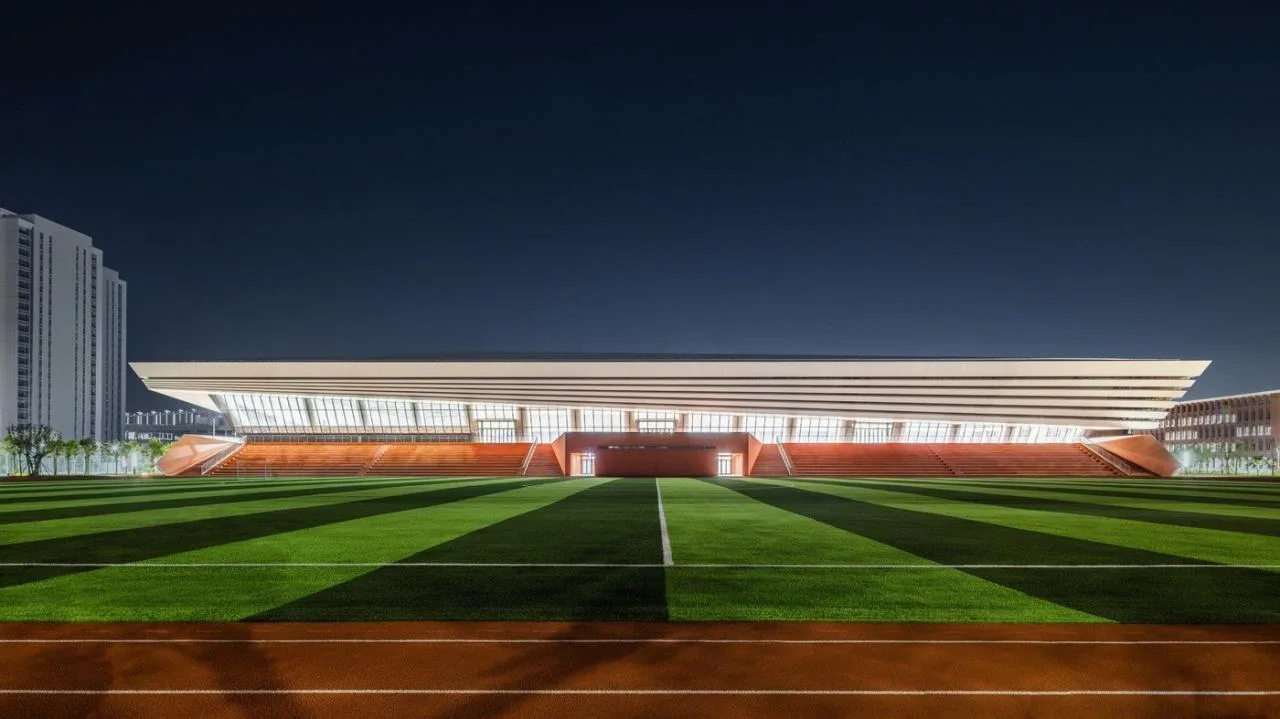
△ View of the sports arena from the stadium © Literal translation of architectural photography
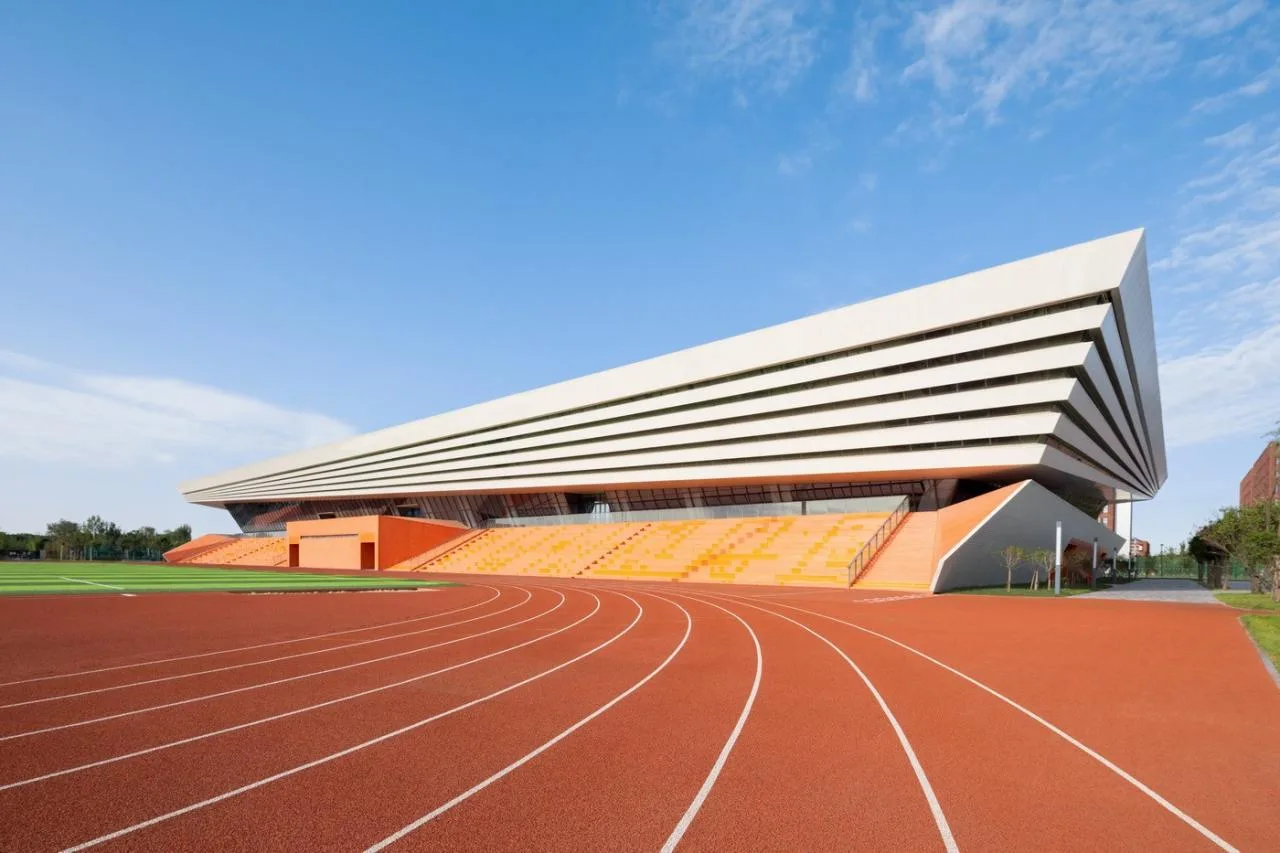
Lightness and a sense of speed in motion © Literal translation of architectural photography
Unified Design and Layered Construction
The gymnasium is positioned west of the track and field area, designed as an integrated complex. The west stand is cleverly embedded within the gymnasium’s form, creating a cohesive structure. An overhanging canopy replaces traditional seating covers, providing shade and rain protection while visually grounding the gymnasium with the stands. This compact design reflects an efficient use of the limited campus space.
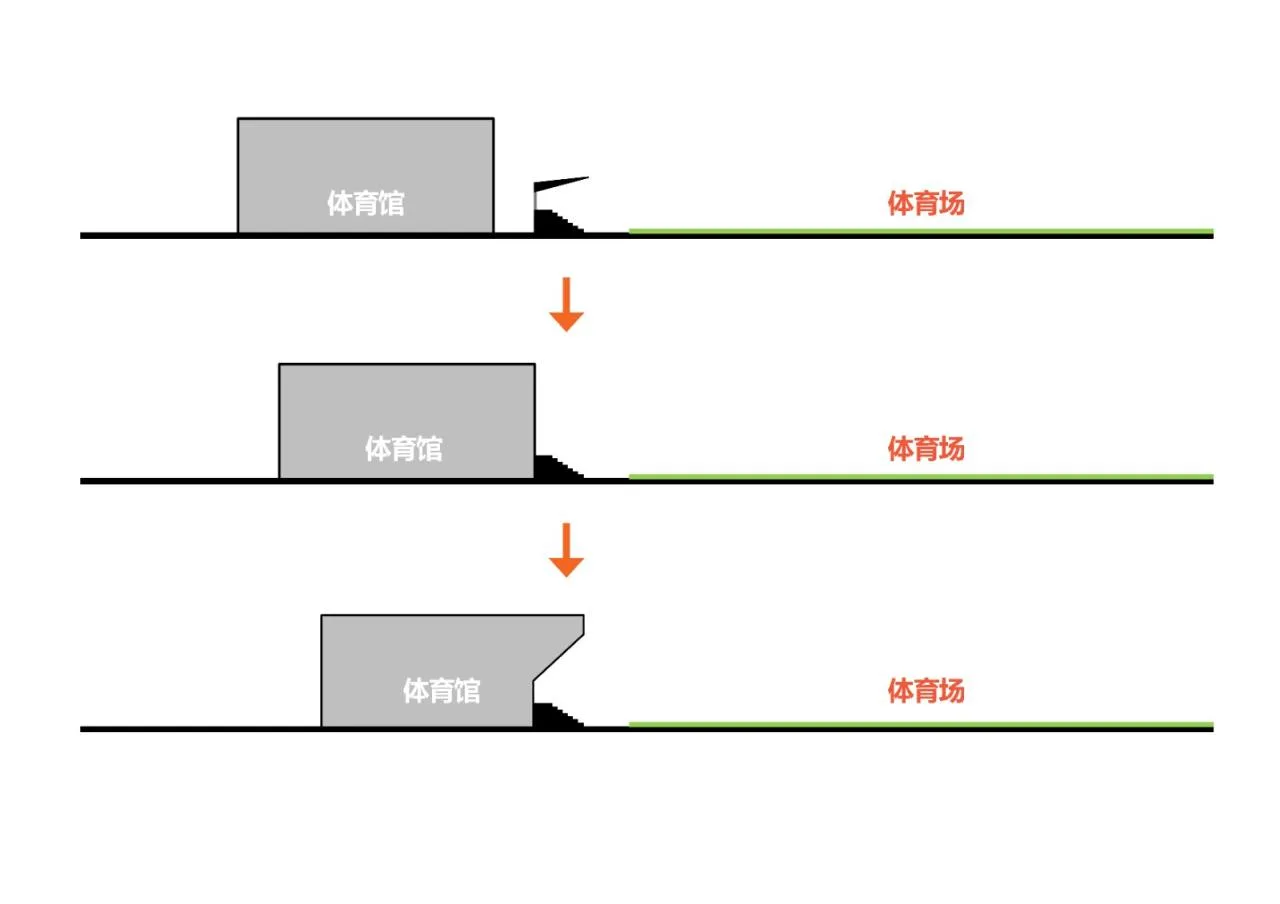
△ Integrated venue design © Chinese Academy of Sciences Architectural Design and Research Institute Co., Ltd
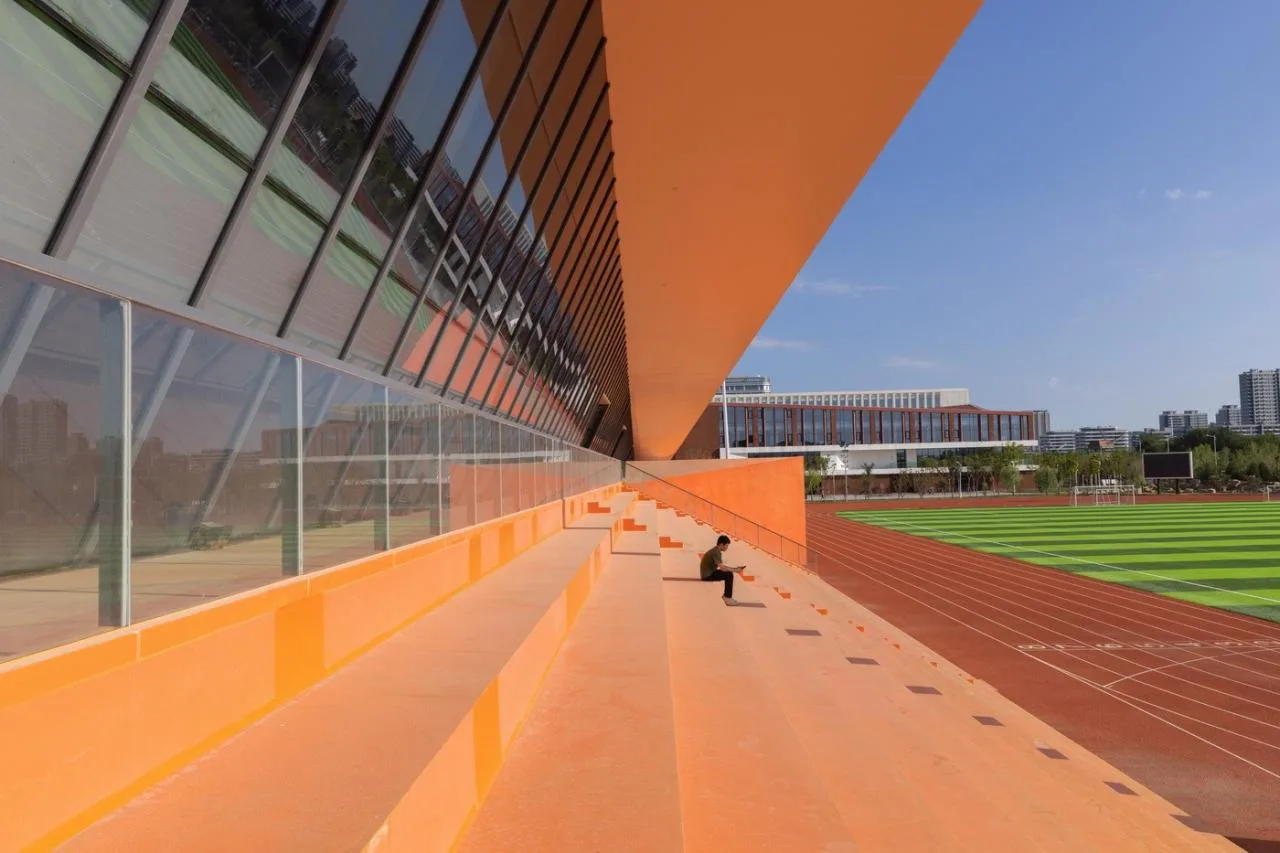
Embedded track and field grandstand © Literal translation of architectural photography
The sports complex integrates the competition hall, training hall, and swimming pool in a compact layout that prioritizes land conservation, material efficiency, and energy savings. The swimming and training halls are stacked vertically and aligned north-south alongside the main venue, sharing central equipment and support facilities.
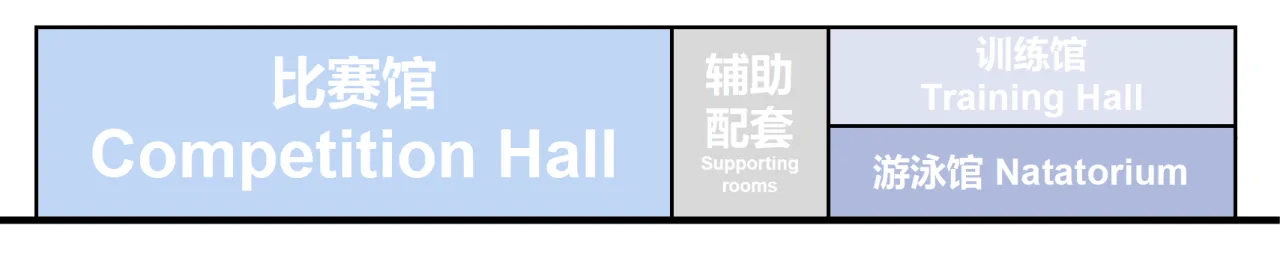
△ Integrated multi-venue layout © Chinese Academy of Sciences Architectural Design and Research Institute Co., Ltd
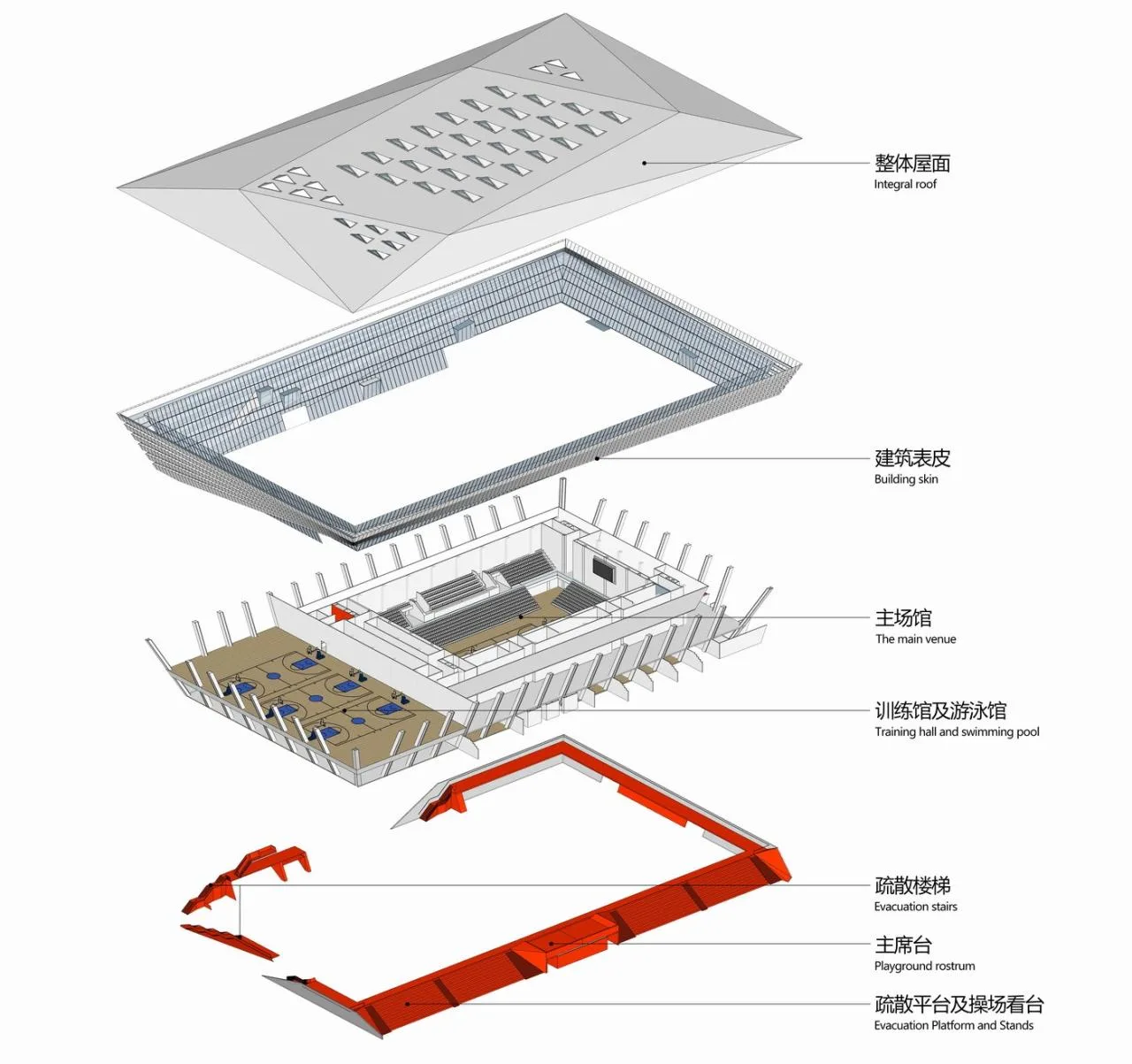
△ Decomposition diagram © Chinese Academy of Sciences Architectural Design and Research Institute Co., Ltd
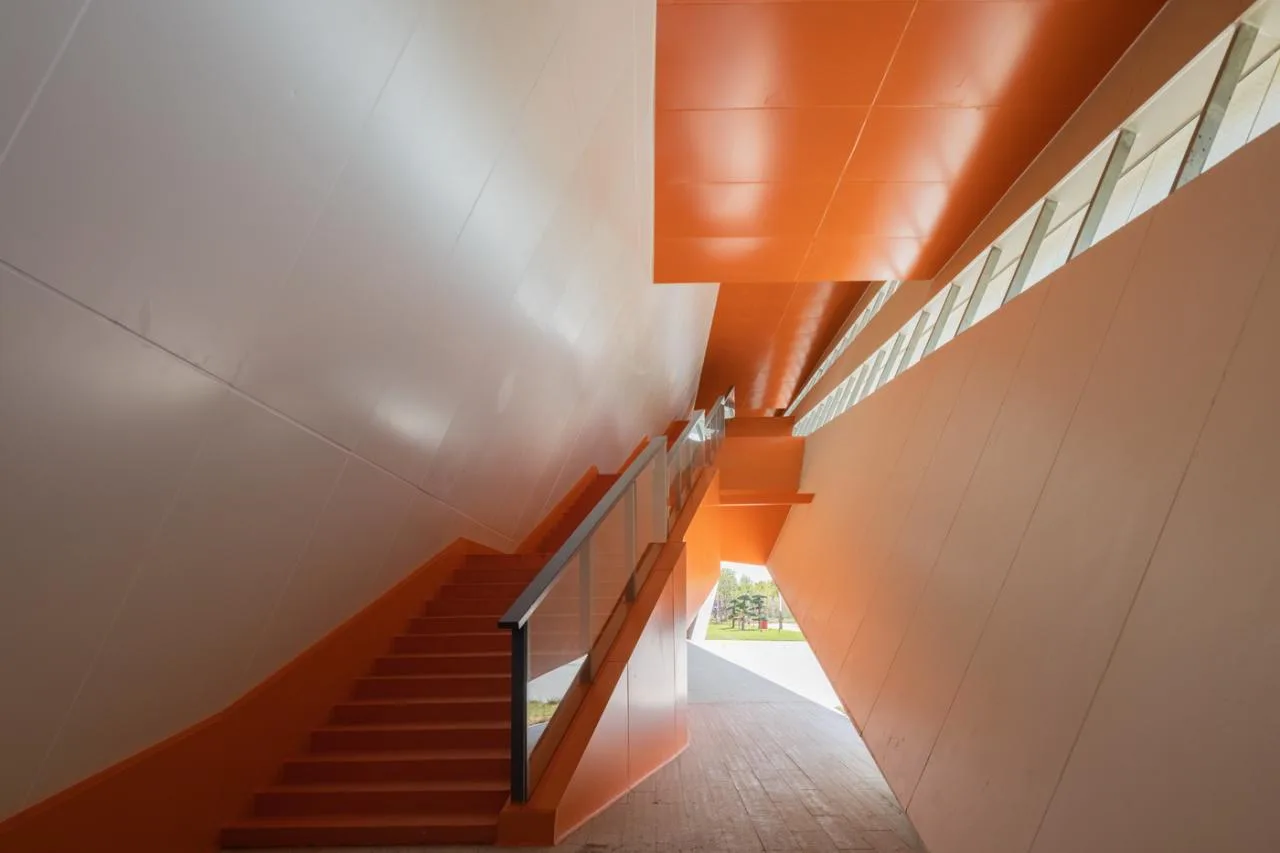
△ Training hall evacuation stairs © Literal translation of architectural photography
Natural Light and Green Ecology
The design actively incorporates natural light through skylights integrated into the roof. These skylights are shaped as three-dimensional triangular pyramids, strategically angled based on light environment analysis to minimize glare. Natural light is channeled into the interior via roof sides, with 28 and 12 corner windows atop the main and training venues, respectively, providing excellent indoor lighting comfort. This approach is a key green design strategy for the project.
Set against the park’s water system backdrop, the skylight’s lattice design resembles sparkling waves and white egrets in flight, creating a visually rich and rhythmic fifth façade for the building.
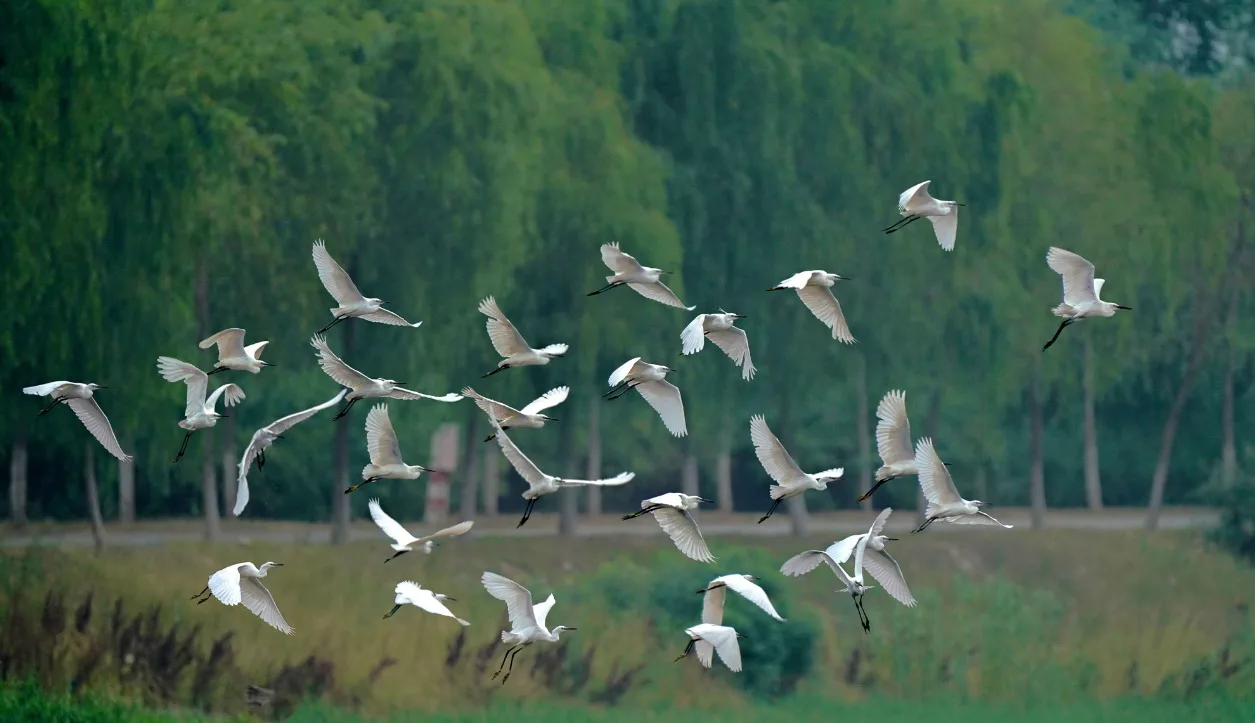
White egrets over Qinhuanghe Wetland Park © Chinese Academy of Sciences Architectural Design and Research Institute Co., Ltd
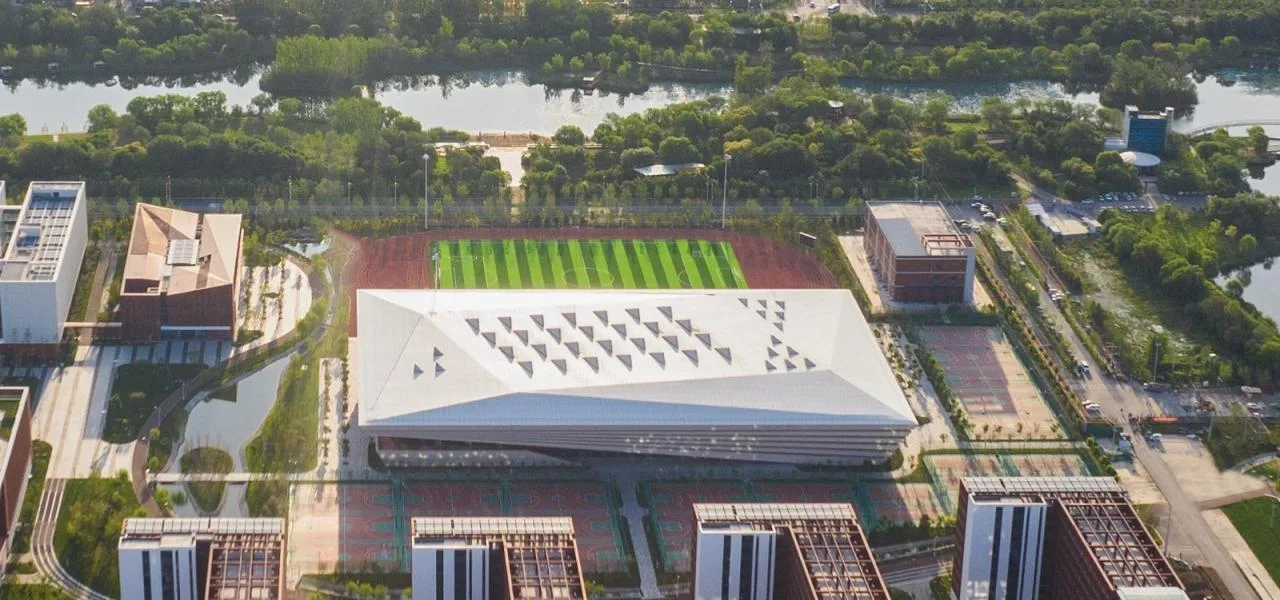
△ Dynamic roof skylight © Literal translation of architectural photography
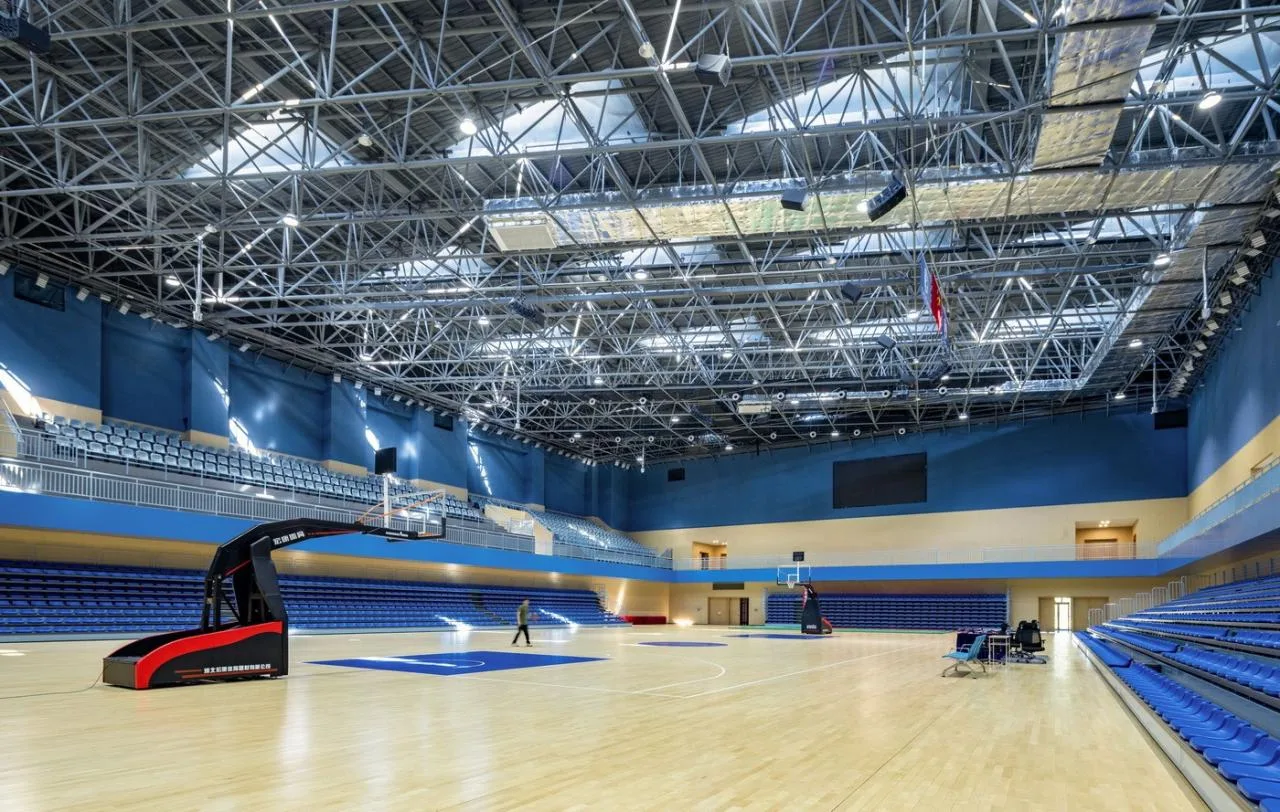
△ Natural lighting © Literal translation of architectural photography
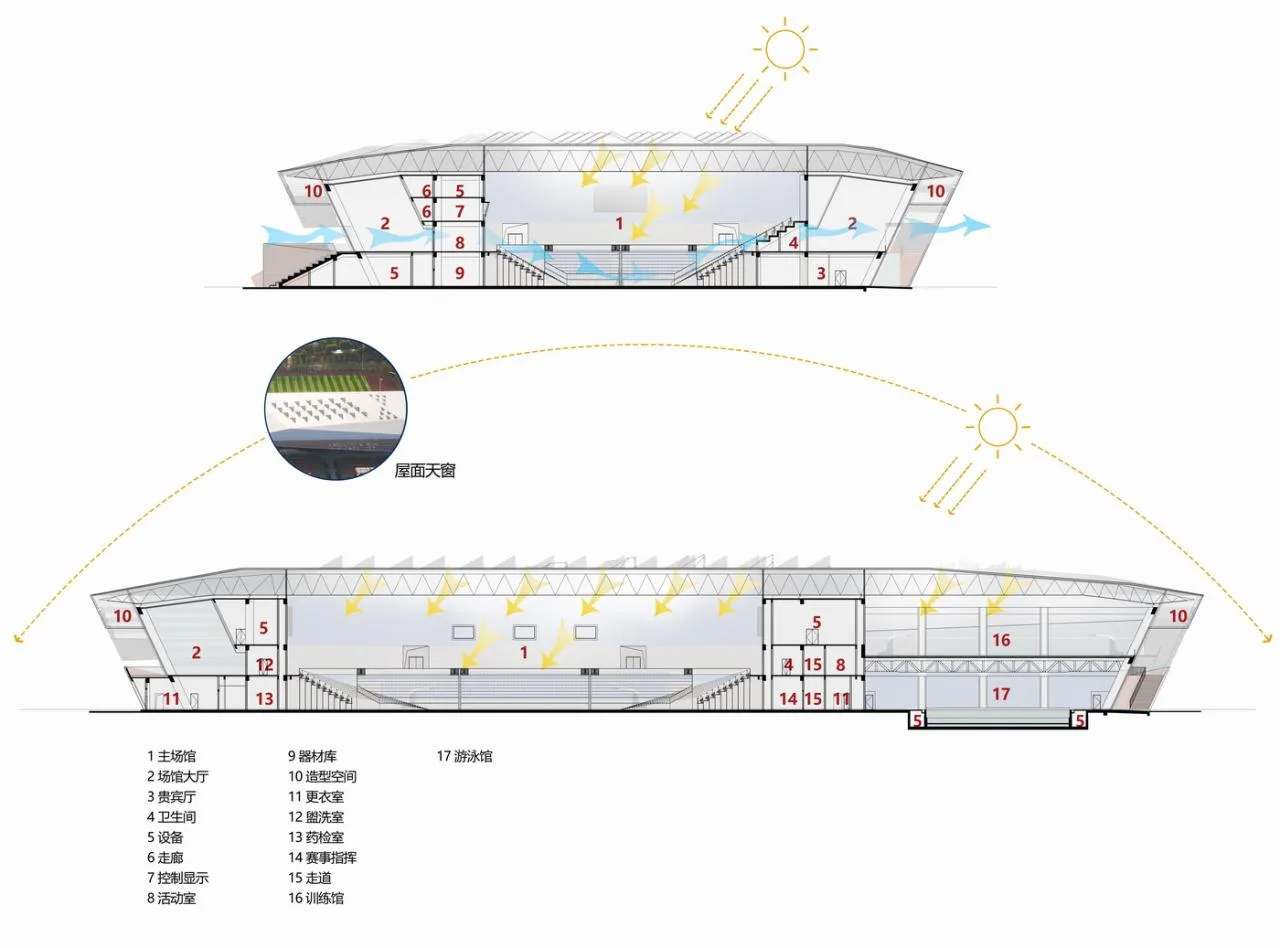
△ Section diagram © Chinese Academy of Sciences Architectural Design and Research Institute Co., Ltd
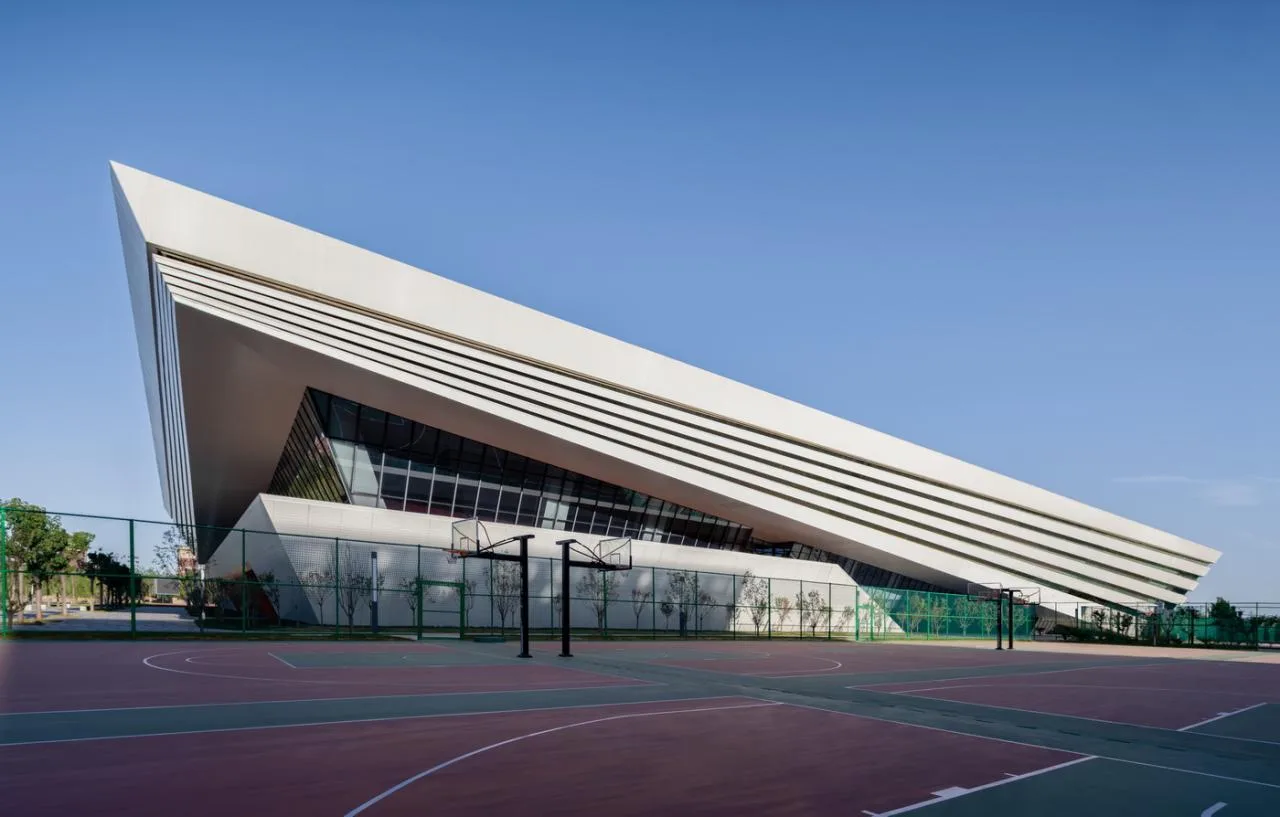
△ Sports equipment showcasing dynamic movement © Literal translation of architectural photography
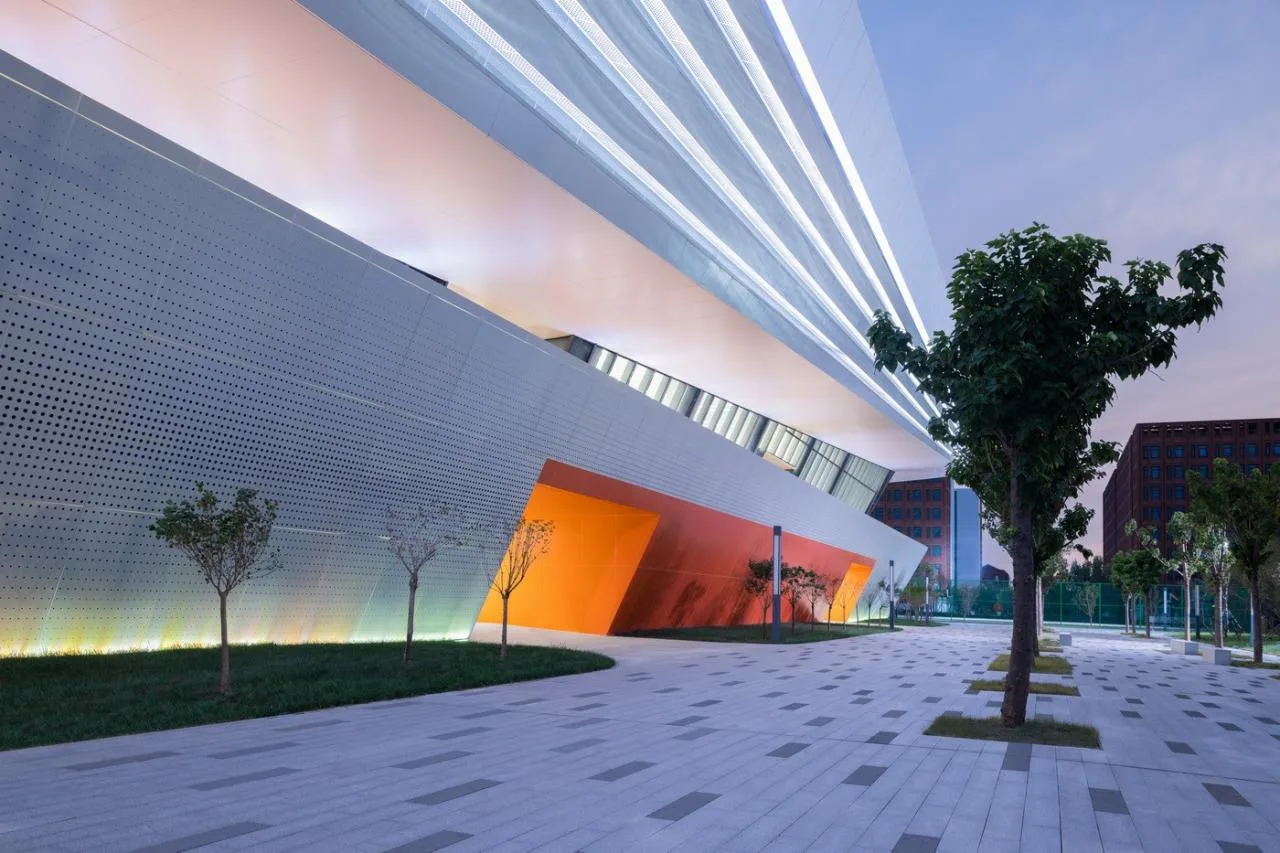
△ Sports equipment showcasing dynamic movement © Literal translation of architectural photography
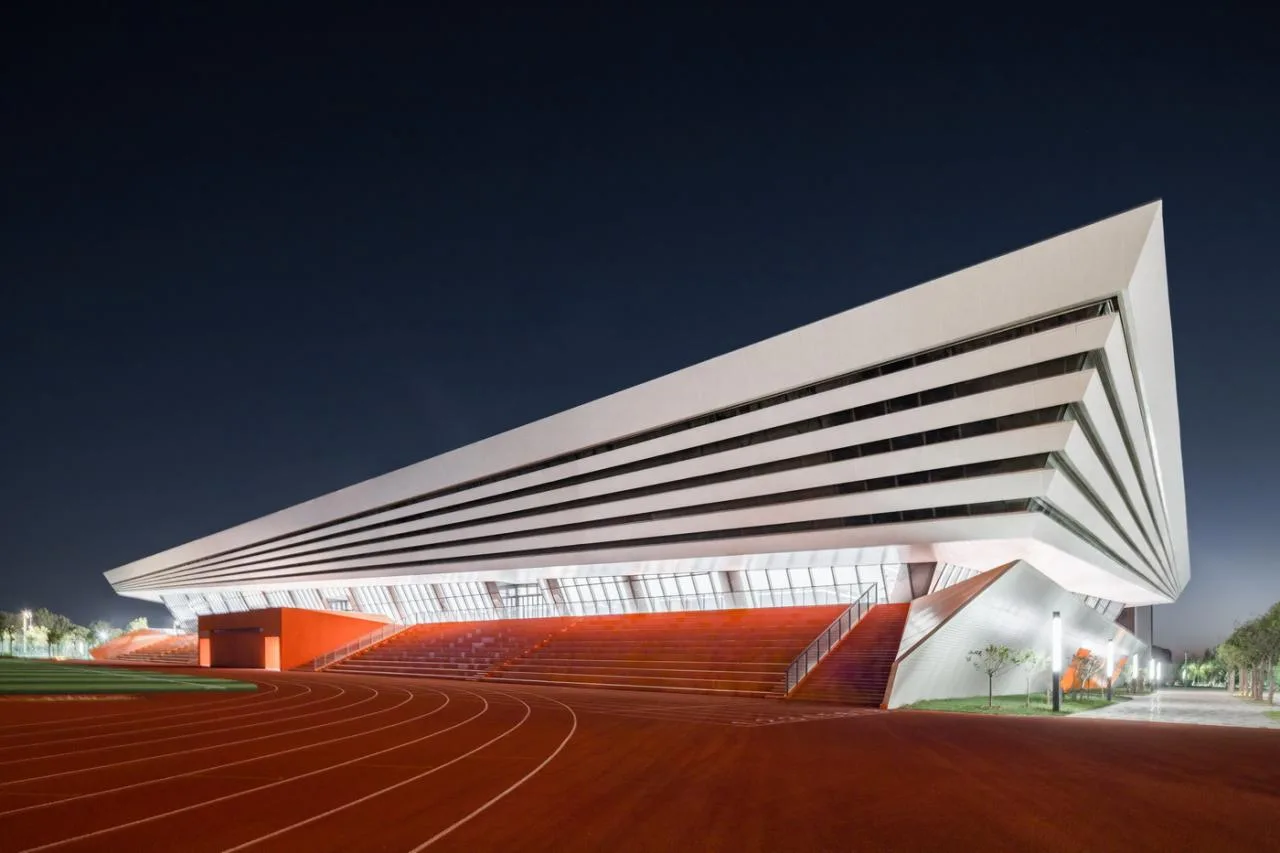
△ Sports center illuminated under the night sky © Literal translation of architectural photography
Project Drawings
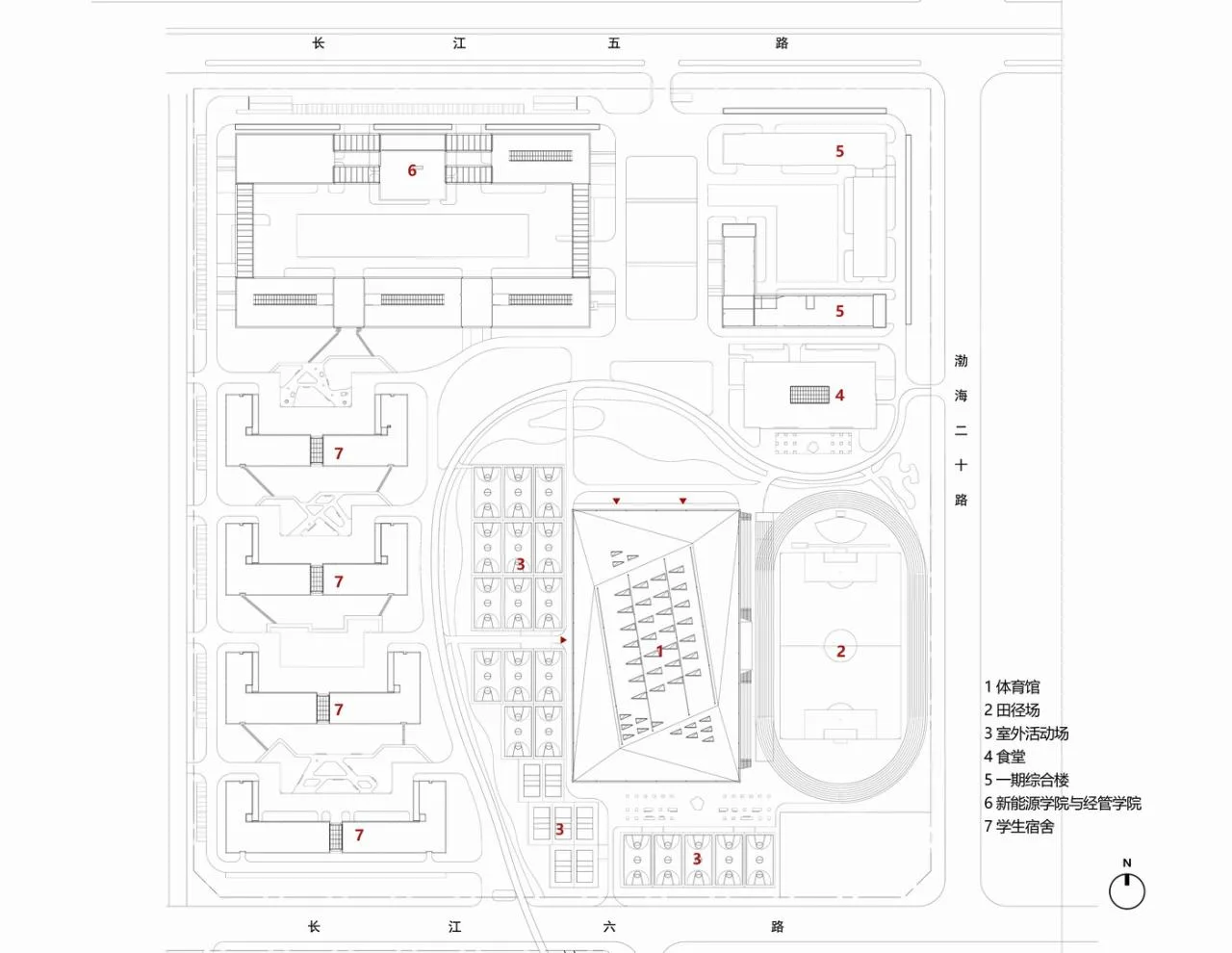
△ General layout plan © Chinese Academy of Sciences Architectural Design and Research Institute Co., Ltd
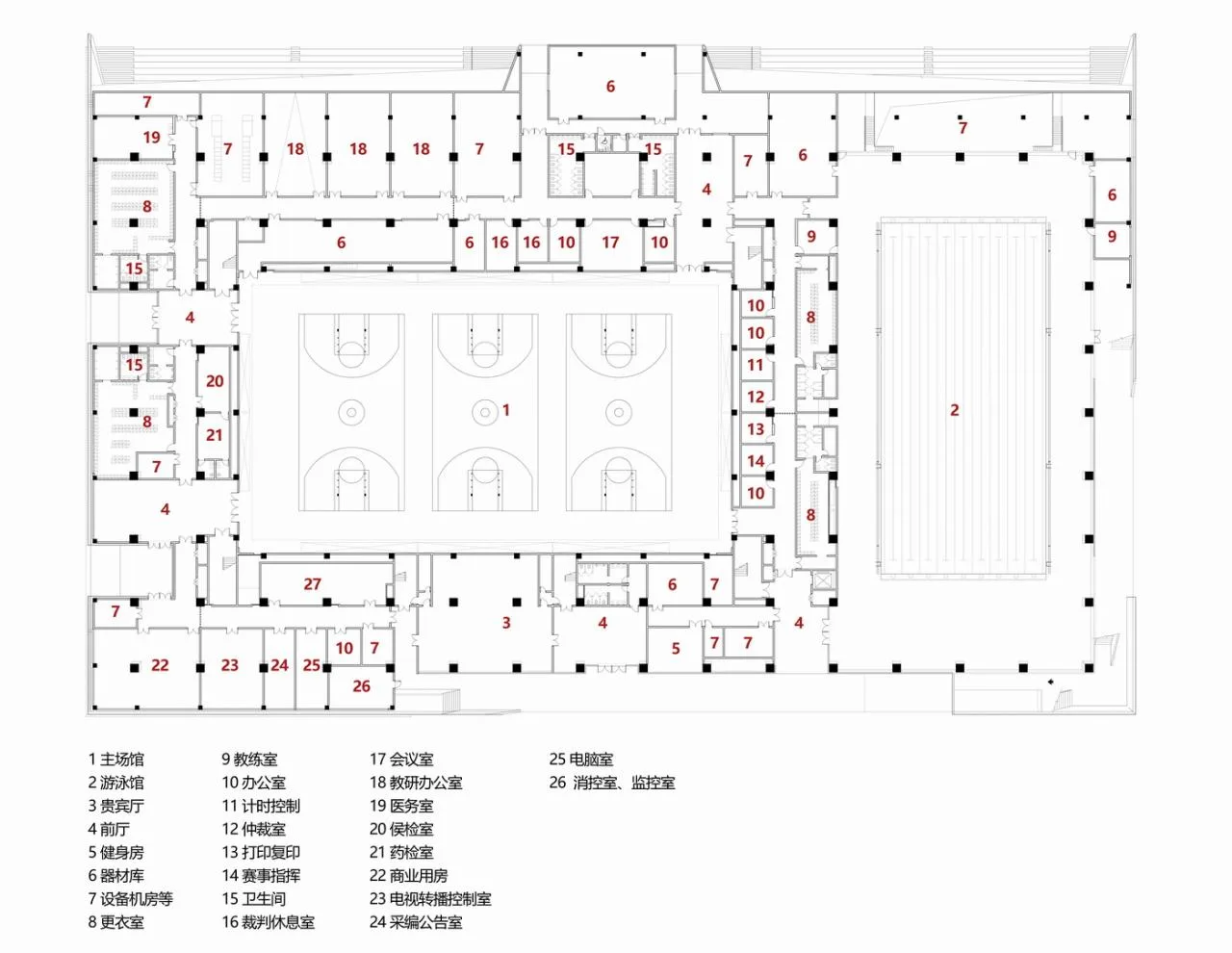
△ First floor plan © Chinese Academy of Sciences Architectural Design and Research Institute Co., Ltd
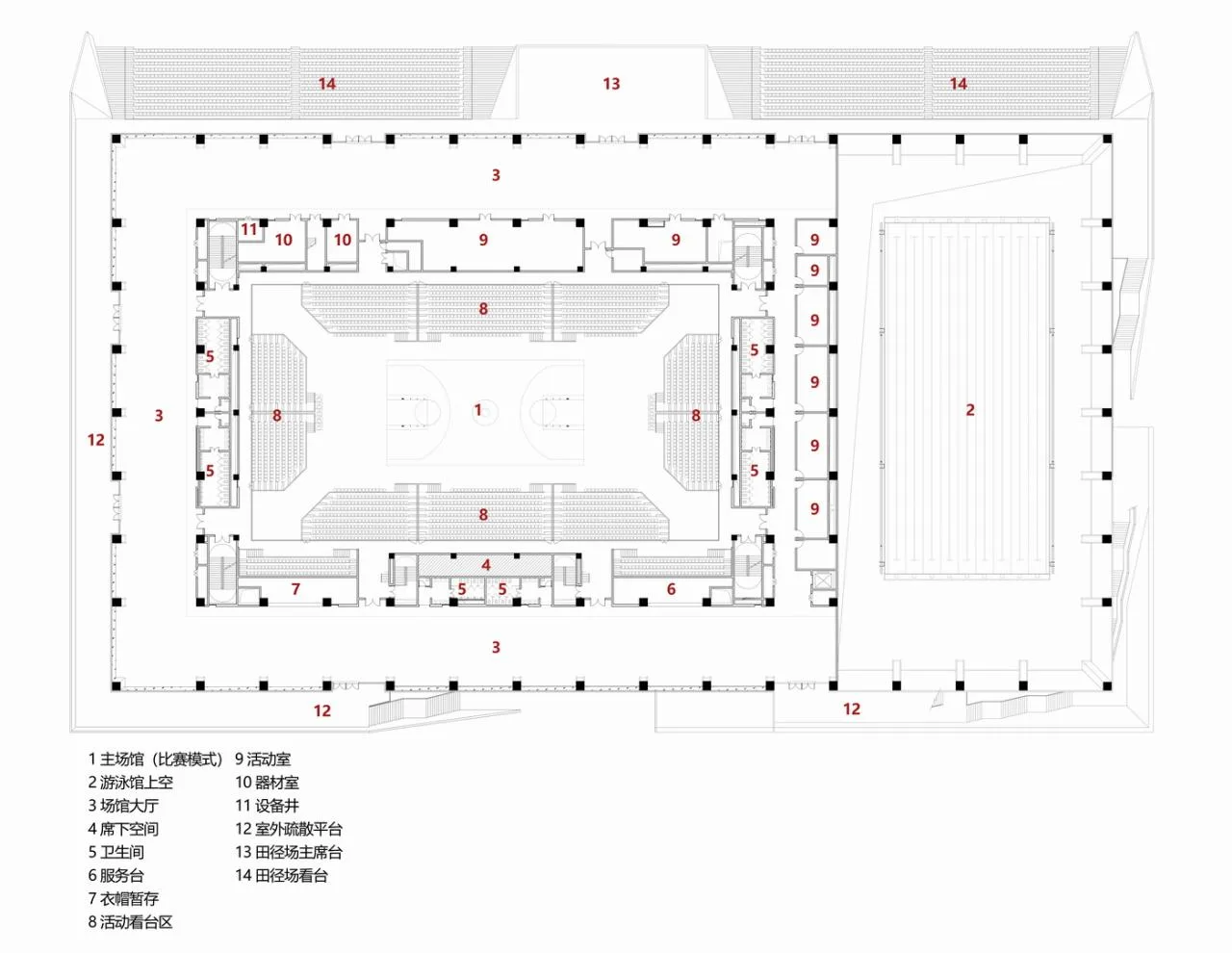
△ Second floor plan © Chinese Academy of Sciences Architectural Design and Research Institute Co., Ltd
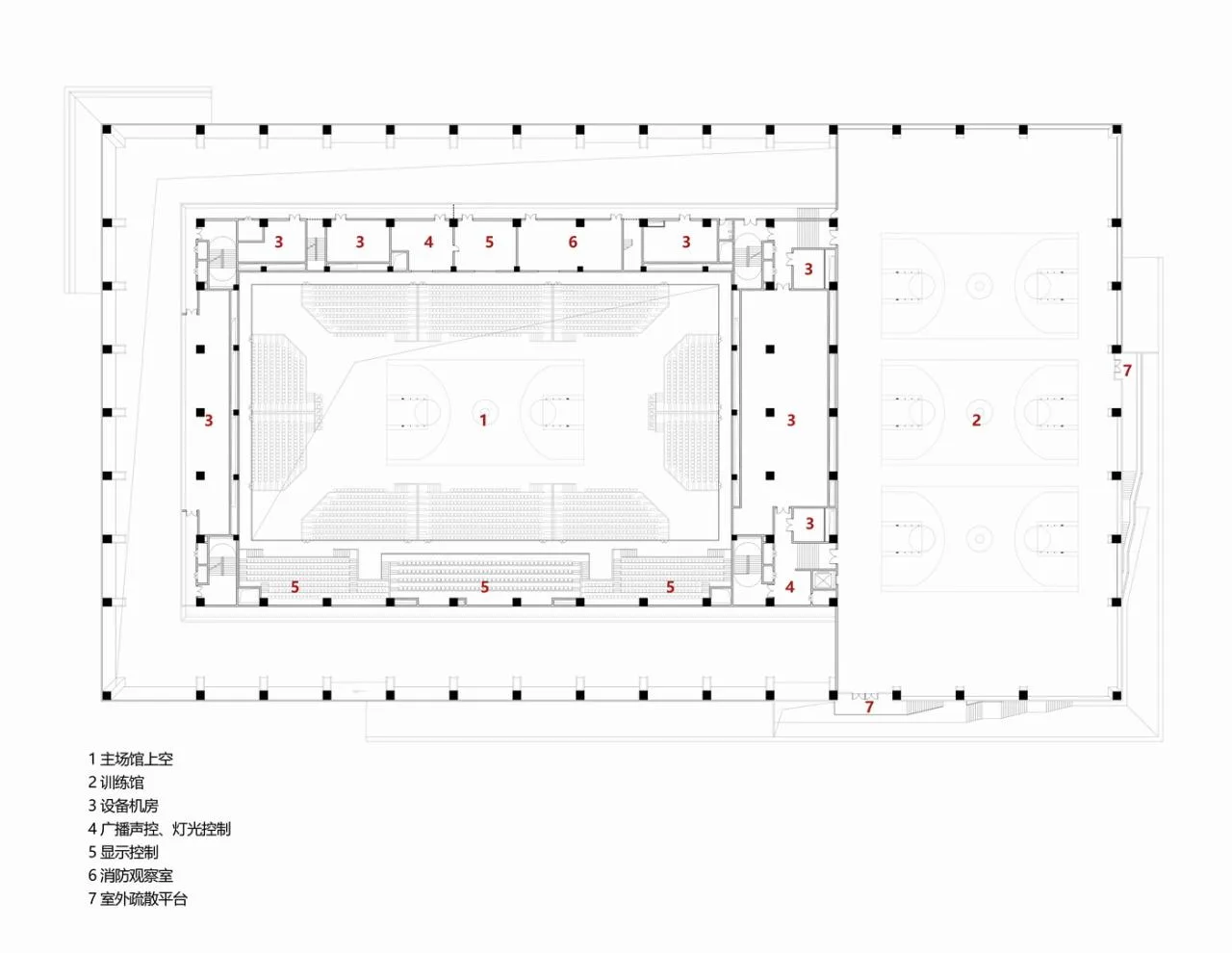
△ Third floor plan © Chinese Academy of Sciences Architectural Design and Research Institute Co., Ltd
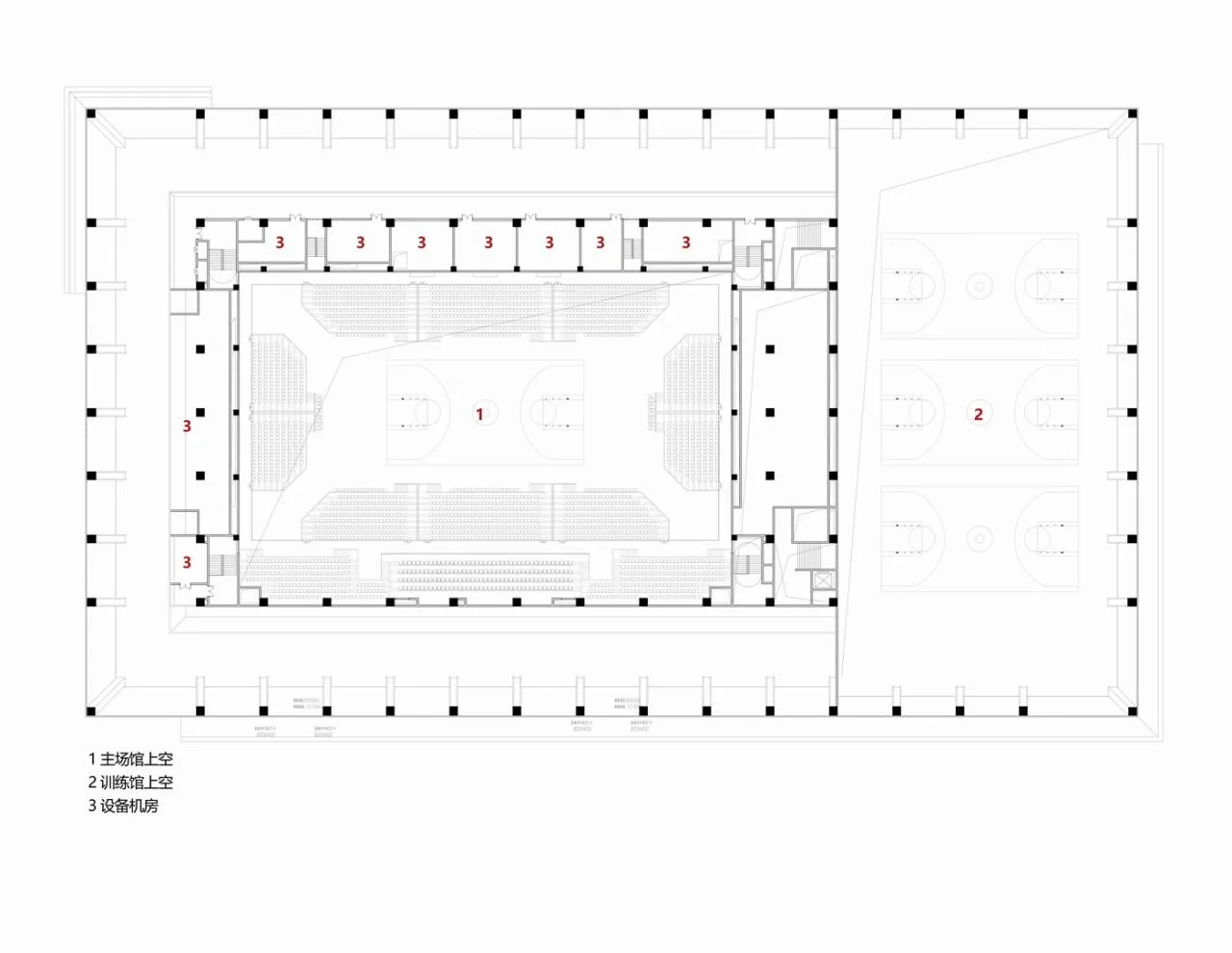
△ Local interlayer plan © Chinese Academy of Sciences Architectural Design and Research Institute Co., Ltd
Project Information
Project Name: Sports Center of Bohai University of Science and Technology
Project Type: Sports Architecture
Location: Binzhou, Shandong
Design Firm: Institute of Architectural Design and Research, Chinese Academy of Sciences Co., Ltd
Design Team:
Lead Architect: Li Xinbin
Program Creators: Li Xinbin, Zhang Chunyu
Technical Guidance: Zhu Jizhong
Architectural Design: Li Xinbin, Zhang Chunyu, Zou Jinming, Liu Sitong, Yang Xiujin
Structural Design: Wei Peng, Fan Xiulei
Mechanical and Electrical Design: Zhang Hongbing, Di Feng, Xu Wenhao, Tian Jiji
Business Managers: Zhao Feiran, Yang Zongchen
Design Period: 2019-2021
Construction Year: 2022
Building Area: 26,112.91 square meters
Photography: © Literal translation of architectural photography
Manuscript Editors: Zhang Chunyu, Li Xinbin
Video Production: Chen Bowen














Must log in before commenting!
Sign Up