
The Hengqin New Area Citizen Service Center in Zhuhai stands as a pivotal livelihood project, seamlessly integrating government administrative functions with citizen services and leisure activities. As a landmark public building in the Hengqin New Area, it represents the forefront of government services, economic reforms, and innovation within the Hengqin Guangdong Macao Deep Cooperation Zone. The project spans 65,530 square meters of land with a total built-up area of 131,876 square meters, encompassing key facilities such as an administrative service center, civic center, conference hall, and reception center.
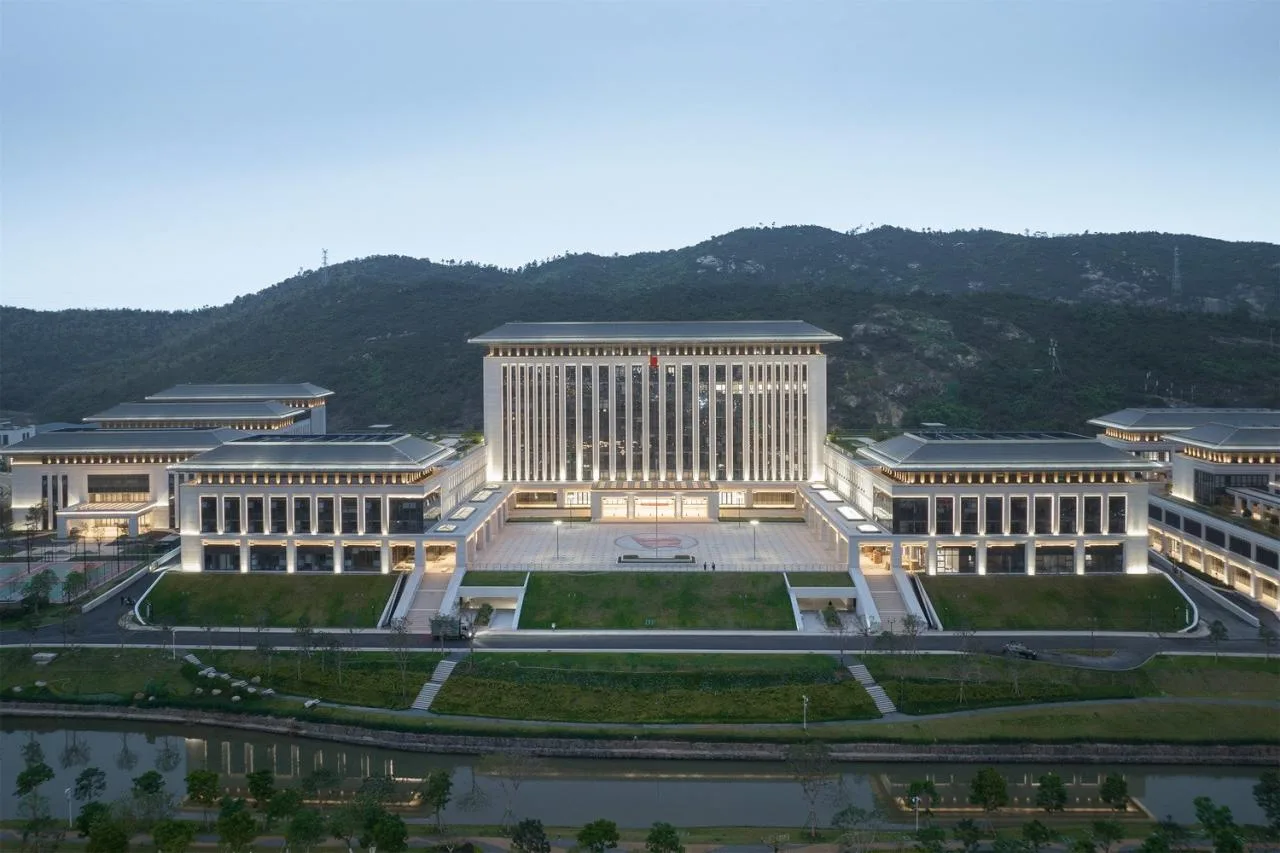
△ Front bird’s-eye view © Tang Xuguo
Located north of Xiaohengqin Mountain and south of a city green space, the site benefits from a unique geographical setting and the distinct natural scenery of the Lingnan region. Positioned along a green urban development axis that blends natural and cultural landscapes, the site also features an urban water system running parallel to Hong Kong Macau Avenue at its southern edge. The interplay of the staggered mountainous terrain with the water landscape vividly showcases the natural urban style characteristic of Lingnan. Consequently, the design focuses on harmonizing the site’s natural terrain and surrounding environment of mountains and rivers to create a building complex rich in local urban identity.
Another critical design consideration is the spatial relationship with surrounding urban functions. The western side of the site accommodates administrative offices such as prosecutors and courts, the eastern side supports village construction, and the southeast is designated for extensive urban residential development. The design not only aims to enhance the urban image of Hengqin New District’s core area but also emphasizes the public and open nature of the citizen service center, fostering coordination with existing and planned neighboring buildings. This approach optimizes site conditions to establish a vibrant, multifunctional urban zone for residents.
Design Philosophy
Embracing the ecological and geographical features of the site, the design concept centers on the theme of “landscape city, ecological island city.” It integrates Hengqin’s landscape culture by drawing inspiration from the existing landscape network. The architectural style references traditional Zhuhai residential architecture, with building arrangements that follow the natural contours of mountains and water, moving away from rigid grid layouts to create harmonious outlines and engaging street spaces.

△ Conceptual deduction
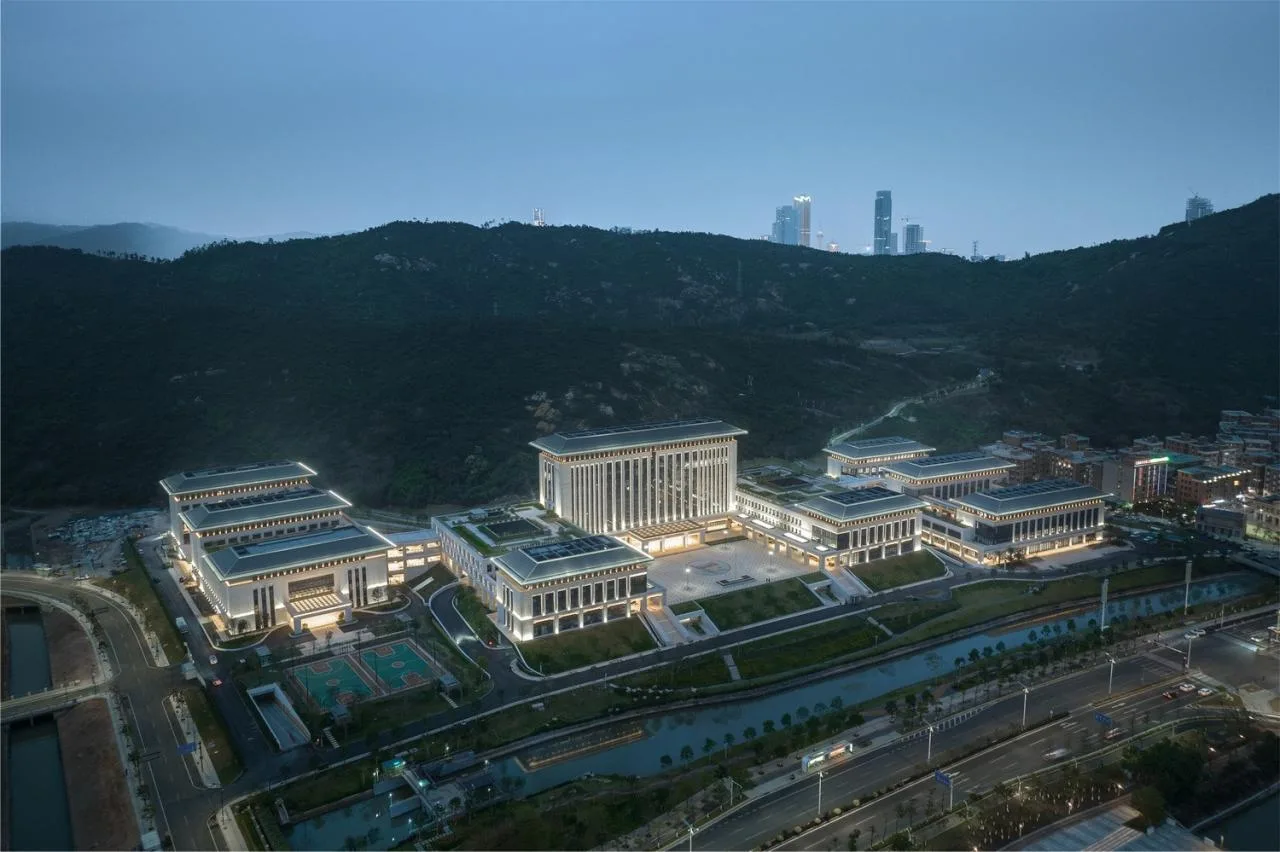
△ Night view bird’s-eye view © Tang Xuguo
The master plan emphasizes the connection between the building axis and the surrounding landscape. The main building aligns with the city’s primary landscape axis. Taking advantage of the existing water systems and mountainous terrain, a belt-shaped landscape corridor divides the site into building clusters and public urban park spaces. The core administrative office cluster sits on the north-south urban landscape axis, balanced by two adjacent building clusters on either side. Following the mountain’s terrain, building heights decrease from 18 meters in the north downwards, creating a natural gradient. Stairs and ramps gradually lead visitors into pedestrian plazas and lively public areas.
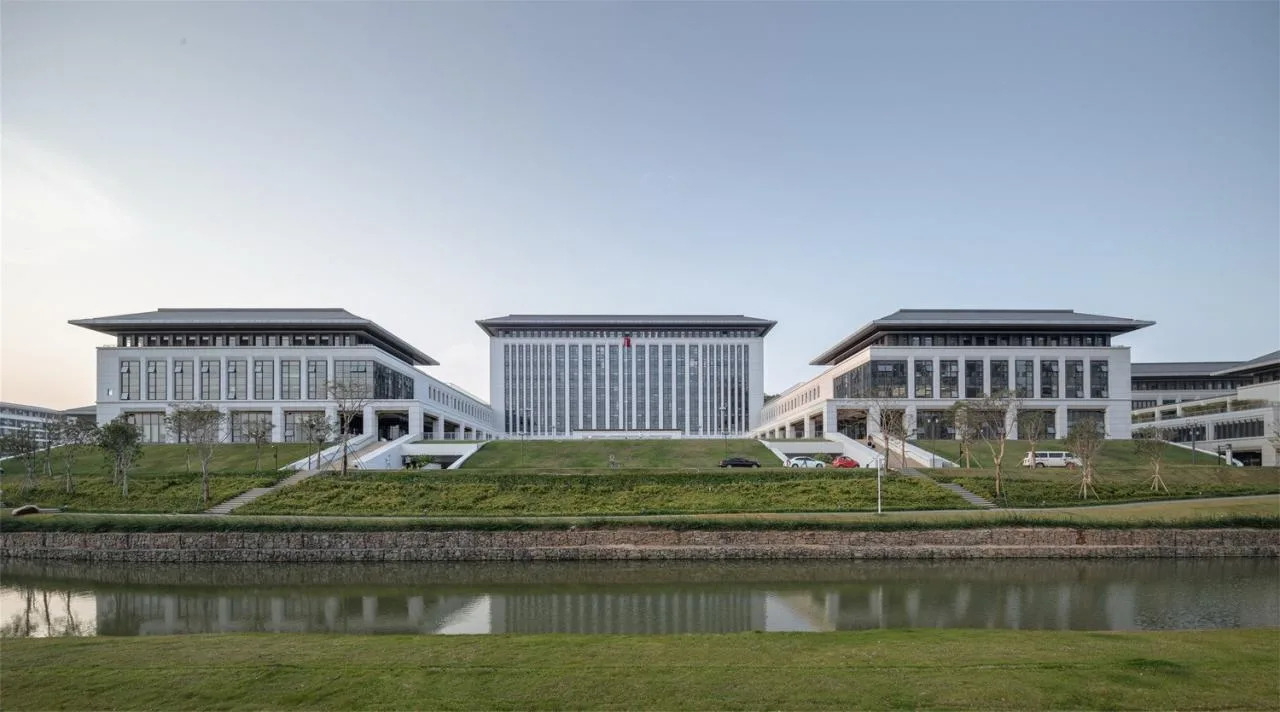
View towards the project from the river channel © Tang Xuguo
Functional Layout
The architectural clusters are designed to respect the original topography, adopting a low-impact development approach. Building clusters are concentrated to minimize disruption to the natural terrain and reduce the volume of above-ground structures. The design divides the complex into three clusters, each internally arranged in the traditional Lingnan residential style of “three rooms and two corridors.” Each cluster is surrounded by courtyards and connected by corridors running north-south, promoting ventilation and natural lighting while prioritizing greenery and energy efficiency. This layout pays homage to the historical and cultural significance of the Lingnan region by enclosing courtyard spaces within the “three rooms and two corridors” form.
△ Reflection of the “three rooms and two corridors” design
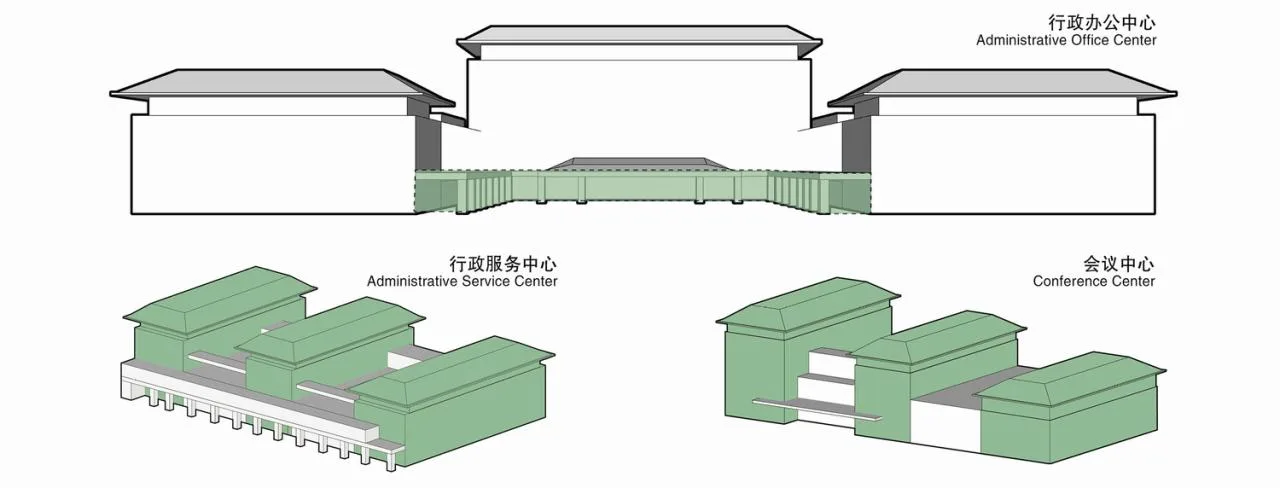
The three building clusters, arranged from east to west, serve distinct functions:

△ Functional diagram
The Administrative Service Center rises five floors. The first and second floors house government halls with 200 service windows, divided into two courtyards—one for citizen services and another for enterprise services. A continuous colonnade on one side of the ground floor reflects the design elements of traditional Lingnan arcade buildings.
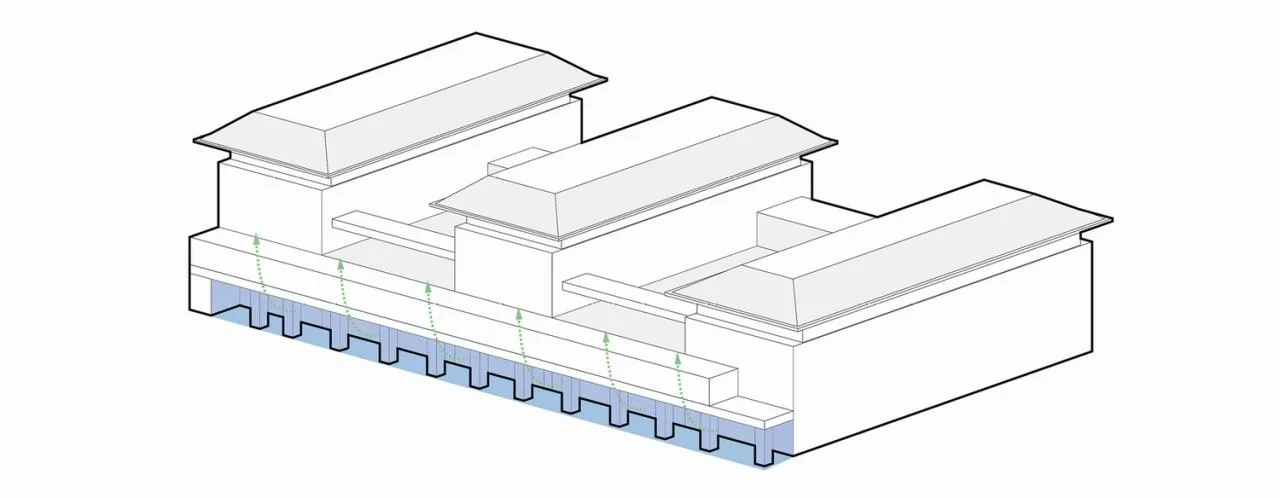
△ Bottom column gallery of the Administrative Service Center
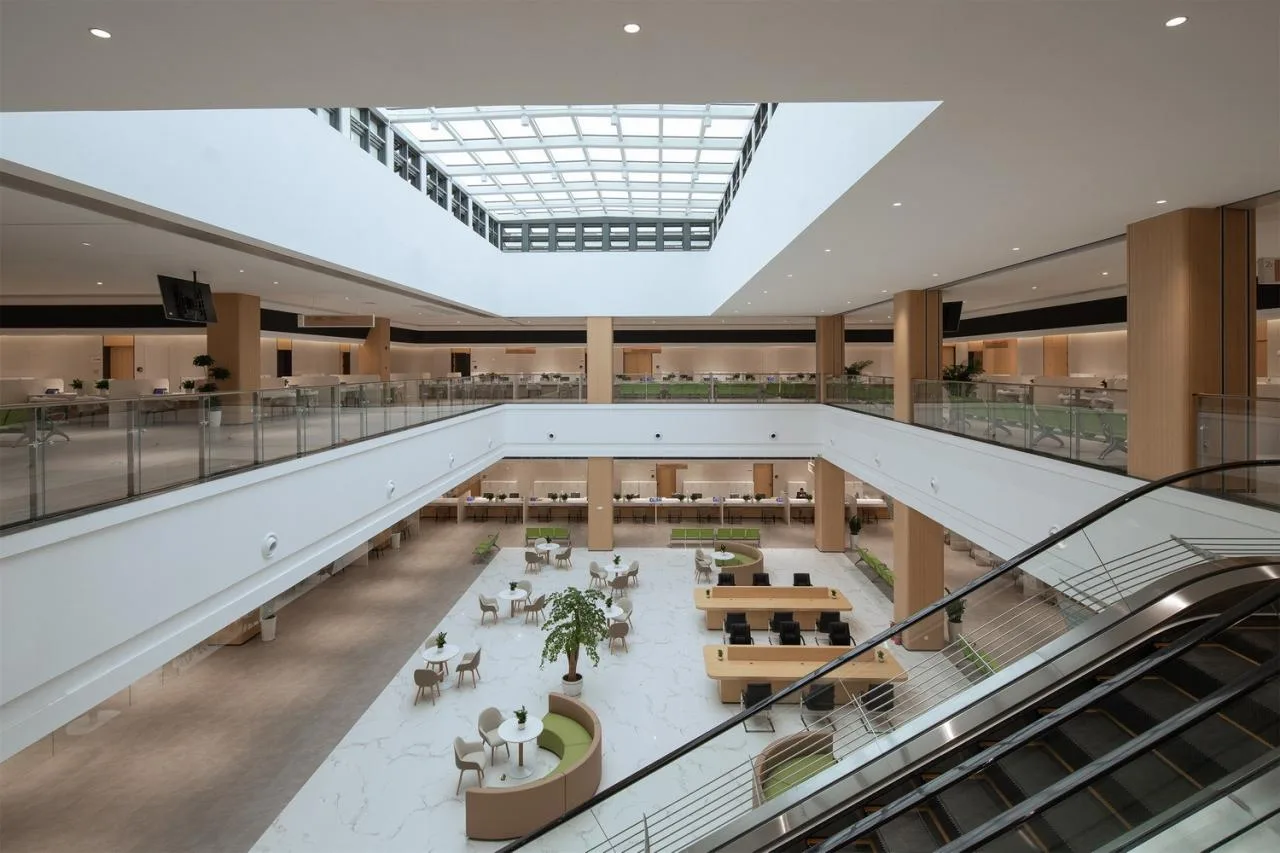
△ Citizen Service Hall © Tang Xuguo
The Administrative Office Center is the tallest building on site, featuring a nine-story tower flanked by four-story podiums. It houses 15 government departments responsible for offices, receptions, meetings, and archives. The design incorporates local residential and traditional Lingnan architectural elements such as “cold alleys,” arcade buildings, and corridors. The eaves of local buildings inspire the architectural form, with corridors designed to facilitate air circulation by removing hot air. Internally, the space is divided into independent zones to prevent interference, while public areas like rest spaces, green roofs, and entrance halls offer shared environments. The first floor is partially elevated, providing a public grey space beneath.
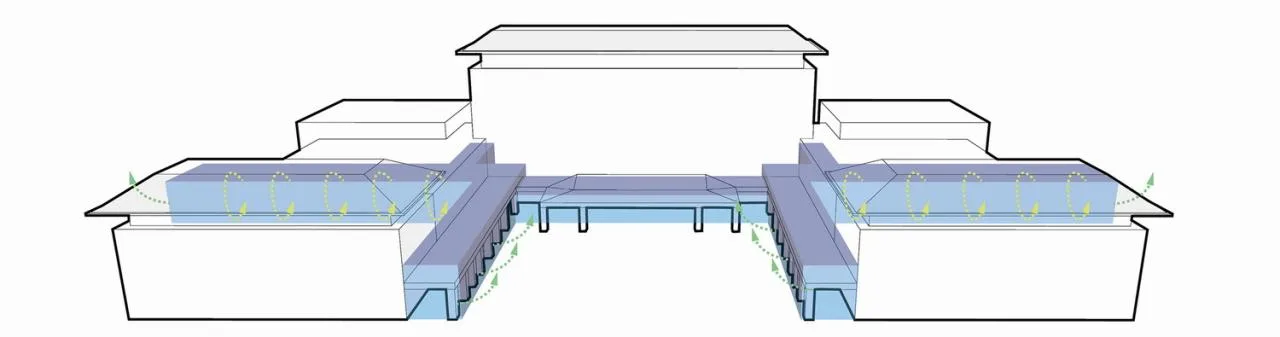
△ The Administrative Office Center integrates traditional Lingnan architectural elements
The Conference Center consists of six floors housing sports facilities and a reception area, serving as supporting functions for the entire complex.
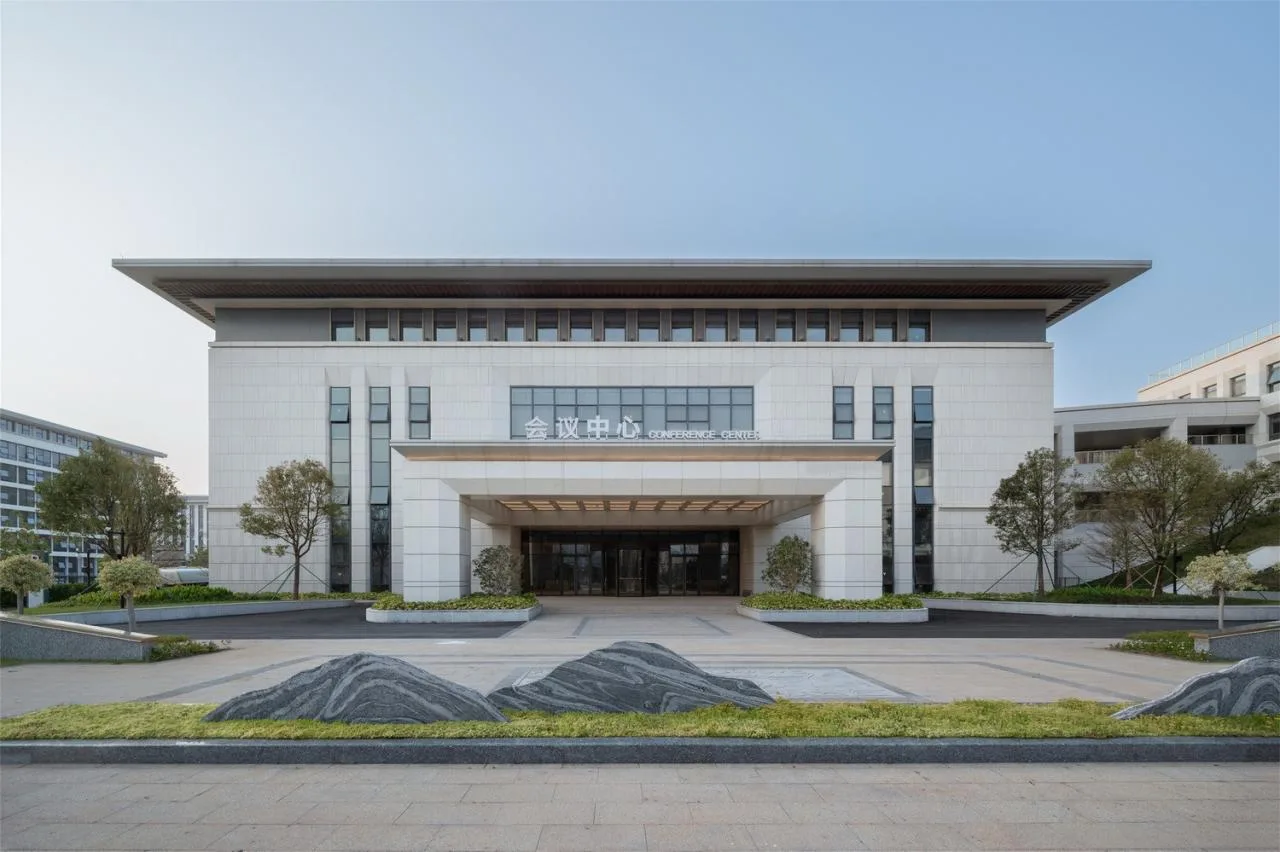
△ Front view of the Conference Center © Tang Xuguo
All three building clusters are seamlessly connected through a comprehensive pedestrian circulation system, forming a cohesive and dynamic complex. Unlike traditional government office models, this project integrates office services with cultural, leisure, and urban park functions. It combines conference and reception facilities, a cultural center, sports center, and public square into a highly accessible, open, one-stop service hub.
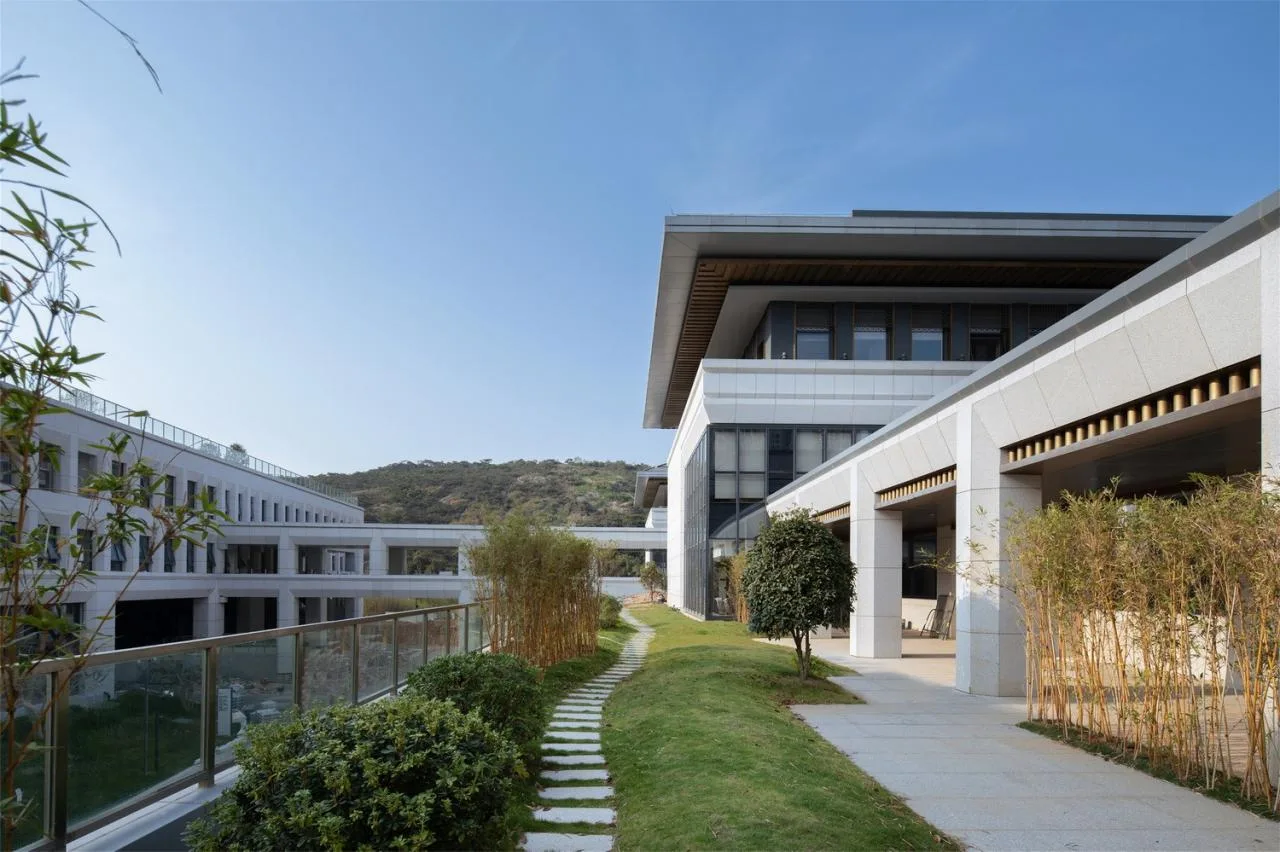
△ Corridor connecting buildings © Tang Xuguo
Vegetation is integrated seamlessly along the southeast coast side of the buildings, crafting a harmonious environment where people and nature coexist. Courtyards and rooftops within the complex are designed as green spaces featuring highly ornamental trees and flowers. The rooftop gardens offer comfortable, pleasant areas for office staff to relax and enjoy.
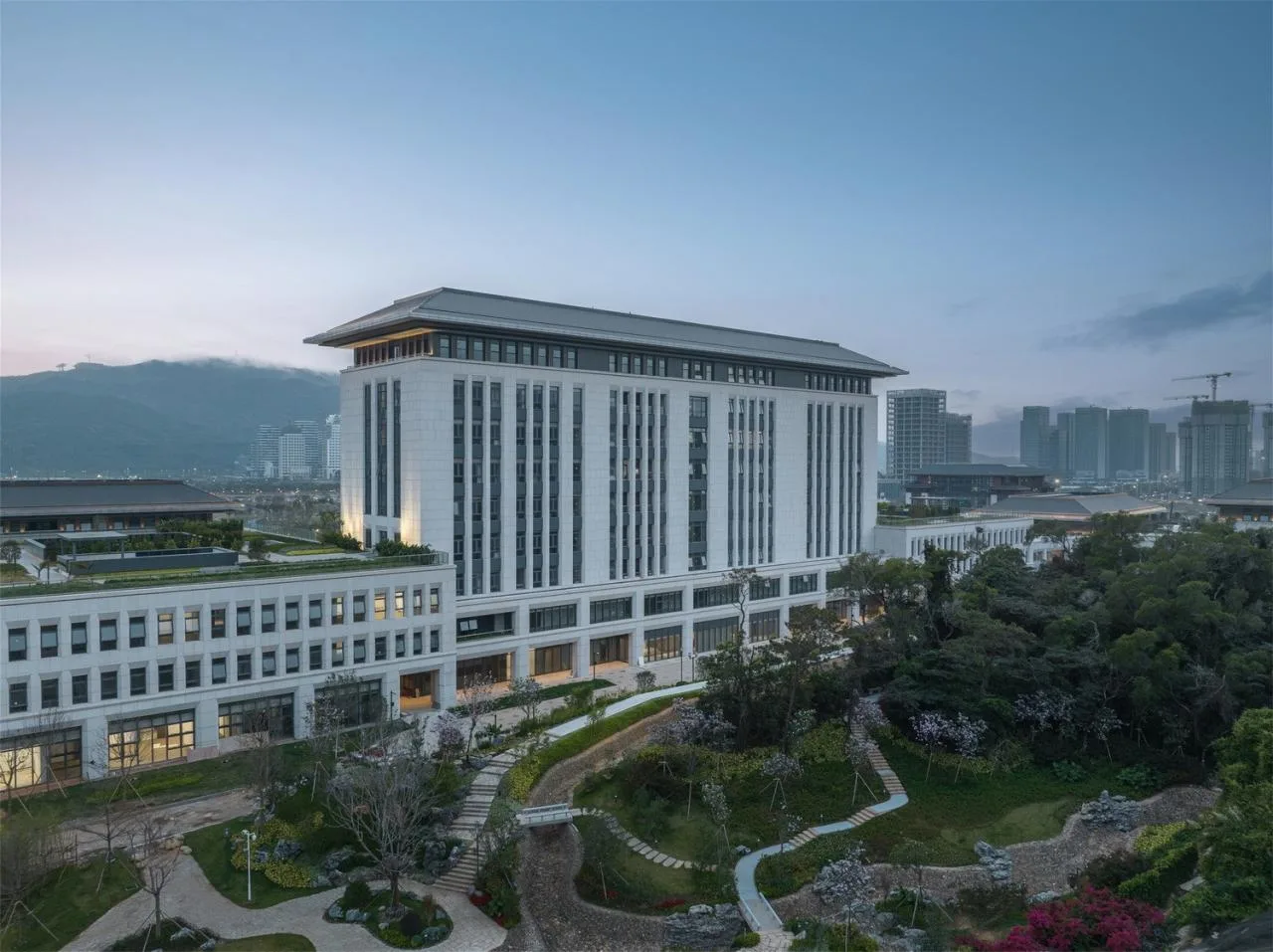
The rooftop garden connects the building with the surrounding mountainous green landscape © Tang Xuguo
The urban park’s public space is mainly positioned on the southern portion of the site, creating an open landscape themed around Hengqin Mountain and Water. Coupled with the water system, it forms a large landscape plaza serving as a vibrant public gathering space. Buildings face this plaza and are accompanied by diverse landscape nodes such as sports parks, internal courtyards, and sunken courtyards, establishing a layered and staggered green landscape system.
Architectural Style and Materials
The building façades reinterpret traditional Lingnan architectural decoration through a modern lens. By refining and simplifying elements such as colonnades, first-floor eaves, and characteristic historical color schemes, the design achieves a sleek yet culturally rich façade.
The external sunshade louvers draw inspiration from traditional Lingnan window pane forms and regional maritime culture. Patterns derive from early wooden lattice windows and Manchurian windows influenced by Western styles.
White stone clads the exterior walls, while deep gray outlines divide the surfaces into clean vertical sections, accentuating panel contours and enriching the façade’s visual appeal.
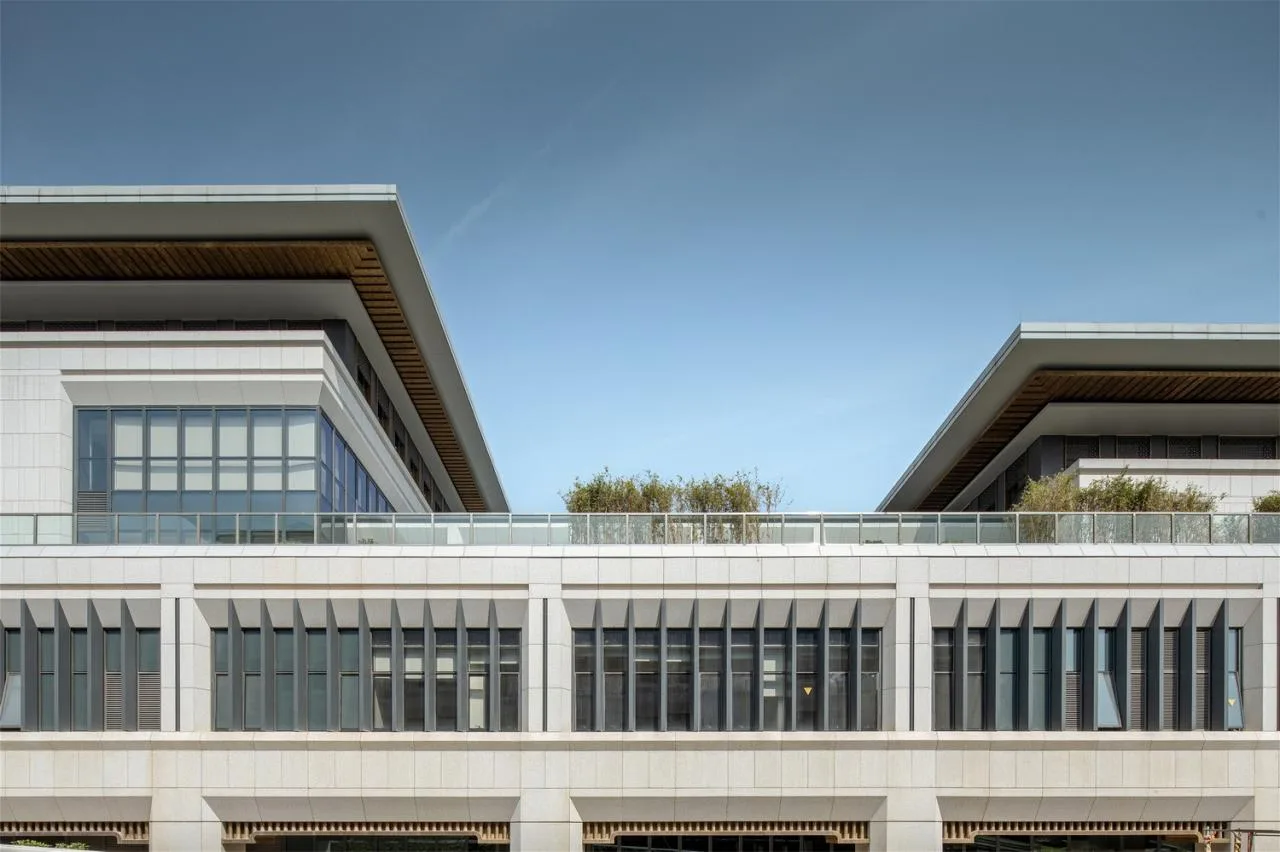
△ Façade design © Tang Xuguo
Detailed studies of Lingnan architectural eaves informed the design, including roof purlin density and tile distribution. Copper plates enhance the visual expression of Lingnan elements, creating harmony between tiles and ridges. Decorative details beneath the eaves are abstracted using light gray aluminum and copper plates, with multiple eave levels and metal grids highlighting cultural characteristics.
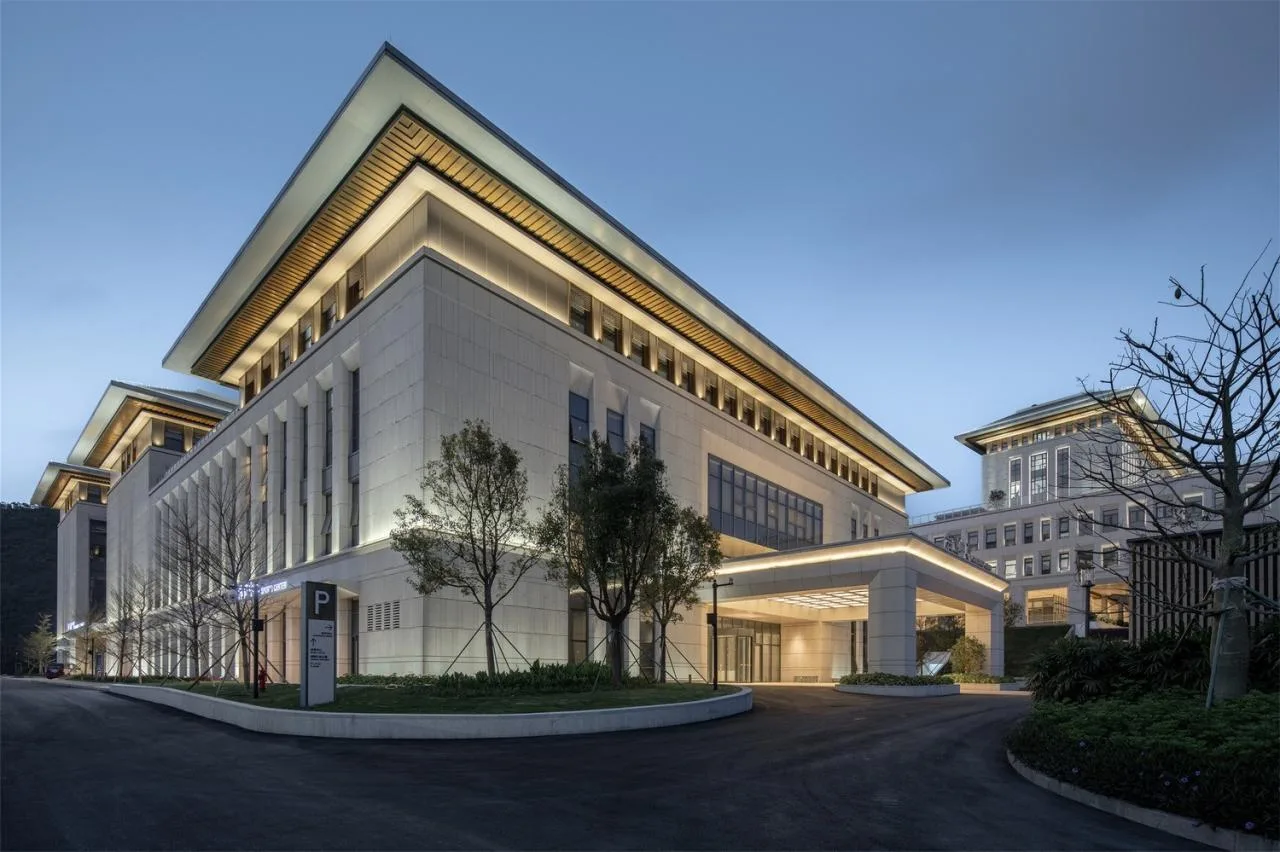
△ Detailed view of building eaves © Tang Xuguo
Sustainable Design
Championing green ecology, energy conservation, and environmental protection, the project incorporates sponge city principles and green building technologies. The design reduces impermeable surfaces by respecting the terrain, naturally guiding rainwater into ecological management systems for recycling. Throughout the building’s lifecycle, priorities include low consumption, high efficiency, cost-effectiveness, environmental protection, integration, and optimization. Water-saving devices and smart energy systems enhance resource conservation, ensuring healthy, comfortable, and efficient spaces for occupants.
Project Drawings
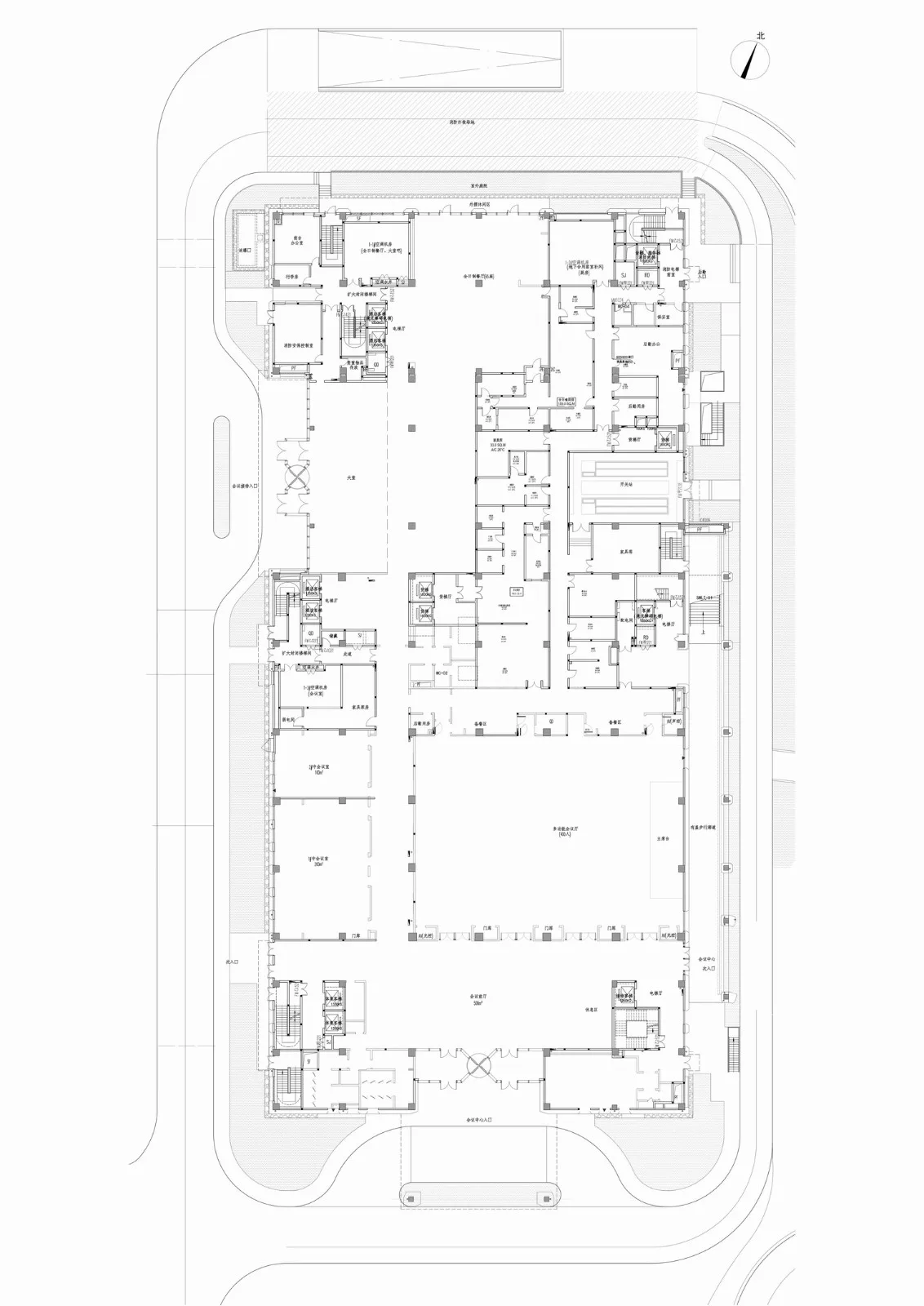
△ Conference Center First Floor Plan
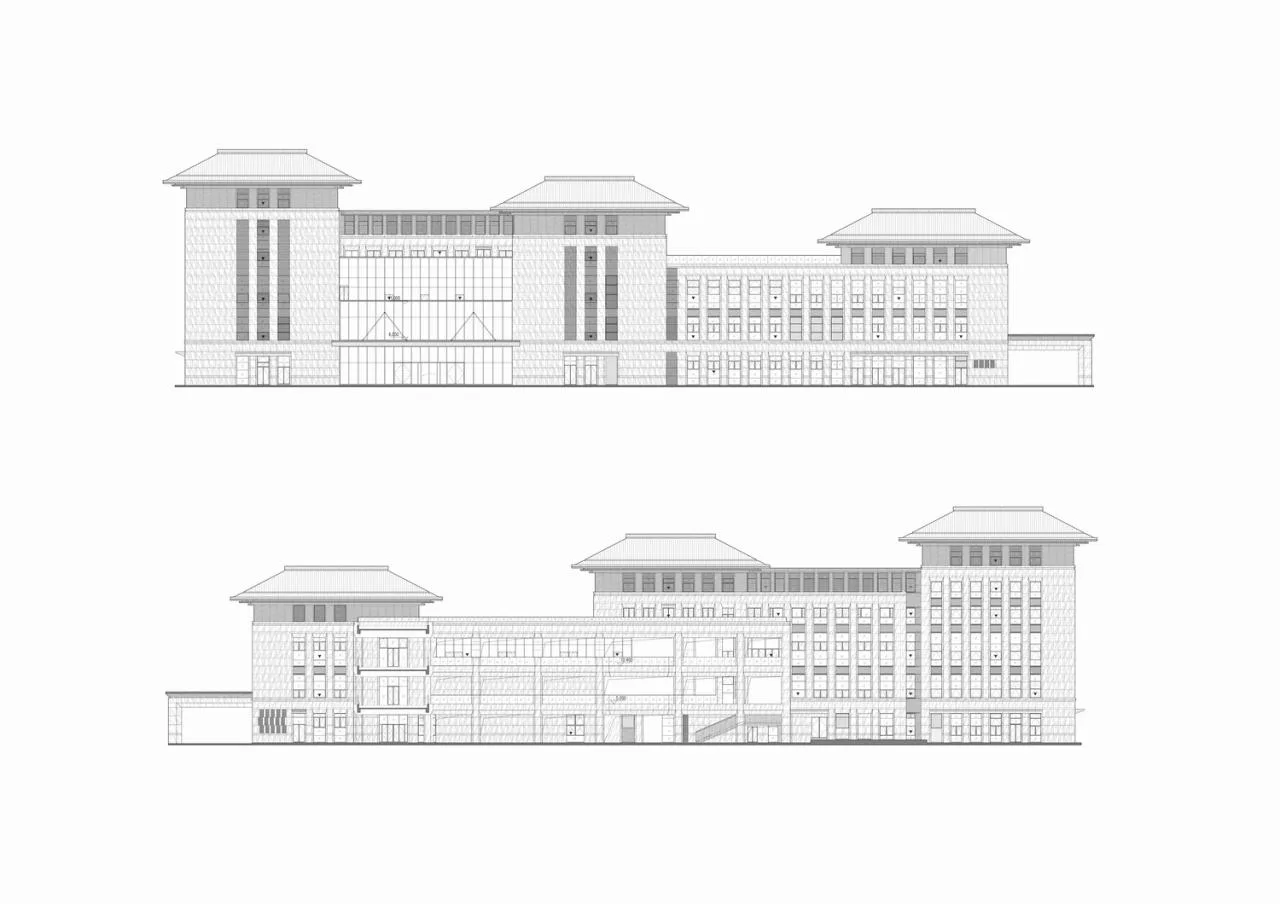
△ Conference Center Elevation
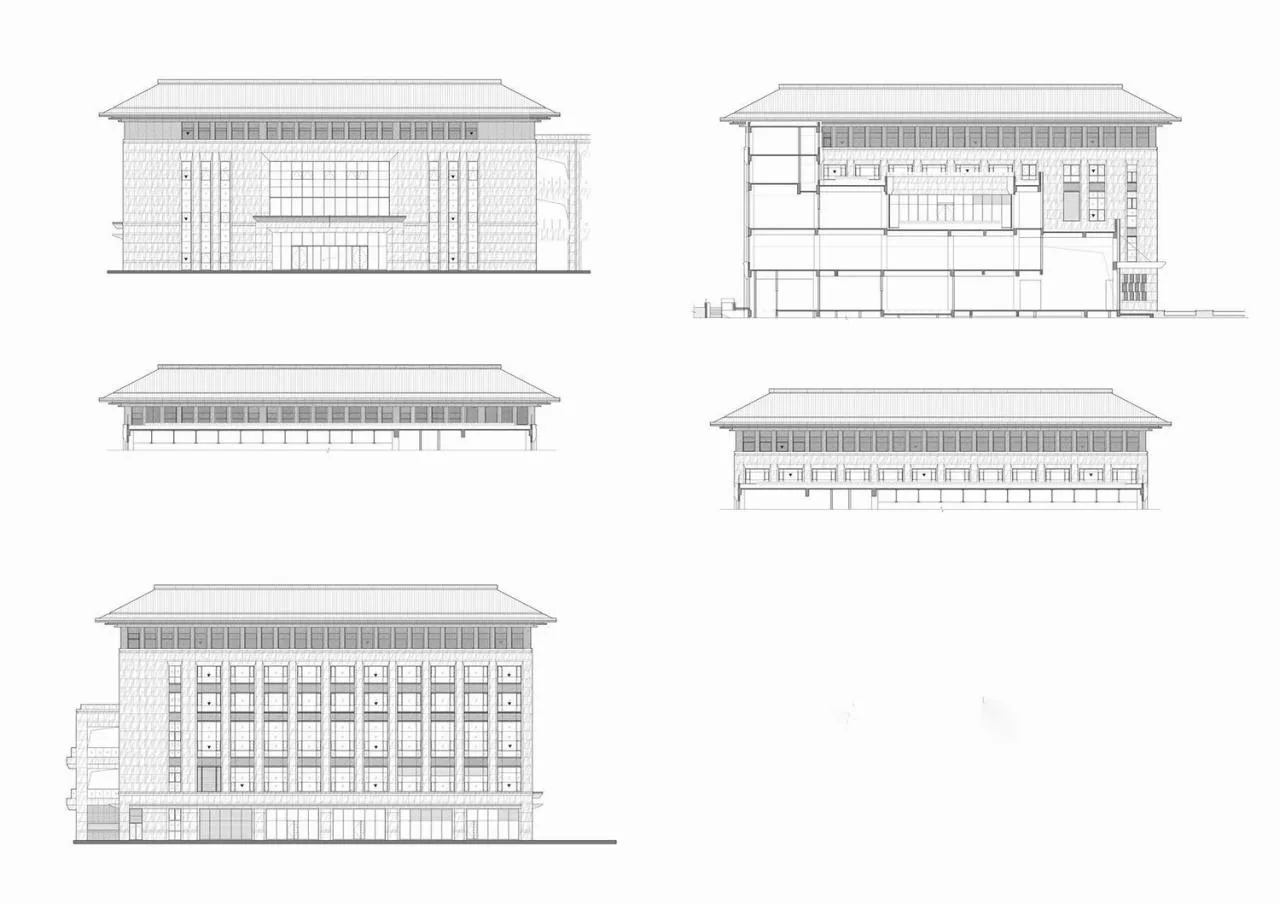
△ Conference Center Façade & Section View
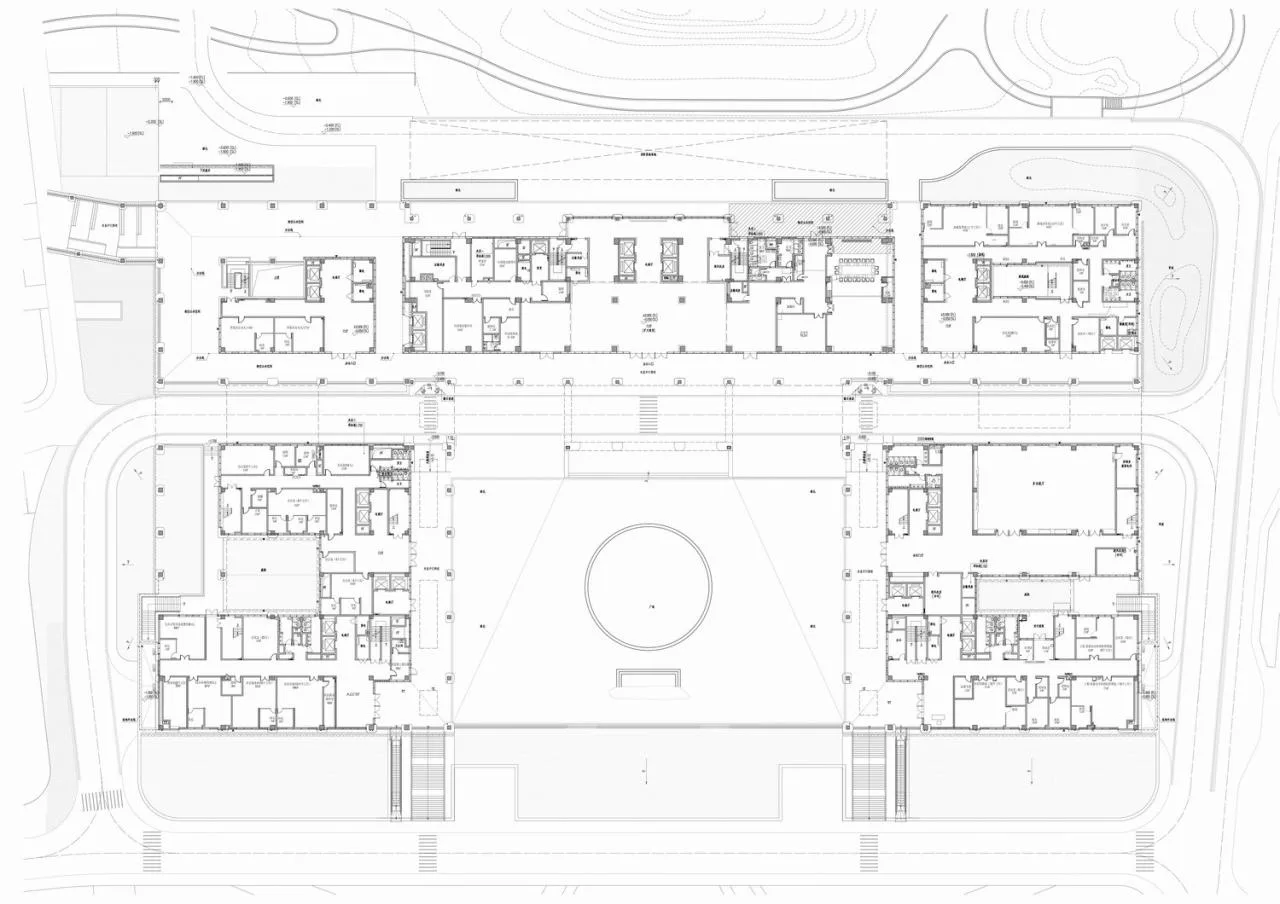
△ First Floor Plan of the Administrative Office Center
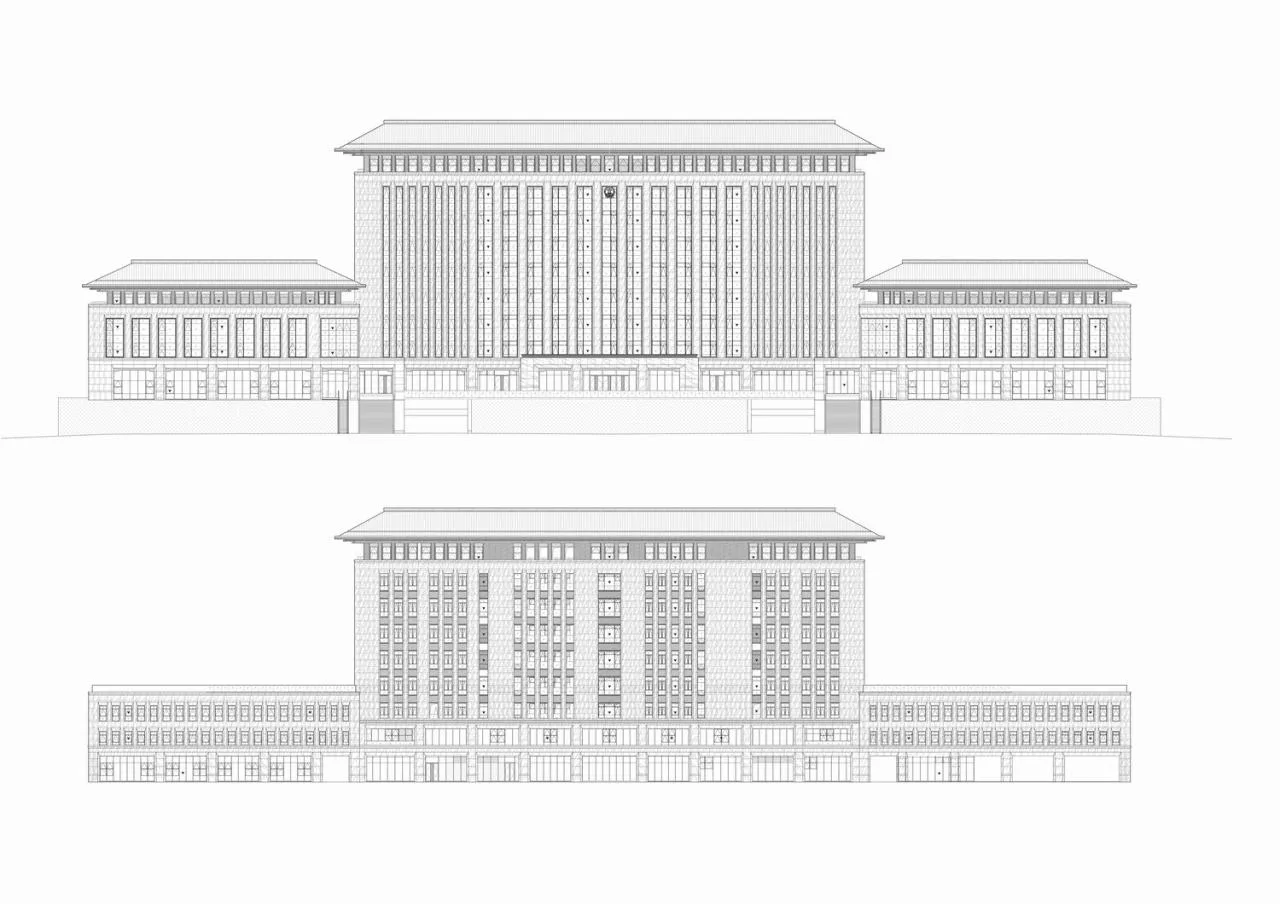
△ Elevation of the Administrative Office Center
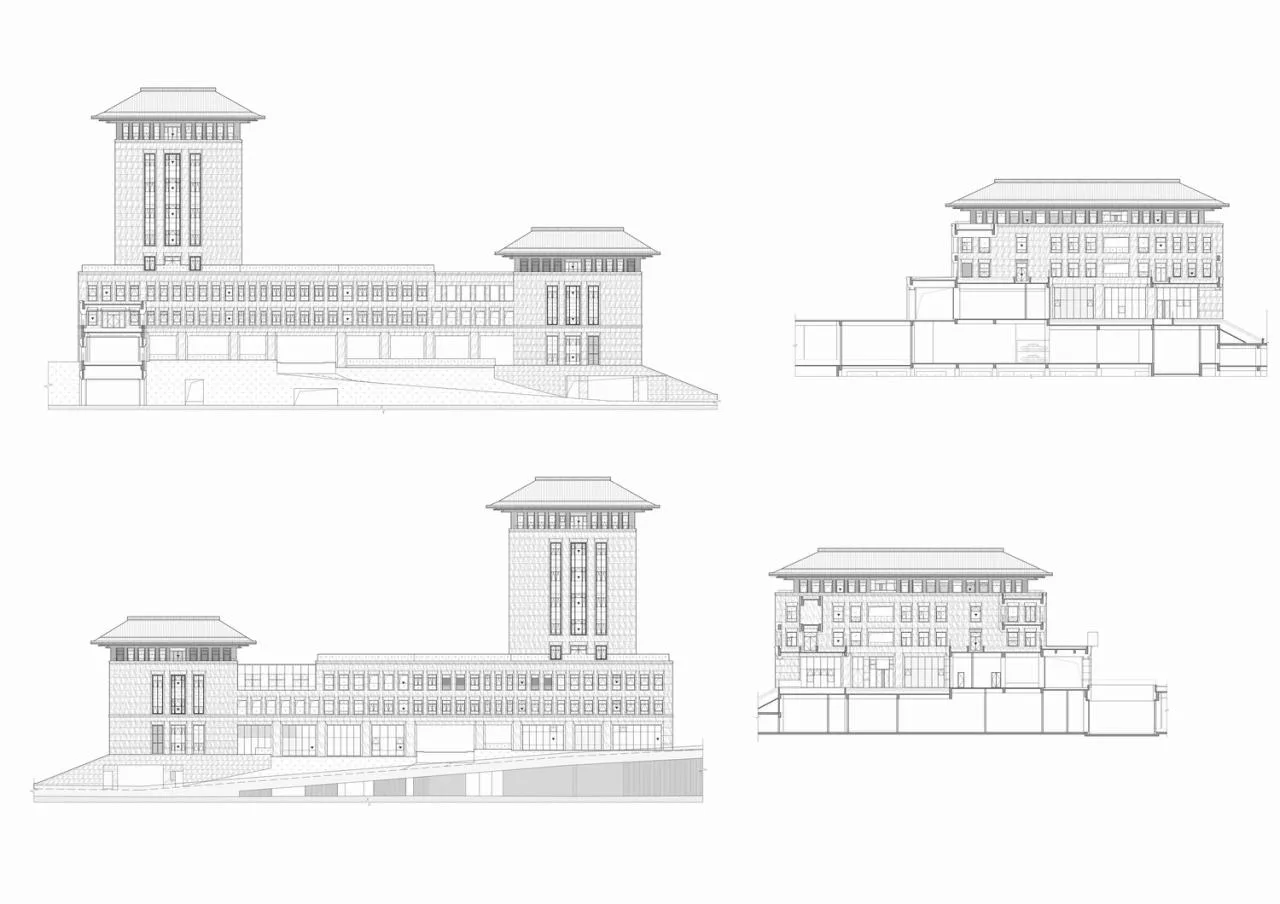
△ Front view and sectional view of the Administrative Office Center
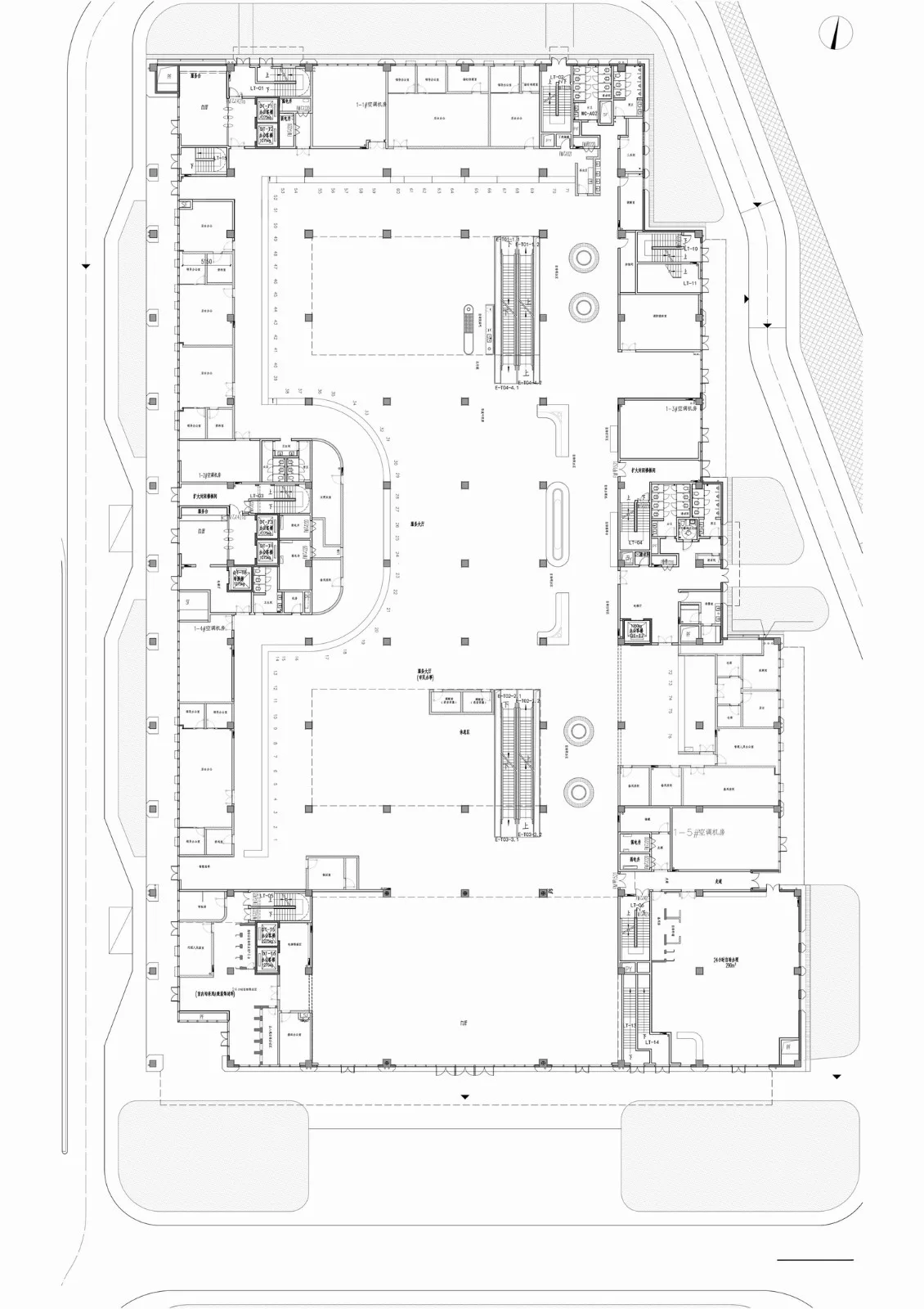
△ First Floor Plan of the Administrative Service Center
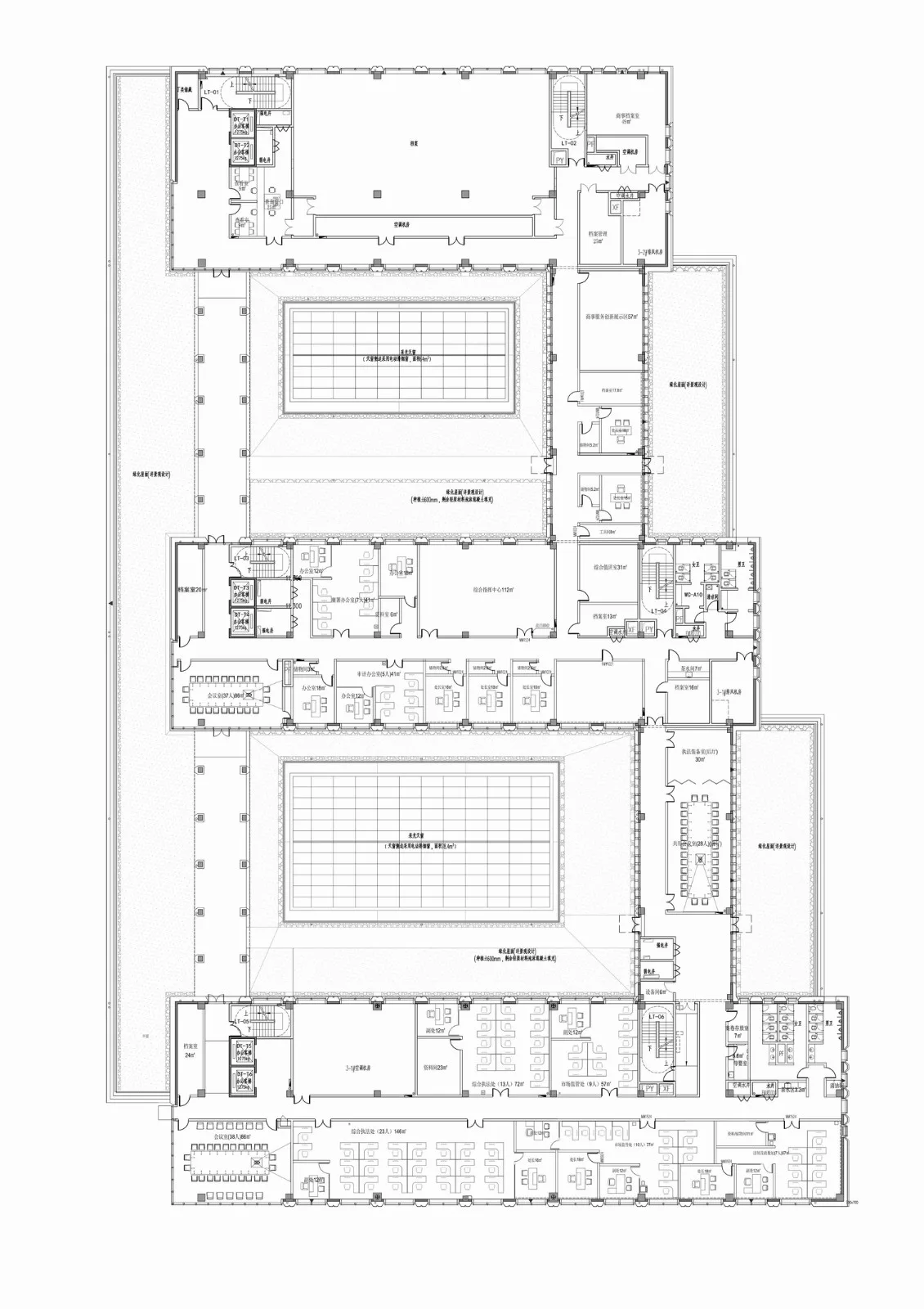
△ Third Floor Plan of the Administrative Service Center
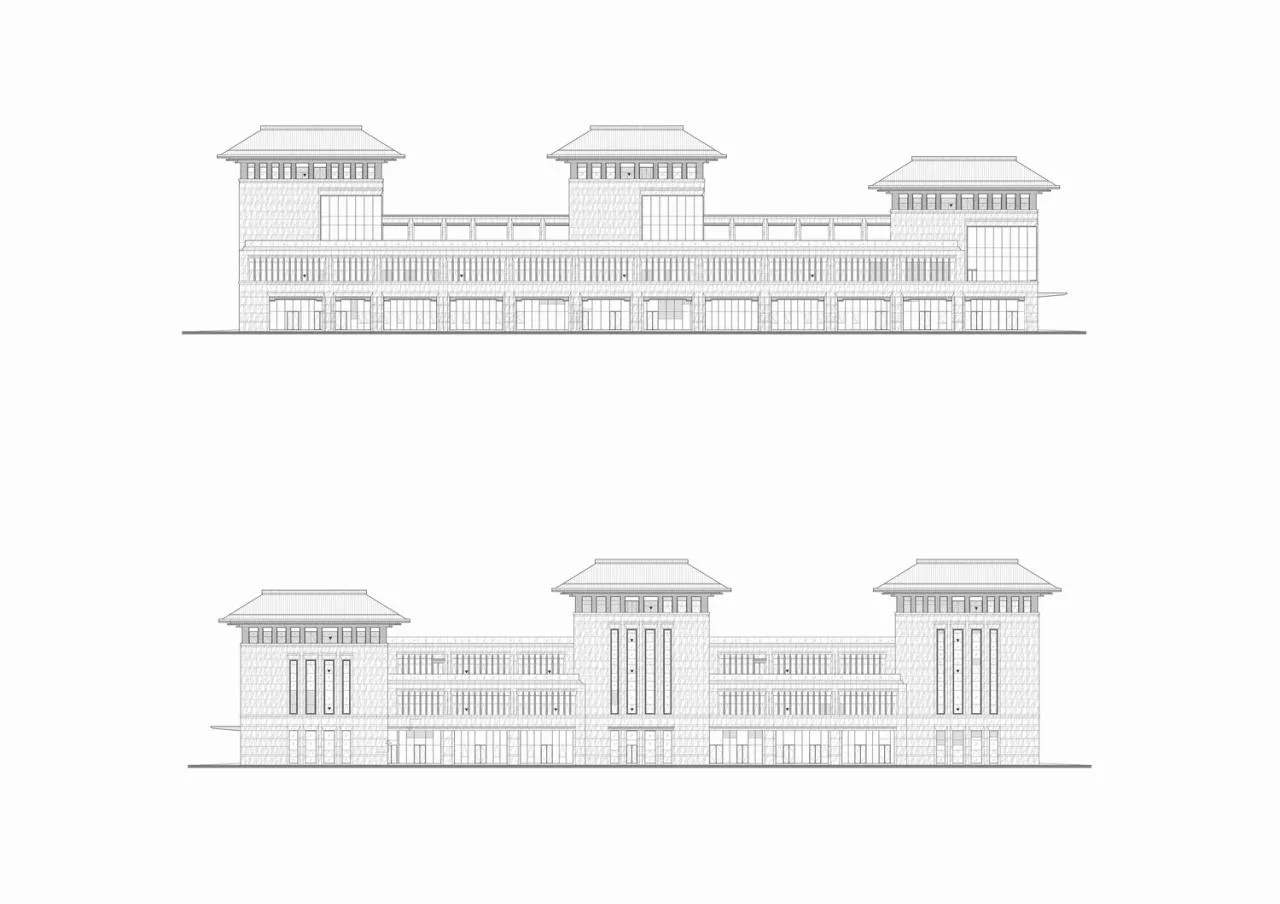
△ Elevation of the Administrative Service Center
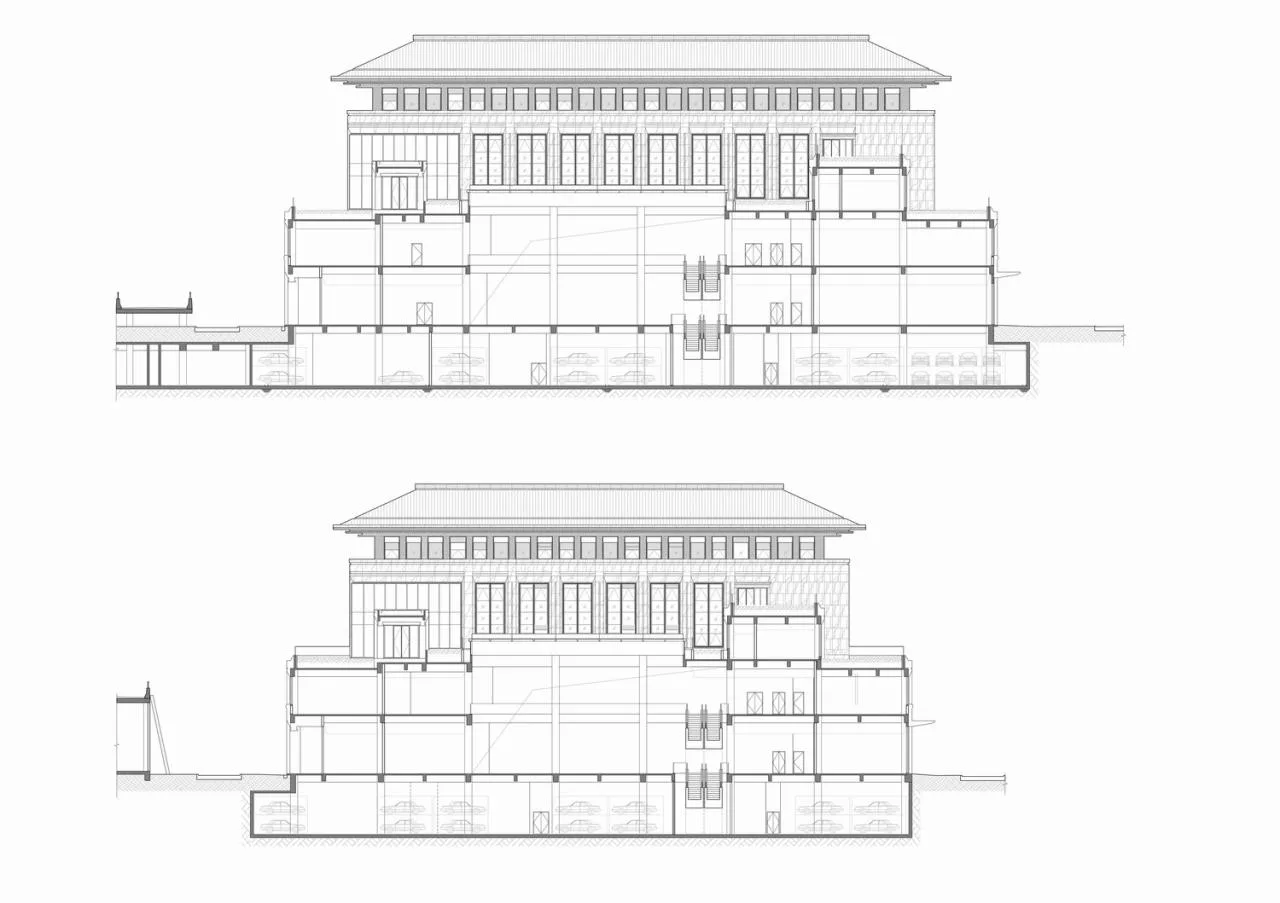
△ Section view of the Administrative Service Center
Project Information
Project Name: Hengqin New District Citizen Service Center
Location: Hengqin Island, Zhuhai City, Guangdong Province, China
Site Area: 65,530.76 square meters
Total Construction Area: 131,876.41 square meters
Design Period: August 2018 – February 2019
Completion Date: 2022
Design General Contractor: Shanghai Huadu Architectural Planning and Design Co., Ltd. (HDD)
Chief Designers: Shen Yi, Dong Weiwei
Project Leaders: An Hao, Dong Weiwei
Project Creators: Zhu Qixiang, Dong Weiwei
Design General Contracting Team Members
Proposal Team: Shi Feng, Yang Tao, Zheng Xueyi, Xu Jing, Chen Lei, Sun Tongtong, Li Su, Luca Forteleoni, Ebenezer Osei Asante, Yao Endi, Leng Changzong, Gong Benling, Chen Xiaotong, Chen Jianfei
Architectural Design Team: Shi Feng, Yang Tao, Liu Jun, Dan Chao, Zhou Zhaomin, Zhou Jun, Cai Baiyang, Feng Xiaolong, Chi Hengdong
Structural Design Team: Zhang Yongqiang, Zhou Zhen, Xu Bingbing, Wang Kun, Wang Guoxun, Xue Hao
Water Supply and Drainage Design Team: Jiang Yi, Wu Wenwen, Wang Yikun, Liu Miaomiao, Yu Xinguang, Zhai Ziman
Electrical Design Team: Ren Fusheng, Xiao Yan, Cao Yuhao, Chen Yu, Zhang Yi, Zhu Xudong, Yuan Jiangfeng, Wan Danqi
HVAC Design Team: Dong Yunfeng, Qiao Xueliang, Xue Xiaofeng, Guo Xinxia, Liu Jiakang, Ren Yi
Landscape Design Team: Zhu Yiyu, Wang Dandan, Yang Gang, Fei Yidong
Interior Design Team: Ge Qing, Ai Jingwen, Liu Haitao
Project Budget Team: Yang Qinglin, Zhuang Qin
Joint Design Units
Interior Design: Zhejiang Yasha Decoration Co., Ltd.
Curtain Wall Design: Biaohe Engineering Design Consultant (Beijing) Co., Ltd.
Landscape Design: Guangzhou Landscape Architecture Planning and Design Research Institute
Flood Design: Shenzhen Xingmingyu Lighting Technology Co., Ltd.
Logo Design: Shenzhen Wenwen Logo Co., Ltd.
Consultants
Transportation Consultant: Hongda Transportation Consulting (Shenzhen) Co., Ltd.
Mechanical and Electrical Consultant: Kejin Baicheng Engineering Technology (Beijing) Co., Ltd., Guangzhou Branch
Green Building Consultant: Shuifa Energy Engineering Technology (Zhuhai) Co., Ltd.
Acoustic Consultant: Shanghai Yingbo Acoustic Engineering Technology Co., Ltd.
Kitchen Consultant: Hong Kong Nord Kitchen Design Consultant Co., Ltd., Shenzhen Nord Kitchen Design Consultant Co., Ltd.
Art Consultant: Hong Kong Oushang Art Consultant Co., Ltd., Shenzhen Nord Soft Decoration Engineering Co., Ltd.
Photographer: Tang Xuguo















Must log in before commenting!
Sign Up