
Reshaping the Park
The Sanxingdui Site is situated 40 kilometers north of Chengdu, on the banks of the Yazi River in western Guanghan City. Dating back 4,800 years, this ancient civilization has yielded tens of thousands of exquisite cultural relics through archaeological excavations. It holds a significant place in the world’s bronze culture and is renowned as the “source of the Yangtze River civilization.” In November 2019, excavation efforts resumed, uncovering numerous national treasure-level artifacts from six newly discovered pits, once again astonishing the world. Sanxingdui archaeology has truly entered a new era.
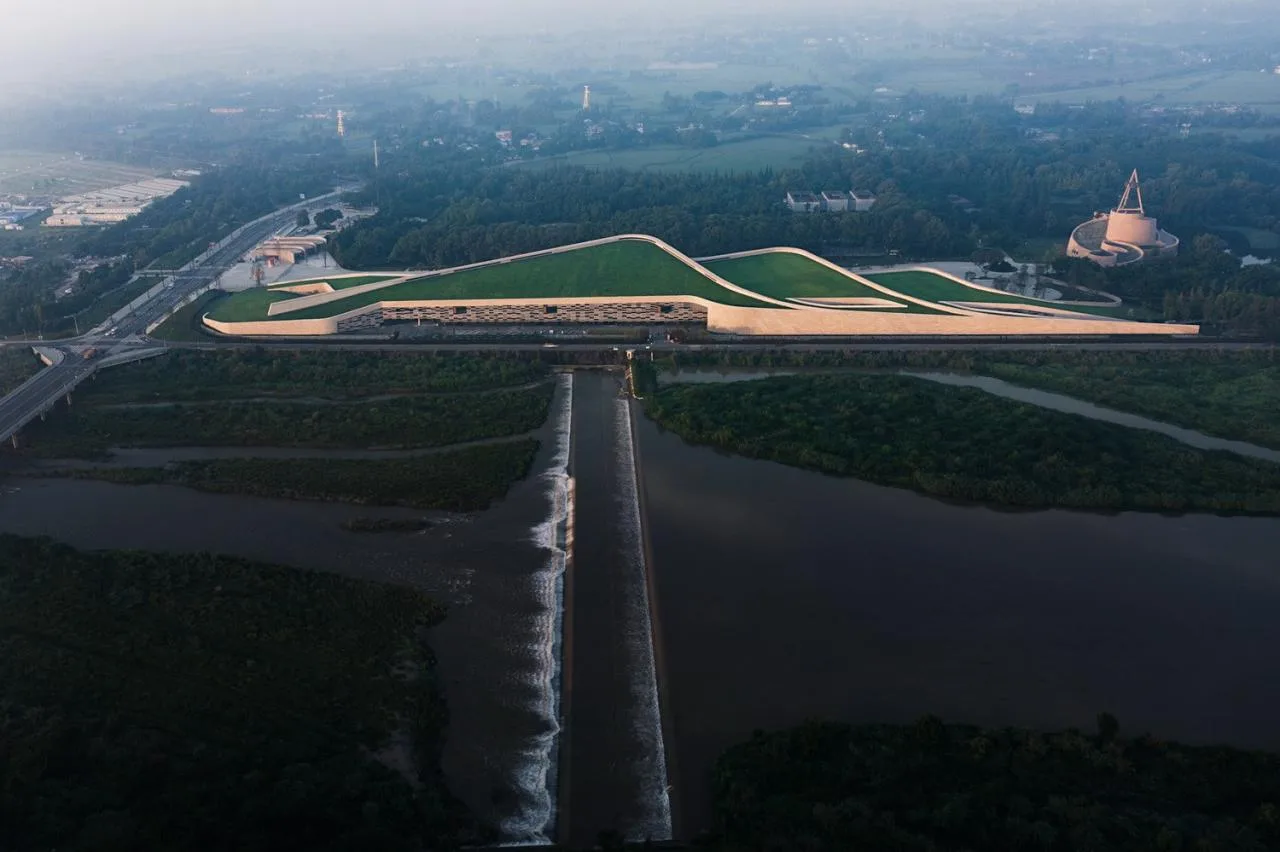
The existing museum park, established in 1997, spans approximately 530 acres. The first and second exhibition halls encompass a combined area of only 11,000 square meters, which can no longer accommodate the growing collection of new relics or the increasing number of visitors. The newly constructed main hall and visitor center cover 54,400 square meters. The main hall is dedicated to displaying cultural relics and providing visitor services, while the original Hall 1 and Hall 2 will be repurposed as digital exhibition spaces and research and education centers.
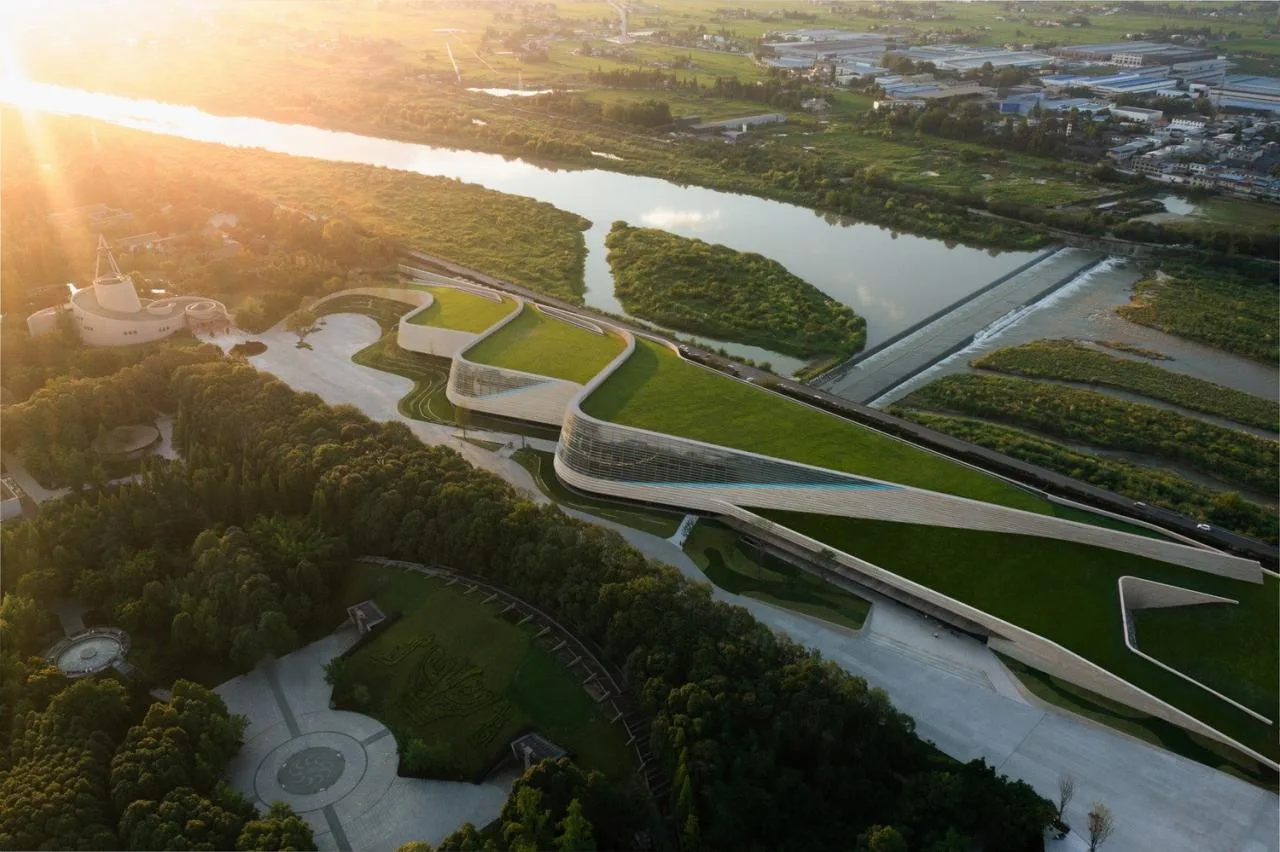
The new building project is part of a broader effort to reorganize the park’s functions and circulation. Currently, the park features two axes from different historical periods, with existing buildings spread out unevenly. The design restructures the entire visitor route into a counterclockwise loop beginning at the new entrance plaza, linking the new museum, the old second museum, the altar, the cultural heritage center, and the first museum, thereby integrating the park into a cohesive whole. The original gate’s old visitor center and parking lot will be renovated, including the addition of a rain shelter for visitor queues. Upgrades such as new restrooms, underground utilities, and flood control channels will support the park’s operations for decades to come.
Stacking Three Stars
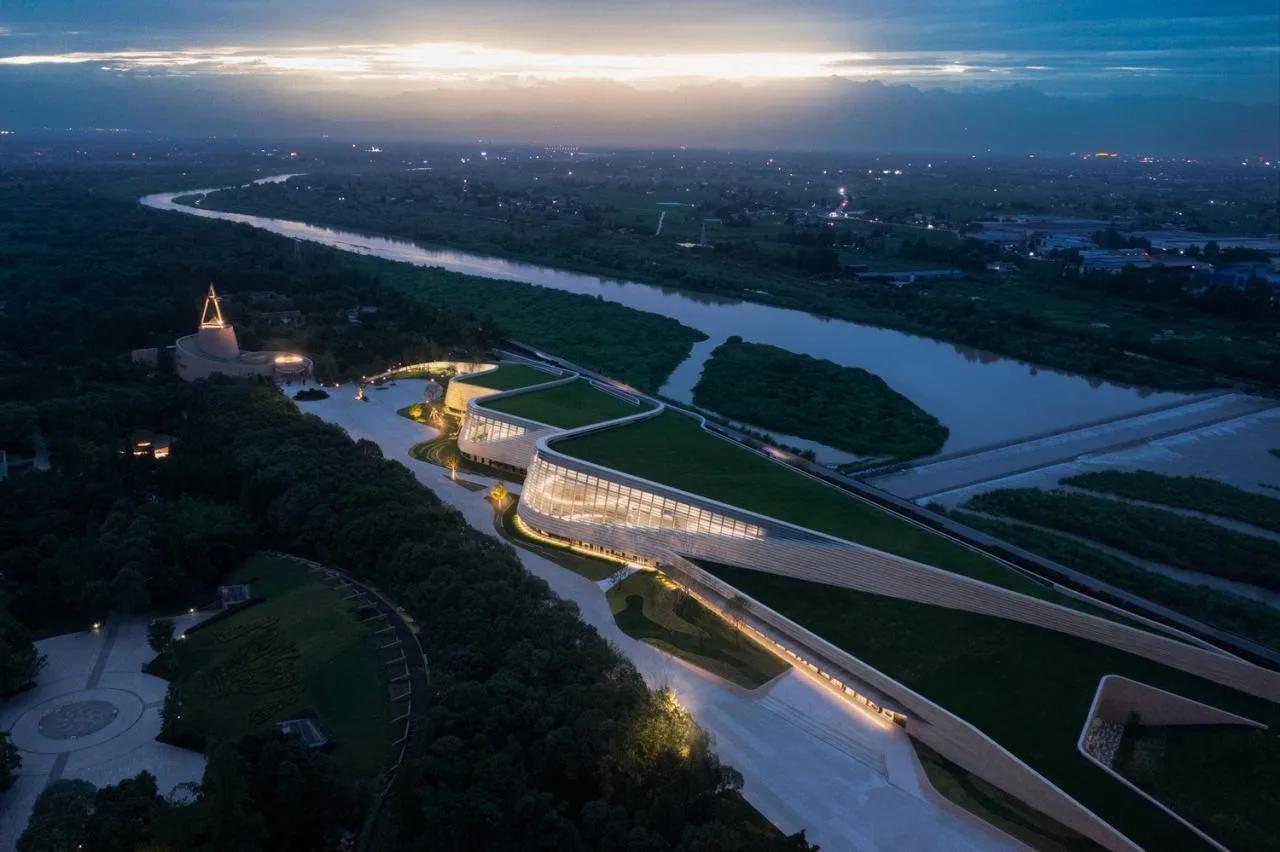
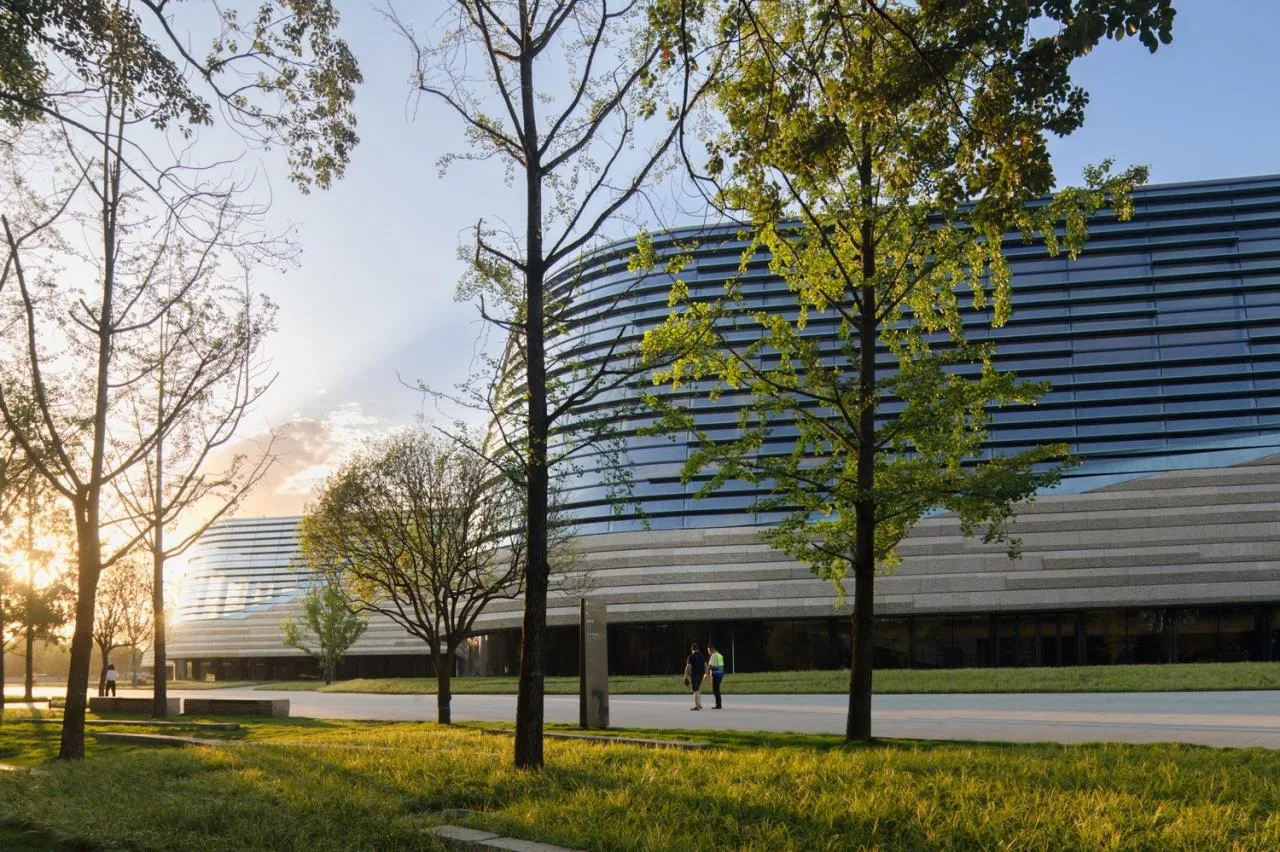
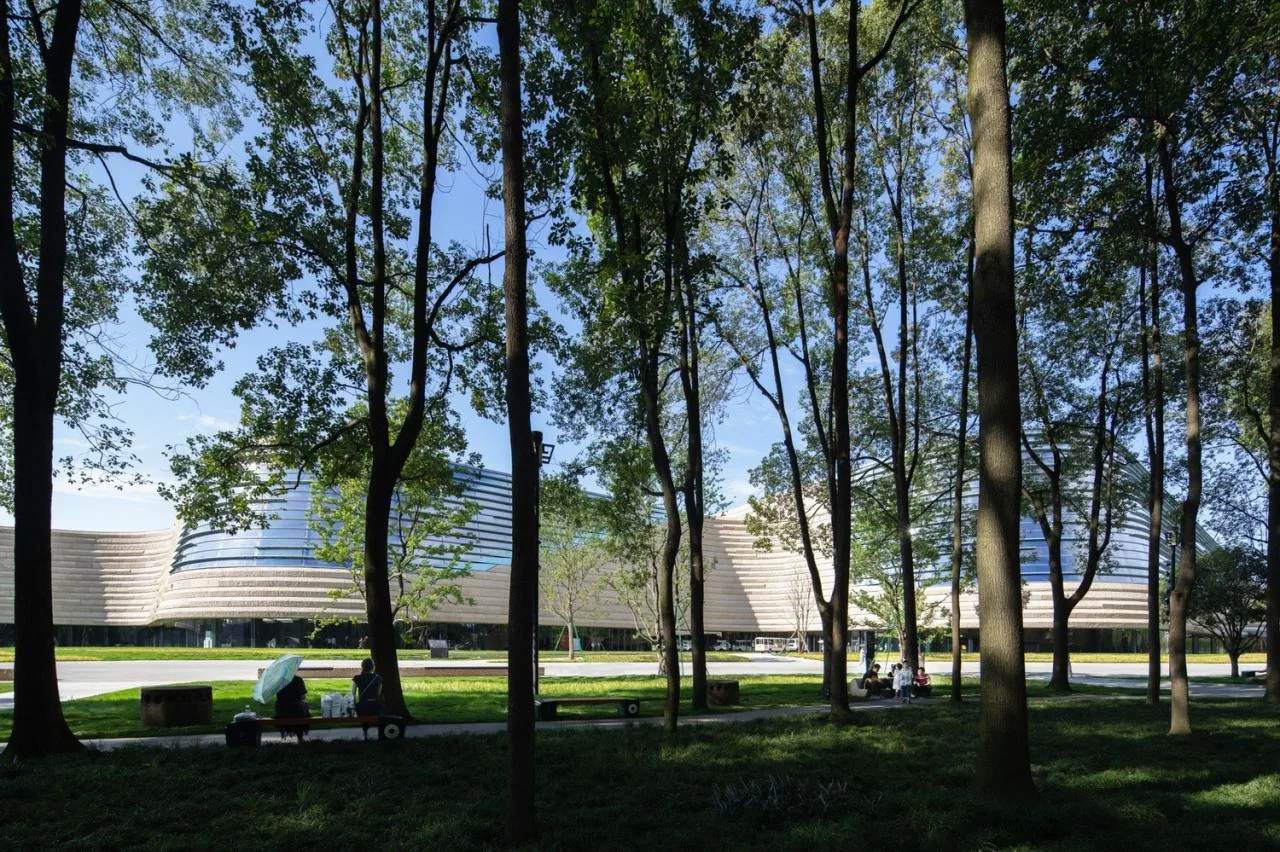
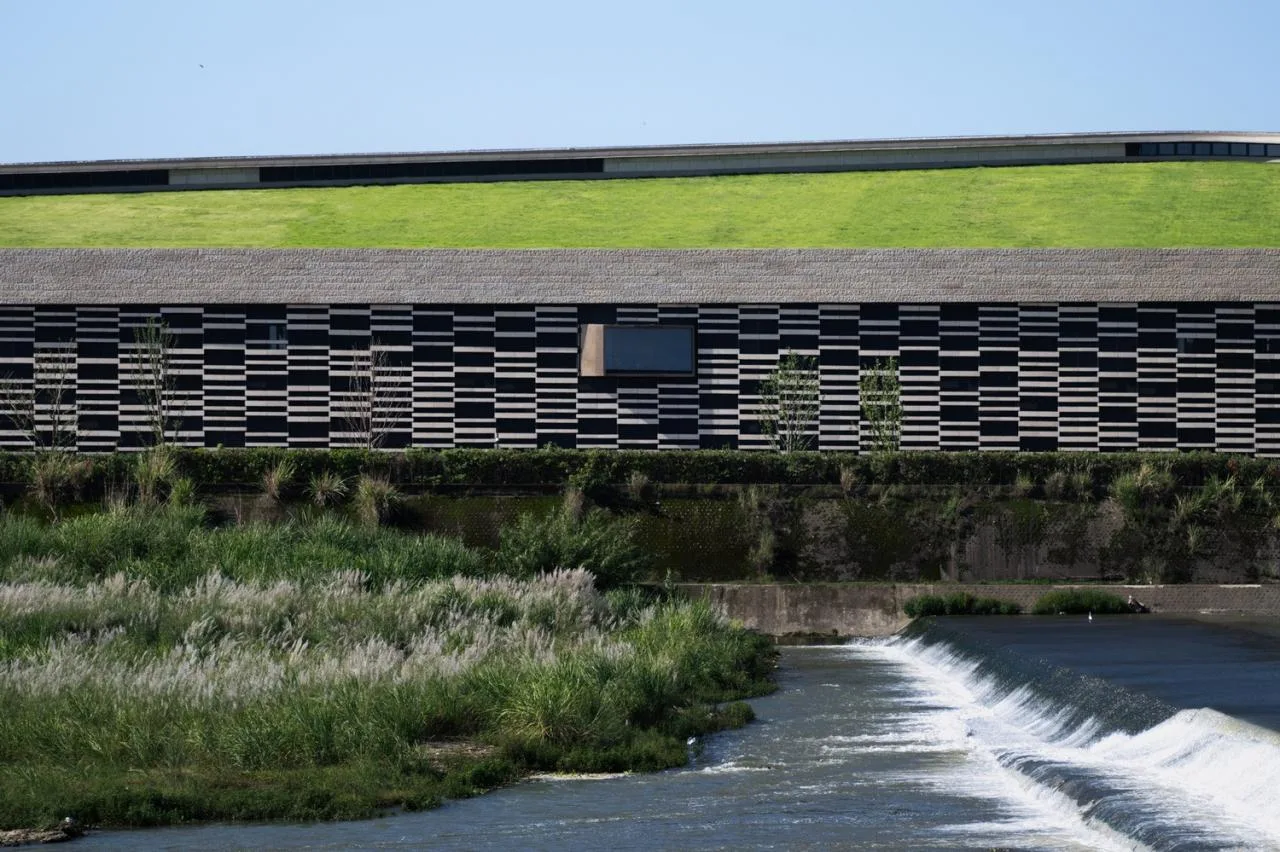
When the museum first opened, saplings were planted along the riverbank, which over 30 years have grown into a dense forest featuring towering trees and water features. The new building is located north of the park’s central axis, on a narrow, approximately 400-meter-long strip of land adjacent to the riverbank. The site boasts stunning scenery, distinct from typical suburban landscapes of western Sichuan. The Duck River has a broad water surface interspersed with long dams and sandbars, while distant snow-capped mountains create a breathtaking backdrop.
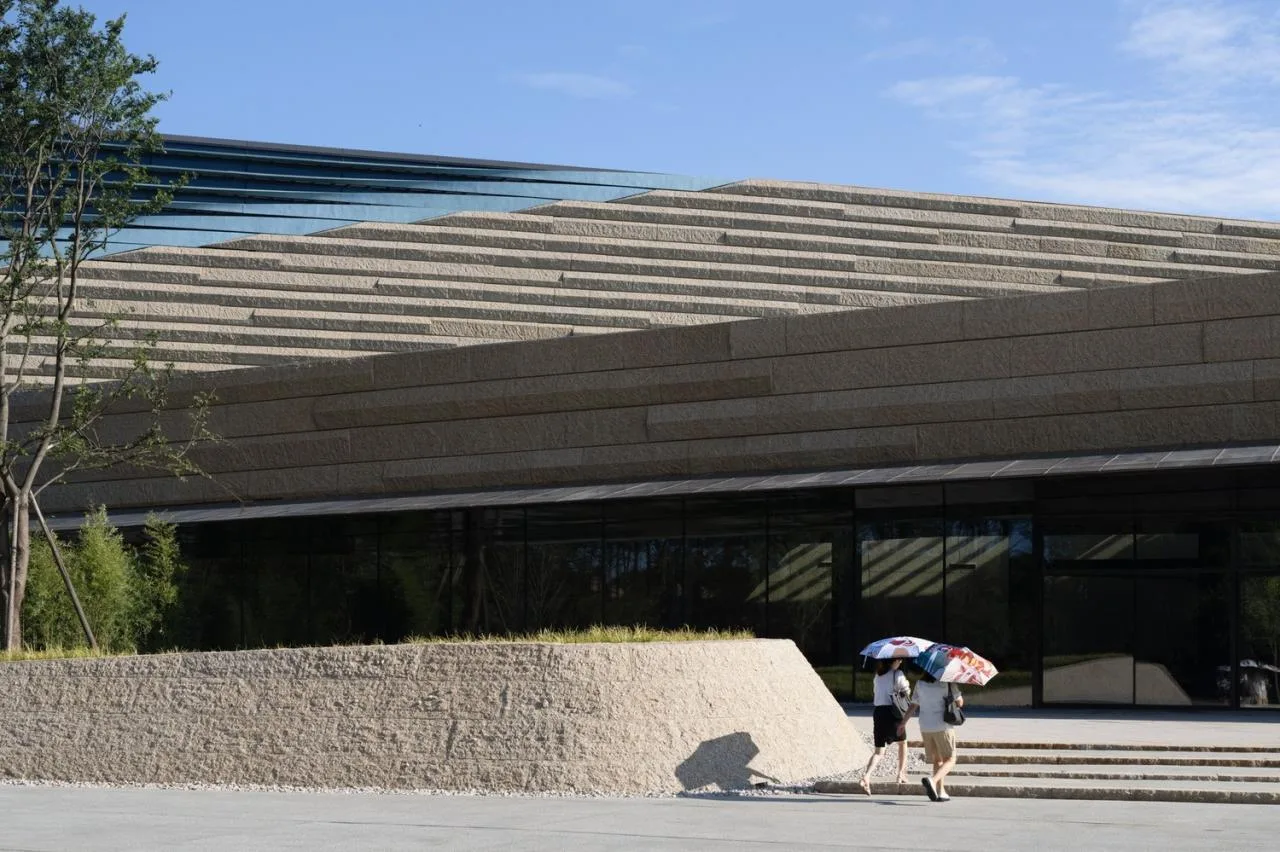
Set within this expansive environment, the architecture is envisioned as a raised landscape consisting of three continuous undulating mounds. This design responds to the site’s topography and cultural context, referencing the three mound-shaped archaeological sites of the ancient Shu Kingdom and the crescent-shaped Moon Bay terrace. Together, they form the “Three Stars Accompanying the Moon” landscape, inspiring the name “Three Star Ruins.”
The geometric form of the stacked building draws inspiration from the No. 2 Old Building, the highest point in the park located at the end of the central axis. This building is a celebrated landmark of Sanxingdui and a signature work by renowned architect Zheng Guoying. The design extends the iconic spiral exterior wall of the old building outward, establishing a guiding curve that shapes the three mounds’ form and spatial arrangement. The roofs of the mounds are covered with sloping soil that gently descends toward the riverbank, blending into the landscape and echoing the slanting profile of Hall 1 on the opposite side of the park’s central axis.
This continuous mound form allows for a compact architectural plan. By integrating previously separate functions, the new museum and visitor center are combined into a unified facility. Along the visitor circulation path, the visitor center, public exhibition spaces, and logistics storage are arranged from east to west. The three mound units decrease in size and height sequentially, rotating 26 degrees southwest towards the Sanxingdui excavation area, creating a spatial and temporal dialogue between the museum and the archaeological site.
The Eye of Architecture
The expressive eyes on the bronze masks are Sanxingdui’s most iconic cultural symbols. This concept of “eyes” is also central to the architectural design, serving as a window for dialogue between the interior and the external environment.
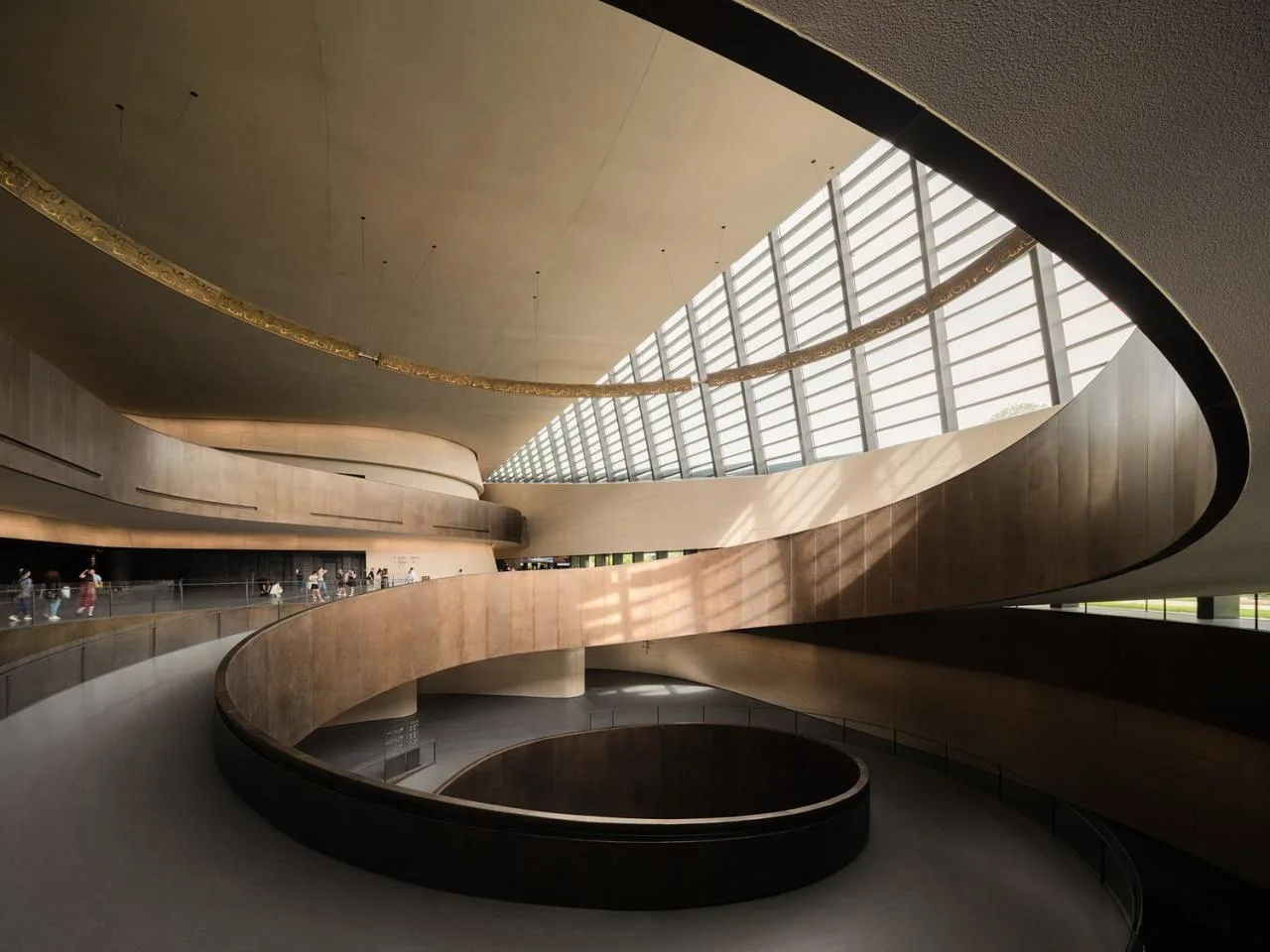
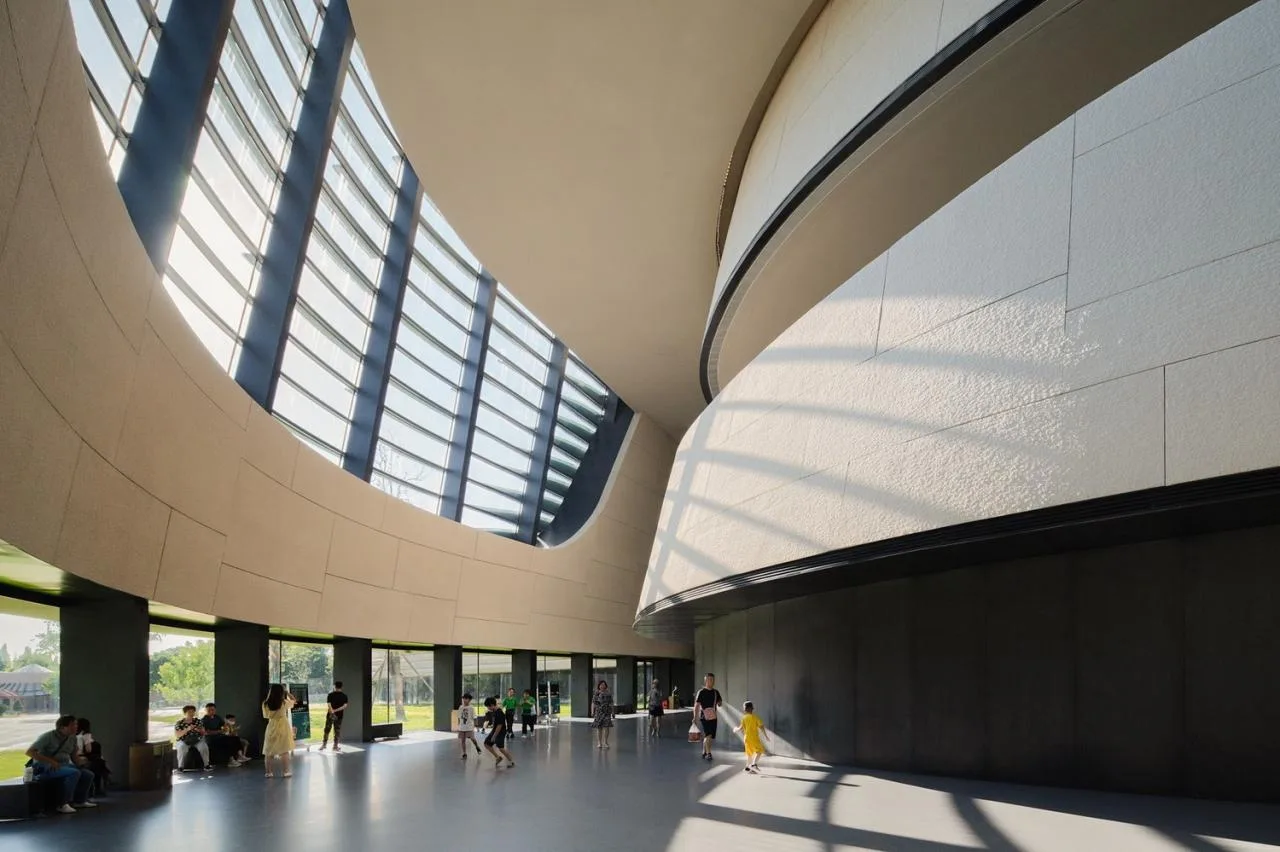
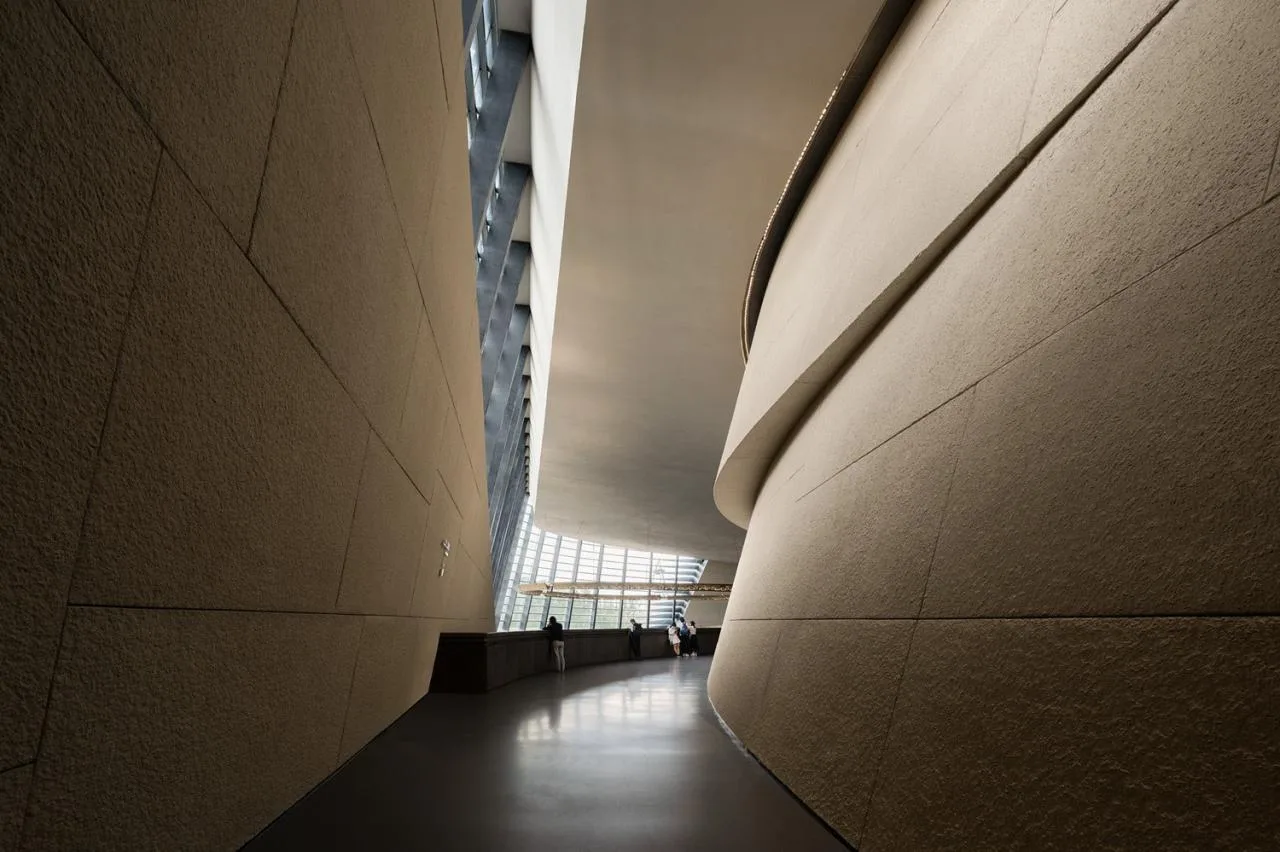
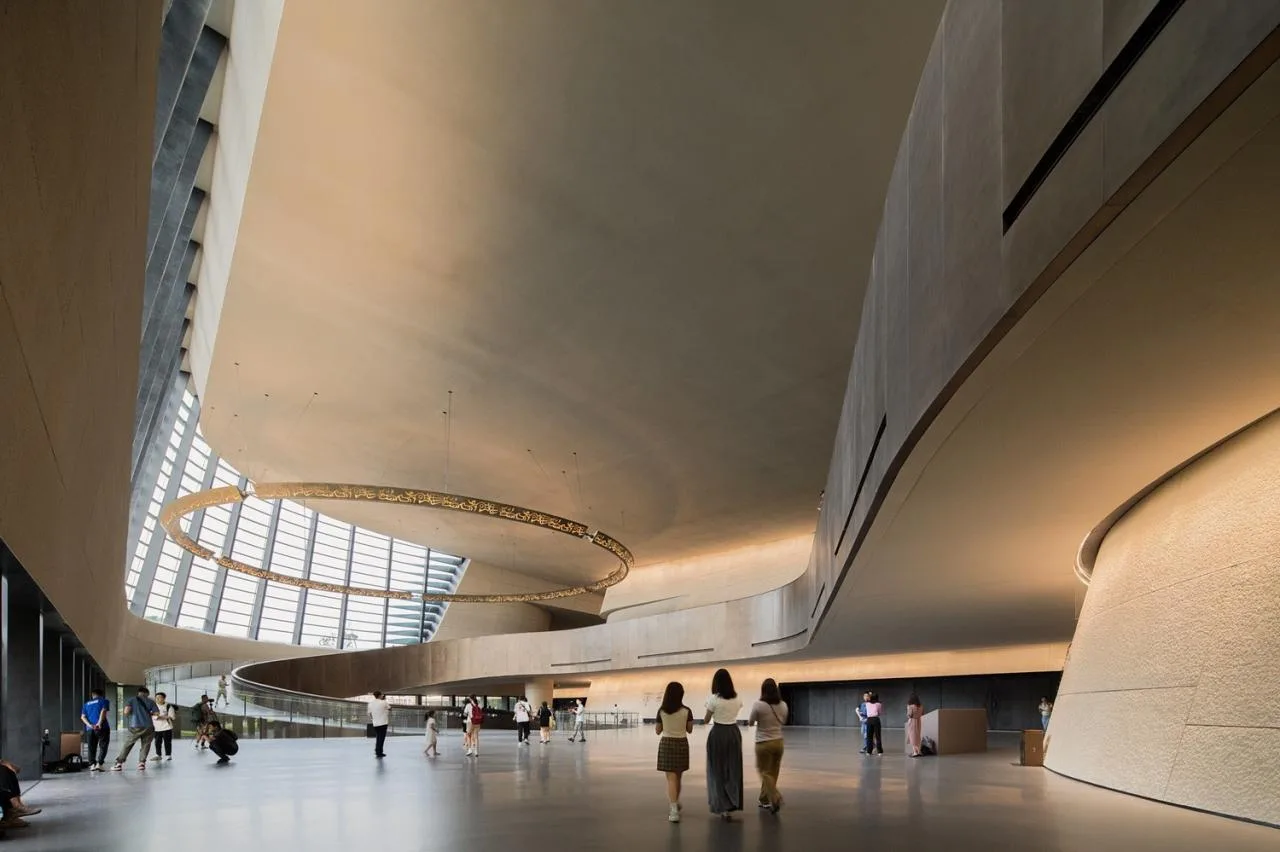
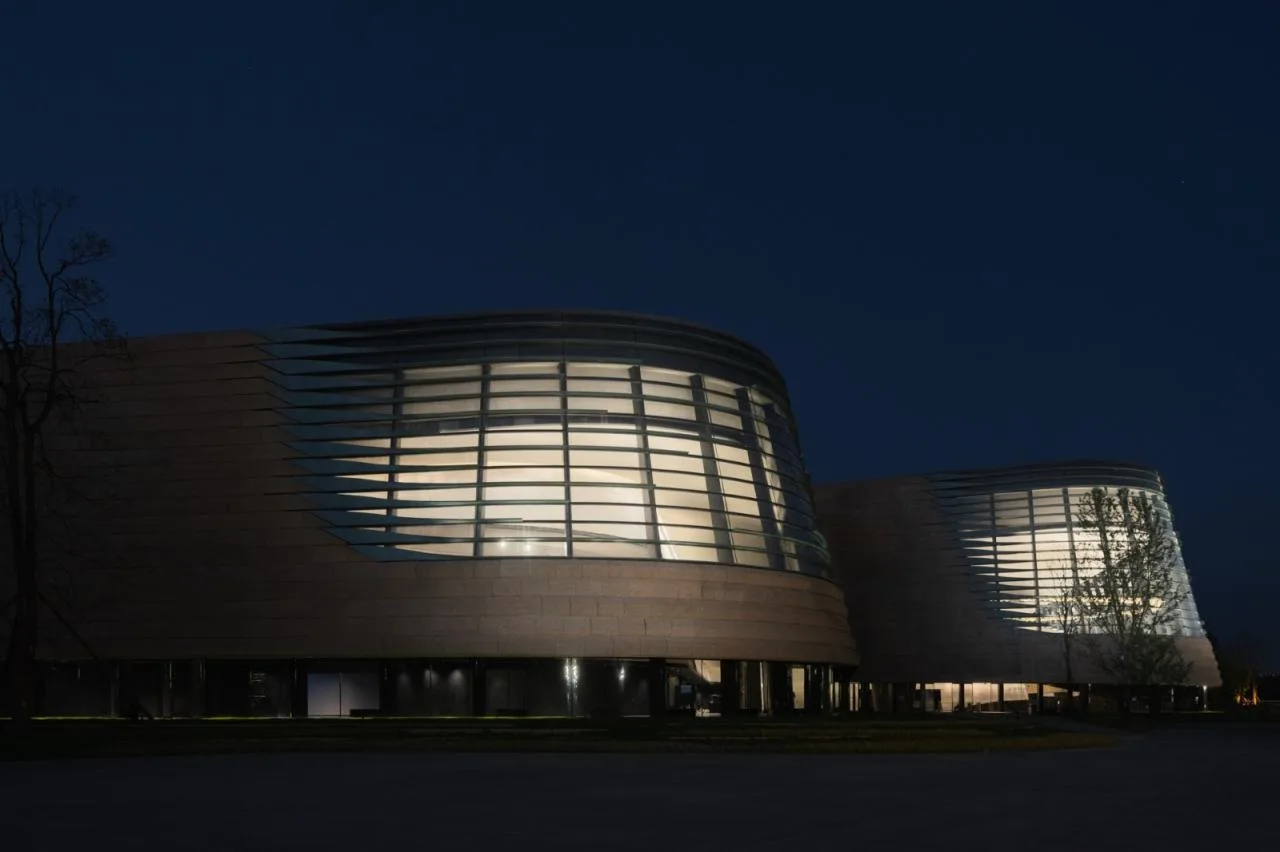
The mound-shaped outer walls enclose cave-like interiors, with a narrow 300-meter-long gap pierced just 3 meters above ground level. Visitors enter through this gap into the reception area, beginning their journey through the museum’s mysterious realm. The large eye-shaped openings on the exterior walls animate the façade and act as natural light sources, channeling daylight deep into the interior. This creates a gradual transition from light to shadow, adding depth and a sense of mystery. To emphasize natural light, all ceiling light fixtures in public halls have been removed, replaced only by subtle wall-washing lights at the wall-ceiling junctions, allowing sunlight to dominate the space.
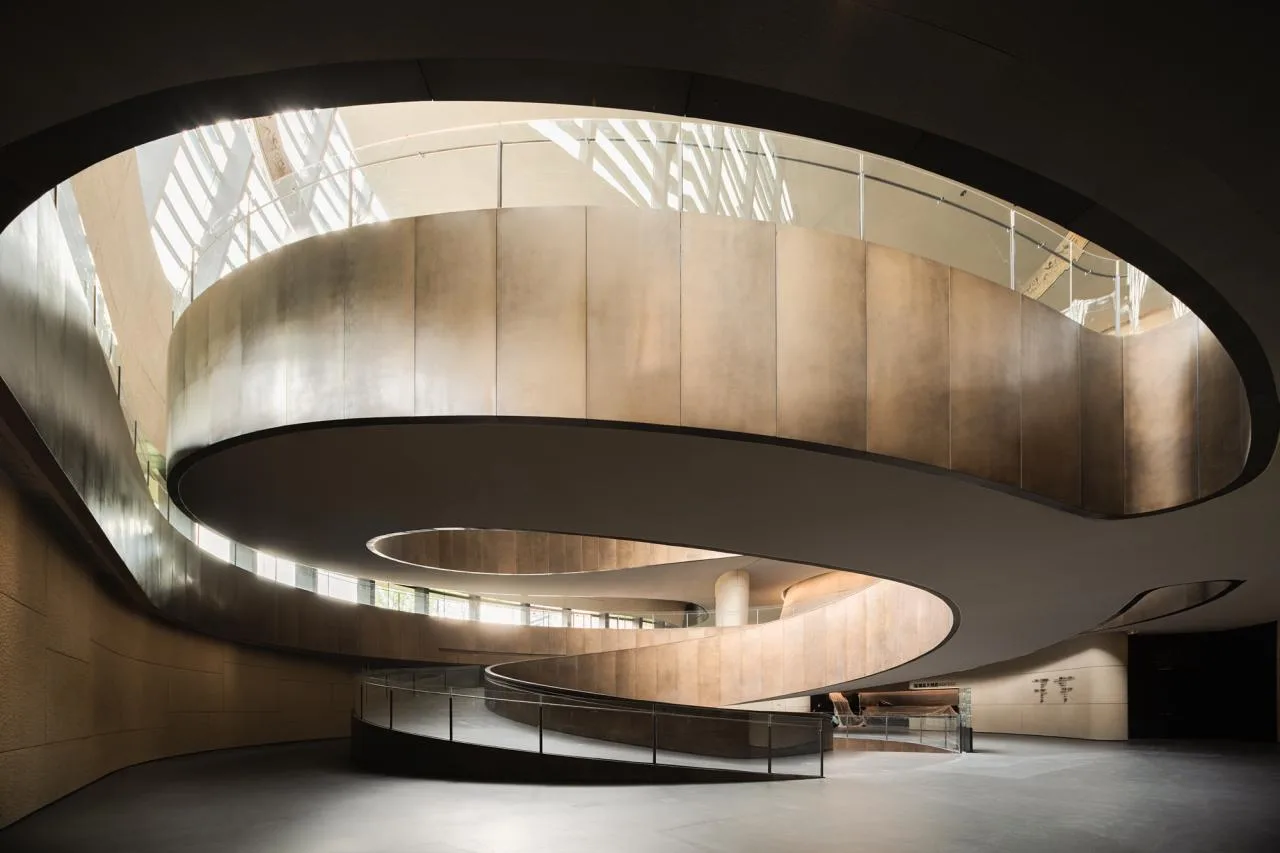
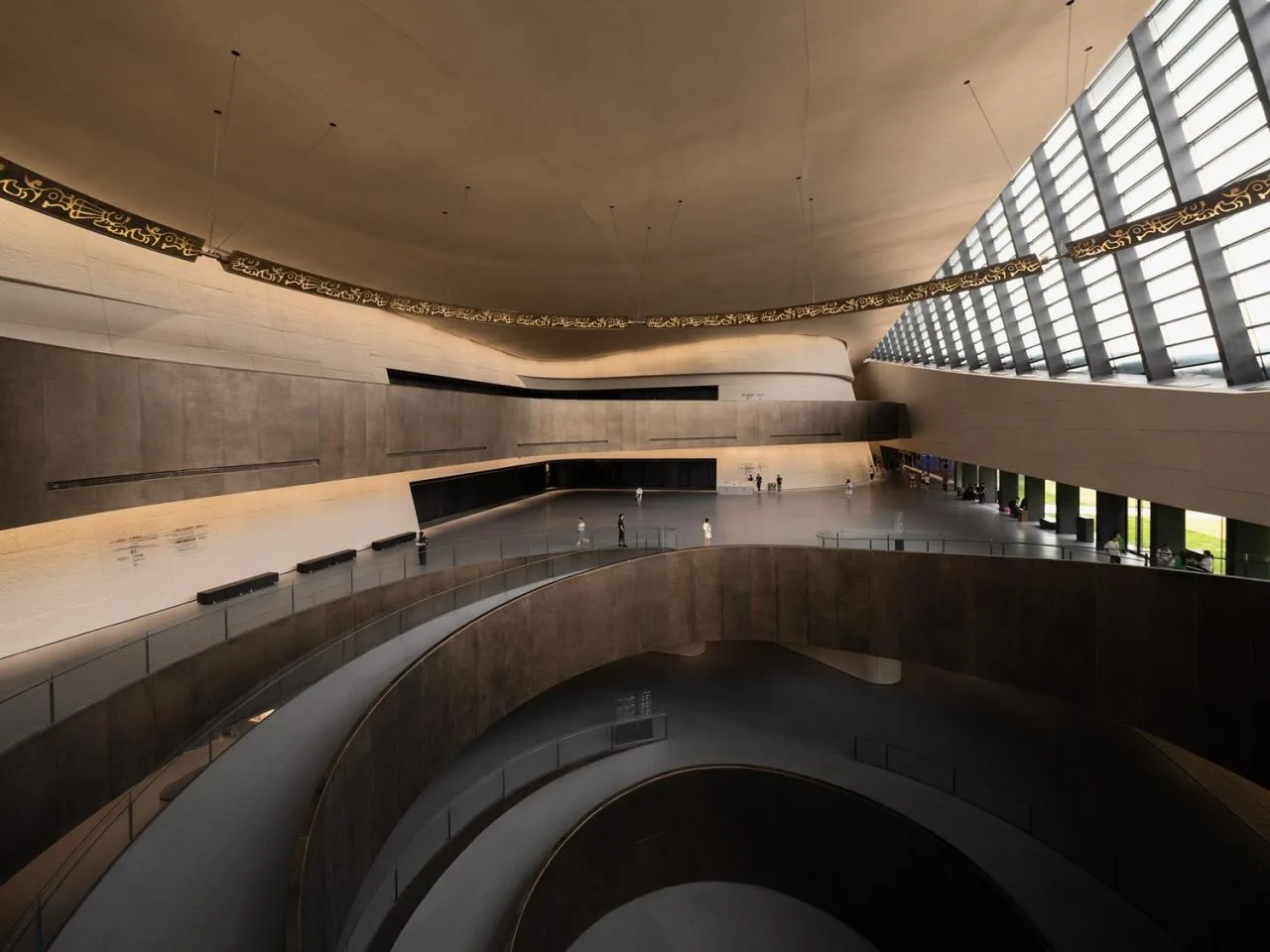
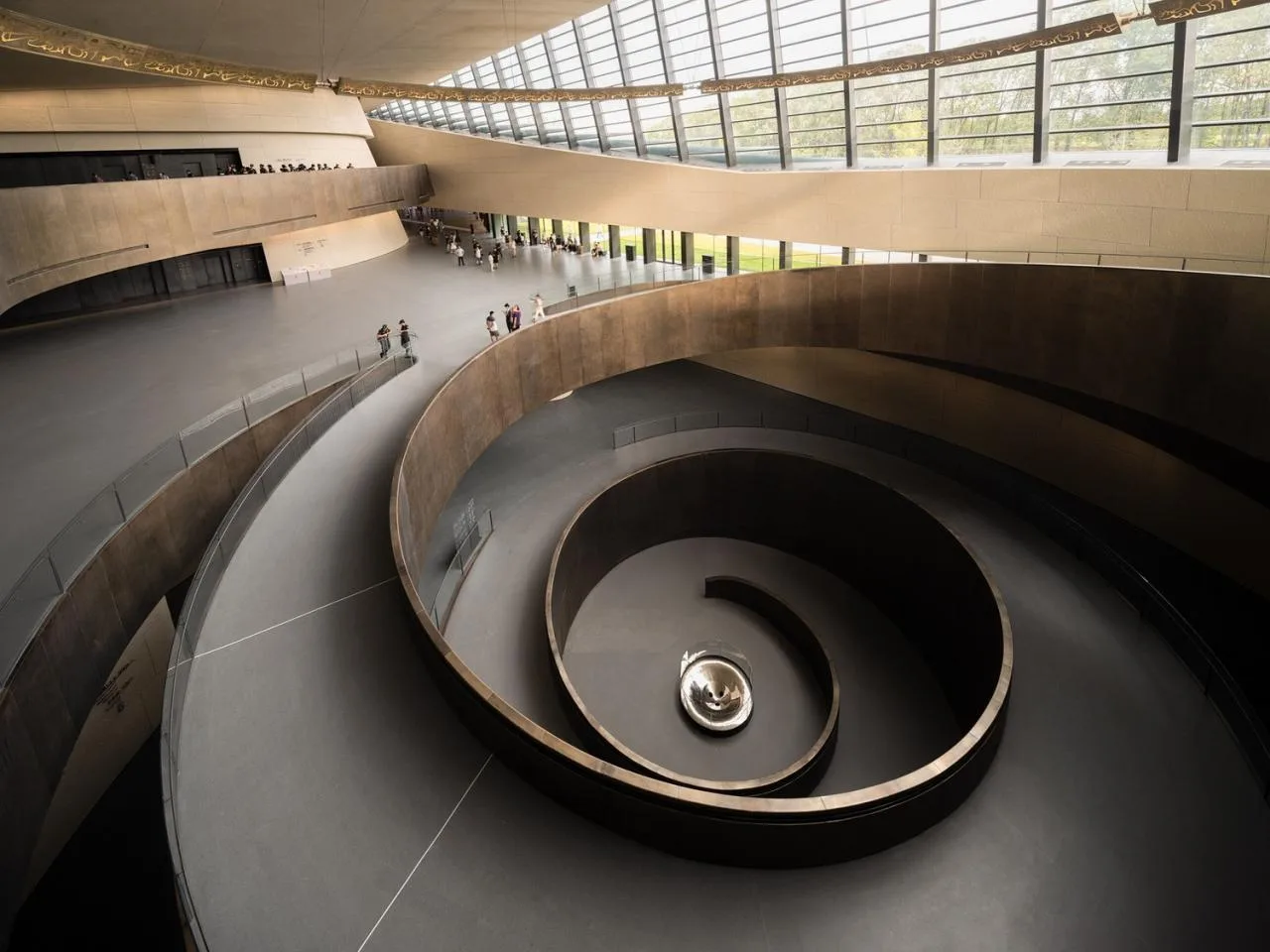
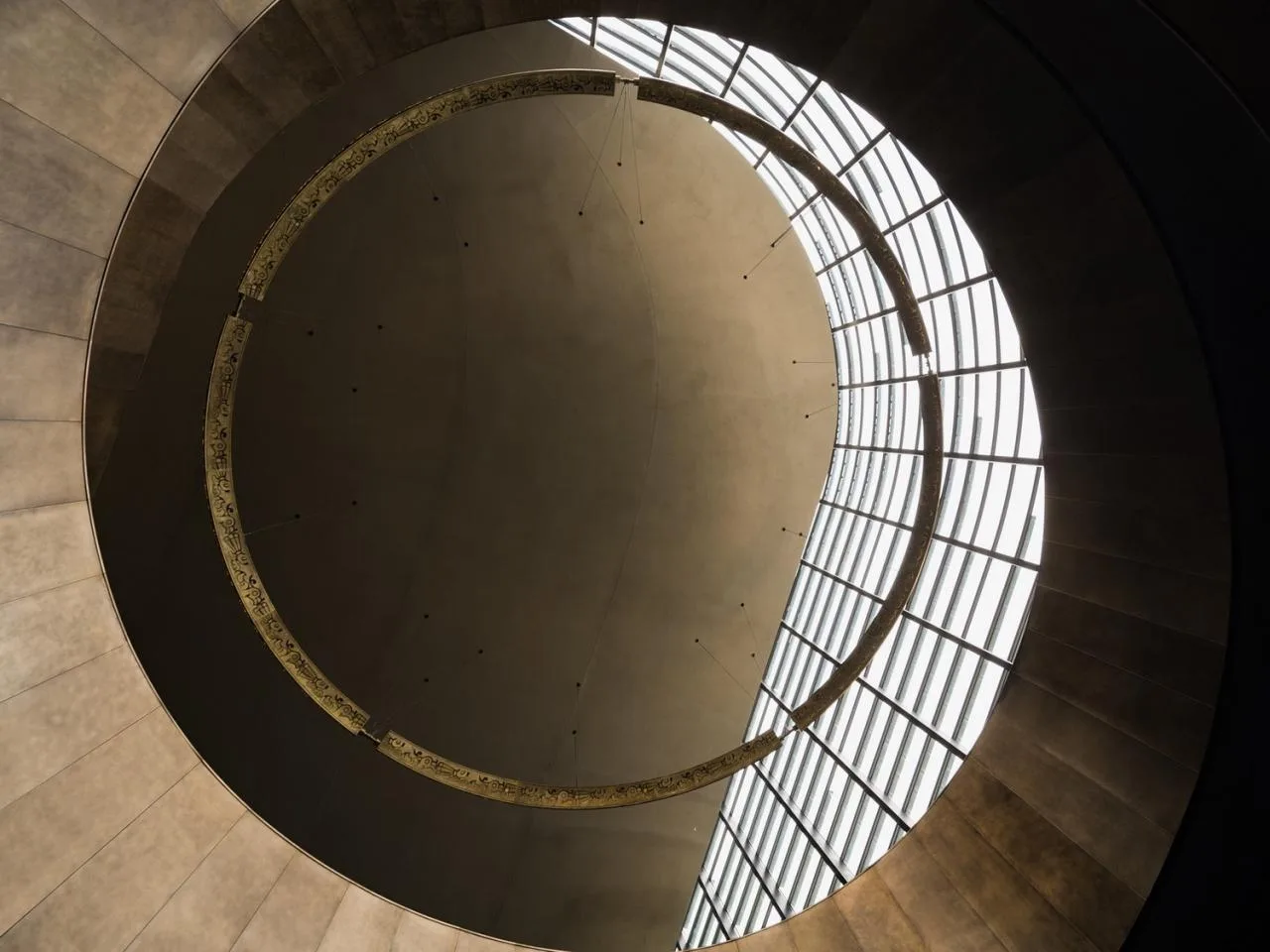
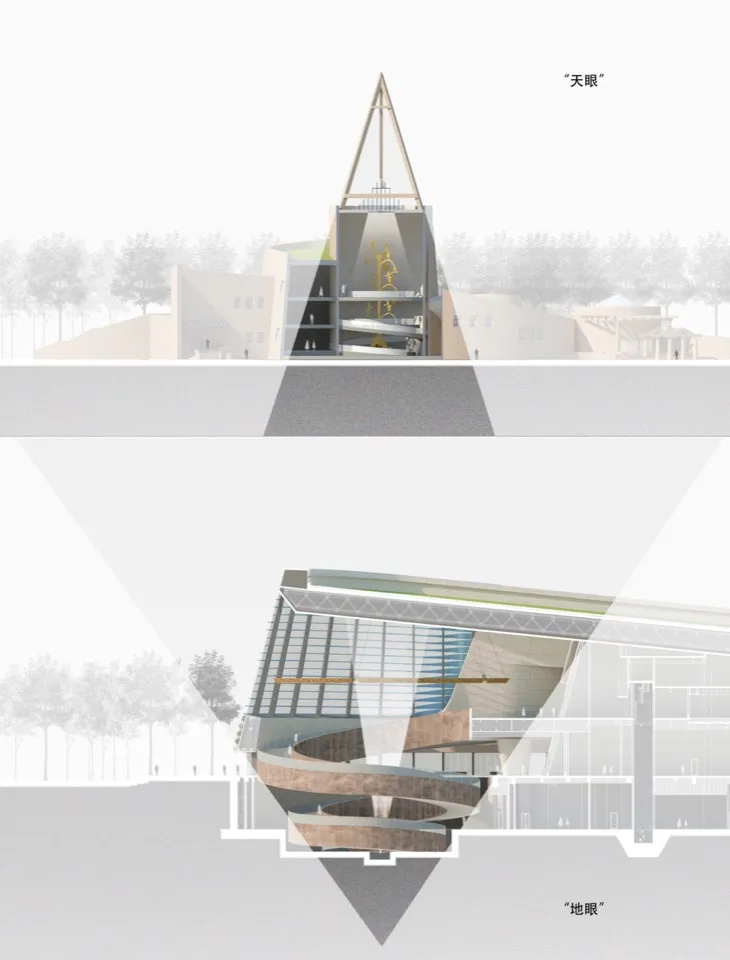
Inside, each eye corresponds to a key node in the public space. The “time-space spiral” in the atrium serves as the central hub for internal circulation. A 360-degree ramp connects the main floors both above and below ground, creating a vertical spiritual journey. The iconic circular atrium of Sanxingdui’s No. 2 Old Building opens skyward, symbolizing the “Eye of Heaven” and representing celestial worship. In contrast, the new building features a “ground eye” that turns toward the earth, symbolizing earthly connection. This is embodied by a spiral ramp descending to the building’s lowest point—a circular pit located 10 meters underground. From this pit, three laser projections shine upward onto a 30-meter-high ceiling, displaying evolving images of Sanxingdui and symbolizing the light of ancient civilization.
The “Heavenly Eye” and “Earthly Eye” express the relationship between heaven and earth and serve as a means of dialogue connecting the new and old buildings, as well as the “gods of heaven, earth, and humanity.”
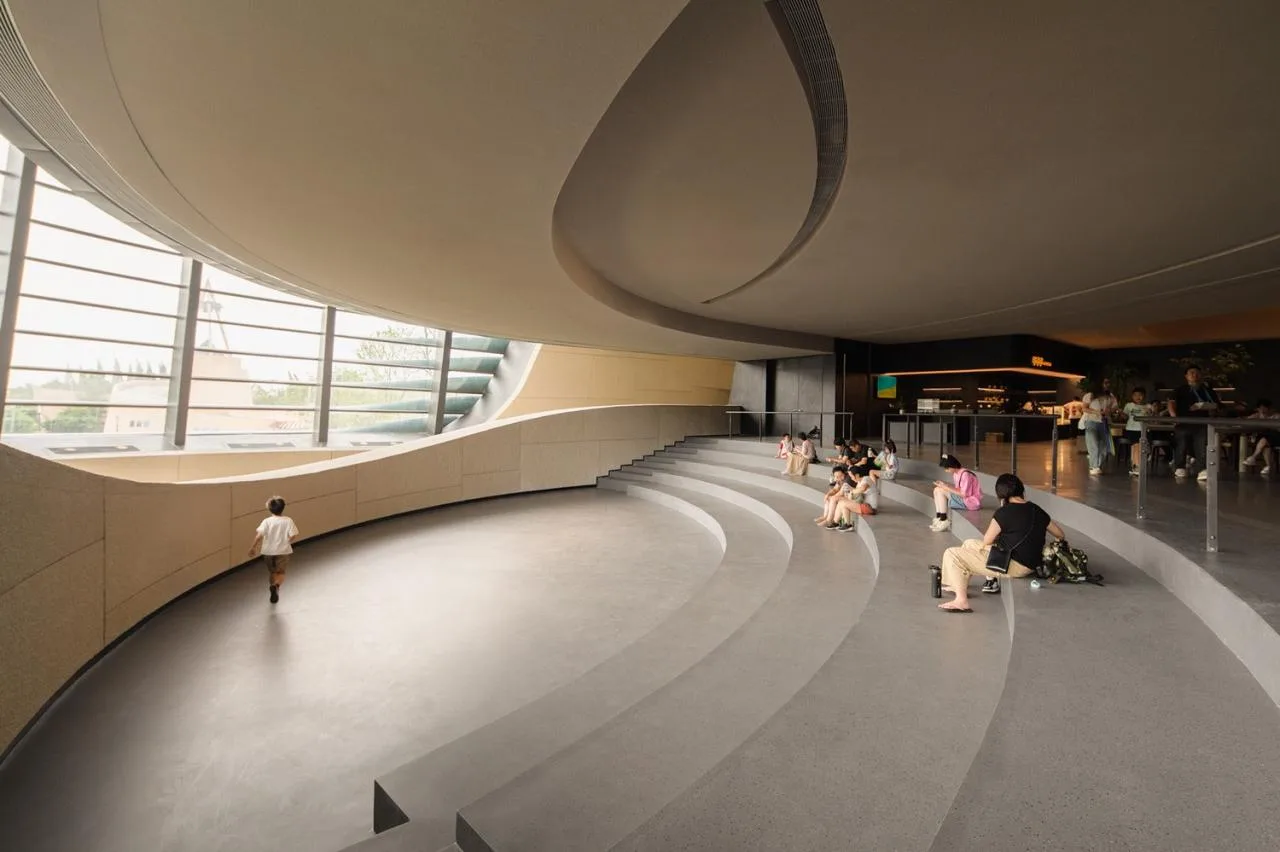
Another significant space is the open-air theater adjacent to the second-floor courtyard, oriented toward Building 2 and the archaeological site. This sunken area hosts temporary events such as performances, lectures, and exhibitions, making it one of the most dynamic areas within the museum. From the large “eyes” on the theater’s exterior wall, visitors can gaze upon the No. 2 Old Building and the lush forest beyond, establishing a framed visual dialogue between the new and old structures.
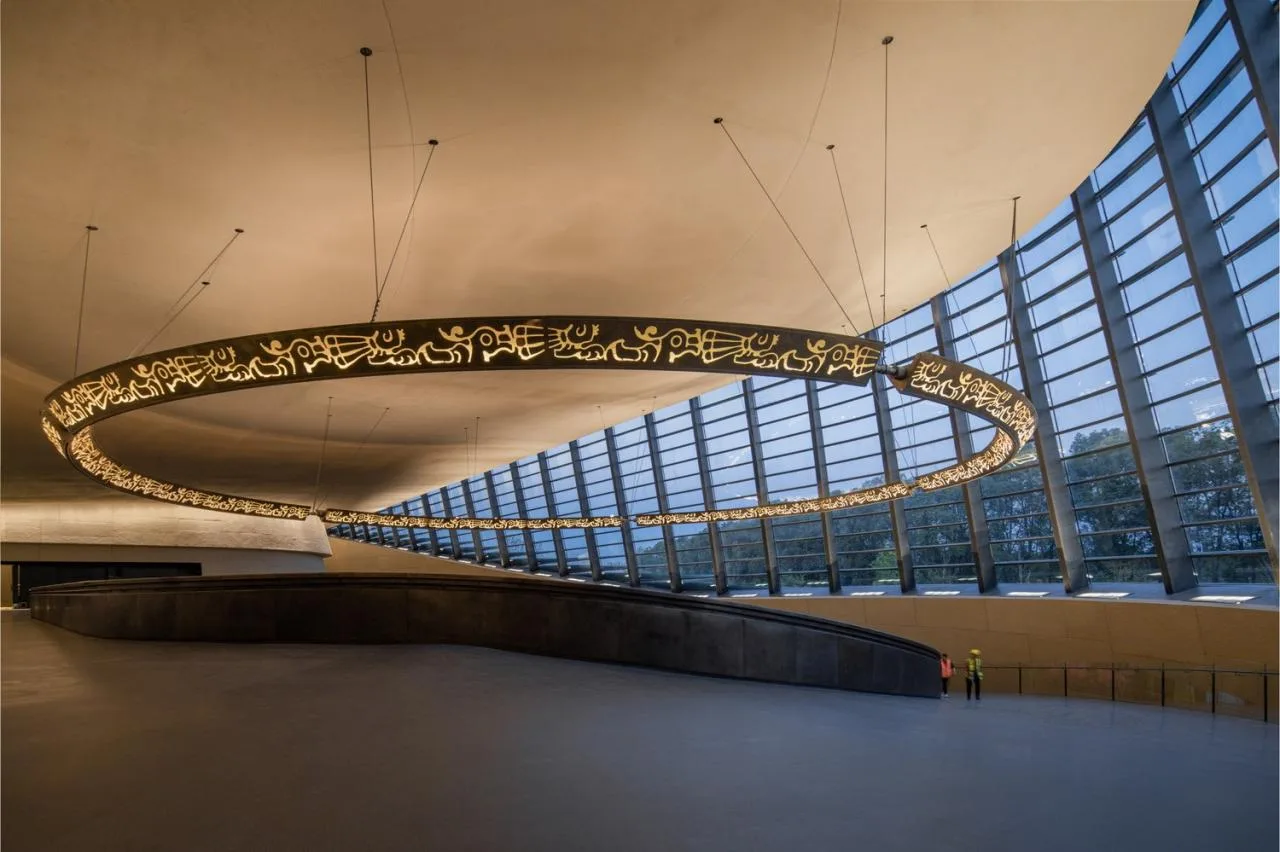
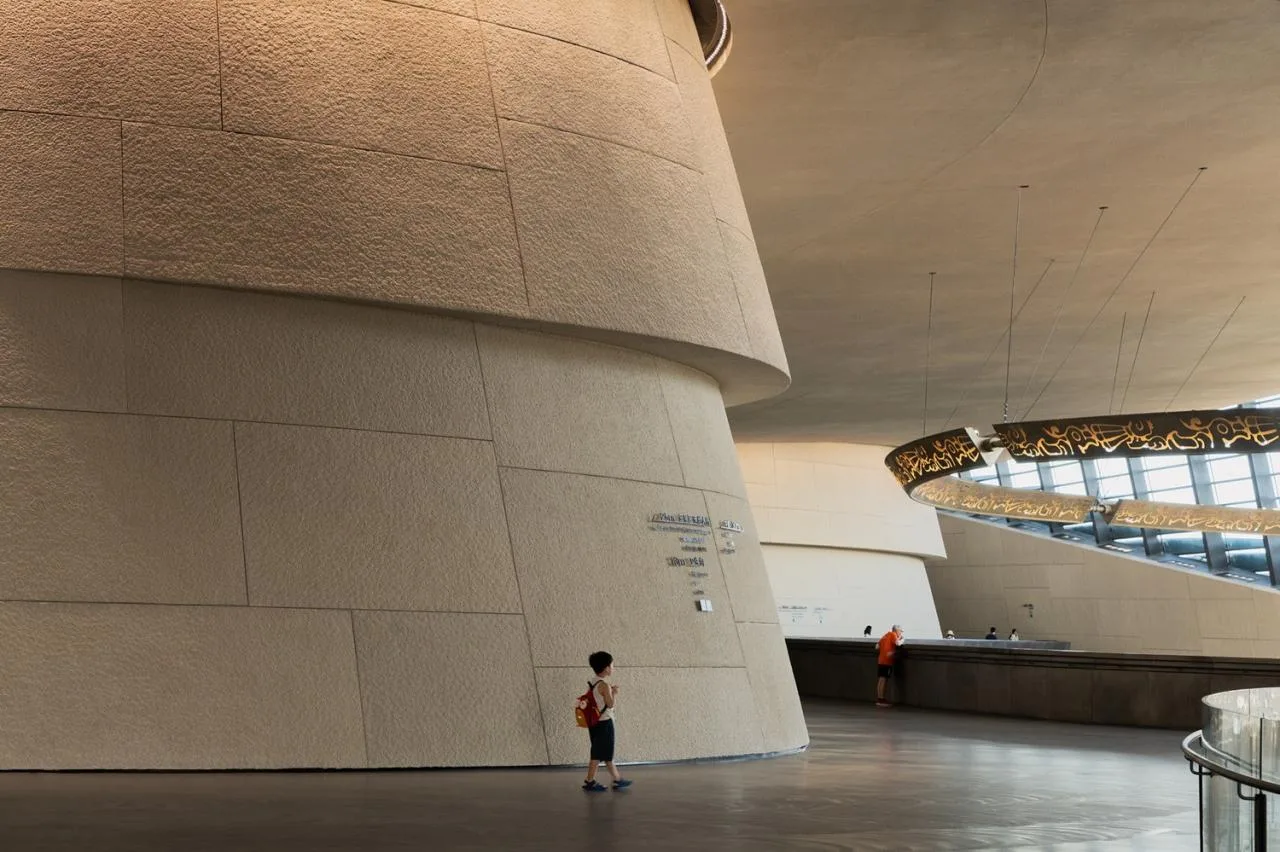
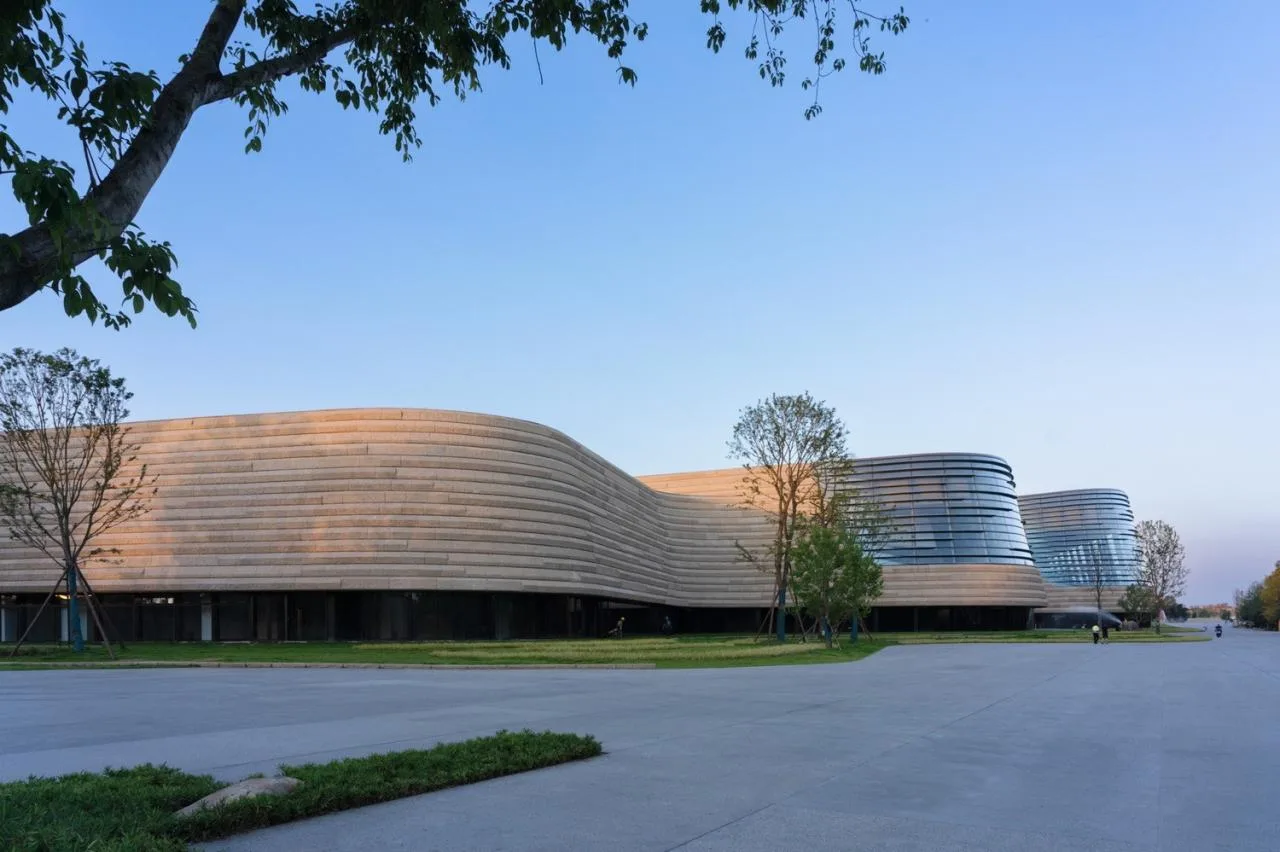
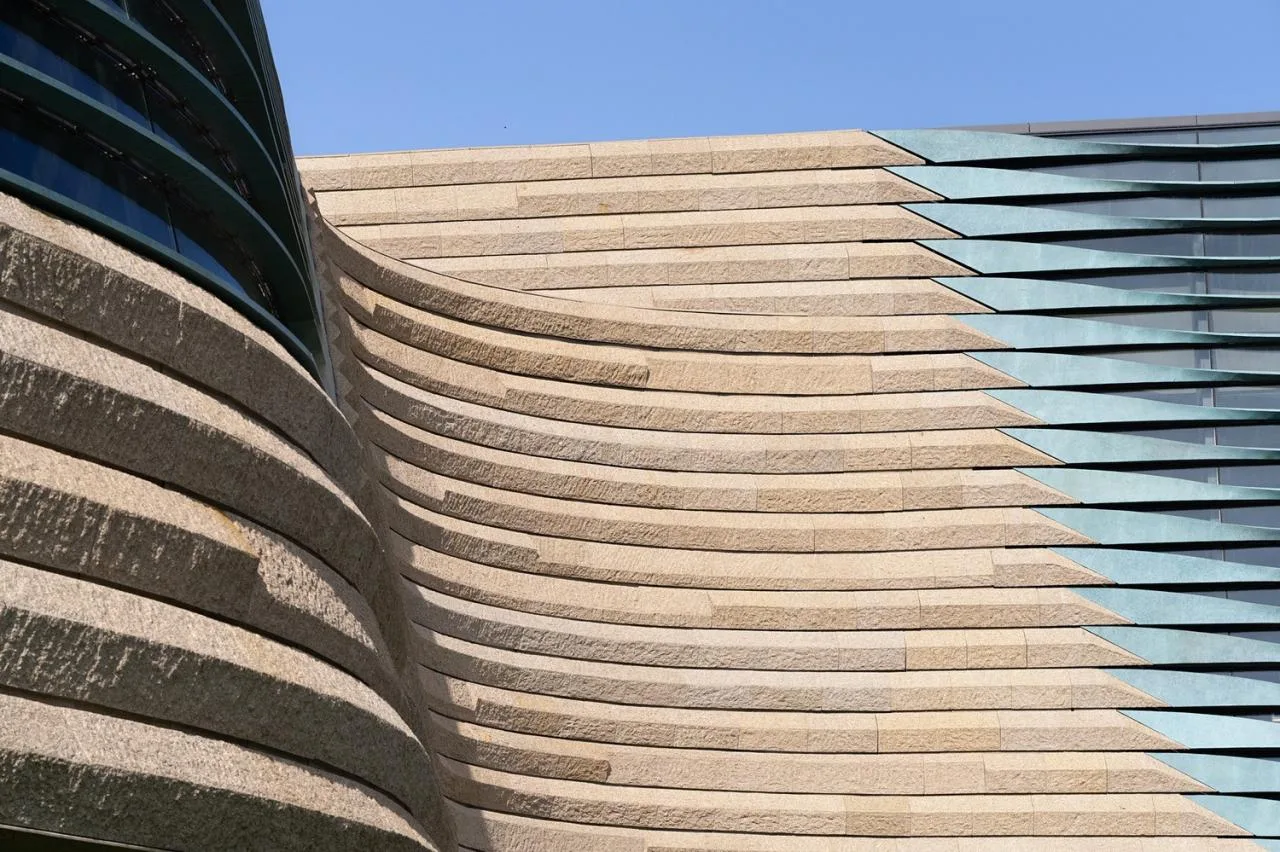
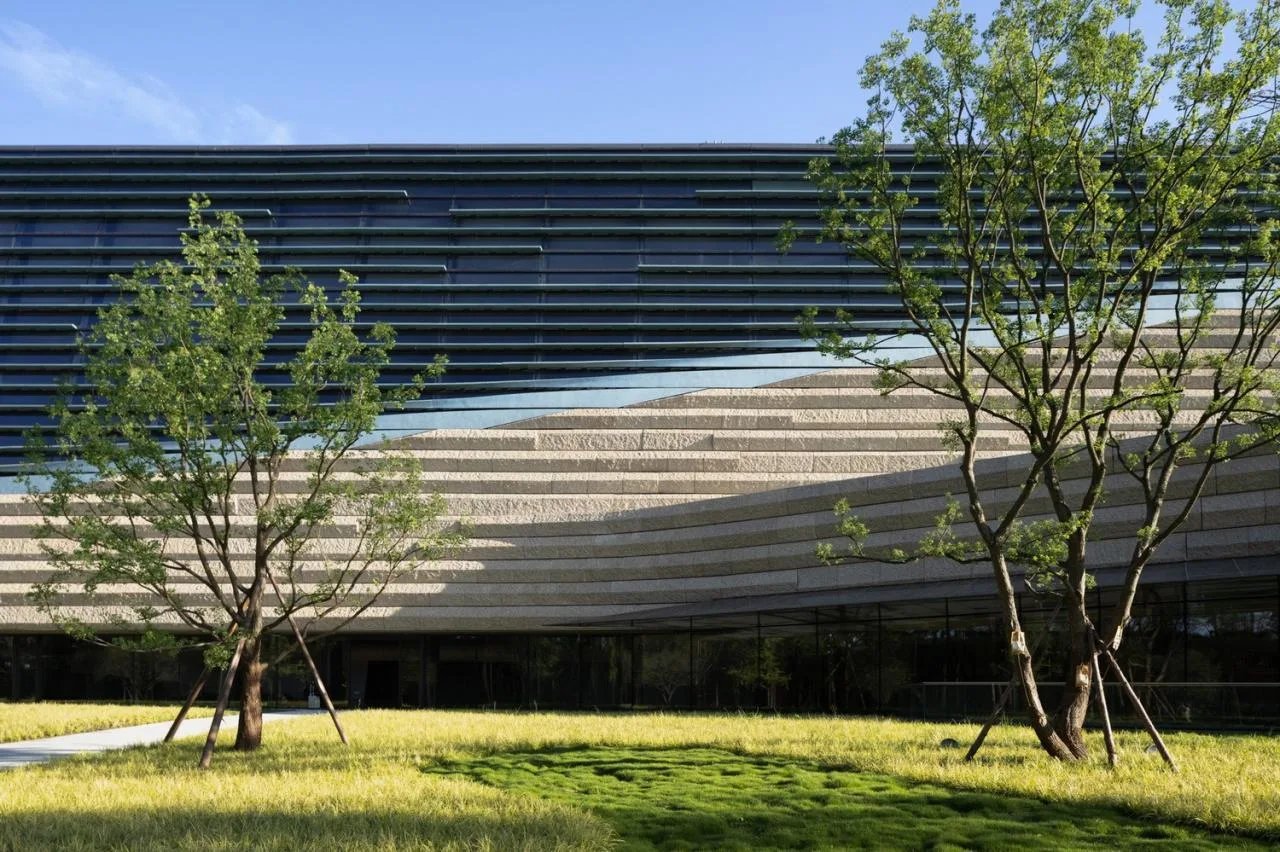
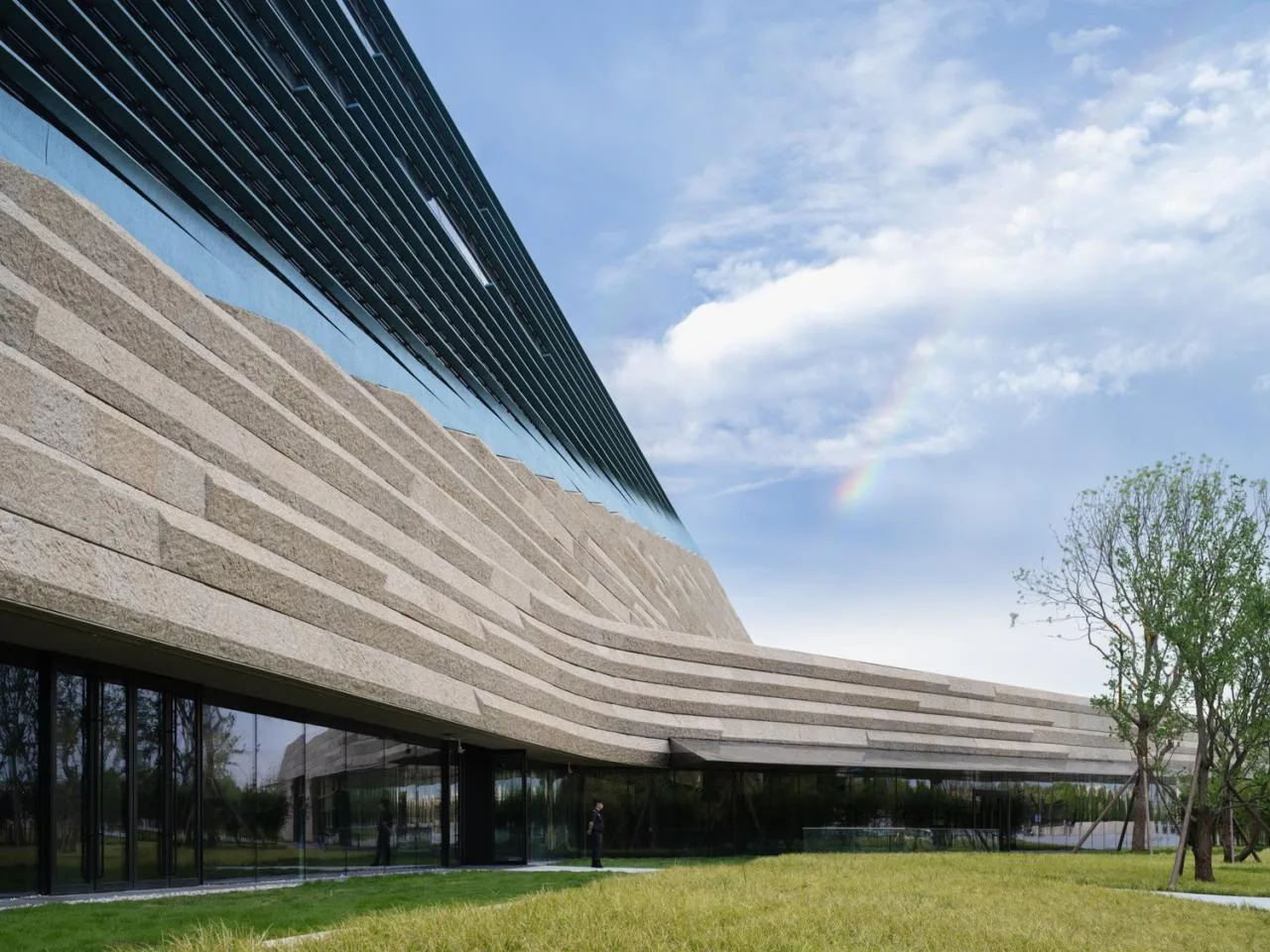
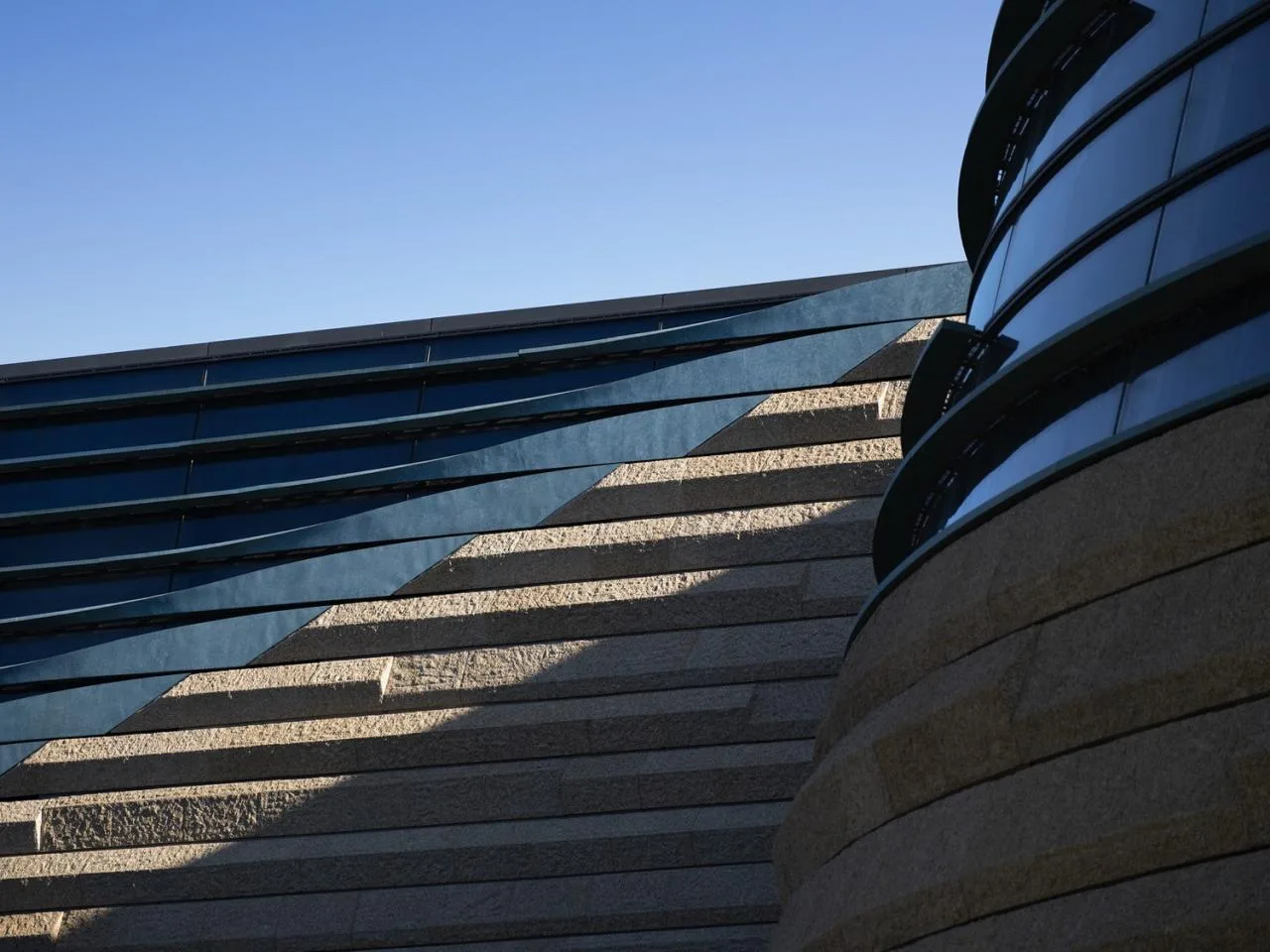
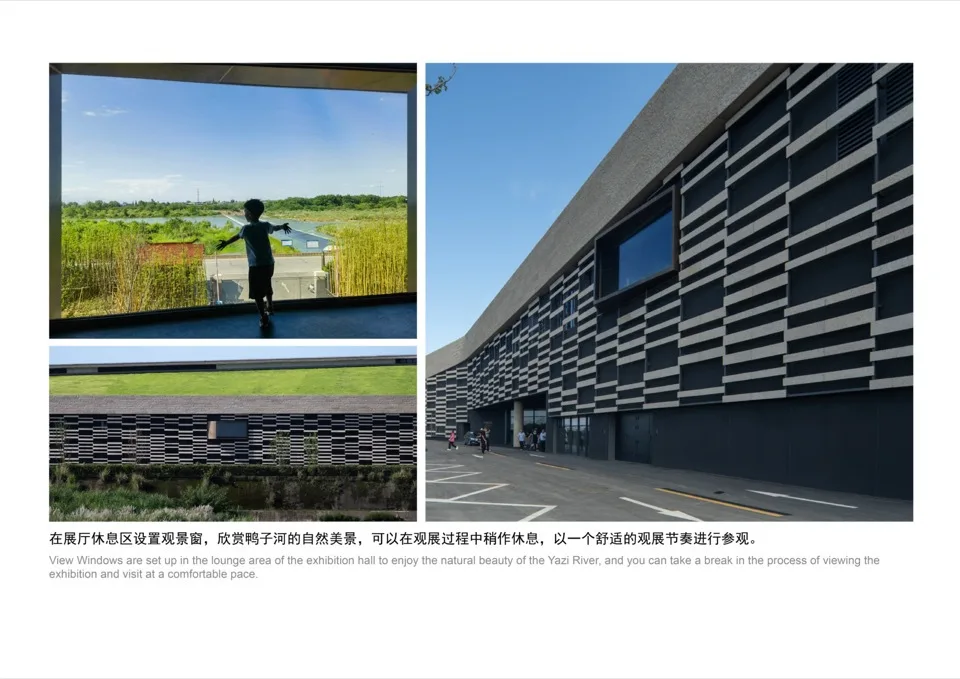
The new building’s exterior materials emphasize uniqueness and cultural symbolism. It is clad in “chrysanthemum yellow” granite, representing the color of the earth. The stone slabs are 8 centimeters thick and hand-chiseled for a rough, substantial texture. The “eye” openings are glazed with ultra-white glass, while bronze sunshades made from specially oxidized brass plates simulate the greenish, mottled appearance of unearthed artifacts, symbolizing Sanxingdui’s bronze civilization heritage.
Exhibition Hall Narrative
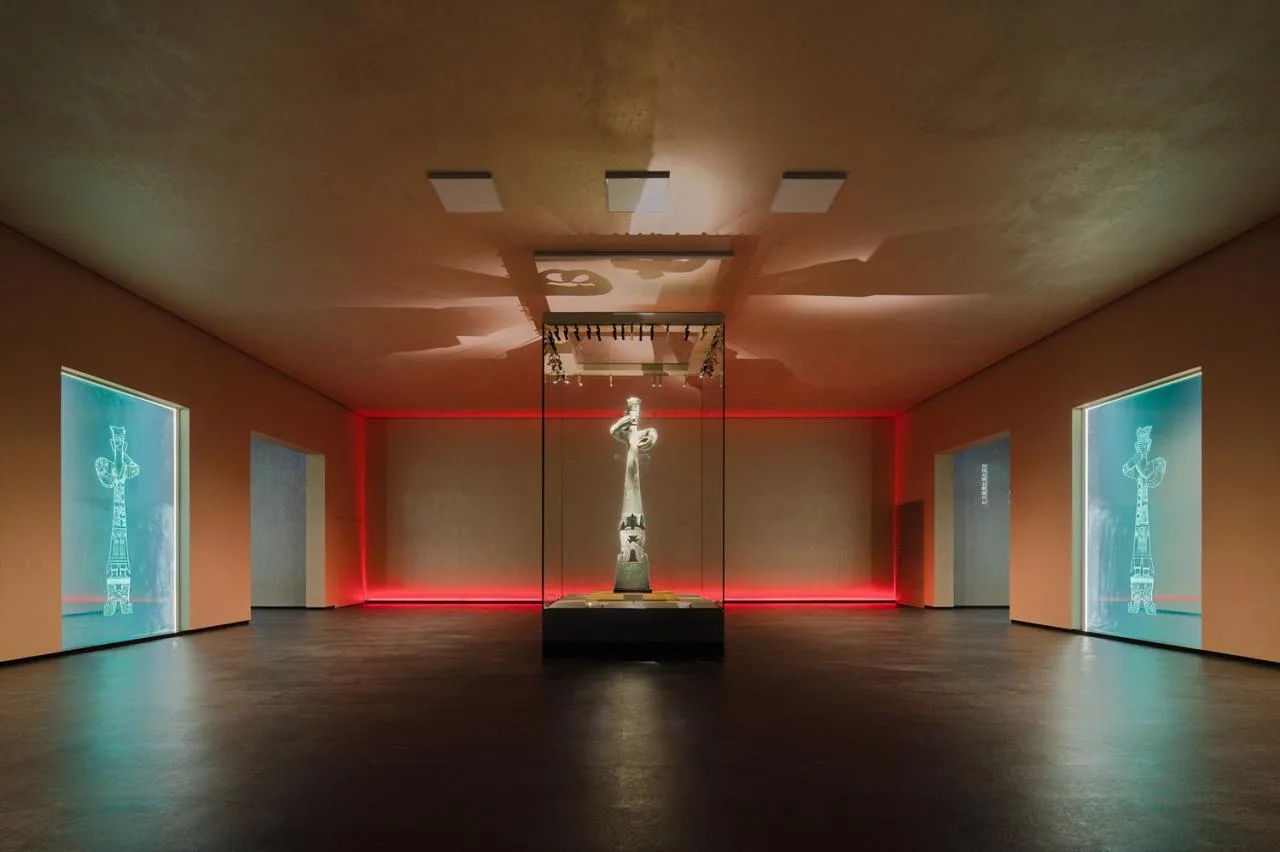
The new building rises two floors above ground, featuring four permanent exhibition halls on each level and two temporary exhibition halls underground, totaling 20,000 square meters of exhibition space. The halls span 15 to 30 meters without internal columns, with floor heights ranging from 7 to 12 meters. The roof employs a steel grid structure, with equipment and piping integrated seamlessly within the grid, achieving a high level of structural and mechanical integration.
Unlike typical museums, the Sanxingdui Museum’s exhibition flow follows a continuous narrative aligned with archaeological storytelling. This approach requires large exhibition halls connected end-to-end, creating a cinematic experience. The new museum implements a zigzag layout that also allows for parallel openings, maximizing flexibility for various exhibitions.
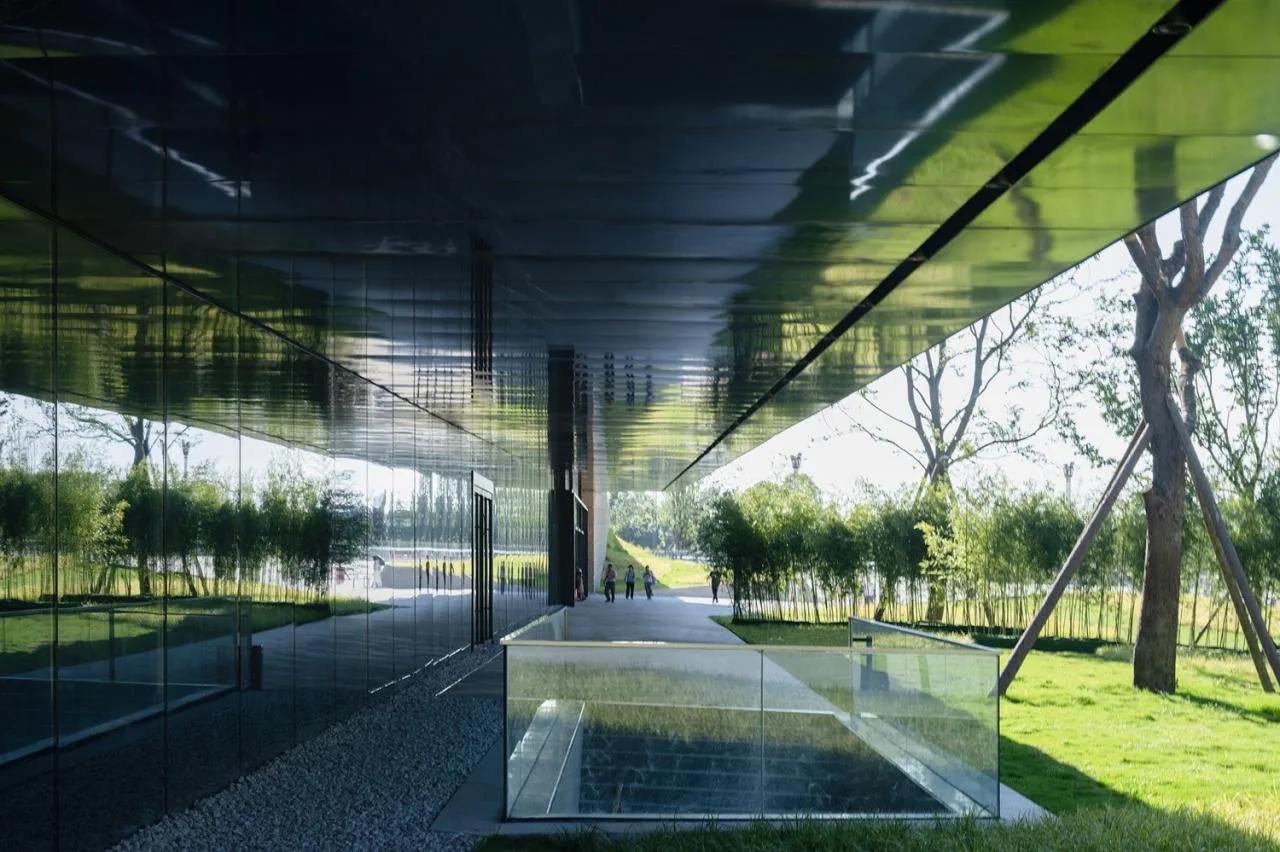
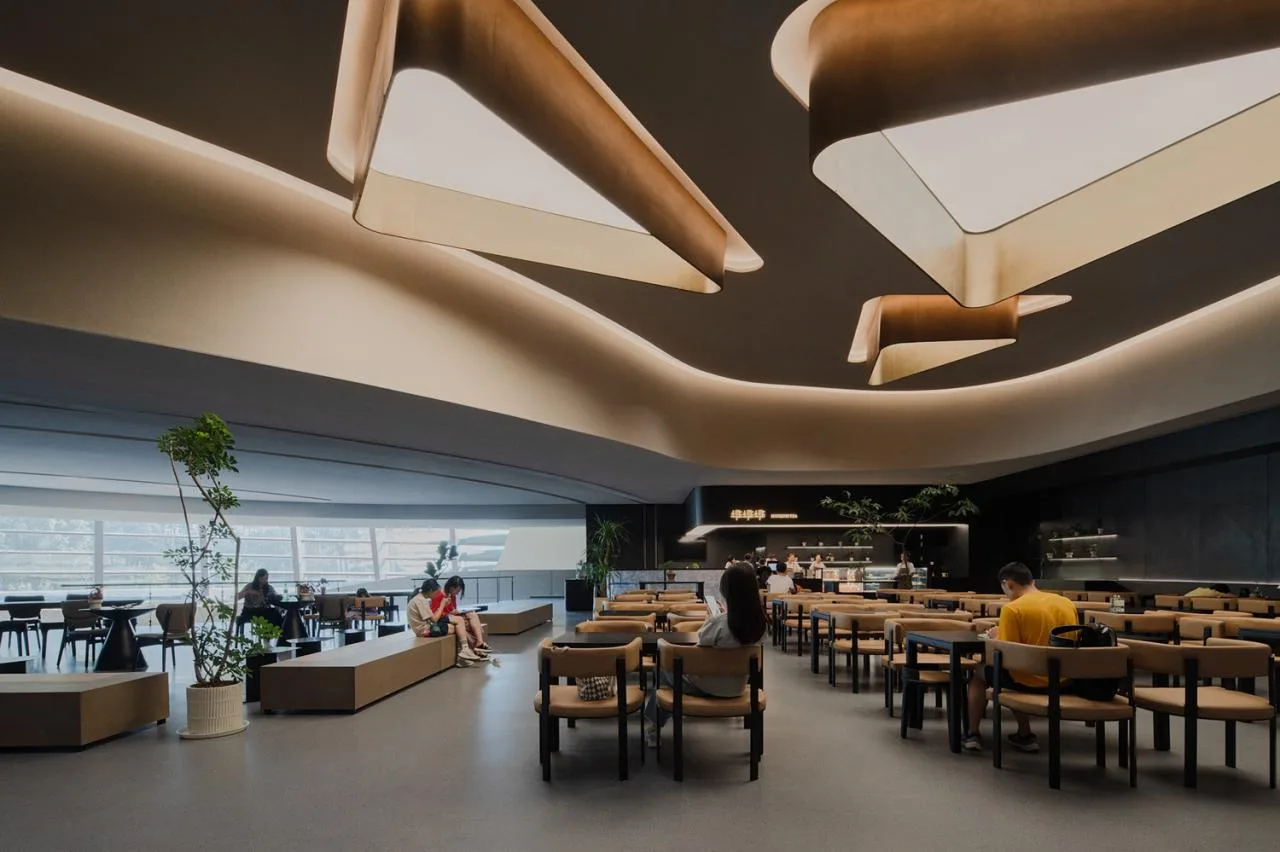
Visitors begin their tour in the introduction hall and can follow a continuous “one-stroke itinerary” through all exhibition halls, or choose to explore independently. To reduce fatigue, amenities including cafes, cultural and creative shops, open theaters, and rest areas are positioned along the route. A special highlight is the second-floor cultural relic exhibition hall facing the river, designed with three rest areas featuring large panoramic glass windows overlooking the Duck River. This allows visitors not only to appreciate historical treasures but also to reconnect with the river that has nurtured civilization through the ages, creating a timeless experience.
Project Drawings
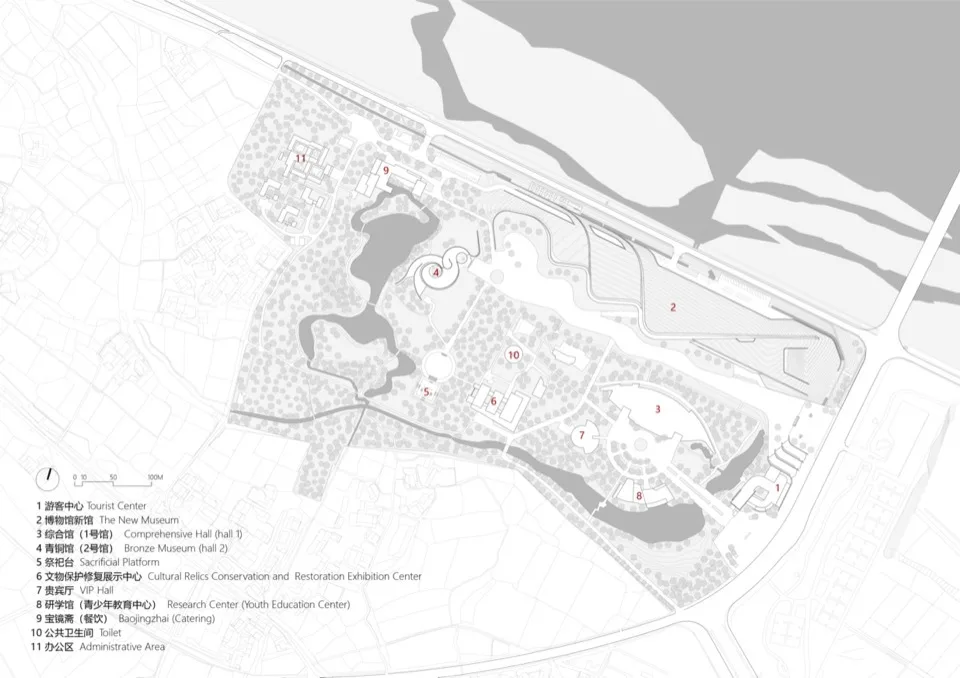
△ General Layout Plan
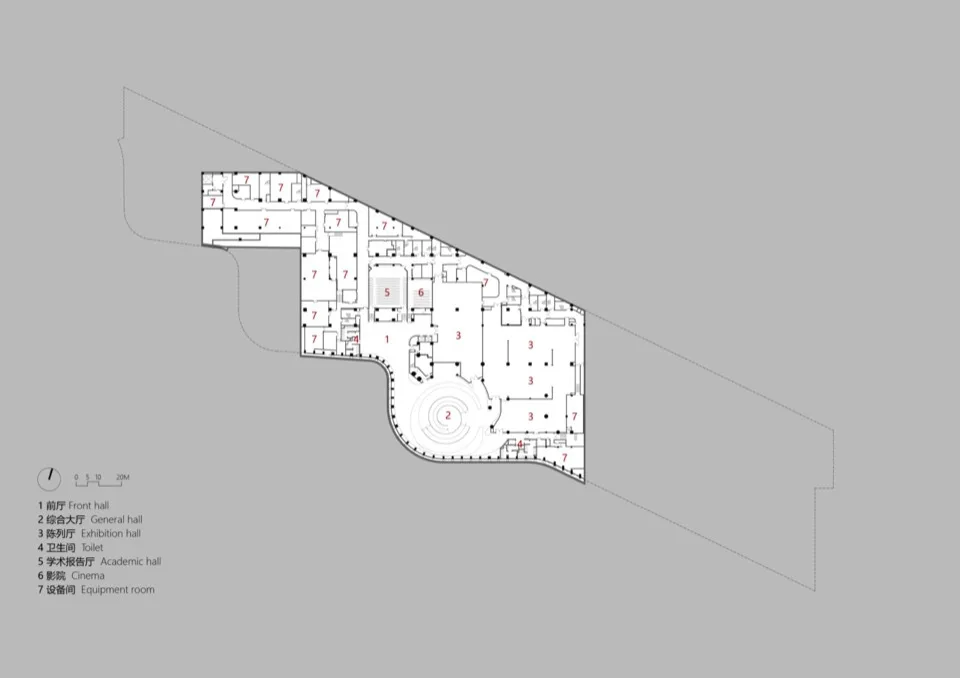
△ Underground Floor Plan
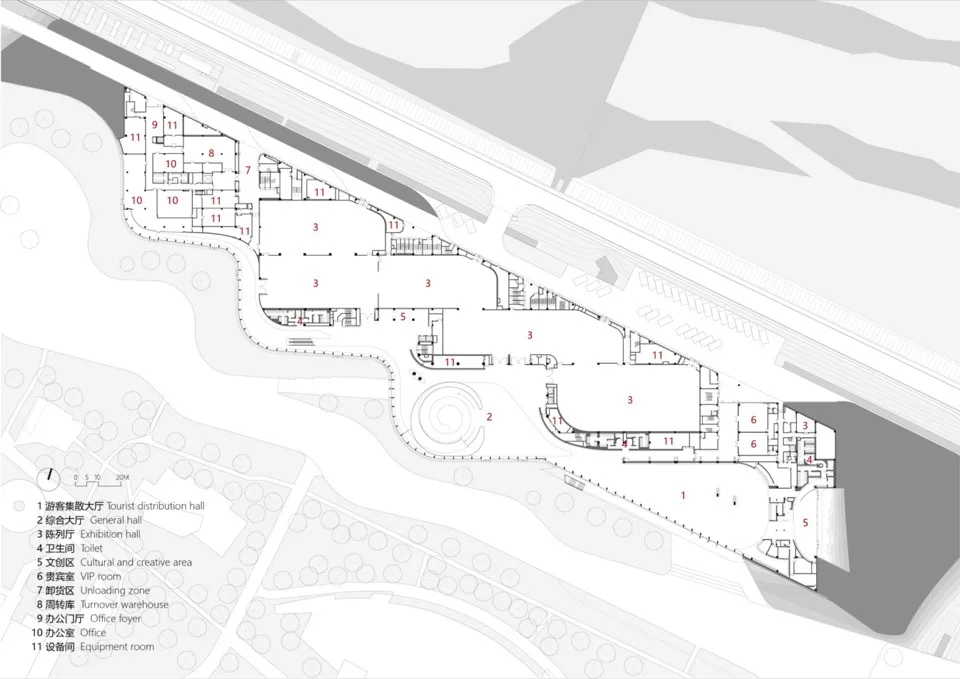
△ First Floor Plan
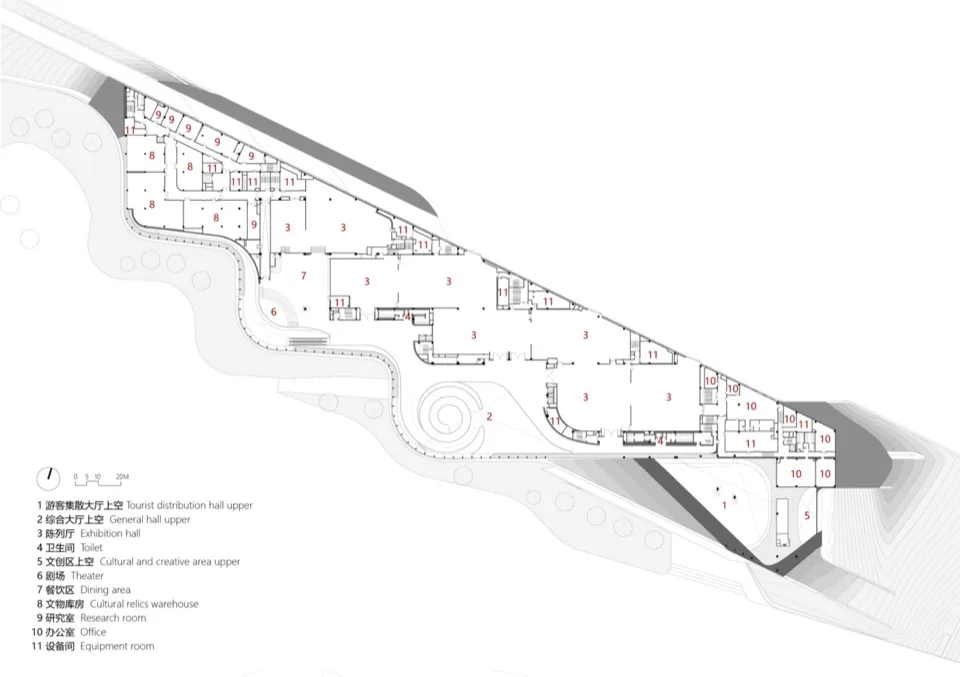
△ Second Floor Plan
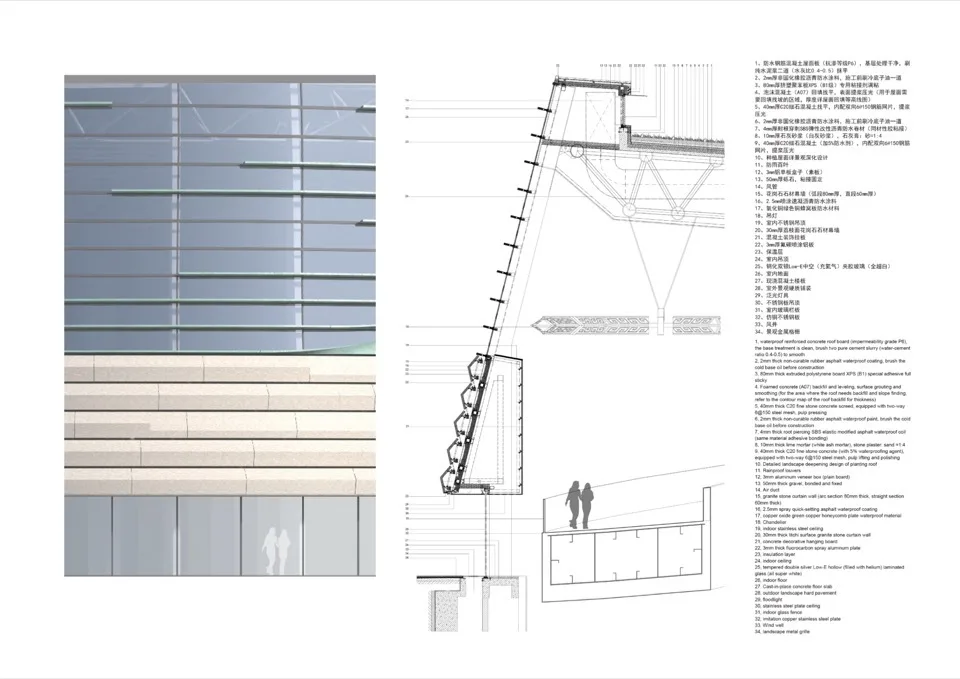
△ Detailed Drawing
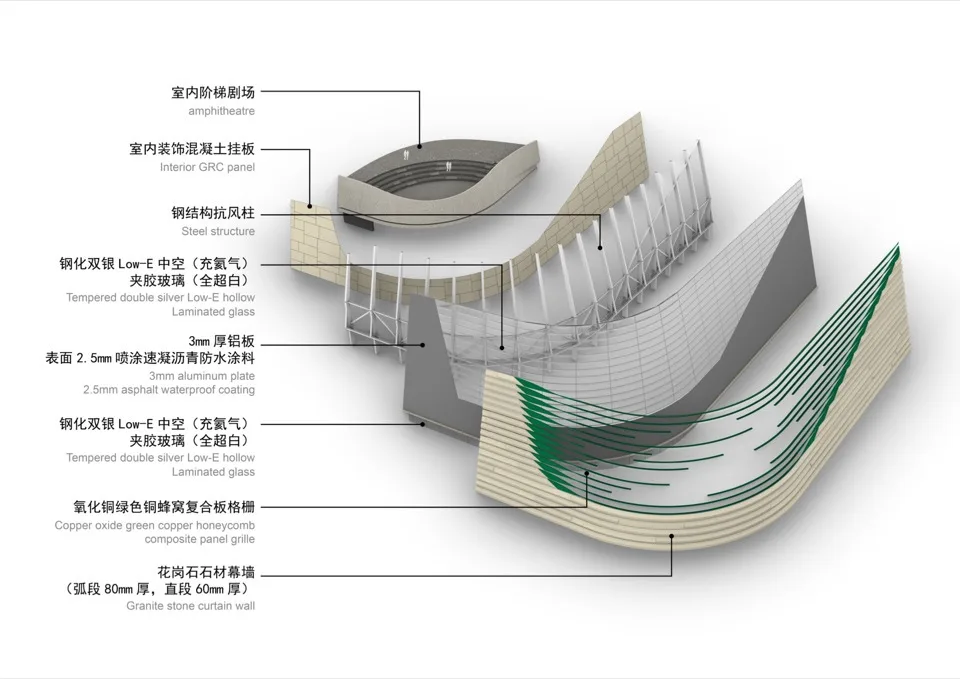
△ Analysis Chart
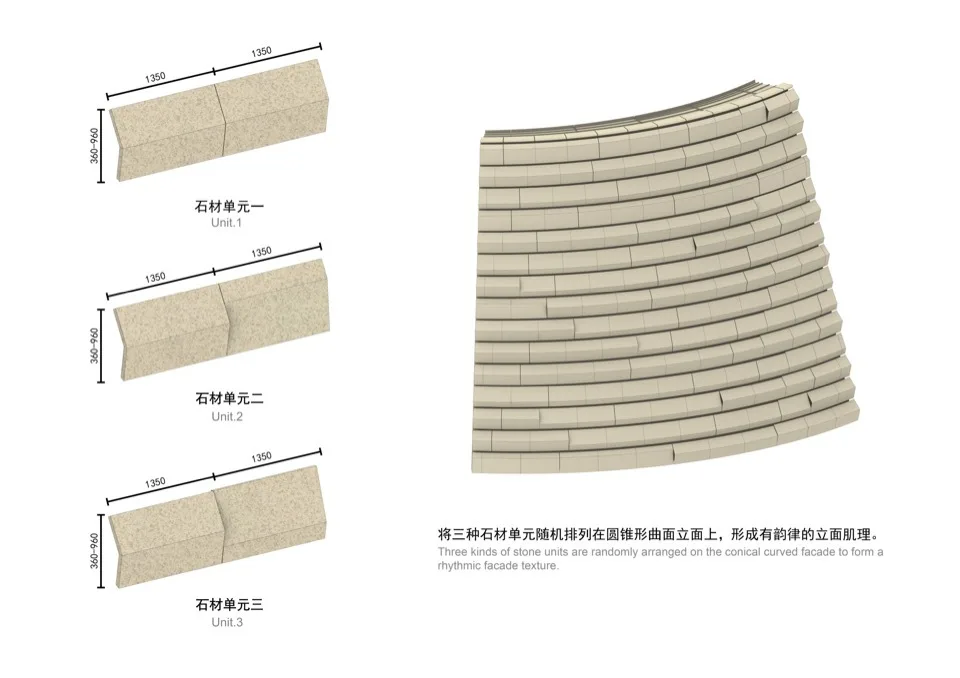
△ Material Analysis Diagram
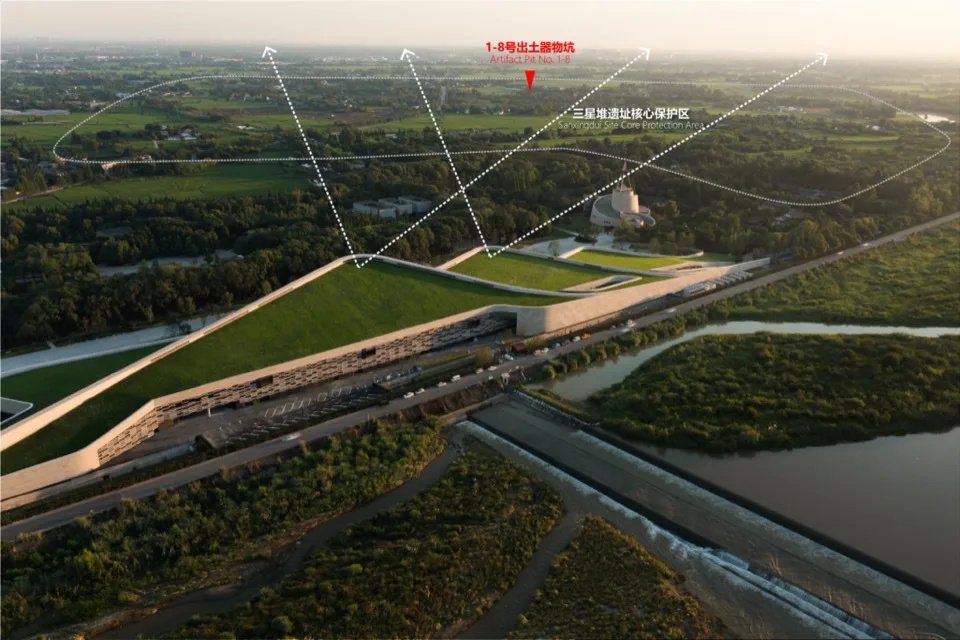
△ Analysis Chart
Project Information
Architect: China Southwest Architectural Design and Research Institute
Area: 54,400 m²
Year: 2023
Photographer: Existence of Architecture – Architectural Photography
Lead Architect: Liu Yi
Project Architects: Xiao Bo, Yang Yang
Project Manager: Luo Dian
Architects: Yang Pengcheng, Sha Peng, Wan Yaling, Xin Zhen, Liu Yu, Cai Qingfei, Ding Hongya, Chen Shuo, Huang Xiangyu, Qiu Yanquan, Li Mu, Qiao Cong
Structural Design: Long Weiguo, Yang Wen, Lai Chenggang, Lan Tianqing, Zhu Siqi, Liu Xiaozhou, Xiao Kejian, Wang Pan, Wen Jian
Water Supply and Drainage Design: Yang Jiuzhou, Liu Shuai, Li Bo, Chen Yao, Zhao Xuanqi, Tan Gujin, Gu Xingyu
HVAC Design: Yang Ling, Wei Minghua, Wen Ling, He Sihao, Fang Xin
Electrical Design: Li Hui, Xu Jianbing, Ao Faxing, Qiu Yu, Li Lu, Liu Chong, Xie Songlin
Curtain Wall Design: Dong Biao, Zhang Guoqing, Chen Zhaohuan, Wang Yiwei, Fu Xiaohui, Luo Xin
Building Energy Efficiency: Feng Ya, Zhong Huizhi, Dou Mei
Building Intelligence: Wu Huan, Bu Xiangyu, Yu Qiang, Liang Jun, Wang Shaowei
Interior Design: Zhang Can, Li Wenting, Lai Wei, Yang Jing, Dong Wenjie, Jiang Pengchong, Liu Wenjing, Tang Jun, Fan Jinli, Yang Yan, Wang Zhangping, Li Guangchao, Tang Jia, Xu Maoya
Landscape Design: Chen Hongyu, Yan Bin, Huang Hao, Wang Zhihao, Li Gang, Fan Xiaoqian
Outdoor Floodlighting Design: Xu Dongliang, Zhang Guoqiang, Wang Shanxin, Yuan Li, Xia Hui
Interior Art Lighting Design: Hu Fang, Li Yahui, Ma Zanbao, Zhao Xian, Zhang Quanliang, Xiang Jun
Cost Management: Zhang Tingxue, Yuan Jie, Peng Xiaofang, Jia Lingli, Yu Jie, Liu Mingyu, Jiang Jinhong, Yang Jiayi, Wei Youren
Owner: Sichuan Guanghan Sanxingdui Museum
Design Phase: December 2020 – August 2022
Construction: Southwest Company of China Construction Eighth Engineering Division
Location: Deyang, China















Must log in before commenting!
Sign Up