
Project Overview
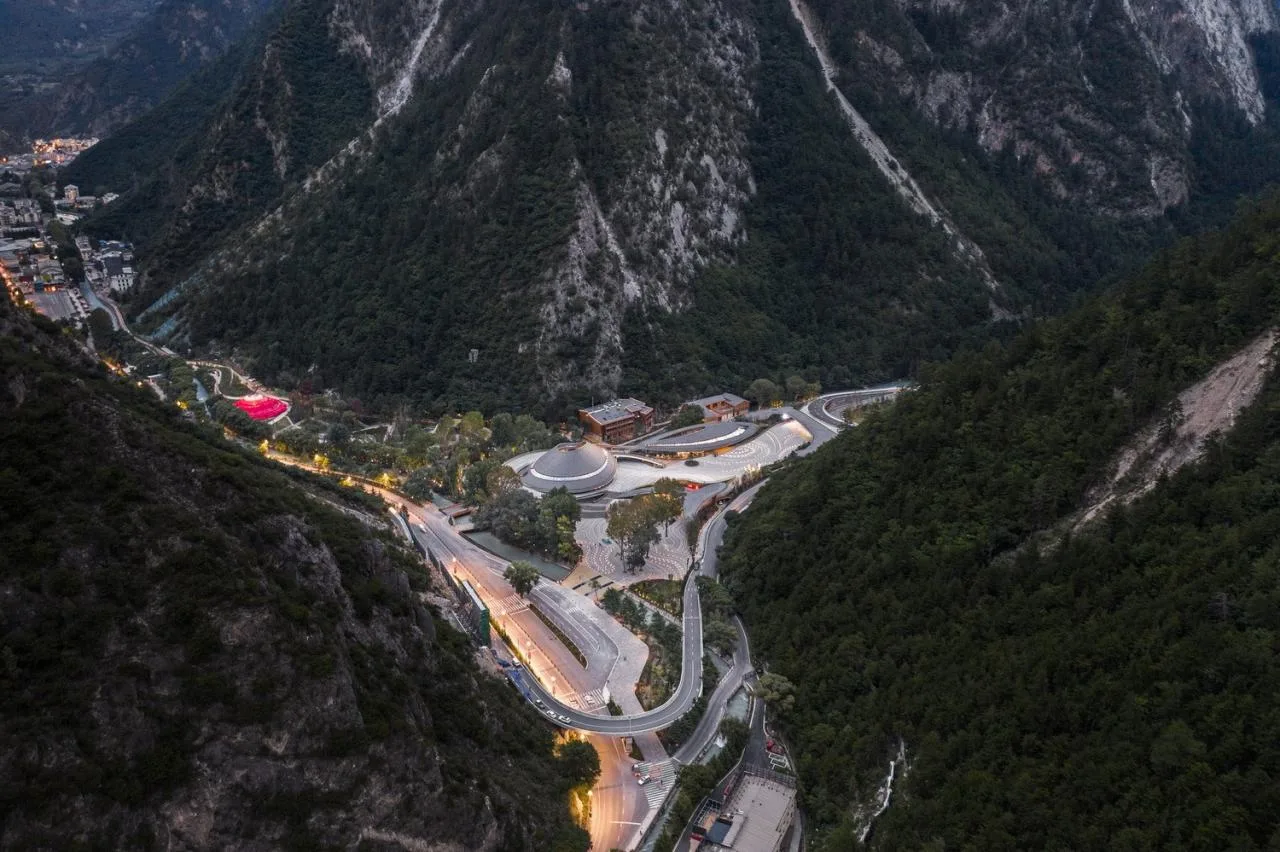
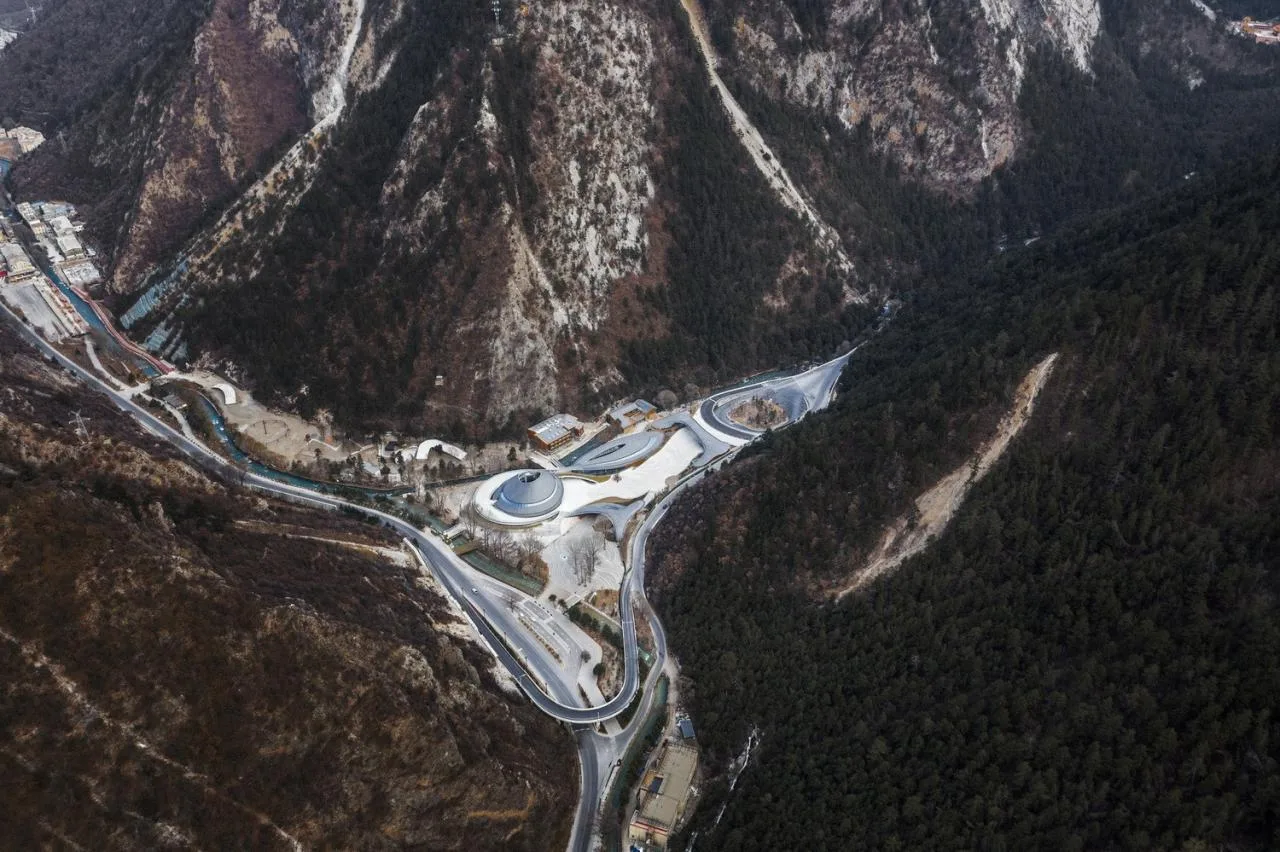
This project involves the construction of three-dimensional tourist service facilities at the entrance of the Jiuzhaigou Valley Scenic and Historic Interest Area. Located at the valley’s entrance, the project covers approximately 30,000 square meters of building space on a land area of 8.996 hectares.
The scope includes a tourist service center, an international exchange center, renovation of the Heye Hotel, development of the Linka Landscape, reinforcement of the Baishui and Feicui River embankments, and construction of overpasses and access roads. Serving as a landmark gateway to the scenic area, the project will support transportation and services for up to 41,000 visitors daily once completed.
The Jiuzhaigou Valley Scenic and Historic Interest Area Management Bureau is the construction authority, with Tsinghua University Architectural Design and Research Institute Co., Ltd. leading the survey, design, and construction, in collaboration with Shaanxi Construction Engineering Ninth Construction Group Co., Ltd. and Sichuan Chuanjian Survey and Design Institute. Academician Zhuang Weimin oversees the overall project as the general director.
As a significant natural heritage site and biosphere reserve, Jiuzhaigou Valley boasts a rich ecological gene pool and unique environment. Earthquake damage to buildings adversely affected the ecological surroundings. Tourism, the region’s economic backbone, provides essential livelihood support for locals. Prompt reconstruction is critical to restoring tourism and safeguarding the community’s well-being.
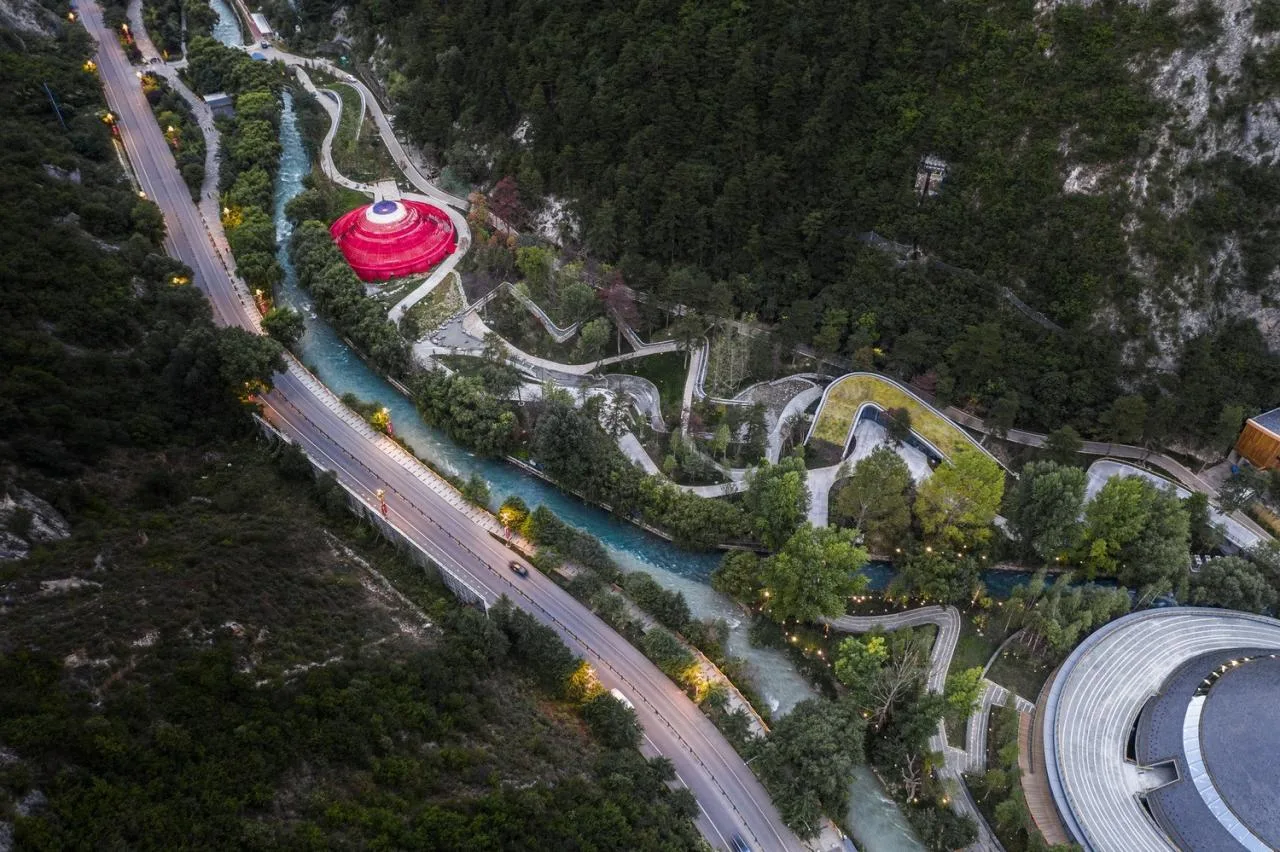
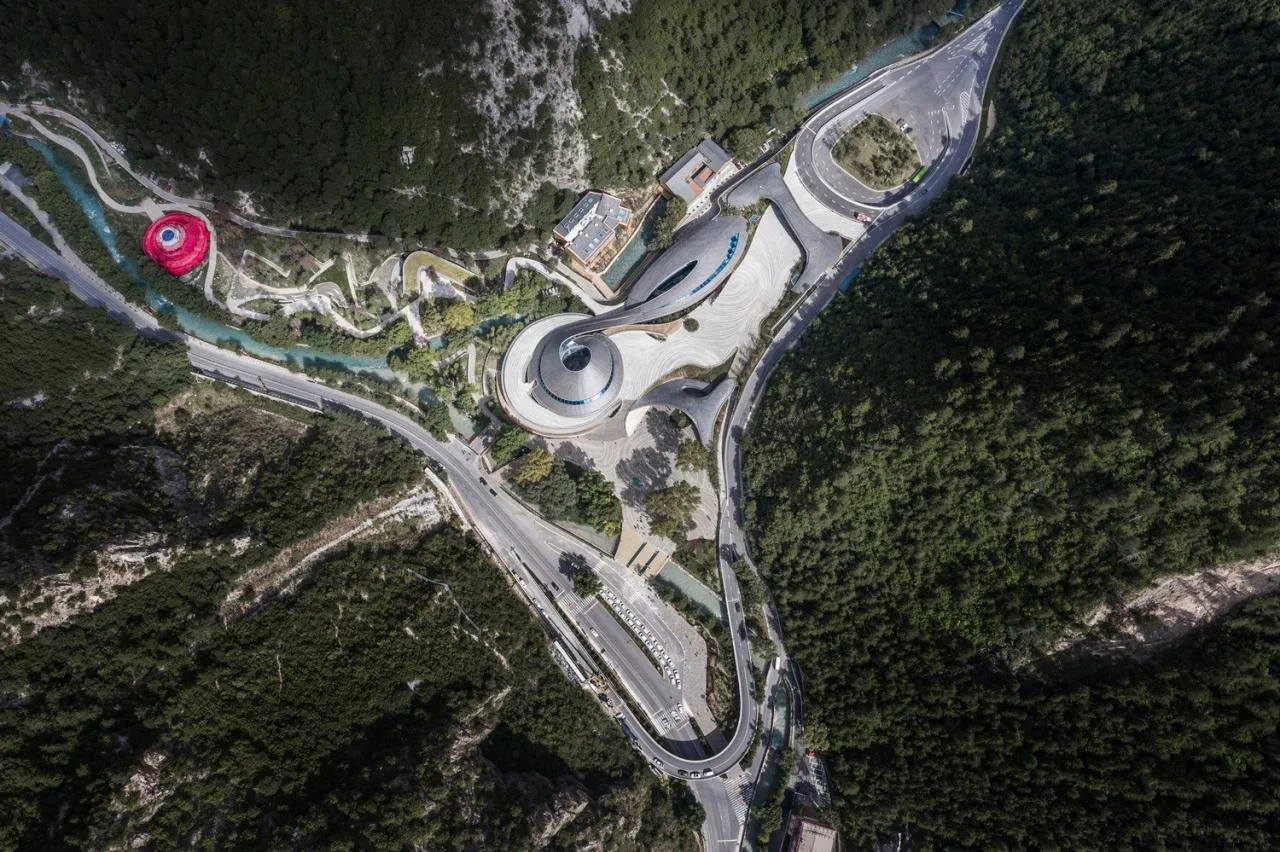
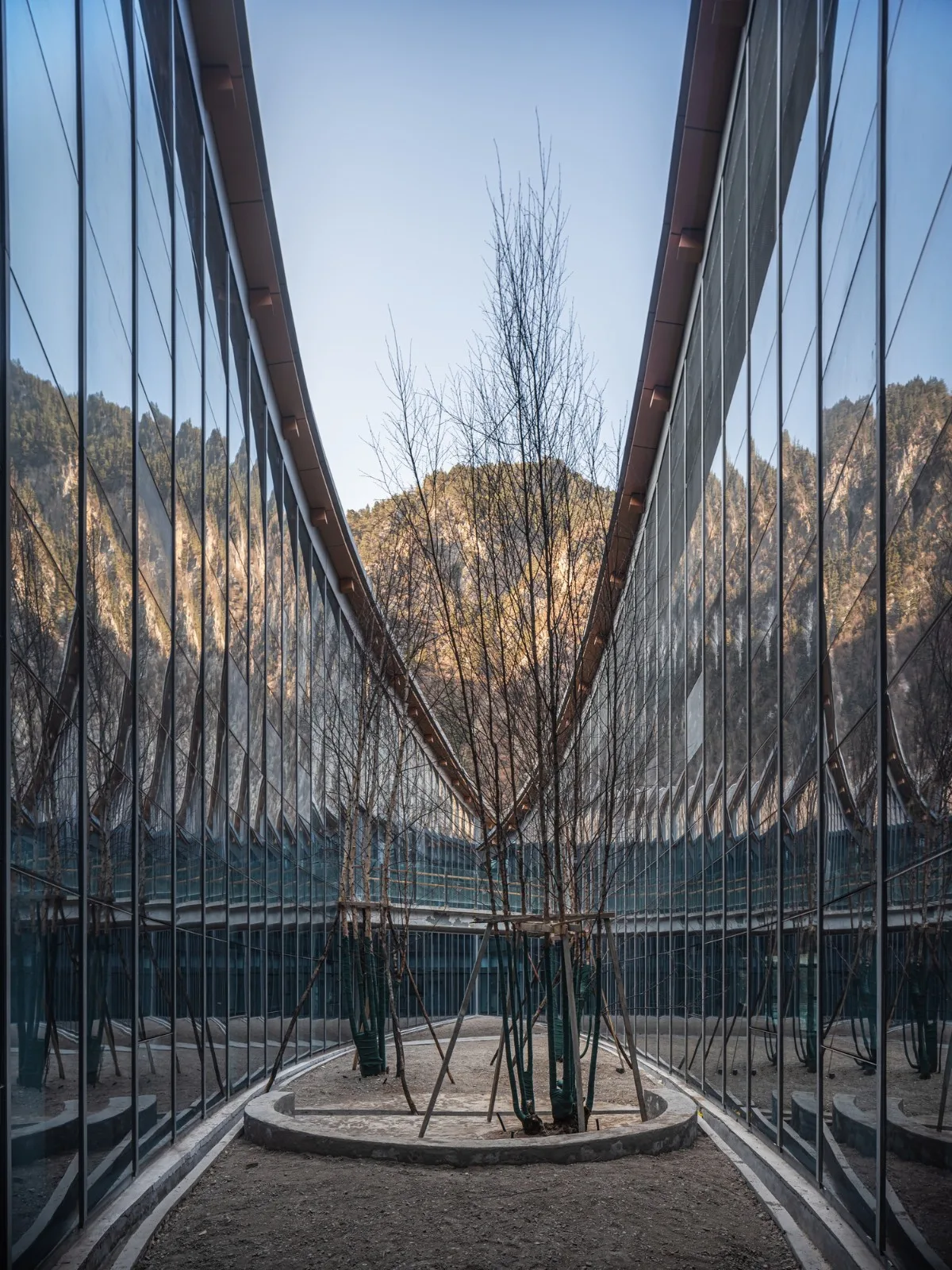
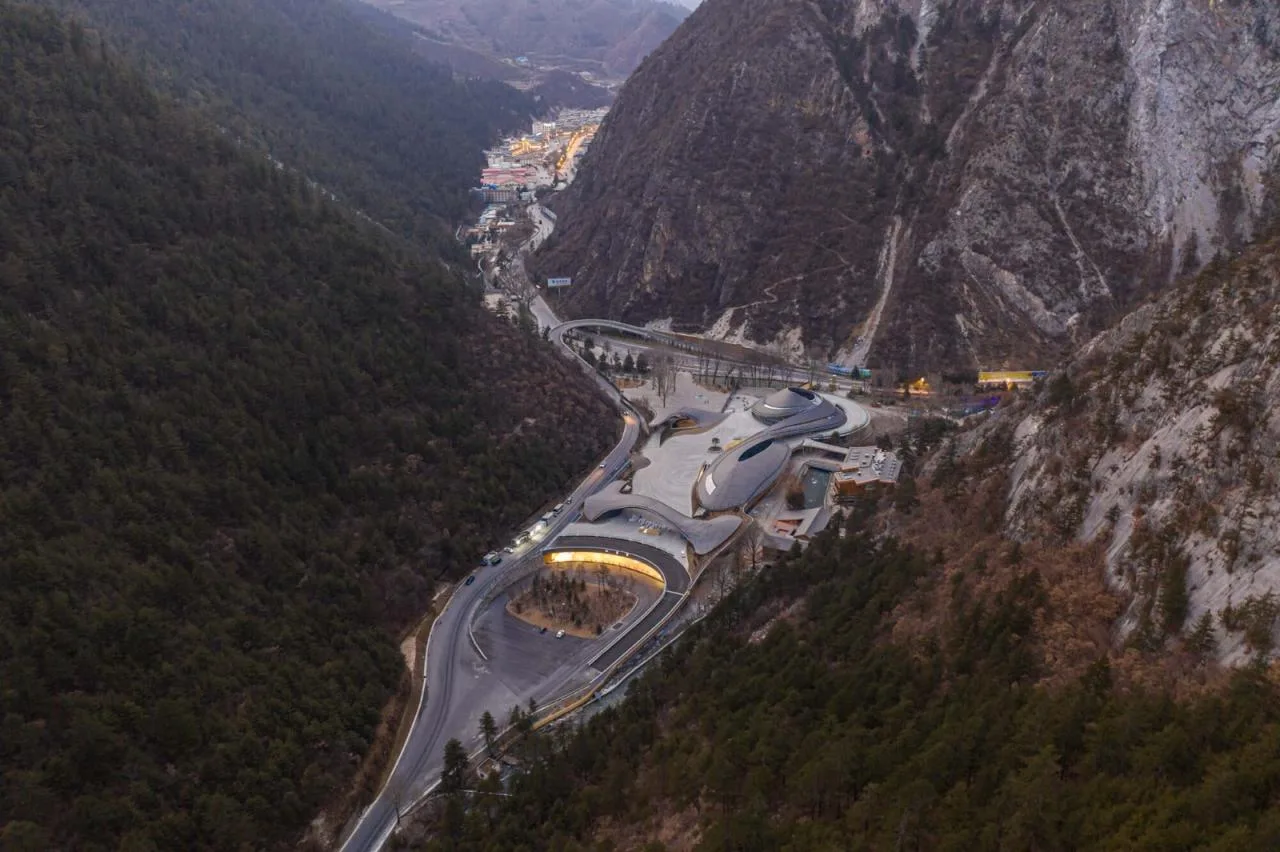
The design concept respects the protected status of Jiuzhaigou Valley as a World Natural Heritage and National Scenic Area. The architecture harmonizes with the natural landscape, reflecting the valley’s topography and Tibetan cultural heritage. Smooth forms integrate traditional culture with modern style, creating an environmentally conscious building that embodies deep cultural significance while fulfilling various management and service functions.
The design draws inspiration from nature, blending seamlessly into the picturesque Jiuzhaigou surroundings and expressing the unique cultural legacy of the Sichuan Tibetan region.
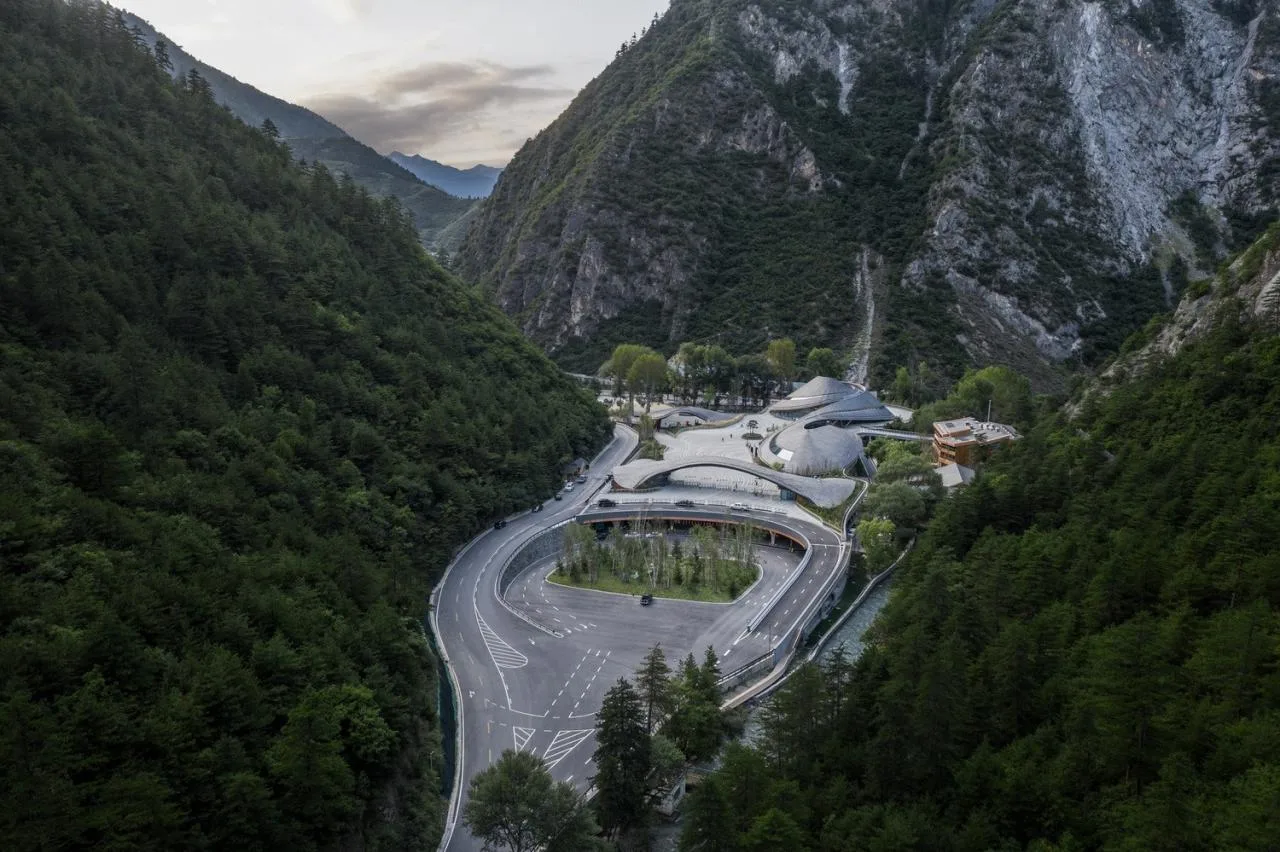
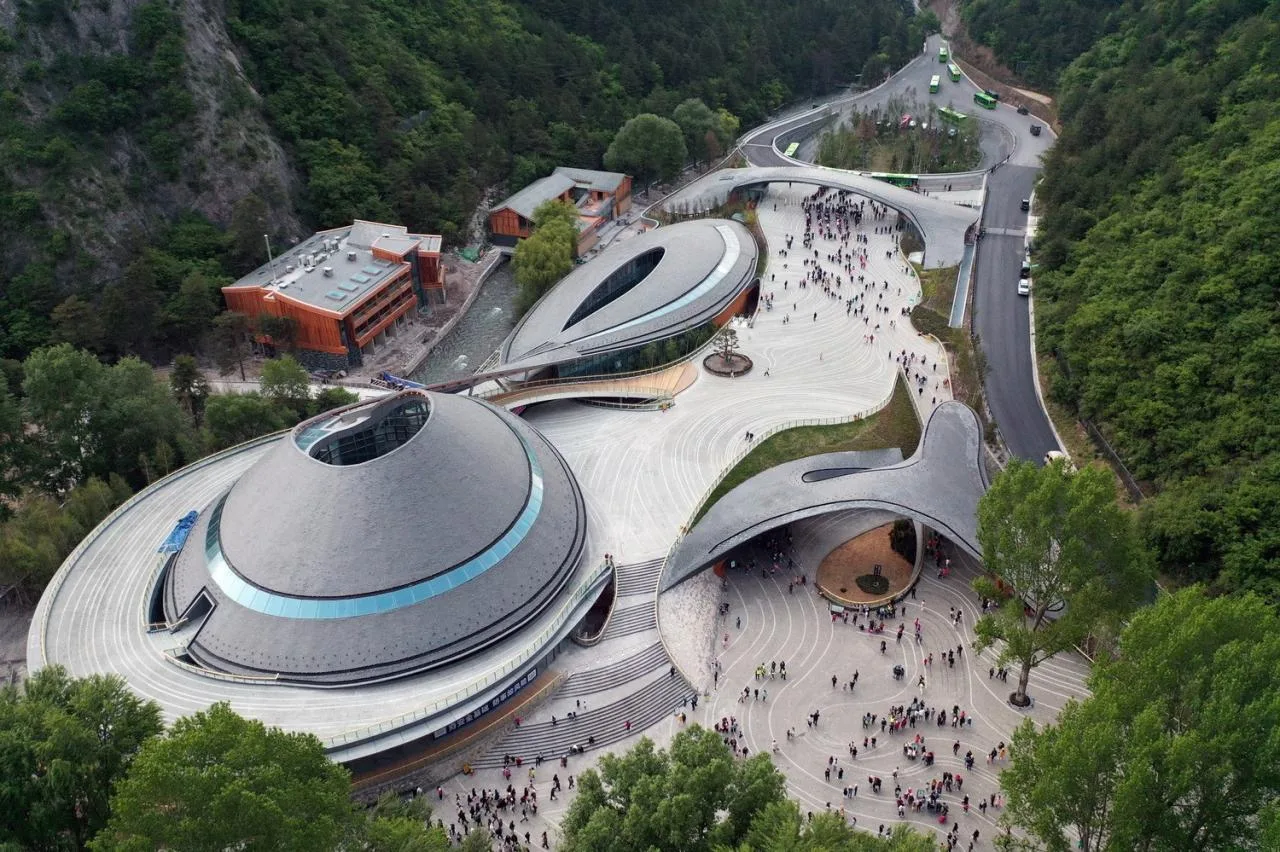
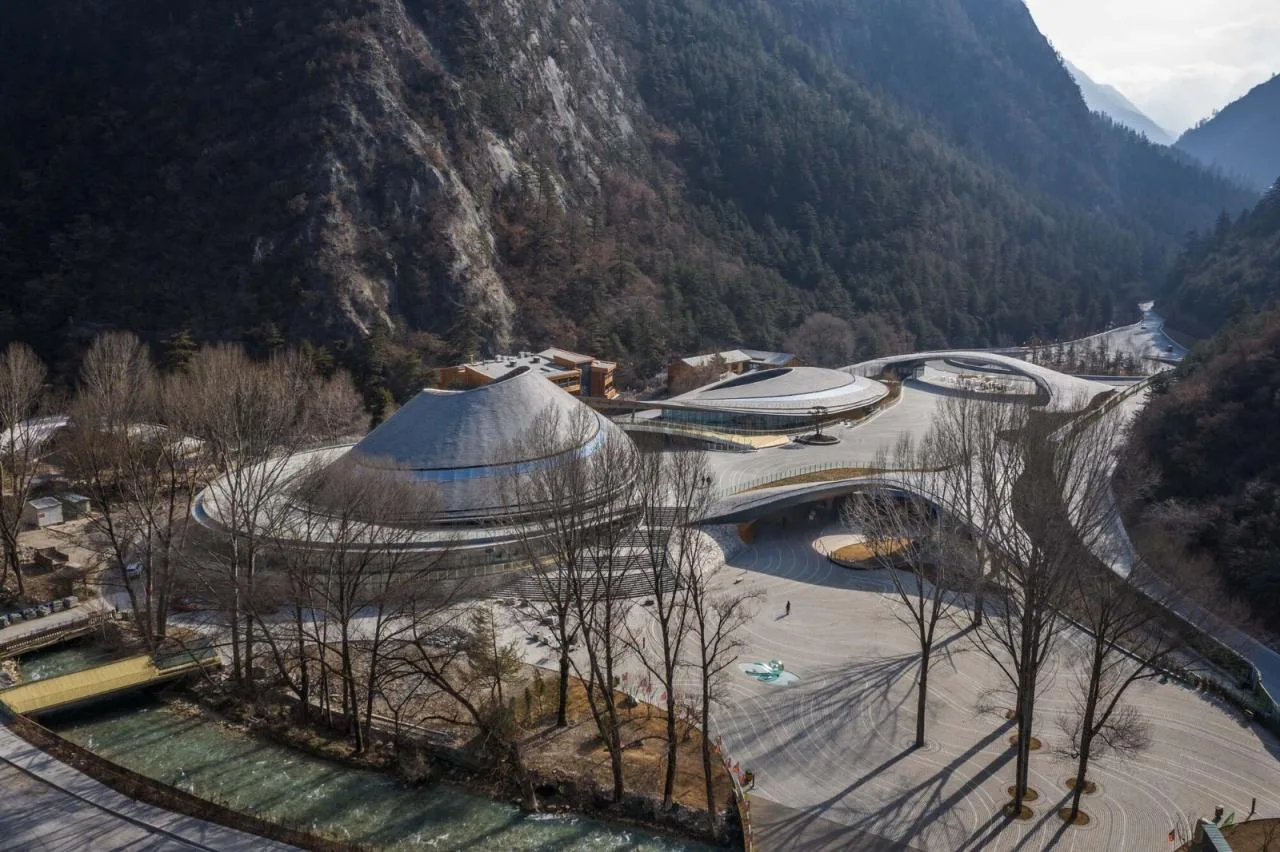
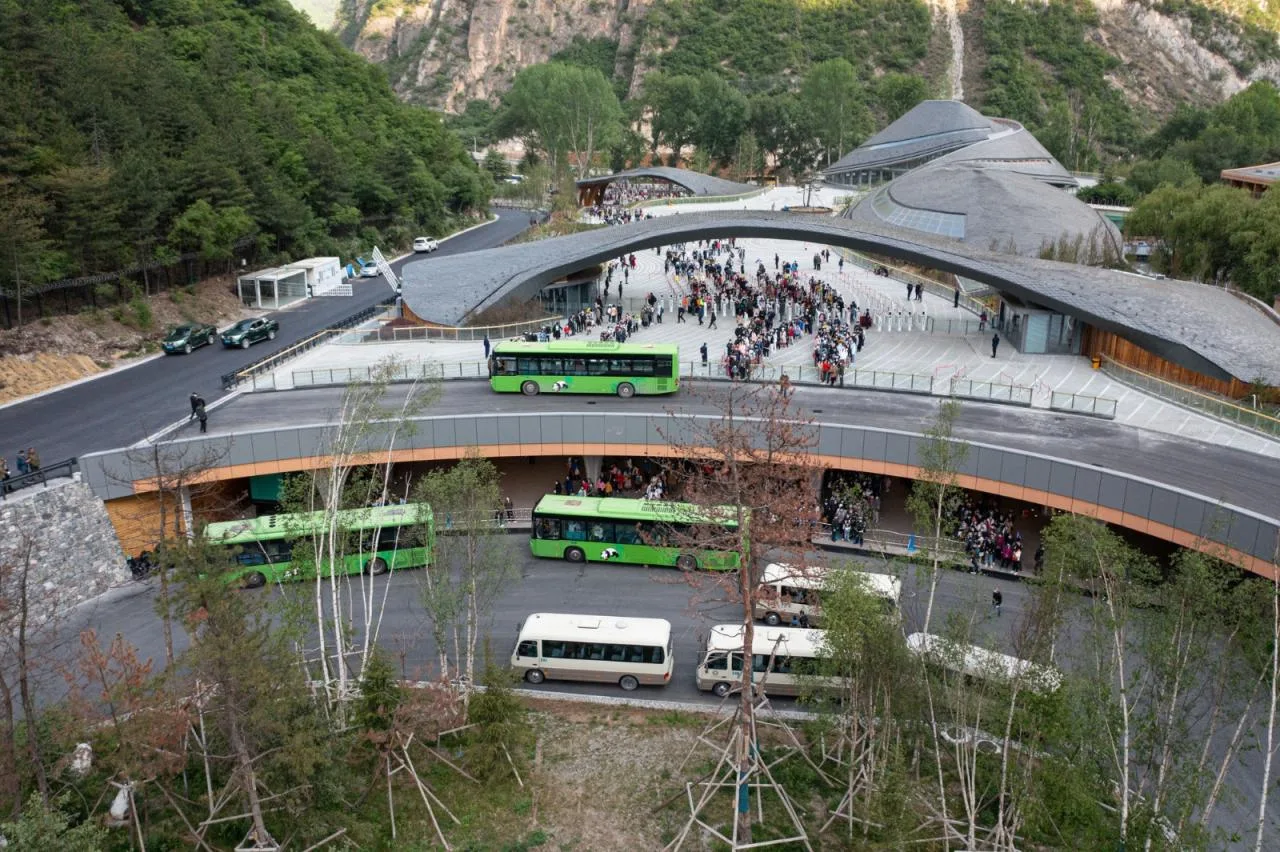
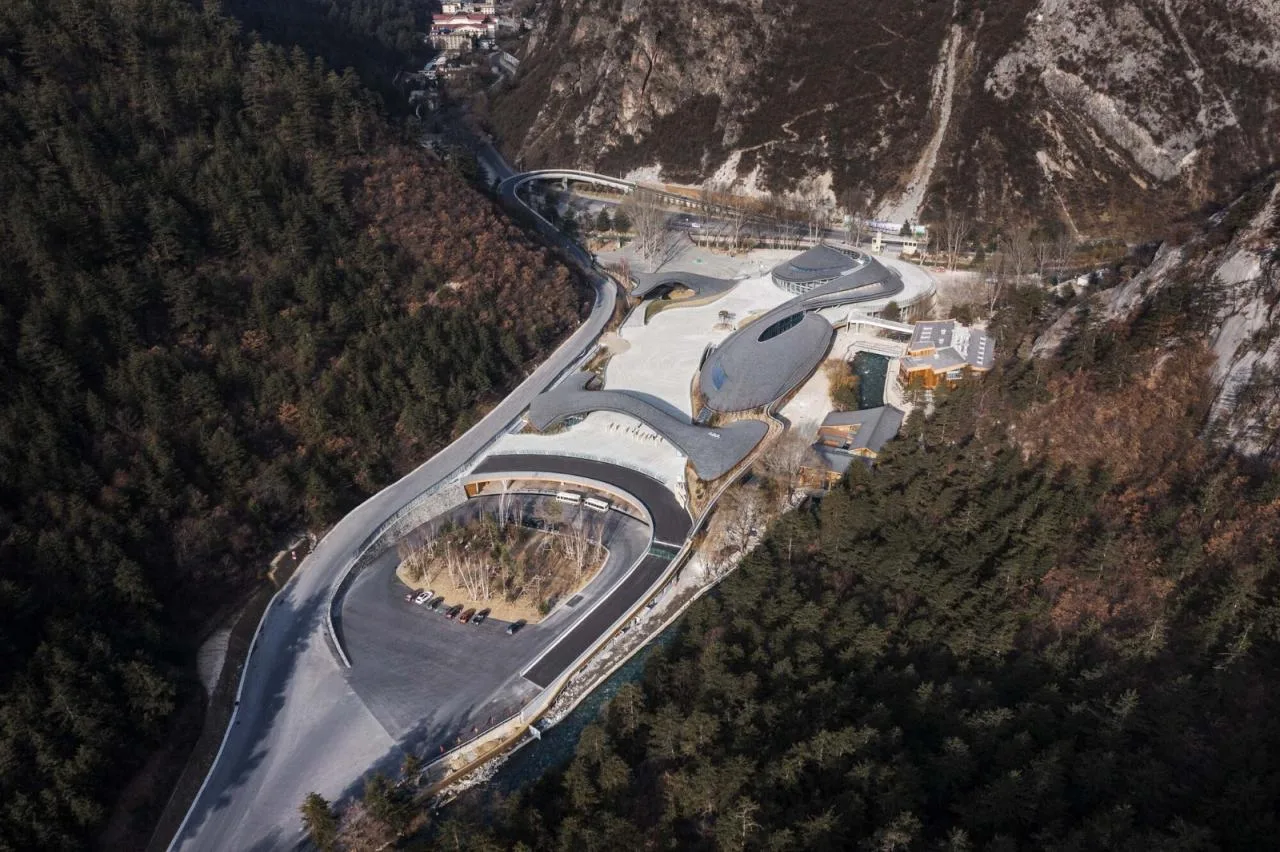
The site’s original terrain is utilized effectively: the western mountainside sits about 6 meters above the Emerald River on the east. A platform was created at this elevation to serve as the main departure level for tourists. The lower platform, slightly above the river level, functions as the main arrival area.
During peak times, both levels operate as departure points, facilitating efficient visitor flow into the valley. From the departure platform, visitors enjoy views of the “three mountains and two rivers,” offering an inviting introduction to the scenic area. This design capitalizes on the site’s height differences to avoid groundwater construction challenges and fosters a strong connection to the landscape.
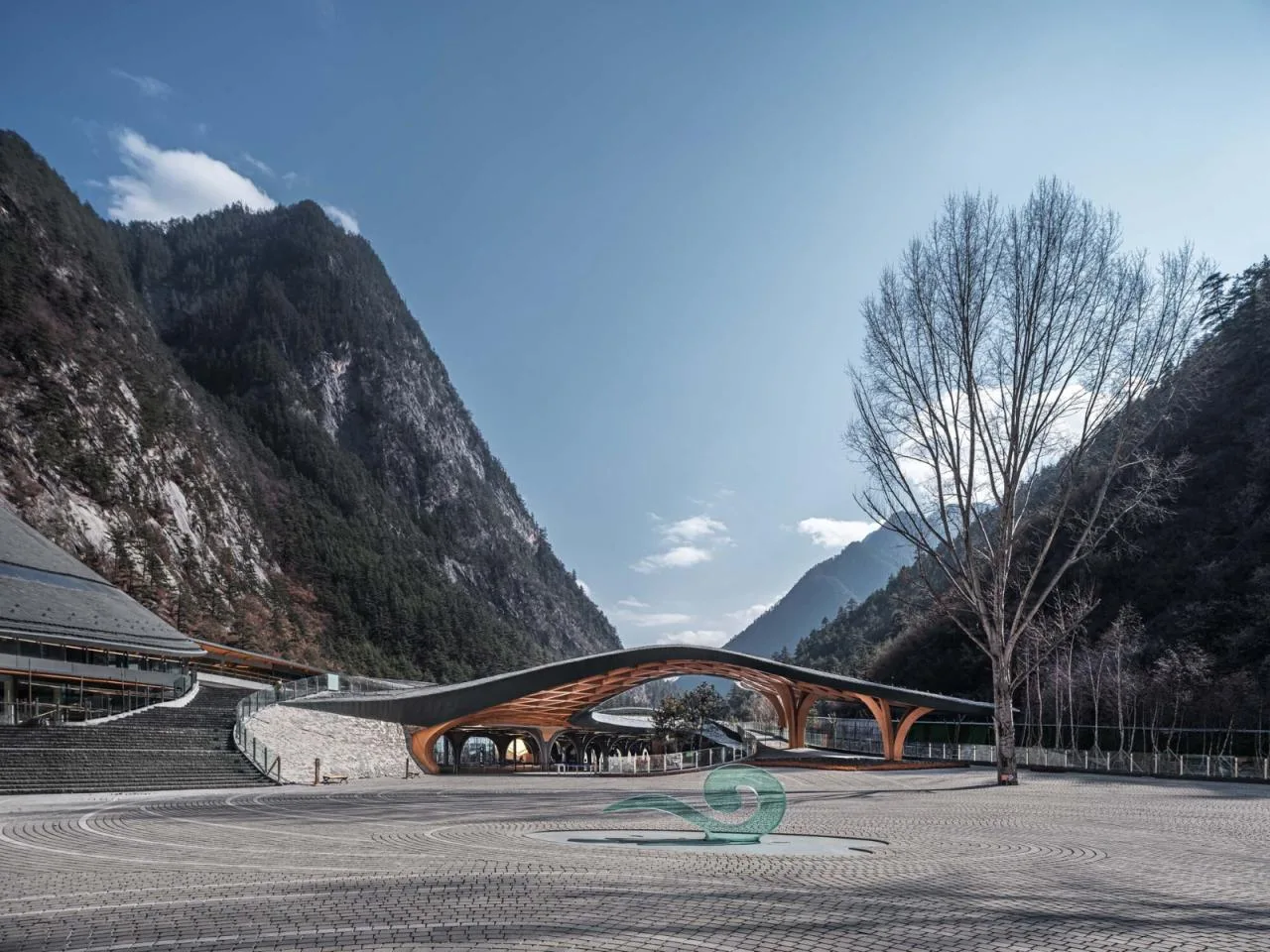
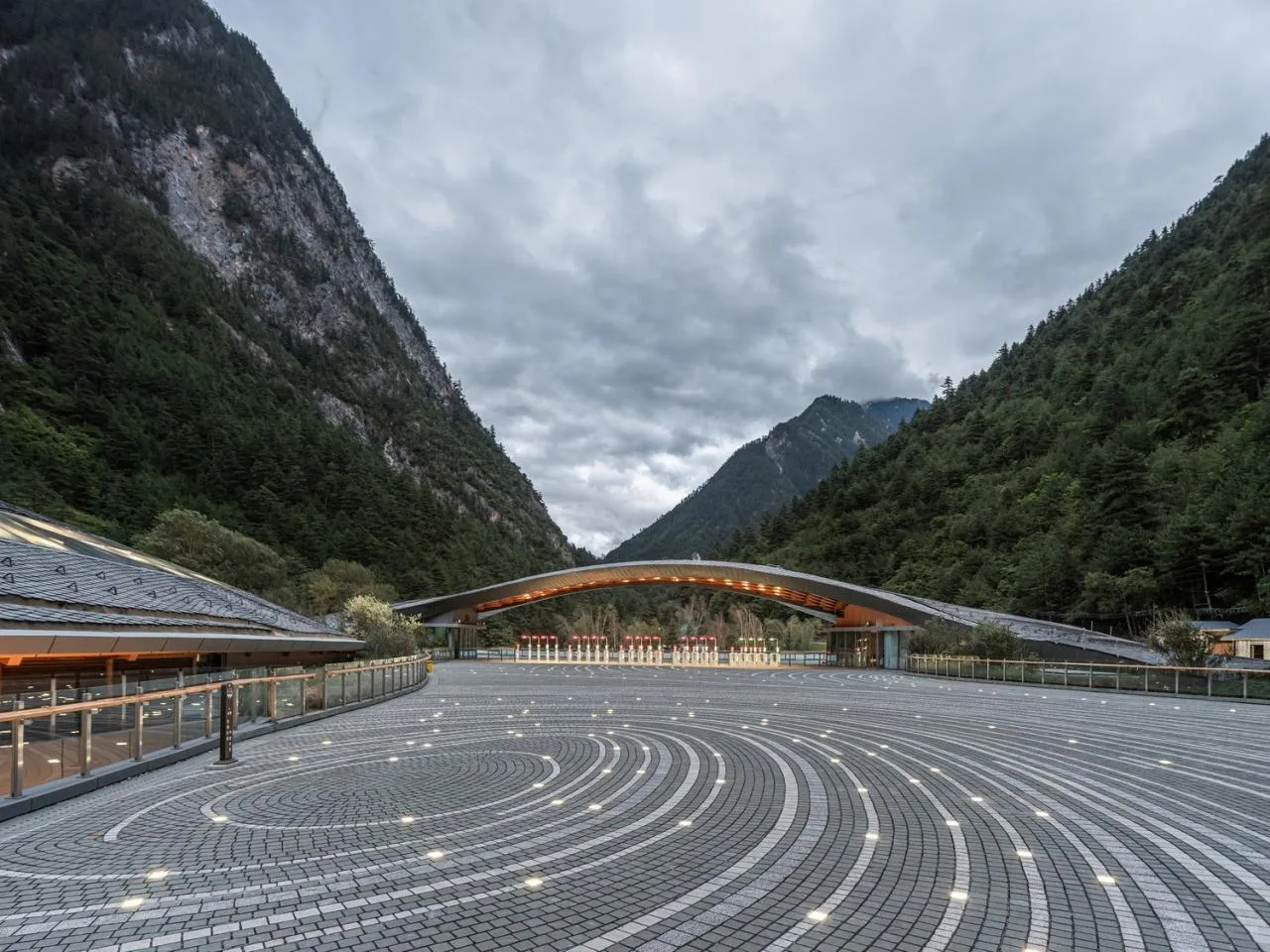
The entrance canopy embodies Jiuzhaigou’s cultural heritage. The widely recognized Jiuzhai Huiyan logo symbolizes the fusion of nature and culture, creating a strong identity for the site.
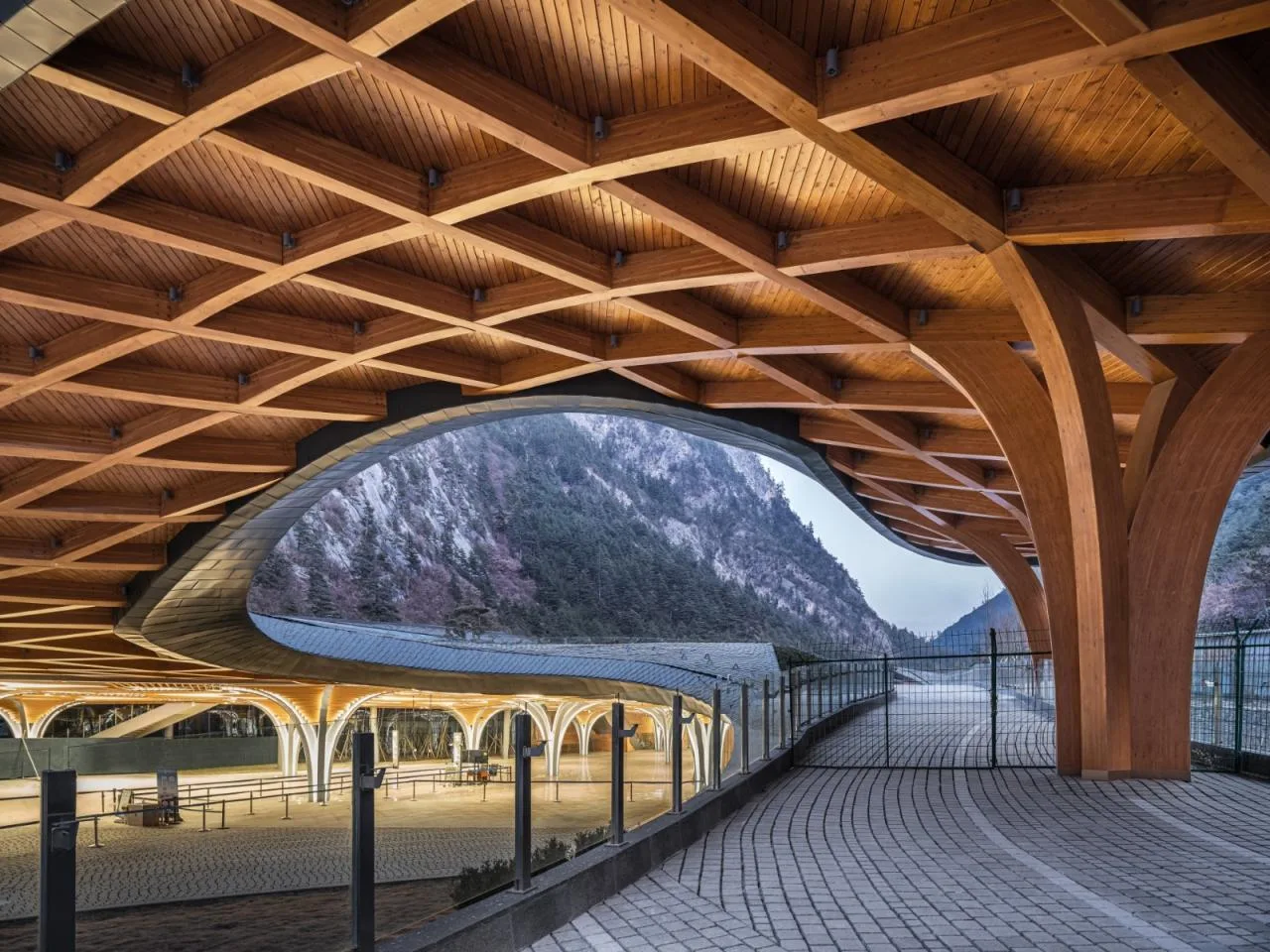
Architecturally, the canopy isn’t a mere symbol imitation. Its tree-shaped columns and continuous terrain guidance harmonize spatially with the surrounding mountains, maximizing functional space for visitors.
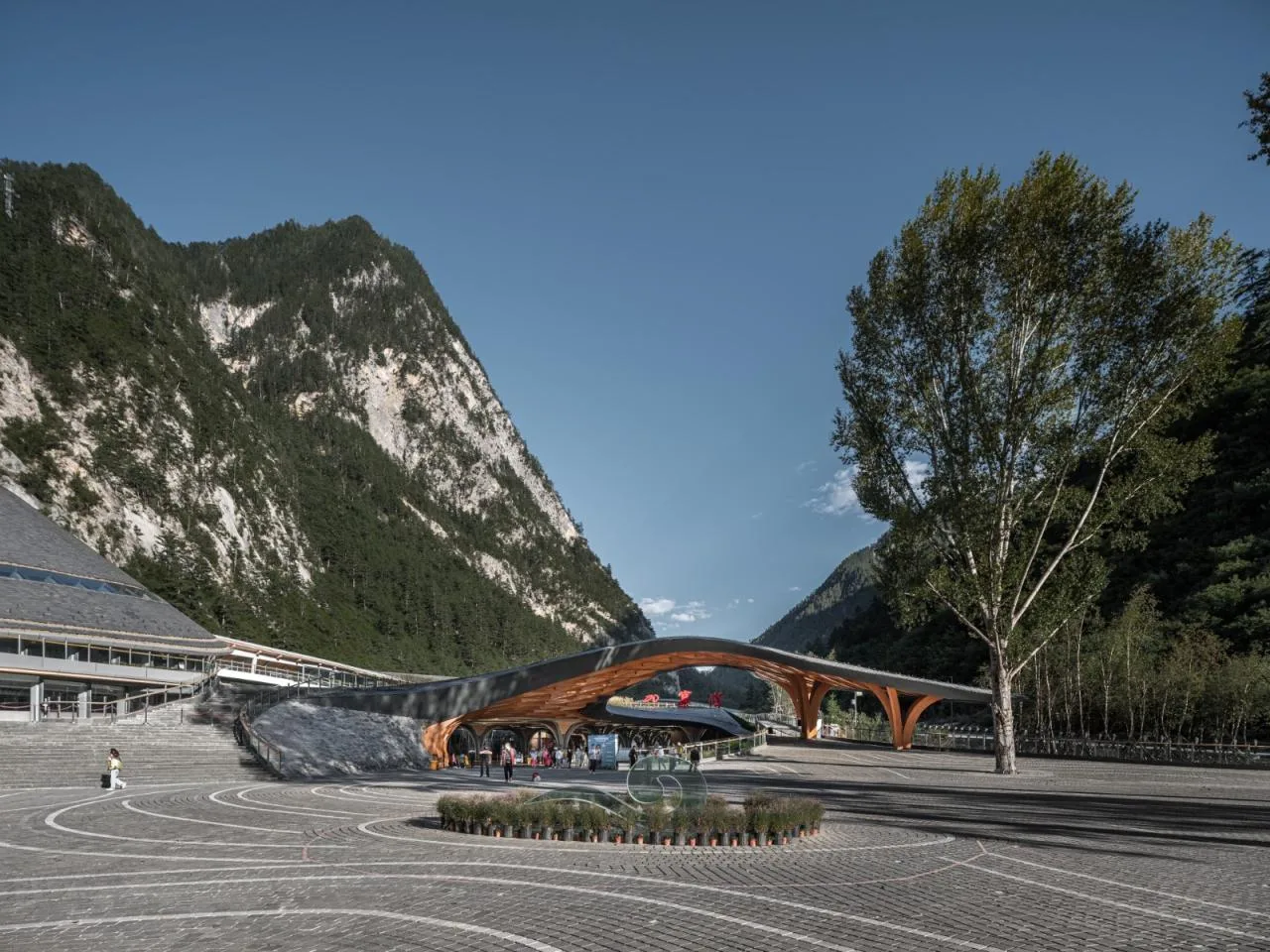
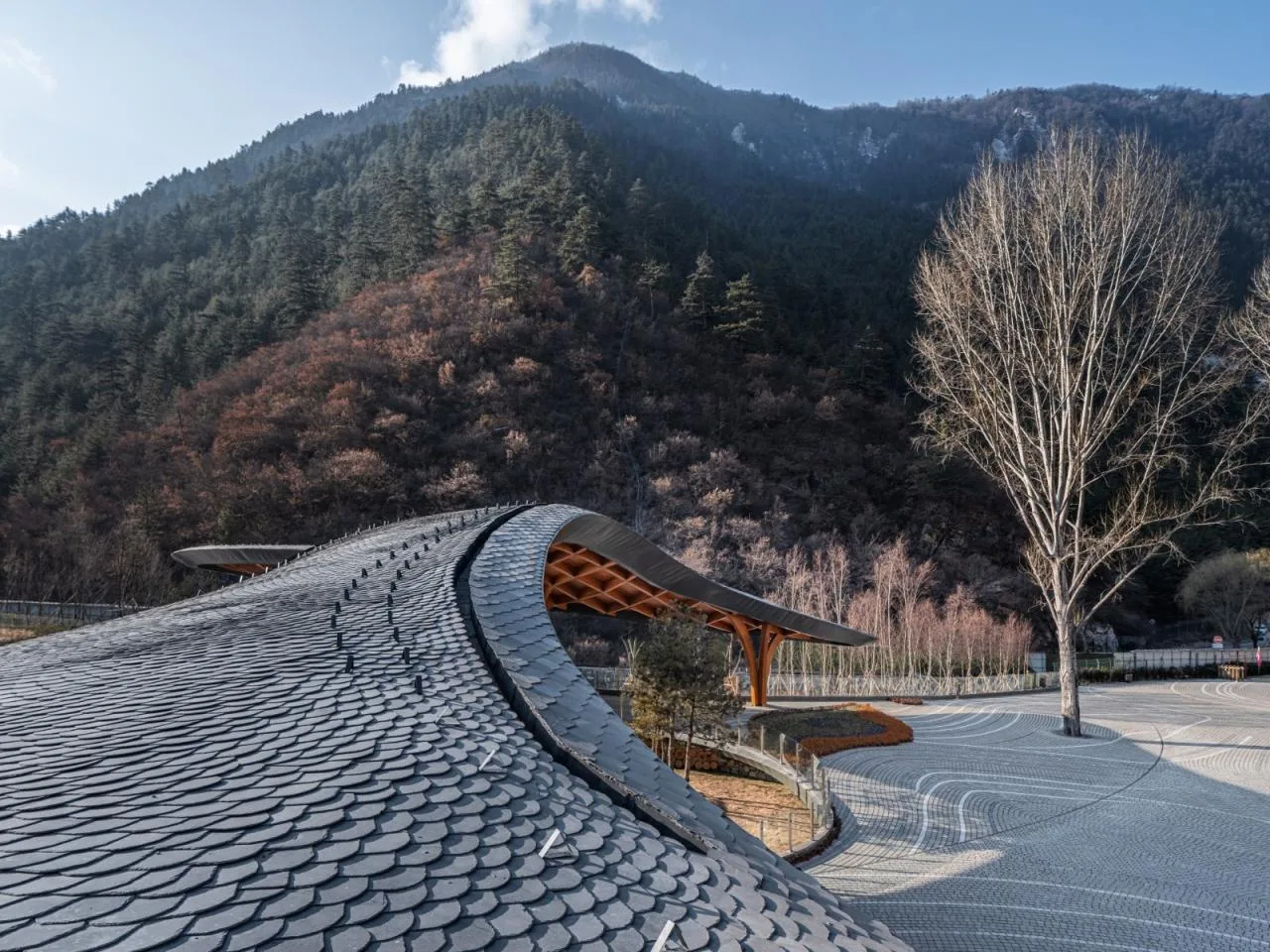
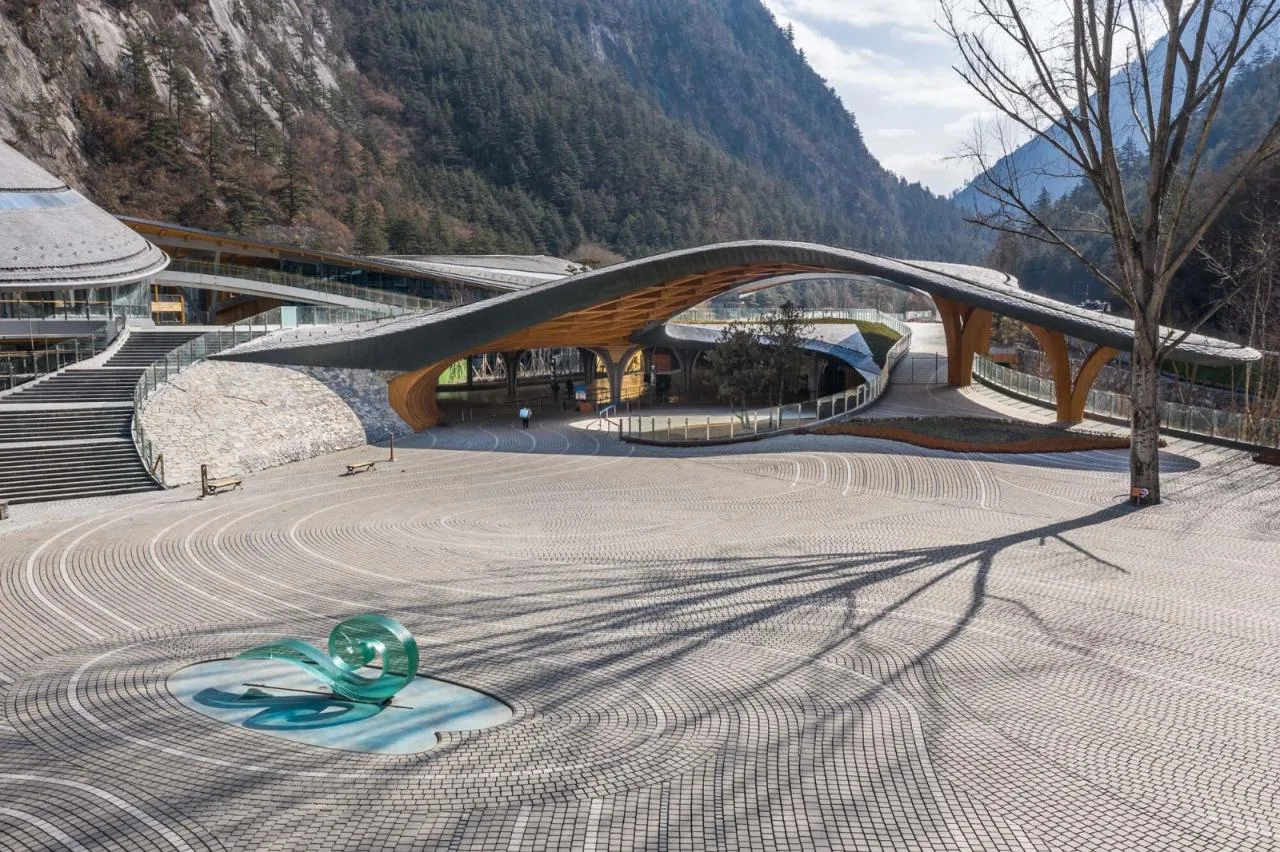
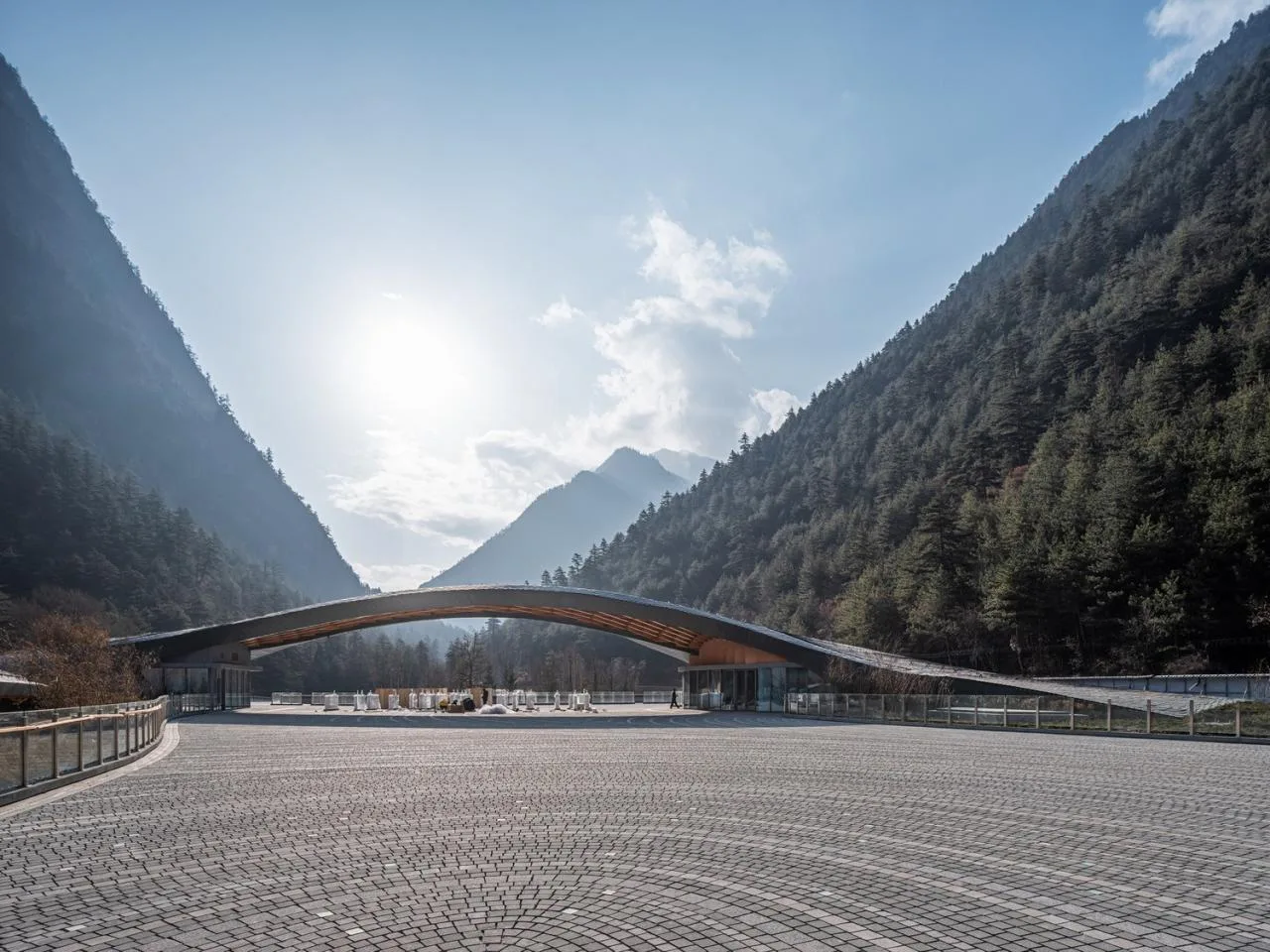
The large canopy features an irregular, single-layer shell glued beam wooden structure with three flowering columns spanning 38 meters — a first in China. A gently sloped ramp (less than 8%) on the west side guides visitors to the upper-level platform for ticketing and transfers.
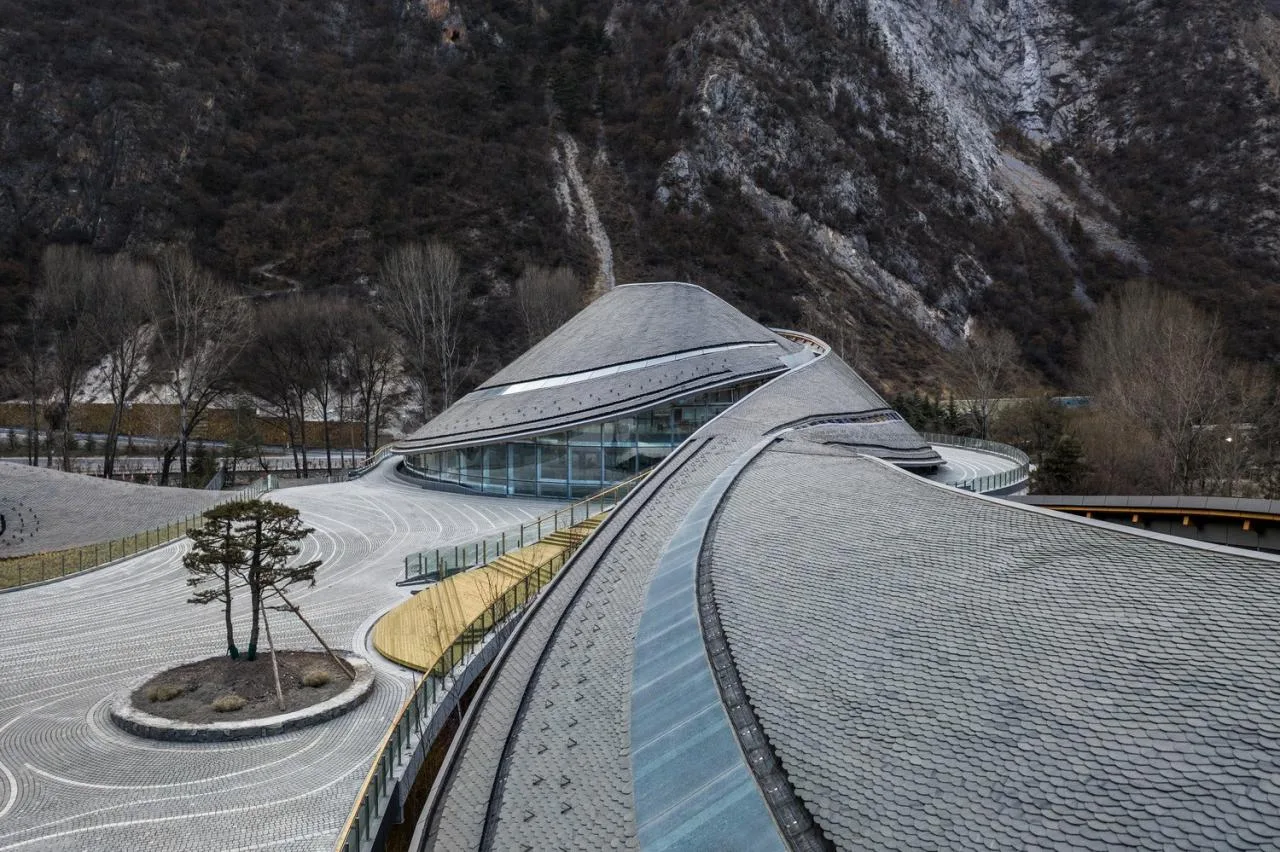
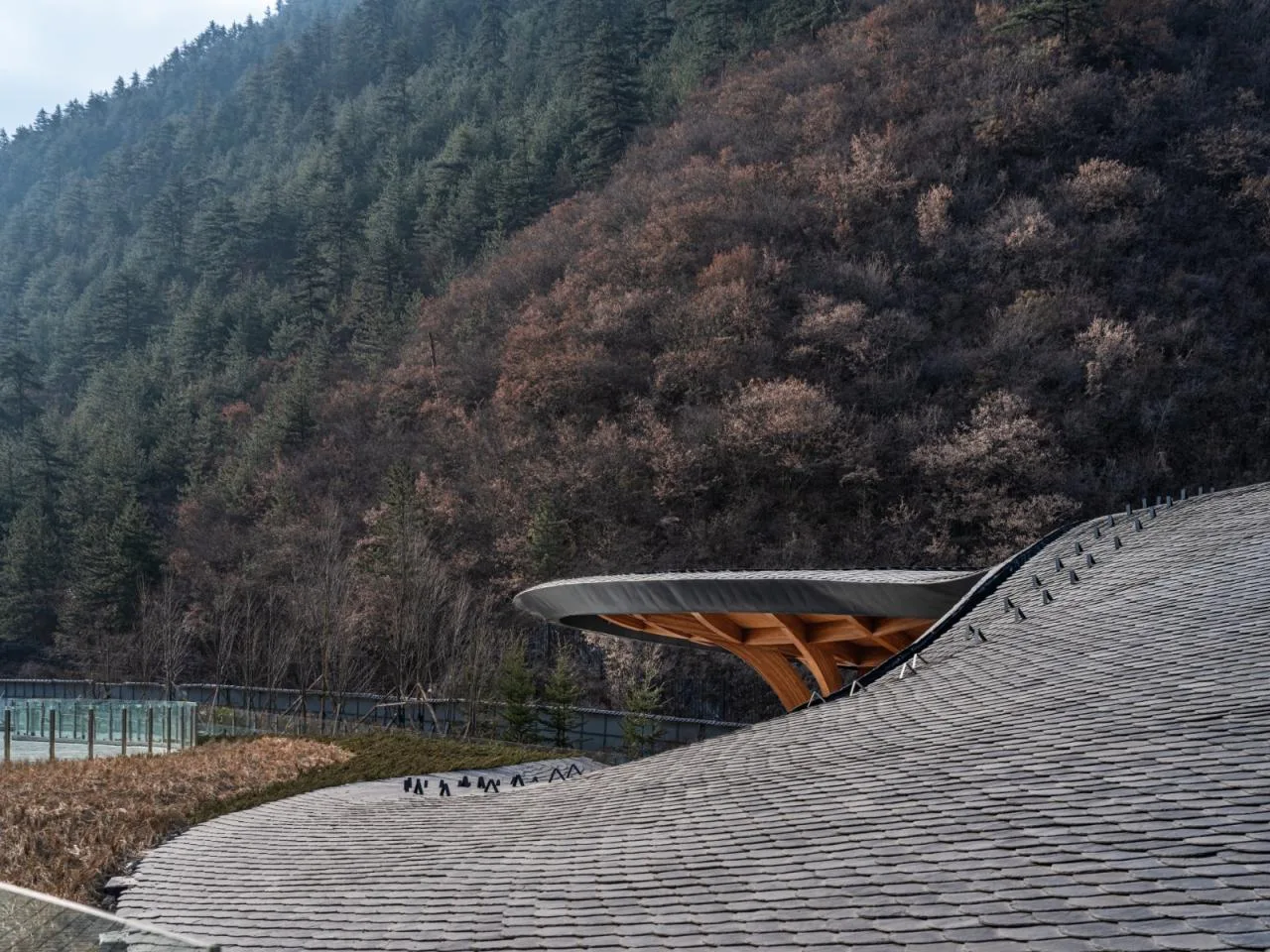
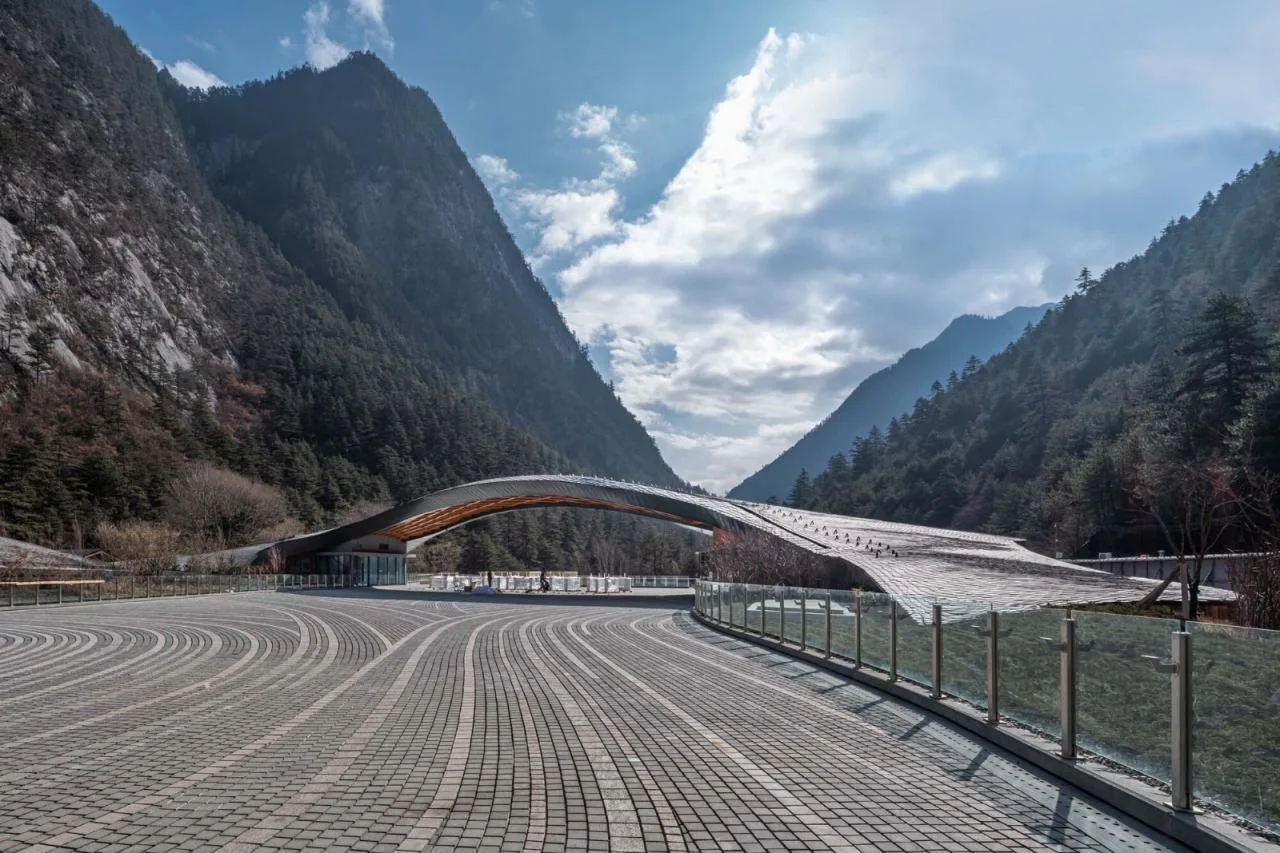
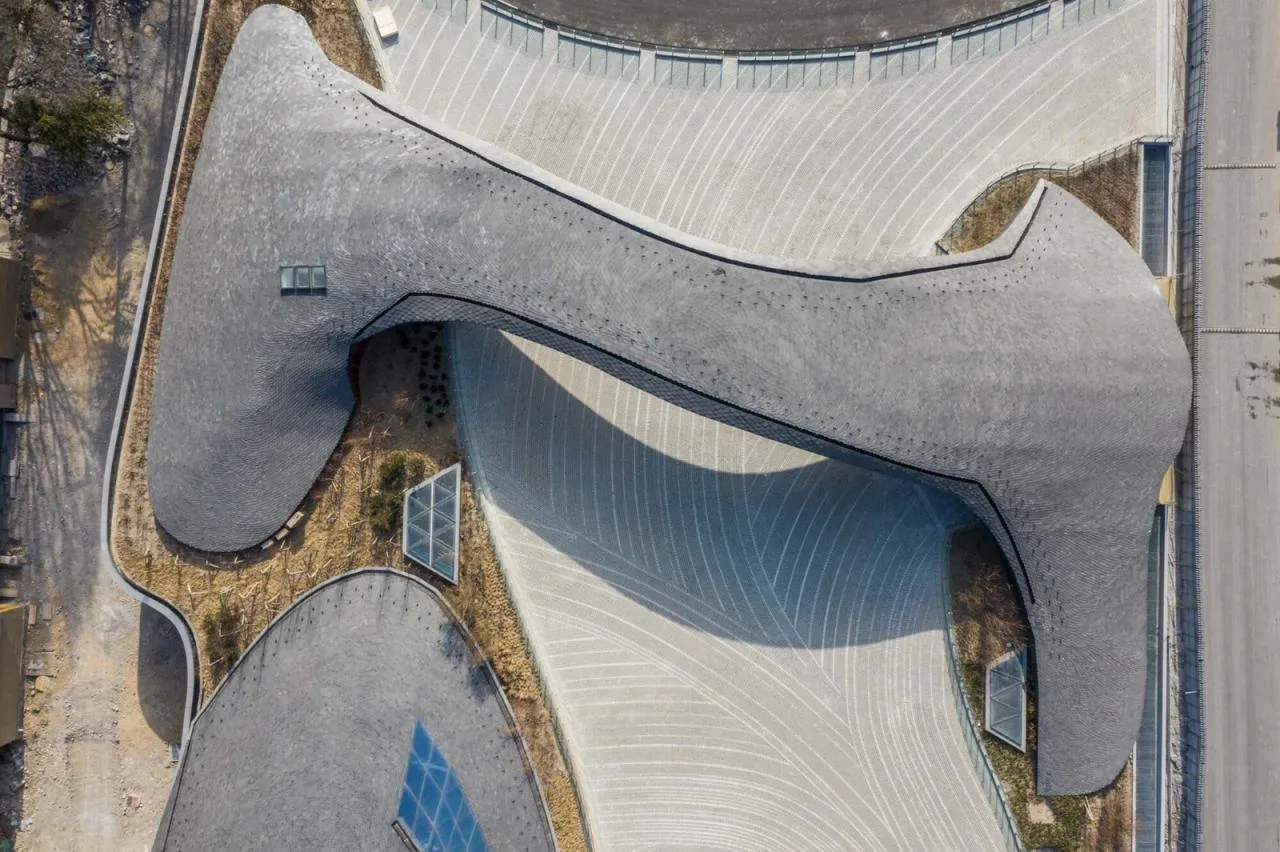
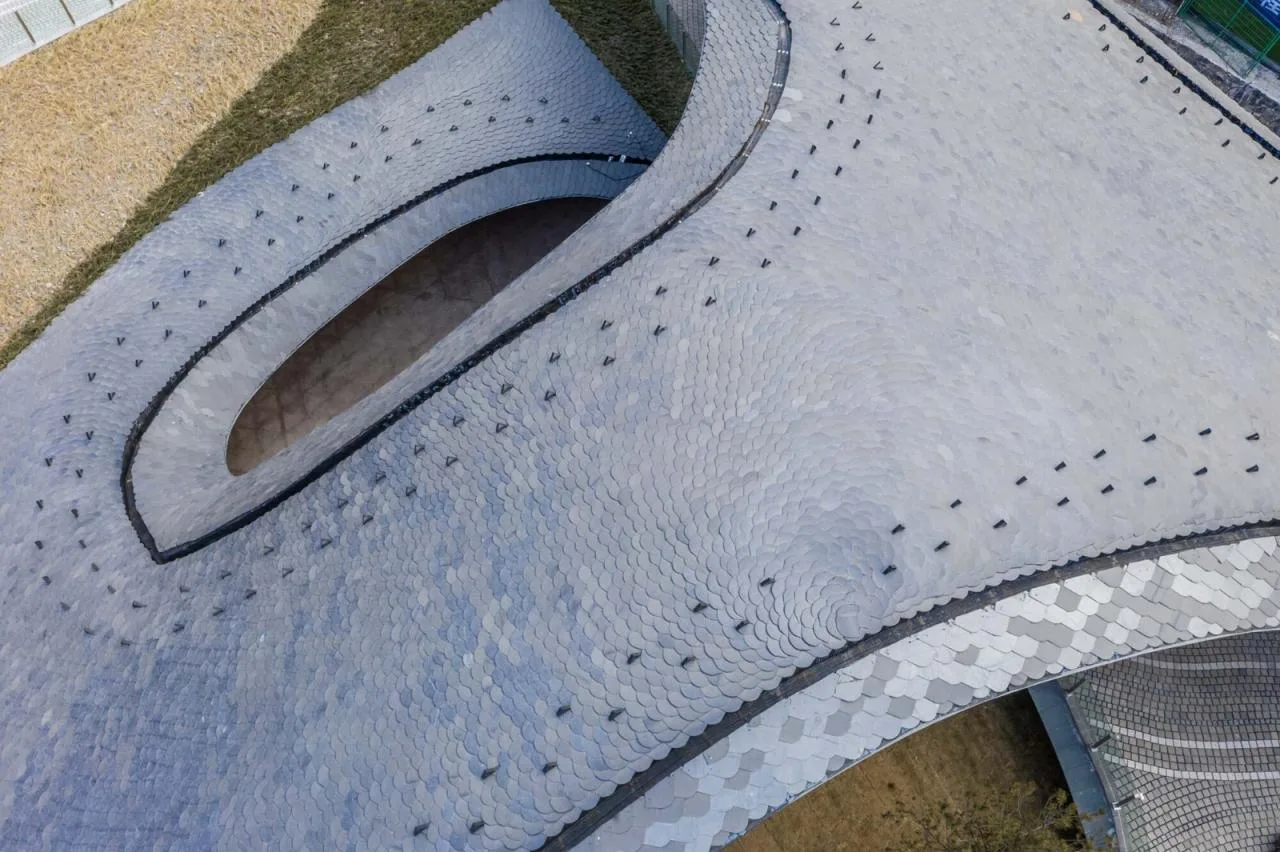
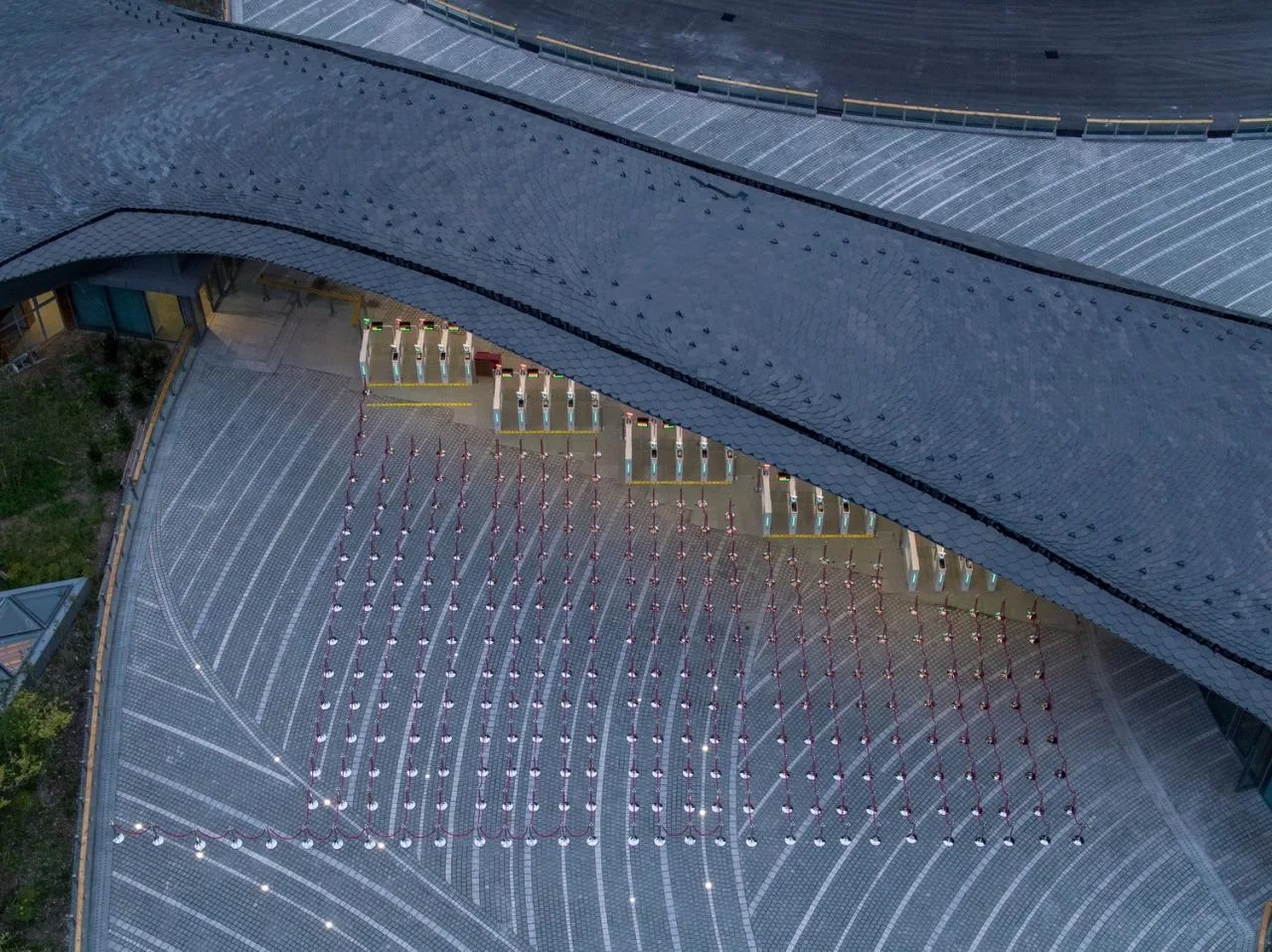
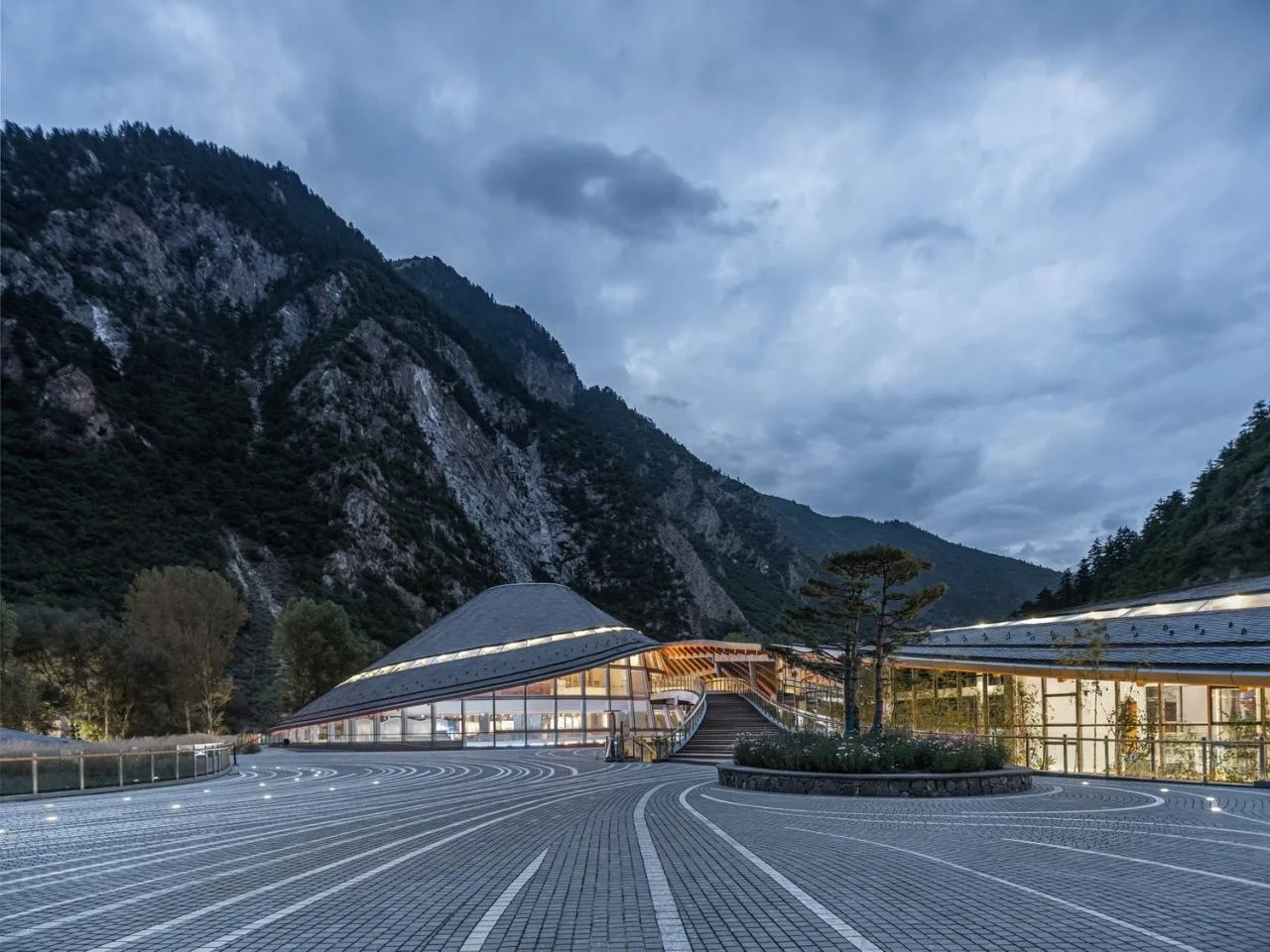
The arched roof resembles a mountain and is clad with local Jiuzhaigou slate tiles. Combined with symbolic elements shaped like Tibetan vowels representing water, the entrance forms a distinctive regional landmark.
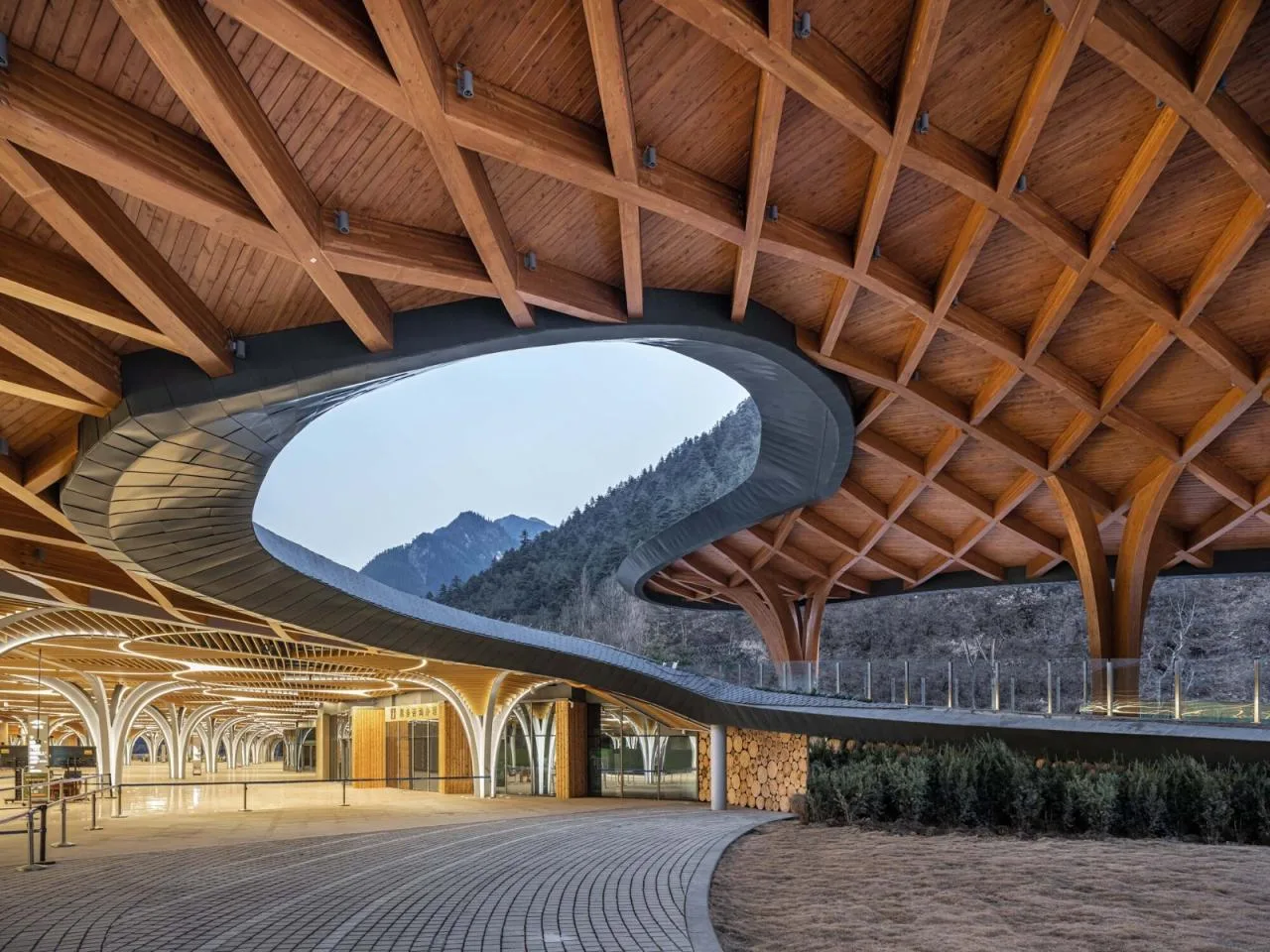
The ticketing area is located beneath the canopy at the upper platform. The canopy’s structure comprises two curved steel beams, laminated beams arranged along Fermat spiral lines, spanning 41 meters. It rises naturally from the distribution platform, embracing the surrounding mountains with an elegant frame.
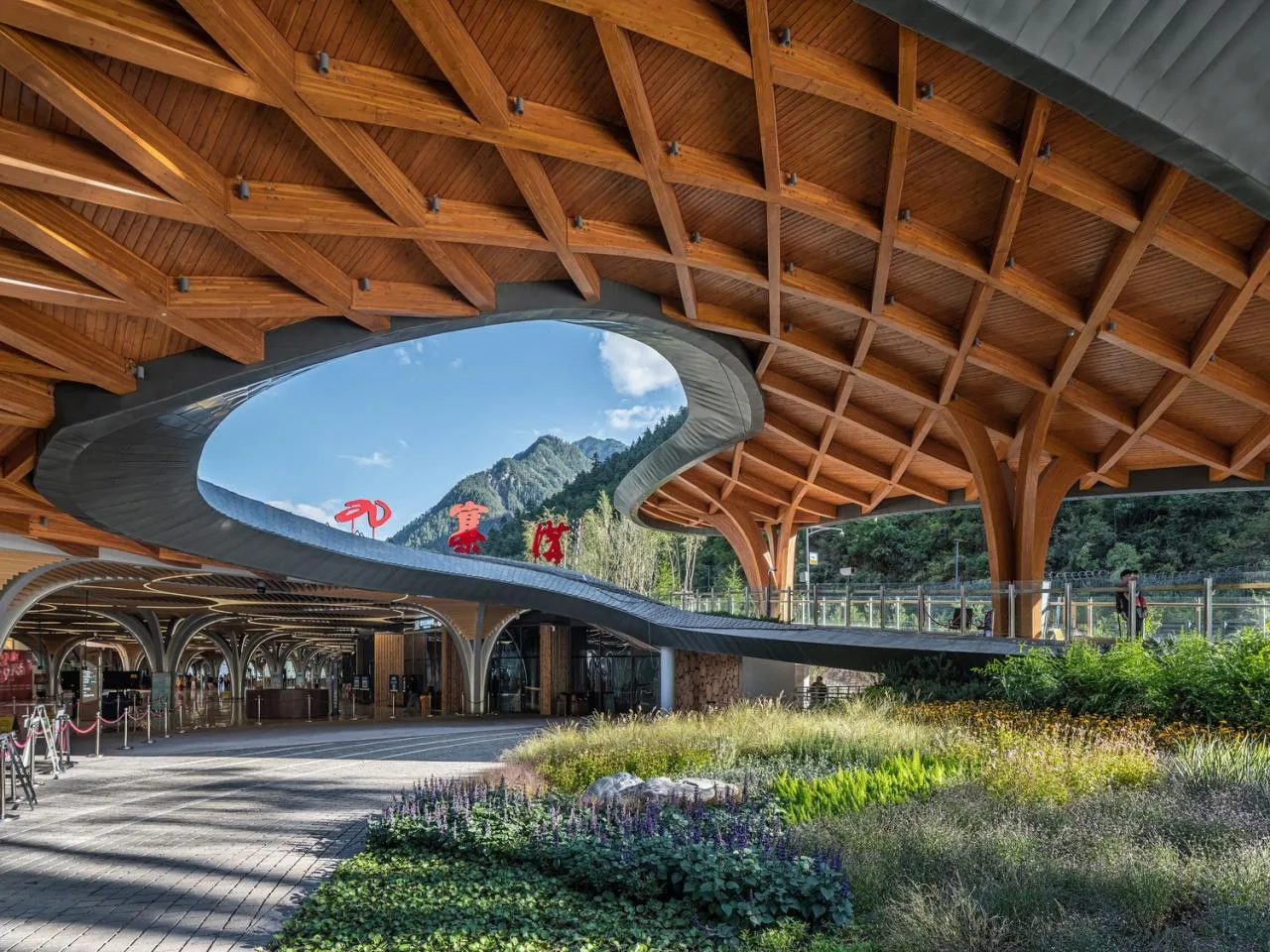
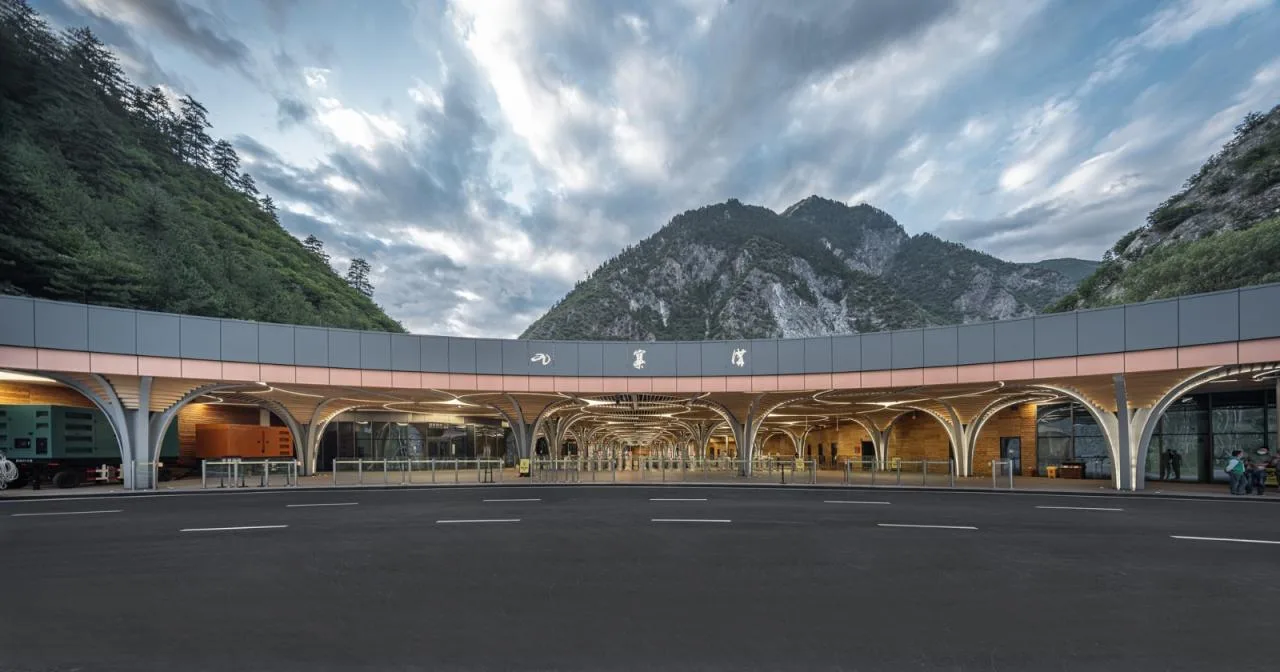
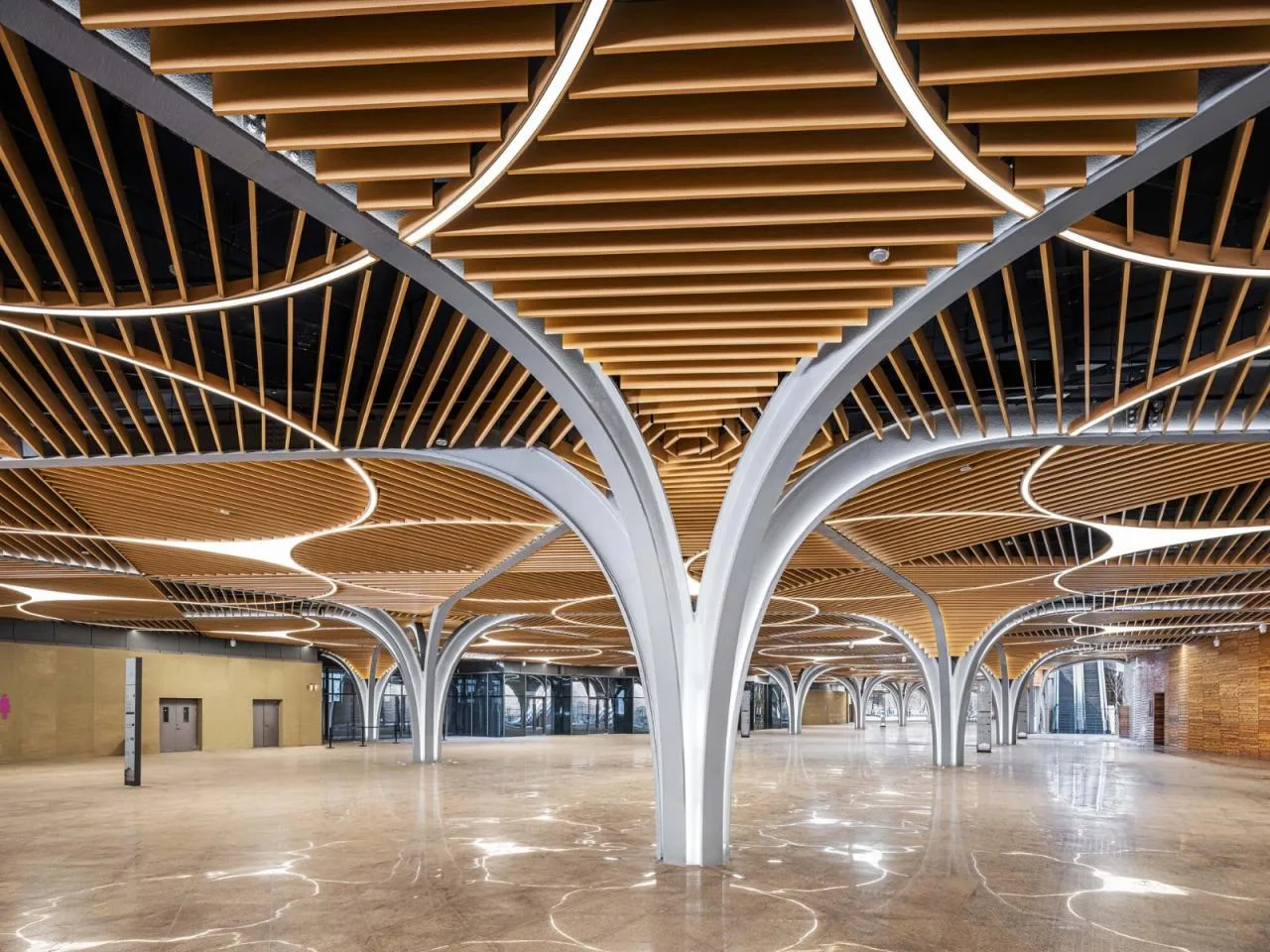
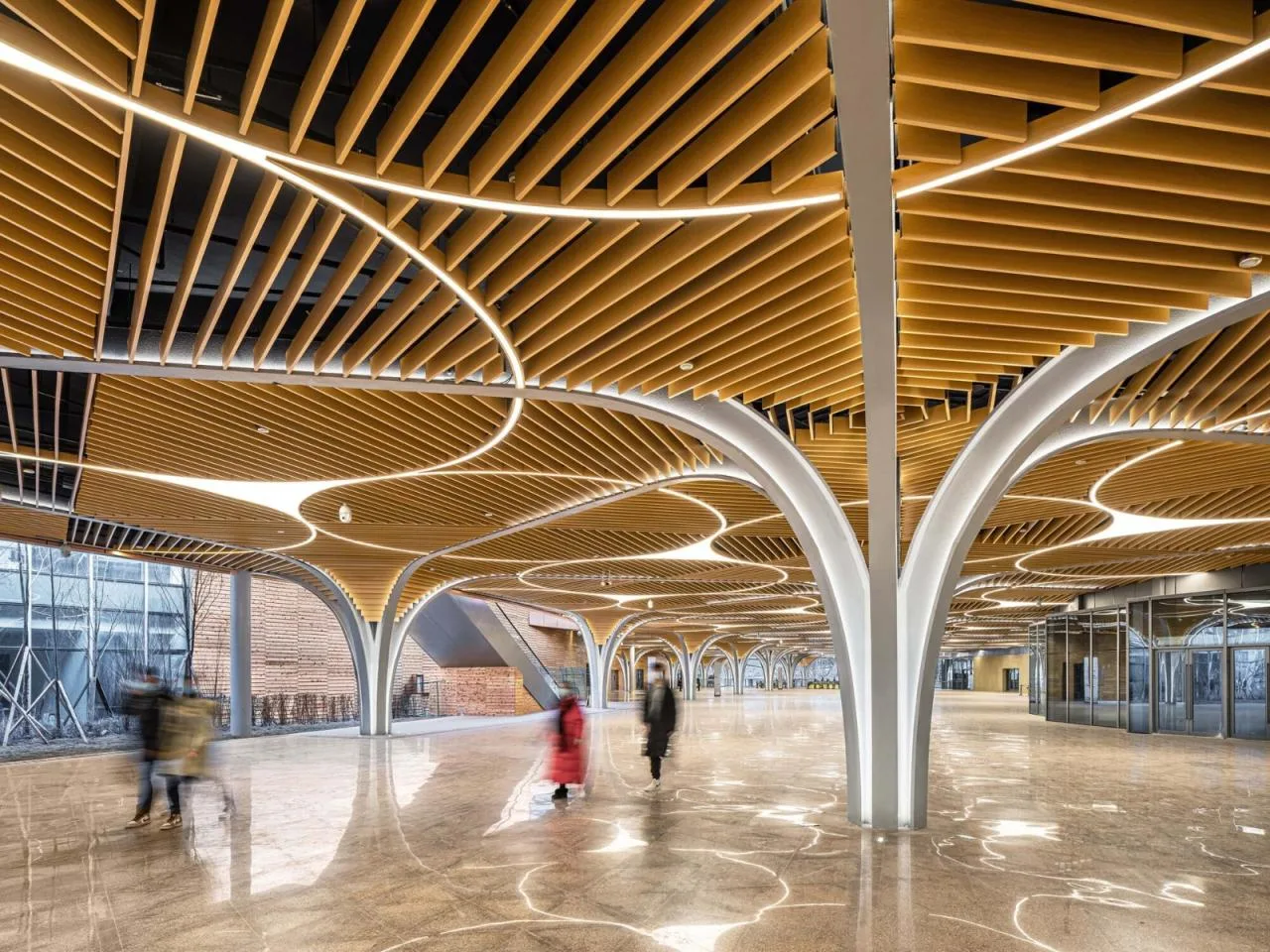
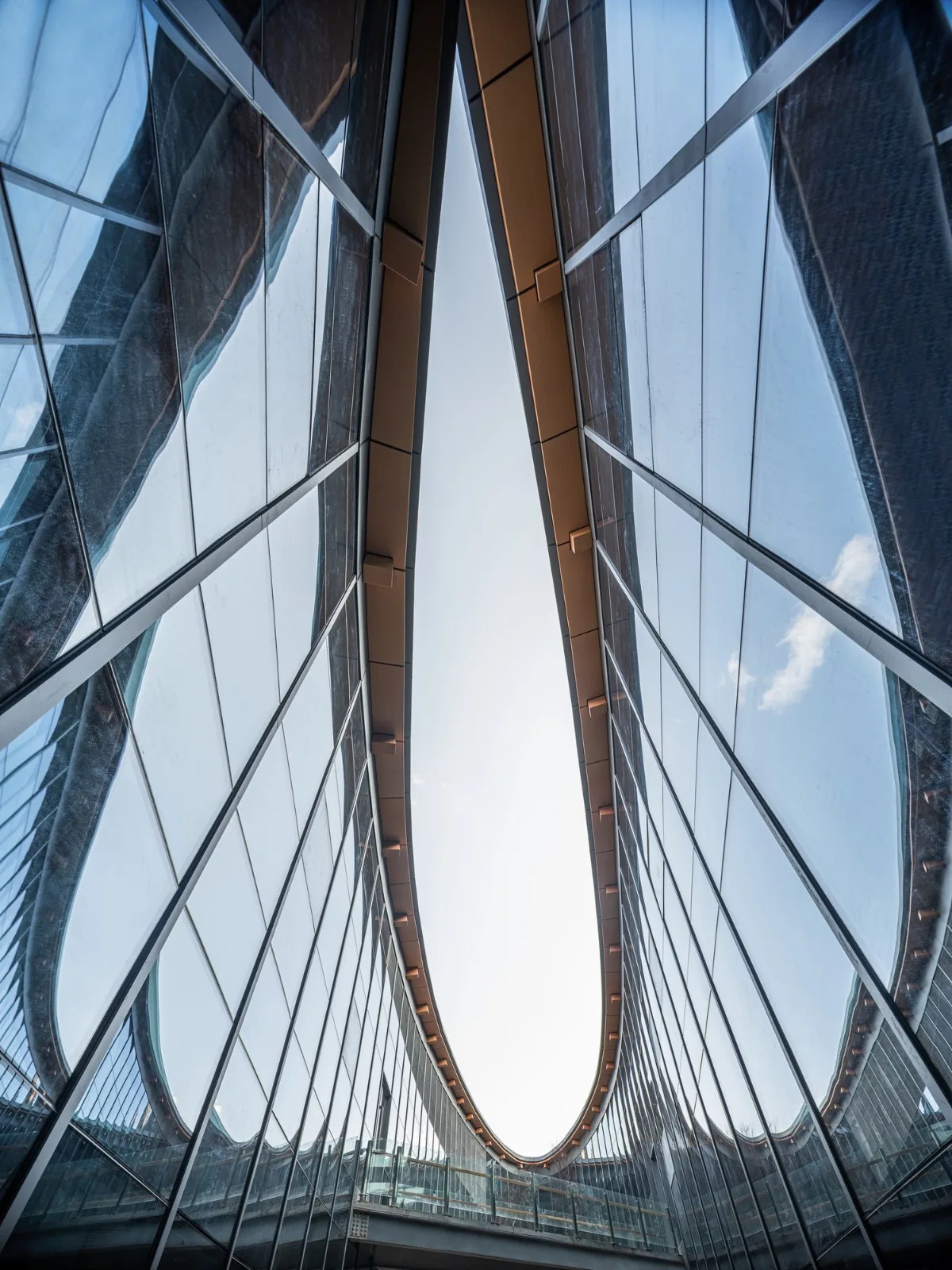
The area beneath the platform spans over 6,000 square meters. To create an open, natural atmosphere without feeling oppressive, the column spans were widened and supported using arched steel beams forming continuous arches in six directions.
Where these arches meet, they form flowering columns — a structural and aesthetic feature rich in natural symbolism. These steel columns require no additional decoration; the structure itself serves as both support and ornament, showcasing mechanical beauty and reducing construction costs.
A total of 36 flowering columns support the collection and distribution space, symbolizing the year-round beauty of Jiuzhaigou Valley. Their rhythmic forms add visual harmony to this semi-indoor space, which remains comfortable and spacious even during peak visitor flows.
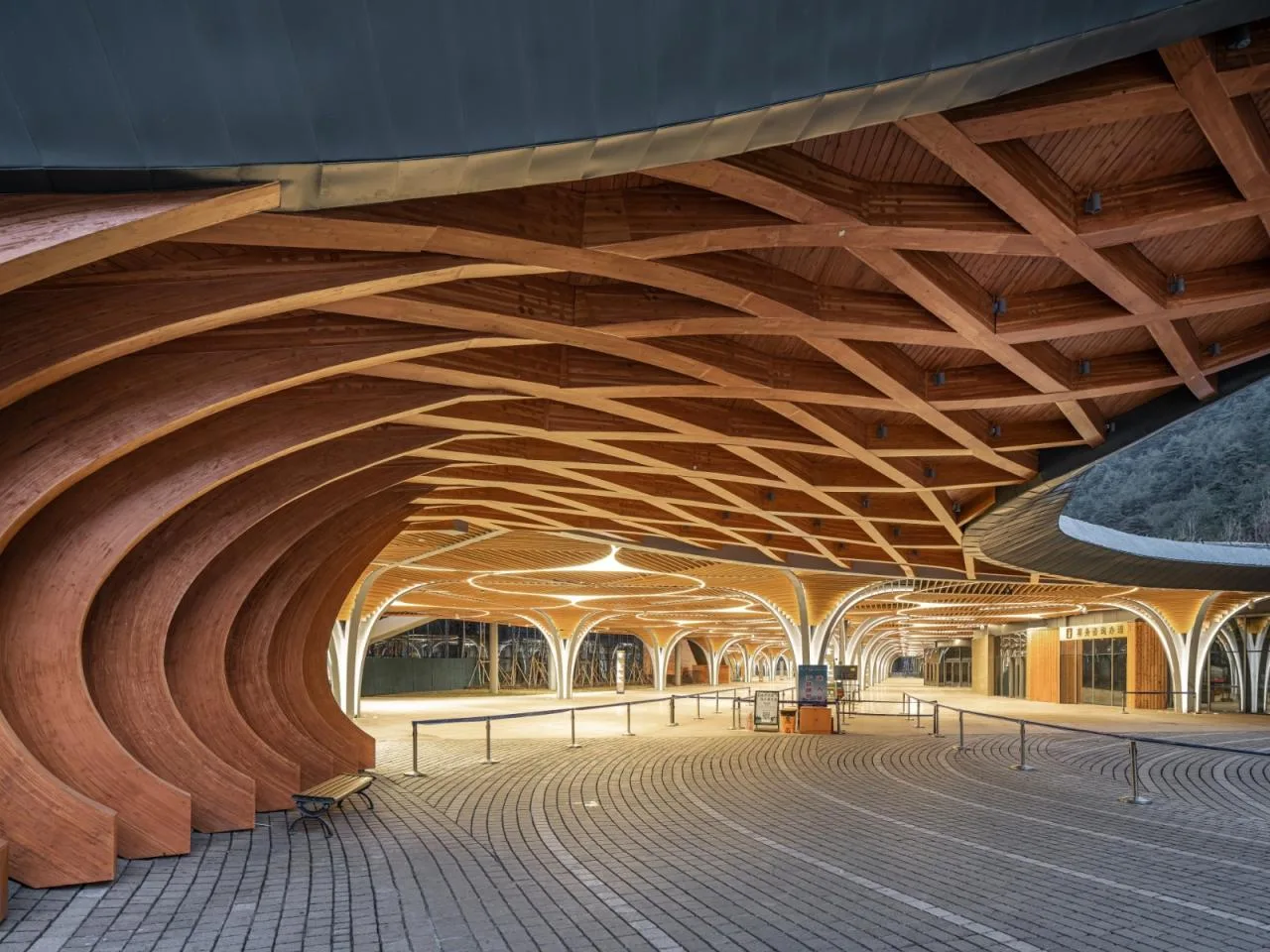
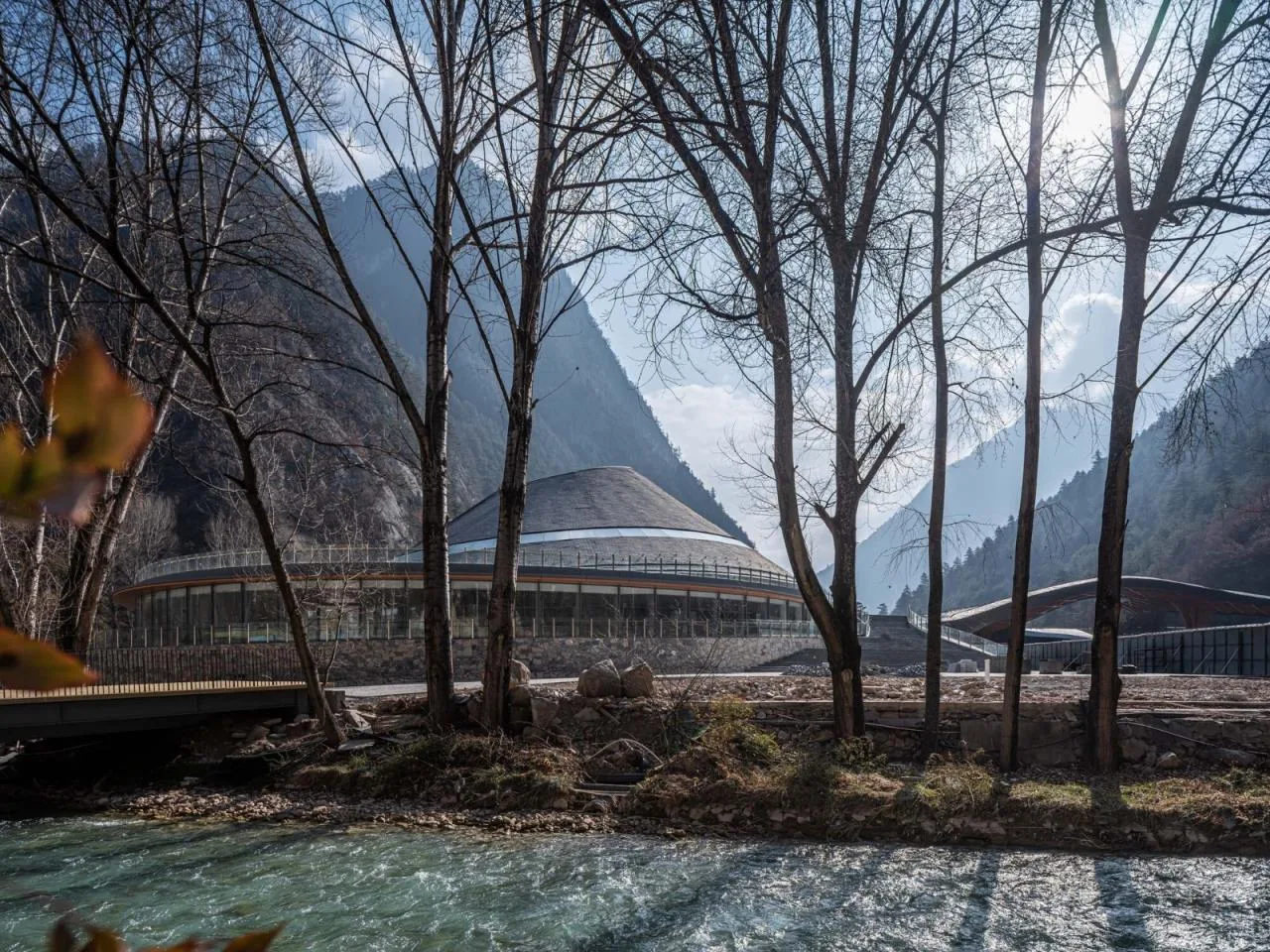
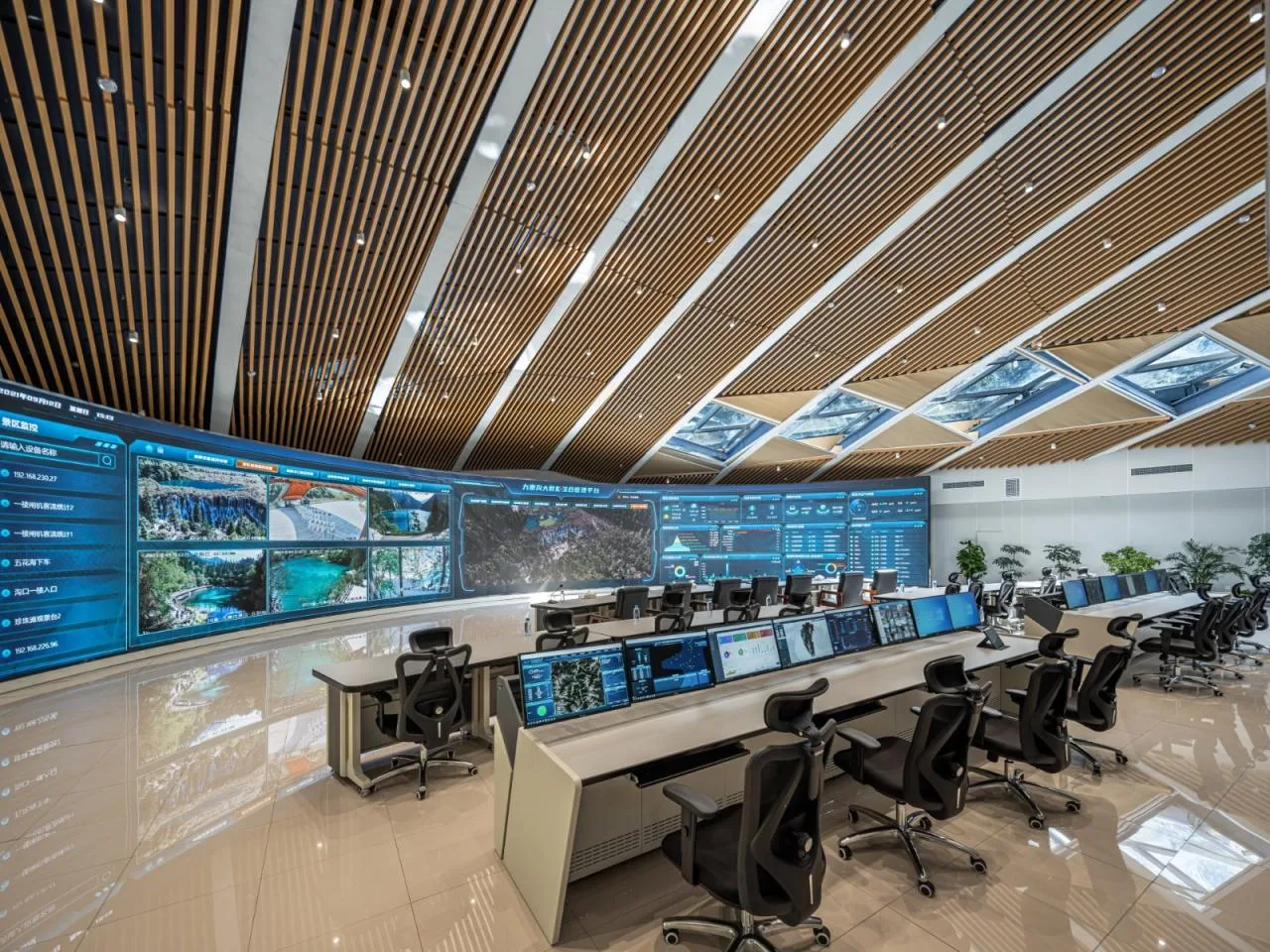
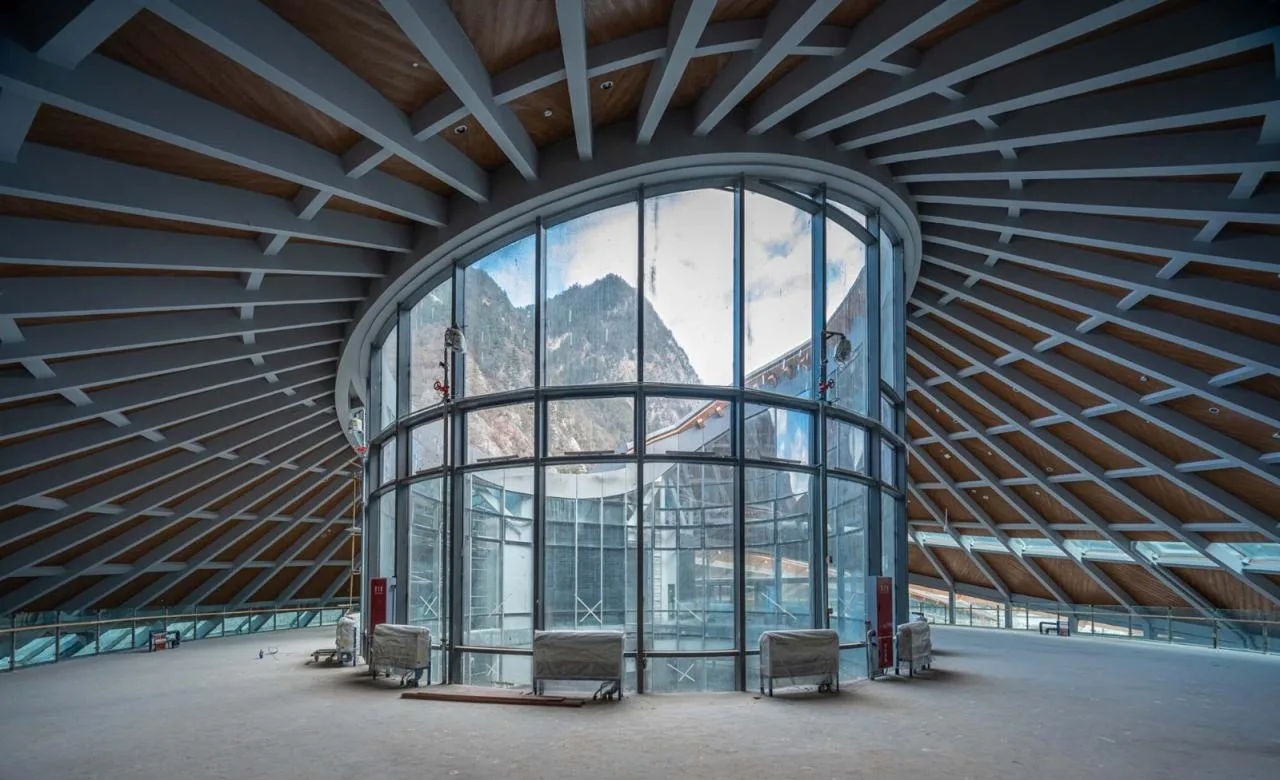
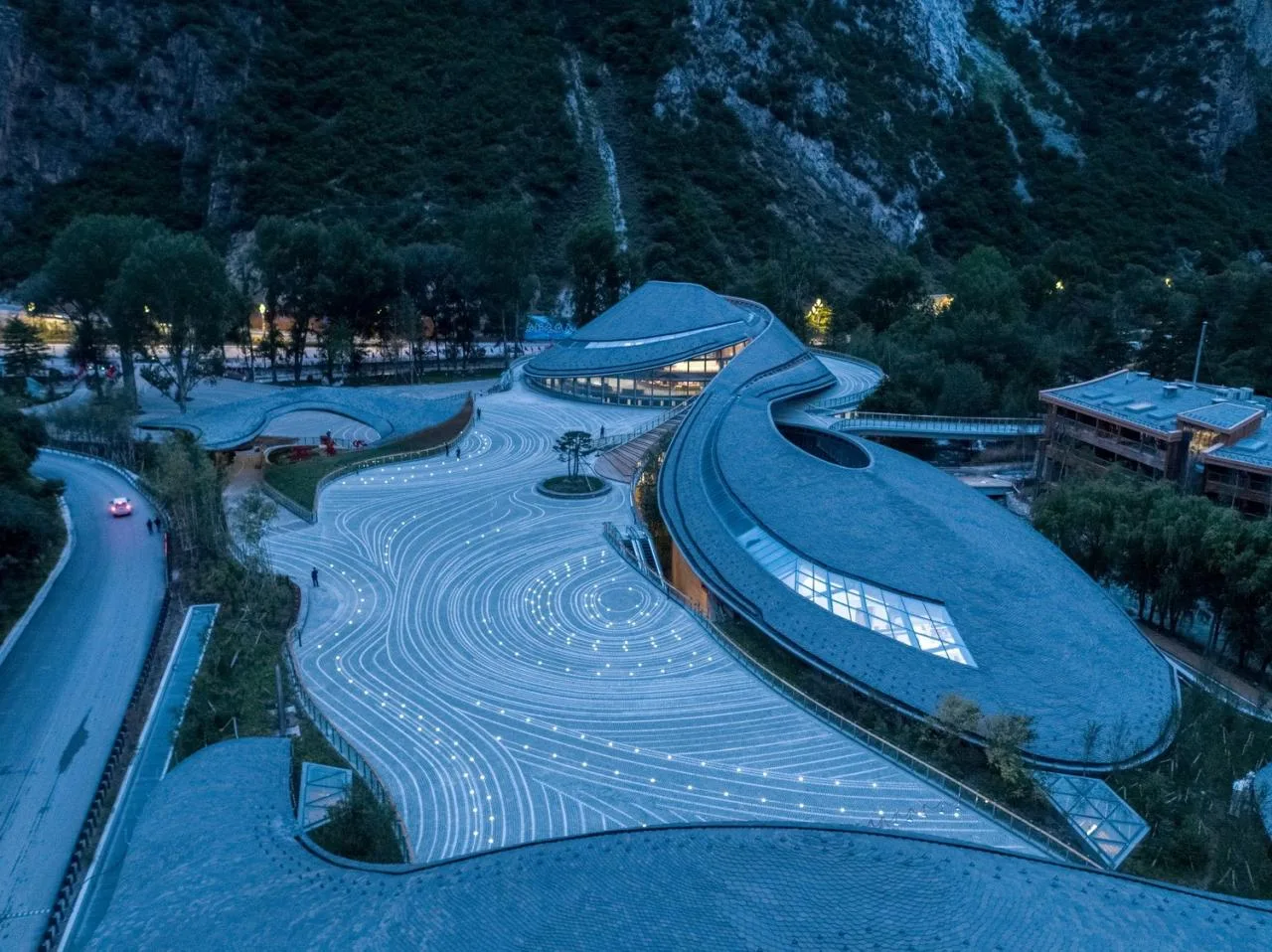
The exhibition center sits east of the tourist distribution center, featuring a roof that connects seamlessly with the Smart Center. Its circular form resembles young plant sprouts, blending into the natural environment while symbolizing the Tibetan “conch” sound, conveying Jiuzhaigou’s natural beauty globally.
Visitors experience a continuous exhibition space with a gentle 3% internal slope spiraling upward from the distribution center. The structure is supported by a dense array of slender steel columns, with the first floor enclosed by ultra-clear, uncoated glass, allowing panoramic views of the Jade River flowing into Baishui River, integrating nature into the exhibition experience.
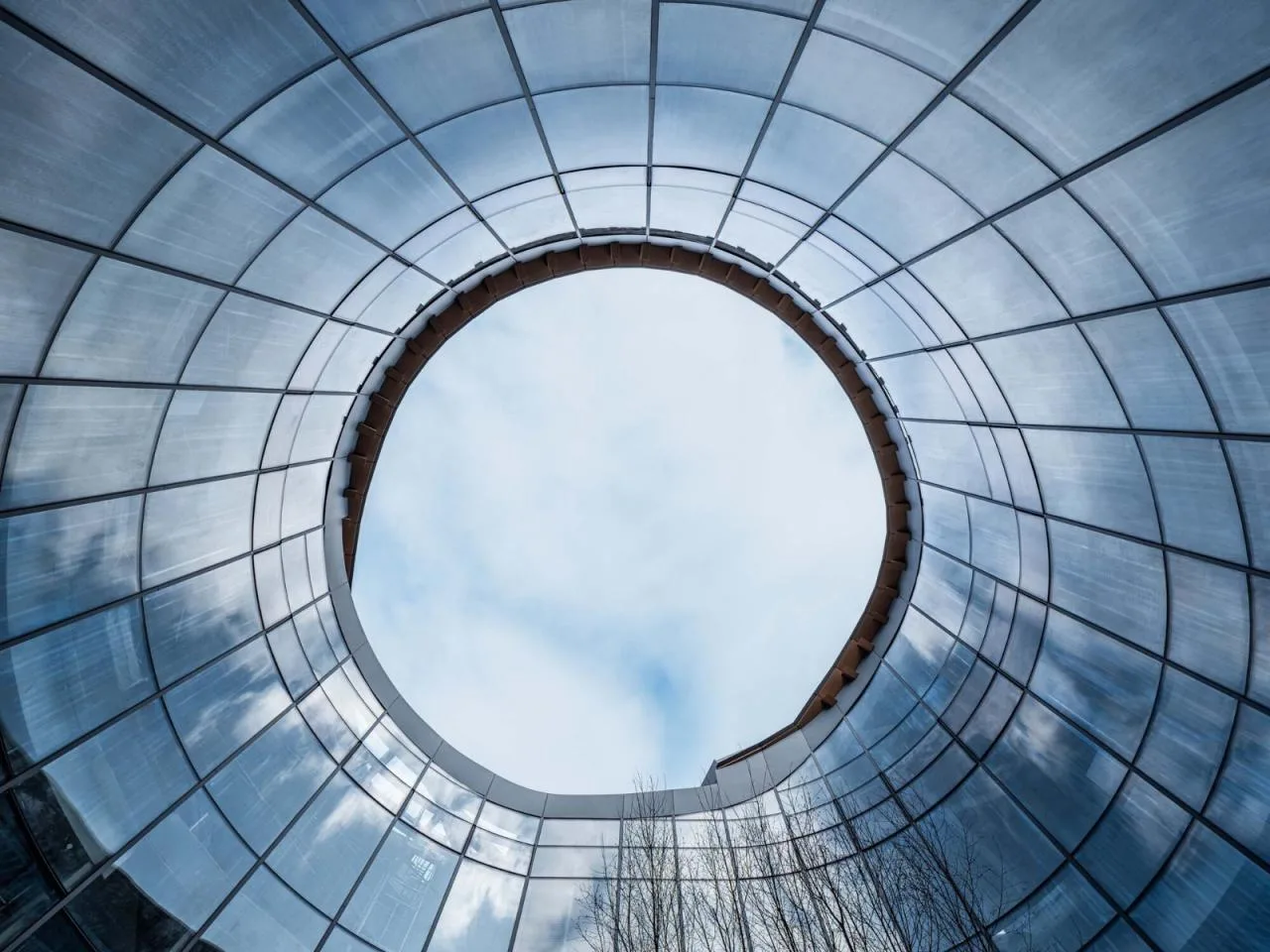
The exhibition center uses over 450 pieces of ultra-clear, double-laminated tempered glass, with the largest curved glass sheet spanning 16 square meters and weighing 1,800 kg. Installation required precise computer-aided positioning and laser theodolite measurements, lifted by 25 and 75-ton cranes.
A major challenge was installing 56 hyperbolic glass pieces, each molded four times to achieve the required curvature before lamination. These pieces cover 9.6 square meters, weigh 1,200 kg, and are installed at a 70-degree inclination, demanding high precision and complex processing.
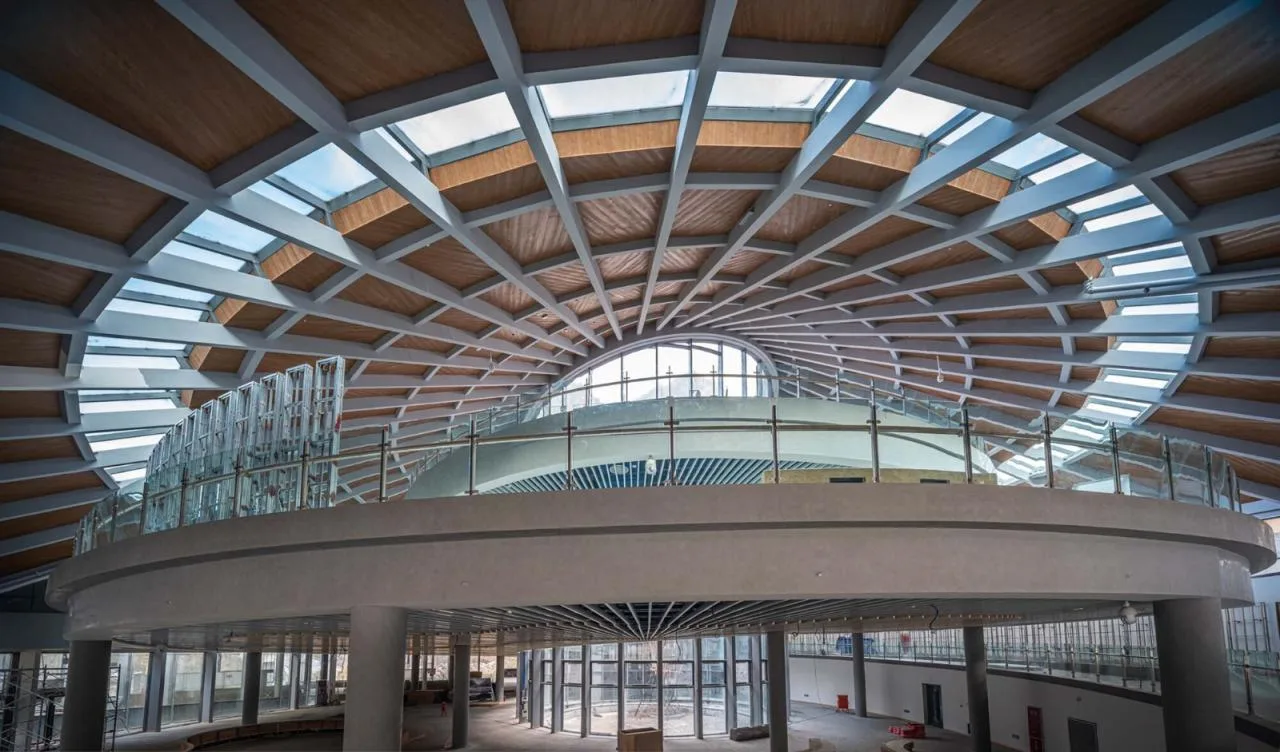
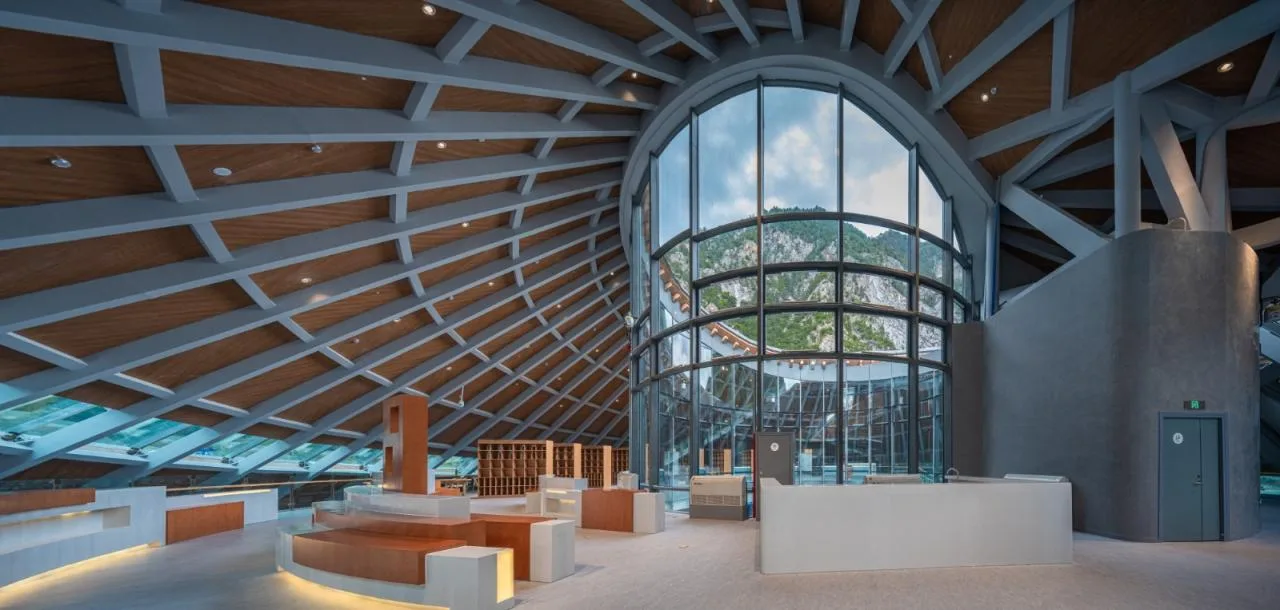
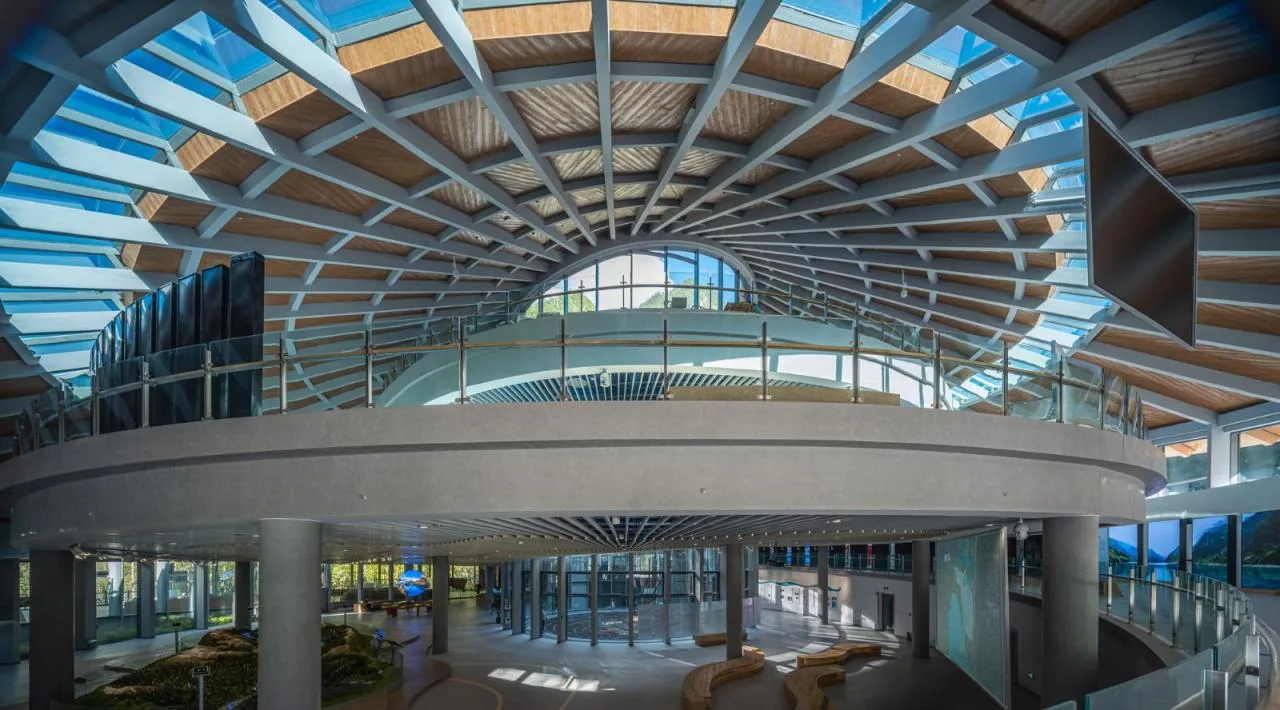
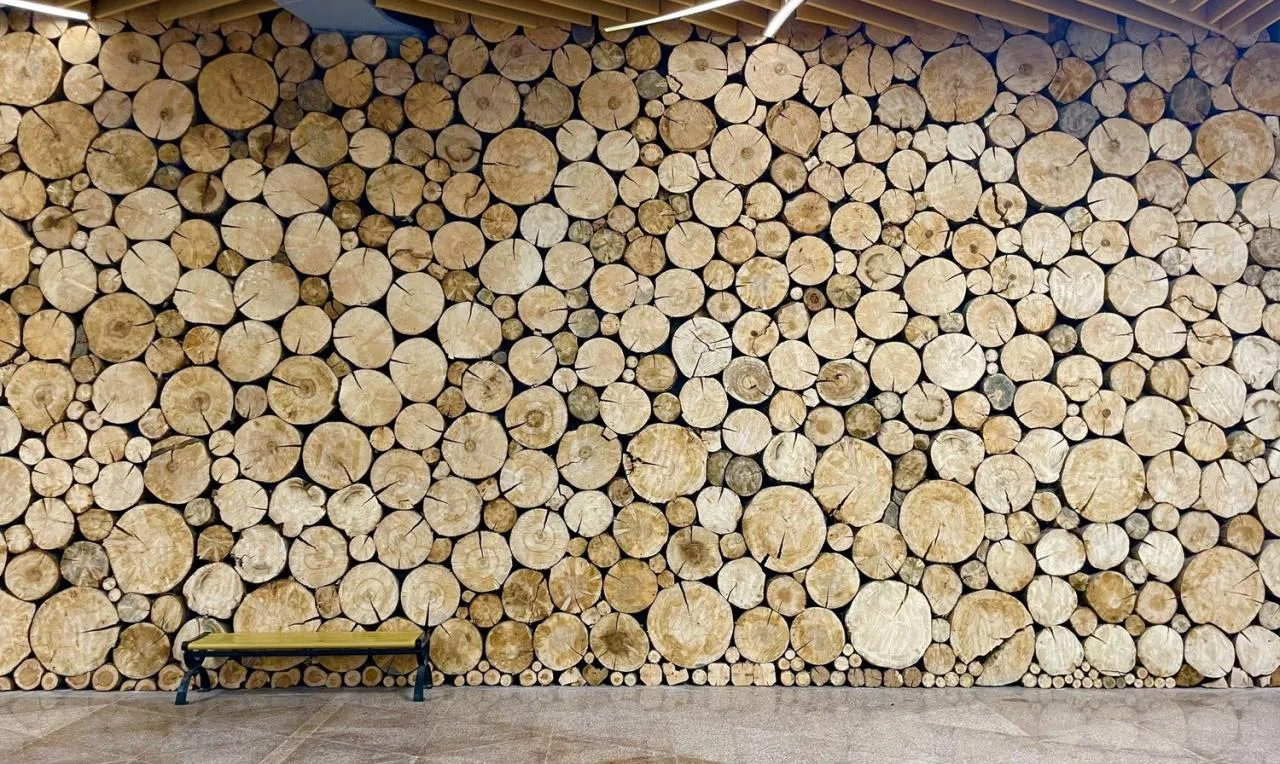
Natural building materials, particularly slate tiles, are used extensively across the Smart Center, exhibition center, and canopy roofs. As a central gathering space for tourists, the main departure square covers over 10,000 square meters.
The decorative paving design, inspired by the “Jiuzhai Starry Sky,” uses natural edged stones of varying materials and sizes to create flowing, randomized star patterns. The black, white, and gray tones enrich the visual depth, echoing the building’s main contour and guiding visitors into the scenic area.
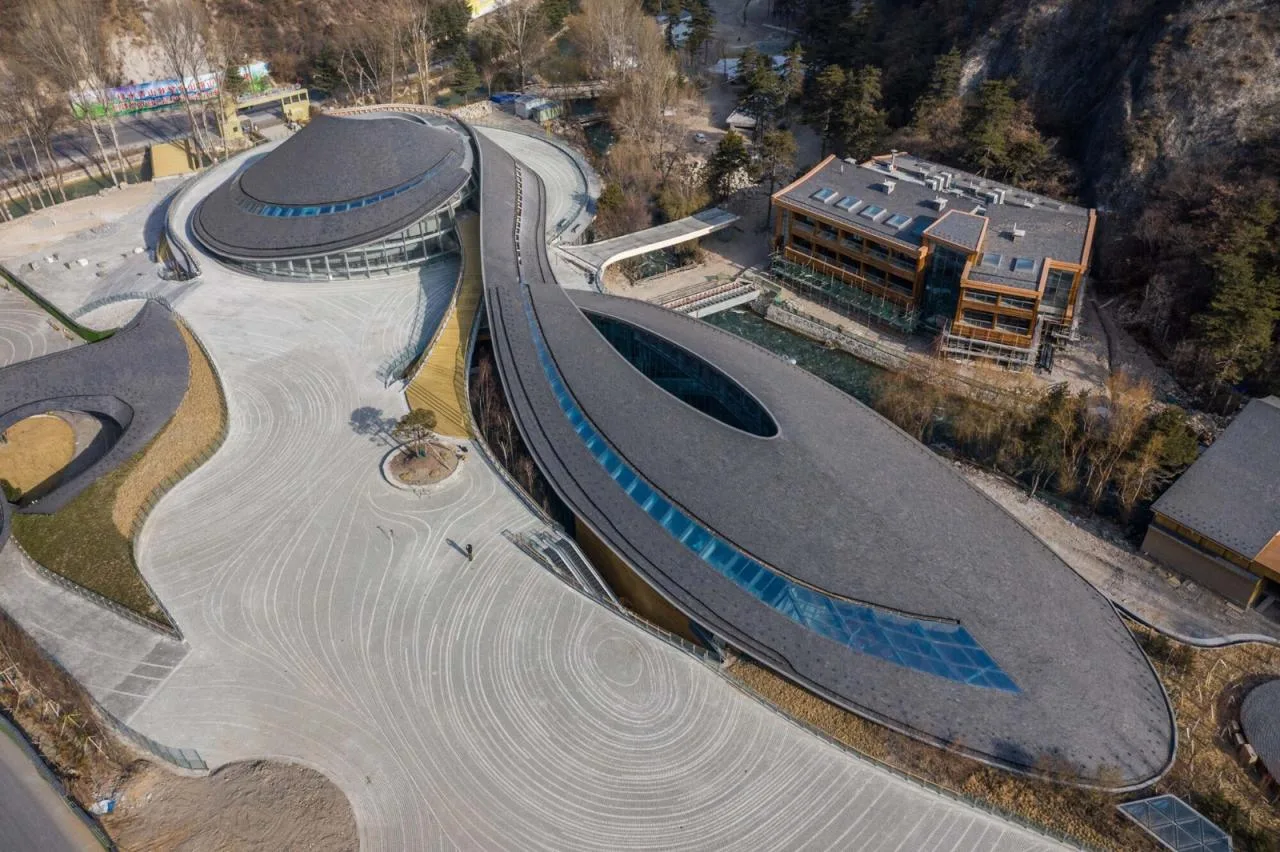
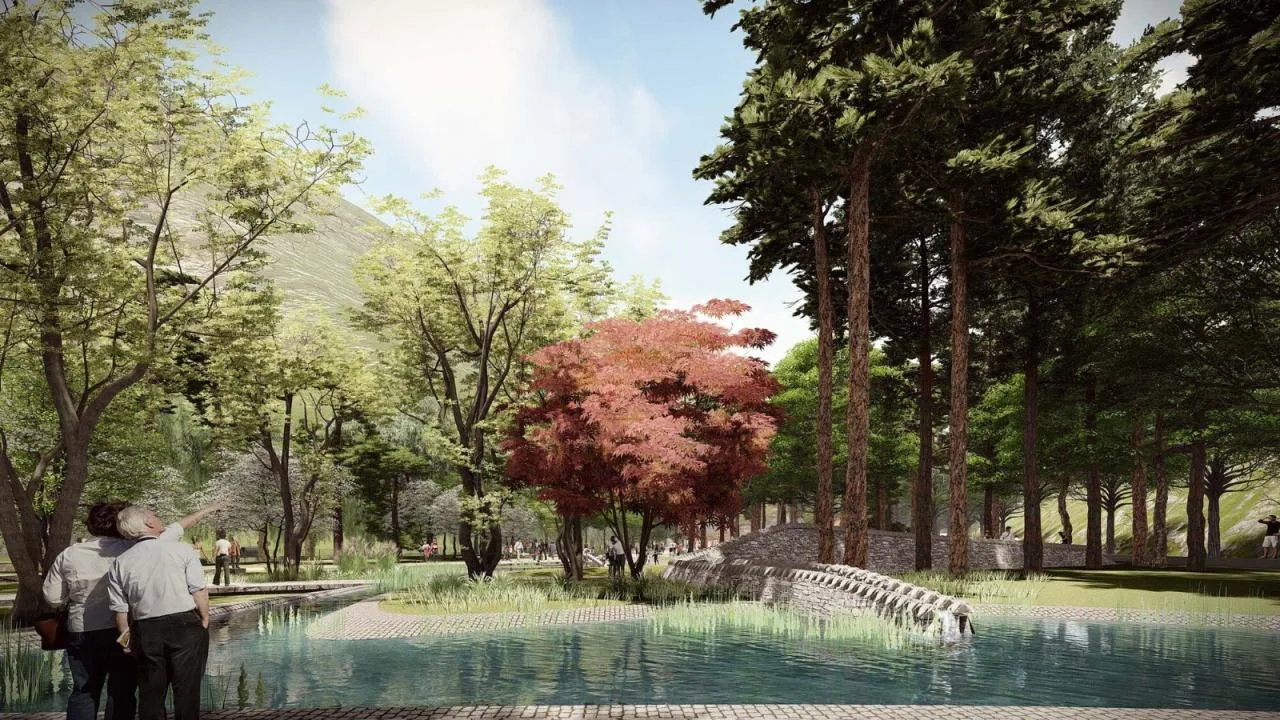
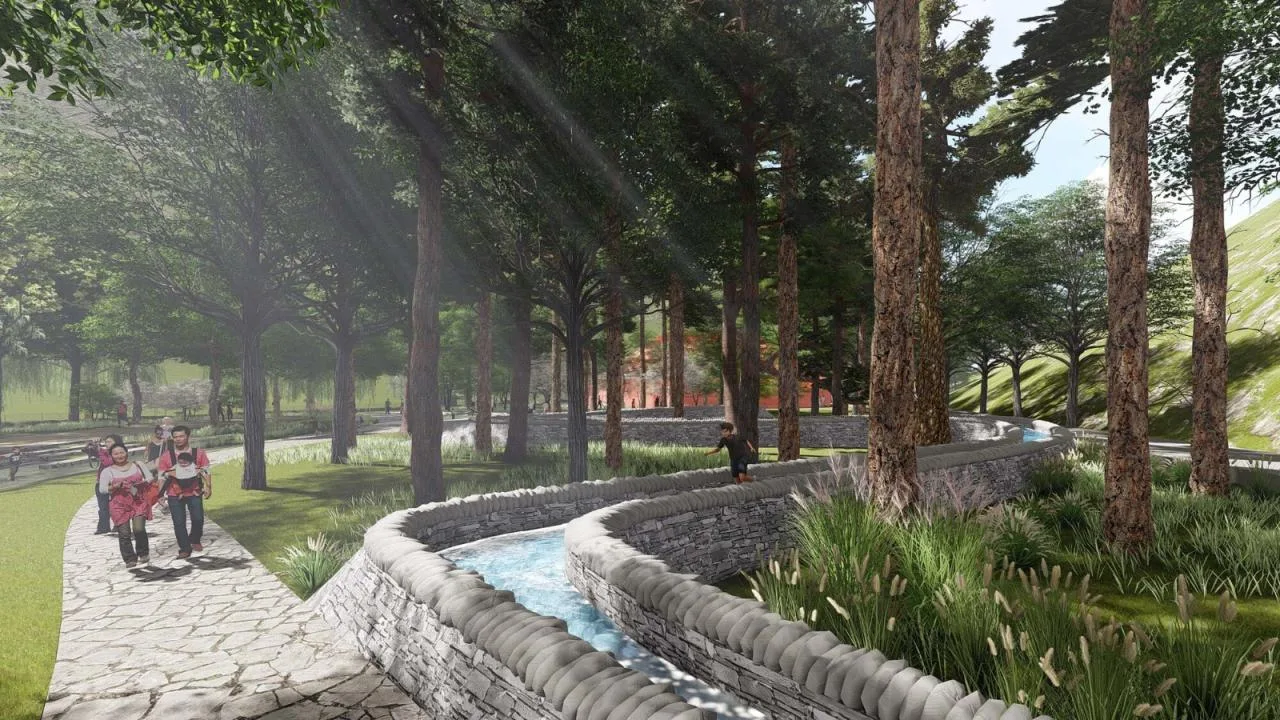
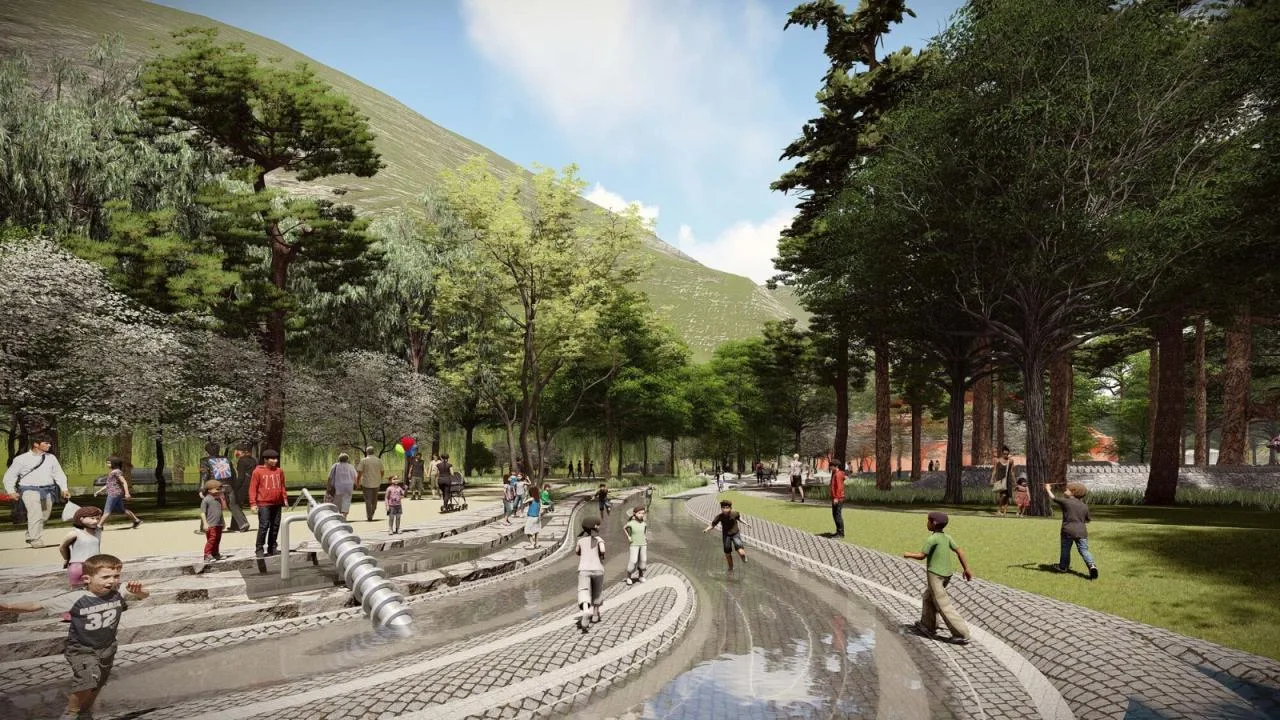
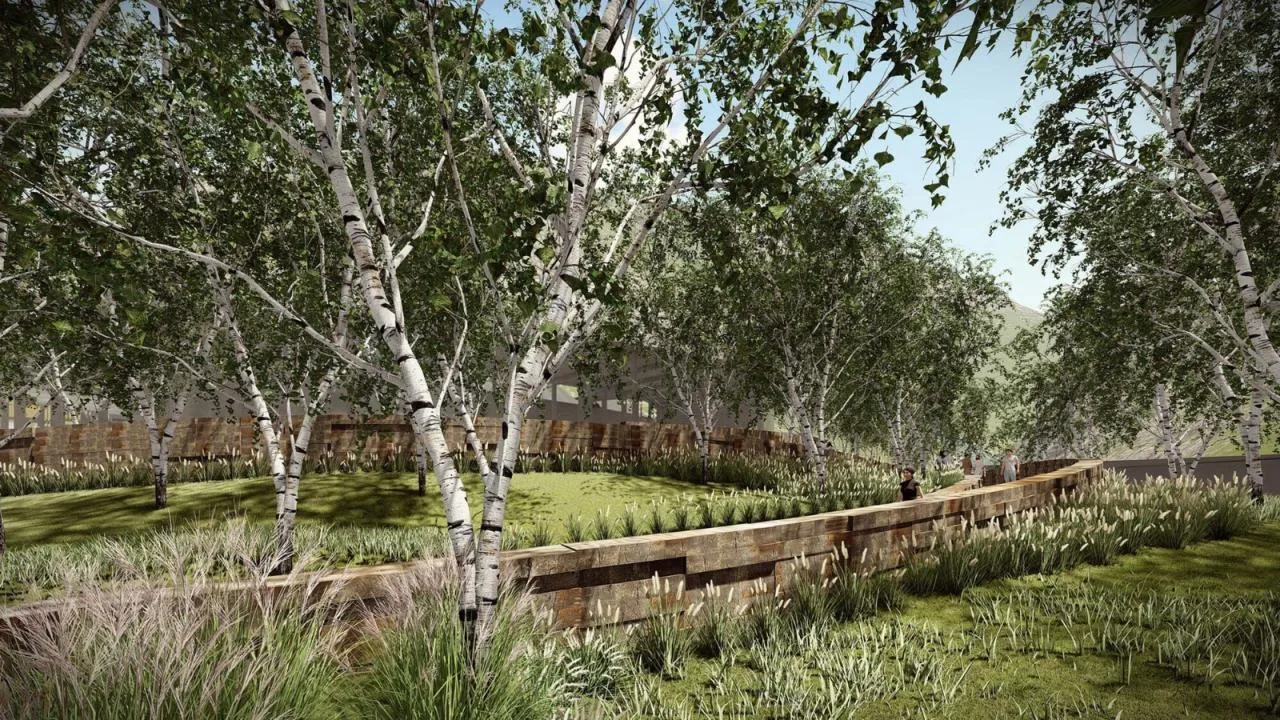
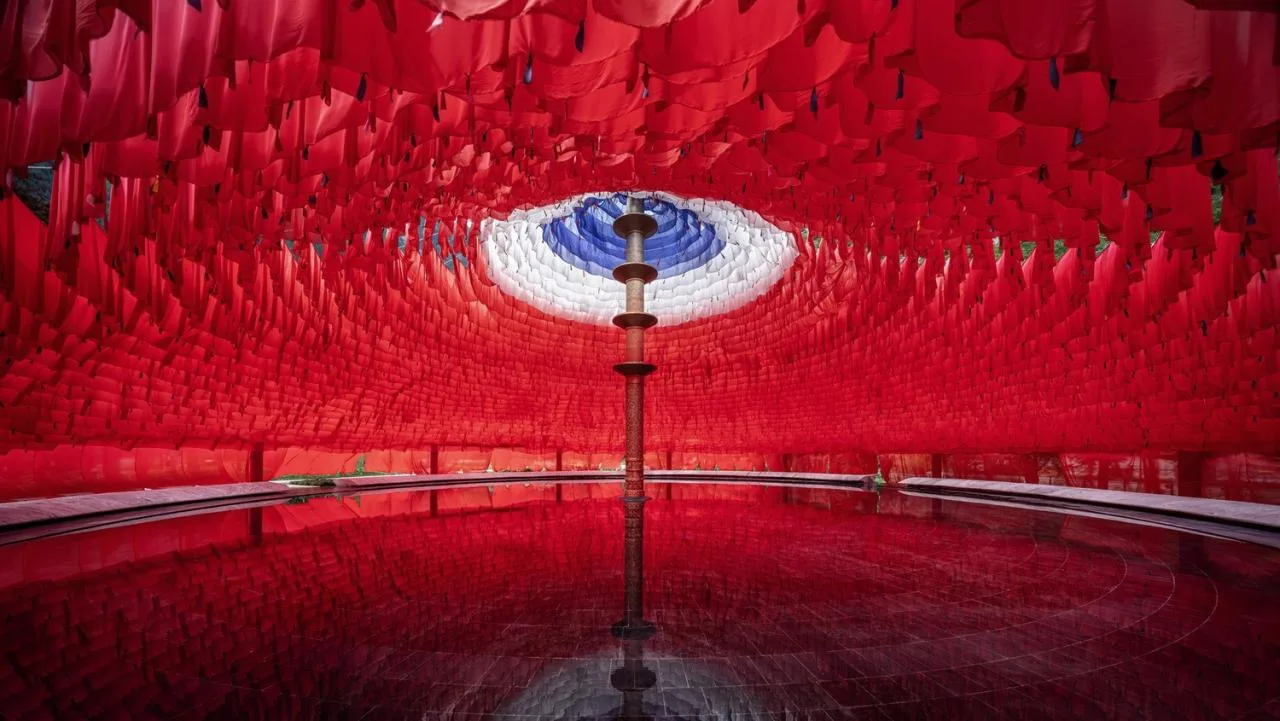
On the east side of the tourist center, the landscape design features a forest card landscape focused on water themes. Designed by Professor Zhu Yufan’s team from the School of Architecture, this “Tibetan Forest Card” is located on the southeast bank of the Jade River.
This design offers a rich water landscape experience while preserving existing vegetation and shaping sparse forest and grassland areas, recreating the Linka scenery. It also alleviates tourist congestion at Goukou Distribution Square during peak hours and provides leisure spaces for both tourists and local residents.
Project Drawings
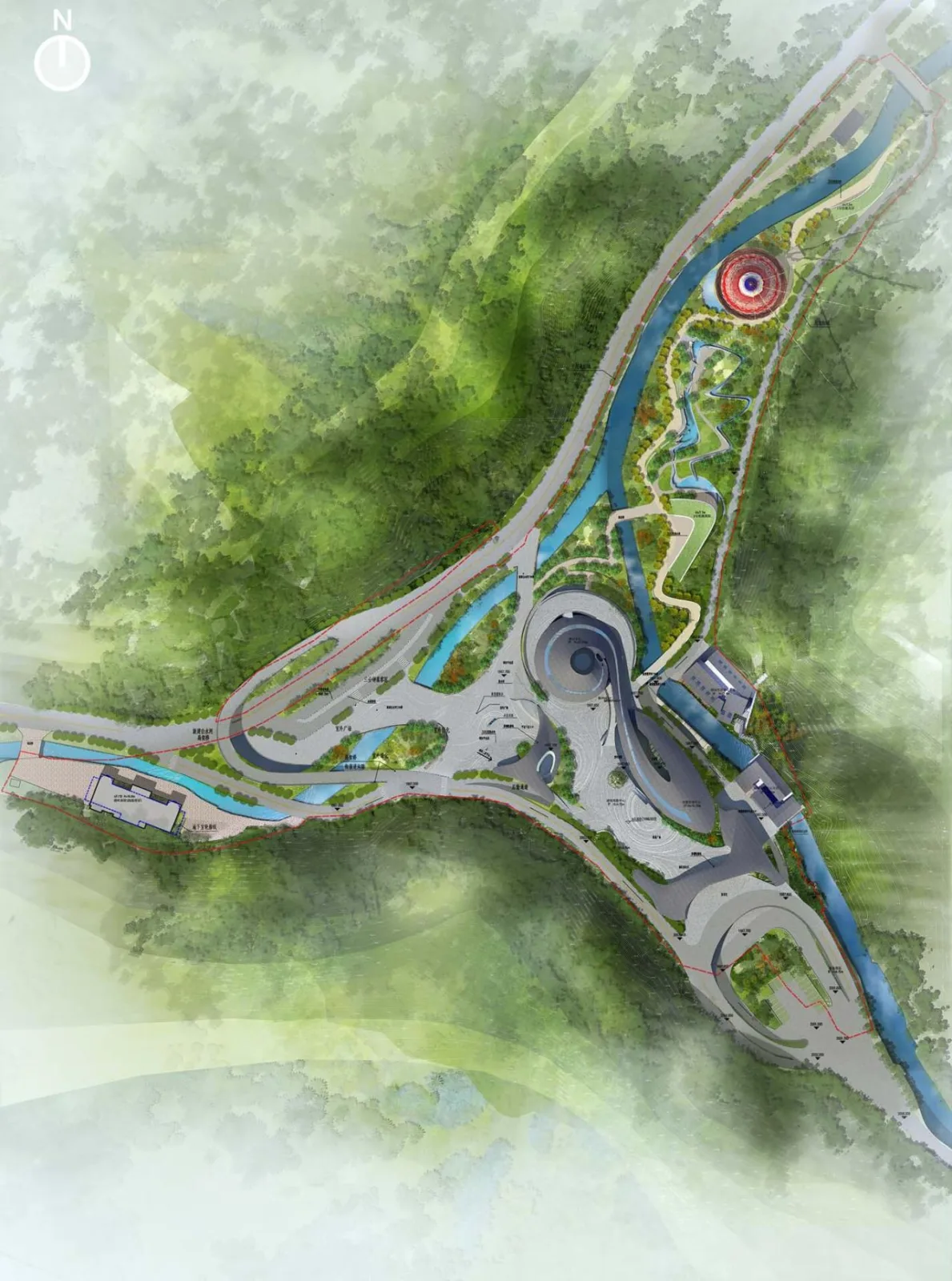
△ General layout plan
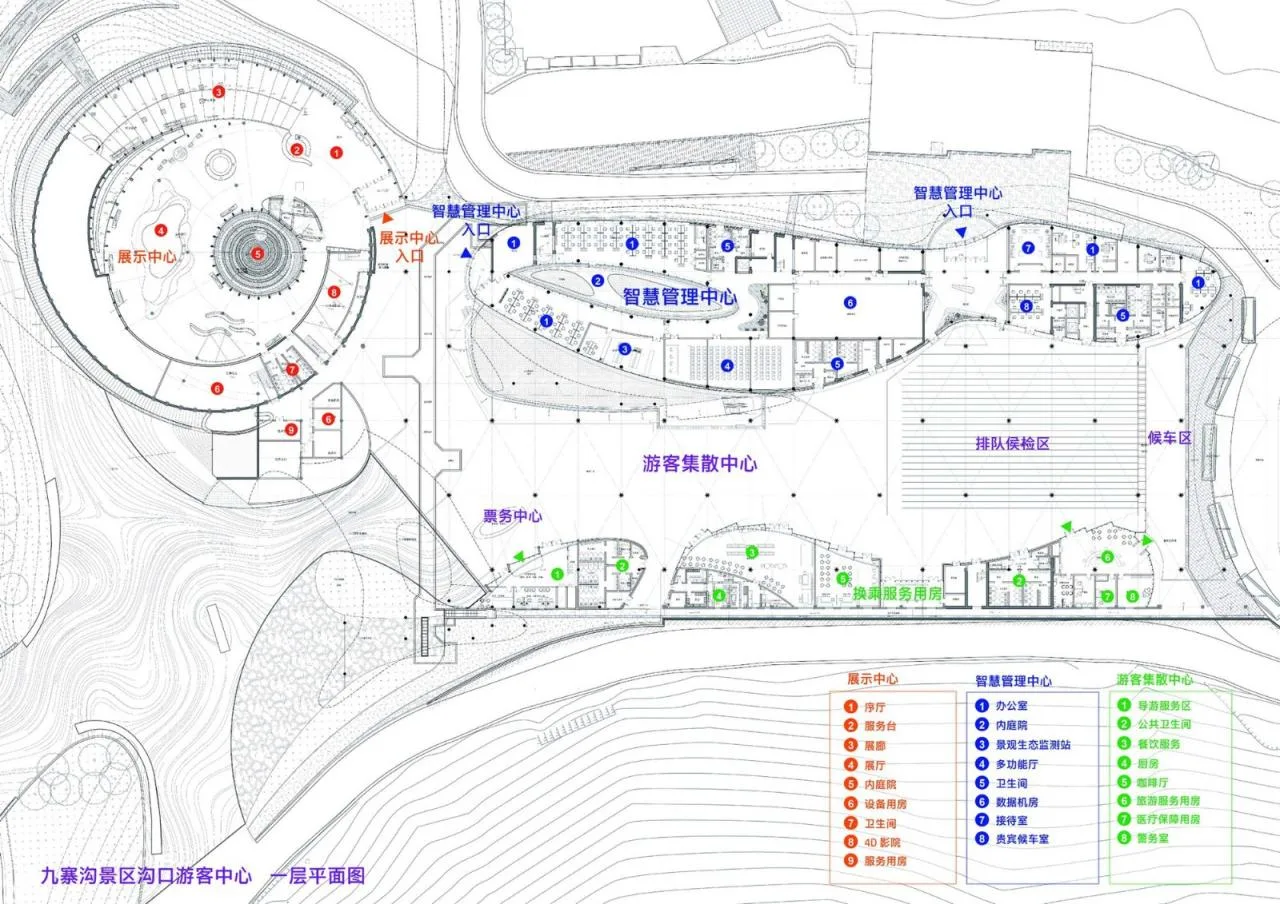
△ First floor plan
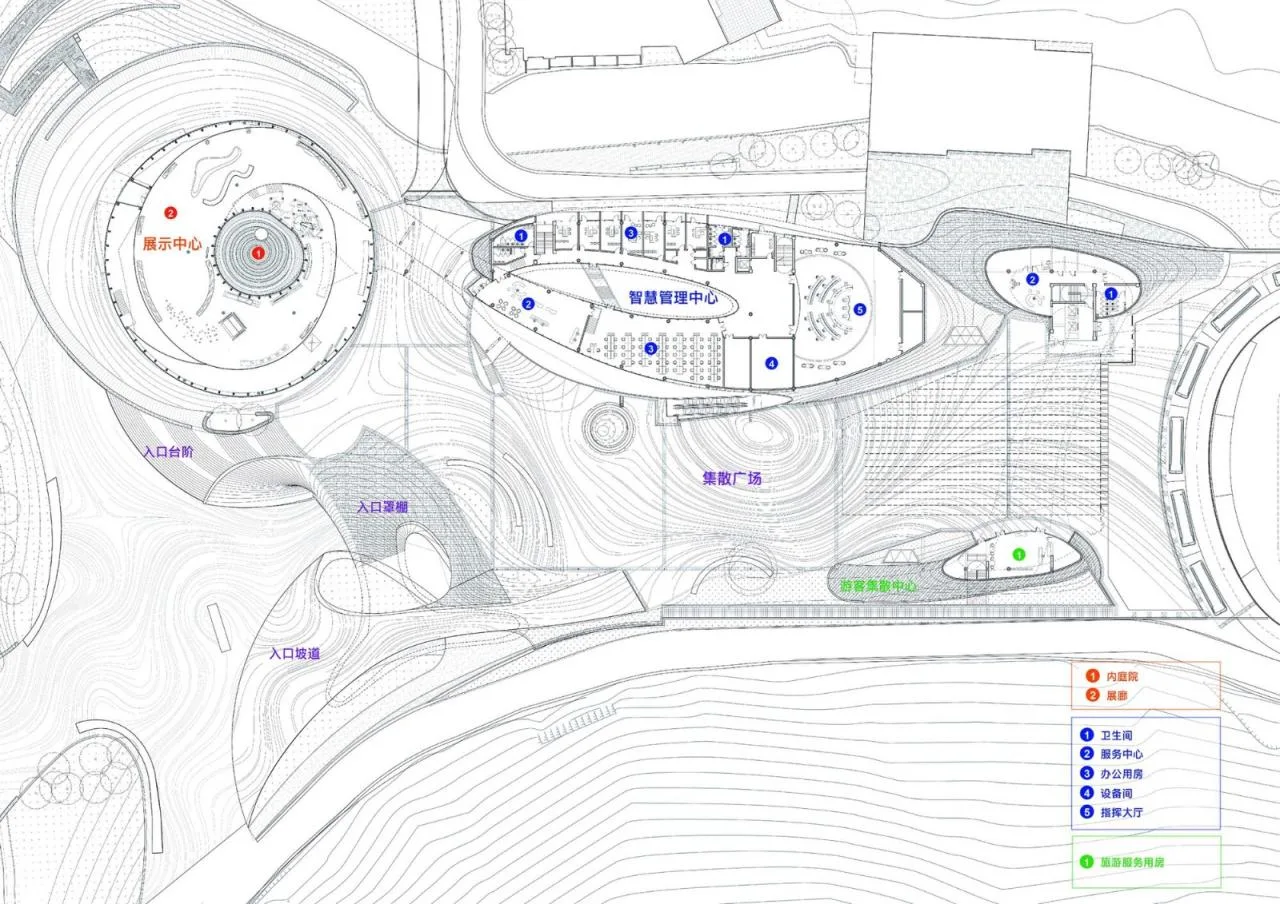
△ Second floor plan
Project Information
Architect: Tsinghua University Architectural Design and Research Institute
Area: 30,650 m²
Project Year: 2018
Project Leaders: Zhuang Weimin, Huo Chunlong
Technical Manager: Sheng Wenge
Architecture Team: Zhuang Weimin, Huo Chunlong, Liu Xiao, Yin Guodong, Gao Gejin, Ding Feng, Wen Qisheng, Sun Zhongxuan, Sun Yuzhu, Gong Shiyu, Zhang Wenjuan, Hao Xiaoxu
Structural Team: Chen Hong, Liu Xiang, Jiang Bo, Xu Jinyan, Wang Xiaopeng
Water Supply and Drainage Team: Liu Jiuling, Cui Yanhui, Shi Qinghong, Wang Chunxiang
HVAC Team: Liu Jianhua, Li Bing, Niu Xiaoyuan
Electrical Team: Xu Hua, Xu Dan, Zhang Hongxia, Liu Lu
Weak Current Team: Guo Hongyan, Liu Lihong
Green Building Team: Liu Jiagen, Yang Difei, Zhao Yang, Chen Shuaiyuan
Landscape Design: Zhu Yufan Design Team
Transportation Design: Duan Jinyu Design Team
Logo Design: Qin Qingxin Design Team
Interior Design: Wang Zuming’s Design Team
Night Lighting: Zhang Xin’s Design Team
Construction Unit: Jiuzhaigou Valley Scenic and Historic Interest Area Scenic Area Administration Bureau
Location: Aba Tibetan and Qiang Autonomous Prefecture














Must log in before commenting!
Sign Up