
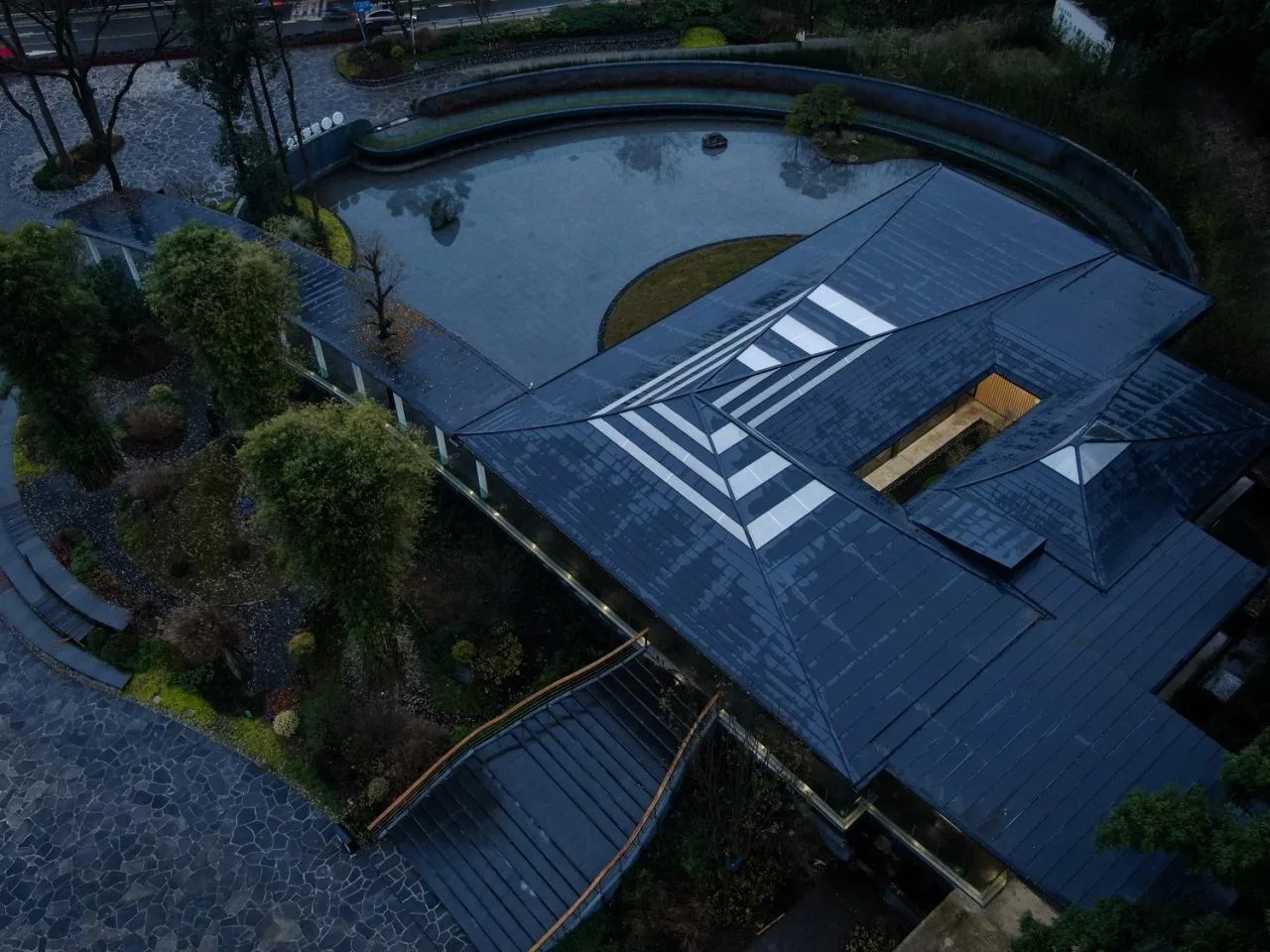
▲ Bamboo woven roof in the evening after rain © Xiaoyin Architecture
The Chongzhou Zhuyi Village Tourist Center represents another architectural exploration of Sichuan’s “bamboo culture” by Xiaoyin Architecture, following their work on the Yibin Zhuzhi Academy. This project delves deeper into the concept of “imagery architecture,” blending cultural symbolism with functional design.
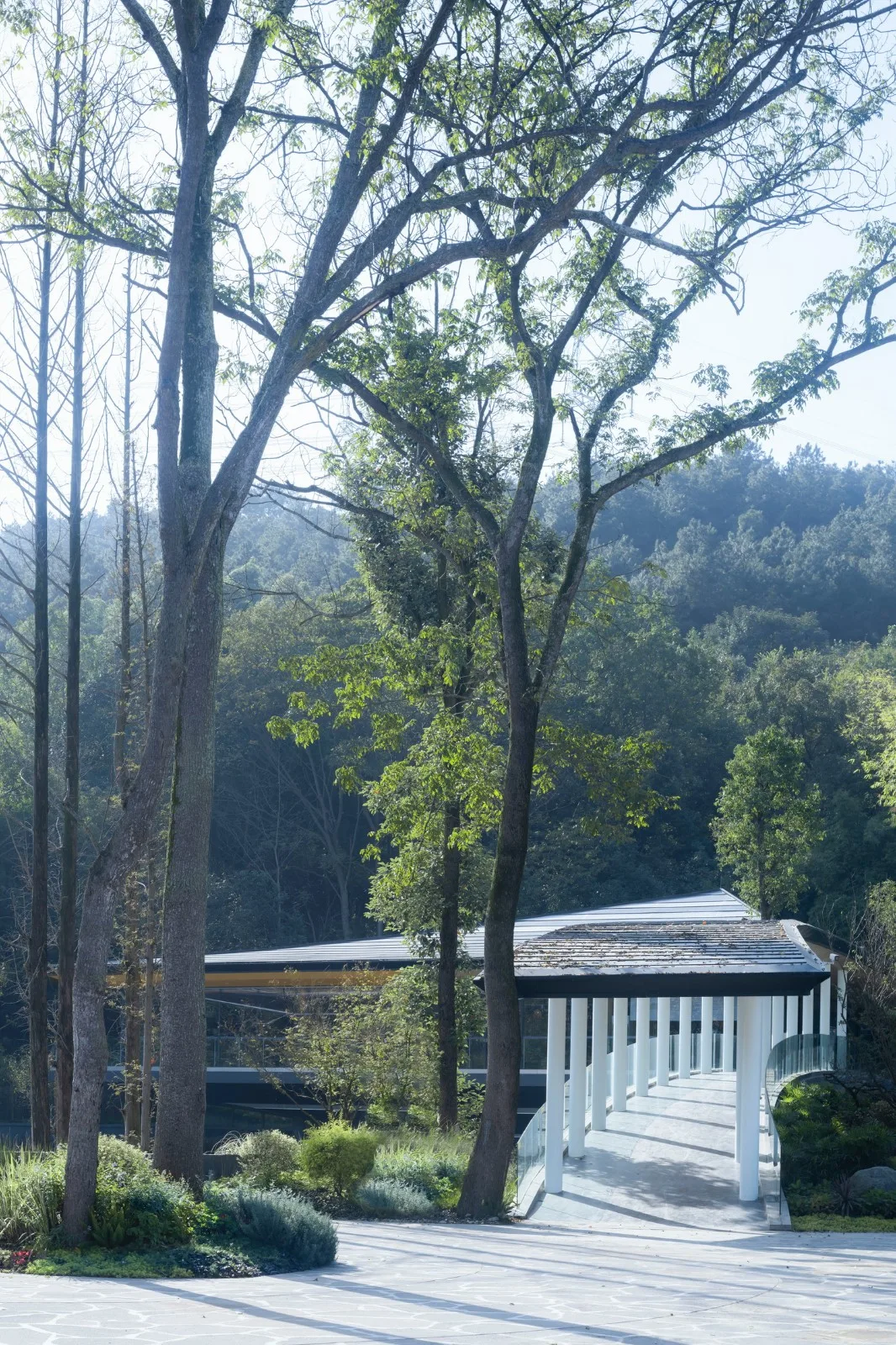
▲ Tourist Center nestled within the forest © Existence of buildings
The theory of imagery architecture aims to fulfill both the functional demands and aesthetic expectations of buildings. It starts from the natural environment and human cultural context, employing innovative technologies and unique artistic elements to strike a balance between beauty and practicality. This approach seeks to maximize aesthetic satisfaction, re-examine the essence and value of architectural design, open new possibilities for buildings, promote harmonious coexistence between architecture and society, and address the needs of the modern era.
Throughout history, humans have pursued a “beautiful life,” which encompasses both reality and imagination in a scenarized experience. Architecture is viewed as an interactive act between people and physical space at a specific moment in time. It involves not only the spatial structure but also the emotional and cognitive relationships people form with buildings. Without human engagement, architecture risks becoming mere ruins—void of meaning and connection.
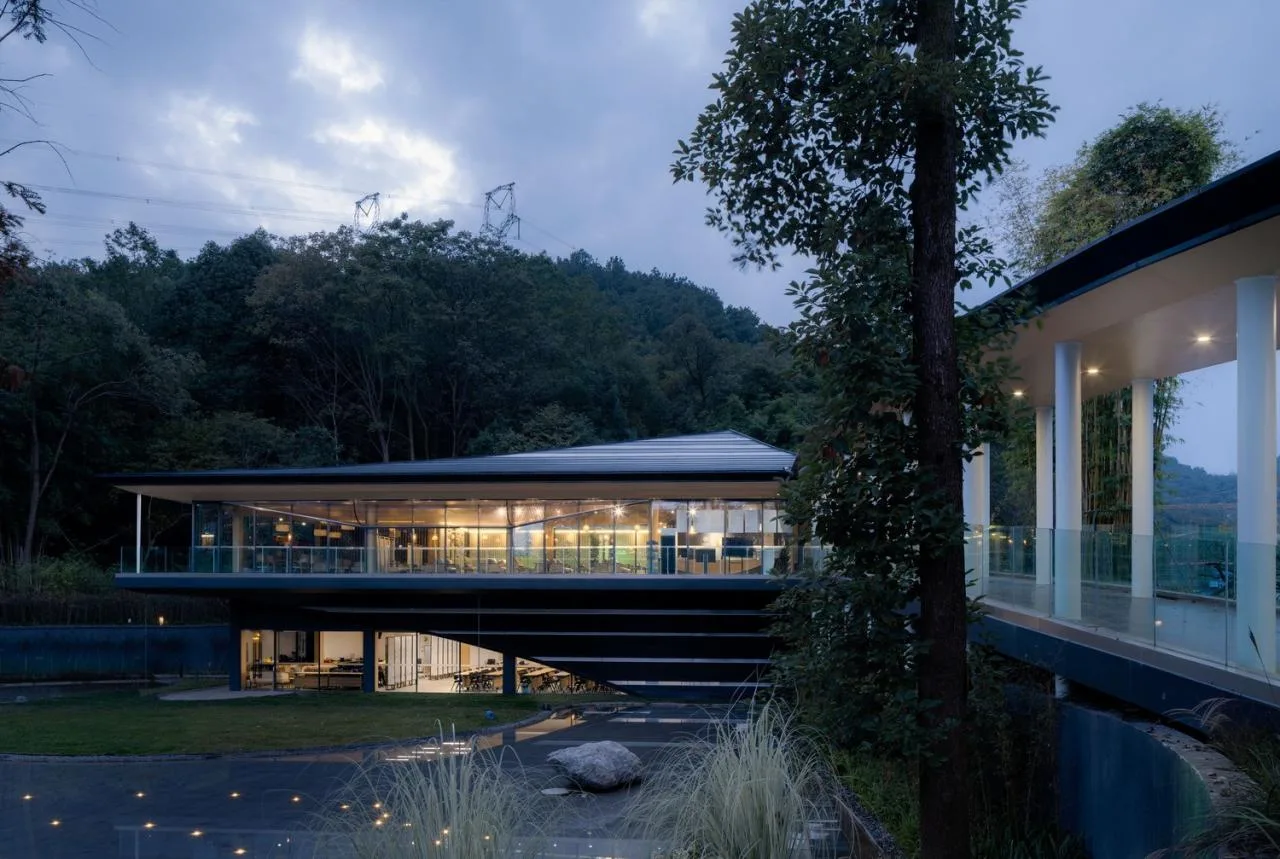
▲ Large bamboo shoots lying horizontally in the evening © Existence of buildings
At its core, imagery architecture emphasizes “imbuing meaning through imagery and conveying meaning via imagery.” Imagery acts as a bridge between humans and nature, existing within a scenarized context. This architectural approach balances aesthetics with functionality, embedding historical background, cultural traditions, and consciousness into new, creative, and diverse forms. The goal is to craft architecture that is original, vibrant, and emotionally resonant, offering multidimensional spatial experiences and poetic environments that celebrate the “beautiful life.” This philosophy guides Xiaoyin Architecture’s work.
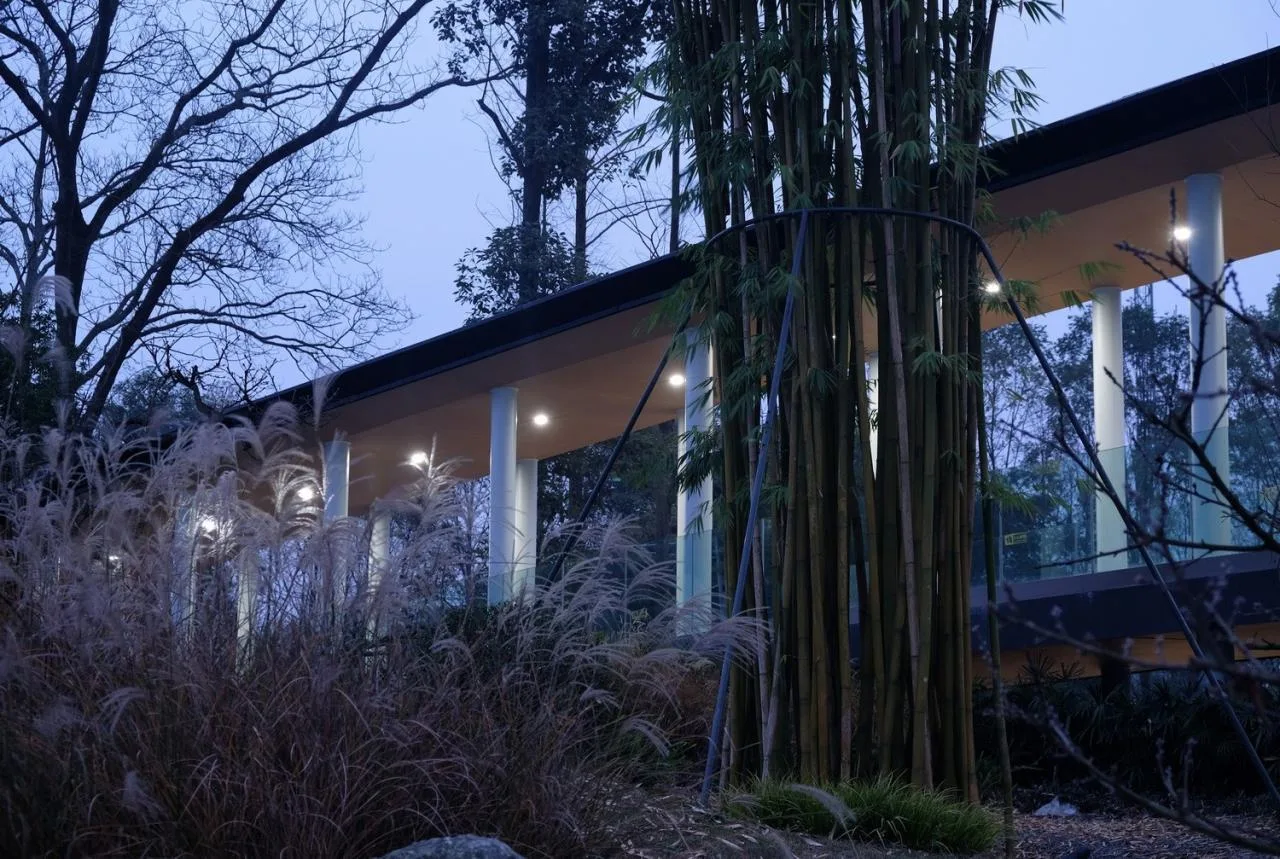
Bridge formed by bamboo roots stretching between large trees © Xiaoyin Architecture
Imagery in architecture can be divided into two main categories: natural and humanistic. Natural imagery includes landscapes, colors, lighting, and naturally occurring geometric shapes—such as the sun, moon, stars, rivers, flora and fauna, climate, and seasonal changes—as well as humanity’s contemplation of nature. It extends beyond mere replication of forms to draw inspiration from nature’s laws, vitality, and aesthetics, enriching architectural design with individuality and enhancing the sensory experience.
Humanistic imagery encompasses cultural and social elements, including historical traditions and expressions of national culture such as language, clothing, cuisine, architecture, literature, art, history, and transportation. This manifests in the use of local materials, incorporation of regional architectural elements, and integration of historical and traditional culture with the natural environment to meet both human and ecological needs.
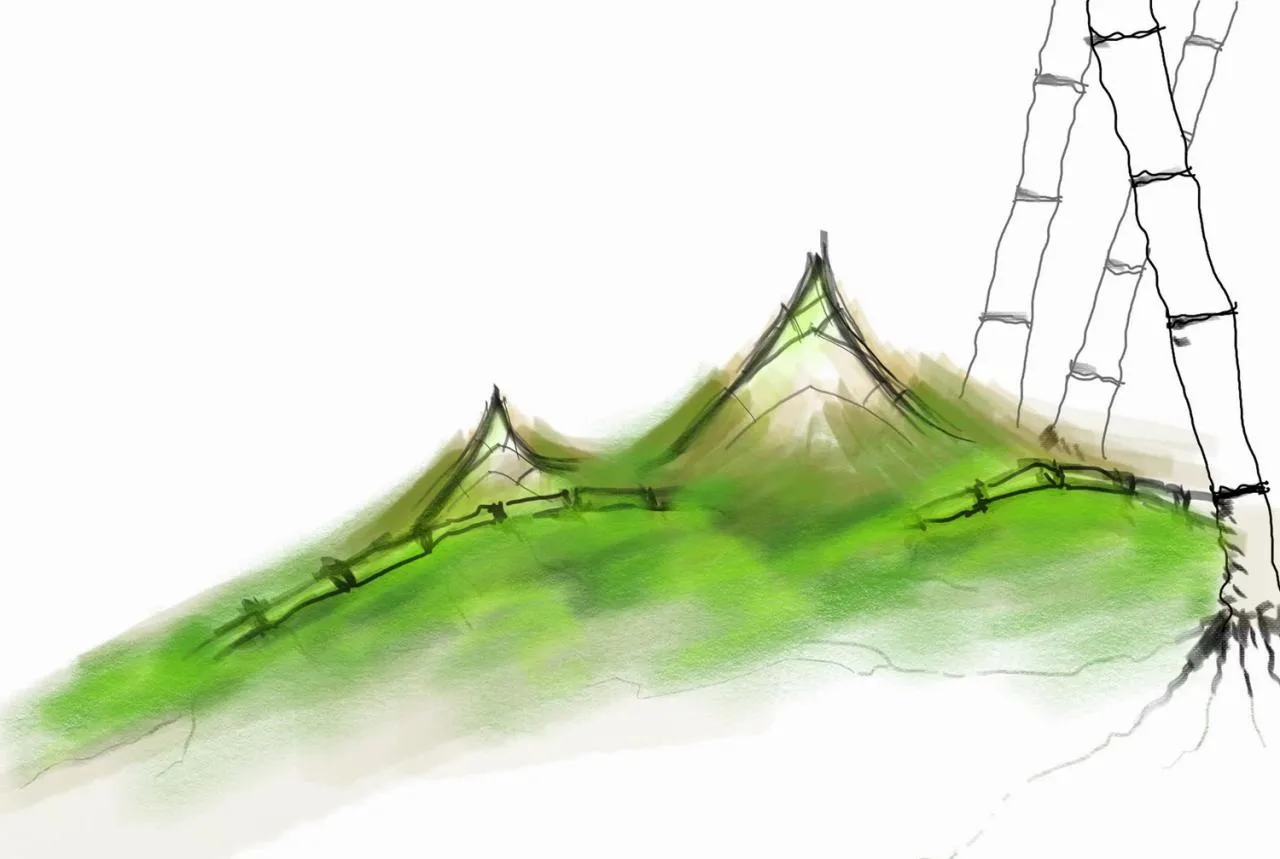
▲ Artistic conception of bamboo breaking through the soil © Xiaoyin Architecture
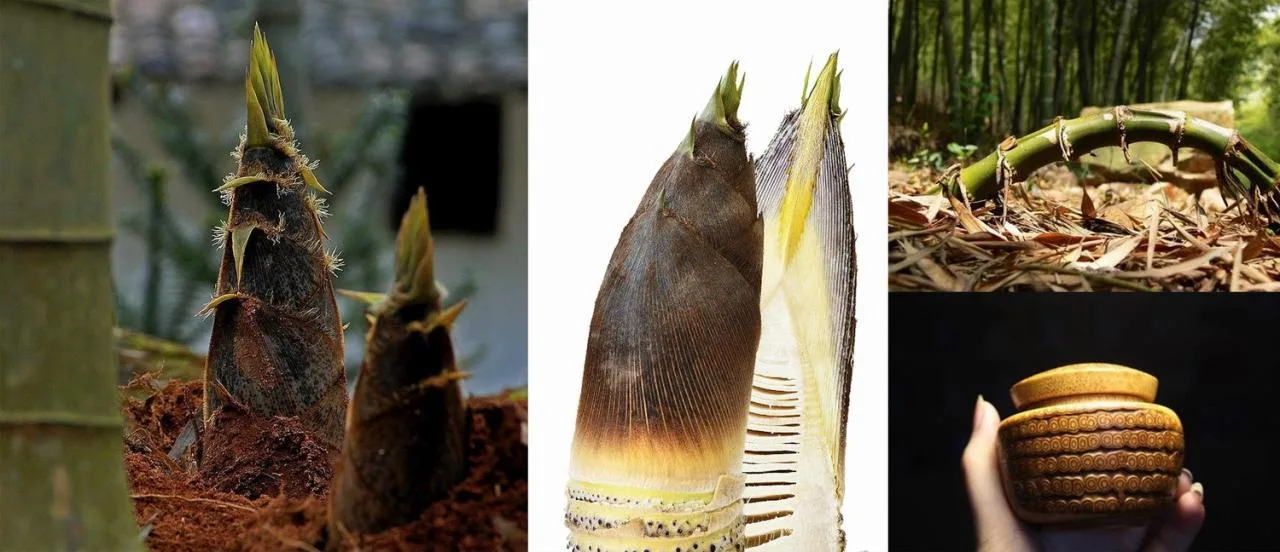
▲ Unique forms of bamboo © Xiaoyin Architecture
The Zhuzhi Academy draws on two natural bamboo motifs—clusters and branches—to “depict images” and reveal deeper meanings. The Zhuyi Village Tourist Center expands this approach by incorporating three natural and cultural bamboo images: bamboo shoots, bamboo whips, and bamboo weaving, further enriching its symbolic narrative.
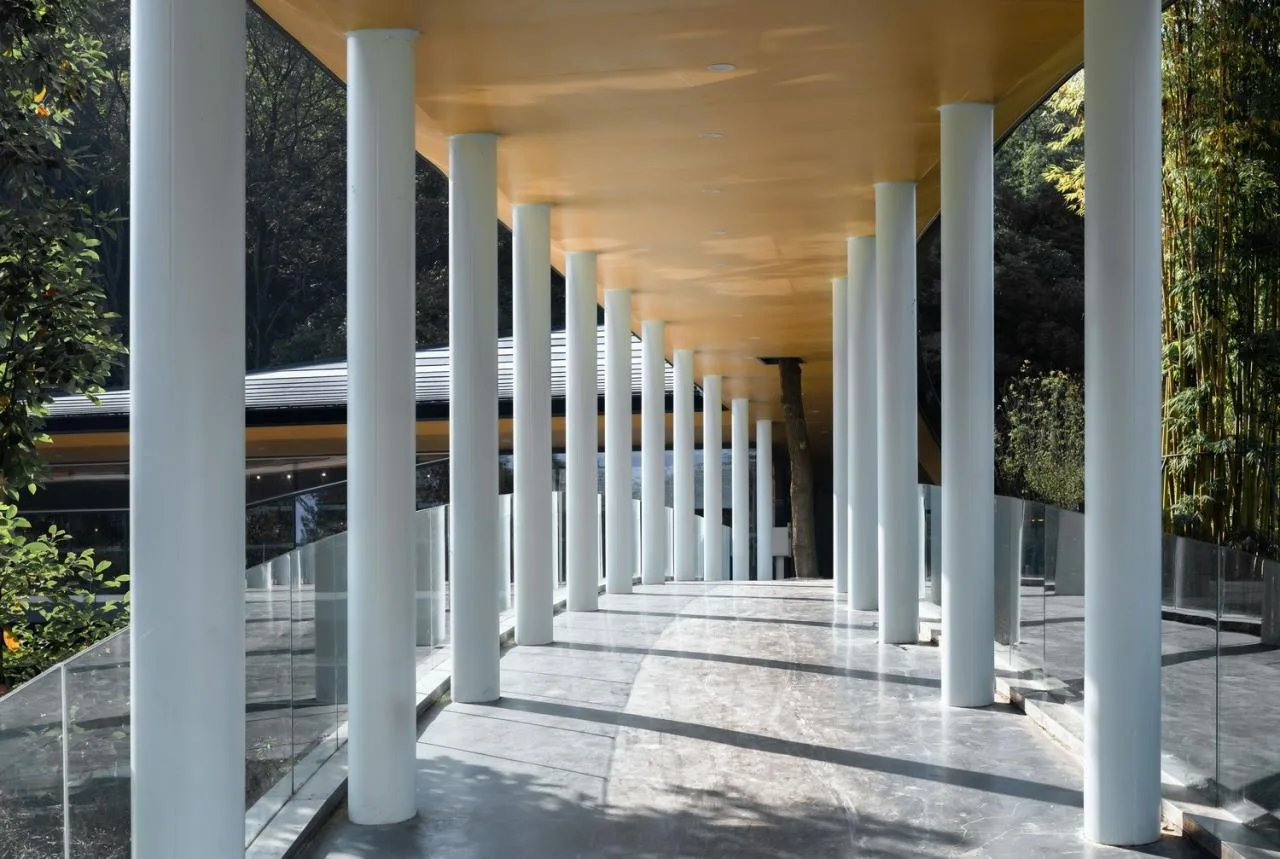
▲ The orderly corridor bridge © Existence of buildings
The principle of “creating images through meaning and conveying meaning through images” focuses on crafting architectural scenes that integrate distinctive elements reflecting natural and cultural imagery. This approach conveys the spiritual essence of beautiful spaces. Imagery transcends symbolic representation to become a conceptual expression of space and aesthetics through specific structures, materials, light, shadow, and color, enriching the narrative and thematic qualities of the space.
“Fu Xiang” refers to exploring all natural and cultural imagery related to the building, identifying suitable sources for design inspiration, translating them into prototypes, and ultimately shaping architectural or spatial forms that are easily readable and recognizable.
“Jian Yi” involves contextualizing these prototypes and images, constructing diverse scenes, enriching the cultural qualities of spaces, and creating narrative architectural environments that express particular aesthetic views and cultural identities. This process aims to evoke emotional resonance and achieve artistic excellence.
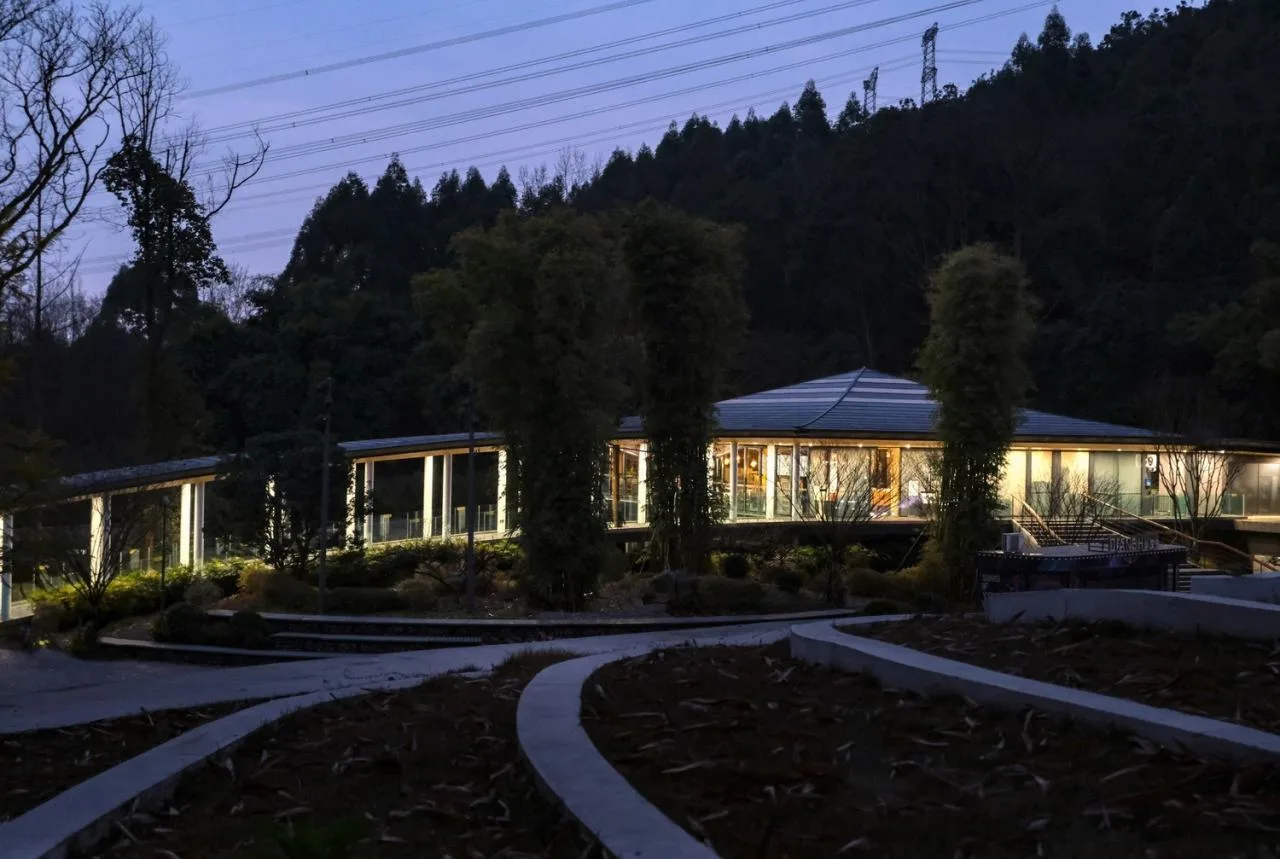
▲ A large roof resembling bamboo roots © Xiaoyin Architecture
Imagery enhances readability by using imitation, reproduction, abstraction, and deconstruction to infuse architecture with symbolic meaning. Incorporating form, material, color, and graphics helps express the humanistic and natural imagery inherent in the design.
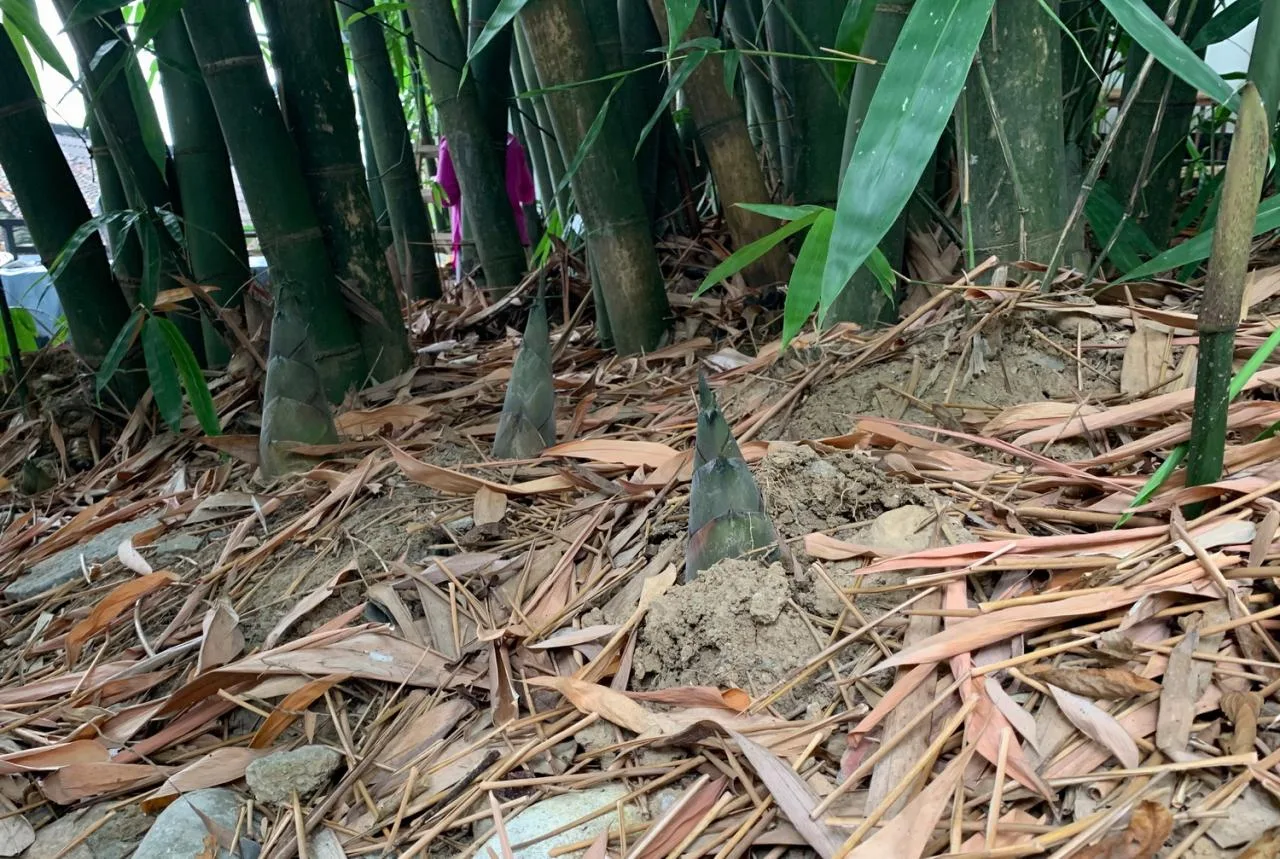
▲ Bamboo shoots emerging next to the old tourist center © Xiaoyin Architecture
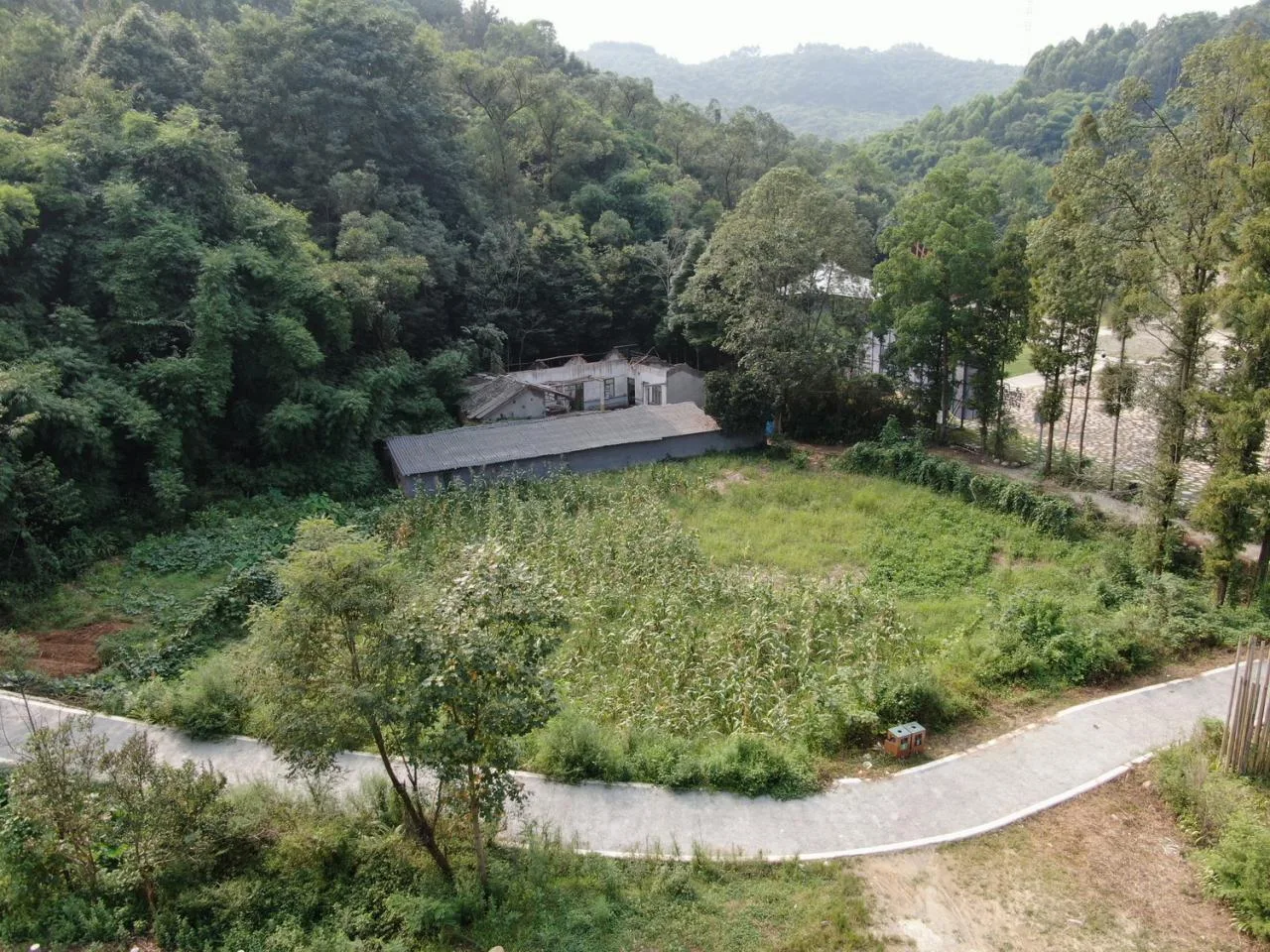
▲ Original site of the tourist center © Xiaoyin Architecture
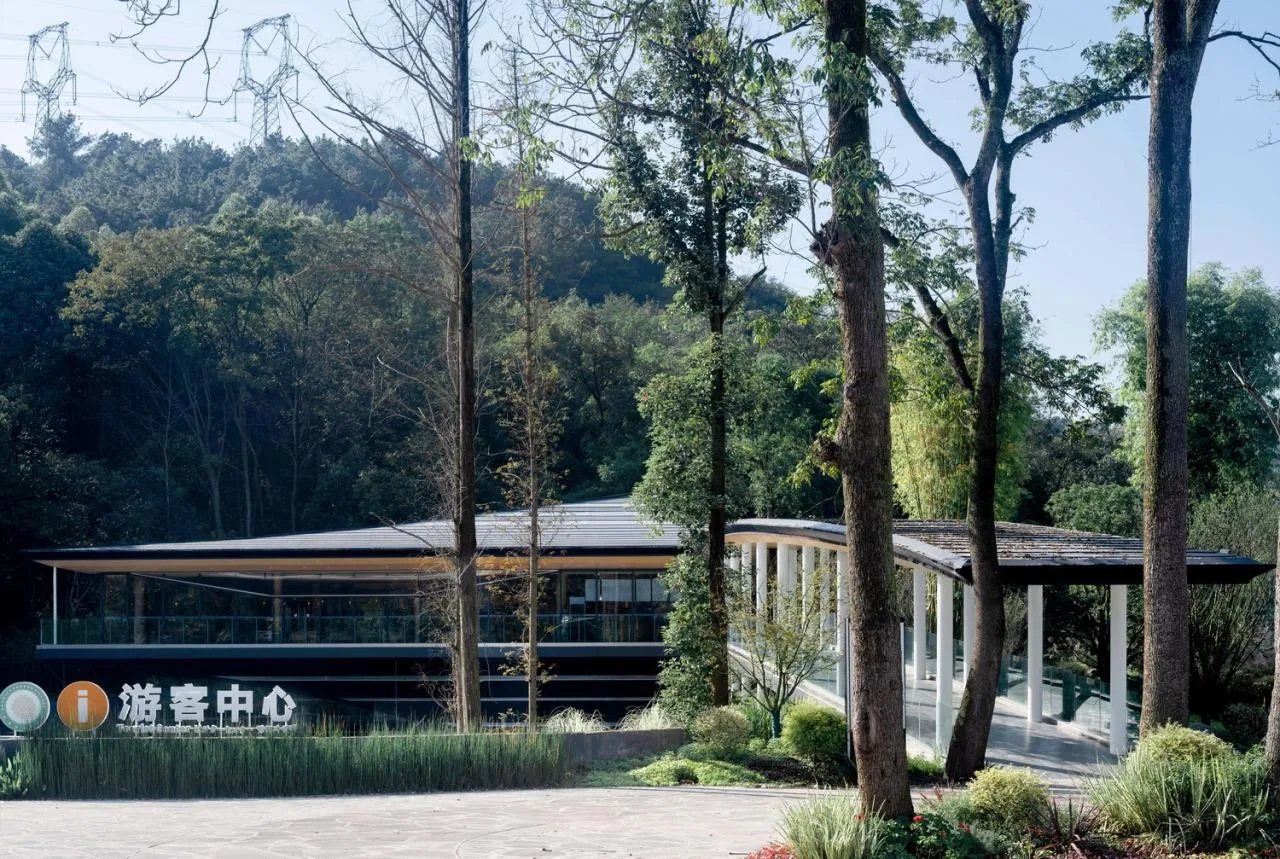
▲ Tourist center blending into the landscape © Existence of buildings
The site was originally a western Sichuan courtyard house with an adjacent vegetable garden. The courtyard and garden sit about 1.5 meters below the surrounding terrain. A lush hill rises to the west with prominent trees on the east and north sides. Through early research, four key image sources tied to Zhuyi Village were selected as the core architectural motifs: two natural images (bamboo shoots and bamboo whips) and two cultural images (bamboo weaving and tiled roofs). During site exploration, we discovered three bamboo shoots breaking through the soil near the old tourist center. This striking scene of spring bamboo shoots inspired the spirit and artistic concept of the new building. The design envisions the structure as a lively bamboo shoot emerging from the earth, seamlessly blending with nature yet brimming with vitality.
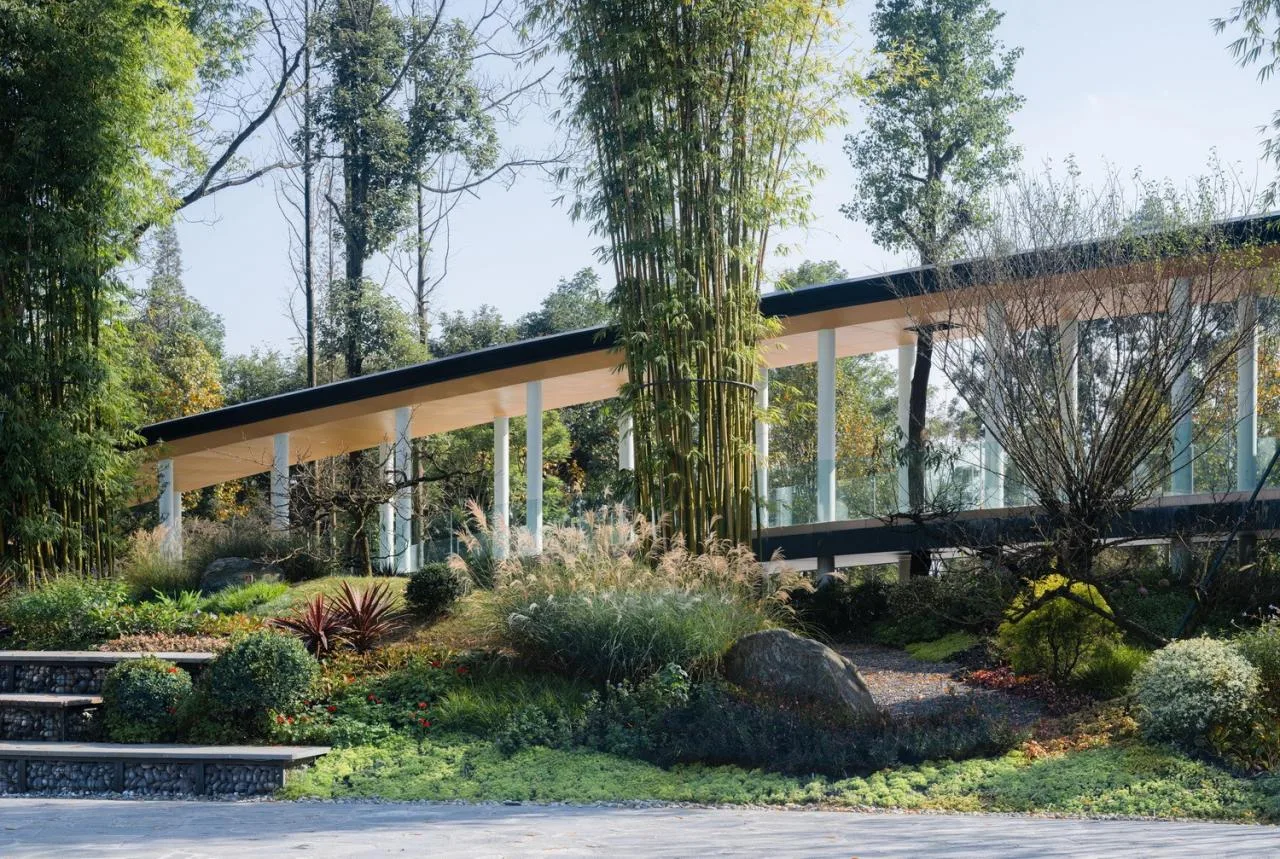
▲ Long corridor inspired by bamboo whips © Existence of buildings
Bamboo whips, which wind and extend across bamboo forests, function to store and transport nutrients and possess strong regenerative abilities. Some buds on bamboo whips grow into new whips, while others develop into shoots that form new forests. This dynamic form and function inspired the design of a long, curved corridor ramp at the front of the tourist center. Winding through the trees, it addresses height differences and accessibility while serving as a key passage for visitors.
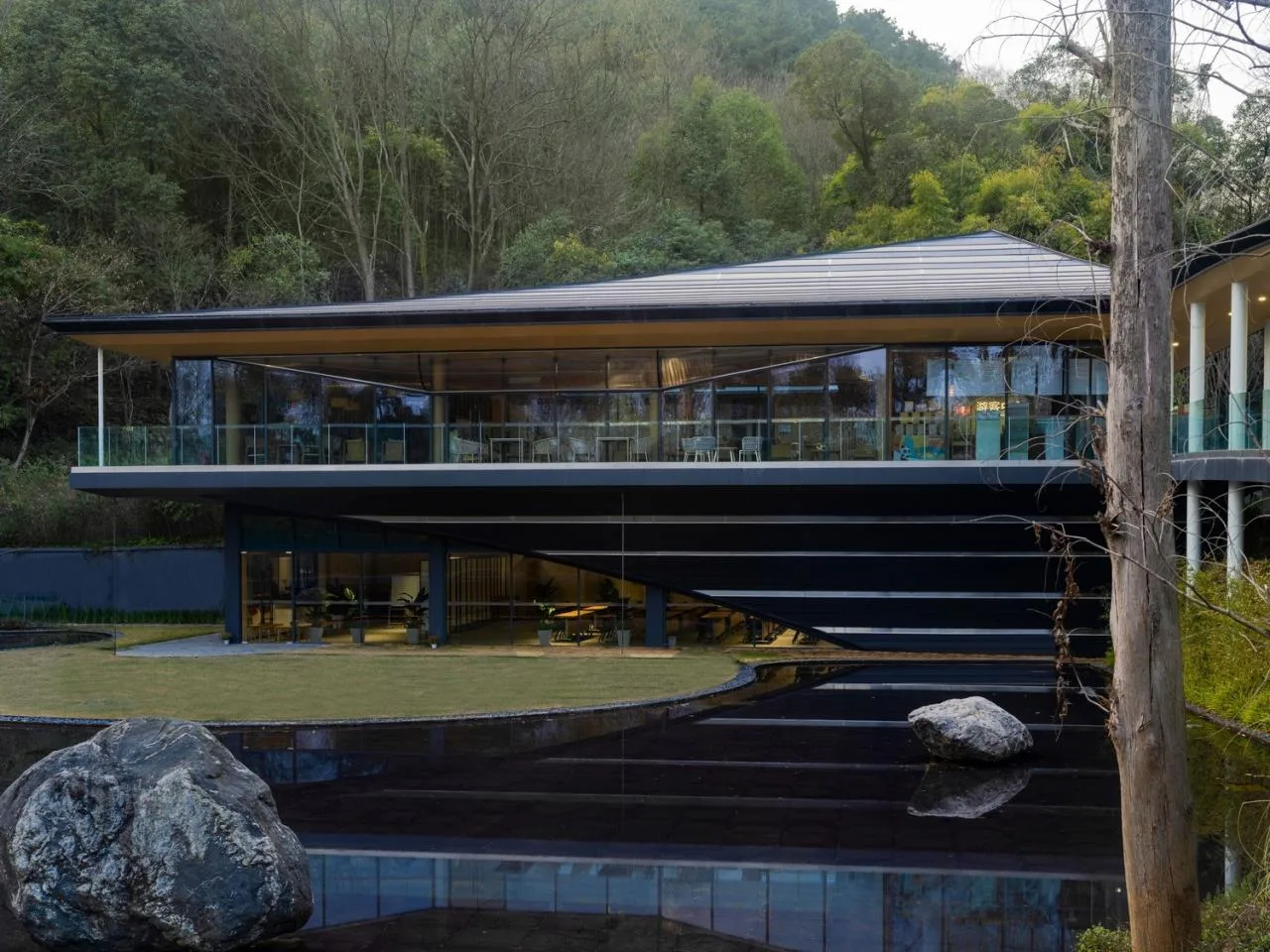
▲ Architectural form inspired by bamboo shoots © Existence of buildings
Bamboo shoots, characterized by their hollow, segmented form wrapped in layers of bamboo sheaths, naturally influenced the functional spaces of the tourist center. The design features three interconnected bamboo shoot-shaped volumes of varying sizes. To emphasize the building’s upward struggle to break free from the earth, the third bamboo shoot is horizontally sliced open, revealing its interior.
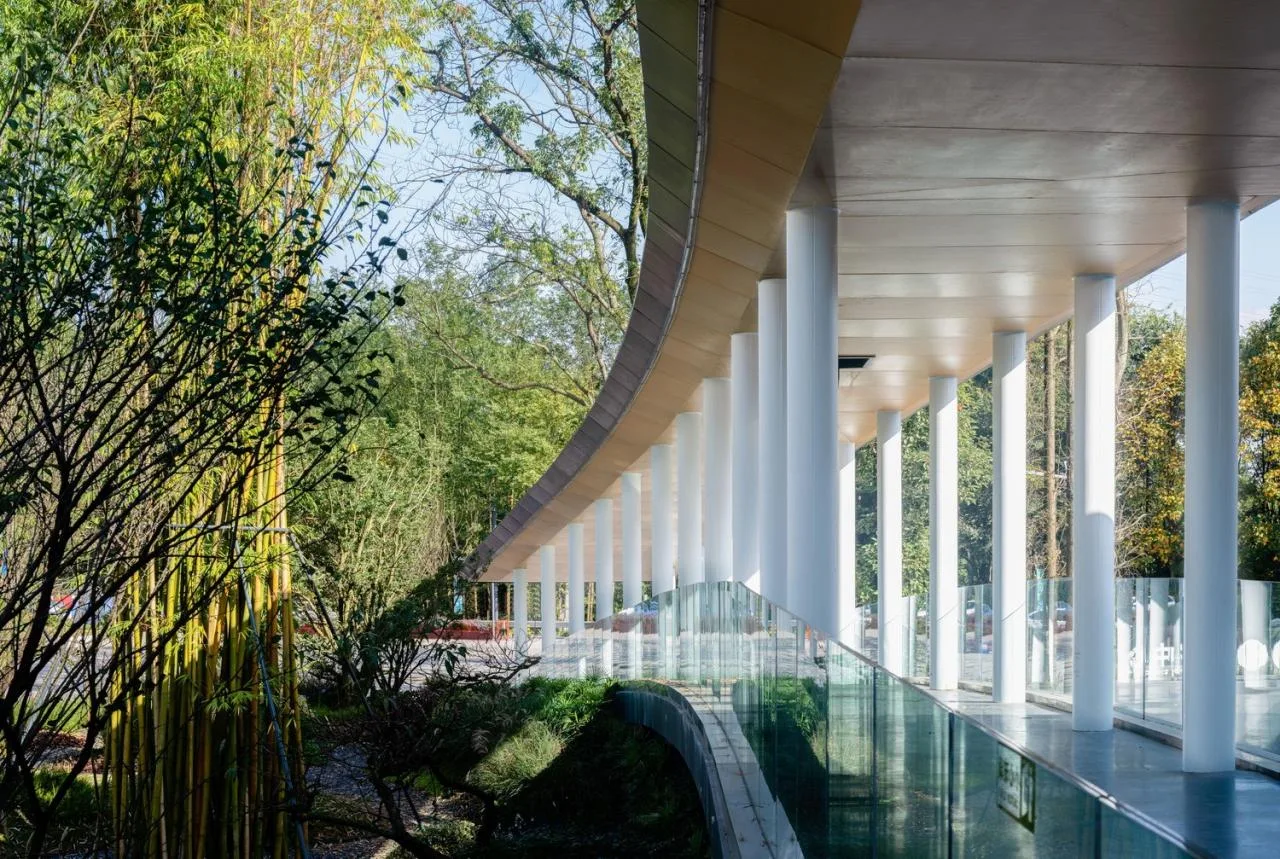
▲ Entrance corridor and accessible ramp © Existence of buildings
The narrative aspect of the design is achieved through reproduction, translation, and combination of imagery to build scenes that foster emotional and cognitive engagement with the architecture. Selecting prominent imagery and cultural symbols creates a coherent system, enhanced by layering and refinement, which highlights spatial characteristics and imbues the building with a unique atmosphere. This integration evokes thematic depth, expresses the building’s ideological vision, and grants it a powerful narrative presence.
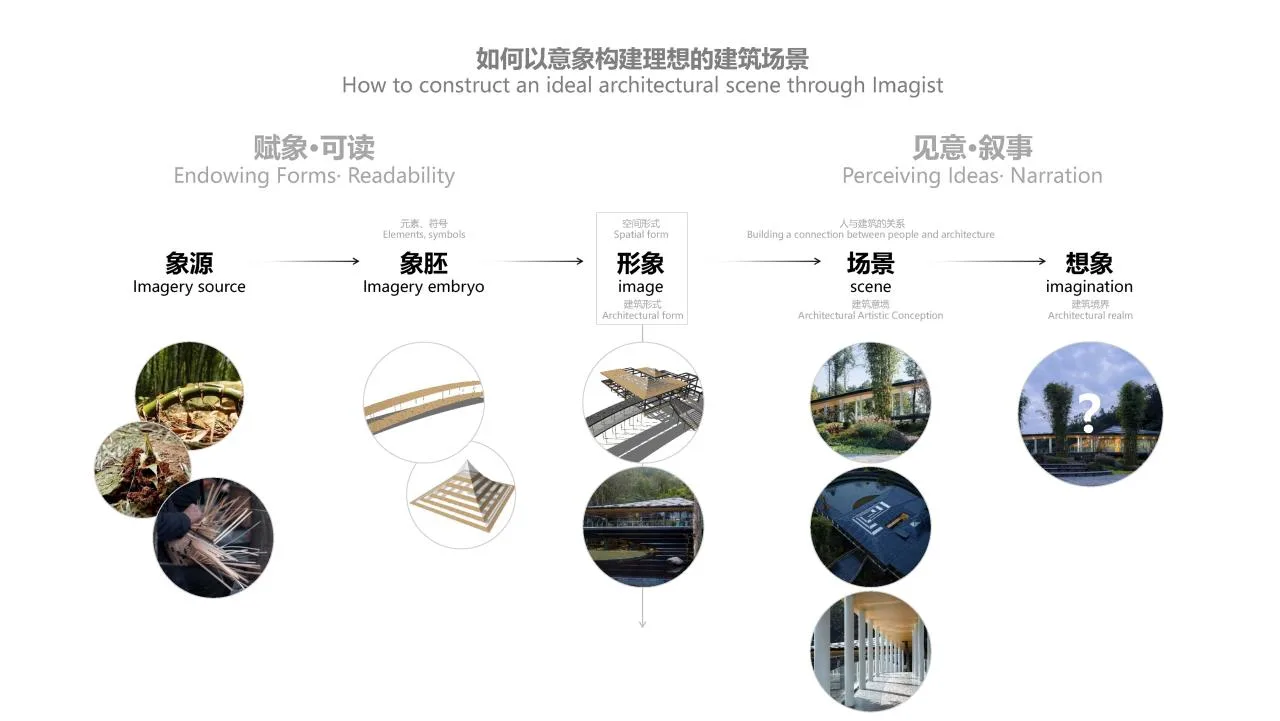
▲ Conveying meaning through imagery © Xiaoyin Architecture
As a national intangible cultural heritage bamboo weaving town, Zhuyi Village is renowned as the “hometown of Chinese folk art (bamboo weaving).” Its bamboo weaving tradition dates back over two thousand years to the Qin Dynasty, featuring unique materials and craftsmanship. The village hosts many traditional western Sichuan forest courtyards, with the original tourist center occupying one such courtyard. Bamboo weaving, tiled roofs, and courtyards naturally became vital cultural carriers within the architectural expression.
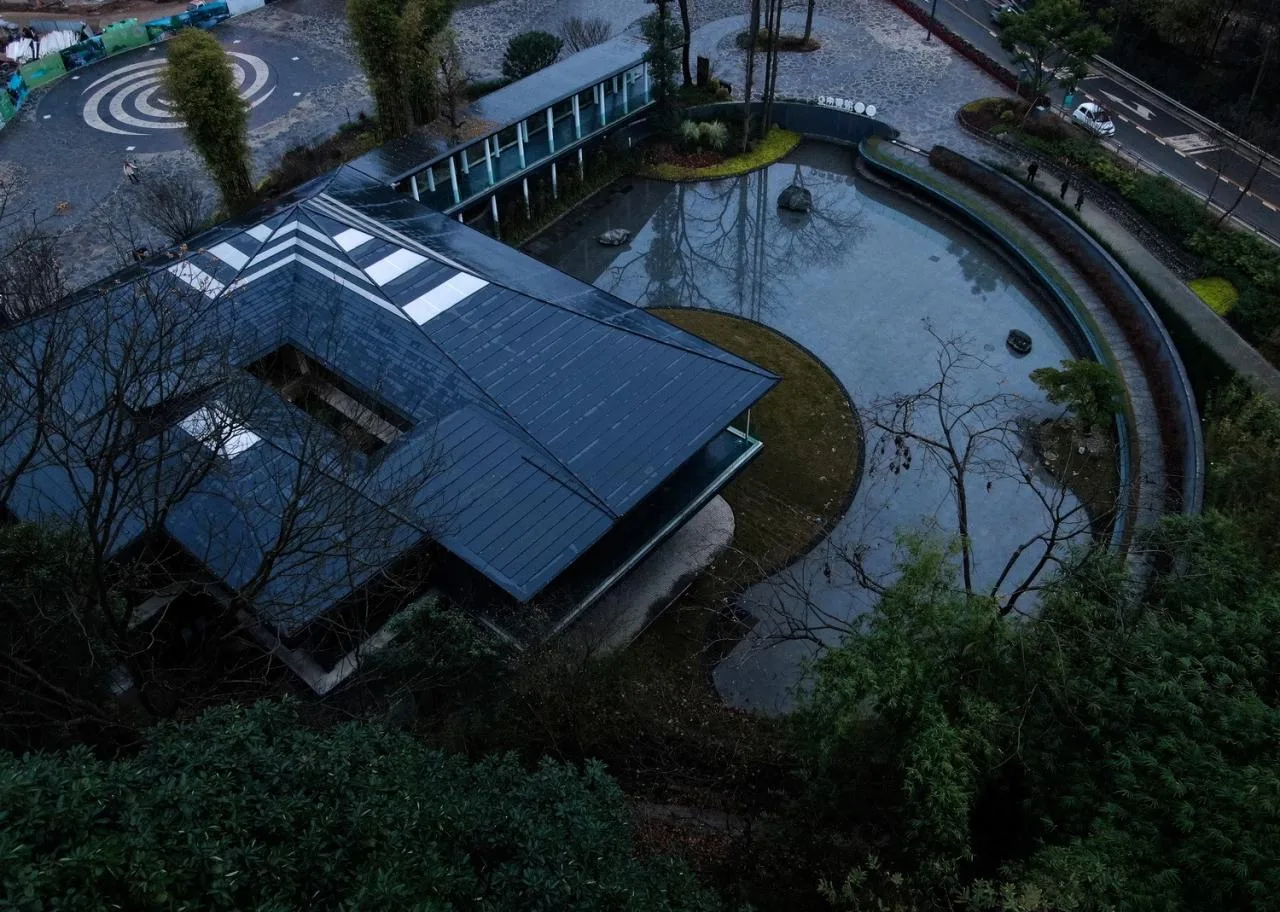
▲ Bamboo shoot-shaped roof woven with bamboo strips © Xiaoyin Architecture
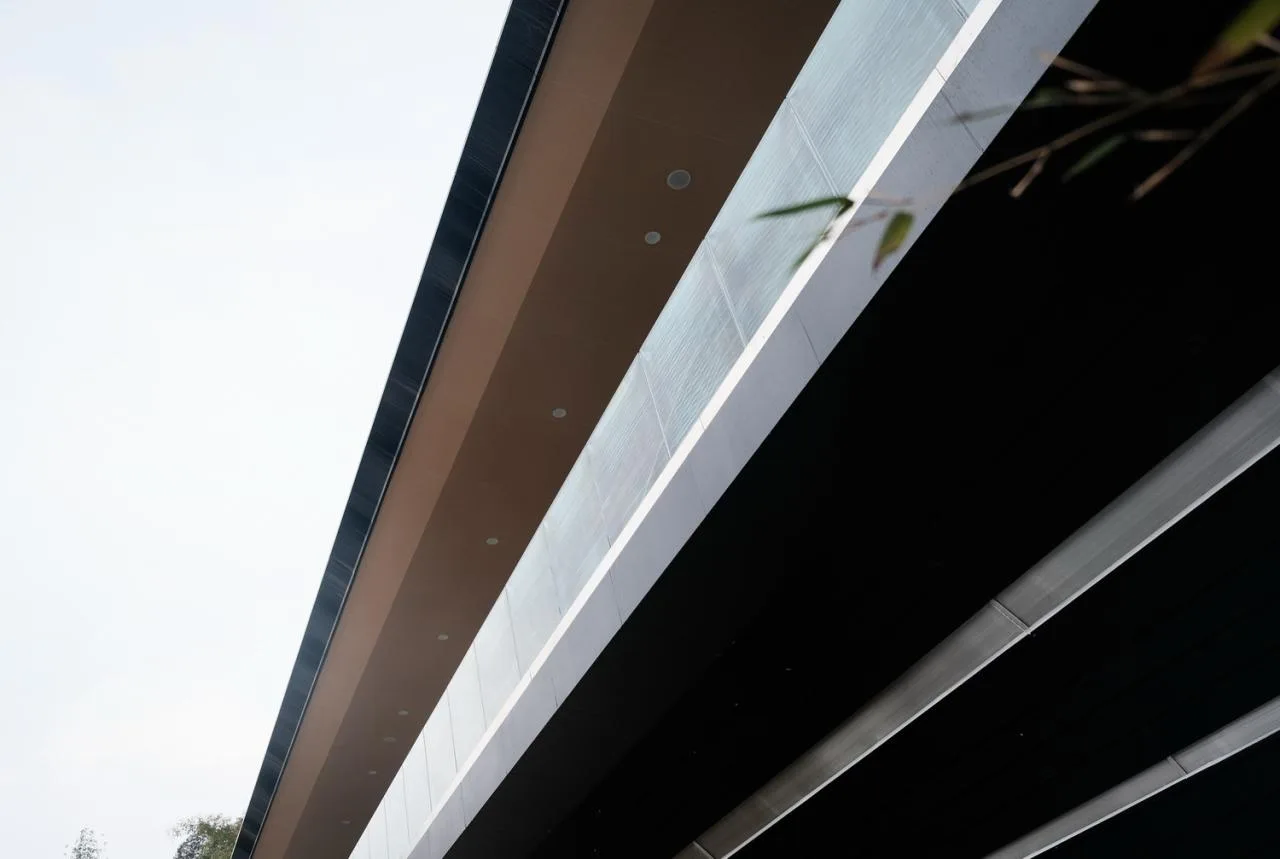
▲ Decorative curtain wall woven from bamboo and translucent materials © Xiaoyin Architecture
The large roof and decorative curtain wall mimic the form of bamboo shoots, crafted from two contrasting materials: dark gray aluminum-magnesium-manganese panels and semi-transparent polycarbonate sheets. This pairing highlights the craftsmanship of bamboo weaving. The dark gray panels evoke bamboo leaves, while their layered arrangement echoes the charm of Chuanxi tiled roofs. The bamboo weaving form clearly conveys the building’s overall shape and appearance, creating the first narrative scene.
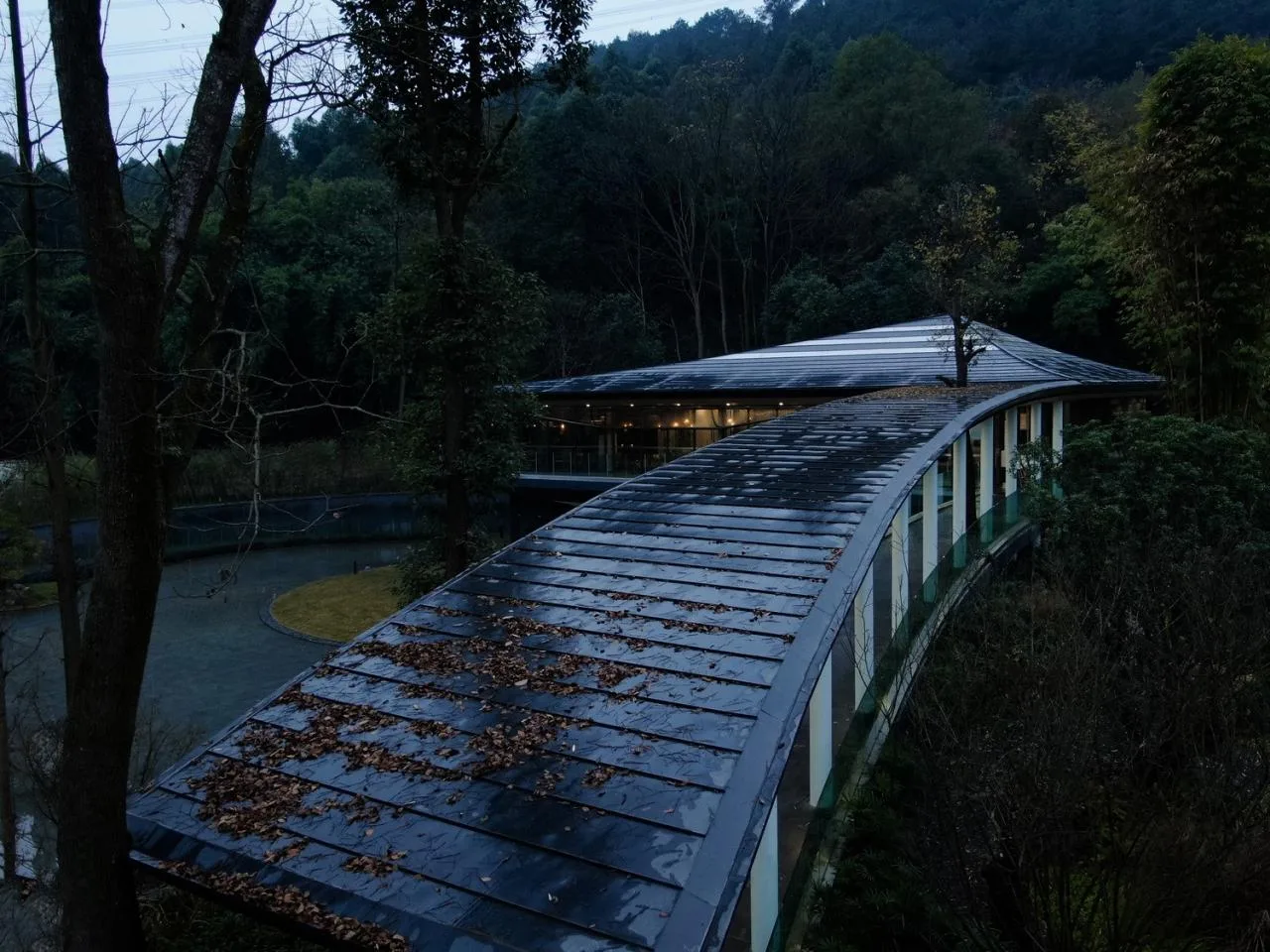
▲ Large bamboo shoots growing from bamboo whips © Xiaoyin Architecture
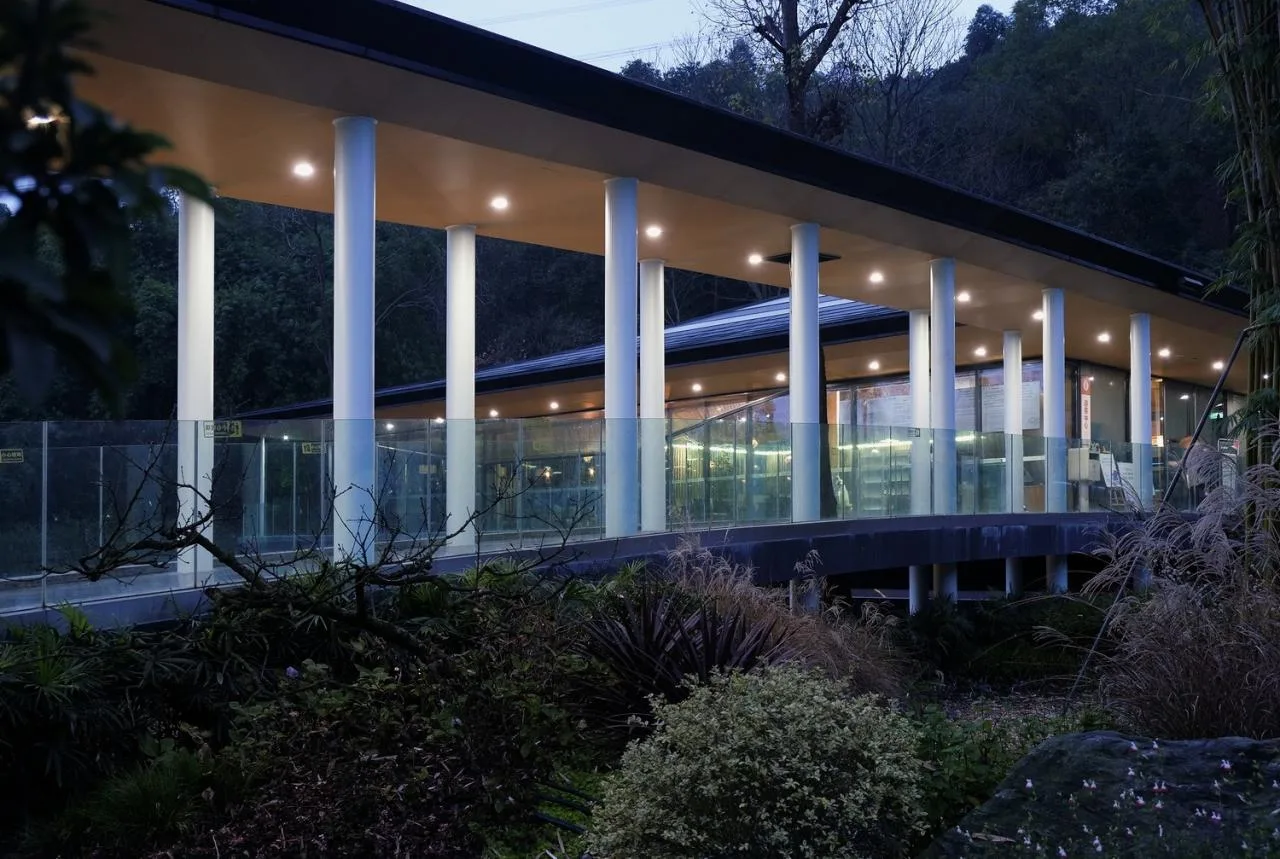
▲ Night view of the curved entrance corridor © Xiaoyin Architecture
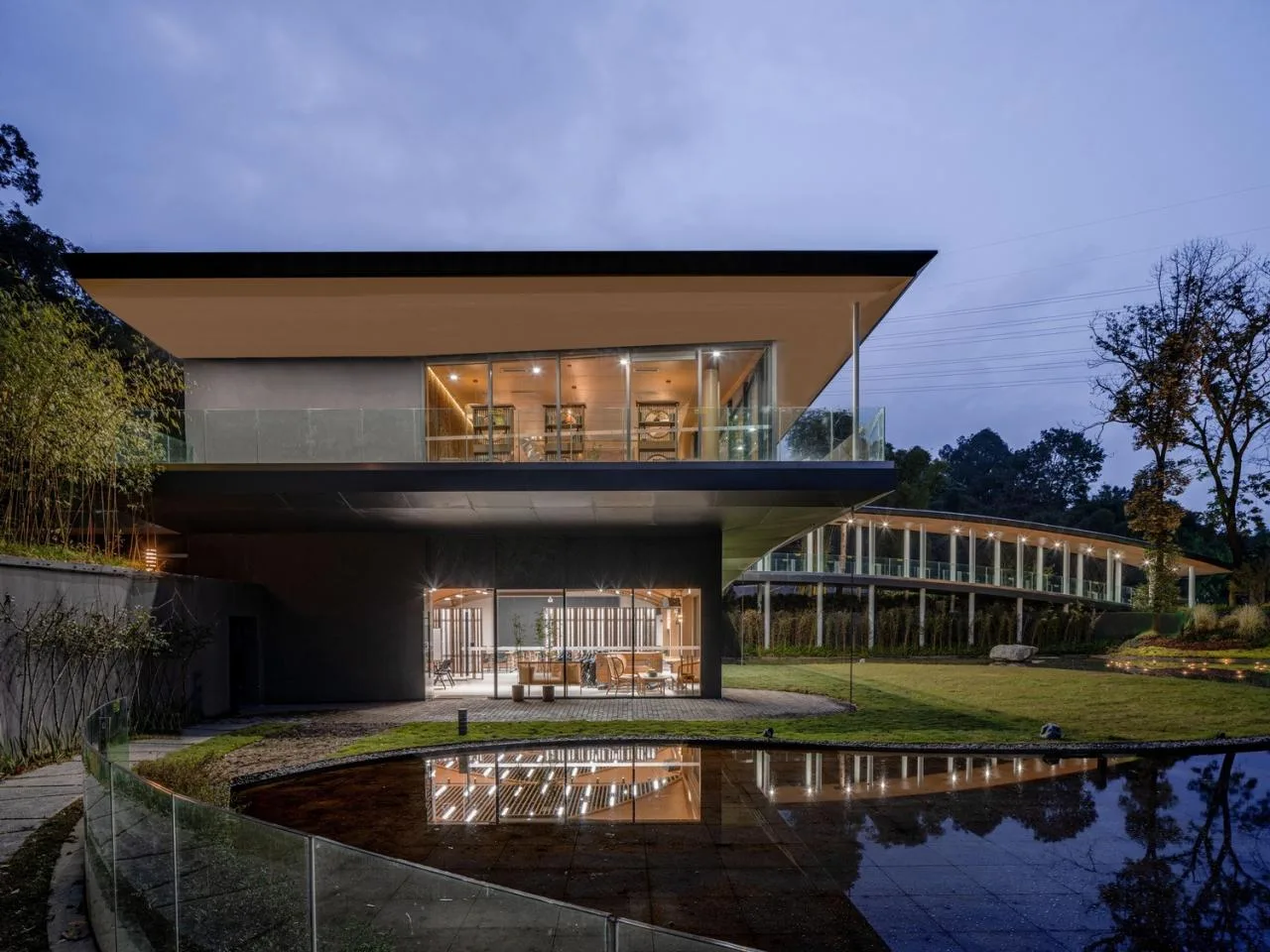
▲ Building’s main form and curved corridor offering suspended views © Existence of buildings
The entrance corridor, densely lined with pillars, mirrors the twisting shape of bamboo whips, while the reception hall’s towering spire resembles a bamboo shoot emerging from whips. Together with the surrounding bamboo forest and large trees, they create a second narrative stage.
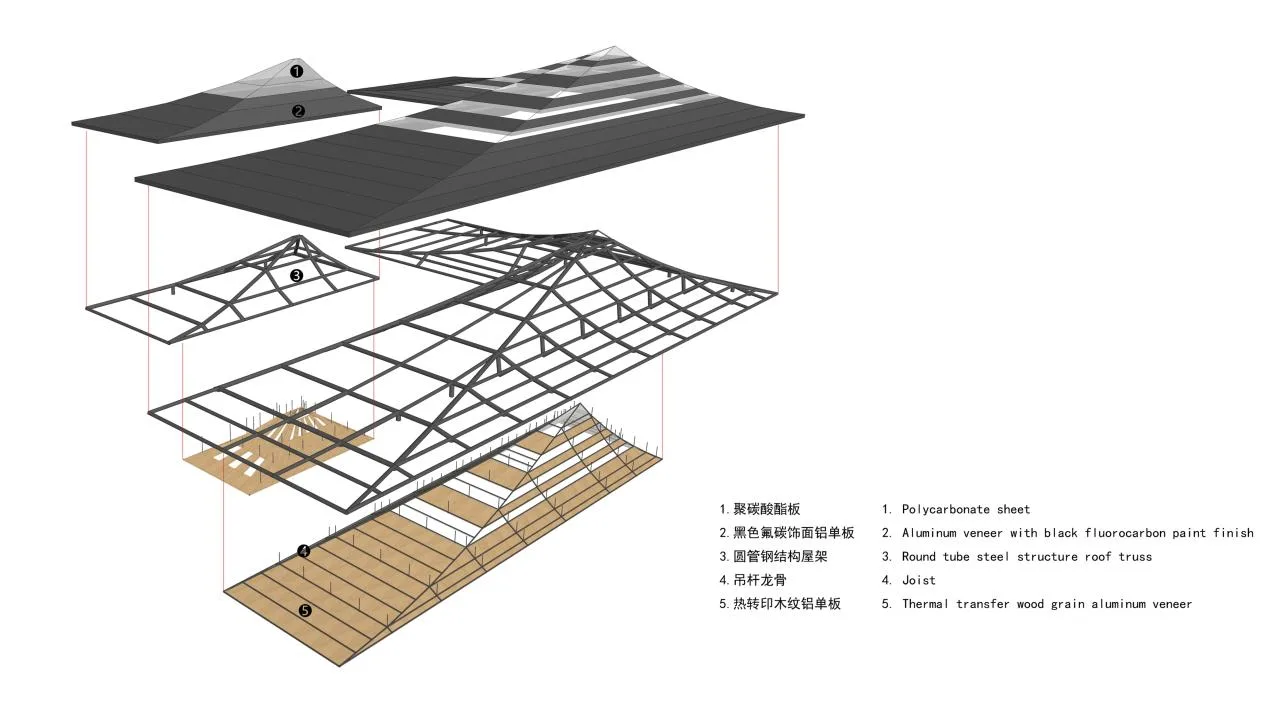
▲ Bamboo woven roof truss structure © Xiaoyin Architecture
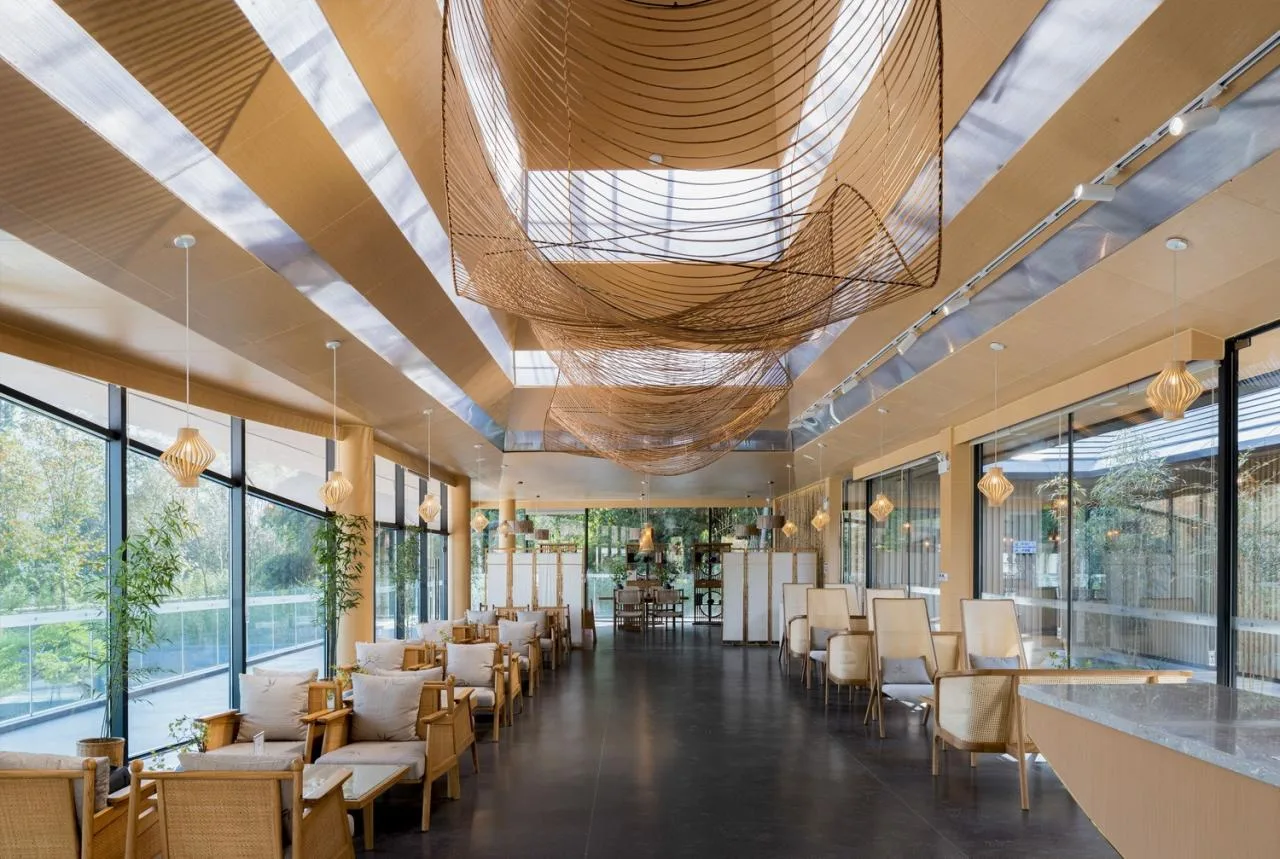
▲ Bamboo woven ceiling © Existence of buildings
To emphasize the cultural heritage of bamboo weaving, the interior roof structure draws on traditional bamboo weaving frameworks. The reception hall ceiling features woven long wooden aluminum slats and semi-transparent polycarbonate panels, visually expressing the form of bamboo weaving. The expansive roof and surrounding corridors frame the verdant outdoors as a series of living paintings, inviting the natural light through polycarbonate panels. This filtered light creates dynamic patterns of shadow and illumination inside the hall, forming the third narrative scene.
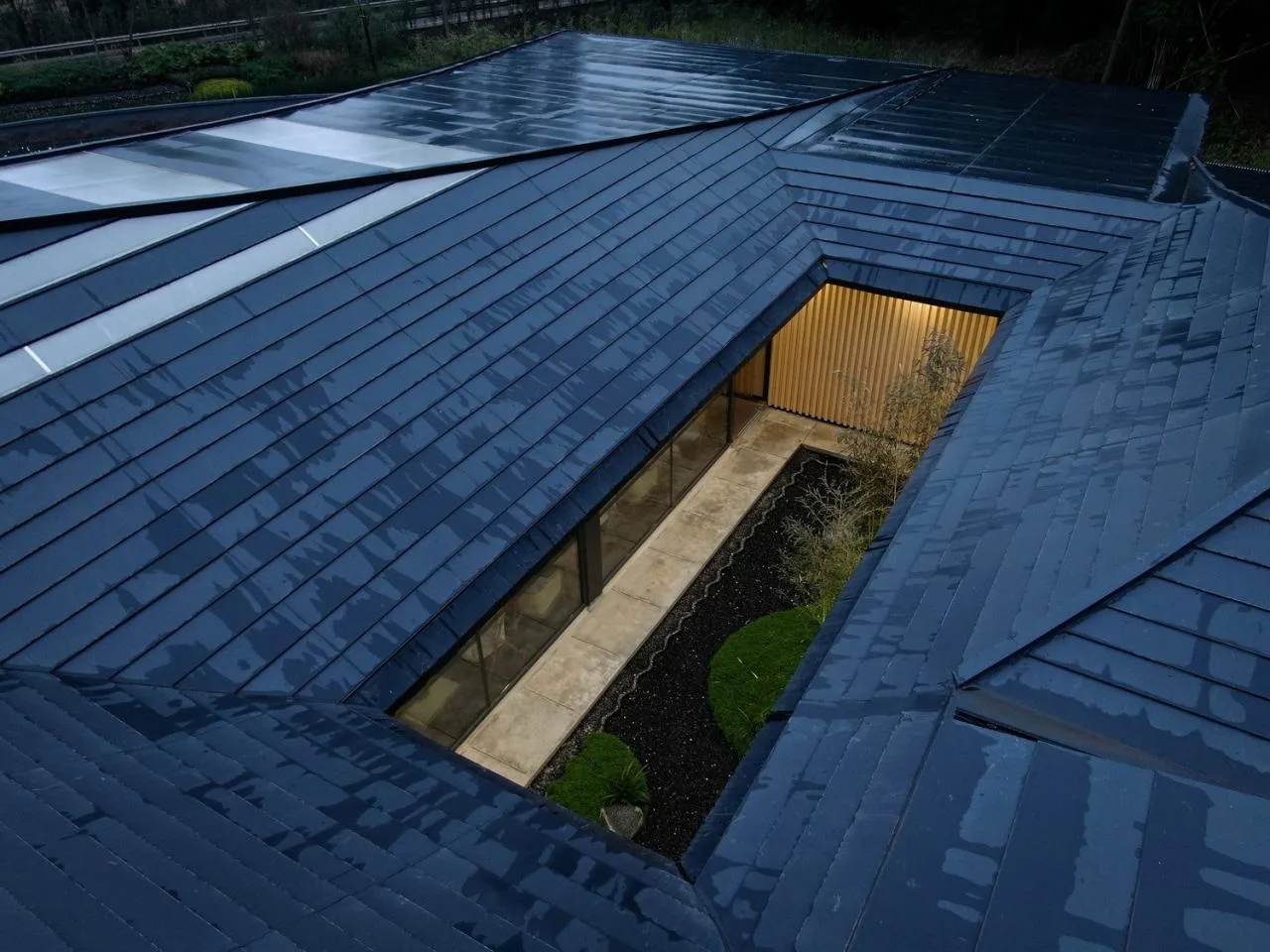
▲ Courtyard view from above © Xiaoyin Architecture
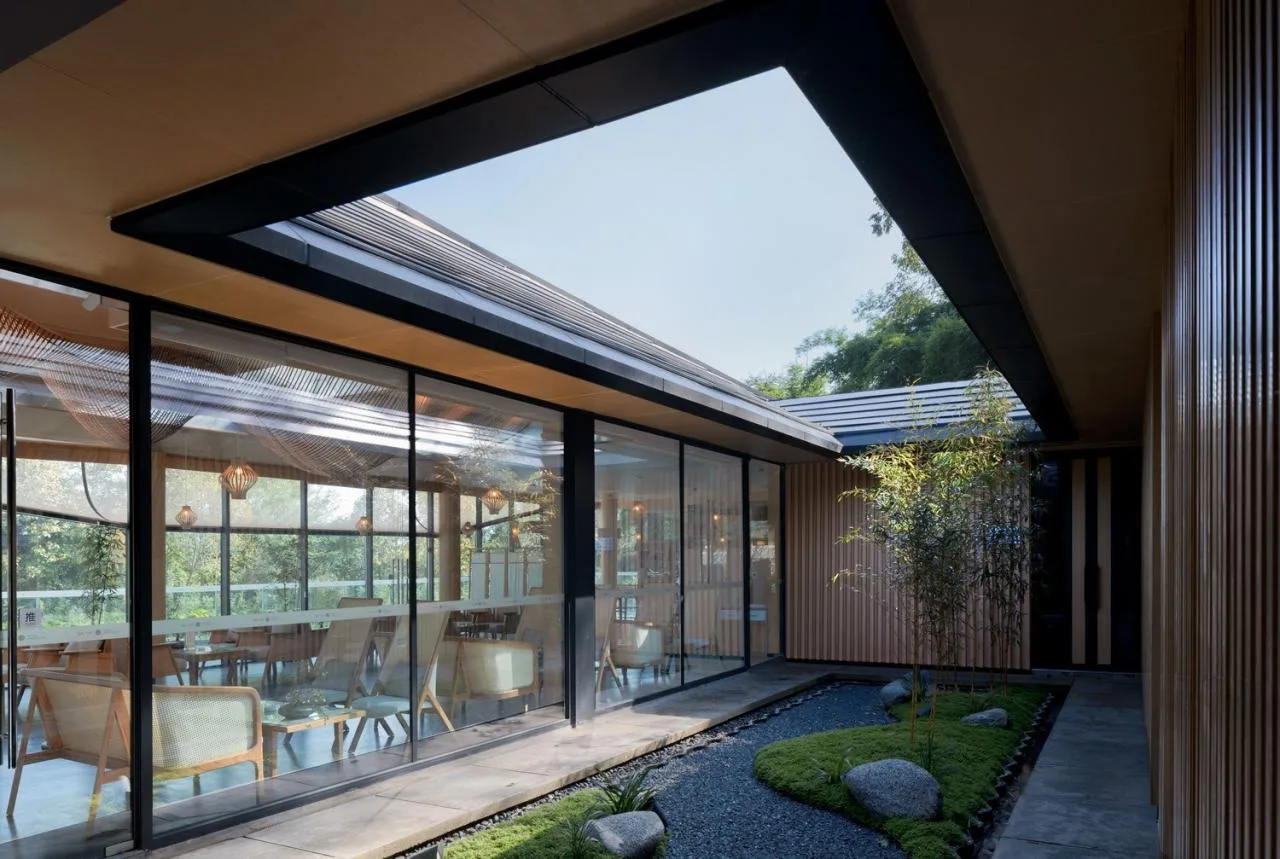
Tiles, gravel, moss, and bamboo elements in the courtyard © Existence of buildings
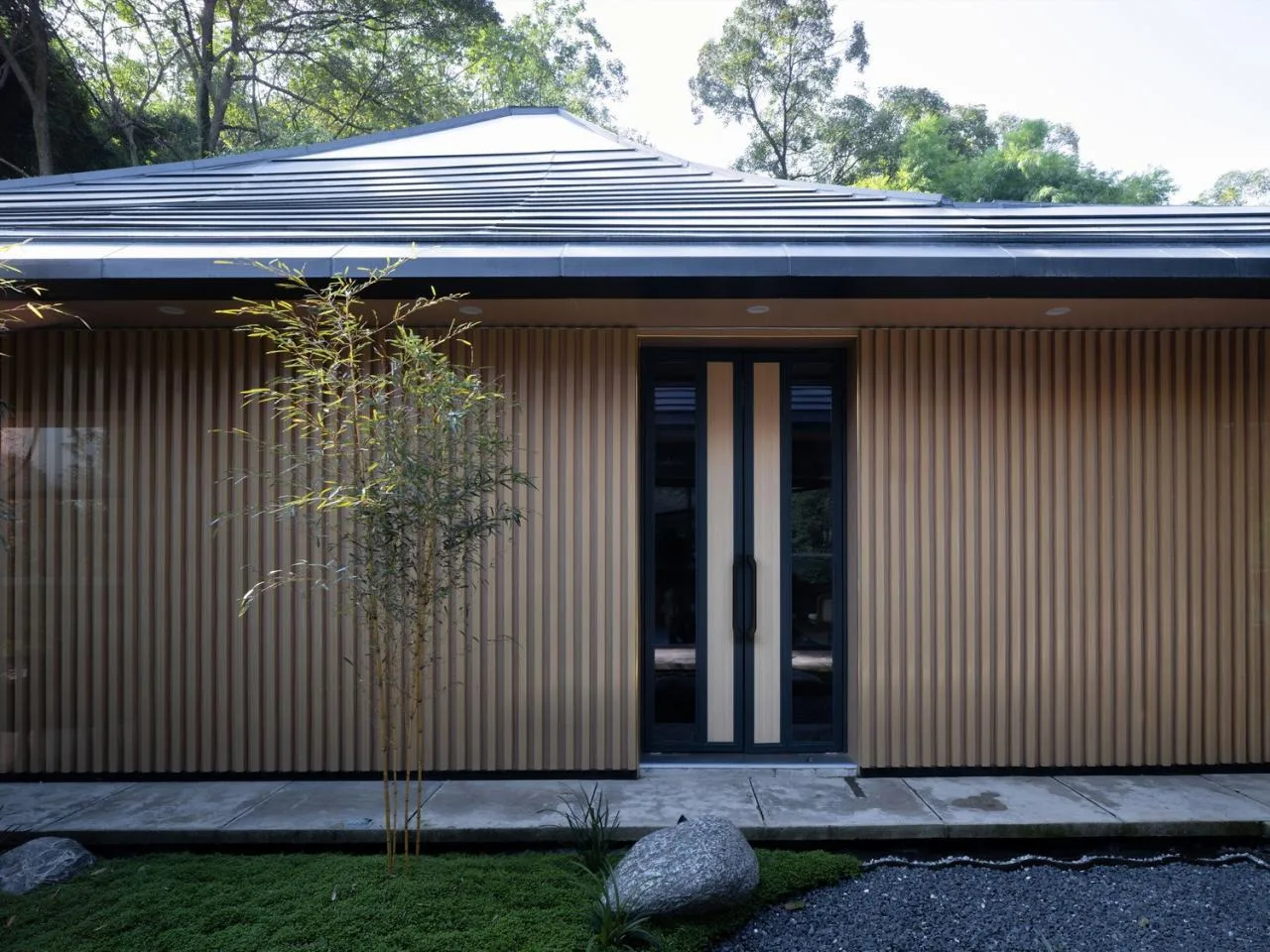
▲ Small bamboo shoots in the courtyard © Existence of buildings
The small courtyard nestled between two bamboo shoot structures preserves the essence and memories of the original western Sichuan courtyard. Tiles, gravel, moss, and bamboo form a green oasis linking the reception hall, bamboo weaving culture exhibition, and logistics office, creating the fourth narrative scene.
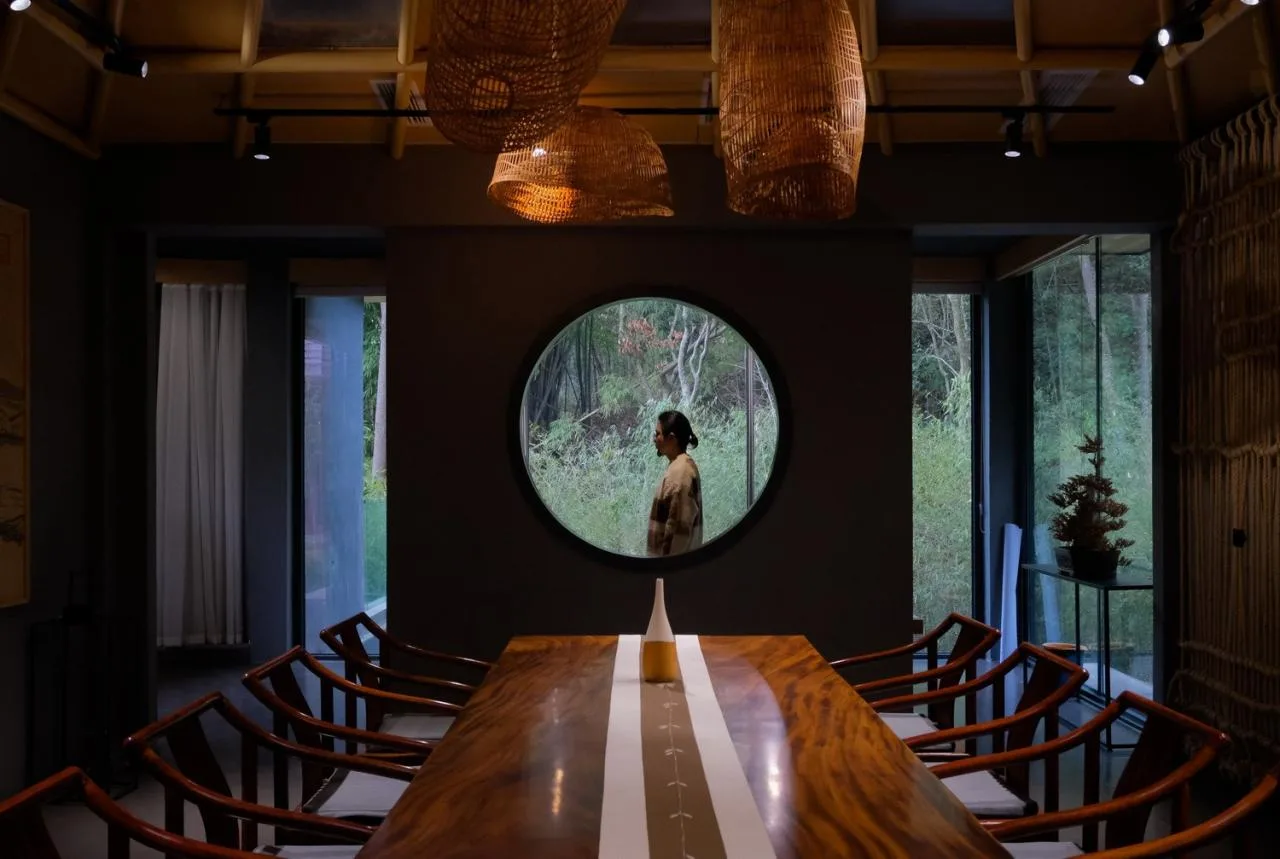
▲ Bamboo Weaving Culture Exhibition Hall © Xiaoyin Architecture
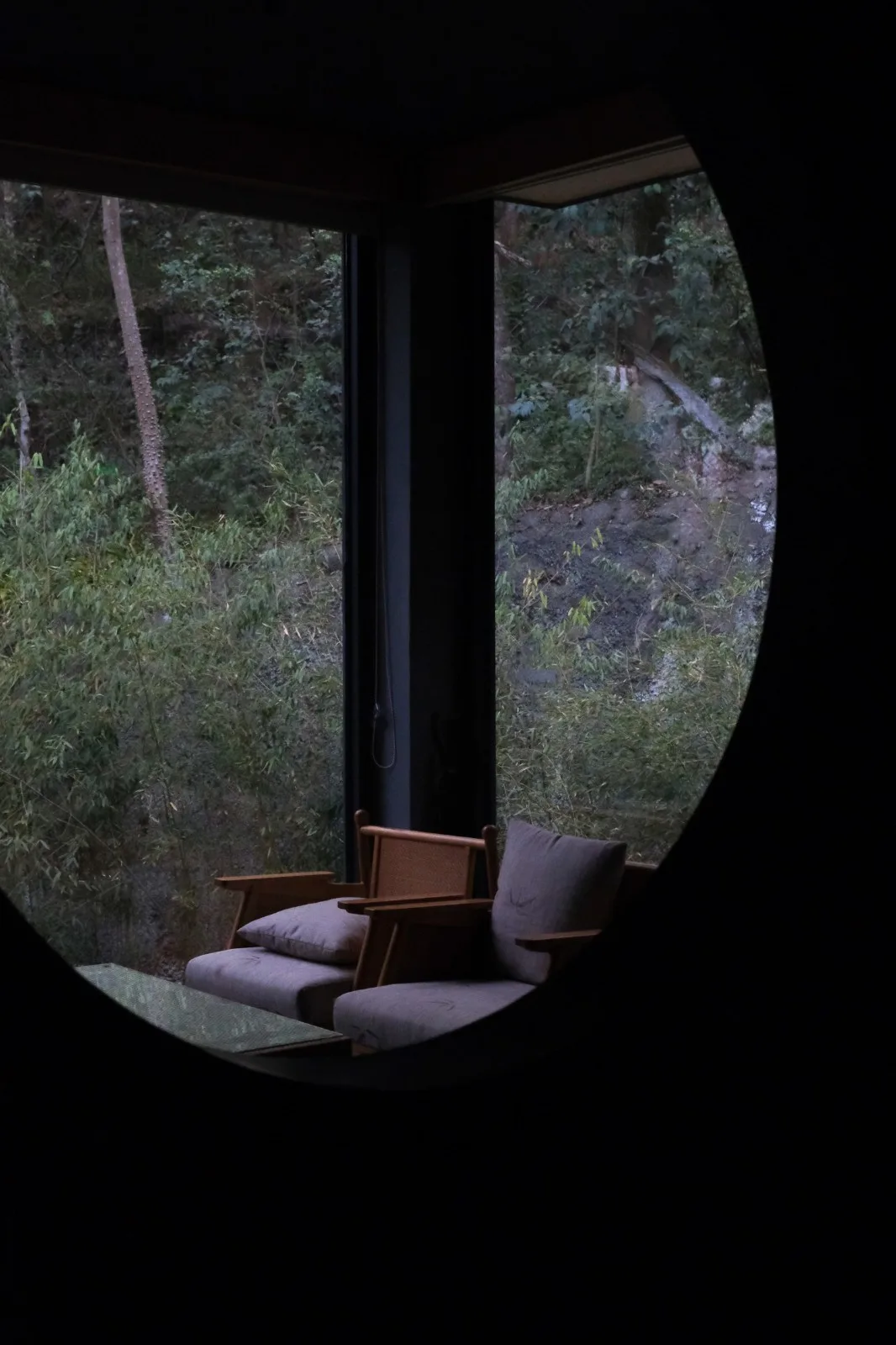
▲ Bamboo forest visible through the Moon Gate © Xiaoyin Architecture
The interior of the “Little Bamboo Shoots” houses the Bamboo Weaving Culture Exhibition Hall, featuring intricate bamboo weaving forms overhead. The traditional garden’s Moon Gate introduces rhythm to the exhibition sequence and frames views of the bamboo forest outside, establishing the fifth narrative scene.
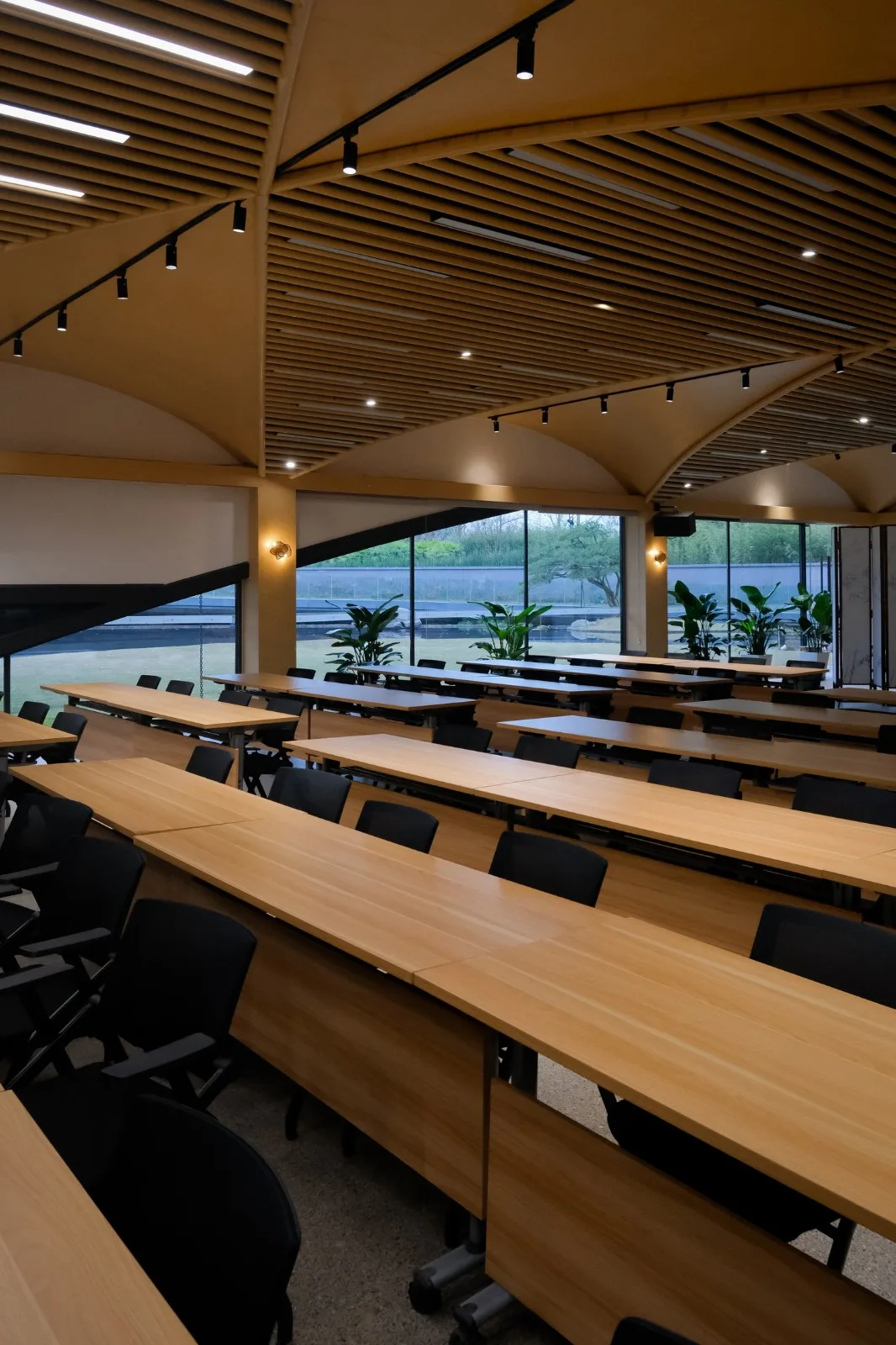
▲ Ceiling of multifunctional hall inspired by bamboo corridor form © Xiaoyin Architecture
The multifunctional hall adopts the common arched form found in bamboo forests, with pillars resembling dense bamboo groves. The overlapping bamboo stalks create arches woven with imitation wood aluminum tubes. This blend of bamboo forest and weaving crafts forms the sixth narrative scene.
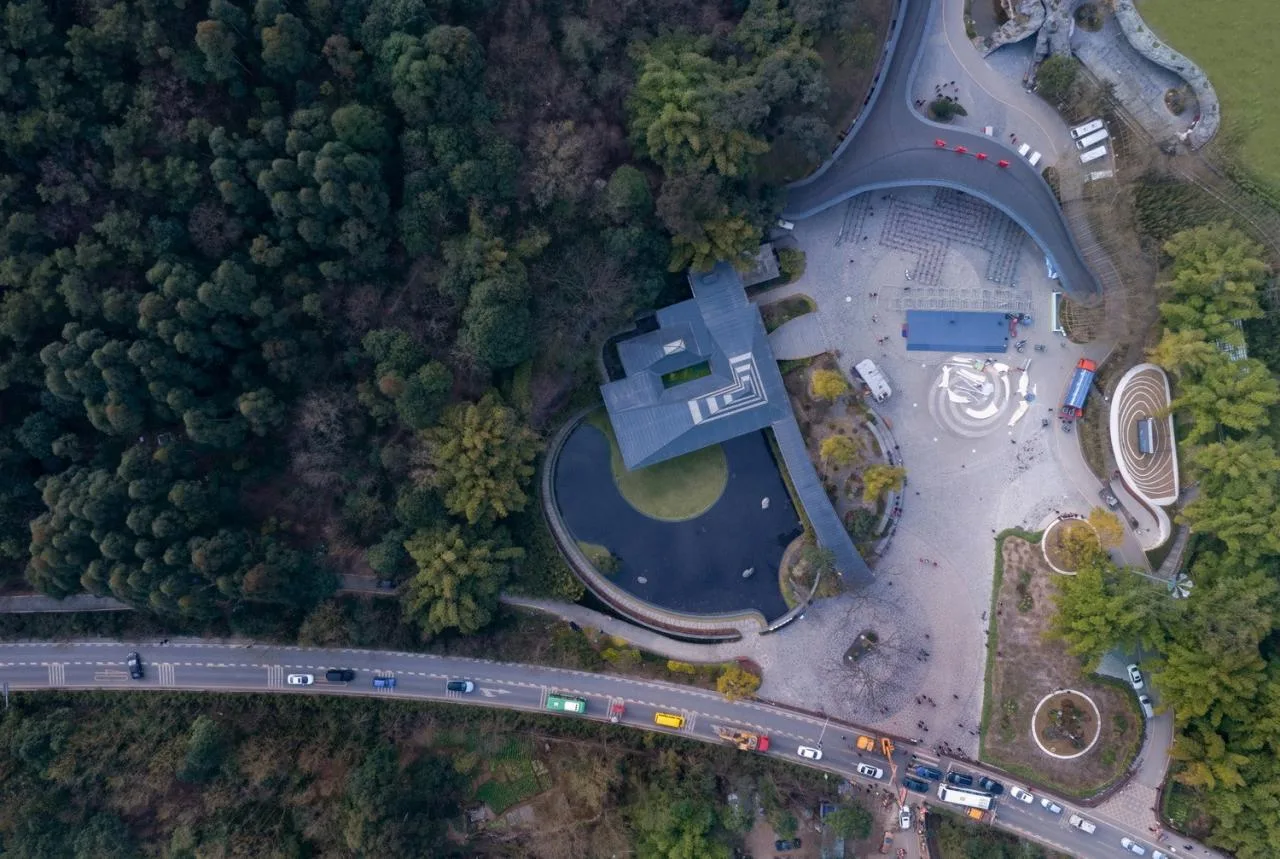
▲ The large plaza on the north side of the tourist center © Existence of buildings
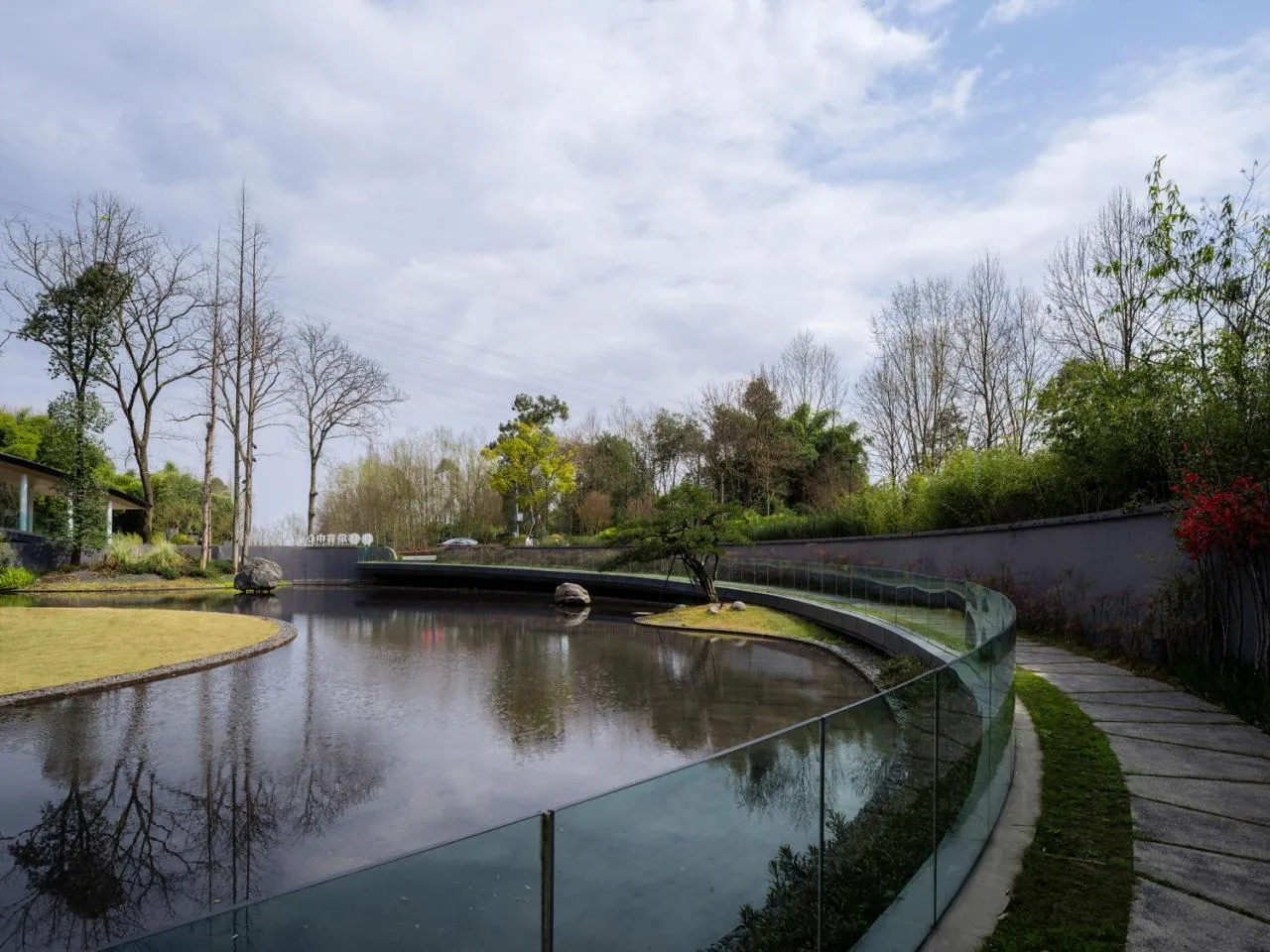
▲ Reflective water feature in front of the building © Existence of buildings
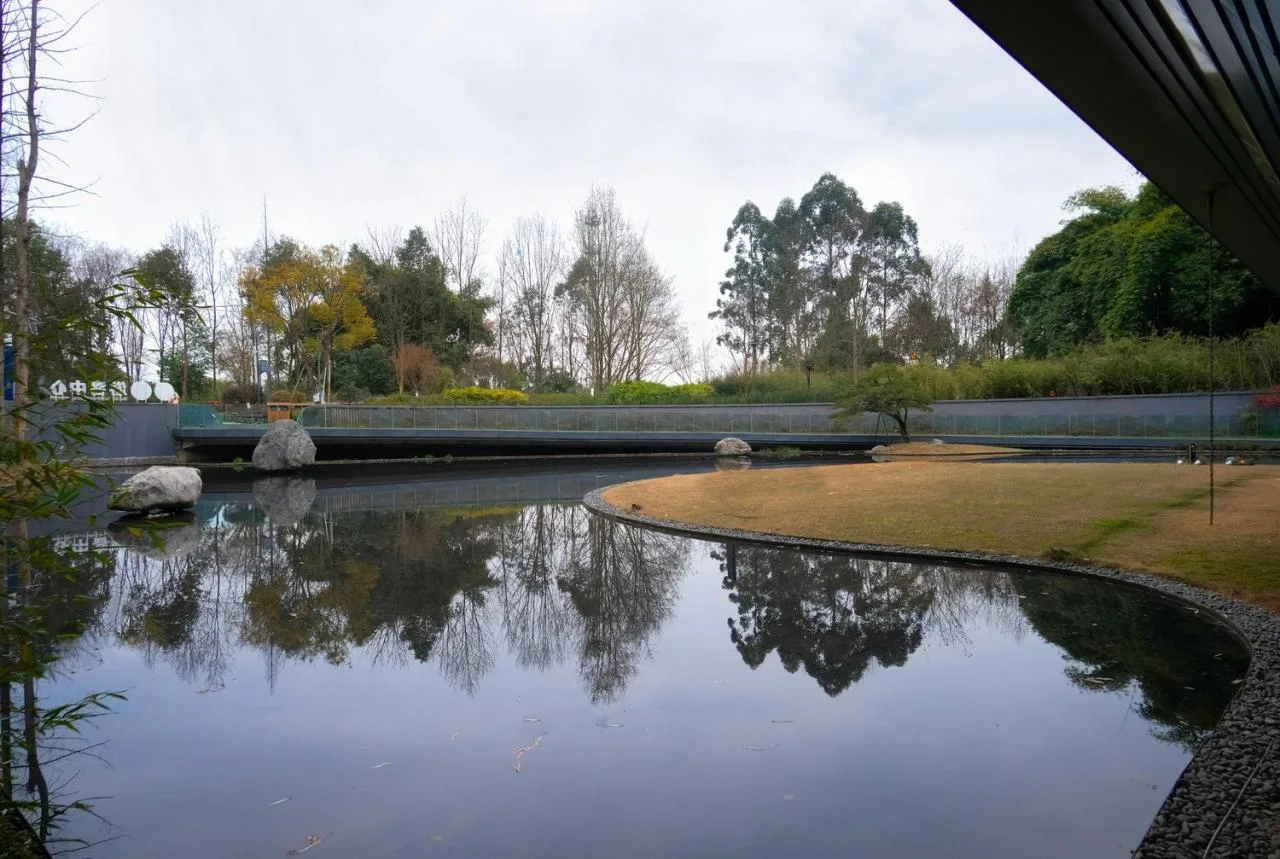
▲ Natural fields rotating between rapeseed and rice crops © Xiaoyin Architecture
Every architectural project faces challenges and compromises. Two aspects of the tourist center fell short of initial ambitions. The “Hundred Bamboo Expo Park,” designed as bamboo root sections on the north side, intended to familiarize visitors with bamboo varieties while enhancing the architectural atmosphere through clustered bamboo forms, ultimately took the shape of a large plaza. The vegetable garden in front, meant to preserve the natural rotation of rapeseed and rice fields and integrate the building into the western Sichuan forest environment, resulted in a lifeless reflecting pool. Architectural practice is complex, and perfect realization is often elusive. Nevertheless, this project aims to broaden the scope of “imagery architecture” and improve future outcomes.
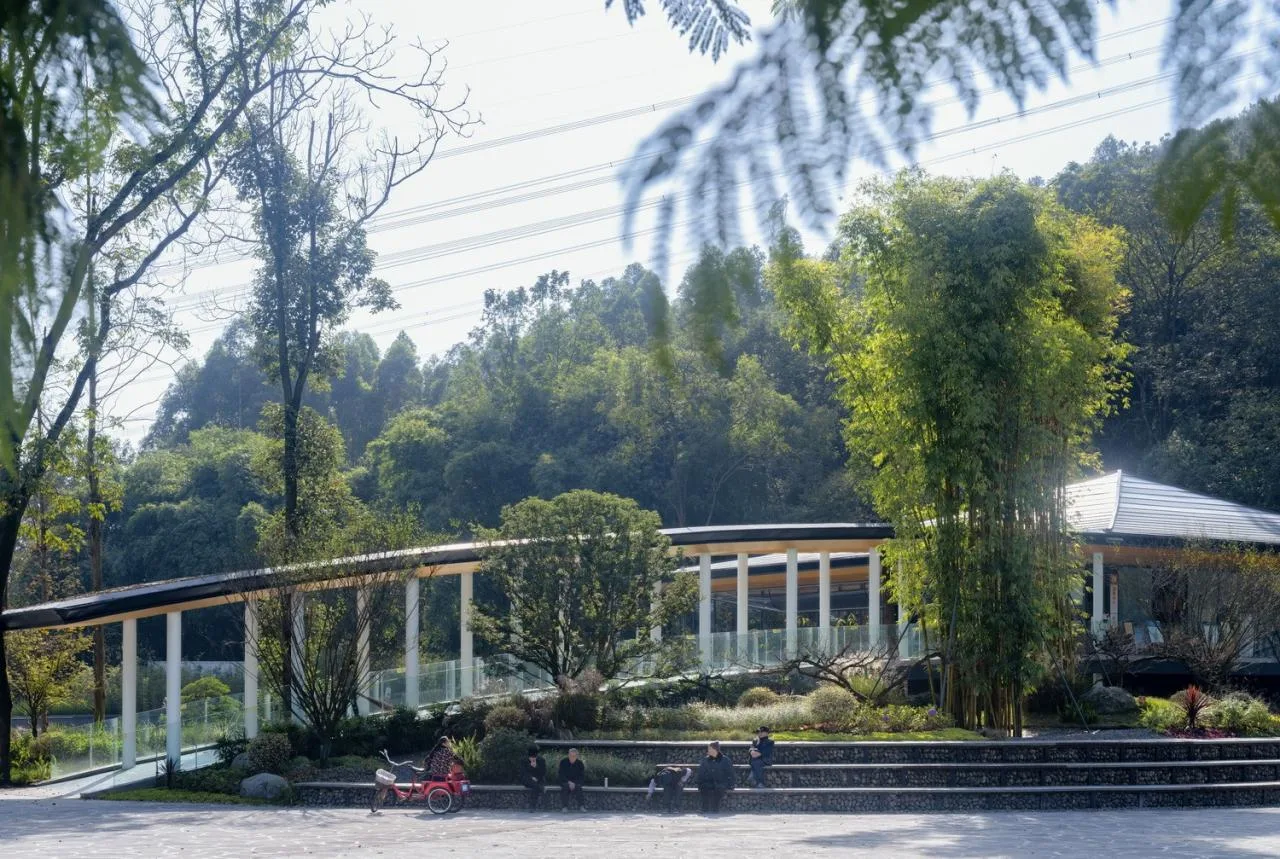
Local residents gather in front of the long corridor © Existence of buildings
The Zhuyi Village Tourist Center offers locals a place to reconnect with their familiar countryside and experience the benefits of rural revitalization. It also invites urban visitors to unwind, reconnect with nature, rediscover bamboo weaving culture, and engage in a direct dialogue between bamboo and craftsmanship.
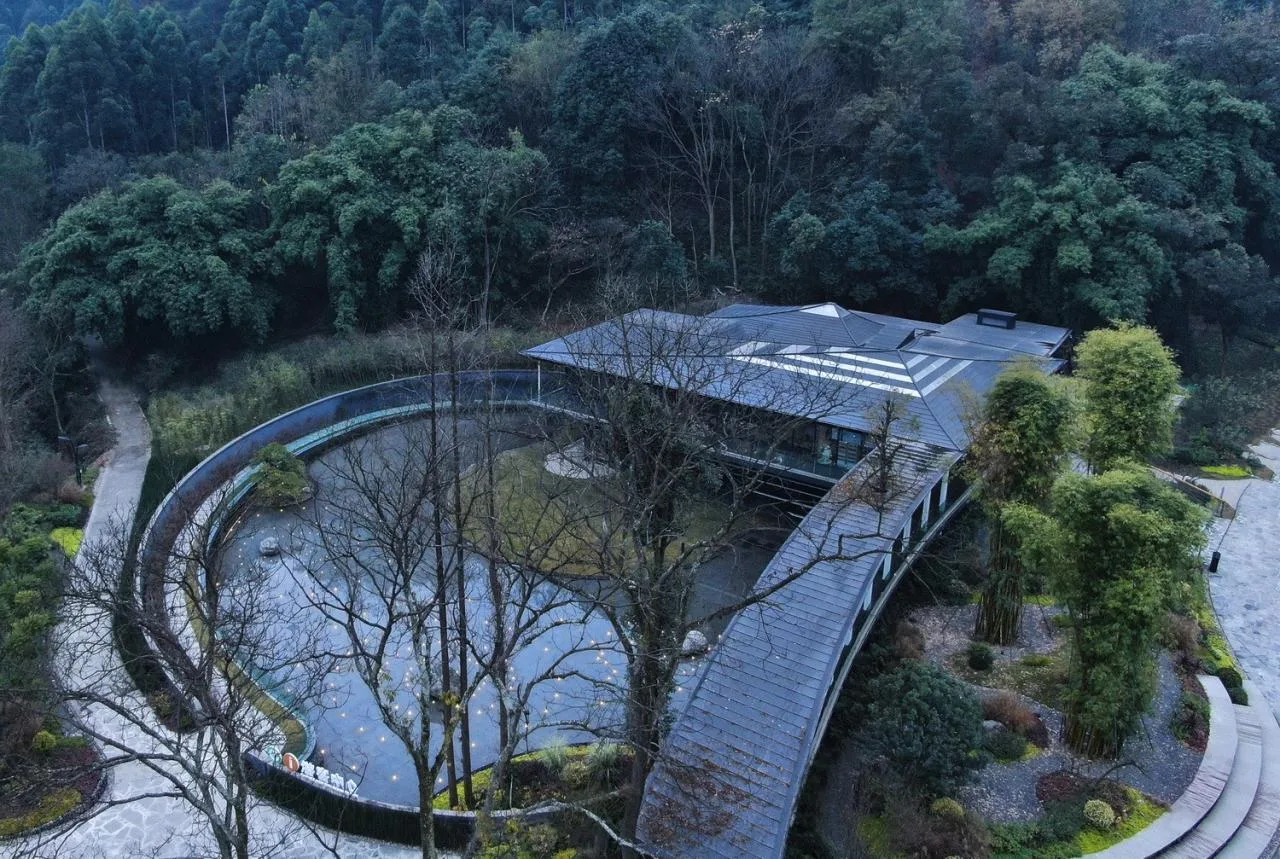
Preserved trees and buildings creating a new harmony © Xiaoyin Architecture
This new model of imagery architecture, which balances pragmatism and aesthetics, helps architects and users gain a deeper understanding of the world. It recognizes architectural design not only as an art form but also as a cultural symbol and heritage. By using imagery to move beyond narrow formal aesthetics, this approach fosters practical beauty, reexamines architectural design, and reshapes the harmony between design and aesthetics.
We hope the practice and promotion of imagery architecture make the concept of balancing function and aesthetics accessible and intuitive. Through clear imagery, architecture becomes easier for the public to interpret—like language—quickly grasping the “architectural meaning” intended by designers. Abstract theories transform into fresh, concrete design expressions, opening new creative possibilities.
Imagery architecture begins with creative spatial construction, achieving a balanced relationship among humans, nature, and architecture. It expresses specific aesthetic views and cultural identities, crafts artistic spatial experiences, and invites deep contemplation of architecture’s connection to beauty.
Project Information
Main Creative Team: Xiaoyin Architectural Firm
Lead Architect: Pan Youcai
Design Director: Yang Zhe (Partner)
Technical Director: Chen Renzhen (Partner)
Structural Engineer: Du Xu
Design Team: Li Zihan, Hu Qinmei, Yang Rui, Gou Yuanjun, He Yi, Meng Zhe, Xiao Siwei (Intern)
Landscape Design Team: Chongzhou Culture and Tourism Group – Sichuan Zhongrui Jinye Culture and Tourism Co., Ltd
Construction Drawing Team: Chengdu Meisha Architectural Design Co., Ltd
Owners: Chongzhou Cultural Tourism Investment Group Co., Ltd., Chongzhou Shuxing Investment Co., Ltd
Construction Unit: Sichuan Xiteng Construction Group Co., Ltd
Photography: Existing Architecture, Xiaoyin Architecture
Authors: Pan Youcai, Ge Xiangxin
Project Location: Zhuyi Village, Daoming Town, Chongzhou City, Sichuan Province
Building Area: 988 square meters
Construction Start: March 2022















Must log in before commenting!
Sign Up