
In the traditional workflow, the decoration industry faces urgent needs to improve standardization and work efficiency. With the advancement and adoption of BIM technology, exploring indoor decoration based on BIM has become essential. Currently, in interior decoration design, professionals use different software to complete design construction drawings, renderings, preliminary budgets, and more.
1. When Building BIM Models Are Available
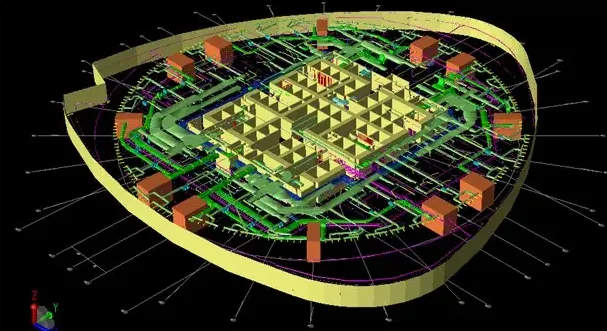
In this case, decoration component models can be directly created within the building information model (BIM). Collision detection tools help identify and resolve conflicts between decoration components as well as between decorations and the original building structure, including water, electricity, and mechanical systems. This significantly reduces the need for scheme adjustments and rework.
This approach greatly enhances on-site construction efficiency, minimizes cost overruns, and prevents schedule delays caused by coordination issues. It is currently one of the most common and effective applications of BIM technology in architectural design.
2. When No Building BIM Model Is Available
BIM technology, still relatively new, has yet to be fully adopted across the construction industry. As a result, many existing buildings were designed using traditional 2D methods without BIM models. In such cases, interior designers use BIM software like Revit Architecture to create a building space model tailored to the project’s specifics. They then incorporate available information on water, electricity, structure, and mechanical systems into the BIM project model.
Based on this model, interior designers can develop decorative component models and perform collision detection to ensure compatibility.
Additionally, BIM’s “Family” feature allows designers to load soft furnishing models, such as furniture, enabling interior furnishing design and layout. Using the “Rendering” function, designers can generate photorealistic 3D renderings from any indoor angle by adjusting lighting settings, greatly improving design efficiency and visualization.
BIM technology also enables the direct generation of professional 2D construction drawings, detailed diagrams, and material lists from the 3D interior design model, which includes structural information. This process enhances both design accuracy and productivity.
For complex design parts that are difficult to interpret with 2D graphics—such as irregular shapes—BIM’s visualization capabilities provide construction teams with an intuitive understanding. Furthermore, BIM allows extraction of any cross-sectional information, supplying detailed and reliable data for template design and construction, thereby ensuring constructability.
In summary, the application of BIM technology in interior decoration design offers significant benefits in terms of efficiency, accuracy, and coordination. We hope this overview proves helpful to everyone interested in advancing their interior design workflow.
















Must log in before commenting!
Sign Up